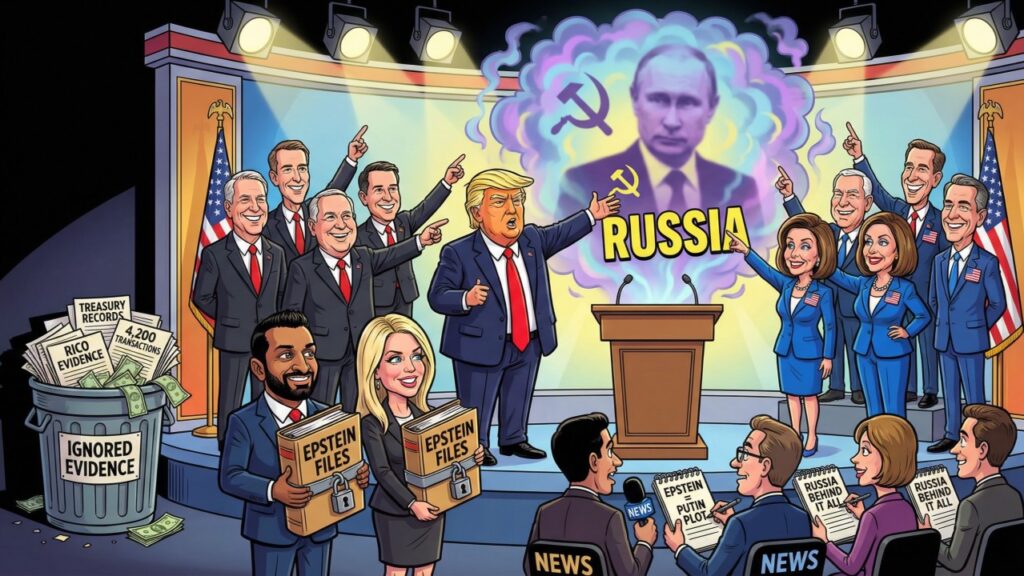
John Helmer and Glenn Diesen map every email, intermediary, and oligarch, and expose how a non‑story in Moscow became a shield for Western corruption.
John Helmer is one of the longest‑serving Western journalists in Moscow, reporting from Russia since 1989 and specializing in oligarch finance, Western corporate power, and Russian politics. Professor Glenn Diesen is a Norway‑based political scientist focused on great‑power politics, NATO-Russia relations, and the way Western institutions project power through alliances, NGOs, and money. In a February 18, 2026 conversation, they did what no major Western outlet has done: they went through the Epstein files line by line, searched the archive for “Putin,” and reconstructed every route Jeffrey Epstein tried to use to penetrate Russia’s leadership, and how every one of those attempts failed, even as American politicians, billionaires, and their media labored to turn that failure into yet another Russiagate weapon.
I. The Battlefield the Epstein Files Landed On
Helmer begins not with Epstein but with the political landscape into which the files were released. Power politics is “a pretty incendiary matter in every country,” he tells Diesen, and every new document dump is “fuel for the fire.” The Epstein scandal is “a major information” weapon in U.S. politics, and the people around Epstein (Peter Mandelson in England, Thorbjørn Jagland in Norway, Miroslav Lajčák in Slovakia, “Frank … Lang” in Paris) are “political fuel for the fire” in their own national contexts.
At the same time, he notes, Russia and the United States are “at war with one another,” even as they try to negotiate out of that war in what he calls “the tale of two midterms.” On one side, Donald Trump faces midterm elections where he is “likely to lose significant support in the Congress.” On the other, Vladimir Putin faces a late‑September political test where, if Russia’s central‑bank policy continues without a military breakthrough, there will be “considerable political dismay, disappointment and possibly flashback in Russia.” The Epstein files fall into this crossfire.
Helmer adds a second, blunter reminder: in all countries, people have forgotten what ruling classes do when they are “not under observation.” Elites have always had sex, abused partners, coerced and enslaved the vulnerable, including children; none of this is new. One only has to read the memoirs of 18th‑century Venetian adventurer Giacomo Casanova to recall life at European courts, or to ask whether Henry VIII ever returned from hunting to a lodge without women “forced, recruited, made slaves.” The Epstein case only shocks publics that have been trained to forget how their betters behave behind closed doors.
II. Epstein, as Helmer Describes Him: Not a Mastermind, but a Second‑Rate Hustler
From there, Helmer reframes Jeffrey Epstein. He is not a geopolitical mastermind but “a relatively amateur finance manager managing tax evasion schemes, money laundering schemes” whose importance has been “exaggerated” because people stopped tracing “the money,” “the clients,” and “the way in which his businesses operated.”
For more than a decade, Helmer notes, Epstein’s financial dealings were dominated by two men:
- Leslie WexnerAmerican billionaire retailer, longtime owner of brands like Victoria’s Secret, Epstein’s most important patron and the source of much of his wealth.
- Leon BlackAmerican billionaire investor and co‑founder of private‑equity giant Apollo Global Management, another key Epstein client.
For such a man to show up in the Russian universe and try to sell oligarchs “what he thought were original ideas for tax evasion and money laundering,” Helmer says, “is funny.” It is funny because Russian oligarchs “had been pioneering their own systems for money laundering, tax evasion for 10 years before Epstein arrived on the scene” and already had their own U.S., European, and worldwide networks.
Helmer’s characterization of Epstein is brutal and precise: he had “a second‑rate brain with a huge ego attached,” a man through whose hands “a lot of money flowed” who “misunderstood the difference between his pocket and his brain, also his fly.”
III. What the Files Actually Show When You Search “Putin”
To see what the Epstein archive actually says about Russia, Helmer did the tedious work. He went into the document database, ran “Putin” as a search term, and found “approximately 1,021 entries.” Reading through them, he tells Diesen, “is a dreary job,” because most are not operational documents at all; they are “press clips” Epstein’s offices received from “all sorts of sources.”
The bulk, he says, come from the Washington Post, the New York Times, and the Wall Street Journal, the same American mainstream outlets that shape U.S. public understanding of Russia. “They’re not particularly competent,” Helmer says. “They don’t reflect his effort to understand Russian politics.” From those media, he concludes, “you learn nothing but misinformation,” and Epstein “was too ignorant to know the difference between misinformation, disinformation and the truth of any matter.”
Yet those same emails, because they mention Putin and Russia, can be “misread in the English press” to make Epstein appear “a Russian agent” in papers like the Daily Telegraph and The Times of London, or to suggest he was close to “Russian oligarchs in New York.” The conversation’s purpose is to walk through the actual routes Epstein tried to use and show how they all come to zero.
IV. The Intermediaries Who Could Not Deliver Putin
Epstein did not call the Kremlin directly. He went to Western influence brokers.
Thorbjørn Jagland
One was Thorbjørn Jagland, a Norwegian politician who served as Norway’s prime minister and later as Secretary General of the Council of Europe, the continent‑wide organization overseeing the European Court of Human Rights and other rule‑of‑law bodies. Helmer and Diesen call him “an exaggerator of his own personal power.”
Jagland, they note, “never met Putin except in a delegation”, either with other Norwegian officials or in Council of Europe groups. Those meetings came as Russia grew more concerned with European sanctions, and Jagland “was never able to deliver any modification, any softening” of Europe’s increasingly aggressive line. Yet he presented himself to Epstein as someone who could arrange a private meeting with Putin in exchange for favors. As Helmer puts it, Jagland “faked this because he wasn’t able to deliver a meeting with Putin anyways,” an archetypal influence peddler “selling access he did not possess to acquire favors he wanted from Epstein.”
Miroslav Lajčák
Another pipeline was Miroslav Lajčák, a Slovak diplomat who has been Slovakia’s foreign minister and has held senior posts at the UN and in EU diplomacy. Lajčák had met Russian foreign minister Sergei Lavrov four times, and Epstein tried to use him to arrange a higher‑level meeting. Nothing came of it.
Ehud Barak
A third was Ehud Barak, former prime minister of Israel and former chief of staff of the Israel Defense Forces, with a background in military intelligence. Barak had met Putin twice as Israeli prime minister in 2000 and 2001. Epstein solicited him as another conduit, hoping his high‑level Russian contacts could secure a private audience. Again, Barak could not deliver.
An Emirati Executive
Helmer also mentions “an Emirati called Salime,” an executive who recently resigned his corporate post. He is another intermediary who “had much [too little] Russian competence” and who had only ever met Putin in groups, not as a direct interlocutor.
In every case, the pattern is the same. These people could produce invitations to forums, not the one‑on‑one meeting Epstein demanded:
- The Eastern Economic Forum in Vladivostok, where Russia courts Asian investment.
- The St. Petersburg International Economic Forum, often called “Russia’s Davos.”
- Business events in places like Sochi.
At best, Helmer says, they could offer Epstein “a crowd handshake, a handshake with a president of Russia in a crowd of businessmen all selling something, especially themselves.” The email record shows Epstein “declined” these and “insisted on a one‑on‑one meeting.” He never got it.
V. The Crypto Pitch Putin’s Team Rejected
What did Epstein want from this hypothetical private meeting? According to Helmer, the emails show that Epstein believed he had a “digital or cryptocurrency scheme that would make Russia a global leader in cryptocurrency transfers.” He thought he could sell this to Putin as he had sold tax‑optimization schemes to U.S. clients.
“Maybe the [Chomsky] family fell for it,” Helmer speculates, referring to the family of Noam Chomsky, who appeared in the logs as an Epstein contact; “Maybe Steven Bannon fell for it. Maybe Wexner and Black fell for it.” The point is not that these specific men did, but that Americans were more likely to buy Epstein’s sales pitch because they lacked the Russians’ experience in tax evasion and in handling “American deceptions and salesmen and hustlers.” Putin’s circle “turned it down.”
VI. The Crimea Trips That Never Happened
When intermediaries failed, Epstein tried a different tactic. The emails show him asking his secretary to book flights to Crimea in 2012 and 2013. He tried this “for two years in a row,” Helmer notes. “He never got to Crimea. He never got to Moscow.” A man now being portrayed as inside the Kremlin could not even complete a basic trip into Russia.
VII. The Oligarchs Who Wanted Nothing to Do With Him
At home in Manhattan, Epstein attempted to infiltrate the Russian oligarch milieu socially. Helmer walks Diesen through each case.
Roman Abramovich
Roman Abramovich is a Russian‑Israeli billionaire, famous in the West as former owner of the Chelsea Football Club in London. Epstein “tried to crash Roman Abramovich’s parties,” Helmer reports. Helmer’s review of the files found no record that Abramovich reciprocated.
Len Blavatnik
Sir Leonard (Len) Blavatnik is a Ukrainian‑born, Russian‑connected billionaire who later became a British citizen and was knighted. He built conglomerates in oil, industry, and media and is one of the richest men in Britain and America. Epstein “tried to lure Len Blavatnik to his dinner parties,” Helmer says, having been told, falsely, that Blavatnik was “close to Putin.” Helmer calls that “nonsense,” though he acknowledges that Blavatnik is a “Russian, Russian‑Jewish” figure “oligarchized” in Moscow, New York, and London. Blavatnik, for his part, “politely declined to show up at his dinner parties.”
Oleg Deripaska and Mikhail Prokhorov
Oleg Deripaska is a metals magnate and major industrialist, later placed under U.S. sanctions. Mikhail Prokhorov is another Russian billionaire, known in the U.S. as the former owner of the Brooklyn Nets. Epstein “tried pursuing Deripaska” and “tried pursuing Prokhorov” as potential clients or social trophies. Helmer says he followed “each of the oligarchs, especially those with U.S. connections,” through the files and found “he failed every time. None of them showed up. I can find no record of them showing up for lunch, dinner, on airplanes.” They did not need his services. “Why would they need his airplane? They had much bigger ones themselves. They had their own islands, their own boats.”
Alexei Kuzmichev and the Townhouse Fantasy
Alexei Kuzmichev is a Russian businessman and one of the founders of Alfa Group, a major private conglomerate with banking, oil, and telecom interests. Helmer recalls that a Manhattan real‑estate hustler approached Epstein offering to bring “a couple of Russians” Kuzmichev and Abramovich, to look at buying Epstein’s townhouse.
Epstein replied by email that “he’d already seen Abramovich and Abramovich had offered him $250 million for his townhouse and he turned it down.” Helmer calls this “a complete fabrication.” Abramovich “didn’t show up”; Epstein’s house “was far inferior in value and in size to the row of houses that Abramovich himself had bought,” and $250 million was roughly “five times larger than the house was worth on the market at that time.” “To think that an oligarch would make a mistake like that,” Helmer says, shows “the level of Epstein’s curiosity and his capacity to read about the Russians.”
Dmitri Rybolovlev
Dmitri Rybolovlev is a potash magnate whose purchase and later sale of a Trump‑owned Palm Beach mansion at a steep markup has long raised questions. Helmer notes that “the one [oligarch] he seems to have connected with but not directly was Dmitri Rybolovlev, the potash oligarch who came in and out of Miami buying the Trump house.” There is “something in the Epstein files about the attempt by Trump and Epstein to save Trump from bankruptcy by getting someone to buy a house or a property or real‑estate combination at a price way above market that constituted a bribe, a financial transfer.” But, Helmer stresses, “Rybolovlev didn’t engage with either Epstein or his intermediaries.”
After reviewing all of this, Helmer’s conclusion is categorical: Epstein “tried for a decade and failed, failed politically at a high level, failed with the Russian oligarchs.” He failed because of his “ignorance,” his “American exceptionalism” in assuming he had something Russians hadn’t thought of, and his “lack of intellectual curiosity,” which extended to the Europeans he used as connectors.
VIII. The Only “Russian Success”: Russian Women as Prostitutes
If Epstein had any Russian “success,” Helmer says, it was not in capturing Kremlin officials or oligarchs. “That was the only Russian success, so to speak, that Epstein ever had,” he tells Diesen: “He recruited Russian women to act as prostitutes at some of these parties. That was it.” Russia appears in the files as a source of exploited young women, not as the mastermind of a global blackmail operation.
IX. Vitaly Churkin: The One Russian Official Who Exchanged Favors
There is a single Russian official Helmer finds in the record who had a real, reciprocal relationship with Epstein: Vitaly Churkin, Russia’s ambassador to the United Nations until his sudden death in February 2017. Churkin was known at the UN as a sharp, witty, effective defender of Russia’s lines in New York.
The emails, Helmer says, show Churkin agreeing to meet Epstein at his Manhattan house, being “courted to come back,” and in fact meeting him “more than once, maybe half a dozen times.” Helmer characterizes these meetings as “arguably… regular diplomatic connection”: Churkin knew Epstein was connected to figures like Tom Barrack, the American investor and chairman of Colony Capital who was “a major financier of Trump’s first campaign” and later, as Helmer puts it, Trump’s ambassador in Turkey and a significant player in Syrian politics. From that perspective, it was “reasonable for Churkin to have gone to Epstein to meet others and listen to the gossip.”
Churkin did do one thing Helmer calls “arguably improper”: he “asked Epstein for the favor of finding Churkin’s son Maxim a job, and Epstein arranged that job.” The email record shows that “both before Vitaly Churkin died and after,” Maxim Churkin maintained a relationship with Epstein. Helmer is careful about what this means: “I’m not saying that there’s anything immoral about that,” he says. “I am saying that’s the only official in the record I’ve been able to find who interacted with Epstein and exchanged favors. It’s not much and has nothing to do with President Putin, the Kremlin, or with the allegations that come from [Don] Lemon or the Telegraph or the other trash that people read in Europe.”
For Russia, then, the evidentiary ceiling of the “Epstein connection” is clear: a UN ambassador who networked with Epstein in New York and helped his son get a job.
X. What Epstein Was Really Doing: Laundering Money for Western Elites
Helmer then turns to the core of Epstein’s business: money laundering and tax evasion for Western elites. The press, he notes, has pursued Epstein’s sex offenses far more aggressively than his financial operations, even though those “weren’t great” in capacity. Citing Forbes, Helmer notes that Epstein ended his life with “approximately more than $530 million,” roughly half in cash and half in real estate. “How much of that he stole from his clients is worth asking,” he says.
Based on his own due‑diligence work on oligarch finances, Helmer describes how such schemes function:
- Art advisoryAdvisers help clients move “hot money” into paintings, store them in free‑port warehouses (like those at Geneva airport), and resell them later for untaxed capital gains.
- Insurance and free‑port schemesComplex insurance structures and customs‑free storage zones are used to obscure ownership and avoid tax.
- Offshore channelsPlaces like Cyprus and other jurisdictions serve as waypoints in “multiple transfer schemes,” routing funds through dozens of entities and hundreds of accounts.
These networks rely on a small, trusted inner circle (“two or three lawyers, two or three accountants”) and staff who understand the criminality. When an adviser grasps this, he often concludes it is “for them stealing from a thief”: he steals the principal.
Helmer illustrates this with the Dmitri Rybolovlev, Yves Bouvier art case in Switzerland and New York. Rybolovlev suspected Bouvier, a Geneva‑based art dealer, of overcharging him on major paintings, including a Leonardo da Vinci that allegedly fetched $450 million. “These aren’t art lovers,” Helmer says. The advisor “isn’t teaching somebody about Rembrandt or Da Vinci”; he is using art as a vehicle for moving illicit funds and storing wealth. Bouvier’s “complex” legal defense ultimately saw him acquitted of stealing, despite Rybolovlev’s accusations of fraud.
In Epstein’s case, Helmer says, the schemes “didn’t just cover art. It covered shares, stocks, insurance premiums, real estate, false bankruptcies, you name it,” and “we haven’t reached anything like the bottom of that yet.” If investigators “got to the financial transactions” and “each of the individuals,” he argues, “you have a large number of Americans committing RICO offenses,” referring to the U.S. Racketeer Influenced and Corrupt Organizations Act. Under RICO, participants are part of a conspiracy with a predicate crime like tax evasion or insider trading. “The United States has a RICO statute… which would nail all of them, every one of them, Wexner, Black, [Noam] Chomsky, Steven Bannon, all of them,” Helmer says.
XI. The Files Trump Opened, and the Files He Refuses to Touch
Between the legal tools available and the political will to use them lies what Helmer calls “a Trump dead end.” The Trump administration “has opened the Justice Department files from which we’re talking now, but it has refused to open the Treasury Department files.” The Justice Department files underpin the public sex story. The Treasury files contain the detailed financial transaction records.
According to Senator Ron Wyden, an Oregon Democrat speaking in committee, those Treasury records show “more than 4,200 transactions” and “more than a billion dollars moving through a single account.” Yet Democrats, Helmer says, “have been unable to force the Republicans to open the financial files.” The result is controlled transparency: the sexual scandal is opened for public consumption, while the pipes that reveal who moved money where remain sealed. For Helmer, that is the real story in the U.S. records: not Russian penetration, but an American and allied elite whose money runs through the same channels as Epstein’s, and who therefore must be shielded from full disclosure.
XII. Norway as a Case Study in Imperial Subcontracting
At this point Diesen uses his own country as a case study in how the system operates abroad. Norwegians, he notes, are shocked that a small country of five million is so heavily represented in the Epstein files. For him, it “makes perfect sense” once you examine Norway’s role as an “international humanitarian superpower.”
Norway, he explains:
- Spends “billions on aid,” but when politicians say “aid,” that money often does not “feed the poor”; it flows through NGOs and think tanks.
- This creates “a huge feeding trough where politicians can continue to go through,” all sharing an incentive to cover for each other.
- Norwegian taxpayer money funds organizations like the Clinton Foundation and similar outfits.
- Politicians use these networks to buy influence, build careers, and secure positions in international institutions, sometimes at odds with national interest.
Diesen offers concrete examples:
- Terje Rød‑LarsenThe Norwegian diplomat who led the Oslo peace process in the 1990s. Epstein left his children $10 million in his will. “I’m not sure exactly why this was,” Diesen remarks, “but probably not just generosity.”
- Børge BrendeFormer foreign minister of Norway, now head of the World Economic Forum (WEF). In private exchanges with Epstein, Brende said the WEF “can replace the United Nations,” something he would never say publicly.
- Ukraine Crisis Media CenterA Kiev‑based NGO financed by Norway, other Western governments, and the National Endowment for Democracy (NED). After 73% of Ukrainians voted for Volodymyr Zelensky’s peace platform in 2019, peace with Donbas and Russia and implementation of Minsk, this NGO issued “red lines” saying the government must not concede on any of the points Zelensky ran on and must not negotiate with Russia without NATO in the room.
Once international governance runs through NGOs, Diesen argues, democratic accountability disappears. Policies that could never be openly adopted can be imposed via “hidden networks” operating outside public scrutiny.
Helmer agrees, saying Diesen has sketched “a part of the structure of imperial rule.” Norway is “a major player in shipping” and “a major oil and gas power,” and through its NGO reach it generates “a large range of think tank propaganda organizations which purport to be independent but in fact are running the war against Russia.” The Epstein papers, he says, show “the way in which imperialism works… financially, economically,” with Norway playing a “subsidiary affiliated role” under U.S. leadership.
XIII. The Diversion Tactics: Bad Apples, Mossad Stories, Satanism, and “Russian Agency”
How will this system respond to revelations in the Epstein files? Not by dismantling itself, Helmer predicts. Instead, “individuals will be made culpable and they’ll resign.” They will resign “on account of their attendance on a plane heading for a sex party,” or the narrative will turn to “Israeli blackmail of individuals,” a Mossad role, or a “Russian agency.” “These are diversions,” he insists.
In Russia itself, some of these diversions appear in mirrored form. Helmer notes that Alexander Dugin, a nationalist philosopher with an outsized reputation in Western commentary, has described the Western‑led system as “satanic.” The Epstein materials have produced lurid allegations of “satanic practices,” “bloodletting,” and “torture” in his properties. But the sex story, the Israel (Mossad angle, the satanism imagery, the Dugin metaphysics) all of these threads, Helmer argues, are distractions from “the underlying financial mechanisms of US imperial rule in Europe.”
Diesen worries that the official “cleanup” will focus precisely on those diversions. They will identify “some bad apples,” he says, while warning the public “do not try to pull down the whole system.” Anyone who insists on systemic accountability will be painted as a MAGA extremist or “an anti‑state actor attempting to sow distrust in government and possibly on behalf of a foreign government.” Meanwhile, “all these billions being pumped into this… government‑run non‑governmental organizations” (“an oxymoron if there ever was one,” he notes) will keep flowing.
XIV. Russiagate, Again and Again
Diesen then explicitly ties the current attempt to “Russiagate the Epstein files” to earlier cycles. The original Russiagate in 2016, he recalls, “was very much about the domestic politics of the United States.” Hillary Clinton’s camp, unable to stop Trump, who boasted he could shoot someone in Manhattan without losing votes, decided that linking him to Russia was the “kryptonite” that would bring him down. CIA briefings informed Barack Obama accordingly, Diesen notes, and Clinton’s team fabricated supposed ties. What began as a domestic intramural fight birthed a “Russian interference” story with “tremendous consequences.” Diesen says he is “very much convinced that if we didn’t have Russiagate, we might not have had a war in Ukraine.”
In 2020, he says, the pattern repeated around the Hunter Biden laptop scandal. The story “would likely have cost Biden the election,” so “the Americans… Russiagated it.” Fifty‑one former intelligence officials signed a public letter claiming the laptop bore “all the hallmarks” of Russian disinformation, even though there was “no trace at all” of Russian involvement. Later they tried to walk it back, but by then the damage was done: Twitter had suspended the New York Post’s account, Facebook had buried the story in its algorithm, and Mark Zuckerberg later admitted the FBI told Facebook to suppress it. Once again, a domestic scandal was deflected outward by invoking Russia.
“It just feels like we could go down this path again,” Diesen says of the Epstein affair. There is a scandal. Trump first tries to dismiss it as a hoax. It becomes clear it is “anything but a hoax.” And the instinct is “again to Russiagate it”, to pretend Epstein is a “Russian agent,” so that instead of “clean[ing] house within,” elites can “just confront Russia.” “Don’t question our elites,” he summarizes.
Helmer agrees with Diesen’s description of how propaganda warfare reinforces imperial warfare. But he stresses that “propaganda is always the byproduct, the surface manifestation of underlying clashes of economic forces and military forces.” At this level, he says, “propaganda in the United States doesn’t matter. Russian counterpropaganda, certainly the truth, doesn’t matter in this level of warfare. Guns matter, force matters.”
XV. Moscow’s Own Crisis Over Whether to Trust Trump’s Financiers
The Epstein files, Helmer adds, do not just expose Western elites; they shine an uncomfortable light on divisions inside Russia about how to deal with those same elites. He describes “a very serious crisis in Moscow over the terms on which Russia can agree with the Trump administration for a peace on the Ukrainian battlefield.”
For the first time in his memory, Helmer says, Russia’s foreign minister is “actively criticizing Kirill Dmitriev’s line for the negotiations.” Kirill Dmitriev is head of the Russian Direct Investment Fund (RDIF), Russia’s sovereign wealth fund, and has been central to outreach to Western financiers. Putin has “changed the delegation” that will go to Genevafor talks, “demilitarized” it, and put Vladimir Medinsky in charge again. Medinsky, a former culture minister, previously led Russia’s delegation to earlier talks; a naval‑oriented team led by Admiral Evmenov has been sidelined.
The crisis, as Helmer frames it, is this: Dmitriev’s faction believes Russia’s interests “will be served by business cooperation, economic cooperation, the so‑called Anchorage formula” with “the very elements of the Trump administration who are most threatened by the Treasury file on Epstein”, people who will not open those files because they would expose illegal schemes involving their own donors and associates.
Helmer points out that if you look at what Dmitriev has been saying publicly about Epstein, he “is playing up the sex. He’s playing up the Satanism. He’s playing up Mandelson’s culpability,” while “keeping clear of any form of criticism of the Trump administration.” Dmitriev “is actually attempting to appease and ingratiate the Trump administration,” Helmer says, including people he has been negotiating with (“Lutnick, Bessent, Kushner and Josh Greenblatt”) in Miami and other places. A summary memo of some of these discussions appeared in Bloomberg “about 24 hours ago,” he adds.
This is what Helmer calls “applied imperialism”: American and Anglo‑American financial and political power “working on Russian negotiators like Kirill Dmitriev to make sure that they bring to the table a form of negotiation” aligned with Western interests. One Russian party is “attempting to divert attention from the underlying structure” because they believe Russia can “advance its interests by making a deal with these very elements.”
Opposed to that is “a large Russian faction, probably the majority of the Security Council,” which believes Russia “cannot make a deal with these elements.” The objection is not moralistic. “It’s not because they’re satanic. It’s not because of their sexual perversions. It’s not because they abuse women,” Helmer insists. “All of that may be true but it’s irrelevant to their war plans for Russia.” Those plans “extend to the breakup of Russia just as they’ve always extended since 1917 and certainly since 1945.”
Helmer warns that by seeking a “partial agreement with business as usual of the Epstein character,” Russia is “risking its alliances” with non‑Western partners: China’s President Xi Jinping, India’s Prime Minister Narendra Modi, North Korea’s Kim Jong Un, Cuba’s Raúl Castro, Iran’s Islamic Revolutionary Guard Corps (IRGC), and others. Why, he asks, would China, India, North Korea, or Iran trust Russia if it cuts side deals with the very imperial financial structure they all oppose?
XVI. Russia as Target, Scapegoat, and Non‑Participant in the Sex Files
For all of this, Helmer emphasizes one basic fact: “Russia has almost no, played almost no, immoral role, sex role with all of the Justice Department files.” Apart from the recruitment of Russian women as prostitutes and the limited Churkin-Epstein relationship in New York, Russian officials and oligarchs rejected Epstein’s invitations, refused his pitches, and did not buy his crypto schemes.
That is why, in Helmer and Diesen’s telling, Russia is not the hidden hand behind Epstein but the primary target of a conscious and repeated campaign to project Western crimes onto a foreign enemy. The same American political, business, and media class that used Russiagate in 2016 and the Hunter Biden laptop in 2020 to evade accountability is now attempting to “Russiagate” the Epstein files, turning a decade of Russian refusals into yet another pretext to blame Russia so elites need not clean their own house.
The sanctimonious irony is staggering. A Western system whose ruling classes have always exploited the vulnerable, whose elites built and used Epstein as a money‑laundering and blackmail tool, whose NGOs undermine democratic mandates abroad, and whose media misinforms its own public about Russia, now insists that the real scandal is Putin. Helmer and Diesen did what that system refused to do: they read the files, followed the names, and reported what they found. Every path to Moscow came to nothing. Epstein partied with Western leaders. Russia refused to dance.
Related reading
- The Trump Coin Presidency: War, Inflation, and the Epstein Panic
- Trump, the GOP, and the Epstein Catastrophe: A Comprehensive Case File
- The Trillion Dollar Bill Is Not Yours: What the Western AI Buildout Means for Russia
- Not This Time: Why the Global South Refused to Play Its Assigned Role in Washington’s War Against Russia