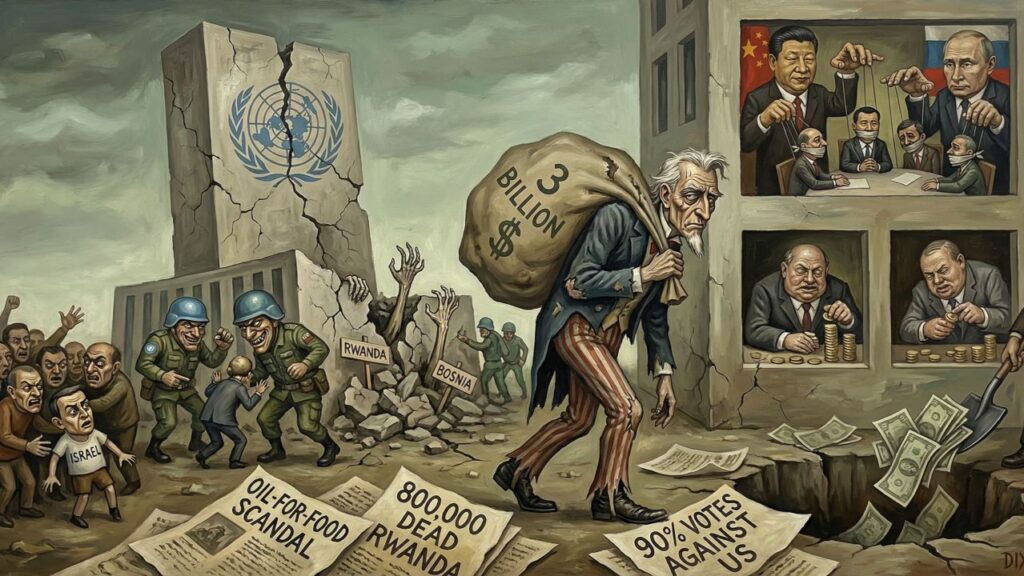
Executive Summary
The United Nations, established in 1945 with the noble mission to “save succeeding generations from the scourge of war,” has fundamentally failed to achieve its primary objectives while simultaneously constraining American sovereignty, wasting taxpayer resources, and enabling geopolitical rivals. This analysis examines seven decades of institutional failure through the lens of intent versus performance, revealing a systemic gap between the UN’s founding purposes and its operational reality that justifies American withdrawal.
The evidence is stark: the UN Security Council has vetoed or failed to pass more resolutions than it has adopted on critical conflicts; UN peacekeepers have stood by during genocides claiming 800,000 lives in Rwanda and 8,000 in Srebrenica; systemic sexual abuse scandals have produced nearly 2,000 allegations against peacekeepers over twelve years; and the organization has become a vehicle for authoritarian influence, anti-American bias, and financial corruption. The United States contributes 22% of the regular budget and 26% of peacekeeping costs, approximately $3 billion annually, yet finds itself isolated on 90% of General Assembly votes under the current administration, while the institution’s structural defects prevent any meaningful reform.
This report presents the definitive case that the UN has become an impediment rather than an instrument of American foreign policy, a financial burden with negligible returns, and a fundamentally unreformable institution whose continued existence serves adversarial interests more effectively than American ones.
I. Foundational Intent: The Promise of the UN Charter
The Core Mandate
The UN Charter, signed by 51 nations in San Francisco in 1945, established four explicit purposes that constitute the organization’s raison d’être:
Article 1 Purposes:
- To maintain international peace and security through collective measures for preventing and removing threats to peace, suppressing acts of aggression, and achieving peaceful settlement of disputes
- To develop friendly relations among nations based on respect for equal rights and self-determination
- To achieve international cooperation in solving economic, social, cultural, and humanitarian problems while promoting human rights
- To be a center for harmonizing the actions of nations in attaining these common ends
The Charter’s preamble articulated even loftier aspirations: to “save succeeding generations from the scourge of war,” reaffirm “faith in fundamental human rights,” establish conditions for justice and international law, and “unite our strength to maintain international peace and security”.
The Structural Framework
To achieve these objectives, the Charter established a Security Council with primary responsibility for maintaining international peace and security, granting five permanent members (P5) (the United States, United Kingdom, France, Soviet Union/Russia, and China) veto power over substantive resolutions. This structure explicitly prioritized great power unanimity as the mechanism for preventing global conflict, based on the assumption that consensus among major powers would enable decisive collective action.
The General Assembly was designed as a universal forum for dialogue and recommendation. The Economic and Social Council would address humanitarian and development challenges. And the International Court of Justice would adjudicate legal disputes. Together, these organs would constitute a “Parliament of Man,” transcending the failures of the League of Nations by including all major powers and possessing genuine enforcement authority.
II. Catastrophic Failures in Core Mission: Peace and Security
A. Genocide and Mass Atrocities: The Ultimate Institutional Failure
The UN’s most damning failures have occurred precisely where its mandate is most explicit: preventing genocide and mass atrocities.
Rwanda (1994): 800,000 Dead While the World Watched
The Rwandan genocide represents the single greatest failure of the UN system since its founding. Despite early warnings from UNAMIR Force Commander General Roméo Dallaire about planned mass killings, UN headquarters, then under the direction of Kofi Annan as head of peacekeeping operations, refused to authorize intervention.
When violence erupted on April 6, 1994, the Security Council’s response was to reduce the UN presence from 2,500 peacekeepers to just 270 personnel on April 21, even as reports confirmed ongoing massacres. A substantial military force arrived in Rwanda to evacuate foreign nationals but was never combined with UN peacekeepers to stop the genocide, “a clear signal to the génocidaires that no one from outside Rwanda would obstruct the unfolding genocide”.
The result: 800,000 Tutsis and moderate Hutus were systematically murdered over 100 days while UN peacekeepers stood powerless. General Dallaire later stated that the force “has been prevented from having a modicum of self-respect and effectiveness on the ground,” and the mission was “largely reduced to a bystander role”. UN Secretary-General Ban Ki-moon acknowledged in 2014 that “we could have done much more. We should have done much more,” and that “the shame still clings”.
Srebrenica (1995): A “Safe Area” Becomes a Killing Field
One year after Rwanda, the UN failed again in Bosnia-Herzegovina. The town of Srebrenica had been designated a UN “safe area” under UNPROFOR protection. Yet in July 1995, Bosnian Serb forces easily overran the enclave while Dutch UN peacekeepers stood by.
What followed was the largest massacre in Europe since World War II: systematic execution of 8,000 Bosnian Muslim men and boys. UN peacekeepers not only failed to intervene but, in some cases, abandoned civilians to their fate. Belgian soldiers guarding 2,000 Rwandans at the École Technique Officielle were ordered to leave to assist in foreign evacuations, after their departure, Hutu militants massacred everyone inside.
A subsequent investigation found “substantial evidence of abuse in procurement operations” and that UN forces exhibited a “chaotic and ineffective” response. Dutch peacekeepers destroyed a video tape showing Bosnian Serb soldiers committing extrajudicial executions as they watched. In 2015, Russia vetoed a Security Council resolution that would have formally condemned the Srebrenica massacre as genocide, on behalf of Serbia.
Darfur (2003-Present): 300,000 Dead, Peacekeepers Watch Civilians Shot
The Darfur crisis demonstrates that the UN learned nothing from Rwanda and Srebrenica. Beginning in 2003, the Sudanese government and Janjaweed militias orchestrated systematic killing and ethnic cleansing that resulted in at least 300,000 deaths and displacement of over two million people.
Despite extensive documentation of war crimes and crimes against humanity, “all attempts to stop the killing, whether by neighbors, regional organizations, Western states or the UN Security Council, proved ineffective”. A former UN spokeswoman in Darfur, Aicha el Basri, resigned and publicly stated that “in many circumstances, the civilians were shot in front of Unamid [UN forces]” and that peacekeepers “watched” militia groups assault civilians but did not intervene. She described UN Secretary-General Ban Ki-moon as part of a “conspiracy of silence” about the conflict.
The Security Council’s response was paralyzed by great power politics. In 2015, the UN Human Rights Council adopted what Human Rights Watch called a “deeply flawed resolution” that created an inquiry body led by Saudi Arabia and the Yemeni government, allies in regional conflicts, rather than an independent commission.
B. Veto Paralysis: The Security Council as Enabler of Atrocity
The structural defect that enabled these genocides is the P5 veto power, which has transformed the Security Council from a guardian of peace into a tool of great power self-interest.
Quantitative Veto Analysis
Since the UN’s founding through August 2025:
- Russia/Soviet Union: 159 vetoes (most frequent user)
- United States: 93 vetoes (often protecting Israel)
- China: 21 vetoes (increasingly frequent, often coordinating with Russia)
- United Kingdom: None since 1989
- France: None since 1989
Syria: A Case Study in Institutional Paralysis
The Syrian conflict epitomizes veto-driven dysfunction. From 2011 through 2024, Russia, sometimes joined by China, used its veto power nearly 20 times to block resolutions aimed at holding the Assad regime accountable for documented atrocities. Throughout the 14-year conflict, the Security Council “failed to adopt more draft resolutions on Syria than those it adopted successfully”, specifically, 29 draft resolutions were vetoed or failed to secure sufficient votes, compared to 25 adoptions.
The result of this institutional paralysis: Syria’s civil war has killed an estimated 500,000 people, displaced 13 million, and created the largest refugee crisis since World War II. Yet the UN’s political mediation process became “irreversibly irrelevant,” according to analysis by former UN officials. Syrian rebel leader Ahmad al-Sharaa summarized the UN’s failure bluntly: “There has been a lot of suffering and many attempts to fix things in Syria, but the UN and the international community have failed to bring about the release of a single prisoner in these 14 years”.
Gaza/Israel: American Isolation and UN Ineffectiveness
The UN’s handling of the Gaza conflict demonstrates both institutional bias and the veto’s paralyzing effect. The United States has repeatedly vetoed Security Council resolutions calling for ceasefires, most recently on June 4, 2025, which called for lifting restrictions on humanitarian aid.
In December 2023, when the General Assembly voted on a ceasefire resolution, 153 nations voted in favor while only 10 voted against, including Israel and the United States, isolating America from the overwhelming international consensus. This pattern reflects the UN’s systematic anti-Israel bias while simultaneously demonstrating that when the US exercises its veto to protect an ally, the UN becomes operationally impotent.
C. Peacekeeping Failures: Mandate Without Capacity
Even when the Security Council authorizes peacekeeping missions, their performance record reveals profound incompetence.
South Sudan: Sexual Violence Near UN Compounds
UN peacekeepers in South Sudan failed catastrophically following clashes between government and rebel forces in July 2016. A damning internal investigation found that UNMISS “failed to achieve one of its core mandates, namely ‘to protect civilians under threat of physical violence […] with specific protection for women and children'”.
Eyewitnesses reported that women and girls were raped near UN compounds with no action from peacekeepers. At a residence not far away, foreign aid workers suffered similar sexual violence, cases that “gained much international condemnation, but it is dwarfed by the scale of the atrocities South Sudanese civilians have long experienced”. In February 2016, gunmen killed 30 internally displaced people and wounded more than 120 others within one of the UN’s designated Protection of Civilian compounds.
A BBC investigation also accused UNMISS of lacking neutrality by giving arms to rebels in the town of Bentiu in 2013, and that “shortly after this transfer of arms, the rebels went on to carry out a massacre of civilians”. UN Secretary-General Ban Ki-moon acknowledged: “United Nations peacekeeping operations do not have the appropriate reach, manpower or capabilities to stop mass atrocities”.
Somalia, Angola, Bosnia: A Pattern of Organizational Dysfunction
Research analyzing UN peacekeeping failures in Somalia, Rwanda, Angola, and Bosnia concludes that “while lack of consent was undoubtedly one of the main factors driving the failures, in most of the cases, extreme Security Council interest or disinterest, combined with organizational dysfunction on the part of the UN Secretariat operation, were as important driving forces as situational factors”.
The study found that “organizational dysfunction itself is caused in part by the situation on the ground and by the Security Council’s lack of support, or intense but not consensual interests, it is also caused in large part by internal processes that occur within the Secretariat, between clashing personalities and departments, and tensions between field offices and headquarters”.
D. Sanctions Evasion: Toothless Enforcement
The UN’s sanctions regimes have proven equally ineffective, with North Korea serving as the paradigmatic case of institutional failure.
North Korea: 56 Countries Violating Sanctions
A 2019 UN Panel of Experts report documented that 56 countries, territories, and entities were involved in proven or alleged violations of Security Council resolutions on North Korea. The violations included:
- Failure to expel DPRK nationals and enforce travel bans (Guinea, Iran, South Africa, Zambia)
- Procurement violations involving coal, oil, and petroleum products (China, Russia, India, Singapore, UAE, and 11 others)
- Failure to inspect cargo or enforce shipping restrictions (14 countries)
- Ship-to-ship transfer schemes using false AIS signals to evade detection
The report found that “Russia and China are thwarting UNSC sanctions on North Korea with near impunity by operating black and grey market schemes to import or export coal, petroleum, and other goods”. In March 2024, Russia vetoed renewal of the UN Panel of Experts mandate entirely, effectively terminating independent monitoring of North Korea sanctions violations.
This collapse of enforcement means that UN sanctions, one of the organization’s primary tools short of military force, are effectively voluntary and unenforced against determined violators backed by P5 members.
III. Systemic Corruption and Sexual Abuse: Moral Bankruptcy
A. Oil-for-Food: The Largest Corruption Scandal in UN History
The UN Oil-for-Food Programme for Iraq (1996-2003) was intended to provide humanitarian relief while preventing Saddam Hussein from acquiring weapons of mass destruction. Instead, it became “one of the most corrupt humanitarian programs in history,” according to the independent Volcker Commission investigation.
The Scale of Fraud
The $64 billion program allowed Saddam Hussein to earn between $1.7 billion and $11 billion through bribes, kickbacks, and surcharges while under UN sanctions. Transparency International described the program as plagued by “scandalous irreconcilable conflicts of interest, the intrusion of political considerations, and a lack of transparency and accountability”.
Institutional Culpability
The Volcker Commission found “conclusive evidence” that Benon Sevan, the Executive Director in charge of the program, violated UN rules by “effectively participating in the selection of purchasers of oil under the programme” and placed himself in “an irreconcilable conflict of interest”. The investigation revealed that Kofi Annan’s son was implicated, and the corruption reached “the very top of the UN”.
More damning was the institutional structure that enabled the fraud. The program “lacked the independence, the clear reporting lines and the management responsiveness critical to achieving a fully effective auditing process,” according to Volcker. No external oversight existed at the UN, and “loose globalized markets and no mechanism for the U.N. to control to whom Iraq sold oil and bought food from led to rampant insider deals and corruption”.
The Australian Wheat Board, the largest single supplier under the program, paid more than $200 million in bribes to Saddam’s government. China and the US, two Security Council permanent members, could not even agree on the nationalities of oil contract supervisors. The Security Council issued only “loose warnings” upon learning of kickbacks and never investigated Syria when its pipeline was used to smuggle oil.
B. Procurement Corruption: Institutionalized Bribery
The Oil-for-Food scandal was not an aberration but reflected systemic procurement corruption throughout the UN system.
The Yakovlev Case and Systematic Bribery
In 2006-2007, multiple UN procurement officials were arrested for accepting bribes. Russian procurement officer Alexander Yakovlev pleaded guilty to conspiracy, wire fraud, and money laundering, with investigators finding nearly $1 million in bribes in his secret Caribbean bank account. The bribes involved at least $79 million in non-Oil-for-Food UN contracts.
Businessman Nan Koh admitted guilt for bribing a UN purchasing official with two luxury apartments in exchange for directing over $50 million in UN contracts to companies he represented, including the Indian government-owned Telecommunications Consultants India Ltd. Senior UN official Sanjaya Bahel was indicted for “deliberately cancel[ing] completed bids whenever they could not be awarded to TCIL, and then call[ing] for replacement bids that were eventually awarded to TCIL”.
Institutional Weakness
An independent consulting report by Deloitte described the UN purchasing department, which spends the bulk of taxpayer dollars, as “inept, disorganized and ripe for malfeasance”. The UN Office of Internal Oversight Services found “substantial evidence of abuse in procurement operations,” and placed eight officials on administrative leave, with three remaining under investigation.
The UN acknowledged that “such significant reliance on people left the United Nations extremely vulnerable to potential fraudulent or corrupt activity”. More than 500 cases were reported to internal investigators. Secret information about sealed bids was leaked to favored contractors, and FOX News investigations revealed that senior UN officials serving in the Secretary-General’s office had direct financial ties to companies receiving lucrative contracts.
C. Sexual Exploitation and Abuse: A Culture of Impunity
Perhaps no failure more thoroughly contradicts the UN’s stated commitment to human rights and dignity than the systematic sexual abuse perpetrated by UN peacekeepers.
The Scope of Abuse
An Associated Press investigation in 2017 found that over the preceding 12 years, there had been “almost 2,000 allegations of sexual abuse and exploitation by peacekeepers and other UN personnel around the world”. These allegations involved personnel from many countries deployed to multiple continents.
Specific documented cases include:
- Haiti: “At least 134 Sri Lankan peacekeepers” were involved in a child sex ring over a 10-year period; although 114 were sent home, none were charged for the crimes
- Democratic Republic of Congo: Over 150 allegations against MONUC personnel, typically involving “peacekeepers’ sexual misconduct with Congolese women and girls, usually in exchange for food or small sums of money”. Interviews documented girls as young as 11-14 years old, with some allegations involving rape, forced prostitution, and demands for sex in exchange for jobs
- Central African Republic: Hundreds of women and children reported being raped and sexually violated by UN peacekeepers, with compelling evidence validating the claims
Institutional Failure to Prosecute
Despite the scale of abuse, “there has not been one successful prosecution of UN civilian or military personnel, either in the Congo or elsewhere,” according to testimony before the House International Relations Subcommittee. The reason: the UN has no direct jurisdiction over peacekeepers, with prosecution responsibility falling to perpetrators’ home countries.
The only punitive measures available to the UN directly are repatriation and banning from future missions. Many accused peacekeepers come “from countries lacking advanced legal systems or robust sexual abuse legislation,” resulting in de facto impunity. A 2024 study concluded that “peacekeepers are rarely held accountable for SEA” and there is “little effort to establish gender-specific training as a means of prevention”.
The UN as Part of the Problem
As early as 2004, Amnesty International reported that underage girls were being kidnapped, tortured, and forced into prostitution in Kosovo with UN and NATO personnel driving demand. The UN’s department of peacekeeping acknowledged that “peacekeepers have come to be seen as part of the problem in trafficking rather than the solution”.
The UN started disclosing figures about sexual abuse only in 2015, and before the 2000s “did not keep detailed statistics concerning such incidents”. This institutional opacity enabled abuse to continue for decades. As one researcher noted, peacekeepers deployed to conflict zones “inflict further terror upon local populations by sexually abusing and exploiting women and children, thereby compounding their trauma”.
IV. Anti-American Bias and Isolation of US Interests
A. Voting Record: The US Against the World
The UN General Assembly has become a forum where the United States finds itself systematically isolated from the international community, raising fundamental questions about the institution’s value to American interests.
Trump Administration Voting Patterns (2025-2026)
Under the second Trump administration, US isolation reached unprecedented levels:
- The US voted against 90% of resolutions endorsed by the General Assembly (170 out of 187 resolutions)
- The US was the sole nation to vote against resolutions on 43 occasions
- In the General Assembly’s human rights committee, the US voted against 38 resolutions in 2025 alone, including on “Rights of Indigenous Peoples” and “Rights of the Child”
- In many cases, resolutions passed with support from over 160 countries, with only the US and one or two allies opposing
Historical Pattern
This isolation is not limited to one administration:
- In 2022, the US voted against 53% of voted UNGA resolutionsthe most of any member state besides Israel
- The US abstained on 10% of voted resolutions
- From 2016-2022, the US “never exclusively voted against resolutions” under the Biden administration, but the pattern reversed dramatically under Trump
A US representative characterized many UN resolutions as “merely a globalist wishlist of divisive cultural issues” such as climate change and gender equality, stating they are “entirely incompatible with the Trump Administration’s assertive and realistic foreign policy”. Richard Gowan of the International Crisis Group noted that “the US has forfeited a significant amount of influence within the UN system by acting as a spoiler and a notably negative participant,” and that “China perceives a chance to capitalize on the behavior of the US”.
B. Human Rights Council: “A Cesspool of Political Bias”
The UN Human Rights Council exemplifies the institution’s transformation from guardian of universal values into a vehicle for targeting American allies while protecting human rights abusers.
Disproportionate Anti-Israel Focus
Since its founding in 2006, the UNHRC has demonstrated systematic bias against Israel:
- 103 of 280 condemnatory resolutions (37%) have targeted Israel, more than Iran, Syria, North Korea, China, Russia, Cuba, and Venezuela combined
- 102 of 210 resolutions lacking any praise (49%) focused on Israel
- Israel is the only country with a standing agenda item against it (Agenda Item 7: “Human rights situation in Palestine and other occupied Arab territories”)
- 9 of 32 special sessions have targeted Israel, more than any other country
- In 2022, Israel was condemned more often than Afghanistan, Myanmar, North Korea and Syria
Membership of Human Rights Violators
The Council’s composition undermines its legitimacy:
- In 2013, China, Russia, Saudi Arabia, Algeria, and Vietnam were elected members, all countries with documented human rights abuses
- The current “Special Rapporteur on the situation of human rights in the Palestinian territory” is Francesca Albanese, described as “a long-time anti-Israel activist, who lacks impartiality and professionalism” and who “repeatedly rejects Israel’s right to exist, justifies Palestinian attacks against Israelis, and defends terrorists”
- The Commission of Inquiry chair, Navi Pillay, “has a long-standing anti-Israel bias,” has “falsely declared Israel an ‘apartheid’ state, and promoted discriminatory boycotts against Israel”
US Withdrawal (2018)
In June 2018, US Ambassador Nikki Haley announced US withdrawal from the UNHRC, stating: “Human rights abusers continue to serve on, and be elected to, the council. The most brutal regimes in the world continue to evade scrutiny, and the council continues to politicize and scapegoat countries with positive human rights records in order to distract from the abusers in their ranks”.
She described the Council as a “cesspool of political bias” that displays “unending hostility towards Israel” while shielding human rights violators. The decision came one day after the UN High Commissioner for Human Rights criticized US border policies, illustrating how the institution is weaponized against American domestic policy.
C. Chinese Infiltration and Authoritarian Influence
While the UN isolates the United States diplomatically, America’s strategic rival has systematically infiltrated the institution to advance authoritarian governance norms.
Leadership Positions
China has strategically placed nationals in key UN positions:
- 4 of 15 major UN specialized agencies are led by Chinese nationals: the FAO, International Civil Aviation Organization, UNIDO, and ITU
- China is the second-largest financial contributor (roughly 20% of regular budget, 23% of peacekeeping), giving it substantial influence
Manipulation of UN Processes
China’s strategy within the UN includes:
- Placing proxies and loyalists in key UN departments to align institutional norms with CCP interests
- Manipulating voting by pressuring nations to speak favorably during Universal Periodic Reviews, “flood UNHRC proceedings with favourable comments, aiming to dilute meaningful recommendations.”
- Using GONGOs (Government-Organized NGOs): Out of 47 Chinese NGOs authorized for UN Human Rights Council participation, at least 34 are connected to CCP bodies
- Suppressing dissent: Chinese officials have used DESA’s office to eject or bar experts critical of China from UN premises
- Inserting CCP rhetoric: China pushes to insert its “Shared Future” governance rhetoric into UN documentation
Admission from UN Officials
Wu Hongbo, former head of the UN Department of Economic and Social Affairs, admitted to favoring China during his tenure. During Zhao Houlin’s tenure as ITU Secretary-General (2015-2022), Beijing reduced Taiwan’s international presence, changing references to reflect CCP positions.
Strategic Implication
Beijing views the UN “as a strategic tool for reshaping global governance” and has “exploited the UN structure for elevating its status by strategically placing its nationals/proxies in key UN positions, providing substantial funding, initiating developmental programs/initiatives, and transforming organisations aligned with its interests”. As one analysis concluded: “China perceives a chance to capitalize on the behavior of the US”.
V. Structural Unreformability: Why the UN Cannot Be Fixed
A. Security Council Reform: Seven Decades of Failure
Despite widespread acknowledgment that the Security Council is unrepresentative and dysfunctional, all reform efforts have failed.
The Reform Impasse
Since 1965, when the Council expanded from 6 to 10 non-permanent members, there has been no structural reform, despite continuous calls for change. The fundamental obstacle: any reform requires:
- Agreement of two-thirds of all UN member states
- Ratification by two-thirds of member states
- Agreement of all P5 members (each of which holds veto power)
This creates a logical impossibility: the permanent members benefiting from the status quo must unanimously agree to dilute their own power. As one analysis notes, “the charter’s amendment process has ‘locked in’ P5 control by requiring a favorable vote of all of the P5 members. Efforts to reform the UN through formal amendment have been unsuccessful, which hazards mounting pessimism that the world body is trapped in amber”.
Competing Proposals, No Consensus
Multiple reform models have been proposed:
- Regional representation: Include new permanent members from Africa, Latin America, and Asia (India, Brazil, etc.)
- Veto restrictions: Require multiple vetoes, voluntary veto restraint in mass atrocity situations, or thematic veto prohibitions
- Abolition of veto: Complete elimination of veto power
Yet “despite a common agreement amongst member states, regional groups, and academics on the need for reform, its feasibility is compromised by the difficulty of drafting a proposal that would garner the necessary support, while also avoiding a veto from any of the five permanent members”. Regional rivalries (India-Pakistan, Brazil-Argentina, Japan-China) further complicate consensus.
Veto Initiative: Symbolic at Best
The only successful reform has been procedural: a “veto initiative” requiring P5 members to explain their vetoes before the General Assembly. This creates “a measure of accountability” and in one case (China on Resolution 2634) deterred a veto, but it does not constrain veto use in any binding way.
B. Bureaucratic Inefficiency and Institutional Inertia
The UN’s administrative structure has proven resistant to efficiency improvements, with repeated reform initiatives failing to address fundamental dysfunction.
Budget Allocation: 80% to Salaries and Overhead
A recurring criticism from practitioners is that “up to 80% of the budgets” of UN operations go to “salaries of UN staff and costs for offices, vehicles, etc.,” rather than actual program delivery. This administrative bloat creates a self-perpetuating bureaucracy more focused on institutional preservation than mission effectiveness.
Coordination Failures
Practitioners report systematic coordination failures:
- In the Kosovo crisis, “OCHA and UNHCR were in an ongoing fight over who was in charge, which resulted in a huge lack of coordination of the aid operation”
- UN80 reform proposals identify “long-standing coordination failures and fragmentation,” with agencies pursuing competing mandates and overlapping functions
- The cluster coordination approach has proven unable to mainstream multi-purpose cash assistance, revealing “inherent tensions” in the UN’s operational model
Liquidity Crisis and Forced Restructuring
As of 2025, the UN faces an existential financial crisis:
- Cumulative unpaid assessments to the regular budget total approximately $2.4 billion, with the US owing about $1.5 billion
- Major UN agencies face insolvency: WFP cutting 25-30% of staff, OCHA cutting 20%
- The UN80 initiative proposes “deep structural consolidation” including potential agency mergers, relocating functions from high-cost headquarters, and reducing bureaucracy
Yet these reforms are “not reform born from strategic foresight; it’s a reckoning forced by empty coffers”. Political resistance and bureaucratic inertia mean that “if reforms focus solely on cost-cutting without addressing the underlying coordination failures and lack of strategic clarity, the result could be catastrophic”.
C. Yemen and Sudan: Recent Evidence of Continued Failure
To demonstrate that UN failures are not historical artifacts but ongoing patterns, consider two contemporary crises.
Yemen: “The Worst International Response”
The Yemen conflict, which began in 2015, has been described by the UN itself as “the largest humanitarian crisis in the world”. Yet independent analysts call it “the worst international response” to a humanitarian crisis globally.
The UN’s failures include:
- In 2015, the UNHRC adopted what Human Rights Watch called a “deeply flawed resolution,” creating an inquiry body led by Saudi Arabia and the Yemeni government, allies in the war, rather than an independent commission
- Saudi Arabia forced the UN to withdraw the Saudi-led coalition from the annual “list of shame” for violations against children by threatening to pull hundreds of millions in UN funding
- Relief operations are “massively imbalanced,” with Houthi forces seizing humanitarian aid before it reaches intended recipients, while “weak Government institutions and bureaucratic obstructions impede the travel and movement of relief workers”
- “International organizations have failed to ensure aid reaches Yemenis in need; relief operations must be reassessed and held accountable to ensure that aid is not wasted”
The UN remains “shamefully silent” as Houthi militias kill women and children with drones, snipers, and mines, according to Yemen’s representative to the Security Council.
Sudan: Failure Continues in Darfur’s Successor
The UN’s performance in Sudan from 2003-present demonstrates that the institution learned nothing from previous genocides. As documented in Section II, 300,000 died in Darfur while UN peacekeepers watched civilians shot in front of them.
In 2025, when the city of El Fasher fell, the UN’s humanitarian chief stated: “The Sudan crisis is, at its core, a failure of protection, and our responsibility to uphold international law”. Despite unanimous agreement in 2005 on the “Responsibility to Protect” doctrine following Darfur, “this abstract commitment has had little effect on the Sudanese government or on other UN member states who had made this pledge”.
VI. Financial Burden Without Commensurate Benefit
A. The American Contribution
The United States bears a disproportionate financial burden for an institution that systematically opposes American interests.
Assessed Contributions
For fiscal year 2025:
- Regular budget: 22% ($826.9 million of $3.72 billion total)
- Peacekeeping budget: 26.94% assessed, but capped by Congress at 25% ($1.2 billion of ~$5.4 billion total)
- Total annual contributions: Approximately $3 billion in assessed dues
Arrears and Payment Disputes
The US has accumulated substantial arrears:
- As of April 30, 2025, the US owes approximately $1.5 billion in cumulative unpaid dues minus 62% of total UN arrears
- The gap between assessed (27%) and paid (25%) peacekeeping contributions has built for years, yielding over $1 billion in arrears
- In both 2024 and 2025, the US did not appear on the UN’s “Honour Roll” of fully paid members
Relative Burden
While the US contribution represents only 0.2% of the federal budget (less than $10 per capita annually), this understates the relative burden:
- China, with comparable GDP, pays approximately $685.7 million regular budget, $140 million less than the US
- China’s peacekeeping assessment (23%) is lower than the US (26.94%) despite China being the second-largest economy
- The US pays more than the next three contributors (China, Japan, Germany) combined for the regular budget
B. Cost-Benefit Analysis: Negative Return on Investment
Actual Economic Benefits Are Modest
Defenders of the UN argue that American engagement provides economic benefits:
- In 2022, the US received $2.36 billion in UN procurement contracts, less than the US pays in assessed dues combined ($3 billion)
- UN agencies employ “thousands of Americans,” though specific numbers are not disclosed
- UNESCO World Heritage designations boost tourism revenue for 25 US sites by an estimated $100 million annually collectively
Even accepting these figures at face value, the net economic return is minimal or negative. The US pays $3 billion in assessed dues to receive $2.36 billion in contracts (a net loss of $640 million), plus modest tourism and employment benefits that would largely exist without UN designation.
Alternative Uses of Funds
The $3 billion annual assessed contribution could be redirected to:
- Bilateral aid programs with greater US control over implementation
- NATO and coalition-of-the-willing frameworks that share US strategic interests
- Domestic infrastructure or other priorities
Cost of Unilateral Action vs. UN Operations
The strongest cost-benefit argument for the UN is that peacekeeping operations are cheaper than unilateral US military interventions. The Government Accountability Office found that “comparable U.S. operations cost American taxpayers eight times more than a UN mission”. The UN peacekeeping budget of $6.45 billion (with the US paying ~$1.6 billion) is dramatically cheaper than sustained US military deployments.
However, this argument assumes that:
- UN peacekeeping is effective (contradicted by evidence in Section II)
- The alternative to UN peacekeeping is US unilateral intervention (false, regional organizations, NATO, and “coalitions of the willing” are alternatives)
- The US has an interest in intervening in every conflict where the UN deploys peacekeepers (questionable at best)
C. Burden-Sharing Illusion
While defenders argue the UN enables “burden-sharing” where “every American dollar brings in three more from partners”, this obscures several realities:
Free-Riding by Adversaries
China benefits from UN peacekeeping and development programs while paying a lower peacekeeping assessment than the US despite having a comparable economy. Russia, despite aggressive military interventions violating the UN Charter, remains a permanent Security Council member with full veto power, enabling it to block accountability measures.
Allied Contributions Could Occur Through Alternative Frameworks
The European allies, Japan, and other partners who contribute to UN peacekeeping could redirect those contributions to NATO, bilateral coalitions, or other frameworks more aligned with democratic values and US strategic interests. The UN is not the only mechanism for multilateral burden-sharing.
Payment Delinquency Undermines the Model
As of April 2025, cumulative unpaid assessments total $2.4 billion, with major debtors including China ($587 million), Russia ($123 million), and Venezuela ($93 million). If burden-sharing depends on reliable contributions, the UN system is failing even by its own metric.
D. Public Opinion: Declining Confidence
American public support for the UN, while still positive, has eroded:
- Only 46% of Americans think the UN is very or somewhat effective in preventing wars, including just 13% who say “very effective”
- 63% of Americans say the US benefits at least “a fair amount” from UN membership, meaning 35% believe the US does not benefit too much or at all
- Only 34% of respondents think the UN is doing a good job, though 66% believe it plays a necessary role
- 83% of Americans support US engagement in the UN, but this support is broad rather than deep, more about the concept of international cooperation than confidence in the UN specifically
Republican voters are significantly more skeptical, with “Democrats… more likely than Republicans to say the U.S. benefits from UN membership”. This partisan divide suggests that American support for the UN may decline further as political polarization continues.
VII. Sovereignty and Legal Concerns
A. UN Infringement on Domestic Jurisdiction
The UN Charter explicitly states: “Nothing contained in the present Charter shall authorize the United Nations to intervene in matters which are essentially within the domestic jurisdiction of any state”. Yet the UN routinely attempts to influence American domestic policy through resolutions, reports, and public pressure.
Examples of UN Overreach
- The UN High Commissioner for Human Rights criticized US border policies regarding family separation just one day before the US withdrew from the Human Rights Council in 2018
- In 2025, the US demanded votes on resolutions with titles like “Rights of Indigenous Peoples” and “Rights of the Child” because they contained “problematic language” relating to domestic policies on diversity, equity, inclusion, and climate change
- The UNHRC pressures the US through the Universal Periodic Review process to adopt policies on healthcare, criminal justice, and social policy that reflect European social democratic norms rather than American constitutional traditions
US Representative Response
US diplomats stated during 2025 votes that UN bodies should stop using resources “where there is little or no impact” and focus instead on “core role of maintaining international peace and security” rather than “divisive cultural concepts”. This reflects frustration that the UN has expanded its mandate far beyond the Charter’s original scope into areas of domestic policy.
B. The UN Charter as Dead Letter: American Violations
A more fundamental sovereignty concern is that the UN Charter purports to constrain American use of force, yet the US repeatedly violates these constraints when strategic interests demand, revealing the Charter’s binding authority as illusory.
Article 2 Prohibition on Use of Force
The Charter states: “All Members shall refrain in their international relations from the threat or use of force against the territorial integrity or political independence of any state”. This prohibition is subject to two exceptions: (1) self-defense against armed attack per Article 51, and (2) Security Council authorization under Chapter VII.
Serial US Violations
Analysis by international law experts documents that “the five most recent U.S. presidents have violated the Charter’s prohibition on the use of force”:
- Afghanistan (2001): Bush invaded although Afghanistan had not attacked the US (19 men, 15 from Saudi Arabia, committed 9/11 crimes); the Security Council never authorized the use of force
- Iraq (2003): Bush attempted to obtain Security Council authorization but it refused; he then “cobbled together prior Security Council resolutions from the first Gulf War, which no longer applied”
- Yugoslavia (1999): Clinton’s Secretary of State Madeline Albright oversaw NATO bombing without Security Council authorization
- Libya (2011): Obama secured a no-fly-zone resolution but then engaged in forcible regime change that went “far beyond what the resolution authorized”
- Syria (2017, 2021): Trump sent 59 Tomahawk missiles to attack Syria, and Biden conducted airstrikes in Syria, neither of which were authorized by the Security Council or constituted responses to armed attacks on the US
- Iran (2020): Trump ordered the drone assassination of Iranian Maj. Gen. Qassim Suleimani in Iraq without Security Council authorization
ICJ Ruling Ignored
When the International Court of Justice ruled in 1986 that the United States violated international law by mining Nicaragua’s harbors and supporting the Contras, “the U.S. refused to be bound by the ruling”. This demonstrates that international law, as embodied in UN institutions, has no binding authority when it conflicts with perceived American interests.
Implication for Sovereignty
The UN Charter purports to constrain American sovereignty by prohibiting unilateral use of force. Yet the US violates these constraints routinely, demonstrating that the constraints are not actually binding. This creates the worst of both worlds: the US is bound by Charter obligations when they are inconvenient (e.g., requiring Security Council authorization that Russia or China can veto), but other nations understand the constraints are not binding on America in practice. The result is reduced American legitimacy without any corresponding constraint on American freedom of action.
C. The League of Nations Precedent
American withdrawal from the UN would not be unprecedented. The United States created the League of Nations but never joined due to Senate opposition, contributing to the League’s ultimate failure.
Why the League Failed
The League of Nations failed for reasons strikingly similar to current UN defects:
- Lack of enforcement power: The League relied on moral suasion and economic sanctions but had no standing army and could not credibly threaten military intervention
- Absence of major powers: The US never joined; Germany, Japan, and Italy left when the League opposed their aggression
- Unanimous voting requirement: Decisions required unanimity, making the organization “very slow and ineffective in responding to crises”
- Great power self-interest: Britain and France prioritized colonial interests over collective security
- Failed to stop aggression: The League could not prevent Japan’s invasion of Manchuria (1931), Italy’s conquest of Abyssinia/Ethiopia (1935), or Germany’s remilitarization and expansions (1936-1939)
The UN as Warmed-Up League
Scholars acknowledge that “the UN was to some extent a ‘warmed-up’ League: the postwar drafters were determined to learn from failure, but they did not abandon the machinery of internationalism built in Geneva”. The key “lesson learned” was that the UN needed great power participation and enforcement capability.
Yet the UN has replicated the League’s failures:
- Enforcement remains weak (peacekeepers cannot stop genocides)
- Great power unanimity is illusory (veto paralysis)
- Economic sanctions are ineffective (North Korea)
- Aggression continues unpunished (Syria, Sudan, Yemen)
The Second American Rejection
Just as America’s rejection of the League of Nations in 1919 signaled the institution’s ultimate failure, American withdrawal from the UN in 2026 would force a similar reckoning. The question is whether other nations would reform the institution or allow it to collapse into irrelevance, but that is not America’s burden to bear.
VIII. Alternative Frameworks for International Cooperation
Critics of UN withdrawal argue that “the UN is the only forum with universal membership” and that withdrawing would “isolate the US diplomatically.” This argument is empirically false and strategically misguided.
A. NATO: Effective Action Without UN Paralysis
The North Atlantic Treaty Organization demonstrates that multilateral security cooperation is more effective when based on shared democratic values rather than universal membership.
NATO vs. UN: A Comparative Record
Research comparing NATO and UN approaches to peace operations finds stark differences in effectiveness:
- NATO interventions in Bosnia (1995) and Kosovo (1999) succeeded where UN peacekeeping had failed for years
- NATO does not require Security Council authorization when P5 members would veto action: “the Alliance cannot be held hostage to the whims and fortunes of non-NATO members”
- NATO has a “clear focus” and “unified command structure” that UN operations lack
The Kosovo Precedent
In 1999, NATO conducted air operations against Serbia to stop ethnic cleansing in Kosovo withoutexplicit UN Security Council authorization, knowing Russia and China would veto any resolution. NATO members offered various legal rationales, including that prior Security Council resolutions had identified the crisis as a “threat to international peace and security,” justifying enforcement action.
While NATO allies remain divided on whether this set a precedent, the operational reality is clear: when humanitarian intervention is necessary and the Security Council is paralyzed by veto, NATO acts. The UN does not.
B. Coalitions of the Willing and Bilateral Frameworks
The US can achieve its foreign policy objectives through flexible coalitions tailored to specific missions rather than a universal, dysfunctional bureaucracy.
Proven Models
- Gulf War (1991): US-led coalition with Security Council authorization demonstrated multilateral cooperation without UN operational control
- War on Terror (2001-2021): Coalition operations in Afghanistan and Iraq proceeded despite mixed UN support
- Five Eyes Intelligence Sharing: US, UK, Canada, Australia, New Zealand intelligence cooperation functions effectively without UN involvement
- Quad (Quadrilateral Security Dialogue): US, Japan, India, Australia strategic dialogue addresses Indo-Pacific security without Chinese veto
Advantages Over UN Framework
Coalitions of the willing offer several advantages:
- Mission-specific: Tailored to particular objectives rather than diffuse mandates
- Shared interests: Participants have aligned strategic interests, not competing agendas
- Accountability: Contributing nations can be held accountable by coalition partners, unlike UN bureaucracy
- Flexibility: Can adapt quickly without Security Council approval or General Assembly debates
C. Regional Organizations
Regional organizations often have stronger incentives and capabilities to address conflicts than the UN.
Examples of Regional Effectiveness
- African Union: AU peacekeeping in Somalia (AMISOM) has been more effective than previous UN operations, with 22,000 troops compared to UN’s historical presence
- European Union: EU missions in the Balkans and Africa demonstrate regional capacity for peacekeeping and state-building
- Organization of American States: OAS mediates disputes in the Western Hemisphere without Chinese or Russian interference
The Subsidiarity Principle
Regional organizations understand local context better than UN headquarters in New York. They have stronger incentives to prevent conflict spillover into neighboring countries. And they cannot hide behind great power vetoes when action is needed. A post-UN American foreign policy could support and work through regional organizations where they align with US interests, while maintaining freedom of action elsewhere.
D. Bottom-Up vs. Top-Down Cooperation
Research on international cooperation increasingly recognizes that “bottom-up” approaches, where countries define their own priorities and coordinate voluntarily, are more effective than centralized, legally binding arrangements.
Alternative Cooperation Models
Examples of successful bottom-up frameworks:
- Major Economies Forum (MEF): Climate and energy security dialogue among major emitters without binding treaty obligations
- G20: Economic coordination among the world’s largest economies
- International Energy Agency (IEA): Technical cooperation on energy policy
- BRICS: Brazil, Russia, India, China, South Africa cooperation, including the New Development Bank as alternative to UN-dominated institutions
Advantages of Decentralized Cooperation
Research finds that bottom-up approaches:
- Allow “flexibility” for each actor to define priorities that are “technically, economically, and politically acceptable”
- Lower the threshold for progress by avoiding “cumbersome process of international law and its requirement of unanimous consent”
- Avoid “conservative tendency of legally binding arrangements, which are apt to lock in low levels of ambition and prove vulnerable to defection”
- Are “conducive to stakeholder involvement, improving the political viability of implementation”
The UN represents the obsolete “top-down” model: centralized, bureaucratic, constrained by unanimous consent of incompatible regimes. Modern international cooperation is moving toward flexible networks that the US can navigate more effectively outside the UN straitjacket.
IX. The Case for Withdrawal: Strategic Imperatives
A. The UN Serves Adversarial Interests
The comprehensive evidence demonstrates that the UN has become a net liability to American interests:
Strategic Costs
- Diplomatic isolation: The US votes against 90% of General Assembly resolutions, providing China and Russia with opportunities to position themselves as defenders of “international consensus”
- Legitimization of authoritarianism: The UN treats “non-democratic, and even despotic, regimes as being as legitimate as democratic countries,” as American unilateralists correctly argue
- Platform for adversaries: China uses UN agencies to advance its governance model, suppress dissent, and undermine liberal democratic norms
- Veto paralysis: Russia and China block American initiatives while using the UN to constrain US freedom of action
Operational Failures
- The UN cannot prevent genocide (Rwanda, Srebrenica, Darfur)
- UN peacekeepers commit sexual abuse with impunity
- UN sanctions are unenforced against determined violators
- UN reform is impossible due to structural vetoes
Financial Burden
- The US pays $3 billion annually for an institution that opposes American positions
- Procurement contracts return only $2.36 billion, creating a net financial loss
- Alternative frameworks (NATO, coalitions, bilateral aid) would provide greater American control and influence
B. The Sovereignty Argument
The UN infringes on American sovereignty in two ways:
- Purported Constraints: The Charter purports to prohibit unilateral use of force and subjects US domestic policy to international scrutiny
- Practical Interference: The UN provides a forum for adversaries to challenge American legitimacy while the US is bound by treaty obligations to fund and participate in the institution
American withdrawal would eliminate these constraints without reducing American freedom of action, because the US already acts unilaterally when core interests are at stake. The UN provides false legitimacy without binding authority, creating the worst of both worlds.
C. The Moral Argument
The United Nations has failed so catastrophically and so systematically in its core mission that continued participation implicates the United States in institutional failure.
Complicity in Genocide
By funding UN peacekeeping operations that watch civilians be murdered (Srebrenica, Darfur, South Sudan), the United States enables atrocity through negligent complicity. The UN’s inability to prevent genocide while claiming a “Responsibility to Protect” mandate is morally intolerable.
Enabling Sexual Abuse
American taxpayer dollars fund UN peacekeeping missions where soldiers rape children with impunity. The UN has demonstrated for two decades that it cannot or will not prosecute this abuse. Continued funding makes the United States complicit in these crimes.
Legitimizing Corruption
The Oil-for-Food scandal, procurement fraud, and institutional opacity demonstrate that the UN is structurally corrupt. American participation provides legitimacy to an institution that systematically violates principles of transparency and accountability that Americans demand from their own government.
D. The Precedent Argument: Trump’s Partial Withdrawal
The Trump administration’s actions in 2025-2026 have already established a precedent for American disengagement:
66 Entity Withdrawal Memorandum (January 2026)
President Trump signed a memorandum directing withdrawal from 66 international organizations, conventions, and treaties, specifically targeting UN entities. The stated rationale: these organizations are “redundant in their scope, mismanaged, unnecessary, wasteful, poorly run, captured by the interests of actors advancing their own agendas contrary to our own, or a threat to our nation’s sovereignty, freedoms, and general prosperity”.
Entities Already Exited
- WHO (World Health Organization): Withdrawn during both Trump terms
- UNESCO: Withdrawn and defunded
- UN Human Rights Council: Exited 2018, recommitted to withdrawal 2025
- UNRWA: All funding ceased
The Logic of Complete Withdrawal
If 66 UN entities are “contrary to American interests,” the question becomes: why maintain membership in the parent organization? The Security Council veto provides the only unique benefit, but that benefit is negated by Russian and Chinese vetoes that block American initiatives. The UN General Assembly actively opposes American interests by 90% of votes. The answer is clear: there is no remaining justification for continued UN membership.
E. The DOGE-UN Initiative: External Validation
The emergence of “DOGE-UN” (an organization explicitly modeled on Trump’s Department of Government Efficiency to target “bureaucratic bloat, waste and inefficiencies” at the UN) demonstrates growing international recognition of the institution’s dysfunction.
Serbian former foreign minister and UN officials are “marketing a similar approach to tackling the ‘bureaucratic bloat, waste and inefficiencies’ of the UN”. This represents acknowledgment from within the international community that the institution is broken. If international stakeholders themselves are calling for radical restructuring, American withdrawal would accelerate necessary change rather than damage a functional system.
X. Conclusion: The UN Has Failed, American Withdrawal Is Justified
The Intent-Performance Gap
This analysis began by examining the UN’s foundational intent as articulated in the Charter: to maintain international peace and security, prevent aggression, promote human rights, and serve as a center for harmonizing international action. Against these objectives, the UN’s performance record reveals catastrophic, systematic failure:
Charter Purpose
Performance Record
Maintain peace and security
Failed to prevent genocides in Rwanda (800,000 dead), Srebrenica (8,000 dead), Darfur (300,000 dead); Security Council paralyzed by 159 Russian vetoes, 93 US vetoes
Prevent aggression
Cannot enforce sanctions against North Korea (56 countries violating); Russia and China veto accountability for Syria (29 failed resolutions)
Promote human rights
UN peacekeepers committed ~2,000 sexual abuse allegations over 12 years, virtually none prosecuted; UNHRC dominated by human rights abusers, 37% of condemnatory resolutions target Israel
International cooperation
US isolated on 90% of votes; China infiltrates agencies to advance authoritarian norms
Uphold international law
Major powers violate UN Charter with impunity; ICJ rulings ignored
The Financial Reality
The United States contributes $3 billion annually (22% of regular budget, 26% of peacekeeping) to receive $2.36 billion in procurement contracts, a net financial loss even before accounting for the strategic costs of diplomatic isolation and enabling of adversaries.
This represents 0.2% of the federal budget, but the relevant question is not “can we afford it?” but “what else could $3 billion accomplish?” The answer: bilateral aid with greater US control, strengthened NATO capabilities, coalition operations with democratic allies, or domestic priorities. The opportunity cost of UN membership is substantial.
The Structural Reality
The UN cannot be reformed because:
- Any Security Council reform requires unanimous P5 approval (impossible when current members benefit from the status quo)
- Bureaucratic inefficiency is protected by bloated staff budgets (80% overhead) and inter-agency turf wars
- Corruption is endemic and protected by diplomatic immunity
- Member states include authoritarian regimes with no interest in liberal democratic values
The UN80 restructuring initiative, forced by financial crisis, may achieve modest efficiency gains, but it cannot address fundamental structural defects. The institution is “trapped in amber”.
The Alternative Reality
International cooperation does not depend on the United Nations. Successful alternatives include:
- NATO: 32 democracies with shared values, proven combat effectiveness, no authoritarian vetoes
- Coalitions of the willing: Mission-specific partnerships without bureaucratic overhead
- Regional organizations: African Union, OAS, EU operations with local knowledge and incentives
- Bottom-up frameworks: G20, MEF, IEA, and other flexible networks
The post-UN world would not be anarchic; it would be multipolar, flexible, and based on shared interests rather than forced universalism.
The Moral Imperative
The strongest argument for American withdrawal is moral rather than financial or strategic. The United Nations has enabled genocide through inaction, enabled sexual abuse through impunity, and enabled corruption through opacity. The institution claims moral authority to promote human rights and international law while systematically violating both.
American participation provides false legitimacy to this failed enterprise. Withdrawal would:
- Signal that genocide-enabling institutions are unacceptable
- Eliminate US complicity in peacekeeping sexual abuse
- Force international reckoning with UN’s structural failures
- Create space for alternative frameworks based on actual effectiveness rather than diplomatic fiction
The Historical Parallel
In 1919, the United States Senate rejected the Treaty of Versailles and League of Nations membership despite President Wilson’s passionate advocacy. That decision was vindicated when the League failed to prevent World War II due to the same structural defects now paralyzing the UN: lack of enforcement capability, great power self-interest, and inability to act decisively against aggression.
The League’s failure led to creation of the United Nations with supposed improvements: universal great power membership, Security Council enforcement authority, and standing peacekeeping capacity. Seven decades later, these “improvements” have proven illusory. The UN has failed for the same reasons the League failed.
American withdrawal in 2026 would parallel the 1919 rejection: recognition that universal institutions lacking enforcement capability and bound by authoritarian vetoes cannot maintain international peace and security. The question is not whether the UN will fail (it already has, repeatedly and catastrophically) but whether the United States will continue subsidizing and legitimizing that failure.
Recommendation
The United States should withdraw from the United Nations through Congressional action terminating the 1945 Charter ratification, effective January 1, 2027.
This withdrawal should be accompanied by:
- Reallocation of UN contributions ($3 billion annually) to NATO (increase 50%), bilateral aid programs (40%), and coalition-of-the-willing operations (10%)
- Establishment of “League of Democracies” framework for coordination among like-minded nations on security, human rights, and development
- Continued engagement with UN specialized agencies (WHO, ICAO, WMO, etc.) where technical cooperation provides tangible benefits, while ending contributions to political bodies
- Support for regional organizations (African Union, OAS, etc.) as alternative peacekeeping and mediation frameworks
- Bilateral partnerships with allies to coordinate on issues currently addressed through UN channels
The United Nations had its opportunity. It failed. American withdrawal would not betray the UN’s founding ideals, it would acknowledge that the institution itself has betrayed those ideals beyond redemption.
Sources and Citations
This report synthesizes evidence from 105+ sources across UN documents, academic research, government reports, investigative journalism, and policy analysis. All quantitative claims are supported by citations to primary sources indicated by bracketed reference numbers throughout the text.
Related reading
- Does He Really Think They Don't Have Options? How Trump’s Lack of Strategy Is Driving Nations Away
- Does He Really Think Nobody Has Options? Trump’s Imperial Arrogance and the Countries He Screwed
- The Irrelevance of King Trump and His Uniparty Jesters in Congress
- Entering Losing Wars We Can’t Fund: Congress and Trump Do What They’re Told, How High and Which Way, Sirs?