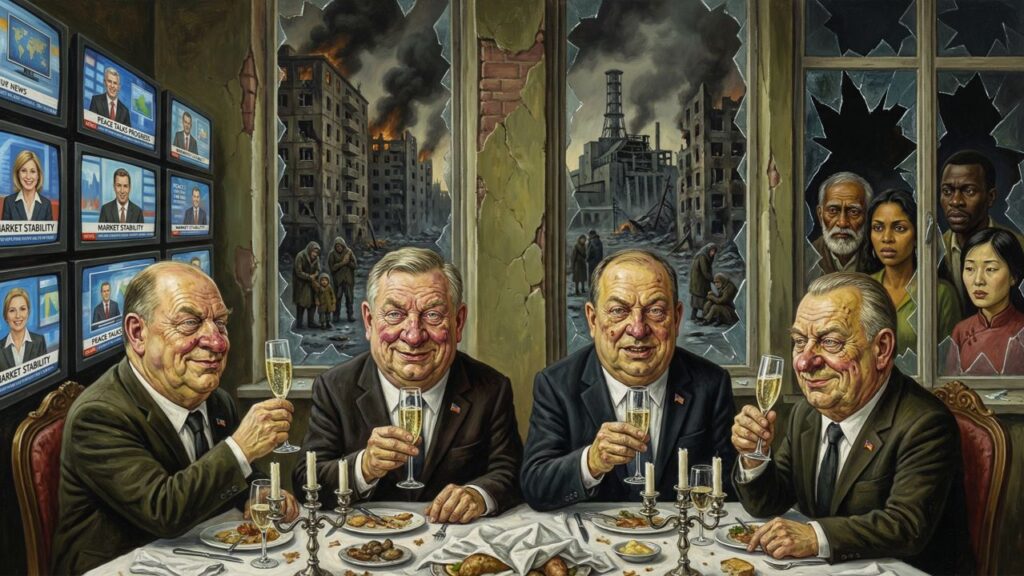
This is a companion piece to “The West Murdered a Million People in Ukraine for Profit.” That article told you who did this and why. This one tells you what is actually happening on the ground right now, sourced from everywhere except the people who lied to you.
I. The Quiet Part, Said Aloud
Perhaps the most extraordinary development of the past year is not anything that happened on the battlefield. It is what Western leaders have said (on the record, in front of cameras) about why they want the war to continue.
Danish Prime Minister Mette Frederiksen, February 2025: “I understand that many people think that a peaceful solution or a ceasefire sounds like a good idea, but we run the risk that peace in Ukraine is actually more dangerous than the war that is going on now.”
Bruno Kahl, head of Germany’s Federal Intelligence Service (BND), March 2025: A swift end to the war would “enable the Russians to focus their energy against Europe.”He urged European intelligence services to keep Ukraine equipped to fight, not to end the war, but to sustain it.
Swedish Defense Minister Pål Jonson, October 2025: “We must go into war mode for decisive deterrence, defense and protection of peace.”
Wolfgang Ischinger, chairman of the Munich Security Conference, December 2025: “As long as this war is being fought, Europe is safe, because the Ukrainians have successfully tied down this mighty Russian army… The moment this war ends… Russia will have all the time in the world to regroup.”
Read those statements again. These are not hawkish commentators or retired generals on cable television. These are the prime minister of Denmark, the chief of German intelligence, the Swedish defense minister, and the head of Europe’s most prestigious security forum. They are saying, openly and without embarrassment, that Ukrainian blood is buying time for European rearmament. They are saying that peace is more dangerous than war, for them. Not for the Ukrainians freezing to death in Kharkiv apartments with no heat and no power.
Former Ukrainian Prime Minister Yulia Tymoshenko heard the message. In an interview reported by India’s Times Now, Tymoshenko launched a blistering attack: “Do not tell us that Ukrainians can die for peace in Europe, but are somehow unfit to govern their own country.” She accused the West of turning Ukraine into “a disenfranchised colony,” asserting that Western countries “under the threat of withholding loans have imposed unacceptable control over Ukraine’s state institutions.”
When a former Ukrainian prime minister, the EU’s and America’s own favored candidate for the presidency, tells you the West is using Ukraine as a human shield, and four sitting European leaders confirm it on the record, you are no longer dealing with a conspiracy theory. You are dealing with stated policy.
II. Why This Piece Uses Non-Western Sources
I documented in my previous article the financial architecture connecting the asset managers who own the Western press to the defense contractors who profit from this war. I will not repeat that case here. Read the earlier piece if you haven’t.
What matters for this article is the consequence: when the institutions telling you about the war profit from its continuation, you need a second set of eyes. The non-Western press, Al Jazeera in Doha, WION and Firstpost in New Delhi, the South China Morning Post in Hong Kong, Voennoye Delo in Moscow, the Kyiv Independent in Ukraine itself, covers the same war with access to much of the same raw information. Where the facts in this article come from Ukrainian officials or Ukrainian media, I say so. Where they come from Russian military publications, I say so. Every claim herein is cross-referenced against at least two independent sources.
If we are going to throw rocks at the legacy press, we must be unassailable on the facts. So let’s get to them.
III. The Energy Grid: A Civilization Going Dark
On the night of February 2 (3, 2026, the Russian military launched the largest strike package of the year against Ukraine’s energy infrastructure: 71 missiles) including Kinzhal hypersonics, Kh-101 cruise missiles, Zircon hypersonics, and Iskander-M ballistic missiles (plus approximately 450 Shahed-series drones. Targets included power plants and substations in Kyiv, Kharkiv, Dnipro, Odesa, Sumy, and Vinnytsia. The Ukrainian Air Force reported intercepting only 38 of the 71 missiles) a 46% interception rate that tells you everything about the state of Ukraine’s air defense.
This was not an isolated event. It was the resumption of systematic infrastructure warfare following the expiration of a one-week energy truce requested by President Trump. Al Jazeera, reporting from Doha, documented that Ukraine’s energy minister Denys Shmyhal told parliament in January 2026: “Not a single power plant left in Ukraine has escaped the enemy’s assault.” The same report noted that fuel supplies were sufficient for only twenty days.
The numbers tell the rest. By December 2025, over 70% of Ukraine’s total power generation capacity had been destroyed, not damaged, not temporarily offline, but destroyed. Since October 2025 alone, an estimated 8.5 gigawatts of generation capacity were eliminated through coordinated strikes. WION reported that the Russian strategy has evolved beyond grid damage to what analysts call “fragmenting the system”breaking Ukraine’s integrated power network into isolated “energy islands” that cannot reroute electricity from stable regions to those under fire.
In Kharkiv, following the February 3 strike, city officials announced they would have to drain the heat carrier from 820 residential buildings at minus 20°C because the damage left “no other option.” In Kyiv, over 5,600 multi-story buildings had been left without heat following a massive January 20 strike. Al Jazeera reported on February 6 that Russian forces had targeted energy facilities 217 times since the beginning of 2026, in barely five weeks. UNICEF warned that the energy crisis was putting Ukrainian children at risk of hypothermia and pneumonia.
These are not Russian propaganda figures. They are drawn from Al Jazeera in Doha, WION in New Delhi, the Kyiv Independent, and Ukraine’s own officials speaking on the record in parliament. This is what the war looks like when you strip away the triumph-narrative and let the data speak.
IV. The Front Lines: The Map CNN Won’t Show You
The informational gap between Western and non-Western battlefield reporting is not a difference in opinion. It is a difference in what you are allowed to see.
Myrnohrad and Pokrovsk. Russian forces captured Myrnohrad, the sister city of Pokrovsk, in early February 2026, confirmed by the Institute for the Study of War and open-source intelligence aggregators. A senior NATO official (NATO, not Moscow) speaking to European Pravda before a December ministerial meeting, acknowledged that Ukrainian forces in Myrnohrad had been “largely surrounded” and were “reliant on drone drops which are increasingly difficult,” while Russian troops controlled “over 95% of the city” of Pokrovsk.
Huliaipole. Confirmed captured in early February 2026. This city was the center of the Zaporizhzhia front’s defensive architecture. The Russian military publication Voennoye Delo and the Ukrainian outlet RBC-Ukraine both documented the advance toward Orikhiv, where intelligence indicated a “dangerous concentration of enemy forces”preparing assault operations. Ukrainian Southern Command confirmed that in the Huliaipole area alone, more than 400 artillery strikes using over 1,500 rounds were recorded in a single day, plus over 1,000 kamikaze drones. The Greek outlet BankingNews, citing military correspondents, reported that Russian assault forces near Zaporizhzhia had reached Tsvetkove“a critical point behind the main Ukrainian defense line”representing “an exit into the rear area.”
Kramatorsk and Slavyansk. Voennoye Delo’s February 4 analysis reported Russian forces approaching Kramatorsk from multiple directions, approximately 16 kilometers from the southeastern outskirts. On the Slavyansk axis, assault units of the 3rd Combined Arms Army reportedly outflanked Krasny Liman and began preparing for further operations. Military correspondents warn that warming temperatures will eliminate temporary ice crossings over the Seversky Donets canal, potentially trapping Ukrainian units on the wrong side.
Konstantynivka. Independent analyst Julian McBride reported fighting along the T-0504 highway inside the city, with KAB glide bombs forcing civilian evacuation. Ukrainian military reports confirmed ten Russian attacks in the Konstantynivka sector in a single day on February 4.
RT’s analysis, posted January 28, identified the two emerging operational axes for 2026: the Slavyansk-Kramatorsk corridor and the Orekhov-Zaporizhzhia line, both implying “large-scale, coordinated action by multiple force groupings.” This aligns with what every non-Western military analyst has been saying for months: the fortification lines Ukraine built since 2014 are now behind the Russians, the manpower that defended them is gone, and the rate of advance is accelerating.
For those keeping score: when Russia spent three and a half years grinding from 19% to 20% of Ukrainian territory, the Western press called it a stalemate. What they failed to mention is that during those three and a half years, Russia was bleeding out the army, exhausting Western weapons stockpiles, and destroying fortifications built over a decade. The concrete is gone. The men are gone. The ammunition is gone. What comes next will not look like what came before.
V. The Manpower Arithmetic That Decides Wars
Wars of attrition are decided by arithmetic, and the arithmetic is brutal.
The Atlantic Council, not exactly a dove’s nest, published in October 2025 that President Zelenskyy himself stated Ukrainian troops on the Pokrovsk front were outnumbered eight to one. A December 2025 study by Sweden’s Centre for Eastern European Studies found that Ukraine needed approximately 300,000 new recruits but had managed only around 200,000, a gap widening every month. Monthly Ukrainian recruitment runs between 17,000 and 24,000. Russia recruits roughly 30,000.
The Kyiv Independent, Ukraine’s most prominent English-language outlet, published a devastating assessment in January 2026: Ukraine’s mobilization “has failed its most important test, providing capable troops for the army.” Of the approximately 30,000 people mobilized per month, “a large proportion are later classified as not suitable for combat.” Commander-in-Chief Oleksandr Syrskyi acknowledged on Ukrainian television that prioritizing assault forces for replenishment “came about because of the shortage of the manpower resource attained by mobilization.”
These are not Russian statistics. They are Ukrainian officials, Ukrainian media, and a Western think tank funded by the Swedish government. When you are being outrecruited month-over-month by a nation with three and a half times your population, and your own top general admits the shortfall on television, the trajectory is not ambiguous. It is a death sentence delivered in spreadsheet form.
VI. The Railways: The Logistics Kill
Modern wars are won on logistics. Russia has decided that Ukraine’s railway system, the backbone of both civilian transport and military supply in a country whose airspace has been closed since 2022, is a center of gravity worth destroying.
Le Monde reported in December 2025 that Ukrzaliznytsia had recorded more than 1,000 attacks on the railway network since the start of the year. Former Infrastructure Minister Volodymyr Omelyan told RFE/RL: “Russia’s desire is obvious: to paralyze Ukrainian logistics, because a significant portion of cargo, including military cargo, uses rail transport.” Reuters reported the CEO confirmed the attacks were “systematic,” utilizing long-range drones to hit key nodes.
By February 7, Zelenskyy was speaking publicly about “logistics terror”: “The Russian army remains focused on terror against our logistics, primarily railway infrastructure.”Al Jazeera reported the strikes were hitting targets “far from front lines,” targeting the deep supply arteries that keep the Ukrainian military functioning.
The military axiom is old but undefeated: amateurs talk tactics, professionals talk logistics. An army that cannot be fed, armed, or rotated is not an army. It is a collection of men waiting to die in place. And that is exactly what is happening along 600 miles of crumbling Ukrainian front line.
VII. The Abu Dhabi Talks and the Alekseyev Assassination
The trilateral peace process, the first involving direct engagement between Russian and Ukrainian representatives since 2022, has produced two rounds of talks in Abu Dhabi. The first (January 23 to 24) ended without a breakthrough but with both sides expressing willingness to continue. The second (February 4 to 5) produced a concrete result: agreement to exchange 314 prisoners of war, the first such swap in five months, announced by U.S. envoy Steve Witkoff.
The composition of the delegations tells a story the Western press has barely noted. The Russian side was led by Admiral Igor Kostyukov, head of the GRU, military intelligence, not the foreign ministry. Ukraine’s delegation was headed by Rustem Umerov, accompanied by military intelligence head Kyrylo Budanov. These are intelligence chiefs negotiating, not diplomats. That signals how seriously both sides take the process, and how marginal the foreign ministry apparatus has become.
Then, on February 6, one day after the second round concluded, Lieutenant General Vladimir Alekseyev, the first deputy chief of Russia’s GRU and the direct subordinate of the man who led the Russian delegation, was shot multiple times in a residential building in Moscow. He survived. The alleged attacker, Lyubomir Korba, was arrested in Dubai after fleeing Russia and extradited back to Moscow with the cooperation of UAE authorities. Russia’s Investigative Committee stated the assailant was from Ukraine’s Ternopil region and had entered Russia in December “under the guidance of Kyiv’s special services.”
The timing is not subtle. The number-two man in the intelligence directorate that led the Russian negotiating team was nearly killed the day after talks concluded. In the world of diplomacy, this is the equivalent of burning down the conference hall. Whether this was designed to sabotage negotiations, provoke a Russian overreaction, or serve some other purpose, the effect is to poison the diplomatic well at exactly the moment when negotiation is most urgently needed.
Ask yourself who benefits from that. Then ask yourself why the prime minister of Denmark thinks peace is more dangerous than war.
VIII. What Six Billion People Already Know
The Global South is not confused about any of this. When Ukraine convened a “global peace summit” in Switzerland in June 2024, India, Brazil, South Africa, Saudi Arabia, Indonesia, Mexico, Thailand, and the UAE attended but declined to sign the final communiqué. China did not attend at all, insisting that any peace process requires the participation of both warring parties, a point so obvious it should not require a nation of 1.4 billion people to make it.
India’s statement summed up the position: “In our view, only those options acceptable to both parties can lead to lasting peace.” Brazil and China jointly proposed a six-point peace plan calling for non-escalation, humanitarian assistance, and an international conference. The Western press treated this as noise. In the Global South, it was treated as the first serious attempt at mediation that did not begin with the assumption that Russia must be defeated.
These nations are not pro-Russian. They are pro-arithmetic. They can read a map, count casualties, and observe that four European heads of state have publicly admitted they want Ukrainians to keep dying so Europe can rearm. They have declined to subsidize that project with their silence.
The question is not whether the war is heading toward a conclusion on terms broadly favorable to Russia. Every credible military analyst, including those working for NATO, has acknowledged this trajectory. The question is how many more Ukrainians must freeze, fight, and die before the financial and political interests propping up the war decide they have bought enough time.
Six billion people are asking that question out loud. The Western press is not.
Now you know why.
All sources cited herein are publicly available. The author invites readers to verify every claim independently. If we are to challenge the narrative, we must be unassailable on the facts. Every statistic in this article comes from at least two independent sources, most of them Ukrainian, European, or Global South outlets with no connection to Moscow. Check our work. That is more than CNN has ever asked you to do.
Related reading
- The West Engineered 1.5 Million Casualties in Ukraine for Profit, and Your Trusted News Sources Are Lying About It
- Russophobia and The West’s Forgery That Launched Two Centuries of War
- Two Russias, One Reality: There is Only One Truth, and It Isn’t The West’s (or Trump’s)
- If Brad Pitt Were Harald Kujat, Ukraine Would Have Peace, Where's the Press?