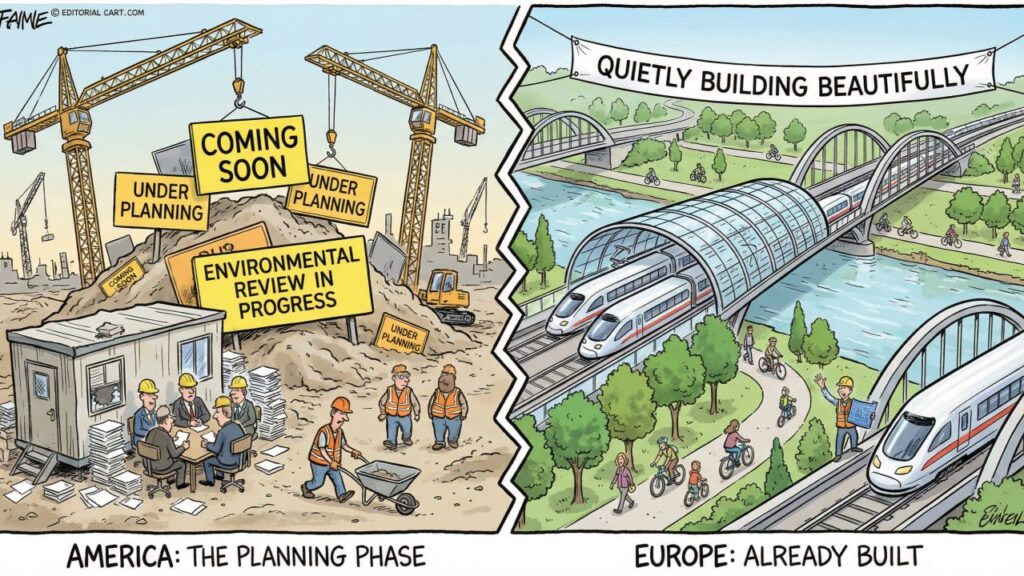
Continuing my theme about what my wife and I noticed in Europe… We observed infrastructure projects, city planning, and the pace at which things actually get built. And we noticed something that would have been comical if it weren’t so infuriating: the complete inversion of the narrative we’re told about European capability and American competence.
In America, we hear endless announcements about grand projects. Second Avenue Subway in New York has been “coming soon” for so long that multiple generations have been born, grown old, and died waiting for it. California’s high-speed rail project, once promised to revolutionize transportation on the West Coast, has become a cautionary tale of delays, cost overruns, and political dysfunction. We hear about affordable housing initiatives that never materialize, transit systems that get perpetually redesigned by committee, infrastructure projects that exist more in PowerPoint presentations than in physical reality. The announcements are grand. The actual construction is minimal.
Meanwhile, in Europe, things simply get built.
In Rome, the traffic to the Vatican was creating chaos in the historic center. So they diverted it underground. Not talked about it. Not commissioned studies about it. Not held public hearings that devolved into political theater. They built it. And in doing so, they created perhaps the most beautiful pedestrian promenade in the world, a space that flows naturally from the city into St. Peter’s Square without the intrusion of automobiles. This wasn’t a decades-long project. It happened in a few short years.
Consider the examples more broadly. The expansion of the Paris Metro continues methodically. New stations get built, new lines get extended, the system grows. The Barcelona Metro expanded significantly over the past two decades. Berlin’s U-Bahn and S-Bahn systems remain models of efficiency and continuous improvement. In Copenhagen, the Metro was completed in phases and works beautifully. In Amsterdam, the tram system is the envy of urban planners worldwide.
Meanwhile, New York’s Second Avenue Subway, first proposed in 1929, is still incomplete. The project was supposed to be finished decades ago. The costs have ballooned beyond reason. Political infighting has been relentless. The same pattern repeats: announcement, delay, redesign, budget increase, political conflict, another delay. The project becomes a symbol not of American engineering prowess but of our collective inability to execute.
Or consider California’s high-speed rail. The vision was compelling: trains connecting major cities, fast and efficient, reducing traffic and emissions. The announcements were made with great fanfare. Politicians held press conferences. The project was going to transform the state. Years and billions of dollars later, very little track has been laid. The project exists primarily in a state of perpetual planning, with cost estimates that seem to increase with each budget cycle and timelines that keep getting pushed back.
It’s not isolated incidents either. The Gateway Project connecting New York and New Jersey keeps getting delayed. The Second Lake Tunnel project in Los Angeles keeps getting redesigned. Infrastructure projects across America seem to exist in a state of arrested development, announced with great confidence, delayed indefinitely, and ultimately scaled back to something barely recognizable from the original vision.
In Europe, you see the opposite pattern. Projects get announced. They get planned carefully, yes, but not endlessly. Construction begins. It continues. It gets completed. The tram lines in multiple European cities were expanded while America was still holding meetings about whether to build a subway extension.
This is where my observation becomes strange and troubling. The American press, the very institutions that tell us about all these failed projects and delayed dreams, simultaneously tells us that Europe is the failing civilization. Europe can’t get anything done, we’re told. European economies are stagnant. European systems are antiquated. Europe is declining. This narrative is constant.
And who is promoting this narrative most vigorously? Often the same people and institutions who benefit from American dysfunction. Jamie Dimon and Wall Street banks profit from infrastructure that doesn’t get built because companies they own can extract more value from congestion and chaos. Energy companies benefit from transportation systems that don’t work because people remain car-dependent. Construction companies benefit from endless planning phases and redesigns because they can bill for studies and consultations indefinitely.
There’s a strange alignment between the American business elite, the people who are making enormous amounts of money from our systemic failures, and the media outlets that tell us we’re superior to Europe. It’s not coincidental. It’s structural.
The why of this is multifaceted and troubling. First, there’s the obvious: money and power. If Europe appears to be failing, then American systems appear superior, and those who profit from American dysfunction remain secure in their positions. The narrative protects the status quo.
Second, there’s the matter of complexity and accountability. When a European city government decides to build a metro extension, there’s a clear chain of responsibility. A mayor, a city council, engineers, and contractors execute the project. If it fails, people know who to blame. Accountability is relatively straightforward.
In America, we’ve created a system of such labyrinthine complexity, with federal, state, and local governments all claiming jurisdiction, with environmental reviews that take longer than the actual construction would, with community boards and civic organizations that can delay projects indefinitely, with lawyers ready to sue at every stage, that responsibility becomes diffuse. When nothing gets done, no one is clearly responsible. The blame gets distributed so widely that it becomes meaningless.
Third, and perhaps most troubling, there’s the ideological component. There’s a strain in American thought that distrusts government’s ability to do anything efficiently. This distrust is often justified, government does fail regularly, but the solution proposed (privatization, deregulation, less government involvement) often creates different problems. Meanwhile, European governments, despite their own inefficiencies, operate with the assumption that certain things (transportation, healthcare, basic infrastructure) are public goods that should be managed collectively. Whether you agree with that philosophy or not, it produces functioning systems.
The irony is nearly unbearable. We’re told that Europe is declining while Europe builds beautiful, functioning transit systems. We’re told that Europe can’t execute while European cities systematically improve their infrastructure. We’re told that America is superior while American cities remain gridlocked, American transit systems crumble, and American infrastructure projects exist primarily in the realm of rhetoric.
The press amplifies this inversion relentlessly. The same outlets that report on California’s rail project failures turn around and tell us that European economies are stagnant. The same commentators who cover New York’s endless subway delays simultaneously insist that Europe is falling behind.
It’s not incompetence. It’s not accidental. It’s a carefully maintained narrative that serves powerful interests. And like most carefully maintained narratives, it requires constant reinforcement because it contradicts observable reality.
All you have to do is look. The Vatican’s beautiful new pedestrian promenade exists. The expanded Paris Metro exists. The Copenhagen Metro works. And Second Avenue Subway remains a dream from 1929.
That’s the story the press won’t tell you. That’s the observation that troubles me most.
Related reading
- Europe’s Private Credit Market Is Unsupervised and Untested
- Europe’s Sleepwalk Toward a Bigger War: Why Real Peace in Ukraine Requires a Pan‑European Settlement With Russia, Not Another Cosmetic Ceasefire
- The Climate Hoax, Europe's Industrial Base Was Dismantled Before the World's Eyes, While the Press Said Nothing
- From Peace Marchers to War Profiteers: How Europe's Left-Green Establishment Betrayed Everything It Claimed to Stand For, And Why Five Countries Refuse