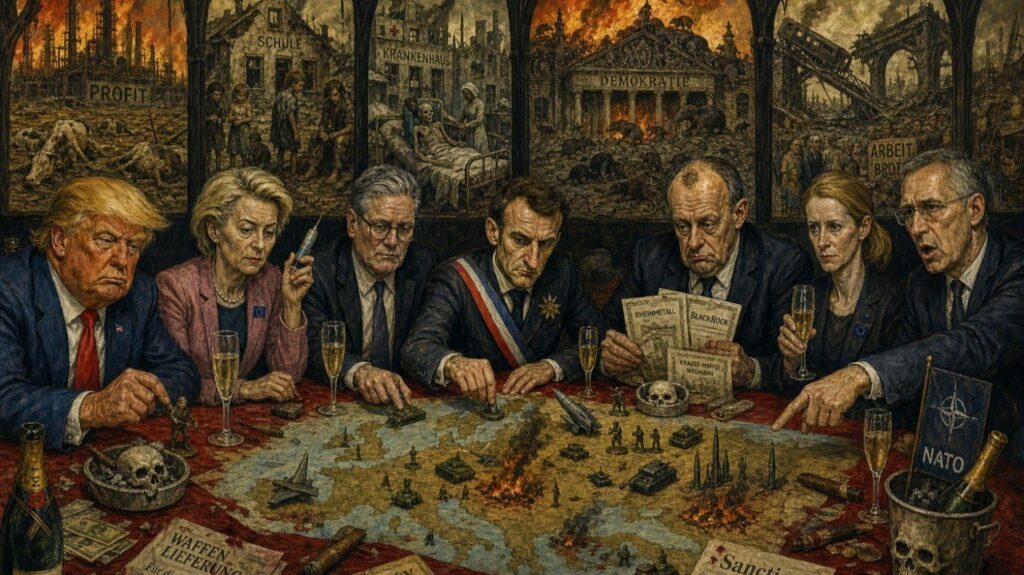
Where are the adults? This is what happens when voters don’t manage their politicians.

By Scott Ortkiese | July 7, 2026 | so@throughlinesynthesis.com
Abstract
The governments of the United States, United Kingdom, and European Union present themselves to the world as the guardians of democracy, the rule of law, and the liberal international order. In 2026, the evidence record of their actions tells a different story: a story of manufactured threats, assassinated foreign officials, kidnapped heads of state, killed peace agreements, weaponized financial systems, destroyed supply chains, and populations whose expressed desire for peace has been systematically ignored. This paper examines that evidence record from the vantage point of the countries targeted, the populations harmed, and the global economy now absorbing the consequences. It names the individuals responsible, traces the financial architecture that keeps them insulated from accountability, and asks the question that the Western media apparatus will not: who is actually threatening whom?
I. What It Looks Like From the Other Side
Open the American press on any given morning in 2026. You will read that Russia is an aggressor, China is a threat, Iran was a state sponsor of terrorism, Venezuela was a narco-dictatorship, and Cuba is a rogue regime harboring enemies of civilization. You will read this not occasionally, not as one perspective among several, but uniformly, in every major outlet, from every authorized commentator, with a consistency of tone and vocabulary that would be recognizable as state propaganda if it were produced by any government the Western press is permitted to criticize.
From Moscow, the picture looks like this: a military alliance that solemnly promised not to expand eastward has expanded through fourteen countries to Russia’s border, installed a government in Kiev after removing an elected one, armed and trained a large proxy military for eight years, deliberately sabotaged two diplomatic frameworks that could have ended the conflict, and is now publicly declaring on a four-year timeline that it intends to fight. The people calling this posture “defensive” are the people who designed it.
From Beijing, the picture looks like this: a country that built its modern economy through precisely the kind of state-directed industrial policy now condemned as unfair competition is being subjected to technology bans, supply chain decoupling, and financial containment, not because it has threatened the United States militarily, but because it has become too competitive economically to be tolerated. The “rules-based international order” applies to everyone except the country that wrote the rules.
From Tehran, the picture looks like this: a country that negotiated a binding nuclear agreement with six world powers, honored every provision of that agreement as certified by international inspectors, and was then subjected to the unilateral destruction of that agreement and three years of “maximum pressure” sanctions that shrank its economy by 30% and impoverished 85 million people, before being bombed and having its head of state assassinated in February 2026. The stated justification shifted three times during the bombing campaign itself, from nuclear disarmament to regime change and back again.
From Caracas, the picture looks like this: on January 3, 2026, American Delta Force soldiers landed by helicopter at 2 AM, stormed the presidential residence, dragged the elected president of Venezuela from his bedroom while he slept, and flew him in his pajamas to a detention facility in New York. Trump announced from Mar-a-Lago that the United States would “run” Venezuela and that its oil, in his words, should have been taken “a long time ago.” This is the democratic values agenda at its most undisguised.
From Havana, the picture looks like this: a country subjected to sixty years of economic blockade, four hundred and forty Trump-era sanctions imposed since January 2026, the interception of oil tankers, a CIA director visiting in person to deliver an ultimatum demanding the severing of all ties with Russia and China, and the open preparation of a second Maduro-style extraction operation targeting Raul Castro. The charge is “sponsoring terrorism.” The evidence for this charge is that Cuba maintains diplomatic and security relationships with countries the United States has also decided to punish.
These are not propaganda narratives. Every claim in the preceding paragraphs is documented, confirmed by primary sources, and verifiable by any scholar in this room. The propaganda narrative, the one that requires sustained institutional effort to maintain, is the one running in the opposite direction.
II. Ukraine: The War That Was Engineered, the Peace That Was Murdered
To understand Ukraine in 2026, you must begin not in February 2022 but in February 2014, and you must begin not with Vladimir Putin but with Victoria Nuland.
Nuland was the Assistant Secretary of State for European and Eurasian Affairs under Barack Obama and the architect of American policy in Ukraine during the critical years of 2013 to 2014. She is also the wife of Robert Kagan, the co-founder of the Project for the New American Century, the neoconservative think tank whose 1997 founding statement called for American global military dominance and whose 2000 report, “Rebuilding America’s Defenses,” named the elimination of hostile states in the Middle East, including Iran, as a primary objective. Their marriage is not a biographical detail. It is a map of the intellectual and institutional network that designed the current catastrophe.
In February 2014, a leaked phone call captured Nuland speaking with US Ambassador Geoffrey Pyatt about which Ukrainian opposition figures should lead the government after the removal of the elected president Viktor Yanukovych. “I don’t think Klitschko should go into the government,” she said. “I don’t think it’s necessary, I don’t think it’s a good idea.” On the European Union’s objections to Washington’s management of the crisis, she was precise: “Fuck the EU.” Yanukovych was removed weeks later. Nuland’s preferred candidate, Arseniy Yatsenyuk, became prime minister. The Western press called it a democratic revolution. Moscow called it a coup. The intercepted phone call, in which the Assistant Secretary of State for European Affairs was selecting the next Ukrainian government, suggests Moscow had the more accurate description.
What followed was eight years of low-intensity war in the Donbas, two sets of diplomatic agreements designed never to be honored, and a steady buildup of the Ukrainian military toward the confrontation that Washington and its partners had decided was inevitable.
In 2019, the RAND Corporation, commissioned by the United States Army, published a study titled “Extending Russia: Competing from Advantageous Ground.” The document analyzed methods to force Russia to overextend its resources. Among the options explicitly studied was “providing lethal aid to Ukraine,” assessed as capable of increasing costs to Russia and exploiting its vulnerabilities. This document was not secret. It was a publicly available US Army-sponsored strategy paper. The people who subsequently called Russia’s February 2022 invasion “unprovoked” had access to a document describing the deliberate strategy of provoking it.
The Minsk diplomatic framework, signed in 2015 and guaranteed by France and Germany, was supposed to provide a political settlement for the Donbas conflict. In December 2022, former German Chancellor Angela Merkel admitted in an interview with Die Zeit that the agreement “was an attempt to give Ukraine time.” She continued: “Ukraine used this time to become stronger, as you can see today.” Former French President Francois Hollande confirmed it separately, describing the Minsk accords as having given the Ukrainian army “this opportunity” to develop its capabilities. Former Ukrainian President Petro Poroshenko had already stated in November 2022 that “we needed these Minsk Accords to get at least four years to form the Ukrainian Armed Forces.”
Three heads of state confirmed that the diplomatic framework presented to Moscow as a genuine peace effort was, in their private understanding, a deliberate deception. Russia was negotiating in good faith with signatories who had agreed, among themselves, never to honor what they were signing. This is not a Russian characterization of events. It is the public confession of the parties who perpetrated it.
When Russia invaded in February 2022, peace was still available. Ukrainian and Russian negotiators met in Istanbul in late March and reached a framework agreement. Russia offered Ukrainian neutrality and withdrawal from occupied territories. The head of the Ukrainian negotiating team, David Arakhamia, later confirmed that the deal was within reach. Then Boris Johnson arrived in Kiev on April 9, 2022. In Arakhamia’s own words: “Boris Johnson came to Kiev and said that we would not sign anything with them at all, and let’s just fight.” Turkey’s Foreign Minister Mevlut Cavusoglu stated publicly that after a NATO meeting, “there are those within the NATO member states that want the war to continue.” Former Israeli Prime Minister Naftali Bennett, who had been personally mediating, confirmed that the West chose to “continue to strike Putin” rather than accept the deal. Victoria Nuland, in a 2024 interview, confirmed that Western governments advised Ukraine against the proposed agreement.
Johnson has denied it. His denial stands alone against the contemporaneous confirmation of four independent parties who were present. In the four years that followed the death of the Istanbul agreement, hundreds of thousands of people died. Konstantinovka, the gateway to Ukrainian-controlled Donbas, fell to Russian forces in July 2026. Russia’s chief negotiator Vladimir Medinsky noted that Moscow’s terms in 2022 “would have been less harsh than what we’re offering today.” They are now offering nothing at all.
The population most directly affected by this decision is the Ukrainian population, and that population has made its position clear. A 2026 opinion survey found that 66% of Ukrainian citizens wanted immediate peace negotiations to begin. That preference was not represented by their government, which issued a decree in autumn 2022 forbidding any Ukrainian official from conducting negotiations with Russia. The decree was not an autonomous decision. According to the same officials who confirmed the Istanbul sabotage, it reflected Western policy preferences.
Meanwhile, the European Union has moved from proxy management to open preparation. France, Germany, and the United Kingdom have declared publicly that Europe must be “ready” to confront Russia by 2030. This is not contingency planning. It is a published temporal commitment to war against the world’s largest nuclear power, announced while that power is engaged in active combat operations and has stated explicitly that it views the entire project as an existential threat. Germany’s appeal for volunteers drew 500 responses from 200,000 invitations. British army recruitment is falling. The publics of Europe do not want this war. The governing class has decided to pursue it anyway.
III. Iran: The Thirty-Year Project Reaches Its Conclusion
The 2026 war with Iran was not a response to a sudden crisis. It was the culmination of a project announced in 1997 when Robert Kagan and William Kristol co-founded the Project for the New American Century. PNAC’s founding statement called for American global military leadership. Its 2000 report was explicit: Iraq was the first target, Iran was the ultimate one. The neoconservative network that designed the Iraq War always understood it as stage one.
The intervening 26 years were a sustained campaign of pressure, sabotage, and preparation. The 2018 withdrawal from the JCPOA by John Bolton and Mike Pompeo, over the objections of every other signatory, over the objections of American allies, over the objections of international inspectors who had certified Iranian compliance, destroyed the only diplomatic framework that had successfully frozen Iran’s nuclear program. The subsequent “maximum pressure” campaign shrank the Iranian economy by an estimated 30%, drove inflation above 40%, and impoverished tens of millions of people who had no role in any decision their government had made.
On February 28, 2026, the United States and Israel launched Operation Epic Fury: more than 900 strikes in the first 12 hours. Supreme Leader Ali Khamenei was killed. The White House characterized it as “crushing the Iranian threat” and enumerated 13,000 targets struck over 38 days. The operation cost an estimated $11.3 billion in its first six days alone, with total costs approaching $45 billion in the first month, against an annual deficit already exceeding $1.853 trillion.
Iran did not capitulate. Iran closed the Strait of Hormuz, through which 20% of global oil supply and 25% of global LNG transits. Iran struck American bases across the region. Iran then struck the Ras Laffan gas complex in Qatar, a single strike sufficient to force Trump to halt the bombing campaign. The ceasefire that followed was not a victory. Iran retained control of the Strait. Saudi Arabia publicly characterized the US and Israel as the aggressors. American credibility with every regional partner collapsed. American air defense systems were degraded. The consensus assessment from CSIS, the Council on Foreign Relations, and the Soufan Centre was that the US achieved tactical damage but could not reach underground infrastructure, eliminate the Strait threat, or produce the political outcome it sought.
Robert Kagan, the man who designed the 1997 project that produced this outcome, published a piece in The Atlantic titled “Checkmate in Iran.” In it, he admitted that Iran would now be able to “demand tolls for passage through the Strait,” that America “cannot project power into the Gulf,” and that Taiwan, Japan, South Korea, and NATO allies must now question whether American military guarantees are real. His proposed solution was a generational occupation of Iran. This is not strategy. It is the confession of a man who has been wrong about every major military question for thirty years, who has suffered no professional consequence for being wrong, and who therefore cannot stop generating the same answer.
The people of Iran, 85 million of them, were never consulted. They absorbed thirty years of sanctions, watched their currency collapse, lived through maximum pressure, and then endured 38 days of bombing because Robert Kagan and his network decided in 1997 that their government needed to be changed. The democratic values agenda had nothing to say about any of this.
IV. Venezuela, Cuba, and the Open Face of the Monroe Doctrine
On January 3, 2026, at 2 AM, American Delta Force soldiers landed by helicopter at the presidential residence in Caracas and dragged Venezuela’s elected president Nicolas Maduro from his bedroom while he slept. He was flown to New York in American custody. Trump announced that the US would “run” Venezuela and that its oil should have been taken “a long time ago.”
The legal basis for this operation was a 2020 Department of Justice indictment on narco-terrorism charges, filed during Trump’s first term and used to construct a $50 million bounty on a sitting foreign head of state. The CIA had been operating inside Venezuela for years prior to the operation, recruiting informants, mapping Maduro’s routines, and preparing the conditions for the raid. Congress was not informed before the operation. Trump explained that he could not tell Congress because Congress “has a tendency to leak.”
Russia condemned it as “armed aggression.” Iran condemned it as a violation of Venezuelan sovereignty and the UN Charter. Cuba condemned it as a “criminal act.” The European Commission called for “a peaceful and democratic transition” consistent with international law, a formulation that carefully avoided acknowledging that a sitting head of state had just been abducted from his home by a foreign military.
Cuba is next. Since January 2026, the Trump administration has imposed more than 240 sanctions against Cuba, signed two executive orders, intercepted seven oil tankers, and sent CIA Director John Ratcliffe to Havana to deliver a personal ultimatum: sever all security ties with Russia and China. The Chatham House analysis of May 2026 noted that Trump had threatened to attack Cuba “shortly after” the Venezuela operation, a threat that his administration subsequently operationalized through economic pressure designed to replicate the conditions that preceded the Maduro capture.
The oil blockade imposed against Cuba has ended the discounted Venezuelan oil supply that kept the island economy functioning, producing daily blackouts and the collapse of basic services. A country of 11 million people is being subjected to economic strangulation because its government maintains diplomatic and security relationships with countries the United States has decided to punish. The stated charge is sponsoring terrorism. The actual charge, the one never stated publicly, is refusing to subordinate its sovereignty to Washington’s preferences.
These are not isolated events. They are a pattern. Panama in 1989. Iraq in 2003. Libya in 2011. Syria from 2011 onward. Venezuela in 2026. Iran in 2026. Cuba in preparation. The pattern has a consistent structure: identify a government that refuses to align with American economic or strategic interests, label its leader a criminal, impose sanctions, fund internal opposition, and eventually remove the government by force. The democratic values framing is applied after the fact, like paint over rust.
V. The Class That Designs the Wars and Never Fights Them
The individuals responsible for this pattern are not difficult to identify. They constitute an interlocking network of think tanks, government appointments, media platforms, and defense industry relationships that has remained functionally intact across six presidential administrations, regardless of which party held the White House.
Robert Kagan co-founded the Project for the New American Century in 1997 with William Kristol. PNAC’s signatories included Dick Cheney, Donald Rumsfeld, and Paul Wolfowitz. Kagan subsequently became a senior fellow at the Brookings Institution, where he has continued to produce the intellectual justification for military confrontation, most recently admitting in The Atlantic that the Iran project he designed has failed while proposing its continuation in a different form. His wife Victoria Nuland served as the architect of the 2014 Ukraine intervention, then returned to government as Under Secretary of State for Political Affairs under Biden, then transitioned through the Albright Stonebridge Group before the Biden administration ended. His brother Frederick Kagan is a resident scholar at the American Enterprise Institute, where he produces military assessments that consistently support escalation. Frederick’s wife Kimberly Kagan runs the Institute for the Study of War, which has provided daily analysis of the Ukraine conflict consistently framed to support continued Western intervention.
This is one family. It spans five major foreign policy institutions. It has advised or directly served in multiple administrations. It has been consequentially wrong about Iraq, Libya, Syria, Ukraine, and Iran. Not one member of this family has faced a professional consequence proportionate to the human cost of their errors. Robert Kagan publishes in The Atlantic. Kimberly Kagan testifies before Congress. The Institute for the Study of War receives continued philanthropic and defense industry funding. The selection mechanism that produces and sustains this class is not conspiracy. It is the straightforward operation of financial incentive: the institutions that fund this network have a material interest in the conclusions it produces, and they continue funding it because it continues producing those conclusions.
The Henry Jackson Society in London, funded substantially by defense industry donors and allied foundations, provided the intellectual infrastructure for Britain’s aggressive Ukraine and Iran postures. The Atlantic Council, whose board includes defense industry executives, has been among the most consistent advocates for escalation across every theater. These institutions are not neutral analytical bodies. They are advocacy organizations with financial stakes in the policies they recommend. They are treated by governments and media as the authoritative source of expert opinion on whether those policies should be pursued. The circularity is total.
The revolving door makes the incentive structure explicit. Officials who produce the desired policy conclusions rotate from government to contractor to think tank and back. They are promoted, published, and invited to testify regardless of their track record. The analysts who correctly predicted the outcome of Iraq in 2003, of Libya in 2011, of Ukraine escalation in 2022, and of the Iran operation in 2026 were excluded from mainstream platforms. The analysts who provided wrong analysis in the service of correct institutional conclusions retained their positions and their access. Over time, the analytical ecosystem shifted accordingly. The expertise that could have corrected the policy was removed from the policy process.
VI. The Democratic Fraud
The deepest dishonesty of the Western posture is not the manufactured threats, the killed peace deals, or the kidnapped presidents. It is the claim that any of this represents the will of the people it supposedly defends.
American public opinion has opposed foreign military adventurism consistently for twenty years. A CBS News poll in March 2026 found Trump’s approval among his own 2024 voters down six points after the Iran operation, with support among independents collapsing to 22%. German military appeals drew 500 volunteers from 200,000 invitations. British army recruitment has fallen during years of war rhetoric. Thousands marched across The Hague, Turin, Geneva, Lisbon, and cities across Spain in March and April 2026 against the war in Iran and the European rearmament drive, demanding that defense budgets be redirected to healthcare, housing, and social services.
The populations of the Western democracies have been expressing their preferences through every available channel. They elect governments that promise peace and receive war. They vote for candidates who denounce foreign adventurism and watch them continue it. They march in the streets and are ignored. They are polled at 66% in favor of negotiations and their governments issue decrees forbidding negotiations. The democratic values these governments export at gunpoint are not practiced at home.
Trump’s fiscal year 2027 budget requested $1.5 trillion for defense, a 66% increase over the $901 billion authorized for 2026, the largest peacetime military budget in American history, larger than the peak of the Cold War as a share of discretionary spending. Simultaneously, the budget proposed a 10% cut to all non-defense federal programs, a 52% cut to the Environmental Protection Agency, a 23% cut to NASA, reductions to the Department of Health and Human Services, and the implicit acceptance of Social Security insolvency within the decade. Trump said publicly at a private White House event that America could no longer afford daycare, Medicaid, or Medicare because “we’re fighting wars.”
The national debt stands at $39 trillion and is growing at $1.853 trillion annually. Taxpayers pay nearly $1 trillion per year in interest alone. The Committee for a Responsible Federal Budget projects the proposed defense buildup would add $5.8 trillion to the national debt, including interest, over the next decade. Moody’s explicitly warned that the proposed increase “would exacerbate the already large U.S. fiscal deficits, increase the interest obligations over time, and further constrain fiscal flexibility.” Federal Reserve Chair Jerome Powell said in a public address at Harvard: “It will not end well if we don’t do something fairly soon.”
Johns Hopkins economist Steve Hanke put it plainly: “MAGA was told an untruth by Trump: no foreign wars, no adventurism. This is a massive militarization, completely the opposite of what he told his base.” The base was told one thing. The money said another. The money won.
VII. The Petrodollar, the Sanction, and the Theft Dressed as Policy
The honest description of the Western sanctions regime is not “economic pressure in defense of international norms.” It is financial coercion deployed to protect the structural advantage that Western financial architecture confers on its operators, and to punish countries that attempt to trade in any other terms.
The petrodollar system, established by the Nixon administration after the 1971 decoupling of the dollar from gold, requires that global oil trades be denominated in US dollars. This single structural fact compels every oil-importing nation on earth to maintain large dollar reserves, which they do by purchasing US Treasury bonds, which in turn finances American deficit spending at artificially low interest rates. The system is a tax on the entire global economy, paid to Washington, which has operated invisibly for fifty years because the alternative never existed at sufficient scale.
It exists now. Russia has redirected its energy exports east, primarily to India and China, settling trade in rubles, yuan, and rupees. The BRICS payment infrastructure, expanded after 2022, is building the alternative settlement system that Western sanctions policy accelerated into existence. Iran has been developing alternative payment channels for twenty years, forced by sanctions to find them. Venezuela’s oil is being managed by whoever Washington installs. Cuba is being strangled for buying it.
The resource dimension of these interventions is never discussed in the Western press. Iraq had the world’s second-largest proven oil reserves. Libya had the largest reserves in Africa. Venezuela has the largest proven oil reserves on earth. Iran has the fourth-largest natural gas reserves and third-largest oil reserves. Trump said out loud about Venezuela that its oil should have been taken “a long time ago” and that the US would take it as “reimbursement for damages.” The mask slipped. The language was precise. The project was not democracy promotion. It was resource capture.
The trade war dimension extends the same logic beyond energy. Tariffs of 25% on Canada and Mexico, the two largest US trading partners, imposed without economic impact assessment, have been projected by the OECD to reduce Mexican economic growth by 1.3% and Canadian growth to 0.7%, while increasing inflation across all three countries. American households face an estimated $1,600 cost from the tariff regime. Canada and Mexico absorb the larger economic damage. The supply chains built over decades of integrated North American production, representing over $1.5 trillion in annual trade, are being dismantled to serve domestic political messaging.
South Korea, Japan, Taiwan, India, and the ASEAN economies have watched the destruction of American reliability in real time. American credibility with every regional ally collapsed measurably after Operation Epic Fury failed to produce the promised outcome. The Pacific alliance architecture, built on the assumption that American military guarantees are real and American financial behavior is predictable, is now being quietly repriced by every sovereign wealth manager and national security planner.
VIII. The Silence of Labor, the Disruption of AI, and the Coming Reckoning
The peace movement in 2026 exists and is growing. Hundreds marched in The Hague on Easter weekend against the war economy, carrying banners that read “cut defense spending and invest in society.” Thousands marched across Spain, Italy, Switzerland, and Portugal against the Iran war and European rearmament. Anti-war demonstrations appeared at British air force bases as American bombers departed for Iranian targets.
But the organized labor movement, historically the most reliable institutional counterweight to military adventurism, has been largely absent from this moment. The reasons are structural. Labor has been weakened by four decades of deindustrialization, the offshoring of manufacturing to lower-wage economies, and the legal erosion of collective bargaining rights in every major Western economy. What remains of organized labor is primarily public sector workers whose employers are the same governments now building the war economy. The structural conflict of interest is total.
Into this landscape arrives a disruption that dwarfs the military question in its long-term consequences: artificial intelligence. In the United States in 2026, the tech and finance sectors are losing 28,000 jobs per month to AI adoption, the fastest and most concentrated labor market disruption recorded in those sectors. The financial activities sector, where office and administrative support roles account for 25% of employment, is described by analysts as “the next big sector most affected.” Challenger, Gray and Christmas has tracked nearly 102,000 announced job cuts attributed to AI in 2026 alone.
Since 2022, the IMF has noted that sectors with rapid AI adoption account for roughly a third of fluctuations in unemployment in the United States. Reuters Breakingviews identified a potential “intelligence crisis” anticipated by 2028, in which widespread displacement of white-collar workers reduces consumer spending sufficiently to create cascading profit collapse across sectors. The Federal Reserve has maintained high interest rates to contain inflation while AI-driven unemployment pressure builds in the sectors it is hitting hardest. The fiscal and monetary policy framework has no answer to this combination.
Governments are spending the money that would fund the retraining, the social safety nets, and the structural adjustment required to manage this transition on weapons, instead. The $1.5 trillion military budget request leaves Social Security on track toward insolvency within the decade. The populations being displaced by AI will find neither the income support of a functioning welfare state nor the employment alternative of a strong labor market. They will find a government that is spending their money on missiles and telling them it is keeping them safe.
The Citrini Research “intelligence crisis” scenario, in which mass white-collar displacement reduces consumer spending, triggering broad-based profit collapse, is not a fringe prediction. It is the logical endpoint of deploying AI as a cost-cutting instrument in a consumer-demand-driven economy without any compensating fiscal transfer. The governing class is not discussing this. It is too busy preparing for the 2030 war with Russia.
IX. Who Is Threatening Whom
Let the record speak plainly.
Russia invaded Ukraine in February 2022, after eight years of documented warnings that NATO encirclement would produce exactly that response, after the deliberate sabotage of the Minsk diplomatic framework by the parties who signed it, after the RAND Corporation published a US Army-sponsored document proposing to use Ukraine to “extend Russia,” and after a peace deal was killed in Istanbul by Western pressure. The invasion was not justified. The conditions for the invasion were deliberately manufactured.
Iran was attacked by Israel and the United States in February 2026, after three years of maximum pressure sanctions destroyed the Iranian economy, after the unilateral withdrawal from the JCPOA eliminated the last diplomatic framework, and after years of targeted assassinations of Iranian military and scientific figures. Iran’s response, which closed the Strait of Hormuz and struck an American ally’s gas infrastructure, produced conditions sufficient to end the bombing campaign. The country that was “defending itself” turned out not to be the United States.
Venezuela was invaded on January 3, 2026, without congressional authorization, without UN mandate, without any imminent threat to the United States. Its president was abducted from his bedroom by the Delta Force. Trump announced the United States would run the country and take its oil. No Western government called this what it was.
Cuba is being subjected to economic strangulation for maintaining diplomatic relationships with countries the United States dislikes. The CIA director visited Havana to deliver an ultimatum. An extraction operation for Raul Castro is in preparation. Cuba has not attacked the United States. It has not threatened the United States. It has not built nuclear weapons. It has insisted on the right to decide its own trading relationships.
China has not attacked any of its neighbors in 2026. It has built infrastructure across the developing world, offered financing without the conditionality that the IMF and World Bank impose in exchange for structural adjustment programs that reliably transfer wealth from poor countries to Western financial institutions, and continued to grow at 4.4% while the American deficit expands and the American military exhausts itself in wars it cannot win.
The countries presented as threats to the rules-based international order have, in 2026, demonstrated more strategic restraint, more diplomatic patience, and more consistent respect for their stated positions than the countries condemning them. This observation is not pro-Russian, pro-Iranian, pro-Chinese, or pro-Venezuelan. It is a description of the documented behavioral record, measured against the stated positions of each party.
X. The Global Economic Depression That Is Coming
The fiscal trajectory is not difficult to model. The United States enters 2027 with a $39 trillion national debt, an annual deficit of $1.853 trillion, a $1.5 trillion military budget request, Social Security approaching insolvency, and a war with Iran that has consumed at least $45 billion and produced no strategic objective. The Strait of Hormuz remains under Iranian leverage. Global oil markets absorbed a 20% supply shock. European industrial competitiveness has been permanently damaged by the combination of Russia sanctions-driven energy costs and the ongoing rearmament drag on public investment.
The OECD projected in early 2025 that Trump tariffs would reduce global growth to 3.0% by 2026, with Mexico contracting, Canada near stagnation, and US growth falling to 1.6%. The Committee for a Responsible Federal Budget projects the proposed defense expansion adding $5.8 trillion to American debt over ten years. Moody’s downgraded the US fiscal outlook, citing structurally negative deficit dynamics. The Congressional Budget Office projects deficits exceeding $1.85 trillion for fiscal year 2026, against revenues insufficient to cover mandatory spending, defense, and interest combined.
The sovereign wealth managers and economists in this room are already pricing these dynamics. The questions your clients are asking are not the questions Western governments are answering. Your clients want to know whether the dollar-denominated reserve system can survive the combination of chronic deficits, military overreach, and declining allied confidence. They want to know whether European sovereign debt is serviceable if energy costs remain elevated and rearmament spending crowds out productive investment. They want to know whether the AI disruption creates the conditions for a consumer demand collapse that triggers a credit event in the highly leveraged Western financial sector.
The honest answers to these questions are not reassuring, and they are not available from the institutions that created the conditions producing them.
XI. The Precondition for a Different Outcome
The Western governing class cannot provide the precondition for a different outcome, because the precondition is the acknowledgment that it was wrong. Wrong about Iraq. Wrong about Libya. Wrong about the Minsk framework. Wrong about killing the Istanbul peace deal. Wrong about maximum pressure on Iran. Wrong about the sanctions regime destroying Russian resilience. Wrong about the 2030 war timeline. Wrong about Operation Epic Fury. Wrong about Venezuela. Wrong about what democracy means when 66% of Ukrainians want peace and their government issues a decree forbidding them from having it.
That acknowledgment is not available from the Brookings Institution, the Atlantic Council, the Henry Jackson Society, or the Institute for the Study of War. Their funding depends on conclusions that support a continuation of the policies that produced these outcomes. Their donors are the beneficiaries of those policies. Their analysts are selected for compatibility with those conclusions. The feedback loop is closed.
The acknowledgment will come from outside that loop. It will come from the peer-reviewed scholarship that Western think tanks cannot fund out of existence. It will come from the sovereign wealth analysis that does not need to produce politically acceptable conclusions. It will come from the economies that absorbed the costs of Western policy and built alternative structures in response, from China, India, Russia, Brazil, South Africa, and the dozens of nations that declined to endorse the sanctions regime and quietly began settling trade in their own currencies.
It will come from the populations of the Western democracies themselves, when the connection between the policy and the pain becomes undeniable. That connection is becoming undeniable now. The gas prices, the strained social services, the AI-driven unemployment, the recruiting shortfalls, the rotating prime ministers, the deficit interest payments approaching $1 trillion per year: these are not separate phenomena. They are the distributed costs of a foreign policy that serves a narrow class at the expense of everyone else.
The cycle has one vulnerability. It depends on populations that do not understand it, and on a global scholarly and financial community that accepts its terms of analysis without interrogation.
Related reading
- Hey World: Give Peace a Chance
- Американский пузырь искусственного интеллекта лишён смысла. Каждый его участник это знает. И тем не менее он раздувается. Почему?
- The American AI Bubble Makes No Sense. Every Party to It Knows. It Is Happening Anyway. Why?
- Economic Statecraft: How the War Machine Replaced American Democracy