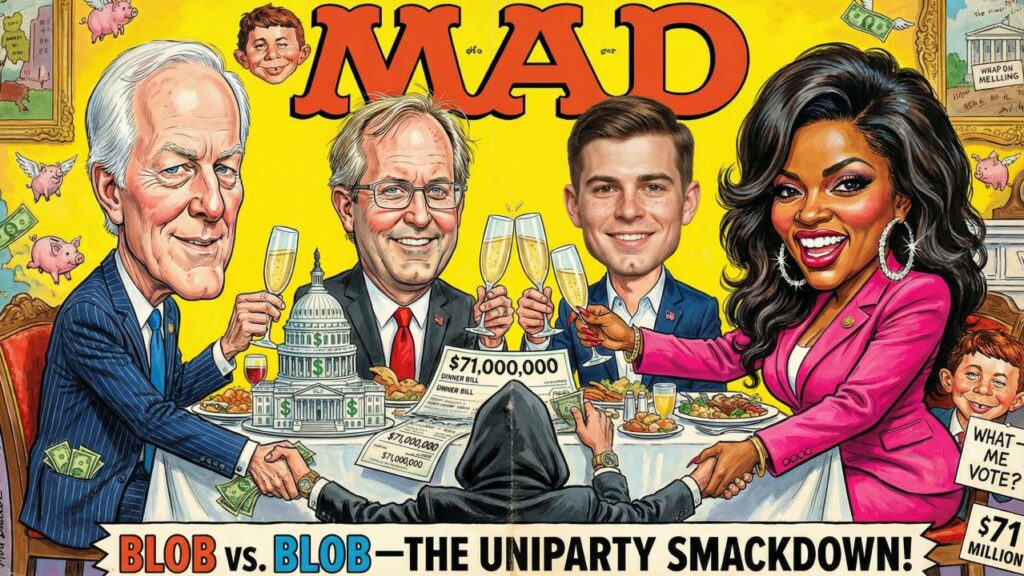
The Uniparty’s Latest Exhibition Match
On March 3, 2026, the state of Texas held an auction. It was advertised as a Senate primary.
Four candidates, two Republican, two Democrat, spent the better part of a year telling their respective audiences exactly what those audiences wanted to hear. They spoke of values. They spoke of fighting for the little guy. They spoke of corruption in the other party, and occasionally in their own, with the practiced indignation of people who have studied corruption the way sommeliers study wine: not to eliminate it, but to develop a palate for it.
The Republican side featured Senator John Cornyn, a four-term incumbent whose $71 million in institutional ad buys set a record for the most money ever spent trying to convince primary voters that an establishment senator is not, in fact, an establishment senator. Opposite him stood Attorney General Ken Paxton, a man who has been impeached, indicted, investigated by the FBI, and divorced on “biblical grounds” by his own wife, and who nonetheless presented himself as the grassroots alternative with a straight face and a $5 million war chest funded significantly by far-right billionaires. Congressman Wesley Hunt, the sensible third option whom nobody picked, collected 13.4% and a participation trophy.
The Democratic side featured Rep. Jasmine Crockett, the progressive firebrand who accepted campaign cash from Marc Andreessen, the Winklevoss twins, Lockheed Martin’s PAC, and BlackRock’s PAC, and state Rep. James Talarico, the earnest young populist who promised to “close the revolving door of former members of Congress becoming lobbyists” while running a campaign that would make him the most attractive revolving-door candidate in a generation.
When the votes were counted, Cornyn led Paxton 41.9% to 40.9%, sending them to a May 26 runoff. Talarico beat Crockett with roughly 53% of the vote. The pundits called it a dramatic night. The donors called it a Tuesday.
Here’s what nobody on any stage said, because saying it would break the fourth wall of American democracy: it doesn’t matter who wins. Not because the candidates are identical, they aren’t, but because the system they’re entering is designed to metabolize their differences into the same output. The machine accepts firebrands and moderates, populists and institutionalists, and produces senators. The senators produce votes. The votes produce contracts, appropriations, and foreign aid packages. The contracts produce profits. The profits produce campaign contributions. And campaign contributions produce the next class of candidates, who will stand on stages and tell voters exactly what they want to hear. The cycle has the elegant inevitability of a washing machine, and roughly the same effect on whatever you put inside it.
Cornyn: The Blob at Rest
If the Republican establishment had a LinkedIn profile, it would be John Cornyn’s Senate biography, the kind of résumé that makes donors reach for their checkbooks and grassroots voters reach for antacids. Four terms. Former Whip. Finance Committee. Judiciary Committee. Top industry contributors: Securities & Investment ($2.5 million), Oil & Gas ($1.5 million), Real Estate ($1.6 million). Top individual contributors: Apollo Global Management ($137,600) and Blackstone Group ($105,125), because nothing says “man of the people” like a private equity firm whose lobby furniture costs more than your house.
Who Gave and Why
The $71 million didn’t materialize from patriotic enthusiasm. It was an investment, and like all investments, it was made with an expected return. Alex Latcham, who oversees political organizations associated with Senate Majority Leader John Thune, spent the better part of a year “alerting Republican financiers” that Cornyn was vulnerable. The pro-Cornyn super PAC, Texans for a Conservative Majority, raised $7.3 million in the second half of 2025 alone and spent over $13.3 million on independent expenditures boosting Cornyn and attacking Paxton. Its donor list reads like a directory of people who need things from the United States Senate: Blackstone Group chairman Stephen Schwarzman, New Balance owner Jim Davis, and Dallas oil and gas billionaire Trevor Rees-Jones. Houston businessman John Nau contributed $2.9 million to the pro-Cornyn super PAC by himself.
Ask yourself: why would Stephen Schwarzman, whose net worth exceeds $40 billion, write a check to save a Texas senator’s primary campaign? Not because he admires Cornyn’s cowboy-hat commercials. Schwarzman runs the largest alternative investment firm on the planet. Blackstone manages $1 trillion in assets. The firm’s business model depends on favorable tax treatment of carried interest, the provision that allows private equity managers to pay capital gains rates instead of income tax rates on their compensation. Cornyn sits on the Senate Finance Committee. The Finance Committee writes tax law. The carried interest loophole has survived every “reform” effort for two decades because the people who benefit from it fund the people who write the tax code. Schwarzman isn’t donating. He’s renewing a subscription.
The same logic applies across every line item. Oil and gas gave Cornyn $1.9 million because he sits on committees that oversee energy policy, pipeline approvals, and federal land leasing. Securities and investment firms gave $3.2 million because he votes on financial regulation. The insurance industry gave $923,000 because he votes their way on the healthcare law. Pharmaceutical companies gave $729,000 because he shepherds drug pricing legislation. Defense contractors, aerospace, electronics, and miscellaneous defense combined, gave over $400,000 because he votes on the National Defense Authorization Act every single year. Lobbyists themselves gave $806,784 because Cornyn is, in the professional estimation of people who sell access for a living, worth buying.
How He Repays Them
Cornyn voted with Trump 99.3% of the time, a compliance rate that would impress a golden retriever. But the real compliance isn’t measured in Trump votes. It’s measured in outcomes. He was named the most effective senator in the 117th Congress by the Center for Effective Lawmaking. He co-authored the Bipartisan Safer Communities Act, gun legislation that made him a heretic to the Texas grassroots faster than you can say “primary challenger.” He shepherded the CHIPS and Science Act through Congress, a $52 billion subsidy to semiconductor manufacturers that was celebrated as “bipartisan” because it was obscenely profitable for donors on both sides of the aisle. In Washington, “bipartisan effectiveness” is a term of art meaning “useful to both parties’ donor bases simultaneously.” In fairness to Cornyn, this is a genuine skill. It’s just not the skill his voters thought they were purchasing.
The repayment mechanism is elegant in its simplicity: Cornyn doesn’t have to do anything corrupt. He just has to keep doing his job. Vote for the defense budget. Vote for the tax framework. Vote for the trade agreements. Confirm the judges. Pass the continuing resolutions. The system doesn’t require betrayal. It requires reliability. And Cornyn is the most reliable machine in the Senate, which is precisely why $71 million was spent to keep him there. You don’t spend $71 million to protect a senator. You spend $71 million to protect a portfolio.
Cornyn has received nearly half a million dollars in pro-Israel lobby support over his career. When he attacked Paxton for associating with Steve Bannon’s “War Room” podcast and failing to “call out antisemitism on the right,” he told Jewish Insider that people like Bannon and Nick Fuentes are “a cancer” that would cause “the destruction of the Republican Party”. The irony of a senator backed by every institutional lever in Washington warning about “corruption” in the conservative movement was apparently lost on him, though to be fair, irony has never been a top contributor.
“I just can’t in good conscience turn over this job representing 32 million people,” Cornyn said, “to a corrupt and unprincipled individual like the attorney general”. Cornyn’s conscience, like his donor list, is evidently subject to terms and conditions that the public is not authorized to review.
But here is the thing about Cornyn that the grassroots refuses to acknowledge because acknowledging it would undermine the premise of every insurgent campaign: Cornyn is not pretending. He is exactly what he appears to be, a professional legislator who serves the institutional interests that fund professional legislators. He does not claim to be a revolutionary. He claims to be effective, and he is. The system works for him because he works for the system. That is not hypocrisy. It is a job description. The hypocrisy belongs to the voters who keep electing institutionalists and then acting surprised when they get institutions.
Paxton: The Blob in Costume
Ken Paxton is what happens when you order an anti-establishment candidate from a catalogue, the wrong model arrives, and the return policy has expired.
He was impeached by his own party’s state House on 20 articles, including bribery, obstruction of justice, and abuse of public trust. The allegations centered on his relationship with Austin real estate developer Nate Paul, a relationship that reportedly included Paxton using his office to intervene in Paul’s legal troubles, Paul hiring a woman with whom Paxton was alleged to have had an extramarital affair, and Paul paying for renovations on Paxton’s home. It was the kind of arrangement that, in a normal workplace, would get you fired, and in Texas politics, gets you a Senate campaign. When eight of his own senior aides reported him to the FBI for corruption, Paxton did what any innocent man would do: he fired all eight of them. Paul pleaded guilty to federal charges in January 2025. The securities fraud indictment that hung over Paxton for nearly a decade was quietly dropped through a deal with prosecutors in March 2024. The system, it turns out, has a VIP lane, and Paxton has the E-ZPass.
The Texas Senate acquitted him on party lines. The conservative media ecosystem declared victory. And Paxton emerged, like a phoenix from a dumpster fire, singed but camera-ready, to challenge Cornyn as a “grassroots champion.” His campaign website presumably did not include a “Legal Troubles” tab, though it would have been the most well-sourced page on the internet.
Who Gave and Why
Paxton’s “grassroots” funding came overwhelmingly from two families: the Dunns and the Wilkses, fracking billionaires who have poured nearly $100 million into a network of nonprofits, political campaigns, think tanks, and websites advancing their religious and economic agenda across Texas. The Dunn-Wilks network has given Paxton more than $2.85 million in direct contributions, 6.8% of his total fundraising, plus $750,000 in outstanding loans, bringing total support past $4.65 million. The Defend Texas Liberty PAC alone gave Paxton’s campaign $950,000. Other major donors to the pro-Paxton Lone Star Liberty PAC included Midland oilman Douglas Scharbauer ($250,000), medical device CEO Jonathan Knutz, and Woodlands banker Robert Marling.
Why would fracking billionaires bankroll a man under federal investigation? Because Paxton, as attorney general, has been their enforcer. He sued the Biden administration over climate regulations. He challenged EPA methane rules. He fought federal oversight of hydraulic fracturing on state lands. He turned the Texas attorney general’s office into a headquarters for the conservative legal movement, putting Texas “on the frontlines of national culture war battles,” battles that happen to align perfectly with the deregulatory agenda of companies that extract hydrocarbons from the Permian Basin. The Dunns and Wilkses aren’t funding Paxton because they believe in populism. They’re funding him because he uses the power of the state to protect their business model. That’s not grassroots. That’s accounts payable.
The smaller donors tell the same story in a different register. Scharbauer runs oil operations in the Permian Basin. Marling runs a bank that services energy companies. The money flows from the same aquifer, fossil fuel wealth, just through different wells. Paxton’s $5 million war chest and Cornyn’s $71 million war chest look like opposites. They’re the same donor class arguing over which employee to promote.
How He Would Repay Them
If Paxton reaches the Senate, the repayment is straightforward: he would vote against climate regulation, vote against methane restrictions, vote for expanded drilling rights on federal lands, and use his seat on whichever committee he’s assigned to block any legislation that threatens the fossil fuel business model. The Dunn-Wilks network doesn’t need Paxton to pass new laws. They need him to prevent new ones. In Washington, obstruction is a service, and the people who fund obstructionists expect a return measured not in legislation passed but in legislation killed. Every clean energy bill that dies in committee is a dividend paid to the men who funded Ken Paxton’s campaign.
On election night, Paxton told supporters: “While the money may be on his side, the people are on our side, and in Texas, the people always win”. One wonders whether “the people” includes Nate Paul, or whether Paul’s guilty plea disqualified him from the populist head count.
But here is the thing about Paxton that his supporters refuse to acknowledge because acknowledging it would undermine their entire theory of politics: Paxton is also not pretending. He is exactly what he appears to be, a transactional politician who serves the interests that fund him, protects the allies who protect him, and punishes the subordinates who threaten him. The only difference between Paxton and Cornyn is that Cornyn’s transactions are legal and Paxton’s are under investigation. The output is the same. The paperwork differs.
The Cruz Postcard From the Future
For anyone wondering what happens when either of these men arrives in the Senate, the case study is already seated in the chamber, probably fundraising. Ted Cruz entered the Senate in 2013 as the Tea Party’s sharpest blade, the man who shut down the government over Obamacare, who refused to endorse Trump at the 2016 convention, and whose colleagues despised him so thoroughly that Lindsey Graham joked about his hypothetical murder on the Senate floor going unpunished. In Washington, being universally despised by your colleagues is supposed to mean you’re doing something right. In Cruz’s case, it meant something else entirely.
Thirteen years later, Cruz is caught on secret recordings trashing Trump’s tariff policies to wealthy donors, calling Vice President Vance a “protégé” of Tucker Carlson, and positioning himself for a 2028 presidential run as, one savors the phrase, “a conventional free-trade, interventionist Republican”. The man who once branded himself as the Senate’s most dangerous outsider now aspires, in his own private words, to be its most conventional insider. When Cruz warned Trump that his tariff agenda could cost the GOP the House, the Senate, and invite impeachment, the President’s response was succinct: “F, – you, Ted”. It was perhaps the most bipartisan sentiment expressed in Washington all year.
That exchange is the entire Blob lifecycle in miniature. Campaign as a rebel. Govern as an operator. Schmooze donors behind closed doors. Get caught. Express remorse. Fundraise off the remorse. Repeat. When Texas froze during the 2021 winter storm, and millions lost power and water, Cruz flew to Cancún with his family. “Obviously a mistake,” he said when photographs surfaced. Obviously. The mistake, one assumes, was getting photographed, not the vacation itself.
Cruz has received $1.9 million in pro-Israel money over his career, seventh-highest in Senate history. He outraised both Paxton and Hunt in Q4 2025 despite not being up for reelection until 2030. The Schmoozer-in-Chief is always fundraising. Old habits, like lobbying relationships and Cancún flight bookings, die hard.
If Paxton won the Senate seat, his arc would be indistinguishable. If Cornyn holds it, the arc simply continues. The fire-breathing outsider discovers that Washington is a remarkably pleasant place when you stop fighting the system and start working it. The transformation from rebel to Blob takes about one congressional term. Two, tops. Then it’s steakhouse dinners, donor retreats, and secret recordings where you tell people what you really think, which turns out to be exactly what the establishment thinks, but with a Southern accent and better boots.
The Other Side of the Aisle, Same Side of the Table
Lest anyone mistake the Blob for a Republican affliction, the Democratic side of the Texas primary offered its own exhibition match in bipartisan theater, proof that the Uniparty is not a conspiracy but a job market.
State Rep. James Talarico defeated Rep. Jasmine Crockett with roughly 53% of the vote, capping a bitter primary that featured allegations of racism, voter suppression in Dallas County, and the kind of scorched-earth rhetoric that would suggest these two Democrats represent fundamentally irreconcilable visions of the party’s future. They don’t. The New York Times observed that the contest was “more about persona than policy”. Their only debate “revealed little daylight” between them on actual issues. They are two actors reading from the same script in different costumes, Talarico in the “faith-based populist on a rusty pickup truck” costume, Crockett in the “progressive firebrand who claps back at Trump” costume.
Crockett: Who Gave and Why
Crockett, the progressive warrior, the fighter against billionaire cronies, the candidate Kamala Harris described as someone who would “hold Donald Trump and his billionaire cronies accountable,” built her war chest from a roster of donors that reads like a satirist’s fever dream. Since 2022, she accepted over $370,000 in federal contributions from PACs representing corporations or business associations. The full list includes pharmaceutical giants AbbVie and Gilead Sciences, financial services firms BlackRock and Goldman Sachs, major defense contractors Lockheed Martin, RTX (formerly Raytheon), and General Dynamics, and household names like McDonald’s, Home Depot, CVS, Verizon, and Toyota. She took individual contributions from Marc Andreessen, who poured $33.5 million into crypto-focused Republican super PACs and $4.5 million into a pro-Trump PAC. She took money from the Winklevoss twins, who donated tens of millions to pro-MAGA crypto efforts. Coinbase CEO Brian Armstrong and Solana CEO Anatoly Yakovenko also contributed, every single one of whom later donated to Trump’s inaugural fund. Two crypto-funded super PACs spent over $2 million to help her win her first congressional primary in 2022.
Why would Lockheed Martin’s PAC give money to a progressive firebrand? Because Lockheed Martin’s PAC gave $1.568 million to federal candidates in the 2023-2024 cycle, 57% to Republicans, 42% to Democrats. They don’t fund ideologies. They fund access. Every member of Congress who sits on or near the Armed Services Committee, the Appropriations Committee, or any subcommittee that touches the $886 billion defense budget gets a check. The check doesn’t buy a vote. It buys a meeting. The meeting buys a relationship. The relationship ensures that when Lockheed’s $6.9 million-per-half-year lobbying operation needs a phone call returned, the phone gets answered. Crockett’s check was small, $10,000 here, $5,000 there. But that’s the genius: it’s cheap enough to be unremarkable and expensive enough to create an obligation that neither party will ever acknowledge.
Why would crypto billionaires fund a candidate who claims to oppose billionaire influence? Because the crypto industry’s regulatory fate is being decided right now, in this Congress, and the industry needs Democrats who will cross the aisle on crypto-friendly legislation. Crockett’s willingness to take their money signaled to the industry that she would be, at minimum, “not hostile.” In Washington, “not hostile” is worth millions. The industry spent over $100 million in the 2024 cycle alone. A few hundred thousand in Crockett’s direction was a rounding error on a balance sheet, and a down payment on a senator who might one day sit on the Banking Committee.
Foreign governments noticed too. The Qatari-linked U.S.-Qatar Business Council paid over $17,000 for Crockett and her family to tour Doha, where she stayed at the Waldorf Astoria Lusail and met with high-ranking Qatari officials. India and the UAE paid for similar trips. These aren’t vacations. They’re onboarding sessions, introductions to a relationship that will mature over a career.
During her 2022-2024 congressional term, Crockett took $276,799 in corporate PAC money total while holding individual stocks in Devon Energy, MGM, and Moderna. If you are keeping score at home, this is the progressive candidate.
How She Would Have Repaid Them
The same way everyone repays them: by being available. By returning the phone call. By taking the meeting. By not being the one who leads the charge against crypto regulation, or defense spending, or pharmaceutical pricing. Crockett didn’t need to cast a single corrupt vote. She just needed to be one of 100 senators who doesn’t make trouble for the industries that funded her, and in a body where legislation requires 60 votes to advance, every senator who “doesn’t make trouble” is as valuable as one who actively helps. The defense contractors don’t need champions. They need a quorum of non-objectors. Crockett was being groomed for that quorum from the day she cashed her first Lockheed Martin check.
Talarico: Who Gave and Why
Talarico, to his credit, ran without corporate PAC money and raised over $20 million primarily from small-dollar individual donations. He outspent Crockett nearly 5-to-1 on advertising, $15.3 million to her $4.3 million, with an additional $7.7 million from a supportive super PAC. His message was that the country’s biggest divide is “top vs. the bottom”. He promised to “close the revolving door of former members of Congress becoming lobbyists”.
The problem is the $7.7 million super PAC. The Lone Star Rising PAC was formed by Alexander Clark, a Texas political operative who identified himself as a “15-year friend” of Talarico in now-deleted Facebook posts. The PAC deployed nearly $3.7 million in negative ads against Crockett. Its money came from: $500,000 from LinkedIn co-founder Reid Hoffman, a Democratic megadonor who maintained a close relationship with Jeffrey Epstein; $400,000 from Austin philanthropist Simone Coxe; contributions from hedge fund manager Stephen Mandel, Hyatt Hotel heir Adam Pritzker, Eagles drummer Don Henley, and private equity billionaire Mark Heising. But the largest source was $3.75 million from the Government That Works PAC, which in turn received $4 million from the Sixteen Thirty Fund, “a leading dark-money hub for Democrats previously associated with Swiss billionaire Hansjörg Wyss and Democratic megadonor George Soros”.
Why would Reid Hoffman give $500,000 to support a candidate who rails against big money in politics?Because Hoffman has spent hundreds of millions on Democratic politics and needs Democrats in the Senate who will protect the tech industry’s interests, antitrust, Section 230, AI regulation, and labor law as it applies to gig workers. Hoffman doesn’t care about Talarico’s “politics of love.” He cares about the Senate Commerce Committee.
Why would the Sixteen Thirty Fund launder $4 million through two intermediary PACs to support a candidate who promises to ban dark money? Because the Sixteen Thirty Fund is the single largest dark-money operation in Democratic politics, and the candidates it funds reliably support the regulatory and tax framework that allows dark-money operations like the Sixteen Thirty Fund to exist. The snake eats its own tail. The money funds the candidate who protects the money.
When a New Yorker reporter asked Talarico over red wine whether he’d accept help from a super PAC, he invoked Christ’s resistance to Satan in the wilderness and promised he would refuse. “The central belief in my faith is that the means are the ends,” he said. “If we lose, it would not feel great. But, but! It’s the belief in the Resurrection, right?” He said this while a close friend was quietly orchestrating a multimillion-dollar super PAC on his behalf, funded by the very dark-money networks he claimed to oppose. When confronted, Talarico said he wouldn’t “unilaterally disarm”. In Washington, “I won’t unilaterally disarm” is the secular equivalent of “the Devil made me do it,” the universal excuse of every candidate who enters the temple and discovers the money changers are offering very competitive rates.
How He Will Repay Them
The revolving door doesn’t close because a candidate promises to close it. It closes when the money on the other side is no longer four times the money on this side. It hasn’t yet. It won’t. Forty-three percent of members of Congress who left office since 1998 and were eligible to lobby have become lobbyists. Ex-staffers with government connections generate a median annual revenue of $300,000, compared to $112,500 for those without government connections.
Talarico will repay his donors the same way Cornyn repays his, the same way Paxton would repay his, the same way Crockett would have repaid hers: by being in the room. Reid Hoffman doesn’t need Talarico to introduce a bill. He needs Talarico to take a meeting. The Sixteen Thirty Fund doesn’t need Talarico to vote a certain way. It needs him to not vote against its interests, and since Talarico may not even know what the Sixteen Thirty Fund’s interests are (the beauty of dark money is that the recipient often doesn’t know who’s paying), he’ll protect those interests by default, simply by being a reliable Democratic vote on the regulatory framework that permits anonymous political spending. The candidate who promised to drain the swamp will discover that the swamp is climate-controlled, the drinks are complimentary, and his campaign consultants already have offices there.
The Game That Never Ends: Why Winning and Losing Are the Same Career
This is the part the grassroots never sees because seeing it would break the spell: for these four candidates, there is no losing. There is only winning the election and winning the consolation round. The game is structured so that every player, winner or loser, ends up in the same economy.
Consider the math. A member of Congress earns $174,000 per year. A former member who becomes a lobbyist can immediately multiply that salary. Bob Livingston pulled in $1.1 million in his first year after leaving Congress, and $4.8 million the next. Former Rep. Jim Nussle earned $2.6 million annually. Former Rep. Mike Rogers collected nearly $2 million in two years from intelligence contractors alone. The median revolving-door lobbyist generates $300,000 in annual revenue; those without government connections generate $112,500. More than half of all registered federal lobbyists have government experience. Lobbyists with Hill experience earn four times as much as those without. The congressional salary is not compensation. It is a down payment on the real career.
This is why Cornyn is not worried about losing. A four-term senator with Finance and Judiciary Committee credentials, backed by Apollo Global Management and Blackstone Group, does not fear unemployment. He fears irrelevance, and irrelevance, in Washington, is a temporary condition cured by a lobbying registration form. If Cornyn loses the runoff, he will have his pick of K Street firms by June. His Rolodex alone is worth seven figures. His knowledge of pending legislation is worth more. The “cooling-off period,” one year for House members, two for senators, is a speed bump, not a barrier. Former members “often skirt the lobby prohibition rules by supervising other lobbyists for the first year” or taking titles like “strategic advisor” or “senior counselor” that technically fall outside the lobbying disclosure requirements.
Paxton, if he loses, returns to the conservative media ecosystem that has sustained him through impeachment, indictment, and divorce. He becomes the martyr of the establishment’s latest purge, a role more lucrative than attorney general and considerably less legally hazardous. The speaking fees alone will dwarf his government salary. The book deal is a phone call away. The consulting contracts from conservative organizations that need a name-brand culture warrior will keep the lights on indefinitely. Paxton doesn’t need to win the Senate. He needs to remain famous. The primary accomplished that.
Crockett, who lost to Talarico, returns to the House with elevated national name recognition, a donor network that includes Silicon Valley billionaires, and the sympathetic narrative of a Black woman who was done in by party infighting and Dallas County voting irregularities. She will write op-eds. She will appear on cable news. She will be mentioned for future races. And if she ever tires of the House, the lobbying industry will welcome her with the warmth of a corporation greeting a regulator it has been cultivating for years. Her corporate PAC contributors, Lockheed Martin, General Dynamics, Goldman Sachs, and BlackRock, did not give her money because they believed in progressive values. They gave her money because they were investing in access. Access does not expire with a primary loss. It compounds.
Talarico, the young populist who promised to close the revolving door, will arrive in Washington if he wins in November and discover what every young populist discovers: that the door revolves because the people on both sides of it want it to. His former colleagues on K Street will take him to lunch. His new colleagues in the Senate will explain how things work. His campaign consultants, the people who crafted his “top vs. bottom” messaging, will statistically have a better-than-even chance of becoming lobbyists themselves once the election is over. The Center for Public Integrity found that campaign consultants increasingly turn to lobbying when elections end, trading on the personal relationships forged in the “war-like, sleep-deprived atmosphere of a campaign”. The consultant who helped Talarico win will use that relationship to help a client get a meeting with Senator Talarico. And the revolving door will revolve.
Winners welcome losers. Losers congratulate winners. Both attend the same fundraisers, work the same donor networks, and end up at the same Georgetown restaurants where the entrées cost $60, and the real menu is printed on the back of a lobbying contract. The partisan warfare is for the cameras. The bipartisan cooperation is for the money. And the money doesn’t care who wins because it funded both sides.
The Money Pipeline: Following the Blob’s Circulatory System
Understanding the Blob requires understanding the money, not as an abstraction, but as a circulatory system with identifiable arteries, veins, and a heart that pumps in one direction: toward the already rich.
The Defense Artery: The top five Pentagon contractors, Lockheed Martin, Boeing, Raytheon, General Dynamics, and Northrop Grumman, employed at least 672 former government officials, military officers, and members of Congress as lobbyists, board members, or executives in 2022 alone. From 2011 through 2022, more than three-quarters of all defense sector lobbyists previously worked in the federal government. Defense lobbying expenditures grew 38.3% from 2020 to 2024, and the industry employs 950 registered lobbyists. Congress responded to this lobbying by adding $25 billion in “program increases” to the defense budget, most of which had no listed author and little public justification. In Washington, $25 billion without attribution is called “bipartisan consensus.” Anywhere else, it’s called a no-knock warrant for the treasury.
The Think Tank Bypass: The money doesn’t just flow from contractors to Congress. It flows through an intermediary layer of think tanks that launder corporate interests into “independent policy research.” The top 100 defense companies contributed more than $34.7 million to the top 50 think tanks between 2019 and 2023. Northrop Grumman led with $5.6 million. Lockheed Martin followed at $2.6 million. The Atlantic Council alone has taken at least $10 million from Pentagon contractors, including BAE Systems, Boeing, Lockheed Martin, General Dynamics, Northrop Grumman, and RTX. CSIS received at least $4.1 million. A Quincy Institute report found that these defense contractor-funded think tanks dominate the public debate on Ukraine policy. The experts quoted in the press recommending more weapons shipments are, in effect, paid spokespeople for the companies that manufacture the weapons. But they have PhDs, so it’s scholarship, not advertising.
The Israel Lobby Capillary Network: AIPAC spent over $100 million in the 2024 election cycle, supported 362 candidates from both parties, and achieved a 98% win rate among its endorsed candidates in general elections. The all-time top Senate recipient is Joe Biden ($4.2 million), followed by Robert Menendez ($2.5 million), Hillary Clinton ($2.4 million), and Mitch McConnell ($1.95 million). The list is bipartisan by design. You don’t capture a system by picking sides. You capture it by funding all of them and letting them pick sides for the cameras.
In any other industry, this circular flow, from contractor to lobbyist to think tank to senator to appropriations bill to contractor, would be described by prosecutors as a kickback scheme. In Washington, it’s called “the policy process.” The participants call it “public service.” The public calls it something else, but nobody polls them on that.
The Ownership Layer: Who Watches the Watchmen? BlackRock Does.
The money pipeline operates under media coverage that treats each election as a genuine contest of ideas. That coverage is produced by media companies whose largest institutional shareholders are the same asset managers who own the defense contractors, the energy companies, and the financial institutions that fund the campaigns.
BlackRock and Vanguard together own:
- 18% of Fox
- 16% of CBS (and therefore60 Minutes)
- 13% of Comcast (NBC, MSNBC, CNBC, Sky)
- 12% of CNN
- 12% of Disney (ABC, FiveThirtyEight)
- 10-14% of Gannett (250+ daily newspapers,USA Today)
The New York Times counts among its major shareholders Carlos Slim Helú and Fairpointe Capital (16%), Vanguard (8.11%), and BlackRock (7.43%). Sinclair Broadcasting, which reaches 72% of U.S. households through local TV, counts Vanguard (5.56%) and BlackRock (4.54%) among its top shareholders.
BlackRock manages nearly $10 trillion in assets. Vanguard manages $8 trillion. State Street manages $4 trillion. Together, they hold major stakes in 88-95% of S&P 500 companies. A Harvard research team described this architecture plainly: “Interlocking directorates, revolving doors of personnel and financial stakes and holdings connect the corporate media to the state, the Pentagon, defense and arms manufacturers and the oil industry”. Critics have called BlackRock “a great vampire squid,” “a shadow bank,” and “almost a shadow government, one that neatly avoids the spotlight”.
When the Cornyn-Paxton race is covered as a dramatic contest between “establishment” and “insurgent,” that framing serves a purpose. It creates the illusion of meaningful choice. The actual story, that both candidates will serve substantially similar donor constituencies regardless of who wins, doesn’t get airtime because the donor constituency owns the airtime. The Talarico-Crockett race was covered as a contest between “progressive firebrand” and “faith-based populist.” Same principle. Different costumes. Same owners.
The Enthusiasm Gap: The Grassroots Votes With Its Feet
The rational response to all of this is exactly what’s happening: Republican voters are checking out. Not because they’ve been defeated, but because they’ve been bored into submission by a system that has turned political participation into the civic equivalent of calling customer service, you wait on hold, you press all the right buttons, and you end up exactly where you started.
In the 20 state legislative districts that have held special elections in 2026, Democrats have outpaced their 2024 performance by an average of more than 10 percentage points. Democratic candidates have outperformed Kamala Harris’s 2024 margins by an average of 13 points. Since Trump’s election, Democrats have flipped 26 state legislative seats. Republicans have flipped zero.
The specific results read like an autopsy report:
- North Texas (January 31): Democrat Taylor Rehmet won a state Senate seat by 14 points in a district Trump carried by 17, a 31-point swing.
- South Louisiana (February 7): Democrat Chas Verret won a state House seat by 24 points in a district Trump won by 13, a 37-point swing.
- Oklahoma (February 10): A Republican held a conservative state House seat by only 28 points, where Trump had won by 58, a 30-point collapse.
“While many in our party may wish to dismiss these outcomes,” one GOP operative told Axios, “the trend is unmistakable: there is currently at least a 10-point Democratic advantage compared to Trump’s 2024 results driven by an energized Democratic base and a lethargic GOP base”.
Trump’s own numbers tell the story. His approval sits at 41.9%, with disapproval at 55.7%. His approval among Hispanics has dropped from 49% to 38%. Democrats hold their largest generic congressional ballot lead of the cycle. Texas House Speaker Dade Phelan has warned that the current political climate could produce a “bloodbath” down ballot, potentially costing Republicans their first statewide loss in three decades.
Sixty percent of Gen Z and millennial voters now report dissatisfaction with both political parties. The Republican State Leadership Committee has explicitly acknowledged being “the party of low-propensity voters”. When your own party infrastructure admits that your voters don’t show up, you don’t have a messaging problem. You have a product problem. And the product is the Blob.
Trump’s Silence: The Bump That Became Baggage
One of the most revealing details of the Texas primary is what didn’t happen: Donald Trump refused to endorse anyone. The president who handed out more than 130 endorsements for Texas races this cycle, from state legislators to agriculture commissioner, sat out the biggest Republican primary in the country.
His strategic calculus was transparent. “He said he considers all three of us to be friends,” Cornyn told Jewish Insider. Translation: Trump didn’t pick a side because there was no upside, only risk. The man who built a political brand on fearless endorsements calculated that this particular endorsement wasn’t worth the cost. When the movement’s leader treats the movement’s biggest primary as a risk to be managed rather than a fight worth having, the grassroots notices. They may not articulate it in those terms. But they notice.
The broader endorsement picture is worse. Agriculture Commissioner Sid Miller, a longtime Trump ally who received the president’s endorsement, was on track to lose reelection. Multiple Trump-endorsed congressional candidates were headed to runoffs, one in distant second place. The “Trump bump” isn’t the force multiplier it used to be. For some candidates, it’s become baggage, an association they have to contextualize for suburban voters who’ve soured on the brand while adding no enthusiasm from a base that has figured out the endorsement doesn’t come with accountability.
Susie Wiles, Trump’s White House chief of staff, has acknowledged the turnout crisis. The strategy for 2026 is to put Trump “on the ballot” for the midterms because “so many of those low-propensity voters are Trump voters”. The plan is to campaign “like it’s 2024 again”. But 2024’s electrifying rallies took place while Trump was fighting for his political survival. Campaigning for John Cornyn’s fifth term, or Ken Paxton’s first, doesn’t quite generate the same voltage. You can’t sell tickets to a rerun. And you can’t sell a revolution when the revolutionaries keep ending up at the same steakhouse as the people they were supposed to overthrow.
The Steakhouse at the End of the Universe
On May 26, one of these Republicans will win the runoff. In November, one of them will probably face Talarico in the general election. In January 2027, somebody will be sworn in to the United States Senate, where he will join 99 colleagues, most of whom arrived via the same pipeline, funded by the same donors, covered by the same media companies owned by the same asset managers, advised by the same think tanks funded by the same defense contractors, and committed to the same bipartisan consensus that the grassroots was told, again, this election would finally disrupt.
It won’t. The losers will land softly. Forty-three percent of departing members of Congress become lobbyists. Those who don’t register as lobbyists take titles like “strategic advisor” and “senior counselor,” positions that pay more, disclose less, and accomplish the same thing. The campaign consultants who ran the campaigns will pivot to lobbying the people their campaigns helped elect. The donors who funded the primaries will fund the general elections. The think tanks that provided the talking points will provide the policy briefs. The defense contractors that funded the think tanks will receive the appropriations. And the asset managers that own the defense contractors, the media companies, and 88% of the S&P 500 will report another quarter of steady returns.
The grassroots Republican voter who stayed home on March 3, and millions did, wasn’t apathetic. He was making a rational calculation. He looked at the ballot and saw what Mike Royko would have seen: a card game where the house takes a cut of every pot, and the players are using the house’s money. You can sit at the table all night. You can win every hand. But the house always gets paid. And the house, in this metaphor, is not a building. It’s a system. It’s the revolving door that spins 43% of Congress into lobbying. It’s the $71 million in ad buys that couldn’t put away a man under federal investigation. It’s the $100 million AIPAC spent funding 362 candidates from both parties in a single cycle. It’s the $22 trillion managed by three firms that own stakes in everything from Fox News to Lockheed Martin to the newspaper you’re reading this in.
The Blob doesn’t need to win every race. It just needs to make winning meaningless. And on that score, the March 3 Texas primary was a resounding, bipartisan, $100 million success.
Related reading
- Hey Texans! Anything Is Better Than Ken Paxton Representing Texas in the U.S. Senate, and I Mean Anything.
- Why Texas Must Send Talarico to the Senate, And Stop Ken Paxton
- Why Texas Must Send Talarico to the Senate, And Stop Ken Paxton
- Paxton Collapse: How Trump’s Texas Pick Turns a Safe Republican Seat Into a Coin Flip