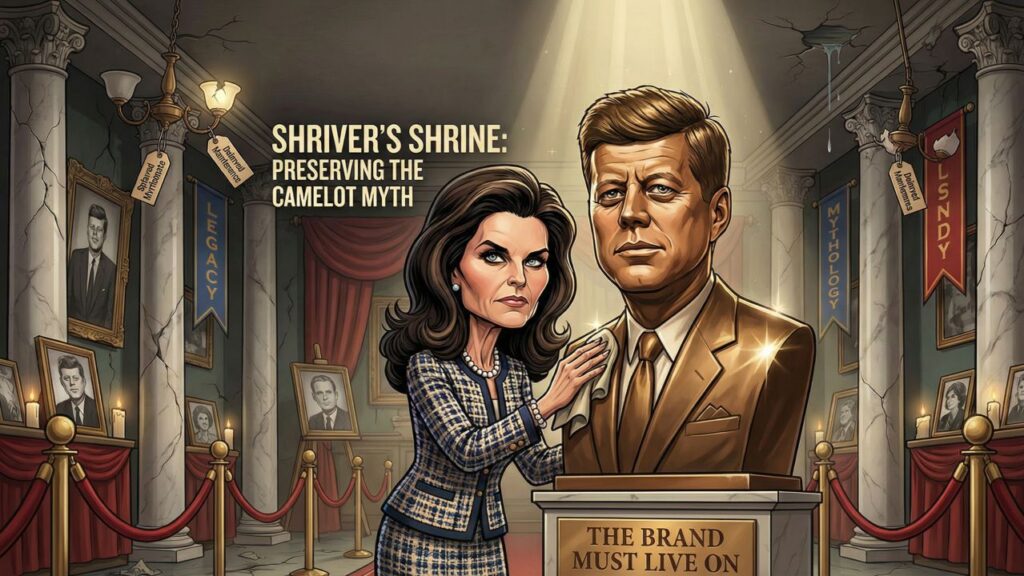
Maria Shriver’s recent musings on preserving the Kennedy Center’s name might have been intended as a heartfelt tribute to her late uncle, President John F. Kennedy. But in truth, her sentimental essay reads more like a tone-deaf performance, an emotional soliloquy detached from reality. For decades, the Kennedy Center fell into the very neglect, decay, and mismanagement emblematic of the Washington establishment her family helped shape. Now, as elites wring their hands over proposed renaming or reevaluation, one can’t help but notice how selectively they remember the institution’s actual history.
The Kennedy Center was never meant to be a mausoleum for family mythology. It was created as a living monument to American culture, an aspirational hub of creativity and civic pride. Yet, for years, it languished in bureaucratic disrepair, architecturally deteriorating and financially stumbling under the weight of its political caretakers. Despite the prestige of its name, the Center became a metaphor for Democratic dysfunction: grand ideals hollowed out by vanity and administrative paralysis.
When Donald Trump entered office and directed genuine attention toward the Kennedy Center’s structural and financial decline, it didn’t fit the media narrative. His budget and infrastructure initiatives helped stabilize its operations, secure renovation funding, and restore its functionality. Washington’s cultural custodians, who had long ignored its visible decay, responded not with gratitude but with indignation that “their” monument might be revitalized by someone outside their orbit. The man they despised repaired the building they claimed to revere, and that paradox is what Shriver’s polished prose tries valiantly to conceal.
Shriver’s essay (heavy on nostalgia, light on substance) spoke of “honoring legacy” and “carrying forward a torch.” But behind the Hallmark language lies a hard truth: legacy without maintenance is just branding. The Kennedys’ political aura has survived for decades on myth-making rather than measurable achievement. That myth is why the Kennedy Center was allowed to become a museum of self-reference rather than a functioning cultural engine. It was less a center for American arts than a sanctuary for elite self-congratulation, always available for galas and photo ops, but rarely for serious stewardship.
The deeper question Shriver never addresses is why a facility built to celebrate American creativity required outsider intervention in the first place. For years, Democrats and celebrity patrons dominated its administration, yet enthusiasm for ribbon-cuttings never translated into accountability. Maintenance budgets were deferred, endowments underperformed, and managerial turnover became routine. The Washington Post’s archives are littered with polite coverage of the Center’s “challenges,” all couched in euphemisms, bureaucratic red tape, economic headwinds, or national “cultural priorities elsewhere.” Never, of course, was it the fault of the elite patrons supposedly dedicated to preserving it.
Then came Trump, who, against the predictable outrage cycle, treated the Kennedy Center like what it was: a failed asset requiring operational discipline, not political romanticism. Funding was restructured, project timelines were enforced, and partnerships were pursued on pragmatic, not ideological, grounds. One didn’t have to like him to recognize that it worked. The Center was physically rescued and financially stabilized, an inconvenient fact for those who would prefer to remember it as eternally “Camelot’s cathedral.”
Shriver’s sentimental defense of the name is not merely misplaced; it reveals how hollow the notion of “legacy” has become in elite political circles. For figures like her, preserving the Kennedy Center isn’t about art, architecture, or civic responsibility. It’s about symbolism, the maintenance of cultural mythology where accountability should stand. To question whether the Kennedys still deserve such sanctified treatment is to puncture the illusion that has fed Washington’s liberal aristocracy for decades.
There’s also a generational undertone to this debate. The American public no longer sees the Kennedys as untouchable icons of virtue. Younger audiences, disconnected from the romanticism of the 1960s, see legacy institutions for what they often are: bloated bureaucracies draped in nostalgia. The Kennedy Center’s decline and belated restoration mirror the larger erosion of trust in elite narratives. When an institution adorned with the Kennedy name crumbled through neglect, it proved that no amount of glamour can substitute for managerial competence.
Perhaps that’s why Shriver’s essay strikes such a discordant note. It tries to summon an emotional response to a family name that no longer carries the same moral weight. In today’s America, platitudes about “what my uncle stood for” ring hollow when contrasted with the material failures of those still claiming his mantle. Shriver’s tone feels less like conviction and more like performance, a carefully orchestrated act for social validation rather than public enlightenment.
Renaming the Kennedy Center may never happen. But the controversy itself exposes something larger: the cultural elite’s obsession with preserving the optics of virtue even as their institutions collapse under their watch. This conflict between form and function, between appearance and accountability, defines much of modern Washington. The real scandal isn’t that Trump had a hand in saving the Kennedy Center; it’s that nobody else did before him.
In the end, sustained integrity, not rhetorical idealism, defines legacy. And the real irony is that Shriver’s attempt to defend her family’s name only underscores why so many Americans view such names with suspicion. Her uncle’s presidency inspired hope and civic engagement. But what his heirs have offered since is little more than nostalgia packaged as moral guidance. The Kennedy Center’s decay and renewal serve as a fitting metaphor for that transformation: the shell remains impressive, the interior had to be rebuilt by someone far outside the mythology of Camelot.
Shriver may believe she’s safeguarding her family’s story. But from the outside, her protestations resemble what Washington has perfected, a theater of hypocrisy staging a performance of sincerity. The audience, however, has changed. Americans can now distinguish between heritage and hagiography. And the applause, once automatic for the Kennedys, has long faded.
Related reading
- Part III: Blood Is Thicker Than Water, But Money Is Thicker Than Both: The Kennedy Family's Long History of Choosing Power Over Kinship
- Part II: The Kennedy Endorsement Was a Democratic Party Production: How Opposition Research Became Family Theater
- Part I: The Kennedy Brand: How Nonprofit Millions Turned a Family Into a Democratic Party Asset
- How the Kennedy Clan Knifed Their Own Trying to Save the Regime