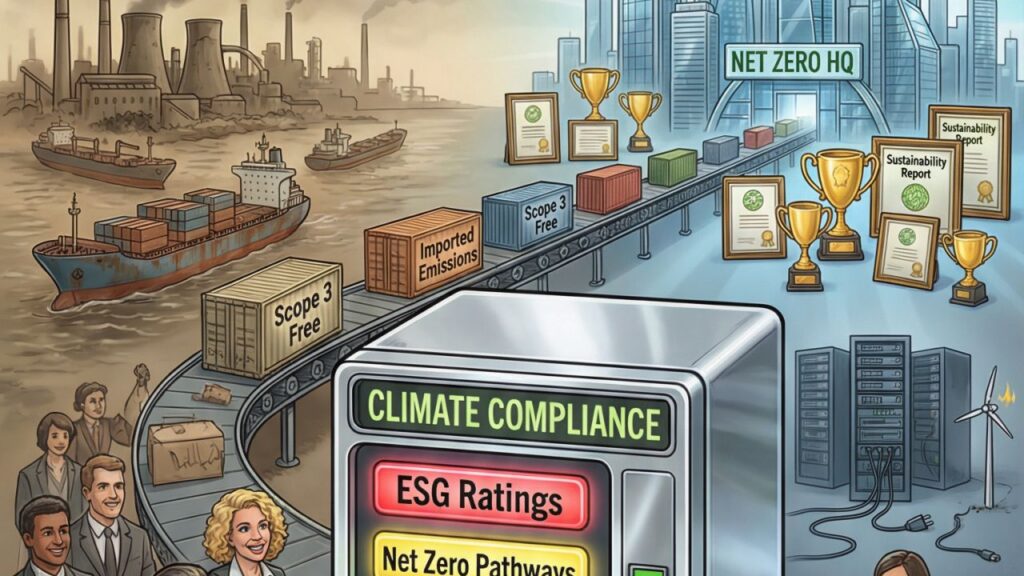
Climate policy and ESG have catalyzed a large, globally integrated ecosystem of financial and professional services that now intermediates hundreds of billions of dollars in capital, operating spend, and subsidies each year. This ecosystem has successfully created new value pools in finance, advisory, data, and assurance. At the same time, its prevailing incentive structures and accounting conventions mean that economic rents are frequently captured without commensurate improvements in global emissions or strategic resilience.
At the apex of this ecosystem, global asset managers, investment banks, and insurers have embedded climate and ESG into core products and risk frameworks. “Sustainable” funds typically command higher fees while remaining closely benchmarked; green and sustainability-linked bonds support premium underwriting and opinion fees; and climate-risk models inform pricing, exclusions, and regulatory engagement. Standard-setters (ESG ratings agencies, index providers, target-setting initiatives, and disclosure-framework bodies) translate these priorities into taxonomies and metrics that effectively gate access to capital and index inclusion. As these standards are incorporated into regulation and mandates, the providers of ratings, indices, and data become unavoidable infrastructure, with strong economic incentives for increasing complexity and frequency of change.
Professional services firms have positioned themselves as the primary integrators of this landscape. Large consultancies design net-zero strategies, Scope 1/2/3 inventories, internal carbon prices, operating-model changes, and implementation roadmaps, then support multi-year execution and periodic “refresh” cycles. Law firms interpret emerging rules, structure transactions, and advise on disclosure and liability. Audit and assurance providers offer limited assurance over sustainability and emissions data that rests heavily on management-determined boundaries and assumptions. Across these offerings, revenue growth is tightly coupled to perceived regulatory risk, methodological opacity, and the breadth of issues swept into the ESG domain.
Within corporations, this manifests as a permanent sustainability and ESG bureaucracy, Chief Sustainability Officers, specialist reporting teams, cross-functional steering committees, and dedicated capabilities in procurement, HR, and operations. These structures manage relationships with investors, regulators, ratings providers, NGOs, and media while directing material budgets toward consultants, data systems, renewable PPAs, offsets, and branded initiatives. In many sectors, these same decision-makers have overseen significant offshoring of industrial and supply-chain capacity from relatively efficient, higher-cost home markets to jurisdictions with lower energy prices and weaker environmental standards. Finished goods are then shipped back to end markets. Territorial and corporate accounting often register this as emissions progress in the originating economy, even as global emissions and transport-related impacts rise. The net effect is a pattern of “decarbonization by relocation” that improves reported metrics without materially advancing atmospheric outcomes.
Non-profit and knowledge institutions provide critical narrative and legitimacy infrastructure. NGOs and advocacy networks mobilize public and political support for more ambitious targets and broader ESG scopes, often funded by a combination of foundations, governments, and corporate partnerships. Academic centers and research institutes align research agendas to these priorities, reinforcing core assumptions about targets, technologies, and governance structures. Media and communications actors amplify this consensus, with climate and ESG coverage framed primarily around urgency, moral stakes, and headline targets rather than system-level cost, feasibility, or trade-offs. The result is a mutually reinforcing information loop in which the same core framing is recycled across reports, campaigns, academic publications, and news coverage, creating strong reputational incentives for alignment and high barriers to dissent.
Governments and regulators provide the coercive and fiscal backbone. Climate and ESG objectives are embedded into mandatory disclosures, taxonomies, procurement criteria, subsidy regimes, and supervisory expectations. Administrative reach extends across energy, industry, finance, transport, real estate, and agriculture, creating new mandates, budgets, and institutions. Career paths frequently span senior roles in government, advisory firms, NGOs, and corporate sustainability leadership, aligning personal incentives with the perpetuation of a complex, dynamic rule set that demands ongoing interpretation and implementation support. In parallel, advanced economies face an emerging inflection point: the rapid growth of AI, cloud, and data-intensive industries will require very large volumes of reliable, low-cost electricity and robust domestic industrial capacity. Yet in many markets, policy and capital have favored intermittent resources and imported hardware over investment in firm, scalable low-carbon baseload (notably nuclear) and competitive domestic manufacturing.
For corporate leaders and policymakers, this landscape raises three strategic concerns:
- Environmental efficacy: A material share of “progress” in reported emissions reflects accounting choices and offshoring rather than step-change improvements in global emissions trajectories or local environmental quality.
- Economic and social distribution: Compliance and intermediation costs are borne disproportionately by consumers, workers in deindustrializing regions, and communities in lower-cost manufacturing hubs, while value accrues to concentrated nodes in finance, advisory, data, and advocacy.
- Long-term competitiveness: Underinvestment in abundant, reliable, low-cost power and domestic industrial capability risks eroding advanced economies’ position in AI, advanced manufacturing, and critical supply chains, even as they bear a growing share of the governance and compliance burden.
A more effective and resilient climate strategy would reorient from process and optics to physical and economic fundamentals. That implies: privileging consumption-based and lifecycle metrics over purely territorial accounting; redirecting capital and policy support toward firm, scalable low-carbon generation and critical domestic industrial capacity; simplifying and rationalizing ESG taxonomies to focus on a limited set of decision-useful indicators; and aligning incentives across public, private, and non-profit actors to reward measurable environmental and strategic outcomes rather than volume of activity.
Related reading
- A Tale of Three Climate Change Dupes: UK, Germany, and Japan
- Climate Change: Deconstructing the Impossible Consensus
- The Climate Hoax, Europe's Industrial Base Was Dismantled Before the World's Eyes, While the Press Said Nothing
- THE DEAD SCIENCE THAT ATE $400 BILLION: How an MIT and Princeton Physicist Exposed the Climate Hoax That Robbed a Planet in 2026