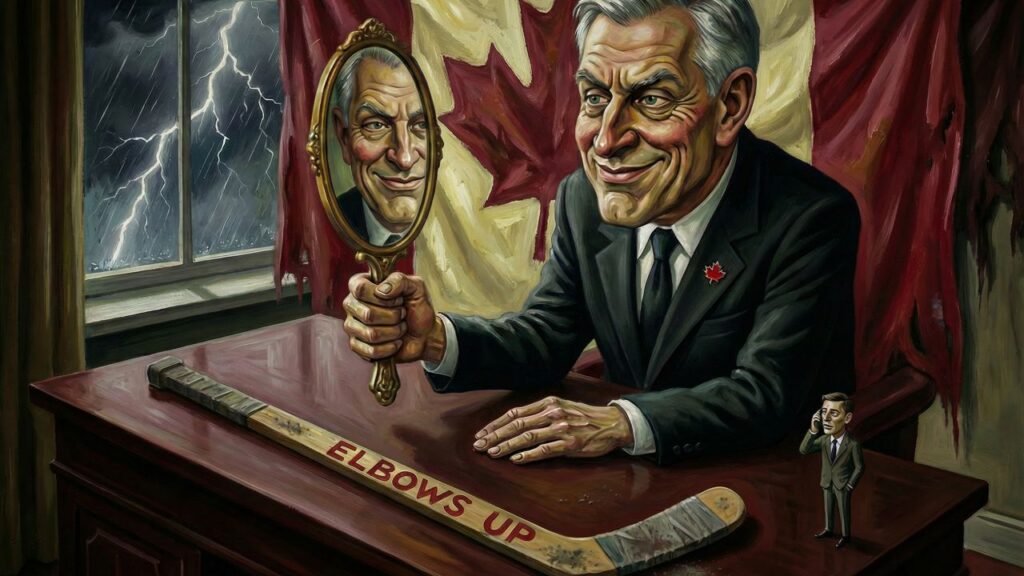
A Conservative backbencher with a phone and a Yale connection is doing more diplomacy than the entire Liberal government. Meanwhile, Canada’s Prime Minister is engineering a snap election to solve a crisis he already has the tools to solve, and hasn’t.
The Note That Started This
I write about geopolitics, institutional corruption, and the permanent failures of Western foreign-policy establishments from Houston, Texas. My usual beat runs through Brussels, Kiev, Washington, and the boardrooms of European multinationals who market sustainability while their supply chains run on radioactive tailings and child labor. I don’t typically look north. Canada is a country Americans tend to think about the way you think about a quiet neighbor, decent people, cold weather, reliable in a crisis, largely uninteresting until something goes wrong.
Something has gone wrong.
A Canadian friend wrote me a note last week. It wasn’t polite. It wasn’t diplomatic. It was the kind of message a man writes when he watches his own government betray the mandate it was given:
“Carney is weaponizing the fears of Canadians, for power he doesn’t need, to do a job he told us he was the man for.”
He pointed out that Ontario Premier Doug Ford had met with Carney to discuss calling a snap election, so Carney could pursue a majority government, so he could “deal with Donald Trump.” He noted that a Conservative MP named Jamil Jivani was doing more substantive work on the U.S.-Canada trade file than the entire Liberal caucus. And he warned that Carney’s gambit amounted to “elbows up, part 2”, a reference that carries weight in Canadian politics for reasons I’ll explain.
I decided to look into every claim. What I found was worse than what my friend described. What I found was a pattern I’ve documented across continents, a leader who manufactures crisis to consolidate power, who substitutes posture for policy, and who treats the democratic process as an inconvenience to be bypassed rather than a constraint to be honored.
The Americans reading this will recognize the genre. We invented it.
Ford Gave Carney the Playbook, Because It Worked for Him
On February 9, 2026, today, the Globe and Mail reported what many in Ottawa already suspected: Ontario Premier Doug Ford and Prime Minister Mark Carney have held multiple discussions (in person and by phone, including at the January 29 first ministers’ meeting in Ottawa) about the possibility of a spring federal election. According to three sources, Ford directly advised Carney that calling an election could be an opportunity to “secure a decisive majority”.
This is not idle gossip between premiers. Ford is speaking from the playbook he wrote himself. In January 2025, Ford called a snap Ontario election more than a year ahead of schedule, telling voters he needed “the largest mandate in Ontario’s history” to deal with four years of Donald Trump. Ford won his third majority. The playbook is brutally simple: conjure existential fear, tell voters the only answer is more power for you, and go to the polls before anyone asks whether you’ve actually used the power you already had.
Carney watched that playbook work. Ford is now helping him run it federally. The two leaders have even compared their respective approval ratings in what sources describe as “light-hearted banter” at the first ministers’ table. There is nothing light-hearted about engineering an unnecessary election during a trade crisis. But the numbers are intoxicating, Carney leads Pierre Poilievre by up to 29 percentage points as preferred prime minister, and the Liberals hold a four-to-nine-point lead over the Conservatives.
The calculus isn’t about confronting Trump. It’s about striking while the polling iron is hot. As Nanos Research’s Nik Nanos captured it: the Liberals will “leverage something said by U.S. President Trump as a rationale for calling an election, seeking a strong mandate to respond to the White House”.
That’s not leadership. That’s stage management.
What Exactly Is Getting in Their Way?
Here is the question that deserves the hardest scrutiny: if Carney already has the power to deal with Trump, why can’t he secure a deal?
The answer is uncomfortable for the Prime Minister. The CUSMA/USMCA review deadline is July 1, 2026. Negotiations are stalled. U.S.-Canada talks that were expected to begin in mid-January were pushed back, reportedly because of tensions between Trump and Carney over Carney’s Davos speech and his narrow EVs-for-agriculture deal with China. Trump himself has publicly dismissed the value of the agreement, saying, “There’s no real advantage to it; it’s irrelevant”.
Meanwhile, Mexico has been quietly and pragmatically negotiating. Economy Minister Marcelo Ebrard met with USTR Jamieson Greer on January 28, and they agreed to “begin formal discussions on possible structural and strategic reforms”. Mexico is at the table. Canada is not. Canada’s Prime Minister was too busy posturing at Davos and making side deals with Beijing that infuriated Washington.
The issues on the table are well-known: U.S. demands on auto rules of origin, dairy market access, Canada’s Online Streaming Act and Online News Act, which Washington views as discriminatory against U.S. tech firms, energy provisions, and critical minerals. These are solvable. They require skilled, sustained, multi-partisan engagement. They do not require a snap election.
As Conservative MP Michelle Rempel-Gardner put it: “Both Stephen Harper and Justin Trudeau successfully navigated a minority Parliament. Why can’t Carney?”.
The answer, of course, is that he can. He simply doesn’t want to.
Jamil Jivani: The Backbencher Doing the Prime Minister’s Job
This is perhaps the most damning indictment of Carney’s approach, and the observation from my friend’s note that deserves the widest amplification. While the Prime Minister muses about whether to dissolve Parliament, a Conservative backbencher from Bowmanville-Oshawa North has been doing the actual work of restarting trade relations with the United States.
In the first week of February 2026, Jamil Jivani, a longtime friend of U.S. Vice-President JD Vance from their days at Yale Law School, traveled to Washington and met with Vance, Second Lady Usha Vance, and Secretary of State Marco Rubio. These were not ceremonial handshakes. Jivani focused on defusing the partisan tensions that have poisoned the Canada-U.S. trade file, advocating for a “multi-partisan committee” to handle the CUSMA talks and urging Canada to stop further deals with China, the single issue most likely to provoke Trump into walking away from the agreement entirely.
“Part of what I’m trying to do by being here,” Jivani told Semafor, “is convey the message that we’re all on the same team, and we don’t need to be fighting with each other. I think there’s a real opportunity to build something with the U.S. administration”.
Jivani was careful to note he was not purporting to speak for Carney. He has offered his help to the Prime Minister before and received no response. He came away from Washington with a clear read: the Americans are “very open to working with Canada,” and the door is not closed, but it requires a Canadian government willing to stop inflaming anti-American sentiment and start negotiating seriously.
Let that register. A single opposition MP, with no resources beyond his personal relationships and his phone, accomplished more in one week of shuttle diplomacy than the entire Liberal government has managed in months of stalled negotiations. Carney’s office didn’t even return Semafor’s request for comment.
I’ve spent the last month documenting how the Western foreign-policy establishment substitutes posture for performance, how military-credentialed conservatives monetize their failures while attacking anyone who tries to bypass the broken machinery. The Canadian version is less bloody but structurally identical: the credentialed class would rather the crisis persist than allow an outsider to solve it, because the crisis is what justifies their power.
My friend was right. Jivani is doing more work than all the Liberals combined, Ford included.
The Floor-Crossing Gambit: Democracy by Poaching
Before Carney began floating the snap election trial balloon, he tried another route to a majority: poaching opposition MPs.
In late 2025, two Conservative MPs, Michael Ma and Chris d’Entremont, crossed the floor to join the Liberals, bringing Carney’s seat count to 171, just one short of the 172 needed for a working majority. Carney did not try to hide his appetite for more. In a December 2025 interview with Global News, he said the defectors “came to us” and were “attracted by what we are doing,” adding: “We’re open. We’re looking for that support because the country needs to move forward”.
In a separate year-end interview, Carney hinted that more floor-crossings could be coming. The message was unmistakable: if Carney couldn’t win a majority at the ballot box and couldn’t quite get there through defections, he would try the third route, going back to the ballot box while his numbers are high.
I’ve watched this pattern operate at the EU level, where unelected commissioners consolidate power through procedural maneuver while insisting it’s all for the greater good. The scale is different. The mechanics are identical. This is not the behavior of a leader focused on solving a national crisis. This is the behavior of a leader focused on consolidating power by any available means.
“Elbows Up, Part 2”: What My Friend Really Means
For the Americans reading this, some context.
The original “Elbows Up” was Carney’s 2025 campaign slogan, borrowed from hockey, it signified a tough, aggressive posture against Trump’s tariffs. Mike Myers appeared in a campaign ad in a Team Canada jersey. Carney danced on election night with his elbows up. The imagery was powerful.
The reality was hollow. Just twelve days before the April 28 election, Carney’s administration quietly introduced sweeping six-month tariff exemptions that gutted the counter-tariff regime. According to Oxford Economics, the counter-tariffs were reduced to “practically nonexistent”. Carney campaigned on a tough stance he had already abandoned. An editorial later dubbed “Elbows Up” the “dumbest slogan” of the year, noting it “created a false impression among the public, leading them to believe it represented Canada’s economic strategy long after Carney had moved away from it”.
Americans will recognize this too. It’s the WMD vial held up at the UN. It’s the “red line” in Syria. It’s the policy commitment made for the cameras that dissolves the moment the cameras turn off. The posture was the product. The policy was an afterthought.
But my friend’s reference to “elbows up part 2” evokes something darker, the original Elbowgate of 2016. That was the incident in which Justin Trudeau physically waded into a crowd of opposition MPs on the House of Commons floor, grabbed the Conservative Whip by the arm, and elbowed NDP MP Ruth Ellen Brosseau in the chest. Trudeau’s infraction that day was an attempt to physically force a vote through Parliament. It was the brute exercise of power dressed up as impatience with procedural delay.
What Carney is contemplating is the political equivalent. He doesn’t need a majority to govern. His minority is the second-largest in federal history. The NDP has no money and no desire for another election. The Bloc has shown willingness to support the government on key votes. The Conservatives, despite their rhetoric, have not been obstructionist enough to trigger a confidence crisis.
Carney can pass legislation. He can negotiate trade deals. He can respond to Trump. He has the power. What he doesn’t have is the unilateral power to bypass Parliament, ignore opposition input, and govern as though he won a mandate that voters deliberately withheld.
And that is what a snap election is really about.
The Legislative Record Tells the Story
If Carney’s urgency for a majority were driven by genuine legislative necessity, you would expect a government straining against the limits of minority rule, a government with bills piled up, blocked by an obstructionist opposition. That is not what the record shows.
By December 2025, only four pieces of legislation had passed under the Carney government. Four. In eight months. Interim NDP leader Don Davies criticized the Liberals for failing to engage effectively with other parties, stating that “nothing in the House of Commons passes without the Liberals getting the support of another party” and that they have not demonstrated a willingness to “reach across party lines”.
CBC’s At Issue panel noted that Carney is “now realizing that yes, you can pass your budget because of the fear of an election, but most votes are not confidence votes”, and that the opposition parties can and have rewritten entire pieces of legislation in committee.
The problem is not that minority government is unworkable. The problem is that Carney does not want to do the work that minority government requires: compromise, collaboration, and accepting that 49% of the seats means you govern with 51% of the humility.
I’ve documented European executives who market sustainability while their supply chains run on cancer villages and conflict minerals. The fraud is always structural, the posture is exquisite, the substance is absent, and the gap between what’s promised and what’s delivered is filled with marketing. Carney’s governance record is the political equivalent. The mandate was to confront Trump on trade. The deliverable is a four-bill legislative record and a stalled negotiation.
Fear as a Governing Strategy
My friend writes that Carney is “weaponizing the fears of Canadians, for power he doesn’t need, to do a job he told us he was the man for.” This is the sharpest observation of the lot, and it’s the one that transcends Canadian politics into something Americans need to understand.
Carney’s entire political identity is built on the premise that he is uniquely qualified to navigate the Trump crisis. He campaigned on it. He won on it. He told Canadians that his experience running the Bank of Canada through the 2008 financial crisis and the Bank of England through Brexit made him the steady hand Canada needed. He said he would build “the most significant transformation of our economy since the conclusion of World War II”.
Nine months later, CUSMA negotiations are stalled. The legislative record is four bills. Counter-tariffs have been quietly gutted. A Conservative backbencher has better access to the U.S. Vice-President than the Prime Minister’s own team appears to. And the Prime Minister’s response to all of this is not to redouble his efforts at the negotiating table, but to hold backroom conversations with a provincial premier about calling an election he publicly denies considering.
I’ve spent the last several weeks writing about the hierarchy of lies that sustains Western foreign-policy failures, the puppet masters who design the narratives, the pawns who execute them, the scriptwriters who package the deception. Carney isn’t a puppet master. He isn’t even a particularly sophisticated pawn. He’s a former central banker who discovered that fear is the most liquid political currency on earth, and that if you can keep the population frightened of Donald Trump, they’ll hand you anything you ask for without demanding to see the results.
The Americans reading this have watched this play out for decades on the other side of the border. The neoconservative establishment inflated China into an existential threat to justify permanent confrontation and trillion-dollar defense budgets. The intelligence community inflated Russian interference into an existential threat to justify domestic surveillance and narrative control. The common denominator is always the same: fear is manufactured not to solve a problem, but to justify the accumulation of power by people who have no intention of solving the problem, because the problem is what keeps the money flowing and the questions at bay.
Carney isn’t building weapons systems or funding think tanks. But the mechanism is identical: manufacture fear, demand power, avoid accountability, and attack anyone who suggests the emperor has no clothes.
The View from South of the Border
I look at this from Houston, and what I see is a mirror. Not because Carney is Trump or Trump is Carney, they couldn’t be more different in temperament. What I see is the universal template of institutional failure dressed up as leadership.
Mark Carney doesn’t need a majority to negotiate a trade deal. He doesn’t need a majority to engage with Washington. He doesn’t need a majority to pass legislation. He needs the willingness to work with Parliament, which he has conspicuously refused to demonstrate.
What Carney needs a majority for is to stop answering to anyone. To stop negotiating with the NDP. To stop having his bills rewritten in committee. To stop facing the indignity of being a Prime Minister who must persuade rather than command.
Doug Ford can advise him on the mechanics. He pulled the same maneuver in Ontario. But Canadians should understand what is happening: a Prime Minister who ran as the indispensable crisis manager is now treating the crisis itself as an inconvenient backdrop to his real project, the accumulation of power.
Jamil Jivani flies to Washington and gets face time with the Vice-President and the Secretary of State. Mark Carney flies to Davos and gets applause from a room full of people who don’t vote in Canadian elections.
And that should concern everyone.
Scott Ortkiese writes on geopolitics, institutional corruption, and the permanent failures of Western foreign-policy establishments. He is the principal of Throughline Synthesis Group.