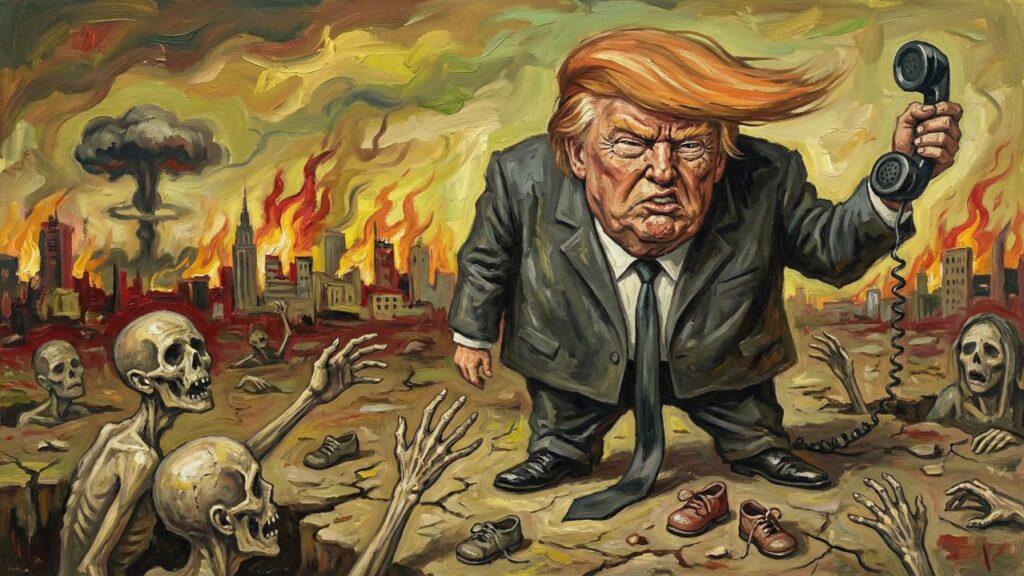
On March 30, 2026, the President of the United States published the following on his social media platform:
“The United States of America is in serious discussions with a new and more reasonable regime to end our military operations in Iran. Great progress has been made. But if for any reason a deal is not shortly reached, which it probably will be, and if the Hormuz Strait is not immediately open for business, we will conclude our lovely stay in Iran by blowing up and completely obliterating all of their electric generating plants, oil wells, and Karg Island, and possibly all desalination plants, which we have not purposefully yet touched. This will be retribution for our many soldiers and others that Iran has butchered and killed over the regime’s 47 year of terror. Thank you for your attention to this matter.”
The night before, aboard Air Force One, he told reporters:
“We’re doing extremely well in that negotiation, but you never know with Iran because we negotiate with them and then we always have to blow them up. Whether it’s the B2 bombers or just terminating the Iran nuclear deal done by Barack Hussein Obama. Probably the worst deal we’ve ever done as a country. One of the dumbest deals we’ve ever done. But I terminated it fortunately. Otherwise, right now they’d have a nuclear weapon. Then we did the attack with the B2 bombers and we stopped them from having nuclear and now we had to blow them up again. And we will probably make a deal with them. I’m pretty sure, but it’s possible we won’t.”
Read these words carefully. Read them again. Then ask yourself: at what point in the history of the American republic did it become acceptable for a president to pre-announce war crimes in the register of a corporate memo and follow them with a pleasantry?
“Our Lovely Stay”
Let us begin with the phrase that should become the epitaph of this presidency: “our lovely stay in Iran.”
In the month since the United States and Israel launched their attack on February 28, 2026, American missiles have struck a girls’ school in Iran, killing 168 young women and their teachers. A U.S. precision strike missile, deployed in combat for the first time in history, struck a community sports hall where children were playing volleyball, killing four of them, including a 12-year-old named Alhami and a child two years old. Thousands of civilian sites have been hit. Hospitals have been targeted. Tens of thousands of Iranian civilians have had their lives destroyed, their families killed, their cities broken.
Donald Trump calls this a “lovely stay.”
The phrase is not a slip. It is not dark humor poorly executed. It is the authentic expression of a man for whom the deaths of Iranian civilians register at the same emotional frequency as a mediocre hotel review. The casual elegance of “lovely stay” applied to a military campaign of this devastation is the most precise self-portrait Trump has ever painted. No speechwriter wrote that phrase. No adviser approved it. It came from the unfiltered interior of a man who has been given the authority to kill at continental scale and experiences it as a kind of vacation.
This is what pathological narcissism looks like when it wears a commander-in-chief’s uniform. Not raging malevolence. Something colder and more dangerous: the complete absence of the moral imagination that would allow him to feel, even abstractly, what it means to be on the receiving end of what he is doing.
The Pre-Announcement of War Crimes
What follows “lovely stay” is not bluster. It is not negotiating leverage dressed in rhetorical excess. It is the explicit, public, on-the-record pre-announcement of war crimes.
Article 54 of Additional Protocol I to the Geneva Conventions, which the United States has signed, prohibits attacks on “objects indispensable to the survival of the civilian population,” explicitly including water installations and food infrastructure. The Rome Statute of the International Criminal Court, Article 8, defines as a war crime “intentionally directing attacks against civilian objects” and “intentionally using starvation of civilians as a method of warfare.”
Trump has not implied these intentions. He has published them. He has named the specific targets: electric generating plants, oil wells, desalination plants. He has stated the purpose: retribution. He has given advance notice on a platform with tens of millions of followers.
Desalination plants in Iran are not military installations. They are what keeps people from dying of thirst in a country that is largely desert. Electricity plants power the hospitals where wounded civilians are being treated, the dialysis machines keeping kidney patients alive, the incubators where premature infants breathe, the water pumps, the refrigeration systems that prevent medicines from spoiling and food from rotting. Destroying them does not degrade an army. It kills civilians slowly, systemically, through thirst, disease, and medical collapse, over days and weeks, in a manner calculated to maximize suffering over time.
This is not a military strategy. It is collective punishment. It is the deliberate targeting of a civilian population to coerce a political outcome, which is precisely what the laws of armed conflict were designed to prohibit after the civilized world watched the Second World War produce exactly this kind of mass civilian death and decided, collectively, never again.
The International Criminal Court has indicted sitting and former heads of government for less explicit statements of intent than this Truth Social post. The question of whether Trump will ever face accountability for it is a question about American institutions, not about the law. The law is clear. He said it. It is in writing. It is timestamped. It is a confession.
“We Negotiate With Them and Then We Always Have to Blow Them Up”
If the Truth Social post is the confession, the Air Force One remarks are the context that makes the confession complete.
In a single sentence, Trump has destroyed every diplomatic framework his own administration has attempted to construct around this war. He has told Iran, and the entire world, that American negotiations are not negotiations. They are intervals between military operations. The pattern, in his own words, is invariant: talk, then bomb, talk, then bomb. “We always have to blow them up.”
Iran has been saying exactly this since February 28. The attack came after Trump’s envoy Steve Witkoff had led Tehran to believe that a diplomatic solution was being genuinely pursued. The scholars whose analysis has informed reporting throughout this crisis, including Mearsheimer, Sachs, Marandi, and Crooke, have documented in precise detail how the diplomatic cover was used to enable the military strike. Now the President of the United States has confirmed it himself, on the record, in his own words, to the White House press pool.
Every government on earth that is currently watching this war and calculating whether American diplomatic assurances can be trusted has now received its answer directly from the source. The answer is no. When Trump says “great progress has been made” in negotiations, he has simultaneously told anyone paying attention that this is exactly what he says before he blows things up. The diplomatic statement and its own refutation were published within twelve hours of each other.
“Barack Hussein Obama”
The middle name is not an accident. It has never been an accident in twenty years of right-wing American political discourse. “Hussein” is deployed to code Barack Obama as foreign, Muslim, disloyal, and therefore responsible for betraying American interests by negotiating with Iran. It is a racial and religious dog whistle with a specific function in this context: to frame the JCPOA not as an arms control agreement, which it was, but as an act of civilizational treason by a president who was never really one of us.
This framing serves Trump’s immediate political need, which is to assign blame for the war to his predecessor rather than to himself. But the factual record, documented by MIT professor Theodore Postol and every credible analyst of the Iran nuclear file, is unambiguous: the JCPOA successfully capped Iran’s uranium enrichment at 3.67 percent, placed 24-hour international monitoring on Iranian nuclear facilities, and required the removal of 98 percent of Iran’s enriched uranium stockpile. When Trump unilaterally withdrew from it in 2018, Iran began enriching to 20 percent, then 60 percent. Iran now holds enough 60-percent enriched uranium to build 11 nuclear weapons within weeks.
The deal Trump calls “the dumbest deal we’ve ever done” was the only thing standing between the world and the nuclear threshold state Iran has now become. Trump destroyed it. And now Trump is fighting a war against the nuclear program that his own decision made possible, while blaming the man whose name contains the word “Hussein.”
The contemptibility of this argument is surpassed only by its danger. If the American public accepts the framing, if the destruction of a functional arms control agreement and the resulting war are successfully attributed to a Black Democrat with a Muslim middle name, then the actual architects of the catastrophe escape accountability. And without accountability, there is no deterrent against the next catastrophe.
“Thank You for Your Attention to This Matter”
Save this phrase. Print it. Frame it. It belongs in the historical record as the most revealing eight words of this presidency.
“Thank you for your attention to this matter” is the closing formula of a corporate memo. It is what you write at the end of a note about a change in parking policy or an update to the expense reimbursement procedure. It is bureaucratic pleasantry, the linguistic equivalent of a firm handshake at the end of a routine transaction.
Trump applied it to a public threat to destroy the water supply of 90 million people.
The tonal register is not accidental. It does not represent a failure of sensitivity or an ironic distance from the content. It represents the authentic emotional state of a man who experiences no dissonance between the content of his threats and the pleasantry that closes them, because for him, the destruction of Iranian civilian infrastructure and the drafting of a routine business communication occupy the same emotional register. Both are transactions. Both are concluded politely. Thank you for your attention to this matter.
Hannah Arendt, covering the trial of Adolf Eichmann in Jerusalem in 1961, coined the phrase “the banality of evil” to describe how the most catastrophic crimes of the twentieth century were perpetrated not by raving monsters but by bureaucrats who processed the paperwork, followed the orders, and maintained the forms of civilized professional conduct throughout. Eichmann was not an ideological fanatic. He was a functionary who could not think beyond the next task, whose moral universe had collapsed to the dimensions of the immediate assignment.
Trump is not Eichmann. But the thank-you-for-your-attention construction points to something in the same family of moral pathology: the ability to contemplate mass civilian suffering and sign off on it with a pleasantry, because at the level of lived experience, the suffering of those people is simply not real to him. They are abstractions. The memo is concrete. The form must be observed.
What Accountability Looks Like
History does not always deliver justice in real time. Sometimes it takes decades. The architects of the Iraq War are still at liberty, still consulted by think tanks, still published in respected journals, still invited to speak at conferences. The price for that failure of accountability was paid not by them but by the hundreds of thousands of Iraqis who died, the soldiers who came home broken, and the region that has not recovered twenty years later.
The price for failing to hold Trump accountable for what he has said and done in this war will be paid the same way: not by Trump, but by the 45 million people now projected to face acute hunger across the Global South as a direct consequence of the supply chain disruption his war has caused. By the 168 girls whose school was struck on the first night. By the two-year-old. By the volleyball player named Alhami. By every Iranian civilian who will die slowly if he carries out his threat to destroy their water supply.
Donald Trump has committed, and publicly announced his intention to commit, acts that in any other context, involving any other nationality of victims, would be described without qualification as atrocities. He has done so openly, proudly, on a platform of his own creation, signed with a thank you.
The question of whether he pays a price for it is the defining moral test of this moment in American history. Not of Trump, whose moral character has been legible for decades, but of the institutions, the Congress, the courts, the press, the electorate, that were built specifically to ensure that no one man could drag a nation this far into darkness without consequence.
They were built for exactly this. The question is whether they still work.
Related reading
- A Bill of Indictment for Murder and Genocide Against the American Military and Trump, as its Commander and Chief
- Обвинительное заключение по делу об убийстве и геноциде против американских вооружённых сил и Трампа как их Верховного главнокомандующего
- Stop Calling It News. Gulf State “Reporting” Is Trump’s Bullshit With A Gulf State Palace Seal.
- American Empire in Ruins: The Unprovoked, Unconstitutional, and Catastrophic US-Israeli War on Iran