Executive Summary
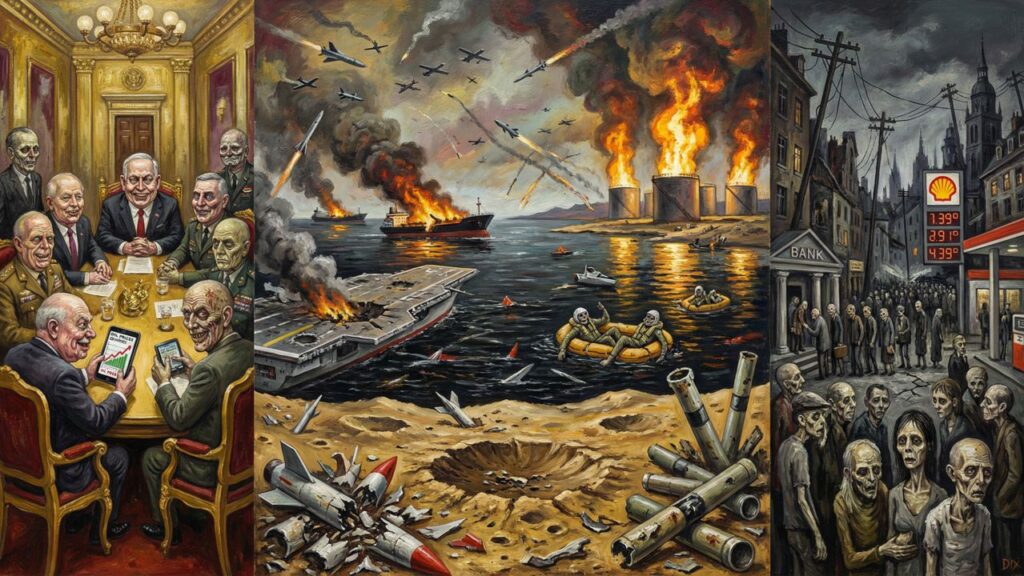
On February 28, 2026, the United States and Israel launched coordinated strikes against Iran, designated “Operation Epic Fury” and “Operation Roaring Lion,” killing Supreme Leader Ayatollah Khamenei, devastating the Kharg Island export terminal, and targeting military infrastructure across the country. Within 48 hours, every premise underlying the operation had begun to unravel. Iran’s retaliation was massive and multi-directional. U.S. bases across the Gulf were hammered, Israeli air defenses were being systematically depleted, the Strait of Hormuz was effectively closed to Western-aligned shipping, and oil prices surged toward $80 per barrel from the low $60s just weeks prior.
What makes this catastrophe unprecedented in the annals of American foreign policy is not merely that it failed, but that its failure was predicted (in precise, specific terms) by virtually every independent military and strategic analyst in the days before the strikes were launched. In the week preceding the attack, a retired U.S. Army Colonel, a University of Chicago professor of political science, a retired U.S. Army Lieutenant Colonel, and a Pulitzer Prize-winning journalist all independently warned that the operation lacked a viable strategy, that Iran would not capitulate, that a limited war was impossible, and that the consequences would be catastrophic.
In the days following the strikes, a retired Royal Navy Commodore, a former British diplomat, a former hedge fund manager, a former U.S. Congressman, and the same Lieutenant Colonel, now assessing the wreckage he had forecast, arrived at an identical, devastating convergence. This war represents a geopolitical, economic, and military catastrophe of historic proportions, one whose consequences will radiate far beyond the Middle East for years to come.
They Saw It Coming
The most damning indictment of the February 28 operation is that it was not a surprise to anyone except, apparently, the people who ordered it.
Three days before the strikes, Professor John Mearsheimer of the University of Chicago told Glenn Diesen that Trump’s own military advisers had already delivered the verdict. “President Trump’s military advisers have basically told him, ‘We do not have a workable strategy. We do not have a plausible strategy for winning this war.'” Mearsheimer noted this was not new information, General Kaine, Chairman of the Joint Chiefs of Staff, had delivered the same assessment on January 14 when Trump previously considered attacking Iran, and “nothing has changed.”
The same day, Lt. Col. Daniel Davis laid out why the war was unwinnable in advance. Iran had underground “missile cities” built over decades. Its fixed missile sites would fire at the first sign of attack under standing orders. Mobile launchers and underground air defense systems presented unknowns the U.S. could not resolve from the air. The air refueling tankers essential for long-range strike operations were “the long pole in the tent”, and Iran’s priority target. Most critically, Davis identified the fundamental asymmetry that would define the conflict: “For us to succeed we have to accomplish all of our primary tasks and that means regime destruction. Iran has merely to survive.”
Two days before the strikes, Colonel Douglas Macgregor, the decorated combat veteran and former adviser to the Secretary of Defense, declared the war “unavoidable” but catalogued its impossibilities. Only two carrier battle groups were available when the operation required several. The USS Gerald Ford had been at sea for nine to ten months. Aircraft would need to fly 700-800 miles to targets, requiring double aerial refueling. Jordan was the only regional state permitting basing, and even that under duress. Iran’s Shahab-2 theater ballistic missiles were hypersonic with ranges exceeding 1,000 miles. Chinese-provided radar systems could see 450-500 miles out. Escort ships’ defensive missiles “could be exhausted very quickly.” Macgregor invoked the Kosovo precedent: a campaign planned for two weeks that lasted 78 days, and that was against a country of 8 million, not 93 million.
Four days before the strikes, Glenn Greenwald published a detailed analysis documenting that the Trump administration had not bothered to make a public case for war. There was no Congressional authorization. No live address to the nation. No consistent rationale, “if you ask 10 different Trump supporters, or even 10 different Trump White House officials, why the U.S. should be aggressively menacing Iran with full-scale war, you will hear 10 different answers.” Greenwald traced the pattern from Venezuela, where a carousel of rationales (drugs, democracy, the Monroe Doctrine) evaporated the moment the operation was complete, leaving only control of oil. He documented how the same Barak Ravid, a former member of Israel’s Unit 8200 military intelligence unit turned Axios reporter, had been used to manufacture a fake “rift” between Trump and Netanyahu before the June 2025 war, luring Iran into a false sense of security.
Every one of these assessments proved correct within 72 hours of the first strikes.
The Strategic Vacuum: No Strategy, No Understanding
The most damning thread running through every post-strike conversation is the absence of coherent strategy. Retired Royal Navy Commodore Steve Jermy, who served as Strategy Director in the British Embassy in Afghanistan, invoked Clausewitz’s dictum that before entering a war one must understand its nature, and French General André Beaufre’s warning that “the loser deserves to lose because his defeat will be the consequence of failures of thinking either before or during the war.” Jermy assessed the situation bluntly: the Americans do not understand the nature of this war, just as they failed to understand Afghanistan, Iraq, Libya, and Syria.
Davis, now assessing the aftermath he had predicted three days earlier, was even more direct. He called the operation “a war you can’t win” with “unattainable military objectives,” noting that when Trump announced his objectives from Mar-a-Lago, Davis “was cringing” because without the other side simply collapsing out of fear, none of the goals were achievable. Davis identified the central strategic fallacy: attempting regime change through air power alone, with no ground forces to compel compliance. As he put it, “you want an army, bring an army… don’t ask us to die in large numbers on the ground because you don’t want to send in an army.”
Macgregor had anticipated this precise failure. “We are not a land power anywhere but in the Western Hemisphere,” he had warned two days before the strikes. “We are primarily a maritime and aerospace power. And maritime and aerospace power has a limited dwell time. They come in, they stay for a while, and then they leave. They do not make a permanent, strategically irreversible impact. That can only be done by large numbers of ground forces. We don’t have them to send.” He drew the parallel to the strategic bombing of Germany in World War II: “We bombed the living daylights out of Germany, killed hundreds of thousands, over a million civilians. It did not change much. It took armies to go in and finally suppress and occupy Germany.”
The regime-change-through-air-power approach has no historical precedent of success, as Jermy observed: “I can’t remember when it was last done or if indeed it has ever been done.” The assumption was that killing Khamenei and destroying military leadership would trigger popular revolt. The opposite occurred.
The Khamenei Miscalculation: Martyrdom Over Collapse
Perhaps the single greatest intelligence failure was the assumption that assassinating Iran’s Supreme Leader would cause the regime to disintegrate. Every analyst independently identified this as a catastrophic error.
Alastair Crooke, the former British diplomat who spent decades negotiating Middle Eastern conflicts, called it “an incredible error of judgment” that demonstrated “complete cognitive dissonance” about who Khamenei was and what he represented to the Shia world. Crooke noted that Israeli intelligence had failed three times in succession: the June 2025 decapitation strike, the January 2026 staged protest infiltration, and now the February 2026 assassination, each time expecting the Iranian state to simply collapse.
Davis assessed that Khamenei likely chose martyrdom deliberately, staying in his known compound rather than retreating to secure facilities: “Evidence suggests that he knew he was going to be assassinated. And I think willingly sacrificed his life to be used as a martyr.” The result was exactly what anyone with cursory knowledge of Shia culture would have predicted: a massive rally-around-the-flag effect, not just in Iran but across Shia communities in Iraq, Pakistan, Bahrain, and beyond.
Mearsheimer had warned three days before the strikes that Iranians could not be expected to welcome the attack. The portrayal of Iran as “the devil incarnate” was Israel’s propaganda, not reality. “When was the last time that Iran started a war?” he asked. “Iran is not a particularly aggressive state. It’s been a victim in almost all the wars that it’s fought in recent years.” The narrative of irrational mullahs seeking destruction was manufactured to justify regime change: “Israel and the lobby have gone to enormous lengths to portray Iran as the devil incarnate… a crazed state… that is interested in destroying Israel.” The reality, Mearsheimer argued, was a rational state actor whose behavior consistently reflected self-preservation, not aggression.
Crooke reported that the Baghdad Green Zone was stormed by protesters, that Bahrain, where 70 to 80% of the population is Shia under a Sunni ruler, teetered on the edge of its own regime change, and that fury swept across the Islamic world. Even Iranians who had protested against the regime for years told Davis they would never embrace Israel or the United States under these circumstances: “We hated the Ayatollah and wanted to get rid of that regime… but you think that we’re gonna embrace the little Satan?”
The Diplomacy That Was Destroyed
What makes the military blunder morally compounding is that a diplomatic solution was in hand, hours before the attack, and weeks before.
Davis identified the night before the strikes as the moment historians will mark as the crystallization of failure. The Omani foreign minister appeared on CBS News to announce that Iran had agreed to extraordinary concessions: zero reprocessing, elimination of existing nuclear stockpiles, and a willingness to place long-range missiles and proxy forces on the negotiating table. “It was a golden opportunity for the Trump administration if that’s what they wanted. They had it in their hand. And when he attacked the next morning… that made it clear, very clear, that none of this was ever about negotiations. It was always about war.”
But the diplomatic path had been visible, and deliberately blocked, for much longer. In his pre-war interview, Davis had documented the pattern: “They worked for two years with the Obama administration to get the JCPOA, which by all accounts was really good at its primary objective, which is to prevent Iran from getting a nuclear weapon… Then, of course, we tore that up in 2018. We said we wanted a better deal, which means they would give more and get nothing.” He named the forces working against any deal: “Former Secretary of State Mike Pompeo and Jack Keane are emphatic about saying no negotiated deal is good because all it would do is extend the life of the regime. We can’t do that. So we should not even try to get a negotiated settlement.”
Mearsheimer had identified the same dynamic three days before the strikes. After the State of the Union address, Trump appeared to narrow his demands to a single issue, no nuclear weapon, dropping enrichment, missiles, and proxies. Iran’s foreign minister responded immediately: “Our fundamental convictions are crystal clear. Iran will under no circumstances ever develop a nuclear weapon.” These were, Mearsheimer noted, precisely “the secret words” Trump had demanded. “It seems to me you have the makings of a deal here.” But the deal was never the point.
Alex Krainer, the former hedge fund manager, emphasized that this was not an isolated incident but the third time negotiations were sabotaged by attacks. First with Hamas leadership killed during talks in Oman, then the June 2025 strike on Iran during negotiations, and now again in February 2026. The pattern, Krainer argued, has permanently destroyed American credibility at the negotiating table, not just with Iran, but with Russia, China, and anyone else considering diplomatic engagement with Washington.
Greenwald had documented the deception architecture before the June 2025 war in granular detail: “Up until the hours before Israel started a war with Iran by bombing Tehran in June, Trump was repeatedly trumpeting how great negotiations with Tehran were going… That public theater, by design, created the impression that a U.S. or Israeli military attack on Iran was highly unlikely… And that, in turn, manipulated Iran out of adopting a posture of maximum war readiness.” When the attack came, “Trump instantly proclaimed that he and Netanyahu planned it together.”
Crooke confirmed Iran’s post-strike position: no negotiation, no ceasefire on terms favorable to Washington. The minimum demands would be complete lifting of all sanctions, return of all frozen funds, and tangible guarantees, conditions the United States is politically incapable of accepting.
The Question No One in Washington Will Answer
If every independent military analyst said the war was unwinnable, if the Chairman of the Joint Chiefs told the President there was no viable strategy, if 70 (75% of the American public opposed it, and if Iran was offering the concessions Washington claimed to seek) why did it happen?
Mearsheimer’s answer was one word: “Israel.” He continued: “Virtually every country on the planet except for Israel is opposed to this war… Iran is not a threat to the United States… We’re doing this because of pressure from Israel and the lobby inside the United States.” He drew the direct parallel to the Iraq war, citing the chapter he and Stephen Walt devoted to it in their study of the Israel lobby: “There is absolutely no question that Israel and the lobby played a central role in pushing the United States into that war.”
Davis independently reached the same conclusion in his pre-war assessment: “This is all driven, and I think we just have to be honest about this, from Israel. This is what Benjamin Netanyahu has long wanted… They do not want the Islamic Republic to exist.” He described the shifting pretexts (nuclear weapons one day, protesters the next, ballistic missiles the day after) as designed to find “whatever seems to be pliable to the American public.”
Macgregor was bluntest: “The lobby owns the Congress and the White House.” He cited the bipartisan standing ovation Trump received during the State of the Union when discussing Iran, “the entire Congress, Democrats and Republicans on both sides, standing up and saying, ‘God bless Israel.’ That’s effectively what they said. And we’re going to support war with Iran.” Polling showed 70 to 75% of Americans opposed the war. “So when we talk about democracy, I think we ought to take a step back and look at the reality.”
Greenwald noted that Netanyahu had visited the White House seven times in the past year, “more than any other world leader by far. It is not because Netanyahu has suddenly developed a keen interest in building Trump’s ‘Board of Peace’… Each time Netanyahu visits, the U.S. finds itself in conflict, if not outright war, with Israel’s enemies.”
Mearsheimer offered the strategic logic behind Israel’s willingness to accept catastrophic risk. Israel saw a closing window of opportunity. Chinese and Russian support for Iran was growing. Iran’s ballistic missile capabilities were improving. “If you’re going to get Iran, if you’re going to affect regime change with American military power and Israeli military power, now is your only chance.” Netanyahu had even asked Trump not to attack on January 14 because Israel couldn’t defend itself, then reversed course weeks later once more U.S. defensive assets arrived. The calculus was chilling: even a “forever war” served Israel’s interests, because “the United States remains committed in that forever war to destroying Iran and eventually the United States will do that.”
The Military Asymmetry: Weeks vs. Months
Across all military assessments, both before and after the strikes, a stark asymmetry emerged. The United States had days to weeks of high-intensity strike capacity. Iran had prepared for months or years of attritional warfare.
Davis estimated the U.S. had “maybe four or five days of high-intensity flight. Maybe we could stretch that out to a couple of weeks if you’re judicious in the use.” He noted that General Jack Keane had inadvertently broadcast this vulnerability by boasting on the morning of the attack that the U.S. “could do this for two or three weeks,” effectively telling Iran to outlast a three-week window. Senator Ted Cruz revealed that Iran could still produce 100 missiles per month despite sanctions, and the country possessed tens of thousands of Shahid drones that had not yet been deployed at scale.
Macgregor had detailed the logistical impossibilities before the first bomb fell. Aircraft flying from bases outside the region needed 700-800 miles of range, requiring double aerial refueling. “You’ve got to have air refuelers on station. Then you have to have air refuelers on their way and air refuelers on their way back so that they could be replenished.” The Navy was exhausted. Escort ships’ missiles could be “exhausted very quickly. Then you have to go back to port to reload.” He identified the fundamental constraint Jermy would echo after the strikes: “How much can you realistically achieve with bombs and missiles falling on people?”
Davis, in his pre-war assessment, had identified the specific tactical nightmare now unfolding. Iran’s underground facilities meant air defense systems the U.S. believed destroyed would reappear: “A week later, two weeks later, a month later, all of a sudden they pop up in the rear when I think that they’re already gone and we start losing aircraft all over the place.” The air refueling tankers were “incredibly vulnerable”, and Iran’s priority target, “because if you take the refuelers out… then you can’t use your offensive firepower to get further in there.”
Crooke described Iran’s phased retaliation strategy in detail. Phase 1 targeted U.S. radar systems across the Gulf, blinding American and Israeli surveillance. Phase 2 used older, slower missiles to systematically deplete Israeli air defense intercept capacity, “8, 10, 12 interceptors used against every arriving missile strike, and missing, mostly missing.” Phase 3 would introduce hypersonic missiles traveling at Mach 8 to 10, beyond the interception capability of Israeli systems. By day three, Crooke assessed, Gulf state air defenses were “almost exhausted entirely,” with Iranian drones flying freely over Dubai.
Jermy, drawing on his naval experience, identified ammunition stocks as the critical constraint, noting that years of supplying Ukraine and Israel had depleted Western inventories: “If ammunition stocks are an issue here… that might play into the timing.” He assessed a 30% chance of U.S.-Israeli success and 70% chance of failure.
Krainer put it starkly: “Iran has all the advantages. They are at home. They are dug in. They’ve been preparing for this encounter for more than 20 years. They have enough missiles and drones to feed a 24/7 conveyor belt… United States is there with military bases which are surrounded and naval assets which are very limited.”
The asymmetry, dimension by dimension:
Strike CapacityThe United States and Israel had 2 to 3 weeks of high-intensity operations. Iran had months of sustained attrition capability.
Missile ProductionThe U.S. and Israel were drawing from depleted inventories with limited production surge capacity. Iran was producing 100 missiles per month under sanctions, with tens of thousands already stockpiled.
Ground ForcesThe U.S. and Israel committed zero ground troops. Iran fought on home territory with the IRGC fully mobilized.
Air DefenseThe U.S. and Israel were consuming interceptors at an unsustainable rate. Iran employed a phased depletion strategy designed to exhaust adversary defenses.
LogisticsU.S. resupply required days of transit to Diego Garcia and double aerial refueling for strike missions. Iran relied on domestic production and underground facilities.
Public WillThe war had just 21% domestic support in the United States. Iran faced an existential threat producing total national mobilization.
The Economic Shockwave
The economic consequences were immediate and cascading. Krainer reported oil prices surging from the low $60s to nearly $80 per barrel within days of the attack, with his trend-following algorithms signaling a sustained uptrend. If the Strait of Hormuz remains closed, through which one in five barrels of global crude oil exports pass, prices could reach “deep into triple digits. $200 a barrel or $300 a barrel. Nobody can predict this.”
Jermy noted that insurance rates on shipping through the Strait had hit 10% of overall cargo value, “a big deal in terms of insurance.” European natural gas prices spiked 40% over the weekend, and global markets crashed.
Krainer warned that Europe, already in a “self-inflicted energy crisis” from cutting Russian hydrocarbons, now faced disruption of Qatari LNG supplies transiting the Gulf: “Europe is looking to accelerate into depression and probably hyperinflation.” He noted ECB President Christine Lagarde’s early retirement announcement and her Munich Security Conference warnings about European bonds being dumped at fire-sale prices, suggesting “interest rates are going to move sky-high.”
Macgregor had warned before the strikes that the financial dimension was as dangerous as the military one: “We’re broke. The fiat currency system is at high risk of imploding. The fiat currency that we utilize isn’t backed by anything except we say the faith and confidence in the American government and its armed forces and its economy. Well, the economy isn’t doing all that well.”
Ron Paul framed the economic dimension in systemic terms. Approaching $40 trillion in national debt, a military budget headed for a 50% increase to $1.5 trillion, and gold surging from $1,000 to $5,000 to 6,000, all signaling the dollar’s accelerating decline. “Empires eventually expand themselves too much. They stretch their wings too far and they spend too much money. Debt and expansion of military power tends to bring things to an end.”
The Grand Strategic Self-Defeat
Rather than breaking the Iran-Russia-China axis, the war threatened to cement it permanently. Jermy identified the underlying logic. Elbridge Colby’s national security strategy aimed to restore American unipolarity by knocking adversaries out of the game one by one. Ukraine was supposed to eliminate Russia; now Iran was supposed to be pulled away from BRICS. But as Jermy observed, “if this fails… it’s just going to cement the determination of Iran to look towards Russia and China as necessary partners.”
Mearsheimer had articulated this strategic catastrophe before the first strike. “Not only are we pinned down in Ukraine now, but because of the Middle East and because of Israel, we’re pinned down in the Middle East. Can you imagine what’s going to happen if we get involved in a forever war against Iran? What that means for our ability to pivot to East Asia? Just think about all those naval and air assets that we have dedicated to the Middle East today as we speak.” The war was doing the opposite of what strategic logic demanded: “We’ve driven the Russians into the arms of the Chinese, which is a violation of balance of power politics 101.”
Macgregor confirmed the dynamic from a military perspective: “The ideal outcome for the Russians and the Chinese is that they have given Iran enough support that Iran can withstand us and survive the attacks without direct intervention.” But if that failed, “it is not impossible that you could see Chinese pilots in Iranian aircraft flying the most modern aircraft.” Chinese destroyers were already in the Indian Ocean. Chinese and Russian submarines were at sea.
Krainer observed that Trump had been “pulled back into his old allies from World War II,” flanked by Macron, Mertz, and Netanyahu, destroying his own stated strategy of breaking free from the post-WWII order and embracing multipolarity. “Trump may have committed a fatal mistake,” eliminating any goodwill needed to negotiate with Russia, China, India, or Japan.
Davis compressed the strategic absurdity into one sentence: “So much for the pivot to Asia.”
The Gulf States: Brand Destroyed
The war fundamentally altered the security architecture of the Persian Gulf, an architecture that was itself a Western creation. As Daniel Yergin documented in The Prize, Kuwait, Bahrain, Qatar, and the Trucial States (now the UAE) were carved out as British protectorates in the 19th and early 20th centuries, their borders drawn around oil concessions, their ruling families sustained by Western military guarantees in exchange for favorable extraction terms. The system worked for a century. The February 28 strikes may have broken it.
Crooke assessed that the Gulf states “will never be the same again.” Their brand of safety, luxury tourism, AI investment hubs, and stable commerce was shattered by Iranian missiles striking Dubai hotels, airports, and military installations. He reported phone calls from Europeans in Dubai “desperate to get out,” trying to arrange six-hour taxi rides across the desert to Oman to catch flights.
Mearsheimer had noted before the strikes that the Gulf states were already signaling non-cooperation: “The Saudis are working with the Iranians, the Gulf States are working with the Iranians to make it clear that they’re opposed to this attack and they will not participate.” Macgregor confirmed: “Right now almost everyone is telling us to get out of their country,” with only Jordan permitting basing, and Huckabee’s Greater Israel comments on Tucker Carlson had further alienated the region. “People that live in the region are looking at the Greater Israel project as an existential threat to them.”
Jermy noted that even Greece had warned Britain against using its Cyprus bases for anything beyond humanitarian purposes. The network of bases, forward-deployed assets, and cooperative agreements that underpinned American power projection in the Middle East was being challenged not by military defeat but by the political impossibility of host nations continuing to bear the risk.
The Constitutional Void
One dimension the pre-war analysts identified with particular clarity was the absence of legal or constitutional authority for the strikes.
Greenwald documented that the march to war bore no resemblance to the deliberative process that, in theory, constrains American military adventurism. “There is not even a pretense of involving Congress, and the Democratic Party is in its usual state of worthless passivity.” No live address to the nation preceded the attack. No systematic public case was made. Trump’s own 2025 National Security Strategy had explicitly renounced the human rights pretext by declaring the U.S. would “not attempt to stop repression in other countries or lecture them about the need for democratic and human rights reforms”, a policy designed to justify relationships with Saudi, Emirati, and Egyptian autocracies but equally applicable to Iran.
The pretext itself was self-contradicting. Trump had insisted for eight months that Operation Midnight Hammer in June 2025 had “totally and completely obliterated” Iran’s nuclear program. Yet by February, White House officials were claiming Iran was “one week away” from weapons-grade material. As Davis had noted before the strikes: “Even when you ask the obvious absurdity of that, you told us that this was obliterated… Now all of a sudden, no, it’s back on again.”
Crooke reported that the Pentagon’s post-strike disclosure to Congress (that there was no intelligence suggesting an imminent Iranian threat, and that Iran had no plans to preemptively attack) effectively removed any legal justification for the strikes. Pentagon officials were already “throwing the leadership under the bus,” telling Congress they had warned Trump that regime change couldn’t be guaranteed, that casualties were likely, and that this wouldn’t be another Venezuela.
The Domestic Political Reckoning
Every analyst agreed that the war carried potentially existential consequences for the Trump presidency. The political warnings that preceded the strikes were as explicit as the military ones.
Mearsheimer had laid out the political calculus three days before the attack: “The midterm elections are coming up in November. The economy is in not great shape. His poll ratings are way down. And if the Democrats score a big victory in the fall and capture both the House and the Senate, which is possible, he will probably be impeached or at least there’s a good chance he’ll be impeached and then convicted.”
Crooke confirmed that the war never commanded more than 21% public support, and the MAGA base was “strongly against the Israel-first policy and the betrayal by Trump of his repeated promises”, no more forever wars, no more regime change, a pledge Trump himself made in Riyadh just months earlier.
Davis, before the strikes, had warned that “if he promises quick, sharp, clean victory and he can’t produce it and we’re suffering casualties and there’s no path for a victory… he starts to look really really bad and he loses even more support at home because he was elected on the guy that’s not going to get into wars of choice.”
Krainer argued that impeachment was now a realistic possibility, and unlike previous attempts, “this time the impeachment will almost certainly be successful because… they have a slam dunk. Trump really broke with every protocol, with the Constitution.” Crooke cited Trump’s own acknowledgment of the stakes: “If we lose the house, I could be finished. But if we lose both houses, then I’ll be in court, and that won’t be pleasant.”
Macgregor had framed the domestic danger in terms that went beyond one presidency: “If things go badly, they’ll be very surprised, extremely surprised. And here’s one other factor… We will be embarrassed on the world stage. Right now, most people in Europe, most people in Asia, almost everywhere you go think that the United States armed forces are invincible and invulnerable. If it turns out we’re not invincible and we’re not invulnerable, will this encourage others against us to take positions opposed to us? I’d say yes.”
The Pattern: 25 Years of Compounding Failure
The Iran war does not exist in isolation. It is the latest iteration in a quarter-century of interventions that share identical features: misunderstanding the adversary, assuming Western-style rational-actor behavior, planning for best-case scenarios, and lacking any coherent post-conflict strategy.
Afghanistan (2001 to 2021)Stated goal: defeat the Taliban, build democracy. Actual outcome: replaced the Taliban with the Taliban after 20 years.
Iraq (2003 to 2011) (Stated goal: remove Saddam, establish democracy. Actual outcome: Iraq now closer aligned with Iran) the intended adversary.
Libya (2011)Stated goal: protect civilians (R2P). Actual outcome: failed state, flooding Europe with refugees for 15 years.
Syria (2011 to 2025)Stated goal: remove Assad. Actual outcome: former ISIS leader now ruling as Western ally.
Iran (2026)Stated goal: regime change via air power. Actual outcome: rally-around-flag, regional conflagration, U.S. bases hammered.
Jermy concluded: “I can’t think of a single intervention in this last 25 years when we’ve done anything other than make things worse rather than better.” The failure, he argued, was not just tactical but philosophical, the West had lost the capacity for strategic thinking, the area expertise (language skills, cultural knowledge), and the intellectual honesty to assess whether intervention was wise before committing to it.
Greenwald had placed the Iran buildup within this exact pattern before the strikes began: “This massive build-up near Iran also signifies the U.S.’s complete inability, or lack of desire, to extricate itself from the Middle East and endless American wars there. In the first year of his second term, 2025, Trump has already ordered sustained bombing of Yemen; extensive military deployments to support Israel’s attacks on Gaza, the West Bank, Lebanon, Syria, Iraq and Yemen; and Operation Midnight Hammer.”
What Comes Next
The analysts painted a grim picture of the trajectory ahead. Iran would not negotiate under current conditions. Its minimum demands (full sanctions relief, return of frozen assets) exceeded what Washington could politically deliver. The war would likely drag beyond the two-to-three-week U.S. window of high-intensity operations, at which point inventories would thin and Iranian attritional strategy would begin to bite harder.
Trump would likely attempt to redefine victory, as he did after the June 2025 twelve-day war and the Yemen operations, claiming nuclear facilities destroyed, missile production set back, declaring triumph and withdrawing. But Iran had no incentive to grant an easy off-ramp. Krainer warned that “the avalanche of consequences is going to continue rolling” in energy markets, in alliance structures, in the credibility of American power projection, and in the domestic political arena.
Macgregor saw only painful possibilities: “One is we don’t lose that many people, but we have little or no impact on Iran… What do we do at that point? Can President Trump spin this as some sort of victory? Not without a submission by Iran.” The most likely outcome, he had predicted, was mutual casualties where “we get the worst of it and the Israelis get by far the worst of it.”
Mearsheimer’s pre-war warning now read as prophecy: “Once you get into these big fights, they’re hard to get out. And the Israelis want to get us into the fight.” The question was no longer whether the war would succeed. It was what form the failure would take, and who would bear the consequences.
Ron Paul, at 90, offered the longest historical view. This is what empires do. They overextend. They destroy their currency. They consume their wealth in foreign wars. The only question is what survives the transition.
Conclusion
Across eleven independent analyses from military strategists, combat veterans, diplomats, economists, political scientists, market analysts, journalists, and political philosophers, five delivered before the strikes and six after, an unmistakable portrait emerges. The U.S.-Israeli attack on Iran was launched without a viable strategy, against an adversary that was better prepared for protracted conflict, at the cost of a diplomatic solution that was hours from completion, in defiance of domestic public opinion and constitutional authority, with insufficient military inventory to sustain operations beyond weeks, triggering economic shockwaves that punish allies more than adversaries, and cementing the very anti-Western alliances it was designed to fracture.
The war was predicted. Its failure was foretold. Its architects were warned, by their own military leaders, by their own political advisers, and by every independent voice with expertise in the region. They chose war anyway.
As Krainer put it, “staggeringly dumb… I still sometimes think, am I dreaming, or did they really do this?” They did. And the consequences are only beginning.
Sources: Pre-war interviews and analyses by Prof. John Mearsheimer, Lt. Col. Daniel Davis (Ret.), Col. Douglas Macgregor (Ret.), and Glenn Greenwald. Post-war interviews conducted by Prof. Glenn Diesen with Commodore Steve Jermy (Ret.), Alastair Crooke, Lt. Col. Daniel Davis (Ret.), Alex Krainer, and Ron Paul. All interviews and analyses February 24, March 2, 2026.
Related reading
- American Empire in Ruins: The Unprovoked, Unconstitutional, and Catastrophic US-Israeli War on Iran
- The Last Blunder: How the US-Israel Attack on Iran Killed the American Empire's Operating System
- US-Israeli Attack on Iran Will Trigger Starvation
- US-Israeli Attack on Iran Will Trigger Global Starvation