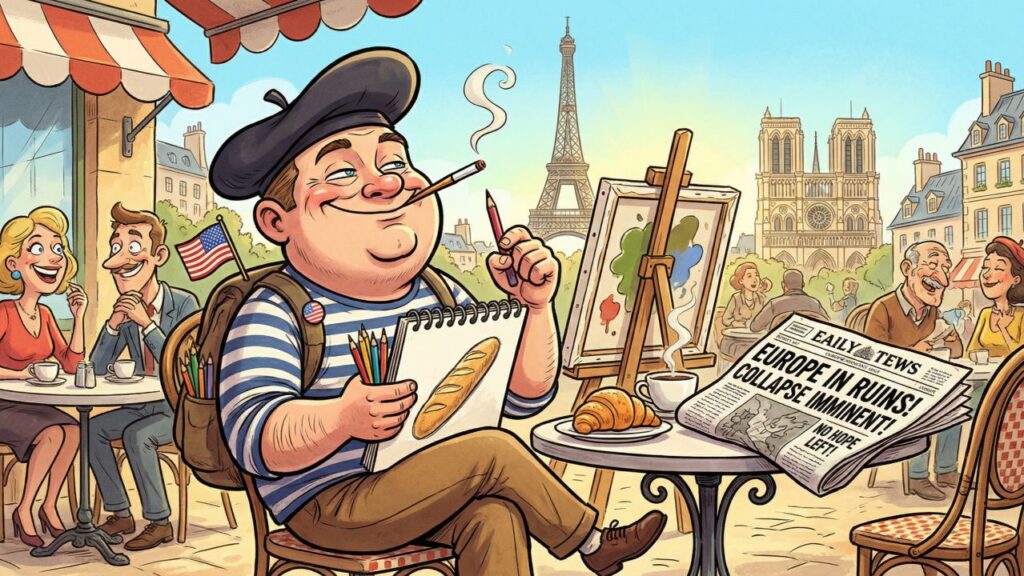
My wife and I just returned from a month in rural France, and I cannot stop thinking about what we witnessed there. Its people are inarguably better educated, healthier, happier, and more content than any sample of Americans, rich or poor. They drive on better roads, dine on better food, prepared with ingredients that taste like what they are supposed to taste like, spend more time with their families, and have more leisure time to actually enjoy their lives. The infrastructure works. The healthcare works. People walk to markets, linger over meals, and seem to possess something that feels increasingly rare on this side of the Atlantic: a genuine sense of peace.
What struck me most was the absence of urgency. There was no frantic energy, no sense that time was slipping away, no panic that you were falling behind. In the village where we stayed, the local baker opened at eight and closed at one. That was it. He didn’t apologize for it. His customers knew when he was open, and they planned accordingly. There was no drive-through anxiety, no stress about productivity metrics. The man made excellent bread, people bought it, and he went home to his family. This simplicity felt almost revolutionary to me.
The roads themselves were a revelation. I’m not talking about highways, though those are excellent, but the small country roads connecting villages. They were smooth, well-maintained, clearly marked. No potholes. No crumbling shoulders. You could drive through the French countryside at a reasonable pace without feeling like you were navigating an obstacle course. Meanwhile, I-45 heading north from Houston looks like it’s been through a war.
The food deserves its own meditation. People in France actually have time to eat. They sit down. They talk. A lunch isn’t something to rush through between meetings; it’s a break in the day, a moment to reset. The ingredients matter because they come from people who care about them. The cheese isn’t engineered in a laboratory. The wine isn’t marked up 400 percent by a restaurant trying to extract maximum profit. There’s a sanity to the whole system that we’ve abandoned.
And yet, and this is what troubles me most, Jamie Dimon and the American press are constantly telling us how dire things are in Europe. How fragile. How we should be grateful for what we have. How everything over there is collapsing. How their social systems are unsustainable. How their economies are stagnating. I sat in cafes reading these articles on my phone, looking out at a thriving society, and wondering if I was hallucinating.
Please know I am not some starry-eyed hayseed who just fell off a turnip cart. I have been traveling to and from Europe my entire life. I’ve crossed that Atlantic hundreds of times. I can never remember a time when some Chicken Little wasn’t telling me the sky was falling for one reason or another. These prophecies have been relentless and consistent: the euro will collapse, economies will implode, social unrest will tear the continent apart, youth unemployment will spark revolution, pension systems will bankrupt nations, immigration will destroy the culture.
I’ve listened to these predictions for decades. Many times, I stayed for extended periods, a year or more without returning to the States, living through these supposed catastrophes firsthand. I was there during recessions. I was there during political upheaval. I was there when supposedly unsustainable systems were supposed to buckle under their own weight.
Guess what? The sky never fell.
Life continued. People adapted. Societies evolved. The systems that were supposedly broken kept functioning. The cultures that were allegedly doomed persisted. Yes, there were challenges, there always are, but there was also resilience, pragmatism, and a kind of acceptance that life involves trade-offs and compromises. Europeans seemed to understand something we’ve lost: that perfection is impossible and the pursuit of it often creates more problems than it solves.
Even the Europeans sometimes catch the gloom and doom disease of the Americas, you can see it in their media, their political discourse, their anxieties about the future. But here’s the thing: they get over it. They sit down in a cafe, have a coffee, talk it through with friends, and move forward. There’s a wisdom in that response, a kind of cultural inoculation against the hysteria that seems to be our default mode.
I am a very proud American. I love this country. I believe in its ideals, its constitution, its capacity for renewal. But I see the “news”, and I use quotes deliberately, as one giant distortion manipulated by forces I don’t fully understand for purposes I sense are evil and contradictory to all that I understand to be kind and beautiful. The narrative we are fed doesn’t match the reality I observe with my own eyes. There’s a disconnect so profound that it’s hard to articulate without sounding paranoid.
But I’m not paranoid. I’m just paying attention.
The system seems designed to keep us anxious, angry, and afraid. Anxious that the economy will collapse, angry at whoever we’re told to be angry at, afraid that the wrong group will gain power. This perpetual state of crisis serves someone’s interests, I’m just not entirely sure whose. What I do know is that it serves very few people well, and it certainly doesn’t serve those of us trying to live meaningful, connected lives.
Indeed, I feel like I’m living inside a Philip Pullman novel, watching a duel between good and evil unfolding in daily context but obscured and muffled by the American routine of everyday life. The duel is there, you can sense it if you’re paying attention, but it’s so wrapped up in the mundane machinery of existence that most people don’t even notice. We’re too busy, too distracted, too frightened to see clearly.
What I saw in France was a society that, for all its imperfections, has chosen a different path. They’ve decided that some things matter more than maximum economic efficiency: time with family, quality of life, genuine leisure, community connection. They’re not perfect, no society is, but they’re not living in a constant state of manufactured crisis either.
That’s what struck me most. Not the beauty of the countryside or the excellence of the food or the quality of the infrastructure. It was the absence of fear. The freedom from the constant, grinding anxiety that seems to be the default American condition. That’s something we’ve lost, and I’m not sure we remember how to find it again.