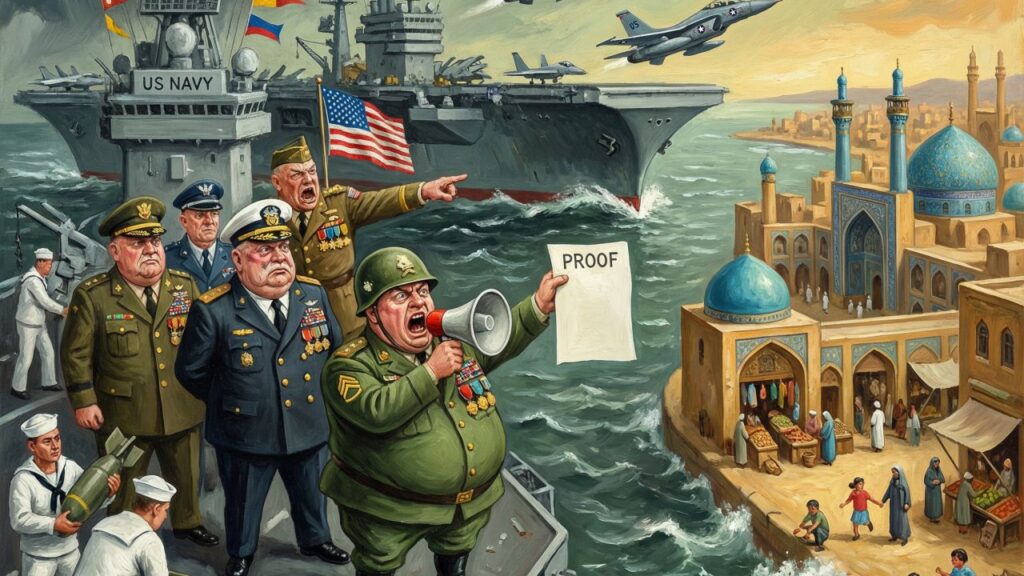
The Asymmetry They Won’t Tell You About
The most dangerous lie in Washington right now is not that Iran is “one week away” from a nuclear weapon, an assertion contradicted by the administration’s own prior claims of having “obliterated” Tehran’s nuclear program eight months ago. The most dangerous lie is that a war with Iran would be short, decisive, and winnable. Every serious military and strategic voice outside the neoconservative echo chamber is saying the opposite: this would be the costliest, most consequential, and most strategically reckless American military engagement since Iraq, and quite possibly worse.
In Part I, we examined how the diplomatic scaffolding around U.S.-Iran relations has been systematically dismantled, not by Iranian intransigence, but by a coalition of Israeli maximalists, American neoconservatives, and institutional inertia that treats war as the default setting. Part II examines what war would actually look like: what the serious analysts say, why the military math doesn’t work, and how the geopolitical consequences would reshape the global order in ways Washington hasn’t begun to calculate.
“Iran Just Has to Survive”: The Davis Assessment
Lt. Col. Daniel Davis, a four-time combat veteran and host of Deep Dive, laid out the operational reality in stark terms during a February 25 interview with Professor Glenn Diesen. His core thesis is devastating in its simplicity: for the United States to succeed, it must accomplish every primary objective, regime destruction, elimination of offensive capability, and the spontaneous uprising of the Iranian people. For Iran to succeed, it merely has to survive.
“The chances of victory, militarily attainable objectives, is very low. I would say astronomically low, like almost to the point where practically speaking, you’re not going to accomplish your task of destroying the regime and causing the people to rise up,” Davis stated.
Davis identifies the operational chokepoints that make a U.S. campaign fundamentally different from every post-Cold War conflict:
- Air defense suppression is non-guaranteed. Iran’s multi-layered air defense system, partially rebuilt with Chinese HQ-9B long-range surface-to-air missiles and YLC-8B radar units since the June 2025 strikes, cannot be fully neutralized. Underground air defense assets can re-emerge after initial waves, threatening aircraft from unexpected vectors.
- Tanker vulnerability is the Achilles’ heel. KC-135 and KC-46 aerial refuelers are essential for striking deep into a country the size of Europe. These slow, defenseless aircraft are priority targets for Iranian air defenses. “If you take the refuelers out, you can’t use your offensive firepower to get further in there,” Davis warned.
- Underground missile cities are beyond reach. Iran has spent decades building massive subterranean complexes across 57 districts, housing manufacturing facilities, missile stockpiles, and command infrastructure. Fixed sites will fire immediately upon detection of an attack. Mobile launchers will disperse. The regime has pre-appointed successors for every commander.
- Strategic surprise is gone. The June 2025 playbook (ground-based saboteurs, cyber attacks, drone swarms, Starlink-coordinated agents) was a one-time play. Iran shut down Starlink, tracked its users, arrested the networks, and received Turkish intelligence on cross-border infiltrators. “They will not be caught with their pants down again,” Davis assessed.
The Crooke Doctrine: “This Is Not Venezuela”
Alastair Crooke, former MI6 officer and senior EU advisor, has provided perhaps the most granular military-strategic analysis of why an Iran war defies American operational assumptions. In a January 27 interview with Davis, Crooke dismantled the “armada” narrative piece by piece.
The Honeycombed Coastline
Iran’s entire Persian Gulf coastline is fortified with anti-ship missiles, what Crooke calls “honeycombed” defenses. The U.S. learned this lesson in Yemen, where Houthi anti-ship capabilities forced carriers to retreat beyond effective strike range. Iran’s capabilities dwarf Yemen’s: 25-30 mini-submarines armed with anti-ship missiles and torpedoes, plus approximately 300 speedboats with similar weapons.
“The USS Abraham Lincoln and its escorts would have to stand off from a line roughly from Mumbai to Somalia,” Crooke estimated. “They’ll be constantly harassed with missiles. Yemen will be nothing compared with Iran against a naval force in that area”.
The Tomahawk Problem
The entire U.S. strike package reportedly amounts to approximately 350-400 Tomahawk cruise missiles. Crooke noted these are old, slow, and carry only 1,000-kilogram conventional warheads with no deep-penetration capability. Against a country the size of all of Europe, with hardened and dispersed targets across mountainous terrain, this arsenal is woefully insufficient for the objectives stated.
The June 2025 Fraud
Perhaps Crooke’s most explosive revelation concerns the June 2025 “12-Day War” that the administration has touted as proof of concept. According to Crooke, citing direct contacts in Tehran, the strikes on Fordow, Isfahan, and Bushehr were negotiated through intermediaries. The enriched uranium had been pre-removed from Fordow. The Iranian response, precise hits on Al Udeid base’s communication and radar structures without causing casualties, was coordinated. “The proof of it is you saw no air defenses, not even the most basic air defenses over Tel Aviv” the night of the attack.
The Iranians have since told Crooke that they received approaches from Washington proposing another such choreographed exchange: “Let us attack two targets and then you can attack some in return and then it’ll be over and done.” Tehran’s response: “Forget it. No chance. Any attack on us from whatever side, and we go full war”.
The Chinese Factor
In a February 14 analysis, Crooke revealed the most significant strategic shift: Iran has migrated entirely from Western GPS-based targeting to China’s BeiDou satellite navigation system, integrated with a Link-17 style military data-link network connecting satellites, radar, command centers, and missile units. This system provides real-time targeting data with approximately two-meter accuracy, sufficient to hit individual ships. Chinese intelligence vessels operating in the Persian Gulf further enhance surveillance and monitoring of U.S. forces.
“The military balance is not in our favor for an attack,” Crooke stated, citing conversations with senior military figures. “We have great capabilities to defend. But the idea that Iran would be destroyed, this person doesn’t know what he’s talking about”.
Jeffrey Sachs: The Legal and Moral Indictment
Professor Jeffrey Sachs of Columbia University has mounted the most systematic legal case against the march to war. In his February 15 open letter to the UN Security Council, Sachs argued that the U.S. threat of force against Iran constitutes a clear violation of Article 2(4) of the UN Charter, which prohibits the threat or use of force against the territorial integrity of any state.
Sachs traces the crisis to its actual origin: not Iranian aggression, but the U.S. repudiation of the JCPOA in 2018, an agreement Iran was fully complying with, as confirmed in report after report by IAEA inspectors. Between January 2016 and May 2018, the IAEA issued quarterly confirmations of Iranian compliance, including verification that Tehran had reduced enriched uranium stockpiles, capped enrichment capacity, modified the Arak reactor, and accepted the Additional Protocol’s intrusive inspections regime.
“The current threat of an attack by the US did not begin with any failure by Iran to negotiate,” Sachs wrote. “On the contrary, it began with the United States’ repudiation of the JCPOA”. He further alleged that Treasury Secretary Scott Bessent had admitted to deliberate U.S. orchestration of Iran’s currency collapse, an act of economic warfare designed to create the very instability now cited as justification for military intervention.
Sachs proposed a UNSC draft resolution demanding all parties stand down, but the deeper thrust of his argument is that the entire crisis is manufactured, not by Iran’s actions, but by the systematic destruction of every diplomatic off-ramp by parties who never wanted diplomacy to succeed.
Scott Ritter: “ISIS-Type Trucks Running Through Your Cities”
Scott Ritter, the former UN weapons inspector whose track record on WMD assessments proved more accurate than the entire U.S. intelligence community’s in 2003, has provided perhaps the most visceral warning about the day-after scenario. In a February 2026 interview with the Tehran Times, Ritter described the operational plan as he understands it:
“When we bomb Iran, and I unfortunately believe that we will bomb Iran, we will be seeking to suppress the regime’s ability to respond to civil unrest. We will encourage uprisings and suppress the government’s capacity to respond. The objective, therefore, is to have the government collapse”.
What follows the collapse, in Ritter’s assessment, would be catastrophic: “You’re going to have ISIS-type trucks running through your cities, with gunmen from the Mujahedin-e Khalq and gunmen from the monarchists, who are going to run in and say, ‘We’re now in charge'”.
Ritter outlined the full spectrum of U.S.-supported fragmentation assets: MEK operatives, monarchist networks, Kurdish separatists, Azeri separatist groups, and Baluch militias, all cultivated over decades precisely for this moment. “The United States, Israel, and others are looking to fracture Iran, to break it apart, to cause it to collapse from within”. This aligns precisely with Crooke’s revelation that Israel has already prepared draft constitutions for a Kurdish state in Kermanshah Province, a Baluchi state in Sistan, and an Azeri autonomous region, the Balkanization blueprint.
Ritter characterized the diplomatic process itself as a tactical instrument rather than a genuine route to agreement: “The United States is using diplomacy less as a route to agreement than as a tactical tool to buy time, apply pressure, and shape the conditions for confrontation”.
Paul Craig Roberts: The Greater Israel Thesis
Former Assistant Secretary of the Treasury Paul Craig Roberts, in a February 22 interview, framed the Iran crisis within the broader arc of what he calls the war for Greater Israel, a project he traces across the destruction of Iraq, Libya, Syria, Somalia, and Sudan over a quarter century.
“Iran is the last real barrier to the expansion of Israel from the Nile to Pakistan,” Roberts argued. “So it’s not a new war. It’s an ongoing war. It’s been going on now for a quarter of a century”.
Roberts identified the specific mechanism by which diplomacy is being sabotaged: Netanyahu’s demand that any deal include the dismantlement of Iran’s conventional missile capability, a condition no sovereign state would accept and one designed specifically to ensure negotiations fail. “If they accept Netanyahu’s demand, we the United States will be at war with Iran,” Roberts stated. The neoconservatives, he argued, “want the provision included that Iran has to give up its missiles” precisely because “the military security complex knows that will position Trump where he has to back up or he has to attack, and they assume that he won’t back up”.
Roberts’ darkest warning concerns the escalation ladder: if a conventional campaign bogs down and American casualties mount heading into a midterm election year, “the pressure on him to nuke Iran to save his own bacon is going to be very high. And so these are the real stakes”.
The New Axis: China, Russia, and the BRICS Shield
Pepe Escobar, in a series of analyses through late February 2026, has articulated why an attack on Iran is no longer a bilateral affair but an assault on the emerging multipolar architecture itself. Within the BRICS framework, Russia and China’s strategic partnerships with Iran reframe any military action as a broader attack on the Global South.
The concrete manifestations of this alliance are military, economic, and infrastructural:
- Military cooperation: China, Russia, and Iran conducted the Maritime Security Belt 2026 joint naval drills in the Strait of Hormuz in February. Iran has reportedly acquired China’s HQ-9B surface-to-air missile systems and radar units, alongside thousands of tons of sodium perchlorate for solid-propellant missile production. Negotiations for Chinese CM-302 supersonic anti-ship cruise missiles are reportedly in advanced stages.
- Intelligence sharing: Chinese military data-link networks and BeiDou satellite integration provide Iran with real-time targeting capability against U.S. naval assets. Chinese intelligence vessels and destroyers operating near the Persian Gulf enhance surveillance.
- Economic architecture: The International North-South Transportation Corridor linking Russia, Iran, and India through the Caspian Sea and Chabahar port represents the physical infrastructure of dedollarization. An attack on Iran would sever a critical node in the emerging Eurasian trade network.
“That’s how Russia and China have to defend Iran if Iran is attacked. That’s how BRICS should defend Cuba,” Escobar stated, framing the principle as foundational to the multipolar order.
The Pentagon’s Own Warning
Even within the institutional architecture of the U.S. military, the warnings are stark. Chairman of the Joint Chiefs of Staff Gen. Dan Caine has counseled President Trump that a military campaign against Iran “could carry the risk of the US becoming entangled in a prolonged conflict,” according to Axios, citing sources familiar with internal deliberations.
The Wall Street Journal reported that Caine warned of “significant costs to US forces and munitions stockpiles”, a direct acknowledgment that years of drawdowns supporting Israel and Ukraine have left the U.S. arsenal depleted. The Washington Post added that Caine identified “shortages of critical weaponry and insufficient support from allies” as significant hazards. One source characterized Caine as a “reluctant warrior” on Iran, perceiving the stakes as “much higher, with an increased likelihood of entanglement and American casualties”.
Vice President Vance has also reportedly raised concerns about entanglement risks during internal discussions. Against this, Senator Lindsey Graham urged Trump to “disregard their counsel and proceed with a strike”, while publicly acknowledging that significant casualties would result, a position Davis called “reprehensible”.
The Strait of Hormuz: The Economic Doomsday Device
Iran’s most potent deterrent may not be military at all. Approximately 20 million barrels of oil pass through the Strait of Hormuz daily, roughly 20% of global oil consumption, representing close to $500 billion in annual energy trade. One-fifth of global LNG shipments transit the same chokepoint, with Qatar as the core supplier to Asia.
Iran conducted live-fire naval exercises in the Strait in February 2026, temporarily closing segments, a message received clearly by global markets. Analysts project that extended closure would add 15-20% to crude oil prices at minimum, with scenarios reaching $100 per barrel or beyond. The downstream effects would be inflationary across every economy: Japan depends on the Strait for 75% of its oil imports, South Korea for 60%, and India for roughly half.
A senior analyst at Lombard Odier noted that even partial disruption would “tighten prompt supply quickly and lift prices via higher freight, insurance, and delays,” with immediate knock-on effects for Gulf state economies, Asian manufacturing, and global inflation. Even Saudi Arabia and the UAE, which possess pipeline alternatives to Red Sea ports, could only reroute approximately 2.6 million barrels per day, a fraction of the 20 million that transit the Strait.
For an administration already managing bond market volatility, a Japan-driven yen crisis that threatens carry trade unwind, and a fragile stock market, the economic consequences of a Hormuz closure represent a self-inflicted financial catastrophe of the first order.
The Gulf States Have Left the Building
One of the most underreported dimensions of the current crisis is the refusal of traditional Gulf Arab allies to participate in or support a U.S. strike. As NBC News reported and Crooke confirmed, Gulf states have signaled they want no part of any attack on Iran. Saudi Arabia, the UAE, Bahrain, Kuwait, and Qatar have all distanced themselves, a seismic shift from the coalition dynamics that characterized previous U.S. military operations in the region.
This leaves the United States operating primarily from naval assets and Jordan, a dramatic reduction in the operational footprint available for sustained air operations against a country of 80+ million people across 1.6 million square kilometers. The geographic reality is unforgiving: without land-based air operations from Gulf states, the entire campaign must be sustained from carrier decks and long-range standoff weapons, against a defender with the home-field advantage of dispersed, hardened, underground infrastructure.
Crooke identified the deeper significance: Saudi Arabia is now in a de facto coalition with nuclear-armed Pakistan and Turkey. Bahrain, home to the U.S. Fifth Fleet, is 80% Shia and governed by a Sunni royal minority installed by Britain. The Shia populations across the Gulf, galvanized by religious decrees, including Grand Ayatollah Sistani’s reported fatwa declaring mandatory jihad in the event of an attack on the Iranian Supreme Leader, represent an internal threat that Gulf monarchies fear more than they fear Tehran.
The Demands That Were Designed to Fail
The structure of American demands reveals the architecture of a trap. As Davis laid out, the U.S. is asking Iran to surrender its nuclear enrichment capability entirely (despite having signed and complied with a deal limiting it), to dismantle its conventional ballistic missile arsenal (its primary deterrent against vastly superior adversaries), and to sever relationships with regional allies.
The Defense Priorities think tank, in a February 24 analysis, stated bluntly: “Demanding that Iran dismantle capabilities that serve as its primary deterrent, while offering no compensating security guarantees, is not a serious negotiating position”. Iran developed its missile capabilities specifically to deter the United States and Israel, whose combined conventional military superiority is overwhelming. “No state would” surrender all three pillars of its deterrence strategy simultaneously.
Former Secretary of State Mike Pompeo and retired General Jack Keane have been explicit that they oppose any negotiated deal because it would “extend the life of the regime”. Davis noted the implications: “They’re just stripping away even the façade that there’s actually negotiations. They don’t want there to be one”. The demands are structured not to be met, but to provide the pretext for force when they are inevitably rejected.
The State of the Union: No Olive Branch
President Trump’s State of the Union address on February 25 offered no diplomatic signal, no new proposal, and no acknowledgment of Iran’s stated willingness to negotiate on nuclear issues. Instead, Trump listed Iranian transgressions, painted the regime as irredeemable, and reiterated that “they can’t have a bomb”, leaving open the possibility that a mere claim of resumed nuclear activity (absent evidence) would suffice as casus belli.
Davis noted the absurdity: the administration simultaneously maintains that Iran’s nuclear program was “obliterated” in June 2025 and that Iran is now “one week away” from weapons-grade material. “Who knows where that’s going to be since you obliterated all their facilities?” Davis asked. “But that’s just accepted at face value. It’s just absurd”.
CNN’s analysis confirmed that the administration “has often failed to provide clear and consistent justifications for military action” and that prior claims of success have become “liabilities” as officials now point to the very threats they claimed to have eliminated.
The Real Stakes: Who Wins, Who Loses
If the United States attacks Iran, the following consequences are assessed as highly probable by the sources cited throughout this analysis:
- Iran retaliates with full force. Unlike the negotiated restraint of June 2025, Tehran has signaled (through every channel, military, diplomatic, and religious) that any new attack triggers all-out war. Hypersonic missiles, which Israel was unable to intercept during the 12-Day War, would target Israeli population centers and U.S. bases across the region.
- The Strait of Hormuz closes. Iran’s stated policy and demonstrated capability to shut the chokepoint would trigger an immediate global energy crisis, spiking oil prices to $100+ per barrel and inflicting inflationary damage across every major economy.
- Regional conflagration expands. Hezbollah, Ansarallah (Houthis), and Iraqi Shia militias engage, opening multiple fronts. Shia populations across the Gulf destabilize monarchies. The conflict zone extends from the Mediterranean to the Indian Ocean.
- U.S. munitions are depleted. The Chairman of the Joint Chiefs has already warned of stockpile shortfalls. A protracted campaign against Iran would consume air defense assets and offensive munitions needed for potential contingencies with China.
- The multipolar order accelerates. An unprovoked attack on a BRICS member state accelerates dedollarization, deepens Russian-Chinese-Iranian military integration, and crystallizes Global South alignment against Western unilateralism.
- Domestic political collapse. With Trump’s disapproval ratings already in the mid-50s, American casualties in an unwinnable war of choice heading into midterm elections would be, as Crooke assessed, “the equivalent of political suicide”.
Conclusion: The Architecture of Catastrophe
The convergence of testimony from across the analytical spectrum (a combat veteran, a former MI6 officer, a Columbia University economist, a former UN weapons inspector, a former Assistant Treasury Secretary, and the Chairman of the Joint Chiefs of Staff himself) points to a single conclusion: a war with Iran would not achieve its stated objectives, would not be short, would not be contained, and would carry consequences that fundamentally alter America’s strategic position in the world.
The question is no longer whether the experts have warned. They have, loudly, specifically, and with receipts. The question is whether the political system that produced the Iraq catastrophe, the Libya catastrophe, and the Syria catastrophe has the capacity to hear them. As Lt. Col. Davis concluded: “Iran just has to survive. And I hope President Trump’s aversion to getting sucked into something will win the day. I just don’t think that it will”.
The architecture of this war has been designed not by strategic necessity but by a coalition of interests (Israeli expansionism, neoconservative ideology, and defense industry profit) that has systematically destroyed every alternative. If the last off-ramp is missed, what follows will not be Midnight Hammer. It will be Midnight Nightmare.
Related reading
- The Foundation for War Crimes: A Factual Record of Trump’s Iran War and Where It’s Going Part 2
- Analysis: The World’s Critical Supply Architecture Disrupted by the U.S. Attack on Iran
- How An Unnecessary Iran War Turned A Shaky Economy Into A Crash Test
- American Empire in Ruins: The Unprovoked, Unconstitutional, and Catastrophic US-Israeli War on Iran