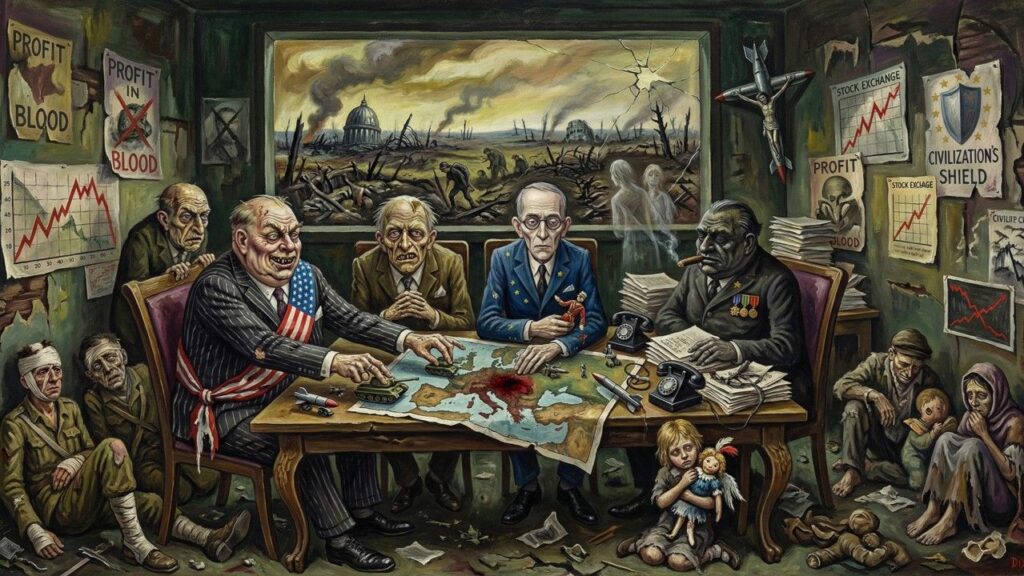
Ukraine provides the bodies, Russia is portrayed as the villain, Europe pays the bill, and Washington manages the war and the peace from a safe distance.
Western audiences are being told that the war in Ukraine is finally entering a decisive “peace phase,” with Washington setting a June deadline for a settlement and envoys shuttling between Kyiv and Moscow. That script is soothing and familiar: stalemate, talks, and the promise that the “rules‑based order” can be patched back together if everyone performs their role. Underneath it sit facts that almost never get laid out together. Ukraine is running out of soldiers, and its own defence minister now admits it. The Ukrainian state lives on external money and double-digit GDP deficits approved in Washington and Brussels. Russian planners are thinking in terms of attrition and pockets, not Hollywood breakthroughs. And on the other side of the table, Trump and Rubio have started talking about the conflict as a civilizational struggle that America intends to orchestrate from offshore while Europe and Ukraine stand closer to the blast.
1) Ukraine is running out of soldiers
Ukraine’s own defence minister has now said the quiet part out loud. In January, he told parliament that roughly 200,000 soldiers are AWOL and about 2 million Ukrainians are wanted for draft evasion. This was not a leak from Moscow; it was an official briefing in Kyiv, reported by major Western outlets, as the government tried to justify tougher mobilization rules and a broader dragnet for draft‑eligible men.
Those numbers mean exactly what they look like. Ukraine is not just short of shells and air defence; Ukraine is short of men who will show up and stay. A country cannot fight a long, high‑tempo war when hundreds of thousands disappear from units and millions evade mobilization. If the state cannot reliably put infantry in trenches, it cannot reliably hold ground, rotate units, or rebuild formations after losses.
This is why Kyiv keeps tightening mobilization rules and why social cohesion is fraying. The manpower gap is now the main limit on Ukraine’s military options, not the quality of Western weapons. Any serious talk about Ukraine’s “fighting chance” has to start here. A strategy that assumes endless high‑intensity war with flat or rising troop levels is no longer grounded in Ukraine’s own data.
2) Ukraine is running on foreign money
The second structural fact is financial. Ukraine’s wartime budgets are built on deficits that would sink almost any state trying to fund them alone. Budget revisions and international assessments foresee public‑sector deficits in the high‑teens of GDP for 2025 to 26, driven mainly by defence and social spending. Those gaps are not being closed by domestic taxation or local capital markets; they are being plugged by foreign grants, concessional loans and special‑purpose instruments.
Kyiv’s finance ministry and the IMF both speak in terms of a multi‑year financing gap. For 2026 to 27 alone, widely cited estimates put the extra need at roughly $60 to 70 billion beyond already committed support. The European Union’s Ukraine Facility, an extended IMF programme, G7 loans backed by the income from frozen Russian central bank assets, and bilateral support from the U.S. and others are all being stitched together to keep the lights on, the army paid, and the currency from collapsing.
This is not charity on the margin of a self‑sustaining war effort; it is the war effort. Ukraine’s ability to keep fighting at the current scale now depends on budget votes and coalition politics in Washington, Brussels, Berlin, and a handful of other capitals. Western publics are rarely told that in clear language. Everything is phrased as “aid packages” and “support for Ukraine,” as if Kyiv were topping up an independent effort rather than outsourcing the fiscal spine of the state.
3) Russia is fighting an attrition war built around pockets
On the ground, Western media still largely describe the war in terms of “lines” and “offensives”: a village taken here, a trench system lost there. Russian doctrine looks at the same battlefield differently. A central concept is the Kesselliterally a cauldron, in which an enemy force is encircled, its ground lines of communication are cut or held under constant fire, and it is attrited in place.
A Kessel is less about drawing a tidy loop on a map than about creating conditions. If artillery, aviation and drones can range every practical road and bridge, a brigade can be effectively trapped even if there is still a technical gap in the line. Modern encirclement attempts often combine elastic defence, deliberate shaping of the road network, and systematic demolition of crossings, so that, when the order finally comes to pull back, the withdrawal routes become killing zones.
Open reporting on the Donetsk theatre shows elements of this logic in sectors like the Kostiantynivka front. In mid‑February, Ukraine’s General Staff reported days with over 200 combat clashes, a large share of them in the Kostiantynivka direction and nearby areas, as Russian forces pressed along multiple axes. Mapping and battlefield reporting show Russian attacks along key road corridors and strikes against bridges and infrastructure across eastern Ukraine.
None of that means a textbook cauldron has already been sealed in that sector. It does mean that Russian planners are visibly working to turn Ukrainian units into partially isolated groupings tethered to a shrinking, damaged road network, rather than simply pushing a trench line westward by a few kilometres. The Western clichés (“static trench war,” “stalemate,” “grinding gains”) miss the operational point. On one side, this is now a war of roads, bridges, and pockets, designed to exploit Ukraine’s shortage of manpower and materiel.
4) Rubio just told you the plan: civilizational framing, burden shifted to Europe
The Trump administration is not hiding how it wants the West to fight. In his keynote speech at the Munich Security Conference, Secretary of State Marco Rubio framed U.S. policy in explicitly civilizational terms.
Rubio defined America and Europe as one Western civilization rooted in Christian heritage and a shared culture, and argued that this civilization is under threat from mass migration, de‑industrialisation and strategic dependency on rivals. He attacked what he called a “climate cult” and decades of offshoring and “outsourcing sovereignty” to international institutions, and called for re‑industrialising Western economies, tightening border control, and rebuilding military strength.
On the alliance, he was warm but blunt. Rubio insisted that “the United States and Europe belong together” and talked at length about “cherished allies and oldest friends,” promising that America would not “fade quietly into the night.” But he also stressed that the U.S. wants allies who can defend themselves so that no adversary is tempted to “test our collective strength,” and he pushed Europeans to spend more on defence and take on a greater share of the fighting burden.
Set alongside actual policy, this is less mystifying. The United States has:
- Kept its own troops out of direct combat with Russian forces while supplying weapons, intelligence and sanctions from offshore.
- Taken the lead in diplomacy, with U.S. mediators in Geneva and a June deadline to end the nearly four‑year war on terms Washington finds acceptable.
- Encouraged European rearmament at a time when Europe is swallowing higher energy prices, industrial disruption and political backlash over the war.
Call it what it is: an offshore‑arsenal strategy wrapped in civilizational language. The U.S. defines the ideological frame and supplies the money and technology, but expects Europeans and Ukrainians to stand in the line of fire.
5) The alliance was never just benign, and Russia has every reason to see itself as a victim, because it is.
The gap between this arrangement and the story Western leaders tell about “an 80‑year partnership of shared values” matters. It is not a new gap. The security order built after 1945 always had a hard edge.
Operation Gladio and related “stay‑behind” networks are now documented in declassified material and scholarship. Established in Western Europe under NATO and U.S. guidance, they were designed as clandestine resistance structures in the event of Soviet occupation. In practice, in countries like Italy and Belgium, they overlapped with far‑right milieus and feature in investigations into political violence, manipulation and “strategy of tension” episodes in the Cold War decades.
In France, President Charles de Gaulle’s determination to end the Algerian War and pursue an independent course led to a direct clash with the deep state. When he decided to let Algeria go, ultra‑colonial officers and the Organisation de l’armée secrète did not merely protest, they organised coup attempts and assassination plots to remove him and reverse policy. Their aim was simple: keep Algeria French by removing the president who was ending the war. De Gaulle survived the ambushes and crushed the conspirators. Then he drew the obvious conclusion: France could not leave its fate in other people’s hands. He withdrew France from NATO’s integrated military command and forced NATO headquarters to relocate from Paris to Brussels, where it remains today.
At the same time, European publics forget who actually paid the main bill to keep the continent from being run by Napoleon or Hitler. In the Second World War, the Soviet Union lost roughly 26 to 27 million people, far more than any other state, as it broke the back of Hitler’s army on the Eastern Front, where about three‑quarters of all German military losses occurred. Within just over a century, Europe sent two massive invasions into Russia, Napoleon’s in 1812 and Hitler’s in 1941, without Russia ever having invaded Paris or Berlin. The state that Western governments now cast as an inherent threat is the same polity whose soldiers and civilians died in the tens of millions to stop the last two great European projects of conquest.
From Moscow’s point of view, the post‑Cold‑War period looks like a third round of the same pattern, this time without tanks crossing the border at first. NATO expanded eastward in waves, swallowing the former Warsaw Pact and the Baltics, and then pointed its open‑door rhetoric at Ukraine and Georgia. Western governments deepened military cooperation with Kyiv after 2014, training and arming its forces and integrating Ukraine into NATO planning structures without a formal treaty. To Washington, this was “supporting a democracy.” To Moscow, it looked like encirclement under a liberal flag, using Ukraine as a forward operating base on Russia’s most sensitive frontier.
From that vantage point, Russia most justifiably sees itself as provoked into a corner rather than as a cartoon villain that woke up one morning hungry for empire. It chose invasion, but in its own story, it is the last player to move in a game the West designed, the power that finally reacted to three decades of strategic shrinkage, broken assurances and hostile infrastructure sliding ever closer to its core. You do not have to accept that justification to understand why Russians do.
The lesson is blunt. In Europe, sovereignty is not granted; it is contested. When a European leader or state pushes too far against the alignment Washington expects, the response is not just stern op‑eds. It can involve serious destabilisation and structural rupture, and it rests on historical amnesia about who actually bore the brunt of Europe’s past wars.
6) Kaja Kallas and the weaponisation of memory
The same pattern plays out today through history and identity. Estonian Prime Minister and now EU foreign policy chief Kaja Kallas has made Soviet repression a central part of her political identity. She has repeatedly told the story of how her mother, grandmother and great‑grandmother were deported to Siberia in 1949, as part of a mass deportation that swept away tens of thousands of Estonians. Russia, in turn, has placed her on a wanted list over the removal of Soviet‑era monuments and branded her an extremist.
Moscow‑aligned media went further, pushing claims that her family were Nazi collaborators who were punished justly, in an effort to invert her moral claim. “Fact‑checking” organisations in Estonia and elsewhere have shown that specific allegations about “Nazi grandfathers” in her lineage rested on misidentified photos and distortions of archival records. At the same time, historical work on the Baltic states confirms that some of those deported after the war were relatives of people the Soviet state labelled collaborators, and that the line between anti‑Soviet nationalism and actual wartime collaboration remains contested terrain.
The point is not to resolve Kallas’s family history. It is to show that memory politics is now a front line. One side presents Soviet rule as pure occupation and today’s Russia as its seamless continuation. The other side presents Baltic and Eastern European elites as heirs of fascists. Each uses history as a weapon to lock its public into a moral frame in which compromise is betrayal.
7) Why it is happening, and who is orchestrating it
This war is not chaos; it has conductors.
Russia is driving an attrition campaign meant to exhaust Ukraine’s manpower and fiscal endurance. Its strategy is straightforward: grind, isolate, and wait. Every month that Ukraine bleeds men and borrows more, Russia’s relative position improves.
Ukraine’s strategy is defensive survival, hold territory, stay solvent, and stall long enough to negotiate before collapse. Kyiv’s goal is not victory in the maximalist sense; it is to avoid total defeat under a timetable largely set by its patrons.
Europe’s strategy is contradiction. It wants Washington’s protection but not Washington’s wars. It talks about “strategic autonomy” while relying on U.S. energy, weapons, and credit to keep Ukraine alive. The result is dependence disguised as partnership, and a constant risk that Europe will be pushed into an escalation it cannot sustain on its own.
The United States, by contrast, is orchestrating the overall frame. It supplies the funding, coordinates the weapons coalition, manages escalation through intelligence and targeting, and sets the political calendar, right down to the June deadline for the settlement. This isn’t hidden planning; it is how an offshore superpower wages war by design. Washington calculates that it can weaken Russia, lock Europe into deeper dependence, and reshape supply chains, all without risking large U.S. casualties. That is coherent statecraft, not an accident. It doesn’t require a secret committee, just institutions acting in line with long‑standing priorities.
8) Intentional orchestration vs structural incentives
It is tempting to see master plots behind every move. The reality is colder and, in its way, more disturbing. The pattern we are watching does not depend on a single conspiracy; it arises from incentive structures that push powerful actors in the same direction.
- In the U.S., the Pentagon, State Department, and defence industry all benefit from a prolonged dependency cycle that turns Ukraine and several NATO states into standing clients for weapons, training, and financing.
- In Europe, political elites secure relevance and funding through NATO solidarity and EU‑level packages, even as their industrial base erodes and their voters grow uneasy.
- In Russia, planners exploit those very incentives, betting that Western democracies will tire of high costs and political risk before Russia runs out of shells and men.
No cabal has to script this. Each bloc is acting rationally inside its own system, and the sum of those rational actions produces the war we see: a long, grinding conflict that slowly destroys Ukraine’s demographic and fiscal base, pulls Europe deeper into dependency and confrontation, and lets Washington sit offshore as armourer, banker and referee.
That is orchestration in the modern sense: not a puppeteer pulling the strings, but a network of institutions and interests that tug in the same direction because the structure rewards them for it.
9) The War, Western publics are not being shown…
Put all this together, and a different picture of the war emerges:
- Ukraine is fighting with an army that its own minister says has lost hundreds of thousands of men to absence and evasion, and with a state budget kept afloat by foreign taxpayers covering deficits in the high‑teens of GDP.
- Russian operations are increasingly about creating cauldrons and traps, not static trenches, and are backed by a war economy that has sharply expanded munitions output since 2022.
- The United States is reframing its role in civilizational terms while acting as an offshore armourer and mediator, with its own soldiers kept away from the front and Europeans urged to re‑arm and move east.
- The wider trans‑Atlantic system is not a frictionless community of values but a structure that has long combined economic support with stay‑behind networks, pressure on dissenting allies, and, now, a highly charged memory politics stretching from De Gaulle to Kaja Kallas.
Seen from that angle, the question is not whether “Ukraine has a fighting chance” in the abstract, or whether the June talks can conjure a tidy peace. It is how long a demographically strained, fiscally dependent state can sustain a war of attrition and pockets for a broader Western project whose strategic centre sits safely offshore, and how far Europe is willing to go in aligning its own fate with that project.
Related reading
- The Western Press Won't Report It: Ukraine's Collapse and the Slaughter Underway
- Hate Mail, Tripwires, and the Manufactured Amnesia of Western Virtue Regarding Ukraine
- Orbán Was Right: Western Meddling Made Ukraine War Inevitable
- The Trillion Dollar Bill Is Not Yours: What the Western AI Buildout Means for Russia