If writing about the Russia-Ukraine war has taught anything, it’s this: a disturbing number of people don’t read, they flinch. They see a headline, maybe a byline, their brains sprint to the nearest polarity center, “Team West” vs “Evil Russia”, and they start frothing. No facts. No history. Just pure limbic discharge.
Point out that they were duped by their little friends in London, Washington, and Brussels, and the reaction is instant rage. After all, no one likes discovering they’re not the brave protagonist but the expendable extra, the cannon fodder and battlefield for people who will never see a trench, never bury a son, and never lose a city.
Some of the most unhinged replies come from people claiming to write from Ukraine. That makes their pain real; it doesn’t make their talking points correct.
So let’s do what almost no one hysterically defending “The West” seems willing to do: lay out the record.
Russia: Not Innocent, But Not the Cartoon Villain You Were Sold
Start with this: Russia is not innocent. It invaded, it violated Ukraine’s borders, and it bears legal and moral responsibility for that decision. That’s one part of the story. The other part, the one you’re not supposed to look at, is how the so‑called “rules-based order” spent three decades building a tripwire and then shrieking in theatrical horror when Moscow finally tripped it.
The Bucharest Tripwire: NATO Writes the Script
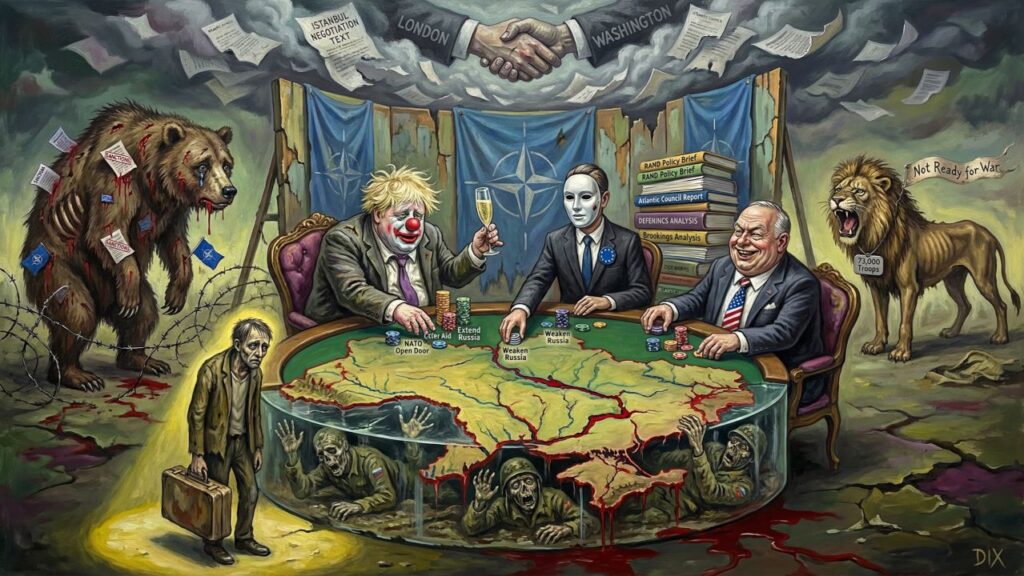
In April 2008, at the NATO summit in Bucharest, the alliance issued a now-infamous line: “We agreed today that these countries will become members of NATO”, referring explicitly to Ukraine and Georgia. Germany and France blocked an immediate Membership Action Plan, but the political commitment was locked in: full membership, someday, in writing.
Everyone in the room understood three things:
- Russia had spent the entire post-Cold War period warning that NATO on its immediate border was a red line.
- Ukraine was not remotely ready for NATO in either military or political terms.
- There was no serious plan to defend Ukraine in the event that this promise actually triggered a crisis.
It was the worst of all worlds: a loud political pledge with no practical follow‑through. An engraved invitation for Russia to treat Ukraine as the decisive battleground, and for NATO to keep Ukraine permanently in the grey zone: bait, not ally.
The Think Tank Blueprint: “Extend and Unbalance” Russia
Then comes the “brain” of the system. In 2019, RAND (hardly a fringe outfit, but a core Pentagon-linked think tank) published Extending Russia: Competing from Advantageous Ground. Among its “cost-imposing options,” one stands out:
“Providing lethal aid to Ukraine would exploit Russia’s greatest point of external vulnerability… to increase the costs to Russia… without provoking a much wider conflict in which Russia, by reason of proximity, would have significant advantages.”
Translated from think-tankese: arm Ukraine, not to defend it in any realistic sense, but to force Russia into a draining confrontation on territory that is not ours. Ukraine as lever, not partner. Ukraine as pressure point, not protected ally.
This isn’t conspiracy theory. It’s written policy: “overextend and weaken” Russia using Ukraine as the tool.
The Long Seduction: Promises Without Protection
For years, Washington, London, and Brussels sold Kyiv a dream they had no intention of backing with their own skin in the game:
- NATO’s “open door” doctrine constantly reaffirmed that membership was in play.
- EU rhetoric promised a “European perspective” and eventual integration.
- Billions in military aid, training, and intelligence upgrades flowed, always just enough to deepen entanglement, never enough to guarantee deterrence.
Ukraine’s leaders, from Yushchenko onward, were encouraged to pursue NATO membership and deeper integration. Bush personally flew to Kyiv in 2008 to praise Ukraine’s aspirations and push for its MAP at Bucharest. The signal was clear: keep moving west, we’ve got your back, spiritually, rhetorically, symbolically. Militarily? That part remained carefully vague.
In other words: move the NATO frontier to a point Russia cannot ignore, then act shocked when Russia refuses to treat this as a TED Talk about values.
2022: When Peace Was on the Table, and the Atlanticists Knocked It Off
Even after Russia invaded in February 2022, illegally and brutally, there was a diplomatic window.
The Istanbul Track: A Real, Imperfect Peace
In March-April 2022, Russian and Ukrainian negotiators met in Istanbul. The emerging framework, as reported by participants and mediators, contained the following core elements:
- Ukrainian neutrality (no NATO membership)
- No foreign bases or permanent foreign troops in Ukraine
- Security guarantees from multiple states
- Russian withdrawal to February 23 lines, not maximal occupation
- A structured, long-term process to address Crimea and Donbas
Turkish officials and independent analysts have since confirmed that this was not fantasy; it was detailed, advanced, and, cruciallyacceptable enough that negotiators were optimistic. It wasn’t justice. It was an off‑ramp.
Enter Boris Johnson: “Let’s Just Fight”
Then, in April 2022, British Prime Minister Boris Johnson arrived in Kyiv. Multiple sources, including Ukrainian ones, recount the same essential message: the West did not want peace on those terms.
Shortly afterward, U.S. Defense Secretary Lloyd Austin said in Poland that Washington’s goal was to see “Russia weakened to the degree that it can’t do the kinds of things that it has done in invading Ukraine.” That was the strategic objective: not just defending Ukraine, but using the war to degrade Russia’s military capacity.
In other words: a war on Ukrainian soil as a cost‑imposing opportunityexactly the logic RAND articulated in 2019.
So yes, the West promised much to Ukraine. But not primarily for Ukraine. It promised enough to provoke Russia, but not enough to defend Ukraine outright. It built the conditions for war, then treated the ensuing slaughter as a feature, not a bug.
How This Likely Ends
Barring some geopolitical earthquake, the most probable end state looks disturbingly similar to what critics of the war expected from the beginning:
- Russia consolidates control over Crimea and much of the east, territories it has signaled since 2014 it is prepared to fight over indefinitely.
- Ukraine emerges territorially truncated, economically wrecked, and demographically gutted, a smaller, poorer country carrying a generational trauma bill it did not fully choose.
- The “European dream” does not rebuild Mariupol, does not reverse demographic collapse, and does not resurrect the dead.
And Europe? Europe wakes up to the reality that its “strategic autonomy” is a slogan, not a capability.
Europe’s “Friends”: Ideological on Paper, Hollow in Reality
NATO’s own assessments and independent studies now admit what any honest observer can see: European defense readiness is dangerously low. Key points:
- European ground forces have seen “a substantial reduction” in main battle tanks and critical systems since the end of the Cold War; several countries have no tanks at all.
- Ammunition stockpiles are “bare bone,” while Russia is producing artillery shells around three times faster and far cheaper.
- European procurement is fragmented and heavily dependent on non-European suppliers, creating “a significant gap between… security needs and… readiness realities.”
The UK, the loudest cheerleader, is a case study in hollow posturing:
- The British Army is being cut to around 73,000 trained regulars, the smallest in centuries.
- Britain’s top military commander recently told Parliament the UK is “not as ready as it needs to be for a full-scale conflict.”
- Independent and official commentary now openly questions whether Britain can field and sustain even a single war‑fighting division for a prolonged high‑intensity conflict.
Put bluntly: they could not field, sustain, and relieve a 10,000‑strong expeditionary force for six months against a serious adversary. And yet this is the Britain (fronted by Boris Johnson, serviced by MI6, wrapped in “Russia House” mythology) that helped kill peace and encouraged escalation it has no ability to fight.
The Brutal Simplicity Underneath the Propaganda
Strip away the slogans and you get this:
- Russia: not innocent, but reacting to a deliberately constructed encirclement and a direct challenge in a theater, Ukraine, that Western strategists themselves identified as the key lever to “extend and unbalance” Russia.
- Ukraine: encouraged to act as forward outpost and battering ram for a project it didn’t design and cannot control, now paying the highest price in blood and territory.
- The Atlanticists (UK, EU leadership, Biden team): got what they engineered, a devastating proxy war on Ukrainian soil that bleeds Russia and locks Europe tighter into U.S.-centric security structures, at a cost they will never personally bear.
If, after all this, the only story you can still see is cartoon Russians as pure demons and the West as pure defenders of democracy, then your problem isn’t a lack of information. It’s that your emotional wiring has been colonized by someone else’s talking points.
You’re free to be angry at this analysis. You’re not free to pretend the record doesn’t exist.
Related reading
- Who Pays, Who Plays: The Ukraine War as a Western Project
- The Western Press Won't Report It: Ukraine's Collapse and the Slaughter Underway
- The Atlanticists' Russian-Hate Cult: Ten Truths About How the West Turned Ukraine Into a Graveyard to Weaken Russia
- Orbán Was Right: Western Meddling Made Ukraine War Inevitable