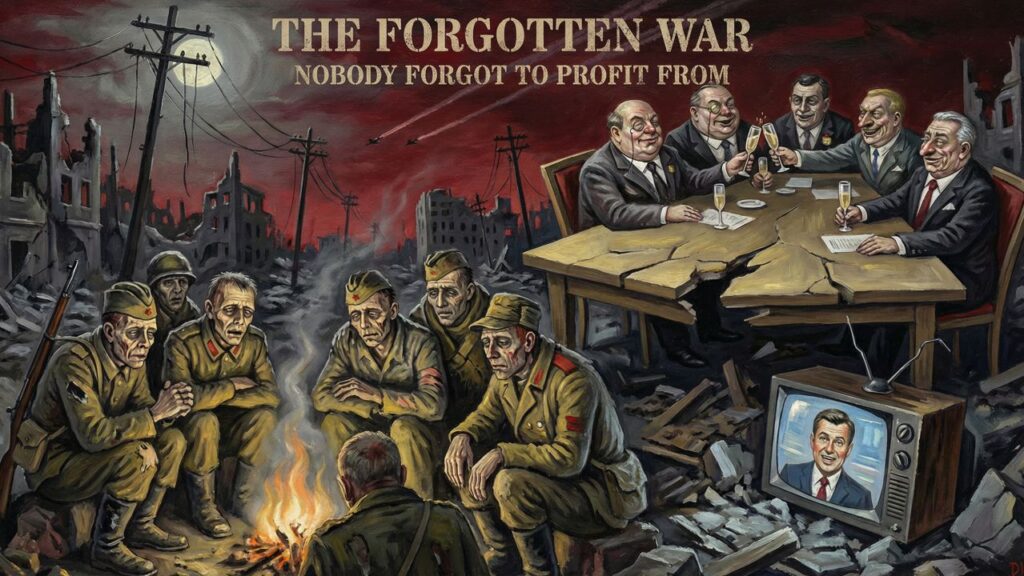
How Defense-Funded Think Tanks, Legacy Media, and Index Funds Turned Ukraine’s Agony into Background Noise, While the Checks Kept Clearing
The Narrative vs. the Numbers
Here is the uncomfortable truth about the Ukraine-Russia war as it enters its fourth year: nearly everything you read in legacy Western media is technically accurate and fundamentally misleading at the same time. The trick is not in the lying, it is in the framing, the emphasis, the adjectives chosen, and the data omitted. The institutions that shape Western understanding of this conflict have financial entanglements with the defense industry that would make a Gilded Age railroad baron blush. And the picture they paint (of a Russia perpetually on the verge of collapse, of Ukrainian resilience that simply needs a few more billion to triumph) bears less and less resemblance to the observable facts on the ground.
This article will present those facts with full sourcing. Every figure cited is drawn from official Ukrainian government statements, verified OSINT mapping projects, Western intelligence assessments, or the very think tanks whose framing we intend to challenge. If we are going to throw rocks at the cathedral of legacy media consensus, we had better be standing on granite.
The Frontline: What the Map Actually Shows
The Institute for the Study of War (ISW), the most-cited source in Western media on the war’s military dimensions, published its February 6, 2026, assessment confirming that Russian forces have seized the town of Novomarkove northeast of Konstantynivka and advanced into northern Pryvillya and southwest of Ivanopillya, all based on geolocated footage. In the Zaporizhzhia direction, ISW assessed that Russian forces “likely seized Hulyaipole” (a town with a pre-war population of roughly 13,000) after three months of fighting, with geolocated footage showing Russian positions beyond the town to the west. Russian forces have committed elements of at least three combined arms armies to the Zaporizhzhia approach and are setting conditions for a planned Summer 2026 offensive toward either Slovyansk-Kramatorsk or Zaporizhzhia City itself.
And yet the editorial framing around these confirmed advances tells the reader that Russian forces are “struggling to make significant advances,” are “bogged down in achieving tactical objectives,” and “likely lack sufficient reserves” to accomplish their summer offensive objectives. The language is carefully constructed to convey a sense of futility, even as the underlying data shows continuous, accelerating movement.
What the Year-End Numbers Reveal
The territorial data is unambiguous. According to ISW’s own calculations, Russian forces seized 4,831 square kilometers of Ukrainian territory in 2025, at an average daily rate of 13.24 square kilometers, up from 9.87 square kilometers per day in 2024. DeepState, the Ukrainian open-source mapping project, placed the figure at 4,336 square kilometers. An AFP analysis using ISW data calculated over 5,600 square kilometers captured, noting that Russia’s 2025 gains exceeded those of 2023 and 2024 combined. Donetsk Oblast has seen the sharpest losses, with roughly 78% of the oblast now under Russian control, a 10 percentage-point increase year-over-year.
Russia now controls just over 19% of Ukrainian territory. The rate of advance has not been linear. November 2025 saw the highest monthly gain at roughly 701 square kilometers, while December slowed to 244 square kilometers as winter conditions degraded infantry operations. But the trendline is unmistakable: the advance is accelerating, not stalling.
The Kupyansk and Starlink Wrinkle
In the Kupyansk direction, Russian forces are conducting sporadic assaults with reduced frequency, reportedly due to freezing weather conditions. A Ukrainian brigade spokesperson confirmed that Russian troops hold infiltrated positions in the hospital in central Kupyansk, though ISW assessed this has not yet changed the forward edge of the battle area.
A significant development complicating the battlefield picture: SpaceX’s implementation of a “whitelist” system for Starlink terminals in Ukraine. Working with Ukraine’s defense ministry, SpaceX disabled all unregistered terminals and blocked connectivity for devices traveling faster than 75 km/h, targeting Russian use of Starlink on long-range attack drones. Ukrainian General Staff sources told broadcaster Suspilne that the block has forced Russian forces to reduce frontline assaults and temporarily halt operations in some unspecified areas. Russian milbloggers confirmed the disruption, saying forces were “scrambling to establish an equivalent”. However, ISW’s own assessment noted the block is affecting both Russian and Ukrainian forces, though disproportionately impacting the Russians.
The Energy Catastrophe No One is Contextualizing
On the night of February 6 to 7, Russia launched over 400 drones and approximately 40 missiles against Ukrainian energy infrastructure, triggering emergency power outages across most of the country. The strikes targeted 750-kilovolt and 330-kilovolt overhead transmission lines, the backbone of Ukraine’s electricity network, as well as the Burshtyn and Dobrotvir thermal power plants in western Ukraine. Nuclear power plants were forced to reduce output, with one unit automatically shutting down.
DTEK, Ukraine’s largest private energy company, called it Moscow’s 220th attack on thermal generation facilities since the full-scale invasion began, and the tenth assault on DTEK facilities alone since October 2025. In Kyiv, residents can expect a maximum of one-and-a-half to two hours of electricity per day, with temperatures forecast to drop to, 19°C in the coming days.
The Numbers Behind the Darkness
These are not isolated incidents. They represent the cumulative destruction of a modern nation’s energy grid:
- Generation vs. demand: As of January 16, 2026, President Zelenskyy stated that Ukraine’s electricity generation capacity stood at 11 gigawatts against demand of 18 gigawatts, meaning the country is meeting only 60% of its electricity needs.
- Thermal destruction: 80% of Ukraine’s thermal and combined heat-and-power capacity had been destroyed as of September 2024, before the intensified Fall 2025 campaign even began.
- DTEK’s losses: The company reported 60 to 70% of its total power generation capacity destroyed, with damages estimated at $64 to 70 billion to repair.
- Nuclear dependency: With thermal generation largely obliterated, nuclear power now provides up to 80% of Ukraine’s remaining electricity consumption. The Zaporizhzhia Nuclear Power Plant, Europe’s largest, remains under Russian control and offline since 2022.
- Generation deficit: Approximately 10 gigawatts of deficit, only partially compensated by imports.
- Fuel reserves: As of mid-January, Ukraine had fuel reserves for approximately 20 days.
- Since October 2025: Economy Minister Sobolev reported at Davos that Russian strikes had compromised an additional 8.5 gigawatts of generating capacity, hitting both thermal and hydroelectric plants.
Energy Minister Denys Shmyhal told parliament in January that “there is not a single power plant left in Ukraine that the enemy has not attacked”. Following the February 7 attack, Ukraine requested emergency electricity imports from Poland.
This is not a story Western media ignores entirely. They report the attacks, quote the outrage, and move on. What they do not do is connect these attacks to the central strategic question: Ukraine’s ability to sustain industrial war production, civilian morale, and economic function under conditions of systematic grid destruction.
The Manpower Crisis That Cannot Be Discussed
Perhaps no topic better illustrates the gap between media narrative and ground-level reality than Ukraine’s accelerating manpower emergency.
In January 2026, Ukraine’s Defense Minister Mykhailo Fedorov disclosed before the Verkhovna Rada that nearly 200,000 soldiers have deserted or gone AWOL. He also revealed that approximately 2 million Ukrainians are listed as “wanted” for evading compulsory military service and mobilization obligations.
The Trajectory of Collapse
The desertion statistics, drawn from Ukrainian Prosecutor General and State Bureau of Investigation data, tell a story of compounding institutional failure:
- 2022: ~10,400 total desertion/AWOL cases (~29 per day)
- 2023: 25,558 cases (~70 per day)
- 2024: 91,140 cases (~250 per day)
- January-July 2025: 120,900 cases (~576 per day)
TASS, using Ukrainian government data, calculated that over 200,000 servicemen deserted or went AWOL in 2025 alone, approximately a quarter of Ukraine’s total military strength. Ukrainian authorities stopped publishing monthly desertion data in November 2025, after cases hit a record of roughly 19,600 in October.
Responsible Statecraft, the Quincy Institute’s publication, documented the phenomenon of “busification”, the practice of forcibly detaining military-age men and conscripting them off the street. The report noted that over 110,000 desertion cases were reported in the first half of 2025, and that more than 20% of Ukraine’s million-strong army had deserted over the course of the war. On October 30, 2025, a group of demonstrators in Odessa overturned a recruitment minibus after a man was forcibly detained.
President Zelenskyy has acknowledged that Ukraine’s military command requires approximately 30,000 new conscripts per month. In April 2024, he signed new conscription laws lowering the draft age from 27 to 25. But the math is unforgiving. Reports from early 2025 indicated that monthly losses were exceeding monthly conscription numbers. The Ukrainian government is scrambling: new contracts will set limits on service length from one to five years, increase basic monthly allowances, and allow recruits to choose their brigade and position.
None of this is a secret. These are Ukrainian government figures, presented to the Ukrainian parliament by the Ukrainian defense minister. Yet search for sustained, contextual coverage of this manpower emergency in the New York Times, Washington Post, or CNN, and you will find scattered references buried in longer pieces, never the lead, never the frame, never the headline.
The “Coalition of the Willing” Fantasy
On February 3, NATO Secretary General Mark Rutte addressed the Ukrainian Verkhovna Rada, promising that countries of the “Coalition of the Willing” would deploy “troops on the ground, jets in the air, ships on the Black Sea” instantly after a peace agreement, with the United States providing a “crucial backstop”.
He delivered this address to a half-empty chamber. European Solidarity MPs, including former President Petro Poroshenko, largely stayed away. Russian Foreign Ministry spokesperson Maria Zakharova mocked the event: “Did Rutte pay? No money, no spectators”.
Russia’s response was unequivocal. Zakharova stated that “the deployment of military units, facilities, supply depots, and other infrastructures from Western nations on Ukrainian soil will be regarded as foreign intervention,” and that all such units would be “considered legitimate military targets for the Russian Armed Forces”. Russian Security Council Chairman Dmitry Medvedev explicitly dismissed the Coalition of the Willing, recalling that both Putin and Lavrov had made clear Russia would regard NATO troops as legitimate targets. Lavrov described the EU’s coalition plans as “an expression of its arrogant style” that leaves “no room for negotiations”. Russia’s Foreign Ministry dubbed Kyiv and its European backers an “axis of war”.
The Negotiations: Abu Dhabi and the June Deadline
Two rounds of U.S.-brokered talks have now taken place in Abu Dhabi (January and early February 2026). The only tangible result: a prisoner exchange of 314 individuals minus 157 from each side, the largest swap in nearly five months. On core issues (territory, ceasefire, security guarantees) there was no breakthrough and no joint political statement.
On February 7 to 8, Zelenskyy confirmed publicly that the Trump administration has given both sides a June deadline to reach an agreement. “The Americans are proposing the parties end the war by the beginning of this summer and will probably put pressure on the parties precisely according to this schedule,” Zelenskyy said in embargoed remarks. The next round of trilateral talks is proposed for Miami.
The gap between the sides remains vast. Kremlin-affiliated media revealed that Moscow demands not only full control but official recognition of Donetsk and Luhansk as Russian territory by all parties, including Ukraine. Putin has repeatedly rejected the U.S. 28-point peace plan and any proposal requiring Russia to compromise on its war aims. Lavrov, speaking on February 6, reiterated Russia’s support for the April 2022 Istanbul Protocol draft as the negotiating basis, a document that ISW itself noted “would have left Ukraine defenseless against renewed aggression,” granting Russia and China veto power over any future security response.
How to Be Fooled: A User’s Guide to the Legacy Press
Here is where we must handle the dynamite carefully. Accusing major media institutions of bias is easy. Proving it with structural evidence that cannot be hand-waved away is harder. But the evidence exists, and it is documented not by fringe conspiracists but by the Quincy Institute, the Public Accountability Initiative, Responsible Statecraft, and The Real News Network, among others.
The Think Tank Pipeline
A 2024 study by the Quincy Institute examined defense contractor funding of think tanks whose experts are quoted in media coverage of the Ukraine war. The findings were stark:
- Of 27 think tanks whose donors could be identified, 77% received funding from the defense sector.
- In media articles related to U.S. military involvement in Ukraine, outlets cited defense-industry-funded think tanks 85% of the timeseven times as often as think tanks that do not accept Pentagon contractor money.
- One former think tank analyst, quoted in the study, stated plainly: “What we were producing was not research, it was a kind of propaganda”.
- Only Human Rights Watch, among the top 15 most-cited think tanks, refuses defense contractor funding as a matter of policy.
The ISW Question
ISW (the source whose daily assessments are reprinted, paraphrased, and amplified across virtually every major Western newsroom) is funded by General Dynamics, Raytheon (now RTX), CACI International, DynCorp, and Avantus (now QinetiQ). In 2023, it collected over $9 million, primarily from undisclosed donors.
ISW was founded by Kimberly Kagan, who is married to military historian Frederick Kagan. Frederick’s brother Robert Kagan co-founded the Project for a New American Century (PNAC) with Bill Kristol, who sits on ISW’s board. Robert Kagan is married to Victoria Nuland, who until recently served as Under Secretary of State for Political Affairs, running U.S. policy on Ukraine and Europe. PNAC itself was funded by arms manufacturers, with Lockheed Martin executive Bruce P. Jackson serving as a director. The late journalist Robert Parry of Consortium News described the arrangement memorably: “Victoria Nuland and Robert Kagan have a great mom-and-pop business going. From the State Department, she generates wars and, from op-ed pages, he demands Congress buy more weapons”.
This is not a conspiracy theory. These are publicly verifiable facts about family relationships, board memberships, and funding sources. ISW’s daily reports remain among the most detailed open-source assessments of the war. But when those assessments consistently frame Russian advances in language designed to minimize their significance (“struggling,” “bogged down,” “insufficient reserves”) while the underlying data shows accelerating territorial gains, the reader is entitled to ask whether the editorial lens through which the data passes has been ground to a particular prescription.
The Ownership Web
The structural issue extends beyond individual think tanks. BlackRock and Vanguard (two of the world’s largest asset management firms, with $9.6 trillion and $8.1 trillion in assets under management, respectively) hold significant ownership stakes in both defense contractors and major media companies:
Company BlackRock + Vanguard Combined StakeFox~18% CBS~16% Comcast (NBC/MSNBC/CNBC/Sky)~13% CNN parent~12% Disney (ABC)~12% Lockheed Martin~13.84% (plus State Street at 14.51%) Boeing, Northrop Grumman, Raytheon, General Dynamics Significant combined holdings
An important caveat must be stated clearly: BlackRock and Vanguard are primarily index fund managers investing on behalf of millions of individual and institutional clients. They do not sit in boardrooms directing editorial policy at CNN or weapons procurement at Raytheon. But the structural alignment of financial interest is real. The same pools of capital benefit when defense spending rises and when the media environment supports continued military engagement. The incentive structure does not require conspiracy. It requires only that no one in the chain has a financial reason to question the prevailing narrative.
CSIS: A Case Study in Transparent Conflict
The Center for Strategic and International Studies (CSIS) is commendably transparent about its funding, which makes the picture worse, not better. Its publicly available donor list shows at least $4.1 million from defense contractors, with Northrop Grumman alone contributing over $500,000. A New York Times investigation documented instances where CSIS conducted work that “culminated with a report released in February 2014 that reflected the defense industry’s priorities,” after which CSIS staff “initiated meetings with Defense Department officials and congressional staff to push for the recommendations”. At the Hudson Institute, a defense contractor that funded a research project was “given regular briefings on the research and the opportunity to suggest revisions to early drafts”.
What Is Actually Happening: A Summary of Verified Realities
- Russia is gaining ground, not losing it. The rate of territorial advance in 2025 was the highest since the first months of the invasion, exceeding 2023 and 2024 combined. Russian forces are preparing a Summer 2026 offensive toward either Slovyansk-Kramatorsk or Zaporizhzhia City.
- Ukraine’s energy grid is being systematically destroyed. The country can meet only 60% of its electricity needs. Nuclear power, now providing 80% of remaining consumption, depends on substations that are being targeted. There is not a single untouched power plant in the country.
- Ukraine’s manpower crisis is existential. Nearly 200,000 soldiers have deserted or gone AWOL; 2 million civilians are wanted for draft evasion. Monthly desertion rates have gone from 29 per day in 2022 to 576 per day by mid-2025. Monthly losses may exceed monthly conscription.
- Peace talks have produced nothing beyond a prisoner exchange. Two rounds of Abu Dhabi negotiations yielded no breakthrough on territory, ceasefire, or security guarantees. Russia demands recognition of its territorial conquests and rejects the U.S. 28-point plan.
- The “Coalition of the Willing” is rejected by Russia as a declaration of war. Moscow has stated unequivocally that European troops on Ukrainian soil would be “legitimate military targets”. Rutte delivered his pledge to a half-empty parliament.
- The Trump administration has imposed a June 2026 deadline. Both sides are being told to conclude the war by early summer, with pressure promised for non-compliance.
- The institutions shaping Western understanding of the war are funded by the industries that profit from its continuation. ISW, CSIS, the Atlantic Council, and the Brookings Institution all receive substantial defense contractor funding. Media outlets cite defense-funded think tanks seven times more often than those without such ties.
A Final Note on Sources and Standards
Every claim in this article is sourced from: Ukrainian government officials (Zelenskyy, Shmyhal, Fedorov), ISW’s own daily assessments, the Kyiv Independent, Reuters, the BBC, Al Jazeera, DeepState mapping data, the Quincy Institute, Responsible Statecraft, TASS (for Ukrainian-sourced desertion statistics), the Public Accountability Initiative, and ISW/CSIS’s own publicly available donor information.
If any of these figures are wrong, the Ukrainian government, the Institute for the Study of War, Reuters, and the BBC are all wrong simultaneously. These are the sources the legacy press itself relies upon. The difference is in what gets amplified, what gets buried, and what adjectives are selected to surround the data.
Reading the war correctly does not require access to classified intelligence. It requires reading the data these institutions publish, ignoring their editorial framing, and asking the simplest question in journalism: cui bonowho benefits?
Related reading
- How the Ukraine War Ends in 2026
- The Phantom Caucus: Why the Ukraine War Lobby is Losing the Midterms Before a Single Vote is Cast
- The Sabotage of the Istanbul Peace Negotiations: Evidence, Architecture, and Complicity
- The Sabotage of the Istanbul Peace Negotiations: Evidence, Architecture, and Complicity