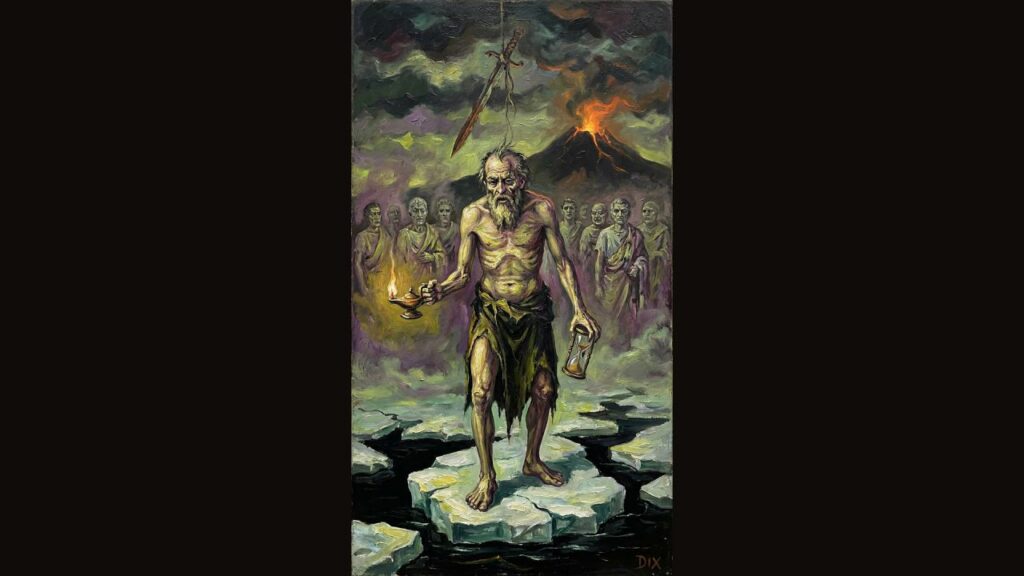
An American republic that burned through its twelve Caesars now contemplates its Constantinople, an empire in decline, hearing Eastern footsteps it cannot outrun.
There is a moment (and if you have lived long enough in this country with your eyes open, you know the one I mean) when the nightmare and the waking world merge, and the ripcord doesn’t work anymore.
You are in pitch black. You know this is life or death, though no one has told you so, you feel it the way a terminal patient feels the room change when the doctor pauses too long before speaking. Things are happening fast. Too fast. You reach for tools and find none. You reach for weapons and find none. You open your mouth to scream and the sound travels nowhere, swallowed by a darkness so total it has become a medium, not just an absence. You scream only once. Instinct tells you what reason hasn’t yet confirmed: you have been silenced. Not by a hand over your mouth, but by the removal of every ear that might have heard you. The scream is not suppressed. It is irrelevant.
And at this unbearable point, the point where the body revolts against the mind’s knowledge that there is no exit, you pull the ripcord. You pull it the way a man pulls it when the chute is his last article of faith. You are going back. Back to the real world. Back to the lit room, the functioning republic, the morning paper on the porch, the congressman who still reads his mail, the neighbor who still answers the door.
The chute opens. You land. And what greets you is worse than the dark.
Your nose is rubbed by an Invisible Hand into a false tableau that couldn’t be bungled or written any worse, a world of mannequin anchors reading scripts no one believes, of politicians performing outrage they do not feel, of algorithms replacing the town square with a funhouse mirror designed to keep you scrolling until you forget what you were angry about. A world dressed in the costume of the republic you remember but emptied of everything that made it function. You have not returned to safety. You have simply discovered that the nightmare was the real world, that the darkness you were trying to escape is the permanent condition, and the “normal” you thought you were waking up to was the dream all along.
This is the dissociation. This is the terminal feeling. You look around for someone to save the ship and realize, like the boys at the end of Lord of the Flies, weeping on the beach when the naval officer arrives, not from relief but from the sudden, annihilating recognition of what they have become, that there is no adult coming. There is no rescue. The officer on the beach cannot undo what happened in the jungle. The ship that arrives cannot give back the innocence that was burned with the island.
Is this how a terminal patient feels? I think it must be. Not the raging, not the bargaining, those stages passed years ago, somewhere between the second and third Caesar, somewhere between the Patriot Act and the algorithmic purge. What remains is the strange clarity that comes only at the end: the ability to see the whole structure at once, to trace every wire, to name every component, because there is no longer any reason to look away. Anyone can see this isn’t going to end well. No possibility of a recovery. The organs have failed in sequence (press, party, Congress, judiciary, civic culture) and each failure accelerated the next. The body politic holds its shape the way a body on a table holds its shape. From a distance, you might mistake it for sleeping.
Never is hope so pure as in the certainty of loss. That is the paradox of this moment. When the last illusion burns away (the illusion that the next election will matter, that the next strongman will be different, that the press will remember its duty, that the algorithm will be reformed, that the people will rise) what remains is not despair. It is something harder and cleaner than despair. It is the freedom to see without flinching, to speak without calculating, to write for the record rather than for the result. Hope purified by the certainty that it will not be rewarded. Hope that has stopped negotiating with power and started testifying against it.
Kafka understood this architecture a century before we built it. His protagonists, Josef K. arrested for a crime no one will name, Gregor Samsa waking to find himself transformed into something his own family cannot bear to look at, the land surveyor in The Castle who can see the authority that governs his life but can never reach it, never speak to it, never learn its reasons, inhabit worlds where the system is total, the individual is insignificant, and the cruelest refinement is that the machinery of control offers no visible oppressor to confront. There is no tyrant to overthrow. There is only process (vast, incomprehensible, self-justifying process) and your place within it is to comply, to wait, and ultimately to disappear.
Milan Kundera defined the Kafkan condition precisely: “the progressive concentration of power, tending to deify itself; the bureaucratization of social activity that turns all institutions into boundless labyrinths; and the resulting depersonalization of the individual”. That is not a description of early twentieth-century Prague. That is a photograph of the United States in 2026. The labyrinth has simply been digitized, privatized, and rendered so seamless that most people do not recognize they are inside it.
This is where we are. And the question is no longer whether the lights can be turned back on. The question is how, precisely, they were turned off, and whether you are prepared to see the room as it actually is once you stop pretending you can still see in it.
Act One: The Money Concentrated
Every structural collapse begins with the same precondition: the wealth of a society migrates upward until a handful of families hold enough of it to override the mechanisms of collective governance. This is not ideology. It is gravity.
The top 0.1% of American households now control 12.6% of total national wealth (a historic peak. The top 10% hold nearly two-thirds of everything; the bottom half of the country owns 2.5%. In 2025 alone, global billionaire wealth surged 16%) three times faster than the five-year average, reaching $18.3 trillion. Elon Musk became the first human being in history to surpass half a trillion dollars in personal net worth. The ten richest Americans added $698 billion in a single year.
This is not inequality. Inequality implies a spectrum. This is consolidation, the conversion of a democratic economy into a feudal estate with a digital veneer. And consolidated money does not sit still. It purchases the instruments of power: the press, the platforms, the politicians, the military apparatus, and the foreign policy that protects the whole arrangement.
Understanding what follows requires understanding this first: the money moved before everything else. It is the prime mover. Everything that happened to the press, to the parties, to the military, to foreign policy, and to you (sitting in the dark, screaming into a void that was engineered to absorb your voice) flows from this single upstream event.
Act Two: The Money Bought the Press
Once the wealth concentrated, the press was the first institution acquired, because the press was the only institution capable of describing the concentration to the people being robbed by it.
The world’s seven richest individuals are now all major media barons. Musk owns X. Bezos owns the Washington Post. Zuckerberg controls Facebook, Instagram, and WhatsApp. The Ellison family holds Paramount, CBS, and is positioning to acquire Warner Bros and CNN. Over half of the world’s largest media companies have billionaire owners. They did not purchase these outlets because they love journalism. They purchased them to hedge against democracy, to suppress criticism, protect their tax positions, shape the narratives that determine what the public is permitted to think, and ensure that no populist movement ever gains enough coherent information to threaten the architecture of extraction.
But the purchase was only half the conquest. The other half was cultural: the profession itself abandoned its own standards from the inside. Former Washington Post executive editor Leonard Downie Jr. and former CBS News president Andrew Heyward interviewed more than 75 media leaders and found that objectivity is now considered “reactionary” and even “harmful”. Journalism professors at Stanford explicitly urge their students to become “overt and candid advocates for social justice” and to shed objectivity as a constraint. The editor-in-chief of the San Francisco Chronicle said it without flinching: “Objectivity has got to go.”
The people training the next generation of reporters are not merely failing to teach fairness, they are teaching that fairness is the enemy. The old creed, accuracy, impartiality, the sacred duty to inform rather than lead, was not eroded by market forces alone. It was surrendered, voluntarily, by a profession that decided its feelings mattered more than its obligations.
The result: Gallup measured public trust in media at 28% in 2025, the lowest figure in the poll’s fifty-year history, the first time it has ever fallen below 30%. Among Republicans, trust stands at 8%. Among independents, 27%. There was no Alamo. No defiant last stand by the legacy press. No chain of principled resignations. The watchdogs simply laid down, rolled over, and let the new owners scratch their bellies.
More than one-third of American newspapers have closed since 2005, from 7,325 to 4,490. Over 50 million Americans now live in places with one local news outlet or none at all. The city desk editor, the beat reporter, the investigative team that could hold a corrupt sheriff’s feet to the fire, gone. Not declining. Gone. And the charlatans who replaced them, the vacuous news readers, the activist-columnists, the credentialed hacks who write only for each other and their awards committees, do not even understand what was lost, because they were trained by people who told them the old standards were the problem.
Act Three: The Money Built Its Military Arm
With the press neutralized, the concentrated wealth turned to its permanent enforcement mechanism: the Military-Industrial Establishment.
Eisenhower saw it coming in 1961. In his farewell address, he warned that the growing entanglement of private defense contractors with governmental power was “completely unprecedented” and would, if left unchecked, distort every American political institution and even threaten democracy itself. He suspected Congress would not be able to stand up to it. He was right.
Pentagon spending has surged nearly 50% in inflation-adjusted terms since the turn of the century and is rapidly approaching $1 trillion annually. Trump has proposed exceeding that figure for fiscal year 2026. Between 2020 and 2024, private firms received $2.4 trillion in Pentagon contracts, 54% of the department’s total discretionary spending. The arms industry employs 950 lobbyists, the majority of them former government officials cycling through the revolving door, and it pours tens of millions into campaign contributions concentrated on the armed services committees that set the budget.
Despite increasingly partisan dysfunction on Capitol Hill, one bipartisan consensus remains iron-clad: the defense budget must rise. This is not national security. This is a business model, one that requires permanent threat, permanent conflict, and permanent public fear to sustain its revenue stream. And it has purchased the political class necessary to guarantee all three.
Act Four: The Money Installed Its Foreign Policy
The Military-Industrial Establishment does not merely build weapons. It sets foreign policy. And the foot soldiers of that policy are the neoconservatives, a class of ideologues whose doctrine of regime change, democracy promotion, and military-first interventionism has been adopted with equal enthusiasm by both parties for the better part of three decades.
This is the Uni-Party in its purest expression. The parties fight viciously over abortion, guns, pronouns, and immigration, cultural territory that costs the donor class nothing and keeps the electorate in tribal formation. But on the questions that matter to empire, war, surveillance, NATO expansion, arms sales, sanctions regimes, the range of tolerated debate is vanishingly narrow. Hawks consistently lead and win congressional votes over doves, regardless of which party holds the White House. The bipartisan consensus on foreign policy is not a sign of national unity. It is the signature of a donor class that agrees on empire even when it disagrees on everything else.
The neocon flunkies are empowered and ready. They have been ready for decades. They stabbed the realists, they stabbed the restrainers, and they will stab whatever Caesar deviates from the imperial script. They serve the Invisible Hand, the one everyone in Washington can feel in the room, the one that shapes every budget, every deployment, every editorial decision, but that no one is permitted to name out loud. Chomsky and Herman described the architecture in 1988: a propaganda model in which mass media functions as a “system-supportive” apparatus “by reliance on market forces, internalized assumptions, and self-censorship, and without overt coercion”. The genius of the system is that it does not require conspiracy. It only requires incentives, and the incentives are now so thoroughly aligned that the machine runs itself.
Act Five: The Algorithms Sealed the Tomb
Whatever voice remained to the citizen after the press was bought, the parties fused, and the military establishment captured foreign policy, the platforms extinguished.
The algorithm does not ban your article. It does not burn your pamphlet. It simply ensures that no one sees it. It de-ranks, de-boosts, shadow-throttles, and buries, all without leaving a fingerprint. The independent writer, the heterodox analyst, the local reporter trying to build an audience discovers that his reach has been quietly strangled by recommendation engines optimized for engagement, not truth. You don’t need to arrest a dissident if you can make him statistically irrelevant.
This is Kafka’s castle made digital. The authority exists. You can see its walls. But you cannot enter, cannot appeal, cannot learn the rules by which your fate is decided. The platform insists it is “optimizing user experience” or enforcing “community standards.” But the effect is identical to a government censor sitting in every newsroom in the country, deciding which stories the public is allowed to find. The old publisher could be confronted, shamed, boycotted. The algorithm cannot. It has no address, no editor, no conscience. It is accountable to shareholders and engagement metrics, not to the republic.
And so the circuit closes. The money concentrated. The money bought the press and killed its standards. The money built its military arm and captured Congress. The money installed its foreign policy through neoconservative ideologues beholden to the defense establishment. The money fused the parties into a Uni-Party that performs disagreement on culture while maintaining ironclad consensus on empire and finance. And the money built the algorithmic cage that ensures no citizen can organize, no coalition can form, no voice can carry far enough to threaten the arrangement.
Each step enabled the next. Each is irreversible without dismantling the one before it. And no one with the power to dismantle any of it has the incentive to do so.
Twelve Caesars
We have burned through our Caesars. Populists, technocrats, wartime presidents, peacetime managers, dealmakers, ideologues, some competent, most not, all of them absorbed by the machine they promised to break. The strongman arrives vowing to smash the system; the system metabolizes him, exploits his chaos, and emerges stronger for having survived the disruption. The progressive militant arrives promising to restore norms; she installs new speech codes, new surveillance architectures, new justifications for the same wars. Whiplash. Turnabout. Revenge politics played out by the world’s most powerful country on a global stage while innocents are sacrificed to interventionist mischief in Iran, in Libya, in Syria, in wherever the next “humanitarian crisis” conveniently aligns with a resource map or a defense contractor’s quarterly earnings.
Rome continued to call itself a republic long after it ceased to function as one. The Senate still met, elections were still held, laws were still passed, but real power had already shifted to a handful of oligarchs who wielded wealth, military support, and patronage networks to dictate outcomes while the institutions of governance served as theater. Senators exploited their positions to enrich themselves, accepted bribes, shifted tax burdens onto the lower classes, engaged in foreign conflicts for profit, and actively prevented the lower orders from achieving genuine political power, all while the wealth gap widened and no checks on their authority emerged.
Suetonius gave us the template: twelve emperors, from the capable to the deranged, from Augustus to Domitian, charting the arc from consolidation through excess to decay. The American presidency follows a rhyming pattern, leaders cycling from vision to vanity to venality, each one promising renewal while presiding over further concentration, further militarism, further erosion of the civic fabric. And now, like Rome contemplating the rise of Constantinople, sensing that the center of gravity is shifting east, that the energy and ambition and organizational capacity are migrating to civilizations that did not spend the last three decades hollowing themselves out from within, America hears footsteps it cannot outrun.
The Living Lie
Václav Havel saw this from inside a system that had perfected it. In The Power of the Powerless, he described how totalitarian systems sustain themselves not through brute force but through a “living lie”, a matrix of performed compliance in which every citizen, from the greengrocer to the party secretary, parrots the regime’s slogans to maintain social standing, until the lie becomes so pervasive that authentic speech registers as an act of aggression against the social order itself. The persecution does not need to be violent. It only needs to be total. Silence, complicity, and obedience deepen and extend the reach of control until the system no longer requires enforcers, because the citizens enforce it on each other.
What Havel described in Communist Czechoslovakia now operates through different instruments but identical logic in twenty-first-century America. The greengrocer does not hang a party slogan in his window; he calibrates his social media posts to avoid algorithmic punishment. The dissident is not sent to a labor camp; he is de-platformed, de-monetized, and rendered invisible by systems that leave no fingerprint. The living lie is no longer a hammer-and-sickle banner in a shop window. It is the curated feed, the managed consensus, the false tableau of a functioning democracy projected onto screens in every pocket and every living room, a tableau so poorly written, so transparently bungled, that its very clumsiness feels like a final insult to anyone still paying attention.
Rigor Mortis
A mature democracy that cannot stomach the most basic reforms (that cannot rein in its oligarchs, discipline its military spending, break up its media monopolies, restore even a pretense of journalistic integrity, or hold a single architect of a catastrophic foreign war accountable) is not a democracy in decline. It is a democracy in rigor mortis. The muscles have locked. The joints do not bend. The body holds its shape, but there is no life in it.
The press is not coming back. The voice is not coming back. The old porosity, the old rough-and-tumble democratic scrum where the little man could grab a microphone and make someone powerful uncomfortable, has been structurally foreclosed. The money is concentrated. The politicians are in place. The Uni-Party has gelled and set like concrete. The Military-Industrial Establishment operates as a permanent government within the government, with its own budget, its own foreign policy, its own lobbyists, its own think tanks, and its own rotating stable of congressional servants. The algorithms police what remains of the public square. The billionaires own the press that was supposed to police the billionaires.
Like rigor mortis, it ain’t reversible.
In This Darkness
You pulled the ripcord. You thought you would wake up somewhere safe, somewhere with light, with neighbors, with institutions that still functioned, with a press that still cared, with a government that still feared the people it ostensibly served.
Instead, you landed here. Nose pressed into a false tableau so clumsily constructed it insults the intelligence of anyone still paying attention, and yet so total in its reach that paying attention barely matters anymore. The nightmare didn’t end. It just changed sets. Kafka’s trial continues in a courtroom that now spans the entire country, presided over by judges you cannot see, governed by laws you cannot read, in a language you are no longer taught.
In this darkness, I will disappear. Not because I choose to. Not because I have given up. But because the architecture that once carried a voice like mine, imperfect, angry, unpolished, but freefrom the front porch to the statehouse has been systematically dismantled, and what replaced it was designed from the ground up to ensure that voices like mine are absorbed into the noise, buried by the algorithm, drowned in the managed chaos, and rendered statistically irrelevant by systems that cannot be confronted, shamed, or boycotted because they have no address, no editor, and no conscience.
Turn out the lights. Not in surrender, though surrender is understandable. In acknowledgment. Acknowledge that the republic you were promised is not the republic you inhabit. That the channels are closed, the watchdogs are dead, the press writes for itself, and the politicians perform a script authored by people whose names you will never know. That the East is rising while the West argues about which Caesar to blame for the fire.
Turn out the lights so you can see clearly in the dark. Because the artificial illumination (the cable news, the algorithmic feeds, the curated outrage, the managed consensus) that light was never meant to help you see. It was meant to blind you. To keep you staring at shadows on the wall of a cave while the real decisions were made somewhere above you, in rooms you will never enter, by people who consider your confusion a market condition and your despair an acceptable externality.
The lights are already out. I am simply asking you to stop pretending they are on.
And in this darkness (real darkness, honest darkness, the darkness that comes after you stop lying to yourself about what you can see) perhaps something still breathes. Perhaps the act of describing the machine, of naming its parts and tracing its wiring, is itself a form of light that the machine has not yet learned to extinguish.
Perhaps. But I am not selling hope tonight. I am writing for the record. For whoever is still out there, reading by whatever light remains.
In this darkness, I will disappear. But not before I have said what I came to say.