Beyond the Caricature: What Vladimir Putin Actually Said, And Why the Legacy Press Won’t Let You Hear It
Executive Summary
On February 6, 2024, Tucker Carlson conducted the first Western interview with Russian President Vladimir Putin since the Ukraine conflict began. The two-hour conversation provided an unfiltered window into Putin’s worldview, historical grievances, and strategic thinking. Yet before the interview even aired, the legacy press launched a coordinated assault, not on Putin’s arguments, but on Carlson himself. Hillary Clinton branded him a “useful idiot.” CNN declared he was “already doing Putin’s bidding.” The BBC dismissed Putin’s historical exposition as “nonsense.” This pattern reveals a fundamental problem: Western media has constructed a cartoon villain so thoroughly demonized that engaging with his actual positions has become professionally radioactive.
This analysis examines the full interview transcript alongside documented evidence to answer a critical question: How much of what Putin said was factually grounded, and how does it compare to the caricature presented by legacy media? The findings suggest that while Putin advances a deeply self-interested narrative, many of his core factual claims about NATO expansion, Western intervention in Ukraine, and sabotaged peace negotiations are substantially corroborated by Western sources, yet systematically excluded from mainstream coverage.
The Interview Legacy Media Didn’t Want You to See
The Immediate Backlash
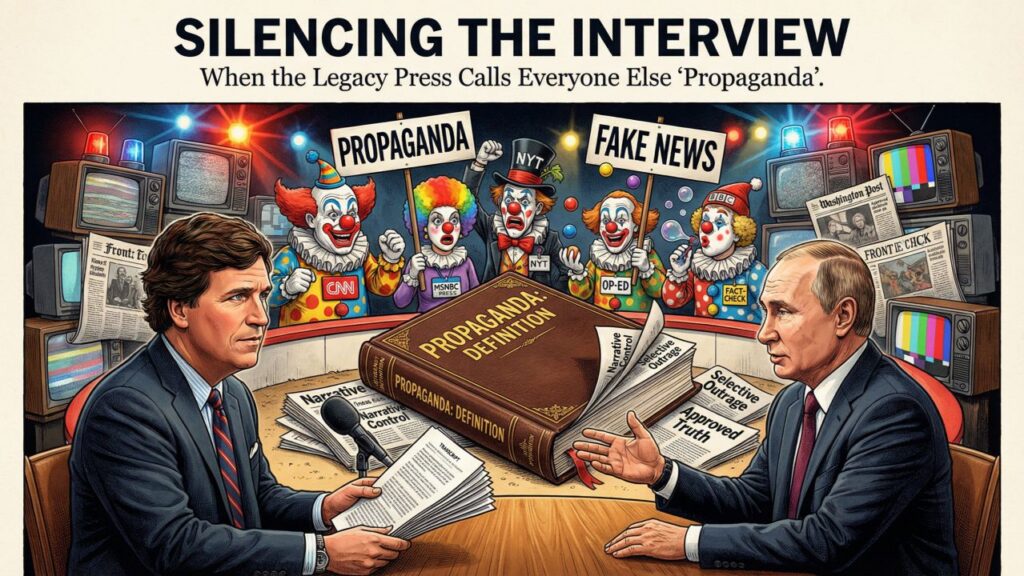
Before a single viewer had watched the Putin interview, the narrative was already written. On February 6, 2024, as Carlson announced the upcoming interview, Hillary Clinton appeared on MSNBC to deliver her verdict: “He’s what is called a useful idiot… He parrots Vladimir Putin’s pack of lies about Ukraine, so I don’t see why Putin wouldn’t give him an interview.” Clinton added that Carlson, having been “fired so many times because he seems unable to correlate his reporting with the truth,” might soon “emerge with a contract with a Russian outlet.”
CNN’s coverage exemplified the reflexive dismissal. In an article titled “Tucker Carlson is in Russia to interview Putin. He’s already doing the Russian authoritarian’s bidding,” CNN criticized Carlson for questioning press integrity before the interview even aired. The network characterized Carlson’s trip as “humanizing the brutal Russian leader” and predicted he would act “as a conduit for Putin’s dangerous propaganda.”
This preemptive delegitimization served a purpose: it inoculated audiences against considering Putin’s arguments on their merits. By attacking the messenger before the message could be delivered, legacy media ensured that substantive engagement with Putin’s claims would be conflated with moral compromise.
What Putin Actually Said
The interview opened with what became its most controversial segment: a 30-minute historical dissertation on Russian-Ukrainian relations stretching back to 862 AD. Carlson visibly struggled with the format, interrupting several times to ask why medieval history mattered to events “two years ago.” Putin’s response revealed the core of his framework: “I understand that my long speeches probably fall outside of the genre of an interview. That is why I asked you at the beginning, are we going to have a serious talk or a show?”
Putin’s historical narrative advanced several specific claims:
- Ukraine as artificial state: Ukraine was “established” by Lenin and the Bolsheviks in 1922, incorporating territories that “had never been called Ukraine” including the entire Black Sea region received under Catherine the Great
- NATO expansion promises: The West promised NATO would not expand “not an inch eastward” after German reunification, yet conducted five waves of expansion
- The 2014 Maidan as coup: The US backed an unconstitutional overthrow of President Yanukovych despite a European-brokered agreement, with Carlson himself noting he “wanted to join” the CIA
- Sabotaged Istanbul negotiations: Russia and Ukraine reached agreement in March 2022, Russia withdrew from Kiev as promised, but Boris Johnson intervened to block the deal
- CIA subversion: The US intelligence community systematically undermined presidential commitments, supporting Caucasus separatists despite direct promises to Putin
Legacy media coverage focused almost exclusively on dismissing these claims as “propaganda” without substantive engagement. The BBC’s analysis typified the response: “For fans who managed to stay tuned any longer, the reward was a re-run of Putin’s top, twisted arguments.” CNN characterized the interview as a “significant propaganda triumph for Putin” in which Carlson “afforded Putin a stage to disseminate his propaganda to a worldwide audience with minimal scrutiny.”
Yet buried in academic analyses, declassified documents, and even Western mainstream reporting from earlier periods, substantial corroboration exists for Putin’s core factual claims, even as his interpretation and framing remain fiercely contested.
The NATO Expansion Question: Promises Made, Promises Broken?
Putin’s Version
In the Carlson interview, Putin devoted significant attention to NATO expansion, framing it as the West’s original sin against post-Cold War Russia. His account proceeded chronologically: after agreeing to German reunification, Russia received assurances that NATO would not expand eastward. Despite these promises, NATO conducted five waves of expansion. At the 2008 Bucharest Summit, despite German and French objections, the US pressured allies to declare that “the doors for Ukraine and Georgia to join NATO were open.”
Putin described asking President Bill Clinton directly whether Russia could join NATO. Clinton initially responded positively (“You know, it’s interesting. I think so”), but after consulting his team, returned with a negative answer. Putin characterized this as Russia being told “we weren’t welcome there.”
The Documentary Record
The question of NATO expansion promises has generated intense scholarly debate, yet the documentary evidence substantially supports Putin’s factual claims while complicating the legal interpretation.
The Baker Assurances: On February 9, 1990, US Secretary of State James Baker met Soviet Premier Mikhail Gorbachev and repeated the phrase “not one inch eastward” three times, stating explicitly that “NATO expansion is unacceptable.” The National Security Archive published declassified documents in 2017 showing a “cascade of assurances” given to Gorbachev that NATO would not expand beyond East Germany.
Gorbachev’s Confirmation: In a 2009 interview with Germany’s Bild newspaper, Gorbachev confirmed that “NATO would not move a centimeter to the east” was indeed promised, though he criticized the expansion as violating the “spirit” rather than the letter of agreements. The lack of written commitment has allowed Western officials to claim no binding promise existed, yet the oral assurances are documented by participants on both sides.
The Expansion Reality: Despite these assurances, NATO admitted Poland, Hungary, and the Czech Republic in 1999; Bulgaria, Estonia, Latvia, Lithuania, Romania, Slovakia, and Slovenia in 2004; Albania and Croatia in 2009; and Montenegro in 2017. The 2008 Bucharest Summit declaration that Ukraine and Georgia would “become members of NATO” represented the alliance’s advance to Russia’s borders.
Putin’s 2007 Warning: At the Munich Security Conference on February 10, 2007, Putin delivered what historians now recognize as a clear warning about NATO expansion. He stated: “NATO expansion does not have any relation with the modernisation of the Alliance itself or with ensuring security in Europe. On the contrary, it represents a serious provocation that reduces the level of mutual trust.” He asked pointedly: “Against whom is this expansion intended? And what happened to the assurances our western partners made after the dissolution of the Warsaw Pact? Where are those declarations today? No one even remembers them.”
US Ambassador to Russia William Burns (later CIA Director) wrote in a 2008 cable: “Ukrainian entry into NATO is the brightest of all redlines for the Russian elite (not just Putin). In more than two and a half years of conversations with key Russian players, from knuckle-draggers in the dark recesses of the Kremlin to Putin’s sharpest liberal critics, I have yet to find anyone who views Ukraine in NATO as anything other than a direct challenge to Russian interests.”
Analysis: Putin’s factual claims about NATO expansion promises are substantially corroborated by Western sources, including participants in the 1990 negotiations. The interpretive dispute centers on whether oral assurances create binding obligations and whether security concerns justify Russian military action. Yet legacy media coverage rarely acknowledges this documented history, instead presenting Putin’s NATO concerns as paranoid fabrication.
The 2014 Maidan: Revolution or Coup?
Putin’s Narrative
Putin characterized the February 2014 Maidan events as a US-backed “coup d’état” that violated a European-brokered agreement. He described the sequence: President Yanukovych delayed signing an EU association agreement to assess economic impacts; the opposition began “destructive steps” supported by the West; European foreign ministers (from Germany, Poland, and France) brokered an agreement guaranteeing early elections; the US urged Russia to “calm Yanukovych down and we will calm the opposition”; yet the very next day, armed opposition overthrew the government while European guarantors “pretended that they didn’t remember that they were guarantors of the peaceful settlement.”
Putin noted the direct US involvement: “The backing of CIA, of course. The organization you wanted to join back in the day, as I understand.” He characterized this as “colossal mistake” from a political standpoint that “should have seen what it would evolve into.”
The Evidence of US Involvement
The extent of US involvement in the 2014 Maidan has been extensively documented, though its characterization remains disputed:
Direct Official Presence: US Senator John McCain and Assistant Secretary of State Victoria Nuland appeared at Maidan protests. McCain met with Svoboda’s far-right leader, standing “shoulder to shoulder with him as they announced their support to the protesters,” while Nuland distributed sandwiches to demonstrators. As the Jacobin analysis noted: “To understand the provocative nature of such moves, you only need to remember the establishment outrage over the mere idea Moscow had used troll farms to voice support for Black Lives Matter protests.”
The Nuland-Pyatt Call: A leaked phone conversation between Nuland and US Ambassador Geoffrey Pyatt revealed them discussing which opposition figures should enter a new Ukrainian government, a conversation that occurred before Yanukovych’s departure. Nuland’s famous line “F**k the EU” indicated tensions over who would control the transition.
NGO and Financial Support: The National Endowment for Democracy (NED), US Agency for International Development (USAID), Freedom House, the International Republican Institute, and the National Democratic Institute provided grants and “technical and tactical assistance to Ukrainians” in the years before Maidan. As one NED founder admitted to the Washington Post: “A lot of what we do today in the open was done covertly 25 years ago by the CIA.”
The February 21 Agreement: Germany, Poland, and France did serve as guarantors of the February 21, 2014 agreement between Yanukovych and the opposition, which called for early elections, constitutional reform, and formation of a national unity government. Yanukovych signed the agreement and ordered security forces not to intervene. The next day, despite the agreement, armed protesters stormed government buildings and Yanukovych fled.
Post-Coup Recognition: The US immediately recognized the new government, with the State Department praising Parliament’s vote to strip Yanukovych of the presidency, despite this occurring through intimidation (protesters attacked MPs from Yanukovych’s party outside Parliament) and without the constitutional process for removing a president.
Analysis: The factual elements of Putin’s account (direct US official involvement, funding of opposition groups, the European-brokered agreement, and its immediate abandonment) are documented by Western sources. The interpretive dispute centers on whether this constituted a “coup” or a legitimate popular uprising. Yet legacy media coverage systematically omits the documented US role, presenting Maidan exclusively as a spontaneous democratic revolution.
The Istanbul Negotiations: Peace Sabotaged?
Putin’s Account
Putin claimed that Russia and Ukraine reached substantial agreement in Istanbul in March 2022. Under the terms, Ukraine would adopt neutrality and not join NATO, while Russia would withdraw to pre-invasion positions. Putin stated that Russia fulfilled its commitment, withdrawing forces from Kiev, but “our Ukrainian negotiators immediately threw all our agreements reached in Istanbul into the bin, and got prepared for a longstanding armed confrontation with the help of the United States and its satellites in Europe.” He attributed this to British Prime Minister Boris Johnson’s intervention: Johnson traveled to Kiev and told Zelensky that “even if Ukraine is ready to sign some agreements on guarantees with Putin, they [the collective West] are not.”
The Documentary Evidence
The Istanbul negotiations and their aftermath have been substantially documented by multiple participants and independent sources:
The Istanbul Communiqué: Negotiations in Turkey produced a draft agreement in late March 2022 in which Ukraine promised not to join NATO or allow foreign military bases on its soil, while Russia committed to withdraw occupation troops (though not from Donbas or Crimea).
Ukrainian Confirmation: David Arakhamia, parliamentary leader of Zelensky’s party who led Ukraine’s negotiating delegation, later confirmed that Moscow was “ready to end the war if we took neutrality… and made commitments that we would not join NATO.” This constitutes direct Ukrainian acknowledgment of the agreement’s substance.
Israeli Mediation: Former Israeli Prime Minister Naftali Bennett, who mediated between Putin and Zelensky, confirmed in interviews that Putin was willing to make “huge concessions” for Ukrainian neutrality. Bennett noted both sides were eager to compromise before US and UK intervention.
Boris Johnson’s Trip: On April 9, 2022, Johnson made an unannounced visit to Kiev. Ukrainian media Ukrainska Pravda reported Johnson delivered two messages: “The first is that Putin is a war criminal, he should be pressured, not negotiated with. And the second is that even if Ukraine is ready to sign some agreements on guarantees with Putin, they [the collective West] are not.”
German Military Confirmation: Retired German General Harald Kujat, former head of the Bundeswehr and former chairman of the NATO Military Committee, confirmed Johnson sabotaged negotiations. Kujat stated: “Ukraine had pledged to renounce NATO membership and not to allow any foreign troops or military installations to be stationed, while Russia had apparently agreed to withdraw its forces to the level of February 23.” However, “British Prime Minister Boris Johnson intervened in Kiev on the 9th of April and prevented a signing. His reasoning was that the West was not ready for an end to the war.”
Johnson’s Public Position: In June 2022, Johnson told the G7 and NATO that “now is not the time to settle and encourage the Ukrainians to settle for a bad peace,” and published a Wall Street Journal op-ed arguing “The war in Ukraine can end only with Vladimir Putin’s defeat.”
Analysis: Multiple independent Western sources (including Ukrainian, Israeli, and German officials) corroborate Putin’s account of near-agreement followed by Western intervention to continue the conflict. This constitutes one of the most significant underreported stories of the war: a potentially negotiated settlement was abandoned in favor of “strategic endurance” aimed at weakening Russia. Legacy media coverage has systematically ignored or downplayed this evidence, maintaining the narrative that Russia has never been willing to negotiate in good faith.
The Method of Demonization: How Putin Becomes Unperson
The Pattern of Delegitimization
The treatment of the Carlson interview exemplifies a broader pattern in Western media coverage of Putin. Rather than engaging arguments, coverage focuses on:
- Attacking the interviewer: Carlson was labeled “useful idiot,” accused of spreading “conspiracy theories,” and his journalistic credentials questioned
- Dismissing without rebuttal: Putin’s historical claims characterized as “nonsense” or “pseudo-history” without substantive fact-checking
- Motive attribution: Coverage assumes malign intent (“propaganda,” “disinformation”) rather than addressing factual accuracy
- Preemptive framing: Establishing narrative before interview aired prevented neutral reception
Academic analysis of BBC and CNN coverage found “Western media coverage disproportionately represents the Ukrainian perspective, with the Russian standpoint largely marginalized or stereotypically characterized.” A study using Galtung’s peace journalism framework found “discernible dominance of war journalism over peace journalism, thus propagating divisive narratives,” with BBC adopting “more aggressive war journalism modality than CNN.”
The Cost of Caricature
Multiple analysts have noted that demonizing Putin substitutes for policy. The Washington Postobserved in 2014 that “the demonization of Vladimir Putin is not a policy; it is an alibi for the absence of one.” The Quincy Institute elaborated: “By demonizing leaders who don’t adhere to our principles, we often end up misunderstanding different cultures and how their societies function.”
The pattern extends beyond Putin personally. The Deccan Herald noted: “On Russia, the Western media owes its readers an apology of the kind that sections of it belatedly offered after it accepted as the gospel truth Washington’s fabricated stories about Iraq’s non-existent WMDs.” Asia Times described how “a Manichean framework has precluded meaningful analysis of the Ukraine war.”
Paradoxically, Putin himself complained about the interview, telling Russian TV presenter Pavel Zarubin: “Honestly, I expected him to be more confrontational and pose what are referred to as sharp questions. I was not only ready for this, but I also desired it, as it would have provided me the chance to reply in kind… To be frank, I did not derive complete satisfaction from this interview.”
Putin’s Worldview: What He Actually Believes
The Multipolar Vision
Throughout the interview and in numerous other forums, Putin articulates a consistent framework: the world is transitioning from US-led unipolarity to genuine multipolarity. At the October 2024 Valdai Forum, he declared: “No one is ready to play by rules set by one person somewhere far away… A multipolar world is more democratic, since it allows a large number of political and economic players to influence outcomes.”
This vision centers on several pillars:
BRICS and SCO as alternatives: Putin consistently promotes the Shanghai Cooperation Organization and BRICS as institutions reflecting “genuine consensus and balance among members” rather than Western hegemony. He emphasized that “Russia and China are united in our vision of building a just, multipolar world order, with a focus on the nations of the Global Majority.”
Sovereignty and non-interference: Putin rejects what he characterizes as Western interventionism justified by “universal values.” He positions Russia and its partners as defending traditional sovereignty principles enshrined in the UN Charter immediately after WWII.
Economic independence: At the SCO Council, Putin highlighted that “the share [of national currencies] in Russia’s commercial transactions with the organization’s participants exceeded 92% in the first four months of 2024,” emphasizing creation of an “SCO payment and settlement mechanism” independent of dollar dominance.
The Grievance Framework
Putin’s historical narrative constructs Russia as repeatedly betrayed by the West:
- Post-Cold War expectations: Russia “believed that the fundamentals of the relationship” (common language in Ukraine, economic ties) and voluntary Soviet dissolution would be “understood by the so-called ‘Civilized West’ as an invitation for cooperation and associateship.”
- Systematic rejection: Despite approaching the West as “bourgeois” market economy without Communist Party power, Russia was told “get lost” on NATO membership, missile defense cooperation, and partnership proposals.
- Double standards: The West bombed Belgrade in violation of international law while accusing Russia of the same; supported separatists in Caucasus while condemning Russian actions; expanded NATO despite promises while characterizing Russian concerns as paranoia.
- Instrumentalization of Ukraine: Ukraine was “turned into expendable material” by the West to “expand their zone of control,” with the 2014 coup representing the ultimate violation of agreements.
The Confrontational Realism
Putin articulates a quasi-realist worldview in which “inherent laws” govern great power relations. He argues that efforts to weaken Russia or maintain Western dominance will inevitably fail as the balance of power shifts. This framework justifies the Ukraine intervention as preventive action against encirclement rather than aggressive expansion.
Critically, Putin’s framework denies Ukrainian agency entirely. In his conception, Ukraine is an “artificial state” without legitimate separate identity, its government a Western puppet, and its policies determined in Washington rather than Kiev. This erasure of Ukrainian nationhood and sovereignty represents the most fundamental disconnect between Putin’s worldview and Western/Ukrainian perspectives.
What Legacy Media Won’t Tell You, And Why It Matters
The Selective Presentation
Legacy media coverage of Putin and Russia demonstrates systematic patterns of omission:
Documented facts excluded: NATO expansion promises, US involvement in Maidan, Istanbul negotiations sabotage, and earlier diplomatic overtures are systematically absent from mainstream coverage or relegated to brief mentions without context.
Alternative perspectives marginalized: Scholars, former diplomats, and military officials who contextualize Russian concerns (like Ambassador Burns, General Kujat, or academics studying NATO expansion) are rarely featured in coverage, while hawks dominate airtime.
Historical amnesia: Putin’s 2007 Munich warning, earlier diplomatic initiatives, and the documented timeline of Western-Russian relations are presented as if they don’t exist, replaced with narrative of unprovoked Russian aggression emerging from Putin’s personal pathology.
Competing evidence dismissed: When contradictory evidence emerges (like Bennett’s mediation account or Arakhamia’s confirmation of Istanbul talks), it’s briefly noted then memory-holed, never integrated into ongoing narrative.
The Function of Demonization
This pattern serves multiple functions:
Policy insulation: By rendering Putin’s arguments literally unspeakable in respectable discourse, policy alternatives (negotiated settlement, acknowledgment of Russian security concerns, recognition of Western role in conflict escalation) become politically impossible.
Simplification of complexity: The Manichean frame (democratic Ukraine vs. authoritarian Russia) eliminates need to grapple with uncomfortable realities: Ukrainian far-right elements, US interventionism, NATO expansion consequences, or competing legitimate interests.
Projection of infallibility: If Putin is mad/evil and the West is defending freedom/democracy, then Western policy failures, broken promises, and strategic miscalculations need not be examined or corrected.
Manufacturing consent: Public support for open-ended military and financial commitment to Ukraine requires presenting Russian position as wholly without merit, Ukrainian position as wholly virtuous, and Western involvement as purely defensive.
The Cost of Willful Blindness
The systematic exclusion of documented facts from public discourse produces several dangerous consequences:
Strategic surprise: When Russia acts on repeatedly stated red lines (Georgia 2008, Crimea 2014, Ukraine 2022), Western publics and policymakers express shock despite years of explicit warnings.
Negotiation impossibility: If Putin’s concerns are dismissed as mere pretexts rather than addressing underlying disputes, negotiated settlements become structurally impossible.
Escalation spiral: Without acknowledging how Western actions appear from Russian perspective, each “defensive” move (NATO expansion, arms deliveries, sanction escalation) generates Russian responses characterized as further proof of aggression.
Domestic manipulation: The same media organs that constructed Iraq WMD narrative, downplayed Afghanistan failures, and dismissed COVID lab-leak theory have forfeited credibility necessary for democratic accountability.
Opportunity cost: Resources diverted to Ukraine conflict preclude other priorities, justified by narrative that brooks no questioning or cost-benefit analysis.
Conclusion: The Necessity of Intellectual Honesty
Vladimir Putin is not a misunderstood statesman. He presides over an authoritarian system, has overseen military campaigns causing massive civilian suffering, and advances a self-interested framework that denies Ukrainian sovereignty and agency. His historical narrative selectively emphasizes facts supporting Russian claims while omitting contradictory evidence. His denazification rhetoric is both cynical and offensive. His conception of Russian sphere of influence belongs to an earlier century.
Yet none of this justifies the systematic exclusion of documented facts from public discourse. The NATO expansion promises were real. The US intervention in Ukrainian politics was extensive. The Istanbul negotiations nearly succeeded before Western pressure to continue fighting. These are not “Russian propaganda”, they are documented by Western participants and sources.
The legacy press has constructed a cartoon Putin so thoroughly demonized that engaging with documented facts about NATO expansion, Western intervention, or negotiation sabotage becomes professional suicide. Journalists who present contrary evidence are labeled “useful idiots.” Former officials who confirm Russian accounts are ignored. Documentary evidence is memory-holed.
This is not journalism, it is information warfare masquerading as news coverage. The public is denied the factual basis necessary for informed democratic deliberation about a conflict consuming hundreds of billions in resources and hundreds of thousands of lives.
The Tucker Carlson interview provided a rare opportunity to hear Putin’s unfiltered perspective, historical framework, and specific factual claims. Rather than engaging these claims through rigorous fact-checking and contextual analysis, legacy media chose preemptive delegitimization, ad hominem attacks, and systematic omission.
A mature democracy requires citizens capable of evaluating competing factual claims and policy alternatives. The legacy press has decided Americans cannot be trusted with information that might complicate preferred narratives. This is precisely the type of information control they claim to oppose when practiced by authoritarian regimes.
The path to sustainable peace requires understanding what the other side actually believes, what legitimate concerns might drive their actions, and what factual disputes underlie competing narratives. You cannot negotiate with a caricature. You cannot understand strategic choices without acknowledging documented history. You cannot make sound policy while systematically excluding relevant evidence.
The legacy press has chosen to keep Americans in the dark, presenting a simplified morality tale in place of complex reality. They have memory-holed promises made and broken, interventions conducted and concealed, negotiations reached and sabotaged. They have constructed an alternative reality in which Putin’s concerns materialized from nowhere, Ukraine is blameless, and Western policy is beyond critique.
This is the real propaganda, not Putin’s self-interested historical narrative, but the systematic exclusion of documented facts that might complicate the approved story. Until American media rediscovers its responsibility to inform rather than indoctrinate, to present evidence rather than manufacture consent, and to trust citizens with complexity rather than feed them simplistic fairy tales, the dysfunction that brought us Iraq, Afghanistan, and now Ukraine will continue producing strategic disasters justified by noble lies.
The Tucker Carlson-Putin interview revealed more about American media than about Russian policy. It showed a press corps so captured by approved narratives that documented facts become unspeakable heresies. It demonstrated how demonization substitutes for analysis, how attacks on messengers replace engagement with messages, and how conformity masquerades as rigor.
You may disagree with every word Putin speaks. You should question his motives and contest his interpretations. But you cannot understand the world by systematically excluding half the relevant facts. The legacy press has failed this basic test, not because they’re stupid, but because they’ve chosen narrative control over truth-seeking.
That’s why they don’t want you watching a two-hour interview where Putin lays out his case, presents documentary evidence, and makes specific factual claims. Not because he’s persuasive, but because he’s checkable. And checking reveals uncomfortable truths about promises broken, interventions conducted, and opportunities for peace deliberately sabotaged.
The real question isn’t whether Putin is right, it’s why legacy media works so hard to prevent you from hearing what he actually says.