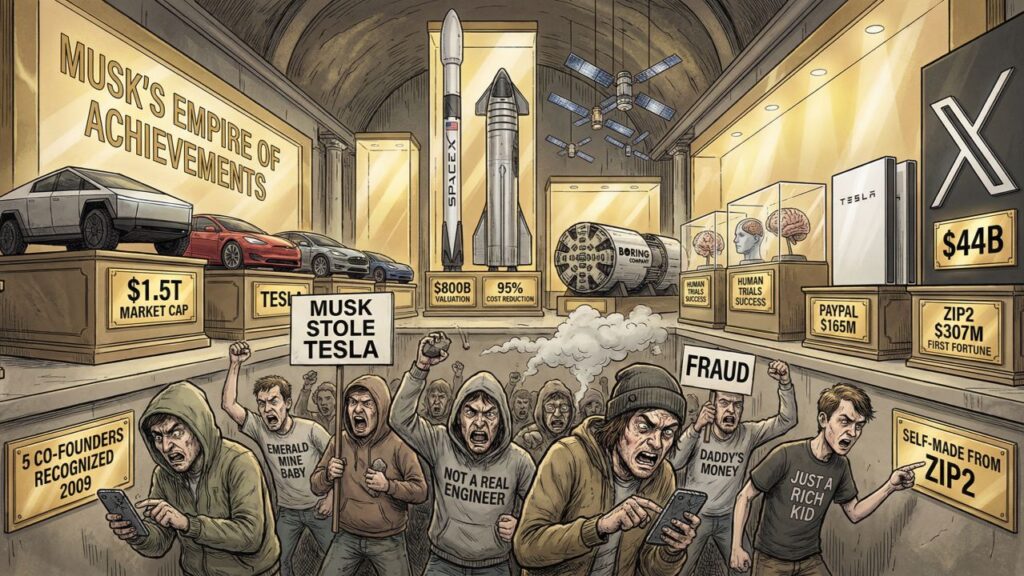
The contemporary discourse surrounding Elon Musk reveals a troubling phenomenon in American culture: the systematic dismissal of extraordinary achievement through the propagation of easily disprovable myths. When critics claim Musk inherited his wealth from an apartheid-era emerald mine, or that he “stole” Tesla from its rightful founders, or that he functions merely as a well-funded figurehead while engineers do the real work, they engage in what psychologists call “tall poppy syndrome”, the compulsive need to cut down those who stand tallest. This tendency reflects not Musk’s failures, but rather the psychological discomfort many experience when confronted with success that exposes the limitations of their own ambitions.
The facts tell a starkly different story. Musk arrived in North America at seventeen with student debt that would eventually exceed $100,000, built his first company with $2,000 in personal funds, faced literal bankruptcy multiple times, and through a combination of technical acumen, strategic vision, and frankly superhuman work ethic, created multiple companies that transformed entire industries. Understanding why this narrative gets distorted, and why it matters, requires examining both the verifiable record of Musk’s achievements and the psychology that drives people to deny them.
The Emerald Mine Myth: Deconstructing a Foundational Lie
Perhaps no false narrative about Musk has proven more persistent than the claim he benefited from family wealth derived from an emerald mine in apartheid South Africa. This story serves a psychologically necessary function for Musk’s critics: if his success stems from inherited privilege rather than earned merit, it requires no uncomfortable self-examination about their own choices and capabilities.
Walter Isaacson, whose biography of Musk represents perhaps the most thoroughly researched account of his life, definitively addresses this claim. Isaacson (a former CNN CEO, Time magazine editor, and Rhodes Scholar who previously authored acclaimed biographies of Albert Einstein, Steve Jobs, Leonardo da Vinci, and Benjamin Franklin) spent two years shadowing Musk and conducting scores of interviews with associates. His credentials matter precisely because critics dismissively label him a “paid promotional hack,” a characterization that collapses under minimal scrutiny. Isaacson’s Steve Jobs biography was notably critical in many respects, and his approach to Musk proved similarly balanced, documenting both achievements and serious character flaws.
According to Isaacson’s investigation, Errol Musk never owned an emerald mine. Instead, in 1986, he sold a light plane to an entrepreneur in exchange for emeralds from a mine the businessman owned in Zambia. This informal arrangement (never registered, involving no ownership stake) resulted in Errol acquiring raw emeralds that he had cut in Johannesburg. While Errol Musk has given contradictory accounts over the years, including exaggerated claims about family wealth, his actual net worth stood at approximately $2 million as of 2023, hardly the fortune suggested by the “emerald mine heir” narrative.
More significantly, Musk’s mother Maye lived in a rent-controlled apartment when the family emigrated, hardly consistent with generational wealth. When Elon and his brother Kimbal founded Zip2 in 1995, their father contributed approximately $28,000, but only as 10% of a later $200,000 funding round, after the company was already established. Musk himself started the company with roughly $2,000 in personal savings, working from an office so small they showered at the YMCA. He was carrying over $100,000 in student debt from his time at Queen’s University and the University of Pennsylvania, where he had received a $14,000 scholarship alongside substantial loans.
These facts matter because they establish the foundation of everything that followed: Musk built his initial wealth entirely through his own efforts, not family largesse. The $22 million he earned from the 1999 Compaq acquisition of Zip2 represented the seed capital for every subsequent venture. There was no safety net, no family office, no trust fund to fall back on when things went catastrophically wrong, as they would, repeatedly.
Walter Isaacson: Examining the Messenger to Discredit the Message
The knee-jerk dismissal of Isaacson as a “hagiographer” or “paid hack” deserves particular attention because it reveals the critical technique: when facts become inconvenient, attack the source. Yet Isaacson’s track record demonstrates precisely the opposite of what critics claim. His biography of Steve Jobs, chosen by Jobs himself based on Isaacson’s earlier Einstein biography, presented an unflinching portrait of a brilliant but deeply flawed man. The Jobs family was reportedly unhappy with aspects of the book’s candor.
Similarly, Isaacson’s Musk biography documents extensive character flaws: the demon mode episodes, cruel treatment of employees, reckless public statements, and concerning behavior toward partners. Reviews in outlets like Vox and The Verge criticized the book not for being too favorable to Musk, but for inadequately grappling with the societal costs of his maverick approach. The suggestion that this represents “paid promotion” fails basic logical scrutiny, no competent publicist would approve a biography documenting their client’s worst impulses in such detail.
What Isaacson does argue, and this appears to be what genuinely troubles critics, is that Musk’s technical contributions are real and substantial, that his companies achieved things previously considered impossible, and that his leadership, however flawed, proved essential to these outcomes. This conclusion derives from extensive reporting, not financial incentive. When critics dismiss Isaacson to avoid engaging with the documented evidence, they reveal that their objection isn’t to the quality of research but to conclusions that challenge their preferred narrative.
The Tesla “Theft”: Legal Settlements and Founding Contributions
The claim that Musk “stole” Tesla represents perhaps the most legally and factually straightforward myth to debunk, yet it persists because it serves the narrative that Musk’s wealth is ill-gotten. The actual history, documented in court filings and settlement agreements, tells a different story entirely.
Martin Eberhard and Marc Tarpenning incorporated Tesla Motors on July 1, 2003. This is undisputed. In April 2004, Musk invested $6.35 million of the company’s $6.5 million Series A funding round, nearly 98% of the capital, and became chairman of the board. Tesla was, at that point, little more than an idea and some preliminary work on converting an AC Propulsion prototype. The company had no factory, no production vehicle, no supply chain, and no path to manufacturing at scale.
When Eberhard sued Musk in 2008 for defamation and sought to be declared the sole founder, a judge struck down his claim. In the September 2009 settlement, all parties agreed that five individuals (Eberhard, Tarpenning, Musk, J.B. Straubel, and Ian Wright) would be recognized as co-founders. Notably, Eberhard issued a statement acknowledging: “As a co-founder of the company, Elon’s contributions to Tesla have been extraordinary”. Musk reciprocated: “Without Martin’s indispensable efforts, Tesla Motors would not be here today”.
This settlement wasn’t a capitulation forced upon Musk, it was a recognition of reality. Legal documents make clear that while Eberhard and Tarpenning conceived the company and initiated the relationship with AC Propulsion, Musk provided nearly all the initial capital, drove the strategic vision, took over as CEO in 2008 when the company faced existential crisis, and personally rescued the company from bankruptcy. The characterization of this as “theft” requires ignoring that without Musk’s investment, strategic direction, and eventual operational leadership, there would be no Tesla to “steal.”
More significantly, examining what happened after Musk became CEO in 2008 demonstrates his indispensable role. The company was within days of bankruptcy when Musk closed a financing round on Christmas Eve 2008, the last possible day, by personally guaranteeing the investment. He had already invested all $180 million he received from the PayPal sale into Tesla and SpaceX, leaving him personally broke and borrowing money for rent. This is not the behavior of someone who “stole” a company for easy wealth; it’s the behavior of someone who believed in a vision enough to risk complete financial ruin.
From Zip2 to PayPal: Establishing Technical Credibility
Understanding Musk’s later achievements requires examining his earliest ventures, because they establish a pattern: hands-on technical involvement, self-taught expertise, and a willingness to personally do the hardest work. Critics who dismiss Musk as merely a financier confront uncomfortable facts about his formative companies.
Musk taught himself programming at age ten using a book on the BASIC language, completing a six-month course in three days. At twelve, he coded and sold his first video game, Blastar, for $500. When he and his brother Kimbal founded Zip2 in 1995, Musk personally wrote the initial software, the first integrated maps, directions, and yellow pages system on the internet. He couldn’t afford a web server, so he wrote software that read the port directly.
The code was, admittedly, a “hairball”, the work of a self-taught programmer rather than a trained software engineer. When Mohr Davidow Ventures invested $3 million in 1996, they brought in experienced engineers who rewrote much of Musk’s code to make it more efficient. But this misses the point: Musk had single-handedly created a functional product valuable enough to attract $3 million in venture funding. The fact that professional engineers later optimized his work doesn’t negate that he built something from nothing.
After Compaq acquired Zip2 for $307 million in 1999, Musk immediately invested $12 million of his $22 million proceeds into his next venture: X.com, an online banking platform. This wasn’t a passive investment, Musk was co-founder and CEO, driving the technical and strategic vision. When X.com merged with Confinity in 2000, the combined entity initially operated under the X.com name with Musk as CEO.
The subsequent boardroom drama (Musk was ousted as CEO in October 2000, with Peter Thiel taking over) represents one of Musk’s few significant business failures. He had pushed for keeping the X.com brand name and expanding beyond payments into a full financial services platform, while the Confinity team favored focusing exclusively on the PayPal payment product. The board sided with Thiel’s more focused approach. But critically, even after his ouster, Musk remained the largest shareholder and supported the company’s success. When eBay acquired PayPal for $1.5 billion in 2002, Musk received $165 million, capital he would immediately deploy into his next, far more ambitious ventures.
SpaceX: Chief Engineer, Not Just Chief Executive
The dismissal of Musk’s technical role at SpaceX represents perhaps the most willfully ignorant criticism, given the extensive documentation from employees, industry veterans, and technical observers. The question isn’t whether Musk functions as SpaceX’s chief engineer, multiple former employees with firsthand knowledge confirm this. The question is why critics insist on denying what people who actually work with him uniformly attest.
Josh Boehm, former Head of Software Quality Assurance at SpaceX, stated unequivocally: “Elon is both the Chief Executive Officer and Chief Technology Officer of SpaceX, so of course he does more than just ‘some very technical work’. He is integrally involved in the actual design and engineering of the rocket”. Steve Davis, early SpaceX engineer, noted Musk’s fluency across disciplines: “I’ve met a lot of super smart people but they’re usually super smart on one thing and he’s able to have conversations with our top engineers about the software, and the most arcane aspects of that and then he’ll turn to our manufacturing engineers and have discussions about some really esoteric welding process”.
Robert Zubrin, renowned aerospace engineer and Mars exploration advocate, observed that during meetings, Musk wanted to discuss “labyrinth purges” and “pump shaft seal design” and demonstrated surprisingly deep fluency in rocket engineering. Sandy Munro, an automotive manufacturing expert with no particular reason to flatter Musk, was “impressed with Musk, who was surprisingly fluent in rocket engineering and understood the science of propulsion and engine design”.
Most tellingly, Musk himself stated: “I know more about rockets than anyone at the company by a pretty significant margin. I could redraw substantial portions of the rocket from memory without the blueprints”. Former employees have noted that while this claim initially irritated engineers who felt it diminished their contributions, Musk subsequently made greater efforts to publicly credit the team. But the substance remains: this is not a figurehead who shows up for photo opportunities. By his own account, and confirmed by employees, Musk spends approximately 80% of his time on engineering and design work.
The tangible results validate this technical involvement. SpaceX reduced the cost of launching payloads to low Earth orbit from $54,500 per kilogram (Space Shuttle) to $2,720 per kilogram (Falcon 9), a 95% reduction. The development of fully reusable rocket stages, achieved through Musk’s insistence on solving problems others considered impossible, further reduced marginal launch costs to approximately $15 million per mission, with refurbishment costs as low as $250,000. Traditional aerospace companies spend $350 million (Delta IV Heavy) to $4.1 billion (Space Launch System) per launch. SpaceX fundamentally transformed the economics of space access through engineering innovation, innovation Musk directly drove.
The origin story reinforces this technical foundation. In 2001, frustrated by the high cost of purchasing Russian ICBMs for a Mars mission concept, Musk decided on the flight home from Moscow to build rockets himself. He founded SpaceX in 2002 with $100 million of his own PayPal proceeds. The company suffered three consecutive launch failures in 2006, 2007, and 2008. By Musk’s own admission, if the fourth launch in September 2008 had failed, SpaceX would have been defunct. It succeeded, barely, marking the beginning of the most successful private space company in history.
Tesla: From Bankruptcy to Industry Transformation
The notion that Musk merely financed Tesla while others did the real work collapses when examining the 2008 financial crisis and the subsequent Model 3 production ramp. These periods reveal Musk’s irreplaceable role not just as capital provider, but as technical leader and operational manager willing to personally shoulder crushing responsibility.
By mid-2008, Tesla faced three simultaneous crises: the global financial meltdown, the collapse of the Series E funding round that was supposed to keep the company alive, and Musk’s personal divorce. Tesla was burning tens of millions per month with the Roadster production plagued by quality issues. SpaceX had just experienced its third consecutive rocket failure. Musk was, by his own description, approaching nervous breakdown: “I remember waking up the Sunday before Christmas in 2008, and thinking to myself, ‘Man, I never thought I was someone who could ever be capable of a nervous breakdown.’ I felt this is the closest I’ve ever come”.
The company’s CFO, Deepak Ahuja, recalled they went through periods where they questioned whether payroll could be met the following week. The only money coming in was Musk’s personal investment (all $180 million from PayPal was gone, invested in Tesla and SpaceX. Musk was borrowing money from friends to pay rent. On Christmas Eve 2008, at 6 PM on the last possible day, the financing round closed) with Musk personally providing the capital to save the company.
This wasn’t passive investment. Musk had become CEO in October 2008 specifically to rescue the company from operational chaos. He personally took over the Model S design program after firing Henrik Fisker, who Musk sued for allegedly stealing design ideas to launch a competing company. Musk hired Franz von Holzhausen as lead designer, and within three months they had designed the exterior of what became the production Model S. To reduce the vehicle’s weight and compensate for the heavy battery pack, Musk made the decision to use aluminum instead of steel throughout the non-battery portions, a choice that required completely rethinking the manufacturing process.
The 2018 Model 3 “production hell” provides even clearer evidence of Musk’s hands-on operational role. When automated assembly systems failed to meet production targets, Musk personally took over the production line, working overnight shifts and sleeping on the factory floor. He wasn’t sleeping in a comfortable office, employees recall him sleeping literally on the floor because the conference room couch was too narrow. CBS correspondent Gayle King, given rare network camera access to the factory, found Musk visibly stressed and exhausted, but deeply engaged in solving bottlenecks.
Musk’s decision to scrap his over-reliance on automation and rebalance with human workers, his directive to build an additional production line in a tent in just three weeks, and his personal presence on the line troubleshooting issues in real-time all proved essential to breaking through production constraints. Within a year, Tesla went from production hell to profitability, delivering over 2,000 Model 3s per week.
The revenue trajectory tells the story of what Musk built: from $413 million in 2012 to $97.7 billion in 2024. Tesla grew revenue by more than 23,000% in twelve years. No passive investor, no matter how wealthy, generates that kind of transformation without direct operational and strategic leadership.
The Investor Perspective: Why the Smartest Money Backs Musk
Critics may dismiss Musk’s achievements, but the world’s most sophisticated investors, people who make their living by accurately assessing value, tell a different story. Their assessments matter not because wealth equals wisdom, but because these investors have access to non-public information, conduct extensive due diligence, and face severe consequences for being wrong.
Ron Baron, whose Baron Capital has invested heavily in both Tesla and SpaceX, projects his SpaceX holdings could increase ten-fold over the next decade. He has stated publicly he won’t sell a single share, believing the company remains in the early stages of long-term value creation. Baron isn’t making this projection based on hope, his firm has conducted exhaustive analysis of SpaceX’s business lines, including launch services, Starlink, and Starship development.
Cathie Wood of ARK Invest, whose flagship fund made Tesla its largest public holding, has made SpaceX the largest position in her ARK Venture Fund and projects the company’s value could reach $2.5 trillion by 2030. Wood has described Musk as “our Thomas Edison” and “our age’s inventor,” noting that his companies represent the type of disruptive innovation that reshapes entire industries. These aren’t casual endorsements, Wood’s entire investment thesis centers on identifying transformative technologies early, and her firm conducts rigorous analysis to support these convictions.
The market itself has rendered a verdict: Tesla’s market capitalization stands at approximately $1.5 trillion as of early 2026, while SpaceX’s most recent private valuation reached $800 billion with discussions of an IPO targeting even higher valuations. Analysts and investors recognize what they call the “Musk premium”, the additional valuation attributed to Musk’s leadership specifically. This premium exists because institutional investors have observed that Musk-led companies accomplish objectives that others deem impossible, from developing reusable orbital rockets to making electric vehicles profitable at scale.
The December 2025 decision by Tesla shareholders to approve Musk’s compensation package, potentially worth $1 trillion if Tesla’s market cap reaches $8.5 trillion, further demonstrates investor confidence. Shareholders explicitly structured compensation to align Musk’s interests with long-term value creation, requiring him to hit extraordinarily ambitious targets to receive any payout. The approval came despite vocal criticism from some institutional investors, indicating that the majority of shareholders believe Musk’s continued leadership justifies even this unprecedented compensation structure.
Understanding the Psychology of Denial: Tall Poppy Syndrome and Entrepreneurial Envy
The persistence of demonstrably false narratives about Musk despite readily available contradicting evidence demands psychological explanation. Why do intelligent people cling to myths about emerald mines and stolen companies when the factual record clearly refutes these claims? The answer lies in what psychologists call “tall poppy syndrome”, the social phenomenon where individuals who achieve notable success are systematically cut down by others to maintain a sense of equality.
Research on tall poppy syndrome reveals it stems from social comparison theory: people measure their self-worth relative to others, and when someone stands out dramatically, it can evoke feelings of inadequacy or envy. Rather than celebrating exceptional achievement, there emerges a compulsion to diminish it. As psychologists note, this behavior “penalizes the very traits we profess to admire: talent, ambition, and creativity”.
The emotional toll on both target and observer is significant, but the underlying mechanism matters more: tall poppy syndrome allows people to protect their self-image by attributing others’ success to factors other than merit. Research on entrepreneurial envy distinguishes between “benign envy”, which motivates self-improvement, and “malicious envy” (which seeks to tear down the envied party. Studies show that when successful entrepreneurs acknowledge both successes and failures, observers experience less malicious envy. But when only successes are visible) as with Musk’s public profile emphasizing achievements, observers who feel threatened are more likely to engage in malicious envy.
Critically, research demonstrates that envious individuals systematically attribute success to luck, unfair advantages, or morally questionable methods rather than skill and effort. This explains the persistence of the emerald mine myth despite its falsity: accepting that Musk built his wealth through merit, technical skill, and extraordinary work ethic would require uncomfortable self-examination about one’s own choices and capabilities. The emerald mine narrative provides psychological relief by suggesting his success was unearned.
Similarly, the claim that Musk “stole” Tesla or merely funds companies while others do real work serves the same psychological function: if true, his success wouldn’t reflect superior ability or effort, eliminating the implicit judgment on those who haven’t achieved similar success. The fact that these narratives are factually false matters less than their psychological utility in protecting observers’ self-concept.
The Boring Company, Neuralink, and the Pattern of Impossible Made Routine
Musk’s more recent ventures, The Boring Company and Neuralink, further demonstrate the pattern that defines his career: identifying problems others consider unsolvable or economically infeasible, then assembling teams and driving engineering solutions that prove conventional wisdom wrong.
The Boring Company, founded in 2016 to address urban congestion through underground transportation tunnels, has constructed 2.4 miles of operational tunnel in Las Vegas with an ambitious 68-mile network under development. The company developed the Prufrock 3 tunneling machine, designed to bore faster and more efficiently than conventional equipment. Projected revenue is expected to exceed $1 billion annually by 2025-2026. Critics initially mocked the concept; now municipalities actively seek partnerships for tunnel networks.
Neuralink, focused on brain-computer interfaces, has successfully implanted its N1 device in three humans as of May 2025, including a non-verbal man with ALS who can now speak through a computer. Health Canada approved clinical trials, marking the company’s expansion beyond U.S. borders. The technology has progressed beyond science fiction into tangible medical reality, with applications ranging from helping paralyzed patients control digital devices to potential future applications in memory augmentation and direct brain-to-computer communication.
Neither company has yet achieved the scale of Tesla or SpaceX, but both follow the characteristic Musk pattern: ambitious vision that industry experts dismiss as impossible, assembly of technical talent to attack the problem systematically, and Musk’s personal involvement in engineering decisions and product design. The companies recruit specialists from neuroscience, AI, robotics, civil engineering, and construction, creating cross-disciplinary teams that tackle problems no single field could solve independently.
Why This Matters: The Cost of Mythologizing Mediocrity
The systematic distortion of Musk’s record carries consequences beyond one man’s reputation. When society dismisses genuine achievement as luck or inheritance, it sends a pernicious message: exceptional effort and technical excellence don’t actually matter. If Musk succeeded merely because of an emerald mine that didn’t exist, why should aspiring engineers invest decades mastering their craft? If he “stole” Tesla rather than rescuing it from bankruptcy through personal financial sacrifice, why should entrepreneurs take career-defining risks on uncertain ventures?
The narrative that Musk is merely a well-funded figurehead also does profound disservice to the thousands of engineers, designers, and technicians who work at his companies. These individuals, many of whom have worked at traditional aerospace and automotive firms, consistently testify that Musk’s technical involvement exceeds that of any CEO they’ve encountered. When critics dismiss this testimony as sycophancy, they imply these accomplished professionals either lack judgment or are liars. The reality is simpler and more uncomfortable for critics: Musk genuinely possesses extensive technical knowledge and drives engineering decisions at his companies.
The investor perspective provides perhaps the most objective validation. Ron Baron, Cathie Wood, and institutional investors managing hundreds of billions in assets have conducted exhaustive due diligence on Musk and his companies. They’ve had access to financial data, internal operations, and confidential information unavailable to the public. Their continued and increasing investments represent validation from individuals who face severe consequences for being wrong. When critics who’ve never toured a SpaceX facility or reviewed Tesla’s internal finances declare these investors deluded, the hubris is remarkable.
Conclusion: The Self-Made Reality Versus the Comforting Myth
Elon Musk arrived in North America at seventeen with student debt, built his first company with minimal capital, sold it and invested the proceeds in his next venture, then invested all the proceeds from that sale into companies that nearly failed multiple times, personally went broke keeping them alive, and through a combination of technical expertise, strategic vision, and superhuman work ethic, built an empire worth hundreds of billions of dollars. This is not a myth or hagiography, it’s a documented record supported by financial filings, legal settlements, employee testimony, investor analysis, and Musk’s own contemporaneous statements during the hardest periods.
The alternative narrative, wealthy emerald mine heir who stole Tesla and pays others to do all the real work, serves psychological needs but crumbles under factual scrutiny. Walter Isaacson’s research definitively debunks the emerald mine myth. Legal settlements establish Musk’s co-founder status at Tesla and document his essential financial role. Extensive employee testimony from across SpaceX, Tesla, and his other companies confirms his deep technical involvement. The world’s most sophisticated investors have staked billions on the proposition that Musk’s leadership creates extraordinary value.
Those who dismiss Musk’s achievements reveal more about their own psychology than about his record. Tall poppy syndrome and malicious envy provide psychological relief by suggesting that exceptional success stems from luck or unfair advantage rather than merit. This allows observers to maintain their self-concept without confronting uncomfortable questions about their own choices and capabilities.
But for those willing to examine the evidence honestly, the conclusion is inescapable: Elon Musk earned his wealth through a combination of technical skill, strategic vision, extraordinary work ethic, and willingness to risk everything, repeatedly, on ventures others considered impossible. The companies he founded and led have reduced space launch costs by 95%, transformed the global automotive industry toward electrification, and pioneered technologies from brain-computer interfaces to underground transportation systems. Whatever one thinks of Musk’s personality, politics, or public statements, his business achievements represent one of the most remarkable entrepreneurial runs in modern history, and he earned every bit of it.
Related reading
- Diogenes Found His Honest Man, Elon Musk, And the Uni-Party Promptly Destroyed Him
- The Tesla "Musk Backlash" Myth: How Lazy Journalism Covers for European Policy Catastrophe
- Mark Kelly's 95% Problem: A Senator With No Credibility Lecturing Elon Musk About Seriousness
- American AI Domination? Not So Fast.