
Overheard: “Don’t sweat it, we’ll sort of make money on Mars, someday, maybe. It’s only money.”
America stopped building things. Now, it’s betting on orbital data centers, chatbots, and a Mars colonization compensation package, while twenty-three banks collect their fees and the people who actually make things watch and wait
The test of a civilization is not what it claims to believe. It is what it builds, what it teaches its children, and what it is willing to pay for in time, money, and discipline. By that test, the verdict on the West is already in; we’re done.
What the Numbers Say Before Anyone Gets to Argue
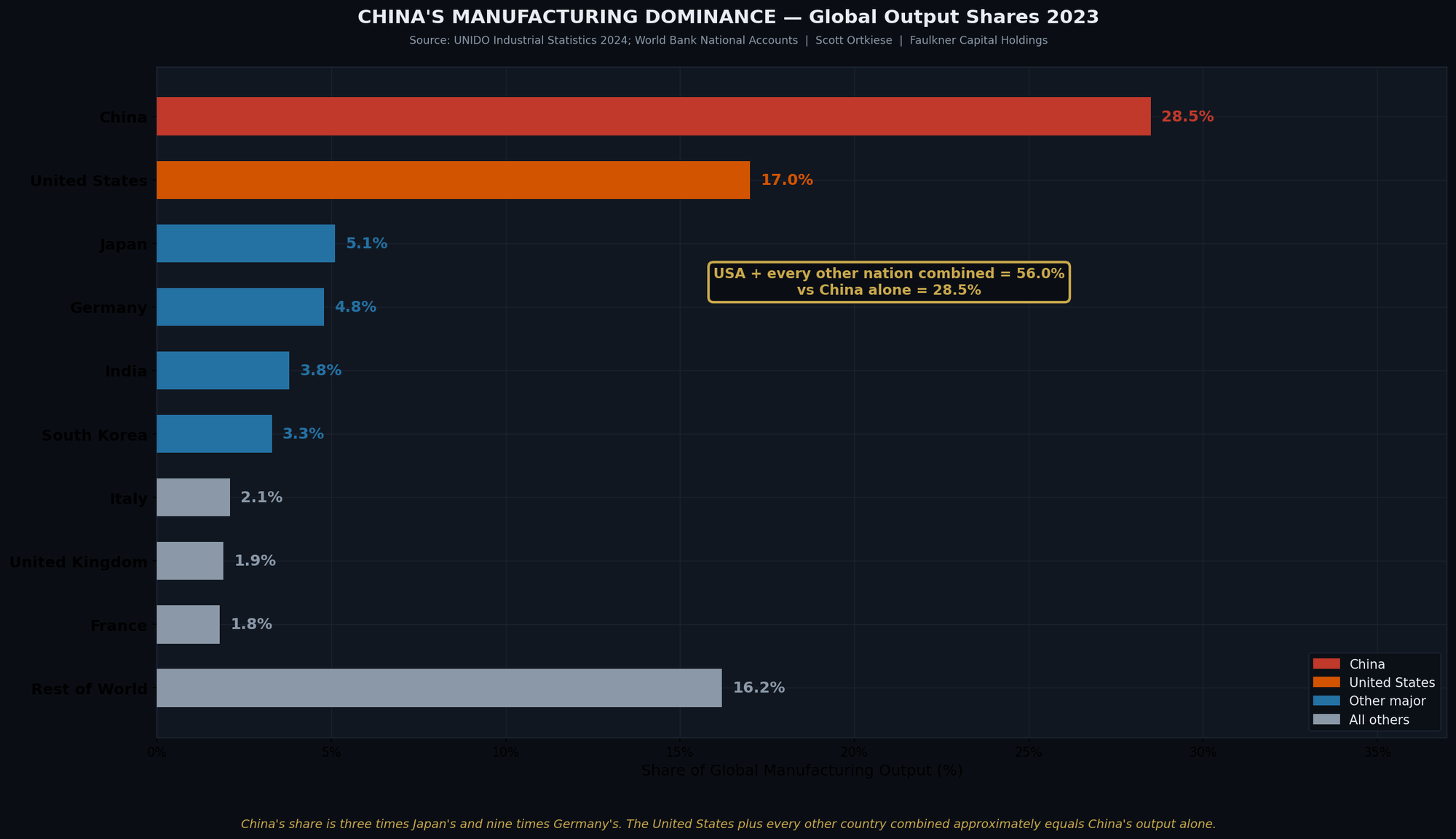
China accounted for 29 percent of global manufacturing output in 2023, more than twelve percentage points ahead of the second-place United States, which controlled approximately 17 percent. When measured by gross production, China’s share is three times that of the United States, six times Japan’s, and nine times Germany’s. The United States plus every other country on earth outside China, together, approximately equals China’s output. That is the scoreboard before you open any document, attend any congressional hearing, or read any S-1 (S-1: the registration document a company must file with the Securities and Exchange Commission, or SEC, before its shares can be sold to the public).
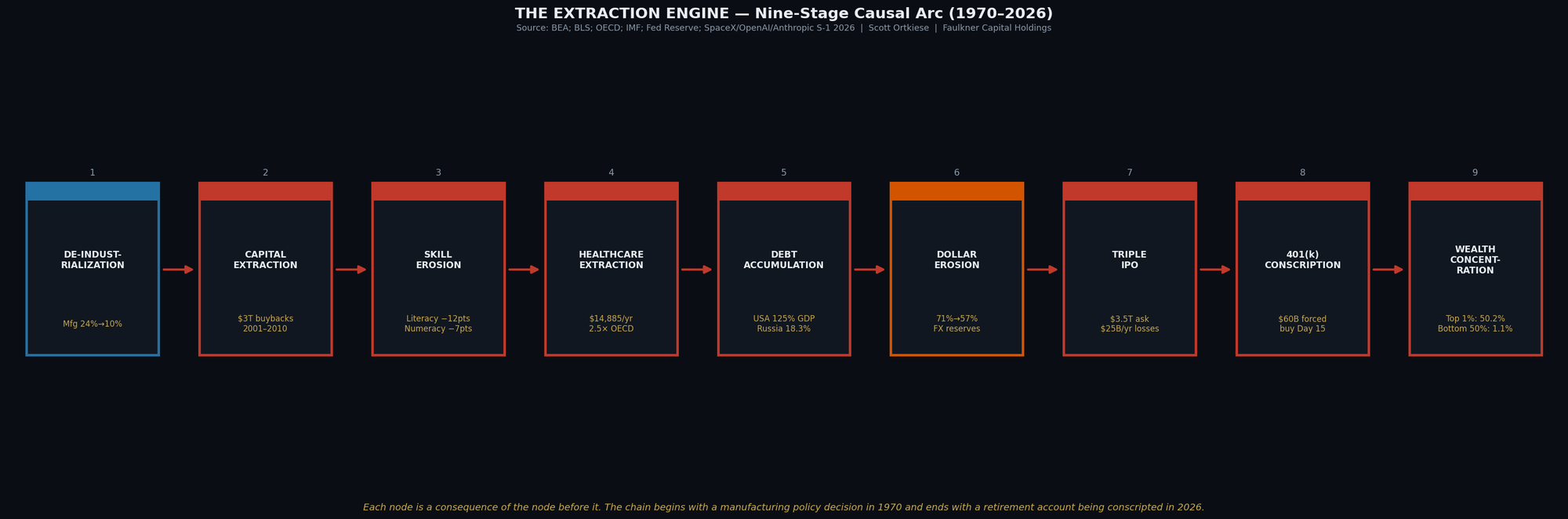
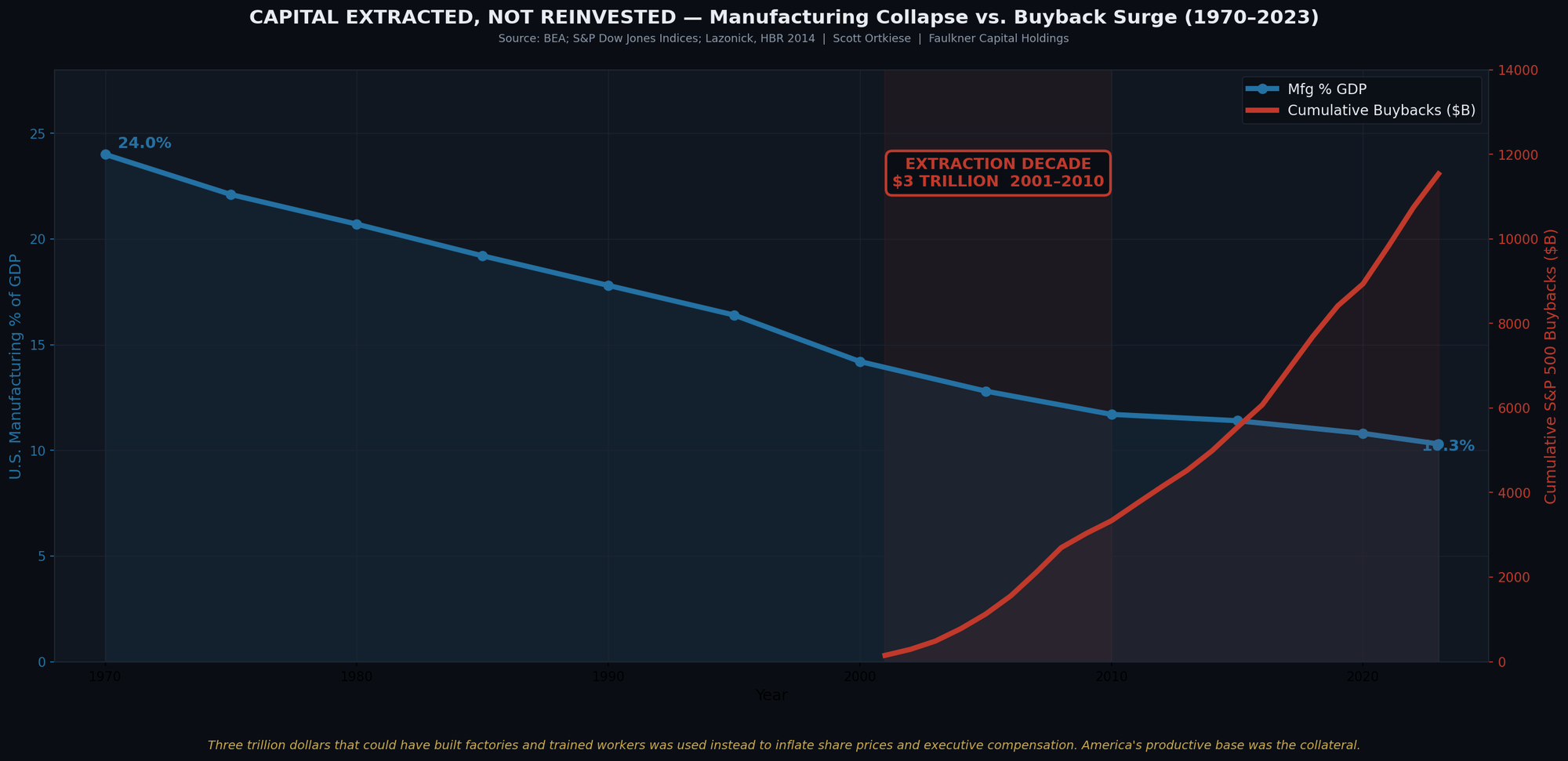
Manufacturing as a share of U.S. gross domestic product (GDP: the total dollar value of all goods and services a country produces in a year) has collapsed from roughly 24 percent in 1970 to just over 10 percent today, one of the lowest figures among the world’s top ten manufacturing nations. Five to seven million manufacturing jobs left in the first decade of this century alone, driven not primarily by automation but by the bilateral trade imbalance with China, which grew from roughly one-third of the Asia deficit in 2000 to 72 percent by 2012. The jobs did not upgrade. They left and did not come back. William Lazonick’s foundational research demonstrated that rather than reinvesting surpluses into the next round of productive capacity, American corporations chose to extract value through stock buybacks: a mechanism designed primarily to elevate share prices and therefore stock-based executive compensation. For the decade 2001 to 2010, S&P 500 (Standard and Poor’s 500: the index of the 500 largest U.S. publicly traded companies) companies spent approximately three trillion dollars on share repurchases: capital that did not build a factory, train a worker, or fund a supply chain.
This is not a complicated story. It is a simple one that powerful people have an interest in making complicated.
The Country That Chose to Build
China’s dominance was not accidental, inevitable, or the product of currency manipulation alone. China’s industrial ascent was the product of deliberate, patient, multi-decade state industrial policy of a kind the United States has not attempted since the interstate highway system and the space program of the 1960s.
The Made in China 2025 program, launched in 2015, set explicit domestic market share targets in high-value sectors: next-generation information technology, high-end computerized machines, robotics, aviation and space equipment, energy-saving and new energy vehicles, new materials, biomedicine, and advanced medical equipment. The industrial policy toolbox deployed included subsidies, below-cost access to production factors, technology transfer requirements, public procurement preferences, and industrial guidance funds targeted at identified bottleneck technologies. In 2019 alone, the value injected by industrial policy instruments into the Chinese economy exceeded the GDP of Finland. This is state capitalism operating as it was designed: not to enrich shareholders in the next quarter, but to achieve productive capacity over the next generation. The 14th Five-Year Plan (2021 to 2025) explicitly prioritized technological self-sufficiency and domestic supply resilience in response to what Beijing correctly anticipated as a sustained Western campaign of technology containment.
The World Economic Forum, in its June 2025 analysis titled “Made in China 2.0,” documented that China is now defining the terms of competition in advanced manufacturing across electric vehicles, solar panels, humanoid robots, and enterprise-grade artificial intelligence. Singapore, Japan, South Korea, Chinese Taipei, Hong Kong, and Macao sweep the top positions in the PISA (Programme for International Student Assessment: the OECD’s triennial survey of 15-year-old student achievement in mathematics, reading, and science across 80-plus countries) mathematics rankings, with six East Asian education systems outperforming every other country on earth in the 2022 round. China’s PISA participants, drawn from representative provinces, have consistently topped the rankings in mathematics, reading, and science across the testing cycles where they have participated. Meanwhile, U.S. mathematics scores in PISA 2022 were “among the lowest ever measured,” with the share of students scoring below a baseline level of proficiency in mathematics increasing by eight percentage points since 2012.
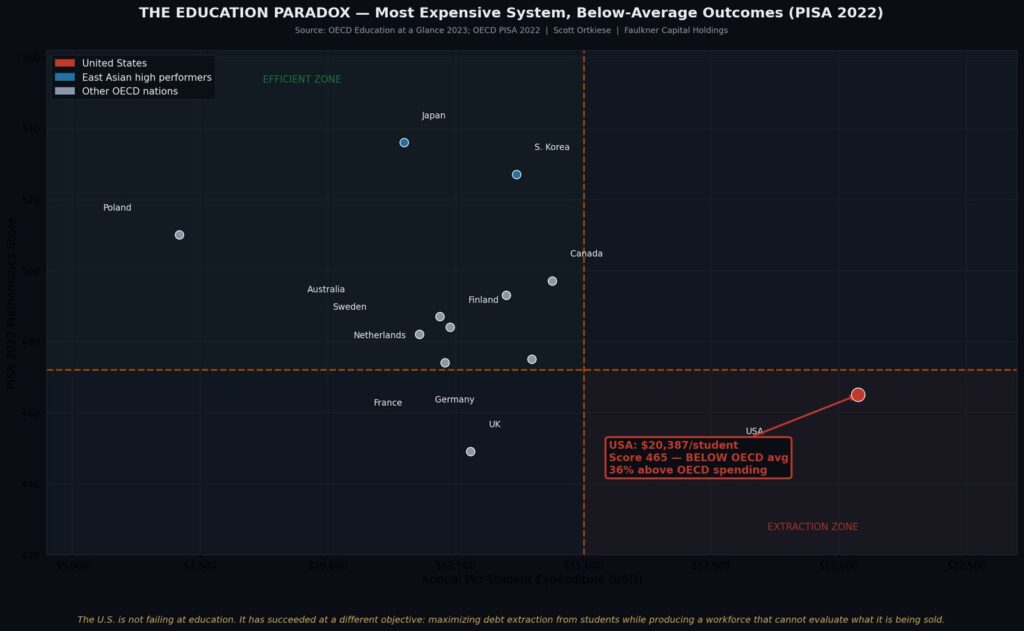
The adult numbers are worse than the student numbers. The OECD Survey of Adult Skills, known as PIAAC (Programme for the International Assessment of Adult Competencies), covering 2022 to 2023, found that U.S. adults aged 16 to 65 saw literacy scores decline by 12 points from 2017 to 2023 and numeracy scores fall by 7 points in the same period. More than one quarter of U.S. adults scored at literacy Level 1 or below on a scale of 0 to 5, meaning they can comprehend only very short texts with minimal distracting information. The OECD 2025 Education at a Glance report confirmed that despite high investment in education, skills proficiencies among U.S. adults remain average relative to other OECD countries, with mean literacy proficiency scores decreasing across all age groups and all levels of education between 2012 and 2023. The United States spends $20,387 per student across all educational levels, 36 percent above the OECD average of $15,022, and produces an adult population whose functional literacy and numeracy are declining. At public institutions, annual tuition for a bachelor’s degree averages $9,596, the highest among OECD countries. At private institutions, that figure reaches $34,041, more than two and a half times the next highest average in the OECD.
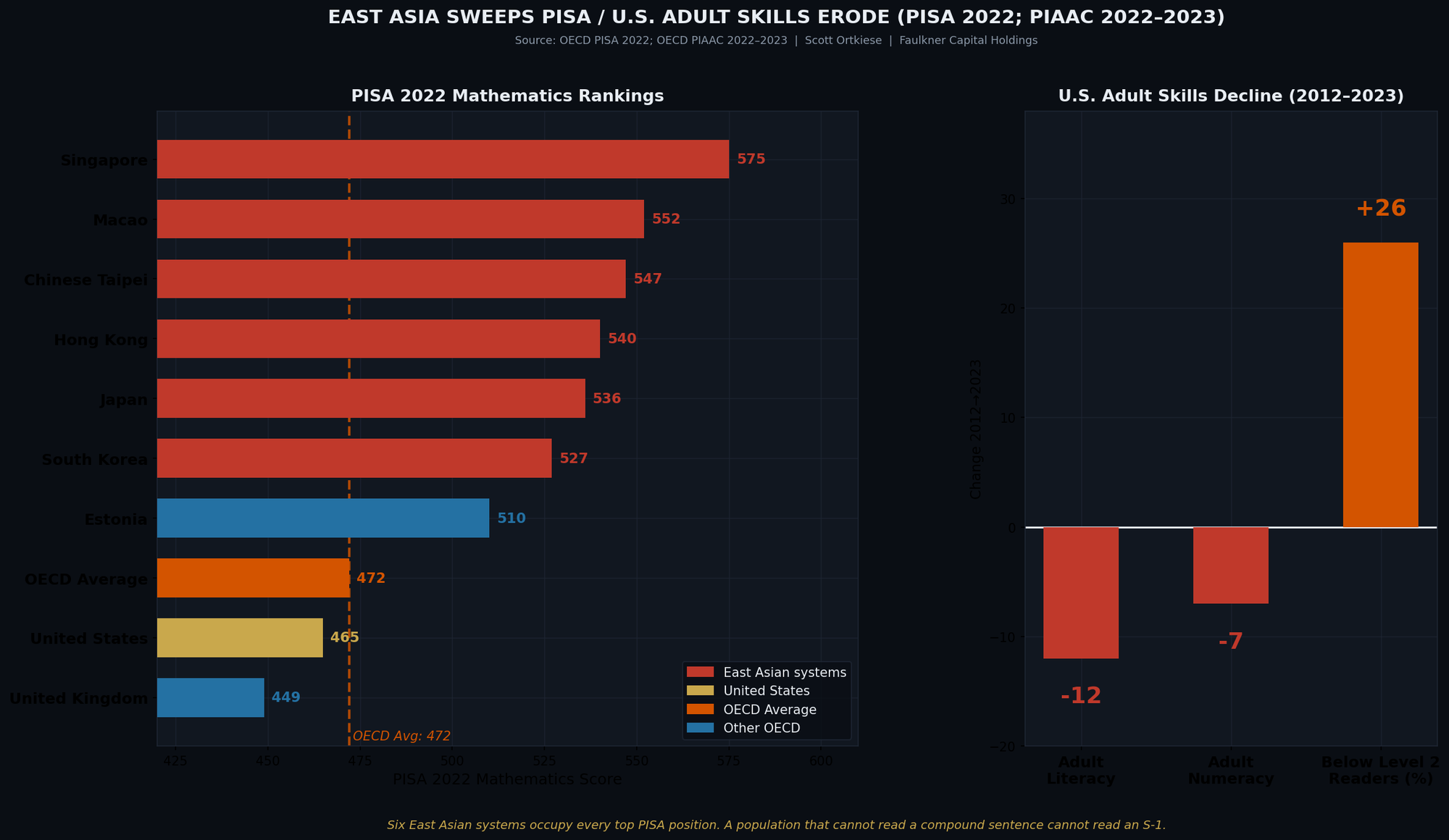
Americans are paying more for education than anyone else, getting less skill formation from it than most comparable countries, and graduating into debt that chains them to a labor market that is closing its entry-level doors. That is not a policy failure. It is a policy success, from the perspective of those who profit from financing that debt and servicing that frustration.
The Healthcare Paradox That Is not a Paradox
The United States spent $14,885 per person on healthcare in 2024, roughly 2.5 times the OECD average of $5,967 and the highest per-capita healthcare cost among all wealthy nations. Switzerland was the second-highest spender at $9,963, less than two-thirds the U.S. figure. For this expenditure, Americans receive: a life expectancy of 76.4 years, last out of 14 peer nations analyzed by Commonwealth Fund and OECD data; the highest rates of ischemic heart disease and diabetes mortality among those same peer nations; the worst maternal mortality rate; and the highest infant mortality rate. Australia spends approximately $390 per capita on healthcare and achieves a life expectancy of 83.2 years, nearly seven years longer than the American average.
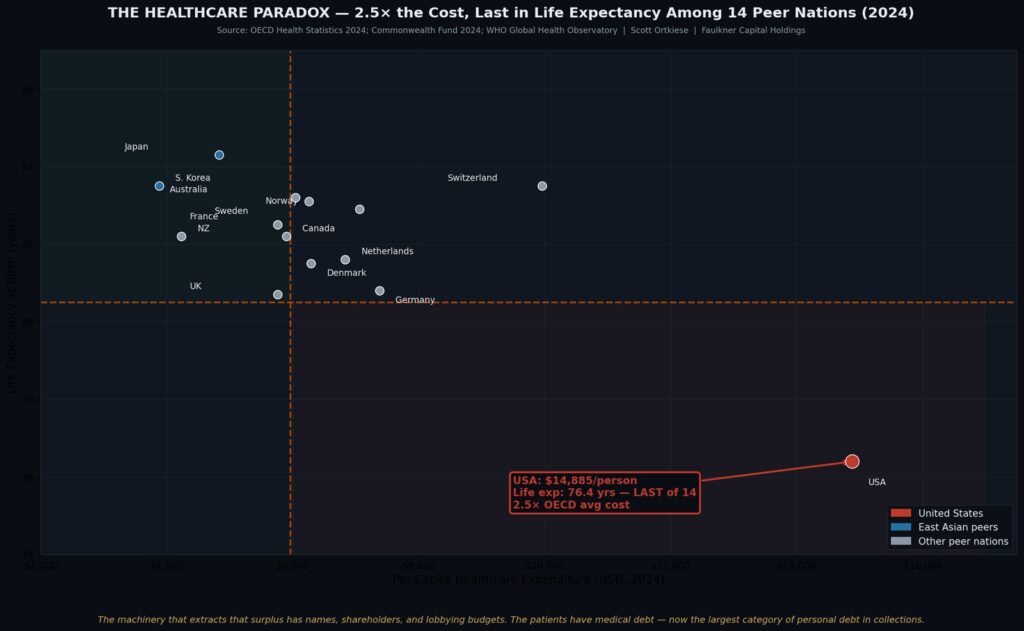
The United States spends over $1,000 per person per year on administrative costs, approximately five times more than the average of other wealthy countries, and approximately equal to what it spends on long-term care. Sweden spends 22 times more on long-term care than on administrative costs. The United States spends approximately the same on both. Prices, not utilization, drive the excess. The machinery that extracts that surplus has names, shareholders, and lobbying budgets. The patients have medical debt, which now constitutes the largest category of personal debt in collections in the United States.
Healthcare and education are the two investments a society makes in its own future productive capacity. The United States has managed to make both simultaneously the most expensive and among the least effective in the developed world. That is not misfortune. That is extraction dressed as a system.
The Debt Architecture of the West
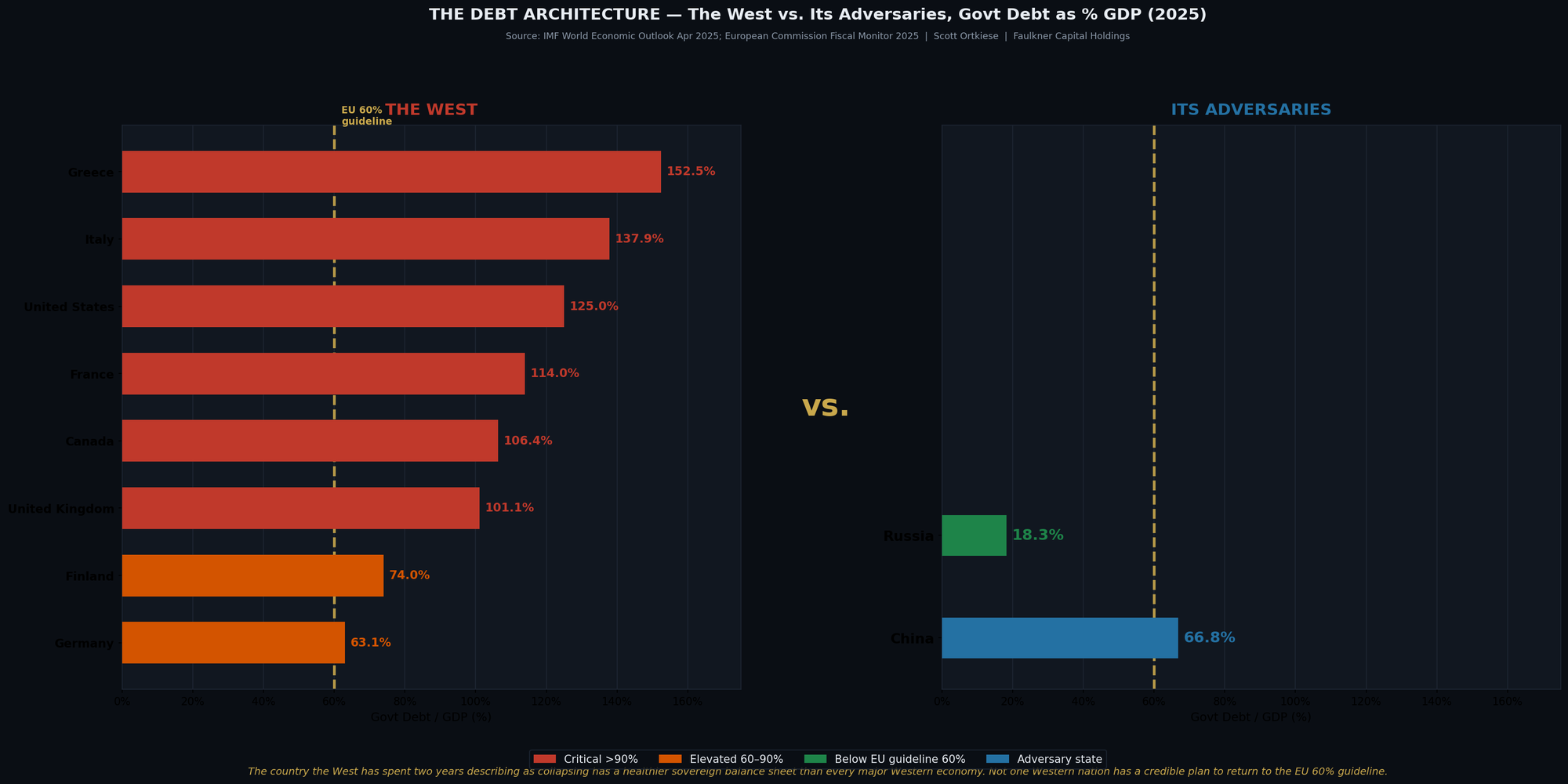
Russia’s government debt to GDP stands at 18.3 percent in 2025. China’s stands at approximately 66.8 percent. The United States stands at approximately 125 percent. France has reached 114 percent. Italy stands at 137.9 percent. Greece at 152.5 percent. The United Kingdom at 101.1 percent. The European Commission’s own guideline states that public debt should not exceed 60 percent of GDP. Every major Western economy is well above it. Not one has a credible plan to return to it.
Gross U.S. federal debt stood at approximately $39 trillion as of May 2026. Net interest outlays surpassed military spending and Medicare for the first time in fiscal 2025, reaching $970 billion, and cross $1 trillion in fiscal 2026. The Congressional Budget Office projects net interest to nearly double to $2.1 trillion by 2036, with cumulative interest costs of $16.2 trillion over the decade. The federal deficit totals $1.9 trillion in fiscal year 2026 and is projected to grow to $3.1 trillion in 2036. The CBO states plainly: “Our budget projections continue to indicate that the fiscal trajectory is not sustainable.”
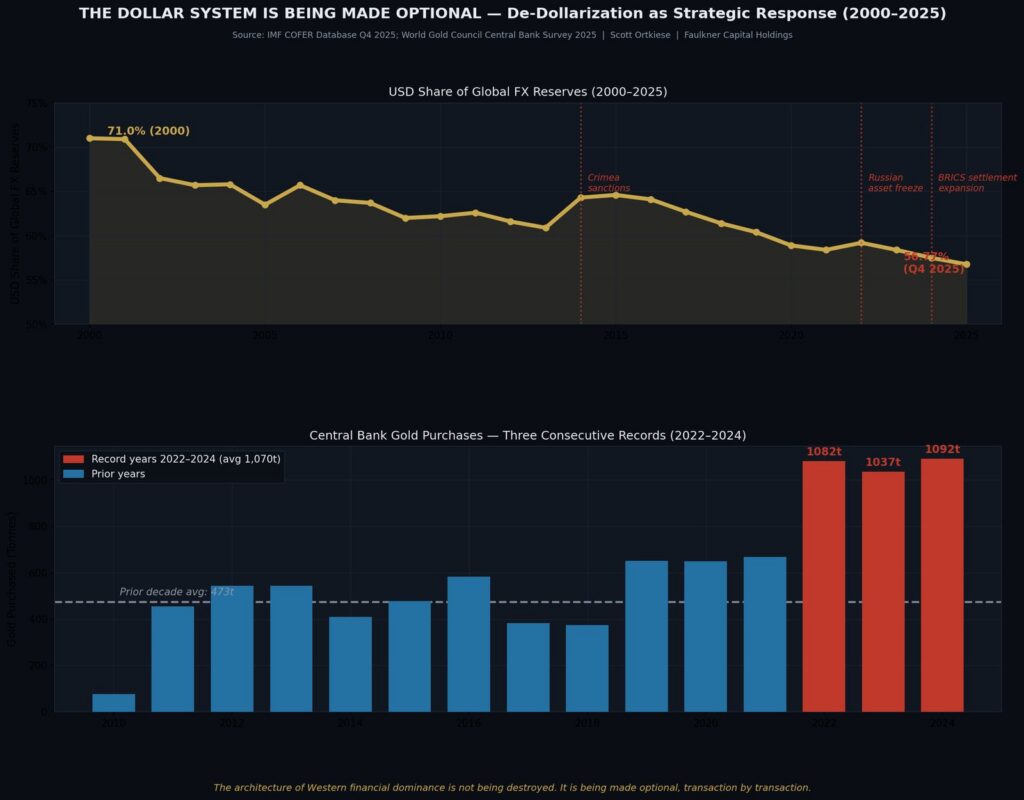
The West built its postwar prosperity substantially on the labor and resources of others. The petrodollar arrangement assembled by Treasury Secretary William Simon in Jeddah in July 1974 required Saudi Arabia to funnel oil revenues into U.S. Treasury bonds in exchange for military protection, terms kept secret until Bloomberg obtained the cables under the Freedom of Information Act in 2016. The arrangement underwrote American consumption for fifty years. The dollar’s share of global foreign exchange reserves has fallen from approximately 71 percent in 2000 to 56.77 percent in Q4 2025. Central banks bought 1,082 tonnes of gold in 2022, 1,037 in 2023, and 1,092 in 2024, each year more than double the prior decade’s average of 473 tonnes. The World Gold Council’s 2025 survey found 73 percent of central bank respondents expect moderate or significantly lower U.S. dollar holdings in global reserves over the next five years. Russia and China now settle 99.1 percent of bilateral trade in rubles and yuan through CIPS (Cross-Border Interbank Payment System), which routes outside the Western SWIFT (Society for Worldwide Interbank Financial Telecommunication) network. The architecture of Western financial dominance is not being destroyed. It is being made optional, transaction by transaction, by the same people the West designated as adversaries because it could no longer compete with them on productive terms.
Russia ran a budget deficit of 2.6 percent of GDP in 2025 and maintains a debt to GDP ratio of 18.3 percent, less than one-seventh of the United States. The country the West has spent two years describing as economically collapsing has a healthier sovereign balance sheet than every major Western economy by a significant margin. This is not an endorsement of Russia’s governance or its war. It is an observation that the Western habit of defining its adversaries as incompetent and failing is a defense mechanism, not analysis.
The Population That Is not Paying Attention
Here is what is not being discussed in any congressional hearing on artificial intelligence, in any earnings call of the companies going public, or in any editorial page of the newspapers that still exist: what happens to the person who does not work in the industries these three IPOs (initial public offerings: the first time a private company sells shares to the public) will create, which is most people.
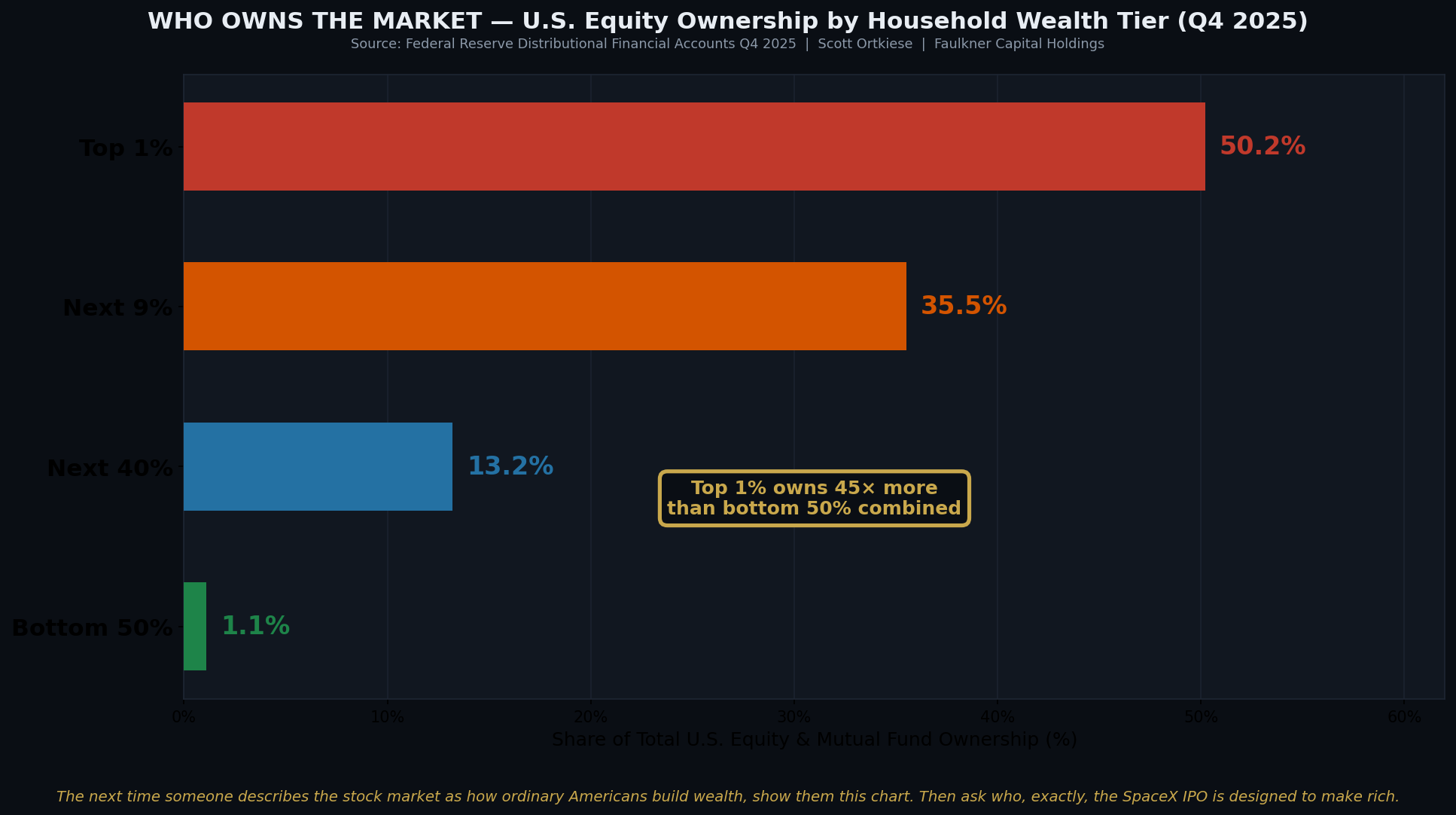
More than 1,200 AI-related laws were proposed in U.S. state legislatures in 2025. More than 180 passed. None address the wealth transfer mechanism being executed through the index fund machinery. None address the related-party transaction network inside the SpaceX S-1. Congress is holding hearings about AI and the First Amendment. The wealth of the top 1 percent of Americans reached a record $52 trillion in 2025. The top 10 percent of Americans own 79 percent of all household wealth. The bottom 50 percent own approximately 1.1 percent of all corporate equities and mutual fund shares.
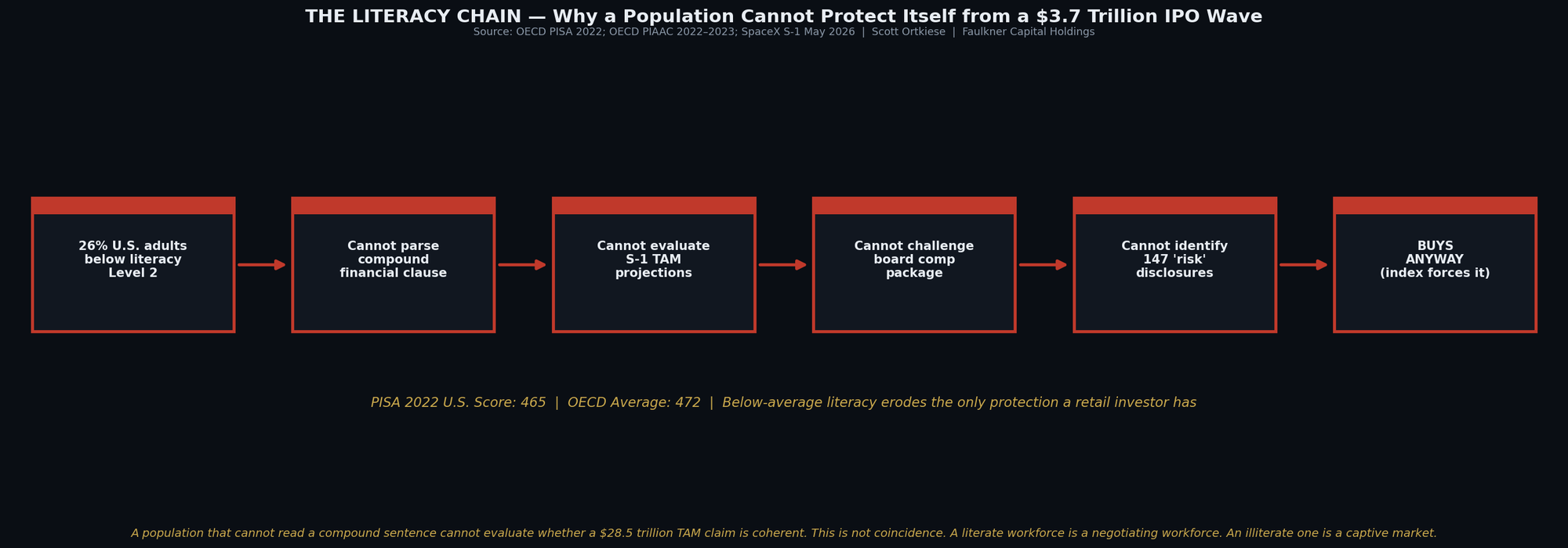
The bought politicians who serve this system are not, in the main, stupid. They understand exactly what is happening. The public they serve is another matter. One in five U.S. adults lacks basic literacy skills. One in three lacks basic numeracy skills. A population that cannot read a compound sentence cannot read an S-1. A population that cannot perform basic arithmetic cannot evaluate whether a $28.5 trillion total addressable market claim in a company losing $6 billion a year is coherent. A population sedated by social media, gig employment, streaming services, pharmaceutical dependency, and the perpetual anxiety of economic precarity is not equipped to mount institutional resistance to anything, let alone to a transfer of capital this large and this carefully engineered.
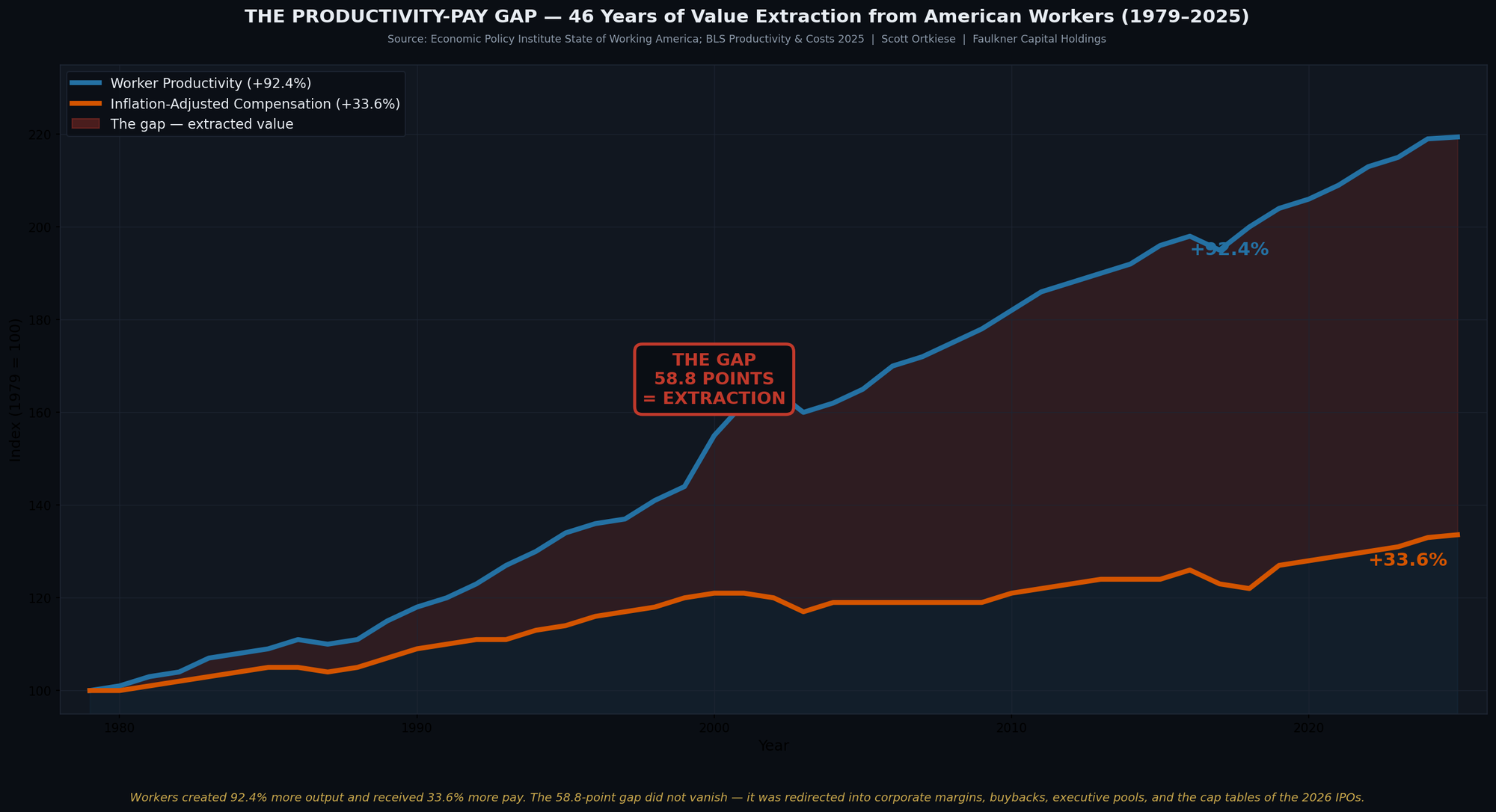
This is not a natural condition. It is the yield of fifty years of deliberate disinvestment in the things that produce a capable citizenry: adequately funded public schools, accessible higher education, a healthcare system oriented toward prevention rather than extraction, a media ecosystem that covers local governance, a labor market that pays workers what their productivity warrants. Since 1979, productivity has grown 92.4 percent. Worker pay has grown 33.6 percent. The Economic Policy Institute documents this gap. Nobody in the rooms where these three S-1s were written lost sleep over it.
The Three Offerings
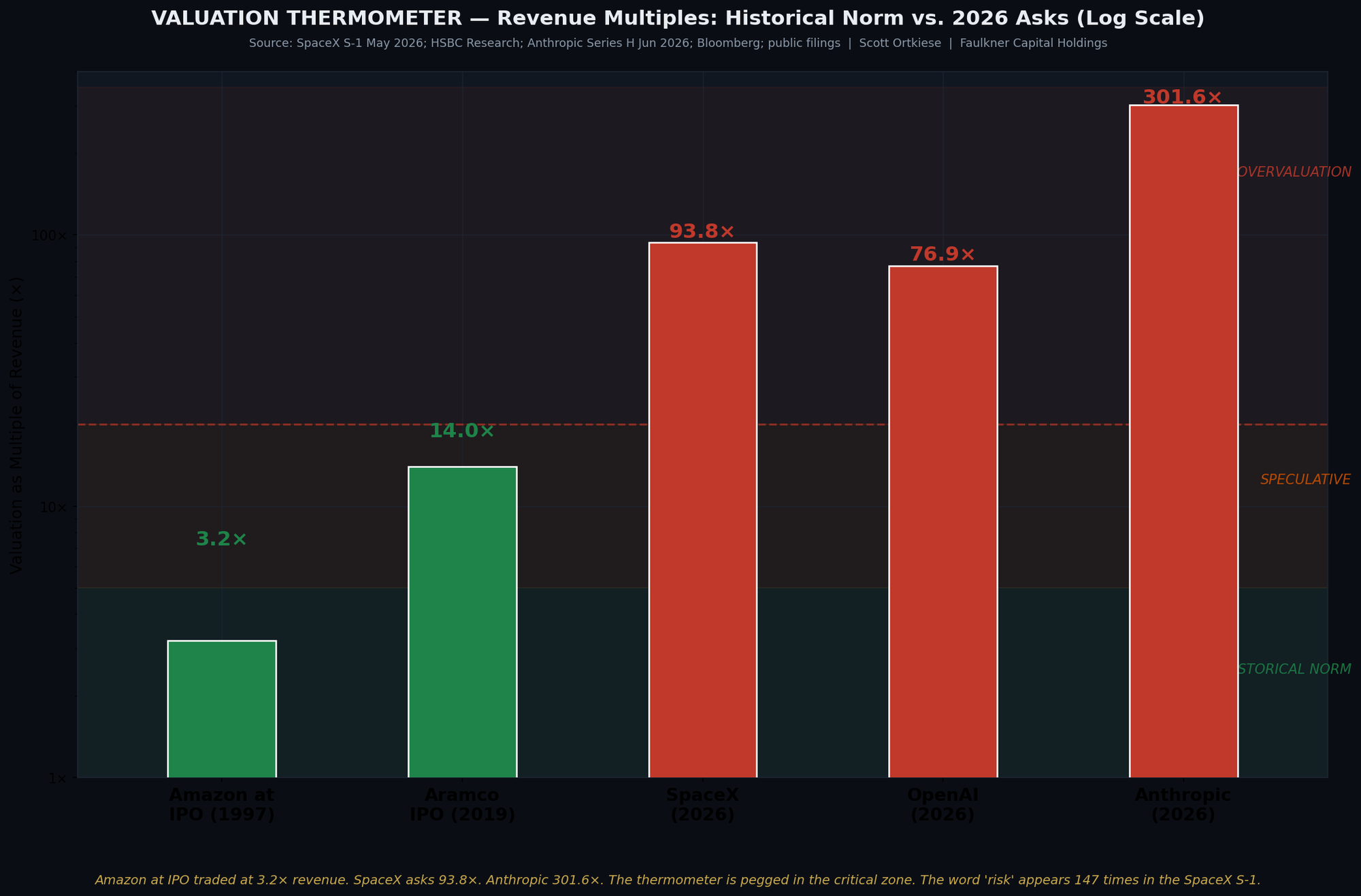
On May 20, 2026, SpaceX filed its S-1, targeting a June 12 Nasdaq debut under the ticker SPCX. The offering seeks to raise $75 to $80 billion at a valuation of $1.75 trillion, more than triple the previous record for the largest U.S. IPO, set by Aramco in 2019 at $26 billion raised. On June 1, 2026, Anthropic confirmed a confidential S-1 filing following a $65 billion Series H funding round (Series H: the eighth round of private investor financing, lettered alphabetically from Series A) that valued the company at $965 billion post-money, the largest venture capital raise in history. OpenAI confidentially filed its own S-1 around May 22, 2026, targeting a fourth-quarter debut at a valuation exceeding $1 trillion.
Three companies. Combined ask: more than $3.5 trillion in new public-market capital absorption within approximately two quarters, against combined trailing losses approaching $25 billion and combined net cash burn that no analyst has yet been able to bound. For comparison, the dot-com peak in 2000 cleared roughly $97 billion in total IPO proceeds across the entire calendar year.
The financial realities are these. SpaceX reported $18.67 billion in consolidated 2025 revenue and a net loss of $4.94 billion. The xAI (xAI: Elon Musk’s artificial intelligence company, merged into SpaceX in February 2026) segment recorded an operating loss of $6.35 billion on $3.20 billion in revenue in 2025. In Q1 (first quarter) of 2026, xAI’s operating loss reached $2.47 billion on $818 million in revenue. xAI’s capex (capital expenditure: money spent on long-lived assets like data centers and chips) in 2025 alone was $12.7 billion, exceeding the combined spending of SpaceX’s Starlink and launch divisions. Starlink, the one profitable segment, generated $11.4 billion in 2025 revenue but average revenue per subscriber declined 18 percent across the year, a deterioration in unit economics that the S-1 acknowledges and then asks investors to look past.
OpenAI anticipated burning approximately $9 billion against $13 billion in 2025 sales, spending roughly $1.69 for every dollar of revenue generated. The company projects operating losses reaching $74 billion in 2028, roughly 75 percent of that year’s projected revenue. HSBC (Hongkong and Shanghai Banking Corporation) Global Investment Research projected in November 2025 that OpenAI’s cumulative free cash flow will remain negative through 2030, leaving a $207 billion funding gap that must be filled by external capital. HSBC’s analysts stated plainly: OpenAI needs to raise at least $207 billion by 2030 so it can continue to lose money.
The SpaceX S-1’s TAM (Total Addressable Market: the management estimate of every dollar a company could theoretically capture if it owned its entire market) section claims a $28.5 trillion opportunity, larger than the annual GDP of the United States and approximately one-third of global GDP. The company simultaneously acknowledges in its own S-1 risk factors that orbital AI data centers involve “substantial technical challenges and untested technologies that may not reach commercial viability.” The auditor, PricewaterhouseCoopers, did not sign the TAM section. PricewaterhouseCoopers signed the financial statements. The TAM section is marketing, placed inside a legal document that conveys the authority of an audited filing.
A June 2026 working paper submitted to arXiv (arXiv: the Cornell University-hosted preprint server for academic research papers) by Wang and Chen, applying a five-pillar diagnostic framework including SADF/GSADF tests (Supremum Augmented Dickey-Fuller and Generalized Supremum Augmented Dickey-Fuller: statistical tests that detect explosive, bubble-like dynamics in financial time-series data) alongside capex-payback analysis, reached the following conclusion: AI is best understood as “a real technological revolution with localized bubble dynamics,” with capital expenditure “having accelerated faster than observed monetization in some layers.” The technology may be real. The prices are not.
George Noble, the former Fidelity portfolio manager who founded Noble Capital and has spent over forty years on Wall Street, read the 277-page SpaceX S-1 in full and wrote publicly, without euphemism: “SPACEX IS COMPLETE GARBAGE. Run, don’t walk from this train wreck.” Noble named the mechanism: “You are about to force every retirement account in America to become EXIT LIQUIDITY for the most overpriced IPO in history. This is a legally sanctioned wealth transfer from Main Street to Wall Street.” Michael Burry, famous for shorting the 2008 mortgage market, endorsed Noble’s analysis to his more than one million social media followers.
Neither Noble nor Burry is a crank. They are among the few credentialed participants in the system willing to say what the numbers plainly show. The machinery chose to proceed anyway.
Twenty-three Banks and the Fee
Here is the question George Noble asked that has not been asked loudly enough anywhere else: “Have you no shame? Have you no decency? Have you no honor? Or is it all about the fees?”
Let us answer it with arithmetic.
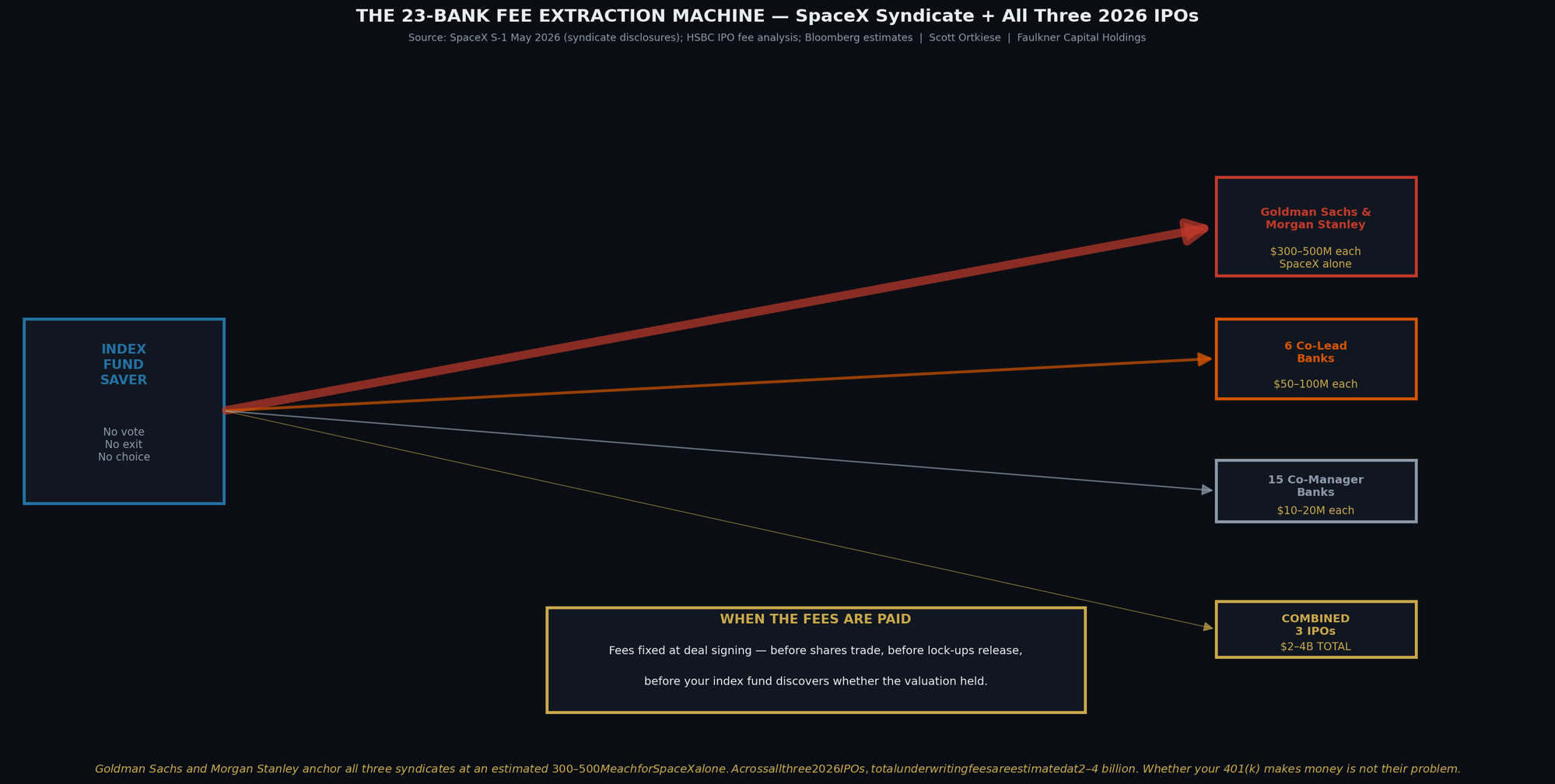
SpaceX is negotiating underwriting fees of less than 0.75 percent on a raise of approximately $75 billion. Even at that compressed rate, the twenty-three banks in the syndicate are expected to collect approximately $500 million from this single offering. Total underwriting fees on the SpaceX listing could exceed $1 billion once base fees, discretionary incentive compensation, and post-listing advisory relationships are included. Goldman Sachs, as lead-left (the bank that runs the order book and therefore receives the largest allocation of the fee pool), takes the largest single share. Morgan Stanley, as stabilization agent (the bank responsible for managing price volatility immediately after listing), takes the second largest. Goldman Sachs CEO David Solomon reportedly won the lead-left position over Morgan Stanley by sending Elon Musk a direct message on X, the platform Musk owns.
Goldman Sachs and Morgan Stanley are simultaneously the primary advisors for Anthropic’s IPO process, which is targeting a fourth-quarter 2026 listing at a valuation approaching $1 trillion. Goldman Sachs and Morgan Stanley are the same two banks advising OpenAI on its own parallel IPO filing. Three offerings. The same two lead banks on all three. By the time this is over, Goldman Sachs alone will have served as lead advisor, lead underwriter, or co-lead on the three largest and most concentrated technology IPOs in American market history, collecting fees in the hundreds of millions of dollars per transaction, with no published research from any of those same banks offering a credible path to profitability for any of the three issuers.
There is no credible path to profitability for any of the three issuers because no one has written one. The standard rationalization deployed in every roadshow, every analyst call, and every term sheet for these offerings is that the companies will eventually dominate markets so large that current losses are irrelevant. That claim requires accepting the TAM projections at face value. Those projections are not audited. They are not binding. They are marketing copy, written by the management teams of the issuing companies and blessed by the same banks that are paid to distribute the shares. A company projecting a $28.5 trillion total addressable market while losing $6 billion a year on the AI segment and acknowledging in its own risk factors that the orbital data-center concept may never be commercially viable has not presented a business plan. It has presented a financing story, dressed in the legal architecture of a public offering, and handed it to twenty-three banks whose collective incentive is to close the transaction, collect the fee, and move to the next deal.
This is not cynicism. It is a structural description of how the incentive flows in the syndicate model. The banks are paid when the deal closes. They are not paid if the deal is pulled. They are not paid if the analysis concludes the valuation is unsupportable. They are not fined if the company’s stock collapses six months after listing. They are not held responsible if the index funds holding those shares in their constituents’ retirement accounts suffer losses. The fee is collected in advance. The consequences are distributed afterward, to the retail investor, the pensioner, and the index fund holder who had no choice in the matter.
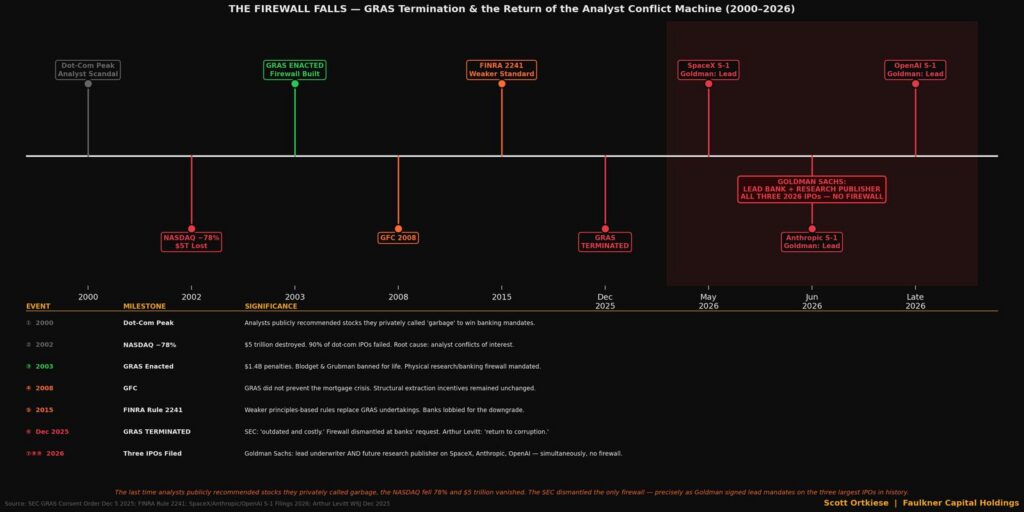
The 2003 Global Research Analyst Settlement (GRAS: the enforcement agreement reached between the SEC, FINRA, and ten major investment banks on April 28, 2003, following revelations that Wall Street analysts had been publicly recommending stocks they privately described in internal emails as “garbage,” “junk,” and “a pig,” in order to win investment banking mandates from those same companies) was the regulatory response to the last time this happened at scale. The settlement required physical separation of research and investment banking, prohibited analysts from participating in IPO roadshows, and banned compensation arrangements that tied analyst pay to investment banking revenue. It extracted $1.4 billion in penalties and disgorgement from ten firms. Two analysts, Henry Blodget of Merrill Lynch and Jack Grubman of Salomon Smith Barney, were fined and banned from the securities industry for life. Not one banker went to prison. The dot-com collapse that preceded the settlement had wiped out more than $5 trillion in market value, with the NASDAQ falling 78 percent from its March 2000 peak to its October 2002 trough. Ninety percent of internet companies that went public during the bubble failed.
The settlement did not prevent the 2008 mortgage crisis. It did not prevent the private equity fee extraction of the 2010s. And on December 5, 2025, exactly as the three AI IPO processes were accelerating toward their 2026 launch windows, the SEC formally terminated the remaining undertakings of the GRAS, agreeing with the banks that the settlement was “outdated and costly” and that FINRA (Financial Industry Regulatory Authority: the self-regulatory organization that oversees U.S. broker-dealers) Rule 2241, a principles-based rule adopted in 2015, was sufficient to manage the conflicts. Former SEC Chairman Arthur Levitt, writing in the Wall Street Journal, called the decision a return to corruption and predicted “a return of scandals where analysts again favor banking revenue over investors.” He published that warning in December 2025. The SpaceX S-1 was filed in May 2026. The Anthropic S-1 followed in June 2026. The OpenAI filing is underway. Goldman Sachs is the lead bank on all three. The firewall between the banking departments that win these mandates and the research departments that will publish buy recommendations to retail investors has just been dismantled, by judicial consent, at the request of the banks themselves.
The fee math across the trilogy is stark. SpaceX raising $75 billion at sub-0.75 percent: approximately $500 million to $1 billion in underwriting fees. Anthropic and OpenAI together targeting well over $100 billion in combined raises: using even the most compressed fee rates applicable to megacap transactions, the syndicate collecting on all three offerings will extract somewhere between $2 and $4 billion in direct underwriting fees, plus advisory fees, stabilization activities, post-listing loan relationships, and the soft-dollar arrangements that never appear in the S-1 footnotes. The typical middle-market IPO fee rate is 7 percent of proceeds, a figure SEC Commissioner Robert Jackson called “the IPO tax” in 2018 and described as unrelated to the actual costs of taking a company public. Even at the compressed megacap rate, two billion dollars in fees is a conservative floor for the syndicate’s total take from this cycle.
Two billion dollars does not buy a steel mill. It does not fund a generic pharmaceutical plant. It does not retrain a displaced coder, repair a bridge, or pay a year’s interest on the student loan balances of the generation whose entry-level jobs the AI systems these offerings are funding will eliminate. It goes to twenty-three banks, weighted by the alphabetical proximity of their names on the cover page of the prospectus, and it goes before a single share has traded, before a single retail investor has been harmed, and before a single pension trustee’s objection has been acknowledged.
The Governance Architecture of the Offering
SpaceX’s governance structure is the institutional expression of the cultural condition described above. It is the architecture of a society that has decided accountability is optional when the person seeking immunity is sufficiently wealthy.
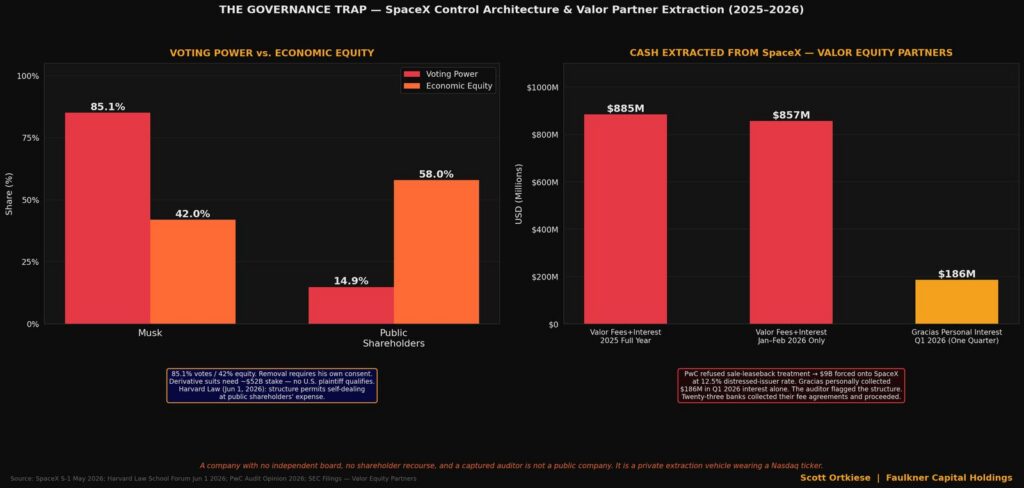
Elon Musk serves simultaneously as Chief Executive Officer, Chief Technology Officer, and Chairman of SpaceX’s board. His Class B shares carry 10 votes per share, giving him 85.1 percent of voting power against approximately 42 percent of economic equity at IPO. Removal of the CEO requires a Class B vote; Class B is his. He is, in the plain meaning of the structure, unfireable without his own consent. The nine-person board carries no independent majority. The company has elected controlled-company status under the Nasdaq listing rules, waiving the independent compensation and nominating committee requirements.
The Texas reincorporation, completed weeks before the filing, replaced Delaware fiduciary law with Texas Business Organizations Code Section 21.563. Under the new charter, a shareholder must hold at least 3 percent of outstanding shares to bring a derivative suit: roughly $52 billion at the IPO valuation. The threshold removes every plaintiff in the country except Musk himself. The S-1 specifies that all securities claims are subject to mandatory binding arbitration: no class actions, no discovery, no public record. SpaceX is the first major issuer to use mandatory arbitration, following the SEC’s 2025 reversal of its longstanding policy against the practice.
Harvard Law School professors Fried and Wang, publishing in the Harvard Law School Forum on Corporate Governance on June 1, 2026, identified the structure as giving Musk explicit permission to appropriate corporate opportunities for himself, arrange related-party transactions that benefit him at the expense of public investors, and sell himself a large fraction of SpaceX’s assets at favorable prices.
Antonio Gracias, Musk’s closest business partner since 2002, controls a 7.3 percent SpaceX stake through Valor Equity Partners and affiliated entities: approximately 500 million Class A shares worth roughly $90 billion at IPO valuation. He sits on the SpaceX compensation and nominating committees without disclosed recusal. Between October 2025 and April 2026, SpaceX executed three large equipment leases with xAI and Valor’s affiliated Cloud Technology Company, covering roughly $20 billion in GPU (Graphics Processing Unit: the specialized semiconductor chip that trains and runs AI models) clusters, networking equipment, and data-center improvements. PricewaterhouseCoopers refused to treat the transactions as ordinary sale-leasebacks and classified them as failed sale-leasebacks, forcing a $9 billion debt entry onto SpaceX’s balance sheet at 12.5 percent senior-secured pricing: the rate distressed issuers pay. SpaceX paid Valor approximately $885 million in fees and interest during 2025 and another $857 million in the first two months of 2026. Gracias personally received $186 million in first-quarter 2026 interest on the $9 billion balance.
The S-1’s Use of Proceeds section does not disclose that approximately $20 billion in bridge loan obligations sit behind the equipment leases, in apparent violation of Regulation S-K (the SEC rulebook that requires the Use of Proceeds section to describe each principal purpose for the offering proceeds).
The pension trustees of New York State, New York City, and California, managing more than $1 trillion in assets on behalf of teachers, nurses, police officers, and firefighters, issued a joint letter on May 13, 2026, calling the structure “the most management-favorable governance structure ever presented to the U.S. public markets at this magnitude” and asking SpaceX to withdraw the filing. They were ignored. The offering proceeded. Twenty-three banks collected their fee agreements and moved to printing.
The Index Machine
The financial mechanism that conscripts the retirement savings of Americans into this transaction does not require anyone’s consent. It operates through rules.
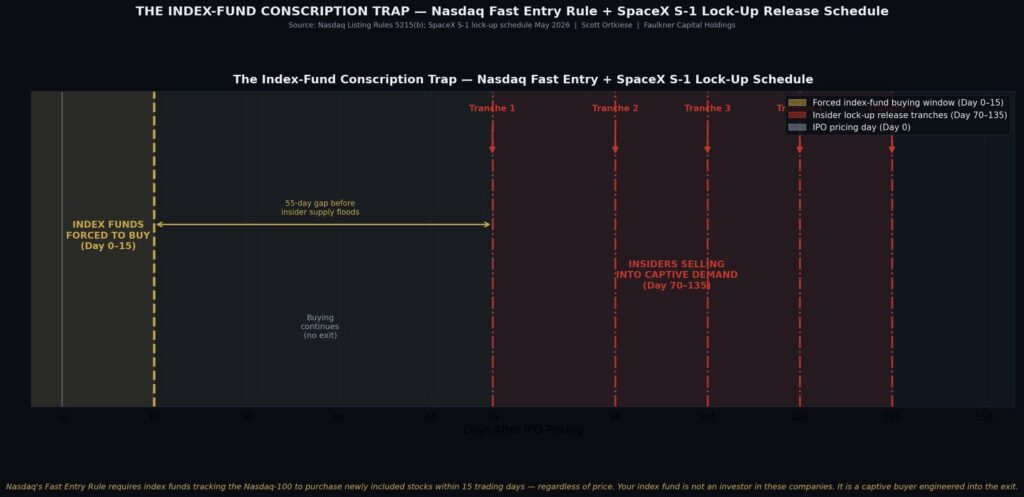
In March 2026, Nasdaq adopted a “Fast Entry” rule, effective May 1, reducing the seasoning period for a top-40 market-cap IPO from approximately three months to 15 trading days and eliminating the 10 percent minimum free float (the share of a company’s total shares that is publicly tradeable) requirement. FTSE Russell (Financial Times Stock Exchange Russell: the index provider that maintains widely tracked global equity benchmarks) simultaneously modified its U.S. indexes to allow megacap companies entry after just five days of public trading. Goldman Sachs analysts estimated the Nasdaq rule alone would trigger up to $60 billion in forced buying from ETFs (exchange-traded funds: mutual funds that trade on a stock exchange and are required by their structure to hold every name in a benchmark index) when SpaceX qualifies, on day 15, with no price discovery interval.
S&P Dow Jones Indices opened a parallel consultation from April 30 to May 28, 2026, proposing to waive the decades-old Financial Viability Requirement that demanded positive GAAP (Generally Accepted Accounting Principles: the standard U.S. bookkeeping framework) earnings over four consecutive quarters, waive the 10 percent free float requirement, and cut the seasoning period from twelve months to six, for companies meeting the MegaCap threshold of roughly $112 billion. On June 4, 2026, S&P Dow Jones announced it would not change its profitability or float rules for the S&P 500, blocking SpaceX from swift entry into that index. SpaceX will enter the Nasdaq-100 (the index of the hundred largest non-financial Nasdaq-listed companies), whose associated passive funds control approximately $1.4 trillion in assets, on day 15.
Americans have a 401(k) (a tax-advantaged employer-sponsored retirement savings plan) or an IRA (Individual Retirement Account: a tax-advantaged personal retirement savings account). The default investment option in both is an index fund. The index fund is contractually required to hold the index as constructed. When SpaceX enters the Nasdaq-100, every passive vehicle tracking that index must buy SpaceX at whatever price the market dictates, on day 15, simultaneously, with no ability to wait, negotiate, or refuse. The staggered lock-up release schedule inside the S-1 frees insiders to begin selling up to 20 percent of eligible shares after the first quarterly earnings report, with additional tranches unlocking at days 70, 90, 105, 120, and 135, precisely as the index-fund buying reaches maximum force. The insiders sell into the forced bid. The retirement saver holds the inventory at the elevated price. The wealth transfer is completed before most account holders read a single quarterly statement.
The Sovereign Hand
Behind the retail saver’s index fund, in the cap tables of all three companies, sits a constituency that has received almost no scrutiny from the congressional hearings about AI.
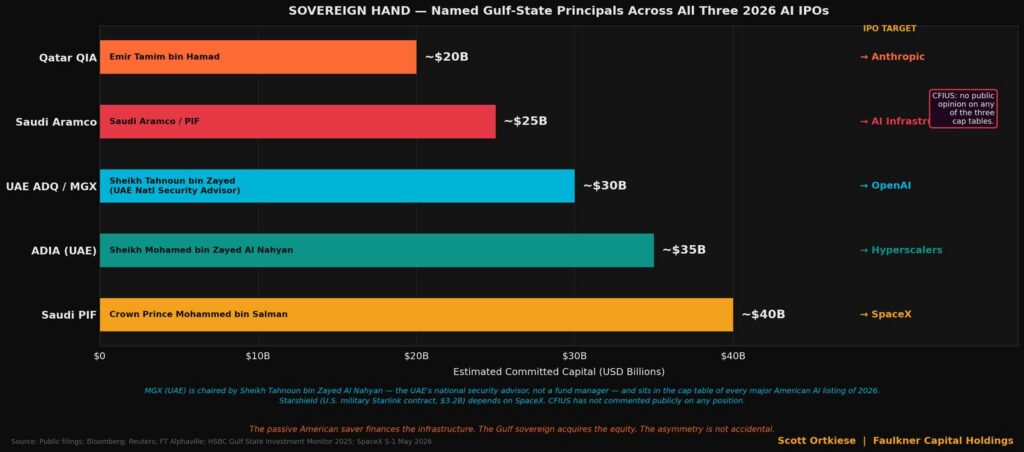
MGX Fund Management Limited was established by the Abu Dhabi government in 2024 as a partnership between Mubadala Investment Company, the emirate’s flagship state investor with $276 billion in assets, and G42, the UAE’s (United Arab Emirates’) national AI champion. MGX is chaired by Sheikh Tahnoun bin Zayed Al Nahyan, the national security advisor of the UAE and the younger brother of the head of state. MGX is an anchor investor in Stargate (the $500 billion AI infrastructure initiative announced from the White House on January 21, 2025). It is a founding partner in the BlackRock-GIP (Global Infrastructure Partners)-MGX Global AI Infrastructure Investment Partnership, which on October 15, 2025, acquired Aligned Data Centers for approximately $40 billion, the largest data-center acquisition in history. MGX led the equity in OpenAI’s most recent primary round. It co-led the Anthropic Series H at a $965 billion valuation. As of mid-2026, a single sovereign vehicle, chaired by a single national security official of a non-democratic government, sits inside the cap table of every major American AI listing of the year.
The Saudi Public Investment Fund, answering to Crown Prince Mohammed bin Salman, and the Kuwait Investment Authority, answering to the Emir, hold parallel positions. Singapore’s Temasek is an anchor investor in the BlackRock-MGX Global AI Infrastructure Investment Partnership. CFIUS (the Committee on Foreign Investment in the United States: the interagency panel that reviews foreign acquisitions of U.S. assets on national security grounds) has not opined publicly on the sovereign positions in any of the three companies.
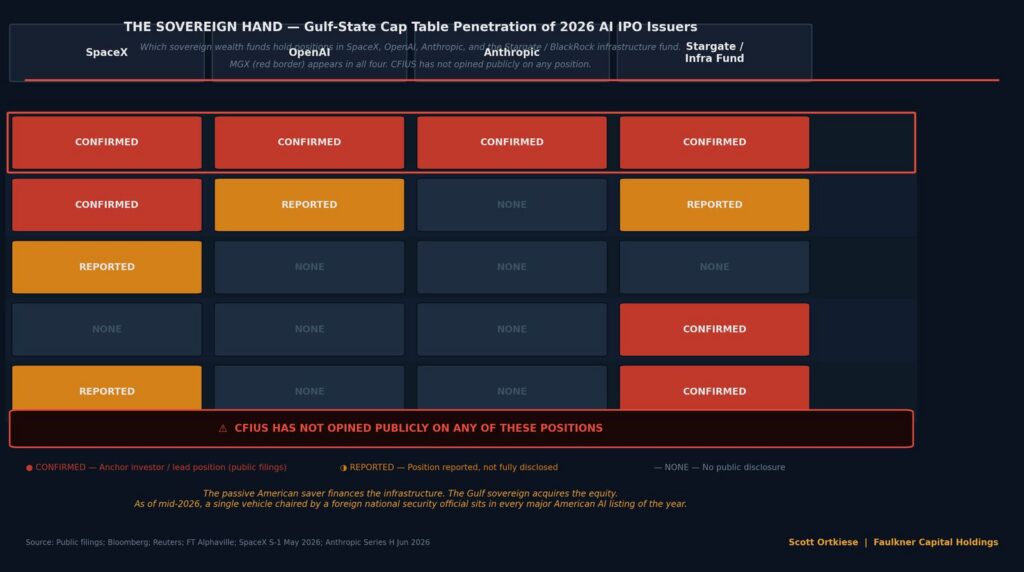
The communications and intelligence infrastructure of the United States military is, under the Starshield contract (the classified military variant of Starlink operating more than 200 satellites under a projected $3.2 billion agreement), dependent on a private company controlled by a single individual who has been adjudicated to have defrauded shareholders, carries two Securities and Exchange Commission enforcement actions, and operates simultaneously as CEO, CTO, and Chairman of the same company the military depends on. That same company’s cap table includes a sovereign AI fund chaired by a foreign national security official whose government has not been asked, publicly, to disclose its national security objectives for its position.
The congressional hearings about AI and the First Amendment are not holding hearings about this.
The Ai Capex Loop and the Physical World
The broader capital misallocation is not abstract. It has a physical footprint that is already competing with the residential and agricultural users that preceded it.
A single hyperscale AI-focused data center can consume as much electricity as 100,000 households and up to five million gallons of water daily for cooling. The UN University Institute for Water, Environment and Health released a June 2026 report documenting that AI’s environmental footprint represents a governance and justice crisis: benefits flow across borders while environmental burdens concentrate in specific communities near the facilities. The carbon footprint of AI systems alone could reach between 32.6 and 79.7 million tonnes of CO2 in 2025. Hyperscale facilities under construction in central Texas, central Arizona, and northern Virginia carry thirty-year power purchase agreements at scales that displace planned residential and industrial load, drawing from the same aquifers that supply surrounding agricultural and municipal users.
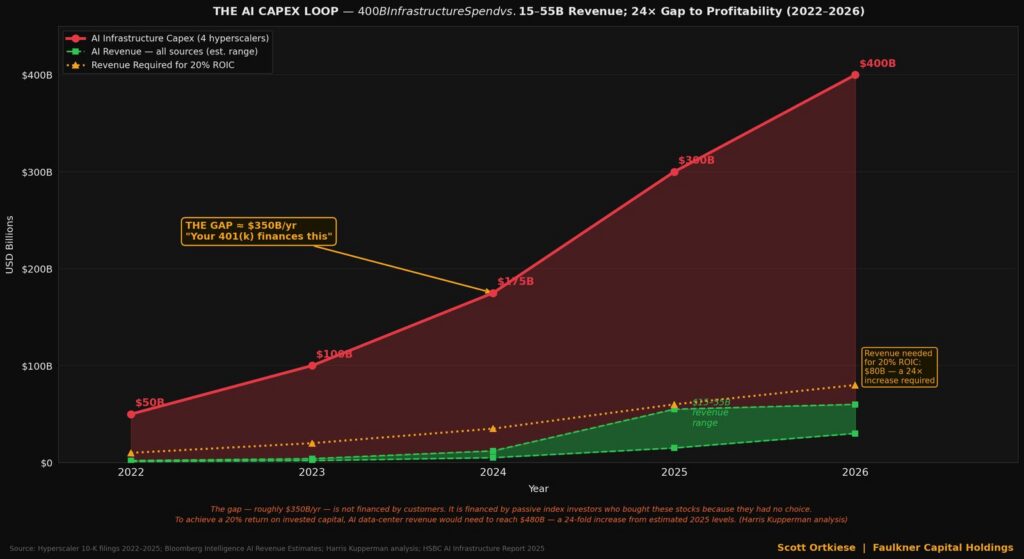
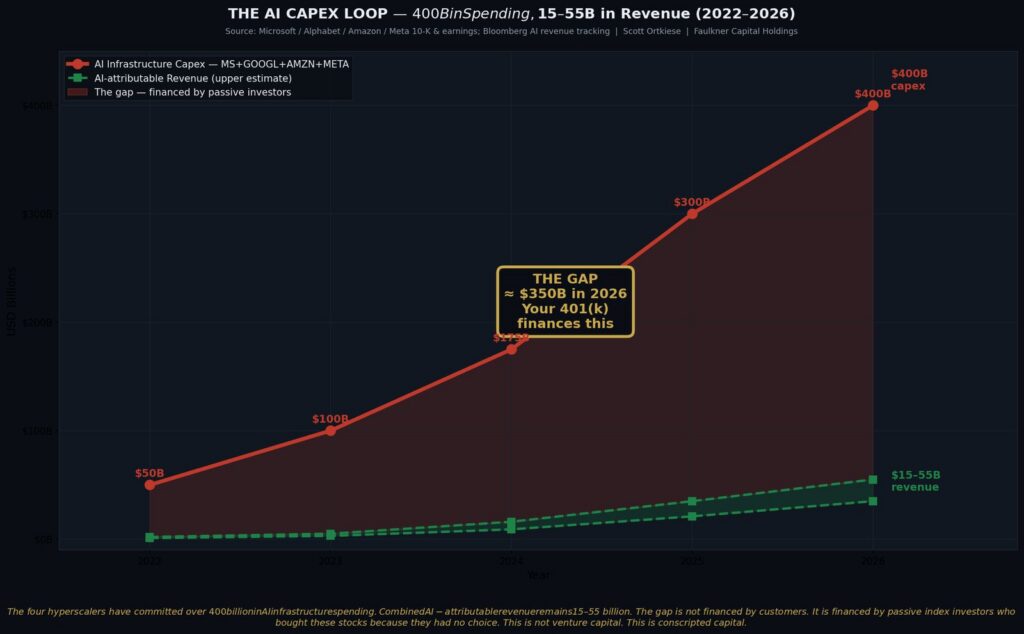
Harris Kupperman’s analysis documented that global data-center spending in 2025 was projected at $400 billion, against estimated revenue from new AI data centers of $15 to $20 billion, with annual depreciation on those assets of approximately $40 billion: twice projected revenue. To achieve a modest 20 percent return on invested capital, AI data-center revenue would need to reach $480 billion, a roughly 24-fold increase from estimated 2025 levels. HSBC modeled $792 billion of cumulative cloud and AI infrastructure spend across the sector between 2025 and 2030, $1.4 trillion in committed compute by 2033, and a $620 billion cumulative data-center rental obligation.
The capital committed against revenue that does not yet exist and may not exist on the timeline the contracts assume is being financed partly by the same index funds whose defaults are being conscripted into the IPO complex. The institution that will be left holding the exposure when the gap closes is the index fund. The index fund is the saver. The saver is the person who has already been displaced by the AI system whose infrastructure the saver’s retirement account is now being required to finance.
What Is Being Given Up
Three and a half trillion dollars of forced index buying does not build a semiconductor fabrication facility. It does not fund a generic pharmaceutical plant. It does not repair a bridge, retrain a coal miner’s child, or fund a rural hospital. It does not buy the machine tools that would let an American factory compete with the Chinese factories producing the goods that fill the shelves of the discount retailers where the displaced American worker shops, because wages have not kept pace with productivity in forty-six consecutive years.
The Magnificent Seven (Apple, Microsoft, Nvidia, Alphabet, Amazon, Meta, Tesla) accounted for 34.1 percent of the S&P 500 by December 2025, up from roughly 14 percent in 2019. BlackRock, under Larry Fink, manages $11.6 trillion. Vanguard manages $12 trillion. State Street Global Advisors manages $5.7 trillion. Together they are the largest shareholder in 88 percent of S&P 500 companies, and the NBER (National Bureau of Economic Research) projects their share of index votes could reach approximately 40 percent within twenty years. A June 2025 study at the Harvard Law School Forum found the United States is a “clear outlier” in common ownership intensity, with concentration nearly twice as high as the next closest economy.
The country’s retirement system flows into those three firms. Those three firms steer toward the Magnificent Seven. The Magnificent Seven own and finance the AI infrastructure companies. The AI infrastructure companies are going public at valuations that require the same retirement system to absorb the offerings at the prices the founders demand. The founders sell into the forced passive bid through staggered lock-up schedules engineered to align with the index inclusion windows. The proceeds concentrate further at the top of a wealth distribution where, as of Q4 2025, the top 10 percent of Americans already own 79 percent of all household wealth and the top 1 percent owns 50.2 percent of all corporate equities and mutual fund shares.
The people at the bottom of that distribution are the same people whose adult literacy and numeracy scores are declining, whose local newspapers have closed, whose entry-level jobs were eliminated not through layoffs but through the quiet non-renewal of hiring processes, whose Surgeon General issued an advisory in 2023 titled “Our Epidemic of Loneliness and Isolation” because 12 percent of Americans now report having no close friends, up from 3 percent in 1990. They are the same people paying $14,885 per year per capita for a healthcare system that delivers a life expectancy of 76.4 years while the Australians pay $390 and live to 83.
These are not separate problems. They are the same problem, compounding.
The Names Attached to the Numbers
Here are the people who built it, named and placed.
Larry Fink runs BlackRock, $11.6 trillion. Salim Ramji runs Vanguard, $12 trillion. Yie-Hsin Hong runs State Street Global Advisors, $5.7 trillion. Together they are the largest shareholder in 88 percent of the S&P 500. They are the permanent owners. They rarely sell. They are steering the retirement savings of the American working and middle class into the offering that is about to arrive.
David Solomon runs Goldman Sachs, lead-left on the SpaceX offering, lead advisor on Anthropic, lead advisor on OpenAI. He sent Elon Musk a direct message on X to win the SpaceX mandate. Ted Pick runs Morgan Stanley, stabilization agent on SpaceX, co-advisor on Anthropic and OpenAI, routing the retail allocation through E-Trade. Behind them: Bank of America, Deutsche Bank, UBS, Citigroup, JPMorgan Chase, Mizuho, RBC Capital Markets, Macquarie, Wells Fargo, Allen and Company, Needham, Raymond James, Stifel, Cantor Fitzgerald, Societe Generale, Mirae Asset, Santander, ING, and BTG Pactual. Twenty-three banks. Every name a franchise built on the stated principle of fiduciary seriousness.
Adena Friedman runs Nasdaq. She wrote the Fast Entry rule that compresses fifteen trading days of seasoning into the mechanism that will trigger $60 billion in forced ETF buying from passive funds the moment SpaceX qualifies. Catherine Clay runs S&P Dow Jones Indices. She opened the MegaCap consultation that proposed waiving earnings requirements for the $13 trillion indexed to the S&P 500. Paul Atkins runs the Securities and Exchange Commission. He reversed the mandatory arbitration prohibition. He terminated the Global Research Analyst Settlement. He stood aside.
Sam Altman runs OpenAI. The company will lose approximately $74 billion in the year it goes public. It needs $207 billion from external capital between now and 2030 just to continue losing money on its current trajectory, per HSBC’s projection. Dario Amodei runs Anthropic. The Series H that valued it at $965 billion is the largest venture capital raise in history. Sheikh Tahnoun bin Zayed Al Nahyan chairs MGX, the Abu Dhabi sovereign AI fund that co-led the Anthropic round, anchors Stargate, and sits in the cap table of every major American AI listing of 2026. He is also the national security advisor of the United Arab Emirates. CFIUS has not opined publicly.
Elon Musk runs SpaceX, Tesla, X Corp, xAI, Neuralink, and the Boring Company simultaneously. He is CEO, CTO, and Chairman of SpaceX without an independent board, an independent compensation committee, or an independent nominating committee. He cannot be removed as CEO without his own vote. His closest business partner since 2002, Antonio Gracias, sits on the SpaceX compensation and nominating committees, controls $90 billion in SpaceX equity through Valor Equity Partners, and personally received $186 million in first-quarter 2026 interest on $9 billion in failed-leaseback debt that PricewaterhouseCoopers forced onto SpaceX’s balance sheet. Three pension trustees, Mark Levine of New York City, Thomas DiNapoli of New York State, and Marcie Frost of California, wrote a letter on May 13, 2026, representing more than $1 trillion in assets on behalf of teachers, nurses, police officers, and firefighters. They were ignored.
George Noble read the 277 pages. He named it. He asked the only question that mattered: have you no shame, have you no decency, have you no honor, or is it all about the fees. He received no answer because the question was not the kind that receives one.
The Individual
The individual was the unit at which American life was supposed to be addressed. The voter. The wage earner. The homeowner. The pensioner. The parent sending a child to a school whose per-student cost is 36 percent above the OECD average and whose outcomes are declining. The patient paying $14,885 per capita per year for a system that delivers a life expectancy 6.8 years shorter than Australia’s at roughly forty times the cost. The young worker whose entry-level door closed not with a layoff notice but with a hiring freeze that never lifted. The saver whose 401(k) is about to be conscripted, by rule, into absorbing the exit inventory of the most overpriced offerings in market history, at prices determined by the founders and their twenty-three banks, on a timeline engineered to align the index inclusion window with the insider selling tranches.
That individual did not vote on any of this. The congressional hearings about artificial intelligence and the First Amendment did not ask what happens to that individual. The politicians who attended those hearings were there because they had been placed there by the same financial architecture that is executing the transfer. No one in the room represented the person outside it.
The rest of the world that individual spent two decades being told to fear and sanction has balanced its books, built its factories, educated its engineers, funded its hospitals, and accumulated its gold. Russia carries 18.3 percent debt to GDP. China graduates more engineers annually than the United States graduates college students across all fields. The PISA scores are not a matter of interpretation. The manufacturing share figures are not a matter of interpretation. The life expectancy data is not a matter of interpretation. The only thing that remains a matter of interpretation is whether the American public, having been systematically impoverished of the education, the healthcare, the local press, the union card, the pension, the entry-level job, and the close friendship that might have made collective recognition possible, will recognize what has been done before the bill arrives.
The bill will arrive. The countries waiting for it are not waiting with malice. They are waiting with the patience of people who did the work.
THE TEST
The SpaceX S-1 claims a $28.5 trillion total addressable market. The United States annual GDP is approximately $27 trillion. The claim is that a single company, controlled without accountability by a single individual who cannot be removed as CEO without his own consent, running simultaneously Tesla, X Corp, Neuralink, the Boring Company, and xAI, found by a jury to have defrauded shareholders, will eventually capture a market larger than the entire U.S. economy. Twenty-three banks signed that document. Goldman Sachs put its name first.
Three pension trustees wrote a letter. The offering proceeded. Twenty-three banks signed the syndicate. Two index providers rewrote the inclusion rules. The SEC terminated the only regulatory settlement that kept research analysts from publicly recommending stocks their own banks are being paid hundreds of millions of dollars to distribute. One regulator stood aside. The population that should have been outraged was busy, distracted, and, by the documented measure of its own government’s statistics, not well-equipped to read the document that would tell them what had just been done.
Gone pecans.
Related reading
- AI Revenue Was Always the Lie, and the Time Bomb Is T-Minus 18 Months and Counting, Not Four Years
- The $1.65 Trillion Nobody Was Supposed to Find: Read the Footnotes Before Someone Else Buys a Tech Stock in Your Name
- The SpaceX IPO Grift: An Anatomy of the Most Ridiculous Overreach in Capital Markets History