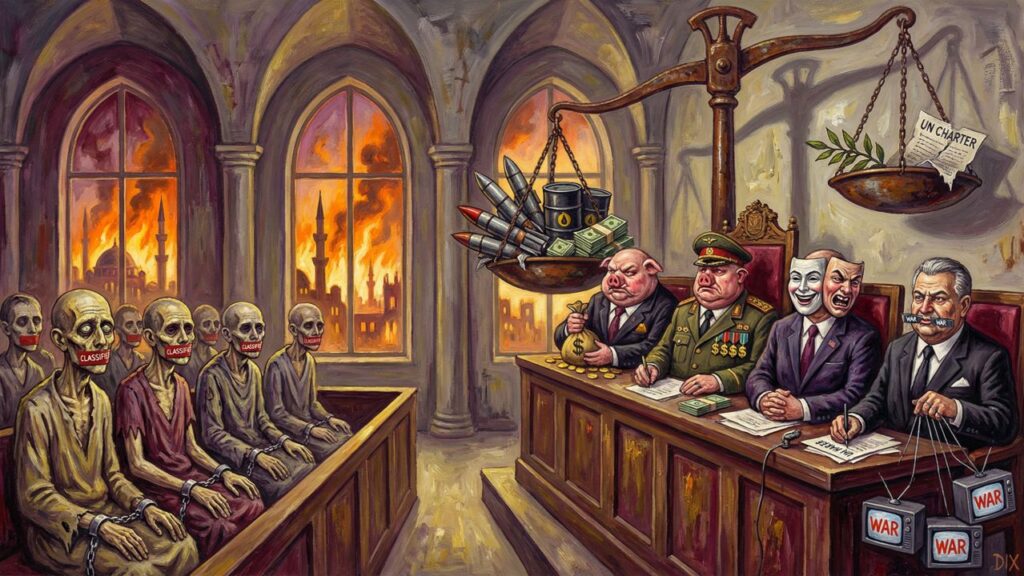
Iran War, a story of lies told by liars to an audience willing to accept lies.
March 7, 2026
By Scott Ortkiese | so@throughlinesynthesis.com | www.throughlinesynthesis.com
Author’s note: This is a companion piece to “Running a 1945 Play in Iran on a 2026 Balance Sheet.” That article documented the pattern: the suppressed peace, the manufactured threat, the economic logic, the historical spine from JFK to now. This article presents the evidence that arrived after the bombs fell: the confessions the officials couldn’t stop themselves from making, the witness testimony that converges from a dozen disciplines, and the real-time media indictment that proves the American people are being lied to as their government commits what international legal scholars have unanimously called an illegal war.
Exhibit A: The Bessent Confession
Before a single bomb fell on Tehran, the United States Treasury Secretary stood in front of Wall Street executives at the Economic Club of New York and announced that U.S. sanctions policy was “designed to collapse” Iran’s economy. The audience applauded.
Scott Bessent was not a rogue official making an off-the-cuff remark. He was describing official policy. At Davos in January 2026, he told Fox Business anchor Maria Bartiromo: “It’s worked because in December, their economy collapsed. We saw a major bank go under. The central bank has started to print money. There is a dollar shortage. They are not able to get imports, and this is why the people took to the streets”. He named it plainly: “This is economic statecraft. No shots fired. Things are moving in a very positive way here”.
On February 4, Bessent repeated the performance under oath before the Senate Banking Committee: “What we have done is created a dollar shortage in the country. It came to a swift and, I would say, grand culmination in December when one of the largest banks in Iran went under. There was a run on the bank. The central bank had to print money. The Iranian currency went into free fall. Inflation exploded, and hence we have seen the Iranian people out on the street”. PolitiFact confirmed every element of the sequence: deliberate dollar starvation, bank collapse, currency crash, and mass unrest.
Senator Katie Britt, a Republican from Alabama, did not ask Bessent whether this was legal under international law. She asked: “What more can we be doing?”
Bessent obliged: “We have seen the Iranian leadership wiring money out of the country like crazy. So the rats are leaving the ship, and that is a good sign that they know the end may be near”.
Let the record be clear about what happened next. Iran’s crackdown on the protests Bessent took credit for igniting killed at least 6,126 people by late January, according to the U.S.-based Human Rights Activists News Agency. NPR reported the toll eventually exceeded 7,000. Food-price inflation hit 70%. The rial went into free fall. And the man who engineered it all called it “economic statecraft, no shots fired” while Wall Street cheered.
This is not an allegation. This is sworn testimony and on-camera admission by a sitting Cabinet member that the United States deliberately collapsed a nation’s economy, created mass suffering, provoked protests, and then watched as the resulting crackdown killed thousands, all as a prelude to the military operation he knew was coming.
Exhibit B: The Rubio Confession
If Bessent confessed to the economic prelude, Secretary of State Marco Rubio confessed to the military trigger, and then spent 48 hours trying to unconfess it.
On March 2, 2026, fresh from briefing congressional leaders, Rubio told reporters: “We knew that there was going to be an Israeli action. We knew that that would precipitate an attack against American forces, and we knew that if we didn’t preemptively go after them before they launched those attacks, we would suffer higher casualties”.
Read that again. The United States went to war not because Iran attacked or was about to attack. It went to war because Israel was going to attack, and the U.S. military understood that Iran would retaliate against American bases scattered across the region, bases that have been there for decades, targets that exist because Washington chose to put them there. The “imminent threat” was self-generated: a circular logic in which the U.S. and Israel created the very danger they cited as justification.
The New York Times’ Edward Wong, one of the paper’s most senior diplomatic correspondents, tweeted the quiet part out loud: “Trump wages a war on Iran because of Israel, a rationale Rubio has now openly stated”. The Council on American-Islamic Relations called it “a stunning admission” that “the United States did not engage Iran due to an imminent threat. We acted under pressure from Israel for its own interests”.
Netanyahu, for his part, made no effort to hide: “This coalition of forces allows us to do what I have yearned to do for 40 years”.
Rubio spent the next day walking it back. He told reporters that Israel’s plans didn’t “ultimately sway” Trump, that the “escalating threat from Iran’s military capabilities” was the real reason. But the New York Times had already reported that U.S. intelligence told congressional staff in private briefings that “intelligence did not suggest Iran was preparing to launch a preemptive strike against the US”. There was, staffers were told, “a more general threat,” not the instant, overwhelming danger that international law requires to justify preemptive action.
Even Politico had published, three days before the bombs, that “senior advisers” to Trump “would prefer Israel strike Iran before the United States launches an assault on the country,” because “an Israeli attack would trigger Iran to retaliate, helping muster support from American voters for a U.S. strike”. They wanted dead Americans, specifically Americans killed by Iranian retaliation against Israeli aggression, to sell the war to the public.
And the Atlantic Council, not exactly a hotbed of anti-war sentiment, concluded: “This is not a classic preventive strike. There was no immediate Iranian threat triggering the operation”.
Exhibit C: The Seven Justifications of a War Without a Reason
The New Yorker’s Susan Glasser counted the rationales and couldn’t keep up. In the first two and a half days of the war, the Trump administration offered: outright regime change; assistance to Iran’s “oppressed peoples”; stripping Iran of “the ability to project power outside its borders”; preventing future terrorist attacks while exacting revenge for past ones; preemptive action against an imminent threat to U.S. forces; preemptive action to block ballistic missiles that could reach the U.S. mainland; and stopping a nuclear program Trump himself had claimed, just the previous week, was already “obliterated”.
“Many of these explanations are based on false premises,” Glasser wrote. “Some already seem to have been abandoned”.
By March 5, the New Yorker ran a second piece titled simply “The No-Explanation War.” Pete Hegseth, the Secretary of Defense, told reporters: “We didn’t start this war.” He pointed out that Witkoff, Rubio, and Kushner had “bent over backwards for real diplomacy”. The New York Times simultaneously published its reconstruction of how Trump decided to go to war, revealing that Netanyahu had come to Washington determined to end the negotiations, that few advisers voiced opposition, and that Trump himself said: “At the end of the negotiation I realized these guys weren’t going to get there. I said, ‘Let’s just do it’”.
The Iranians, however, had presented a seven-page proposal on enrichment levels in that final Geneva session. Steve Witkoff and Jared Kushner flew to Geneva, received it, and returned telling Trump that “a deal was unattainable”. Scott Horton, the director of the Libertarian Institute, who sat down with Breaking Points the week the war began, put it bluntly: “I think that’s probably why they launched the war, right?… The Iranians were too willing to compromise. And Witkoff was about to come home with an acceptable deal. And they couldn’t have that”.
This is the trap. If Iran is intransigent, it proves they can’t be negotiated with. If Iran is flexible, it threatens the war plan. Either way, the bombs fall. The seven justifications are not confusion; they are camouflage for a war that had no legal, moral, or strategic justification, and the administration knew it.
Exhibit D: The Arestovich Smoking Gun
The Iran war did not emerge from a vacuum. It emerged from a system, and that system has a precedent that it would prefer you forget.
In March 2019, Oleksiy Arestovich, then an advisor to Ukrainian President Volodymyr Zelensky, sat for an interview with the Ukrainian outlet Apostrophe and laid out, with a calm that would later seem chilling, exactly what was about to happen to his country:
“With a probability of 99.9%, our price for joining NATO is a full-scale war with Russia”.
The interviewer asked: what’s better, war or absorption?
“Of course, a major war with Russia and the transition to NATO as a result of the victory over Russia”.
He went further: “No social and economic sacrifices are such in the face of this task, even if the exchange rate is one dollar for 250 hryvnia”. He described the operational shape of the coming invasion, an air offensive, invasions from four directions, a siege of Kyiv, an advance from Crimea, with what Intellinews later called “stunning accuracy,” two years before it happened. He predicted the timing: 2021 or 2022. He was off by a few months.
This was not a leak. It was on Ukrainian television. It was the strategic calculus of the government that would later tell the world the invasion was “unprovoked.” Arestovich understood that NATO accession required a war. He said so. He called it “the coolest thing”.
When Israeli Prime Minister Naftali Bennett later confirmed that Russia and Ukraine had reached the outlines of a deal in the spring of 2022, Putin dropping “denazification” and disarmament demands, Zelensky agreeing to forgo NATO, and that “the West blocked it” because they “decided to crush Putin rather than to negotiate”, the Arestovich interview provided the context. The war wasn’t a shock. It was a policy. Turkish Foreign Minister Cavusoglu said so: “There are those within NATO member states that want the war to continue”.
Now apply that template to Iran. The Geneva talks were the Istanbul talks. The seven-page Iranian proposal was the neutrality framework. And the decision to bomb was, again, a decision that peace was more dangerous to the empire than war.
Exhibit E: The Doctorow Warning, No More Rules
Gilbert Doctorow, the American political analyst based in Brussels, appeared on Glenn Diesen’s channel on March 5 and described what Moscow took away from the decapitation of Khamenei:
“The attempted decapitation strike on Iran has sent shockwaves through Moscow, as there are no more rules”.
This is not rhetorical. Doctorow’s argument is structural. Putin’s approach, a slow war of attrition in Ukraine combined with diplomatic engagement with Trump, rested on the assumption that there were limits. That negotiation was possible. That restraint would be rewarded. The Iran strike obliterated that assumption.
“Russia sees in Iran exactly their own problem,” Doctorow said. Iran had been negotiating, making concessions, keeping channels open, and was rewarded with a coordinated surprise assault that killed its supreme leader in broad daylight while negotiators were still reviewing drafts in Geneva. The lesson for Moscow is devastating: restraint doesn’t buy security. It buys time for the adversary to prepare the kill shot.
Russia’s deterrent, Doctorow argued, is being “squandered, thrown away by being too weak, and now it’s almost existential. It’s time to rebuild it”. Pressure is building on Putin for a “massive spring offensive” in Ukraine. The hawks in Moscow, who have long argued that Putin’s patience is being mistaken for weakness, now have their strongest evidence yet. Iran refused to conclude a mutual defense pact with Russia in the fall of 2025; Moscow’s foreign policy establishment is not sympathetic to that decision, but it recognizes the consequence: a state that tried to go it alone against the US-Israeli machine was destroyed for its trouble.
This is how the Iran war accelerates World War III. Not through a single dramatic trigger, but through the destruction of the last restraints on every actor in the system. When there are no more rules, everyone arms up.
Exhibit F: The Witness Matrix
The power of the argument assembled in these pages is not that any single analyst has it all figured out. It is that a dozen minds, working independently from radically different disciplines and ideological starting points, have converged on the same diagnosis. No single person organized this testimony. No one paid for it. No think tank funded it. It emerged because the evidence is overwhelming and the pattern is unmistakable.
Jeffrey Sachs, economist at Columbia, testifies: “We are in the early days of World War III.” Eisenhower’s warning was “reporting a reality that already existed.” The CIA killed JFK for making peace. “The world is in a more dangerous situation than it has ever been, period”.
John Mearsheimer, political scientist at the University of Chicago, testifies: “The United States and its European allies share most of the responsibility for the crisis” in Ukraine. NATO expansion was the provocation, not the response.
Jacques Baud, former Swiss military intelligence officer, testifies: He wrote the report saying no WMDs in Iraq in 2002. He documented Ukraine shelling the Donbas on February 16, 2022, eight days before Russia invaded. NATO programs in Ukraine preceded and provoked the conflict.
Gilbert Doctorow, political analyst in Brussels, testifies: The Iran decapitation strike “sent shockwaves through Moscow, as there are no more rules.” Russia sees in Iran “exactly their own problem.” Spring offensive pressure is building.
Glenn Diesen, political scientist in Norway, testifies at the UN Security Council: Western media built three false narratives on Ukraine. “What was Russian propaganda yesterday is now consensus.” Media serve as an extension of security services.
Douglas Macgregor, retired U.S. Army colonel, testifies: “99% chance” of war driven by Israel. The U.S. military is unprepared, with only two carrier groups and limited missiles. “Iran’s missiles are almost inexhaustible, whereas the missiles on our side are very limited”.
Richard Sakwa, Russia and Europe scholar at the University of Kent, testifies: Russia was excluded from the post-Cold War security order. “Wider Europe” triumphed over “Greater Europe.” NATO expansion was neither defensive nor inevitable.
Scott Ritter, former UN weapons inspector, testifies: Iran’s missile arsenal can overwhelm U.S. defenses via saturation strikes. “When the United States runs out of ammunition, it runs out of the ability to project power”.
Michael Hudson, economist, testifies: Dollar hegemony forces foreign central banks to recycle dollars into Treasuries. The U.S. weaponized its financial system and is driving de-dollarization. “Free trade means central planning by Wall Street”.
Peter Schiff, economist and financier, testifies: The Iran war triggers economic chaos with oil up 60%, deficits “in the stratosphere,” and dollar collapse accelerating. “We’re going to destroy infrastructure then rebuild it. With what money?”
Scott Horton, director of the Libertarian Institute, testifies: Iran remained an NPT member throughout. The 2007 National Intelligence Estimate found no active weapons program. The “smoking laptop” was an Israeli forgery smuggled through the MEK. The Iranians were “too willing to compromise. They couldn’t have that”.
Naftali Bennett, former Israeli Prime Minister, testifies: “Basically, yes. They blocked it, and I thought they were wrong,” on Western powers stopping the Russia-Ukraine peace deal.
This is not a panel convened by anyone. This is convergence. When the economist, the general, the spy, the weapons inspector, the prime minister, and the historian all point at the same structure and say “that is the problem,” the structure is the problem.
Exhibit G: The Media Machine in Real Time
Every war has its propaganda apparatus. What distinguishes the Iran war is how transparently the apparatus is visible, not because the media have become more honest, but because alternative channels now exist to document the lies in real time.
The Seven Rationales Problem
As the New Yorker documented, the administration offered seven contradictory justifications in 60 hours. The New York Times editorial board asked “Why Have You Started This War, Mr. President?” then amended the headline to “Trump’s Attack on Iran Is Reckless,” then concluded that “a responsible American president could make a plausible argument for further action,” helpfully providing the war case the administration couldn’t articulate on its own.
The Israel Erasure
MSNBC’s Rachel Maddow devoted a 20-minute segment to the question “Why is this happening? Who benefits?” and barely mentioned Israel. Her villain was the Gulf Arab states. This, days after Netanyahu publicly stated that Trump had fulfilled his “40 years” of yearning. Days after Rubio admitted it was Israeli plans that triggered the attack. Maddow has to know. She chose not to say.
The CNN Discipline
When CNN, the only American network broadcasting from inside Iran, showed scenes of daily life in Tehran that didn’t match the apocalyptic framing, the State Department intervened. Media organizations were advised to “corroborate information with official U.S. government sources before publishing”. Translation: check your reporting against our propaganda before you print it.
The Orwell Dictionary
Mondoweiss documented how cable news replaced “kill” with “take out,” a euphemism that, as the outlet traced, dates to Rhodesia’s white supremacist regime describing its murder of black liberation fighters. The dead became abstractions. The bombing of a girls’ sports hall became “degrading regime capabilities.” The assassination of a head of state during negotiations became “a decisive defensive action”.
The Horton Exposé
Scott Horton, on Breaking Points, reported what may be the single most disturbing media detail of the war’s first week: “U.S. troops were told the Iran War is for Armageddon and the return of Jesus”. A combat unit commander briefed soldiers that Trump was “anointed by Jesus to light the signal fire in Iran to cause Armageddon and mark his return.” This is not satire. This is an American military unit being told it is fighting a religious crusade.
Diesen at the UN
Glenn Diesen stood at the UN Security Council on February 21 and testified that Western media have operated as an extension of the security establishment: building the “unprovoked” narrative, suppressing the record of NATO expansion and diplomatic failure, and punishing any analyst who challenges the frame. What was “Russian propaganda” in 2022, that NATO expansion provoked the war, that peace talks were sabotaged, that the attrition war was unwinnable, is now grudgingly acknowledged in mainstream outlets. The same cycle is beginning with Iran: the “terrorist state” myth will eventually collapse, but not before it has served its purpose of justifying the unjustifiable.
Exhibit H: Who Wants This War?
The question that animates both this article and its predecessor is not what happened but who benefits. The answer is not a shadowy cabal. It is a visible, documented, and self-reinforcing system.
The Defense Ecosystem
In the first trading day after the Iran strikes, Lockheed Martin stock rose 3.4%. Since January 2026, Lockheed’s share price has climbed nearly 40%. RTX (formerly Raytheon) rose 4.7% on the first market day. In January, Lockheed signed a deal with the Pentagon to quadruple production of THAAD interceptors from 96 to 400 per year, at $12.77 million each. Eleven Patriot missiles, each costing between $250,000 and $4 million, were reportedly fired to intercept a single Iranian missile.
The White House reportedly plans to ask Congress for an additional $50 billion in military funding. In 2025, the defense sector spent $42.3 million on lobbying, with 852 registered lobbyists, 60% of whom are former government employees. Forbes identified the primary beneficiaries: Lockheed Martin, RTX, Boeing, Northrop Grumman, Palantir, L3Harris, General Atomics, and the oil majors Exxon and Chevron. Penn Wharton’s Budget Model estimates the war could cost the U.S. economy between $50 billion and $210 billion.
Jacobin documented the circularity: the $500 billion in extra Pentagon money the White House plans to request from Congress next year had been a problem, how to spend it all. Two days after the war started, the administration told Congress it plans to burn through $153 billion in additional military funding approved in 2025, money Congress expected to last five years, in a single year.
The war is not incidental to the budget. The budget requires the war.
The Illegality
Legal scholars across the political spectrum agree. Asia Times: “Preventive war has no legal basis under international law. The UN Security Council did not authorise any military action”. The Conversation: “Under international law, these attacks are neither preemptive nor lawful”. A specialist analysis in Diplomacy and Law concluded: “No Security Council resolution authorised the initial strikes against Iran. The February 28 cross-border strikes remain prima facie incompatible with Article 2(4)”. Launching strikes during active negotiations, the Independent noted, “violates the principle of good faith in Article 2(2) of the UN Charter”.
This is not a gray area. It is an illegal war of aggression, the same charge under which the United States prosecuted German and Japanese leaders at Nuremberg.
The Verdict the Witnesses Demand
Sixty-five years ago, Dwight Eisenhower stood before the American people and told them the military-industrial complex was already in control. Jeffrey Sachs, appearing on Glenn Diesen’s channel today, March 7, 2026, says Eisenhower “was reporting to us a reality that already existed”.
The reality now is worse. Scott Bessent confessed to economic warfare against 88 million Iranian civilians and called it “statecraft”. Marco Rubio confessed that Israel dictated the timing of the attack and then spent a day trying to un-say it. Politico reported that administration officials wanted Israel to strike first specifically to generate American casualties that would sell the war to voters. The New York Times reported that the CIA had been tracking Khamenei’s movements for months and that the strike was launched during negotiations, using the diplomatic process as cover for an intelligence operation. International legal scholars have called it what it is: an illegal war of aggression launched without Security Council authorization during active, good-faith negotiations.
Defense contractors are making billions. Oil companies are making billions. The American people are paying with blood, treasure, and whatever remained of their republic’s claim to moral authority. The Iranian people are paying with their lives.
And every witness in this article, from Sachs in New York to Doctorow in Brussels to Diesen in Norway to Macgregor in Washington to Ritter in his living room to Hudson at his desk, saw it coming, said so publicly, and was ignored or marginalized for the trouble.
The machine rolls on. But the record is now complete. The confessions are on camera. The witnesses have testified. The convergence is documented. And the question is no longer whether the American people were lied to. It is whether they will consent to the lie now that they know.
The first act of refusal is the simplest: refuse to look away.
Related reading
- The Irrelevance of King Trump and His Uniparty Jesters in Congress
- Does He Really Think They Don't Have Options? How Trump’s Lack of Strategy Is Driving Nations Away
- Does He Really Think Nobody Has Options? Trump’s Imperial Arrogance and the Countries He Screwed
- The Trump Protection Racket: How a Declining US Empire Extorts Friends and Enemies Alike