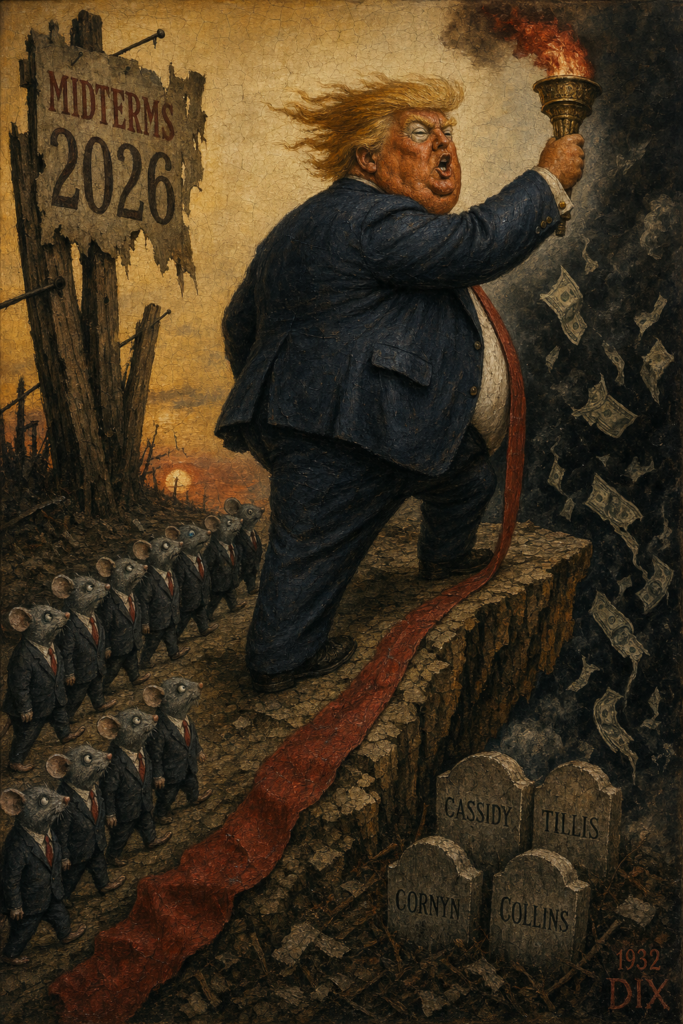
Republicans hoping to be mummified in office like Mitch McConnell should make other plans.
Scott Ortkiese | Throughline Synthesis | Houston, August 29, 2026
A word to Republican voters, up front
If you are a Republican and you want your party to act like a Republican Party again, the only vote available to you in November that changes anything is a vote for a Democrat. Not a protest. Not a write-in. Not staying home. A vote for the Democrat on your ballot, in every race, from the top of the ticket down.
Read that sentence twice. It is not a betrayal of your party. It is the only remaining act of loyalty to it. Your party has no conscience. It has no obligation to you. Its promises mean nothing. The proof is not in dispute by anyone in either party: Donald Trump still controls it. Sixty-seven days before an election the party is favored to lose. With a bond market repricing his fiscal posture in real time. With a war at thirty-one percent approval. With his own approval at thirty-three percent. He still controls them. That is the fact. Everything else is commentary.
The party will not reform itself. It cannot. Six pressures documented below lock every one of its 245 members into the same position, and none of the exits is open from the inside. The only pressure the party will feel is the pressure of losing power. The only lesson it will learn is the one delivered at the ballot box by its own voters. Anyone who tells you otherwise is either lying to you or lying to themselves, and in Washington in 2026 the difference is academic.
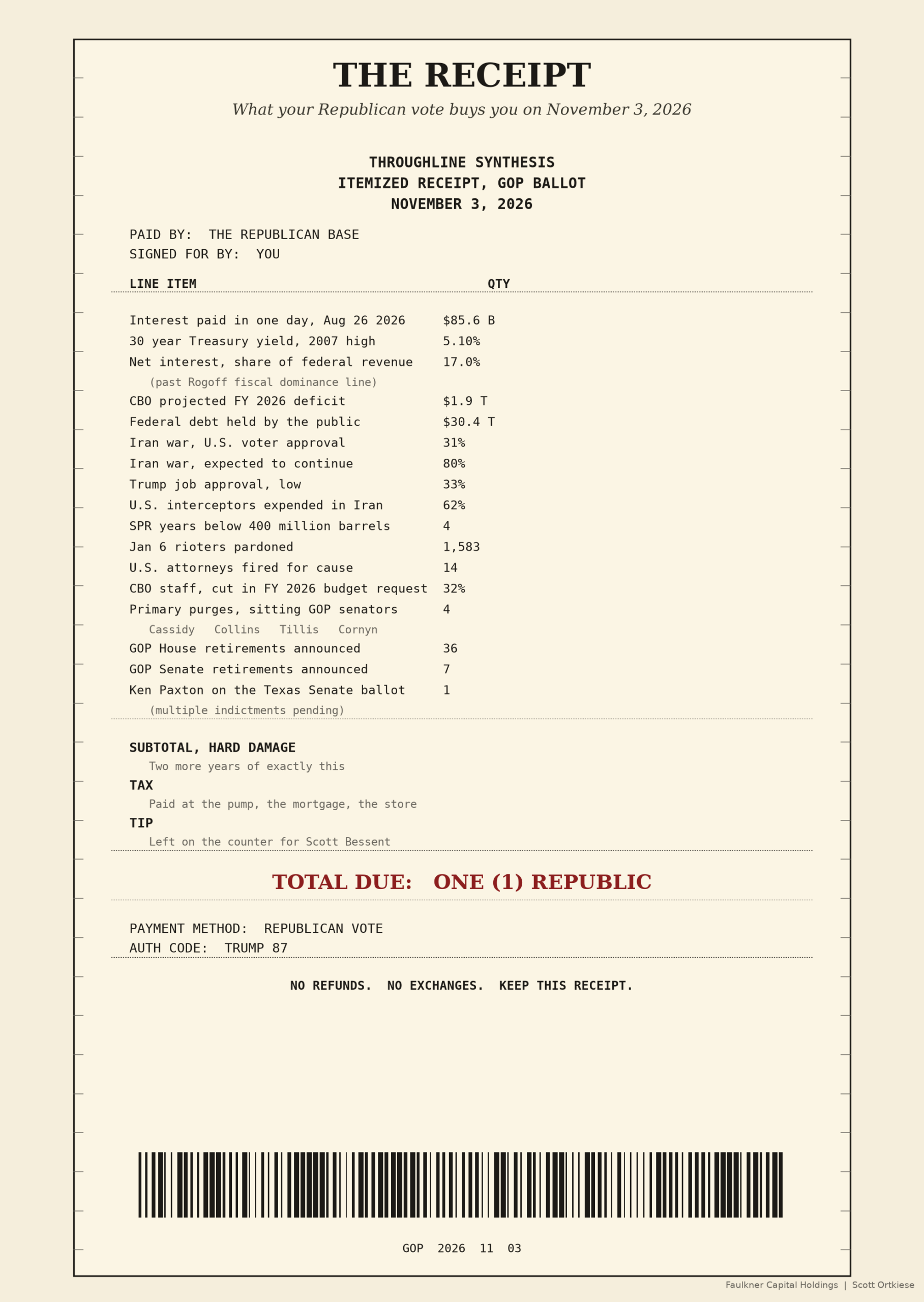
A Republican Party that keeps its majorities on November 3 has been told, by you, that this is acceptable. That the corpulent demagogue on the cover of this article is acceptable. That the primary purges of Bill Cassidy, Susan Collins, Thom Tillis, and John Cornyn are acceptable. That replacing Cornyn with Ken Paxton is acceptable. That an eighty-six billion dollar interest payment in a single day is acceptable. That an Iran war polling at thirty-one percent approval is acceptable. That Scott Bessent doubling the Treasury buyback on the same day the 30 year yield hit its 2007 high is acceptable. That gutting the CBO, weaponizing the DOJ, pardoning the January 6 rioters, and threatening prosecutors by name from the Truth Social account of the sitting president is acceptable. Every seat the party holds on November 4 is a permission slip signed by its own voters for another two years of exactly this, and worse, because there is no ceiling that has held yet.
A Republican Party that loses its majorities on November 3 has finally been told the opposite. The men and women who spent 2025 and 2026 with their heads down, watching Trump ruin the sovereign balance sheet and destroy their own careers one at a time, will lose their committee gavels, their staff budgets, their fundraising priority, their green-room bookings, their K Street lunches, and, in enough cases to matter, their seats. The next Republican who considers voting with Trump on a bond-market-breaking bill will remember what happened to the last one. The next Republican senator who is asked to confirm a Bessent will remember. The primary electorate will still be there. The general electorate the party lost by six points will also still be there, and this time it will be watching. The arithmetic of individual survival, which today points every incumbent toward Trump, will finally start to point the other way.
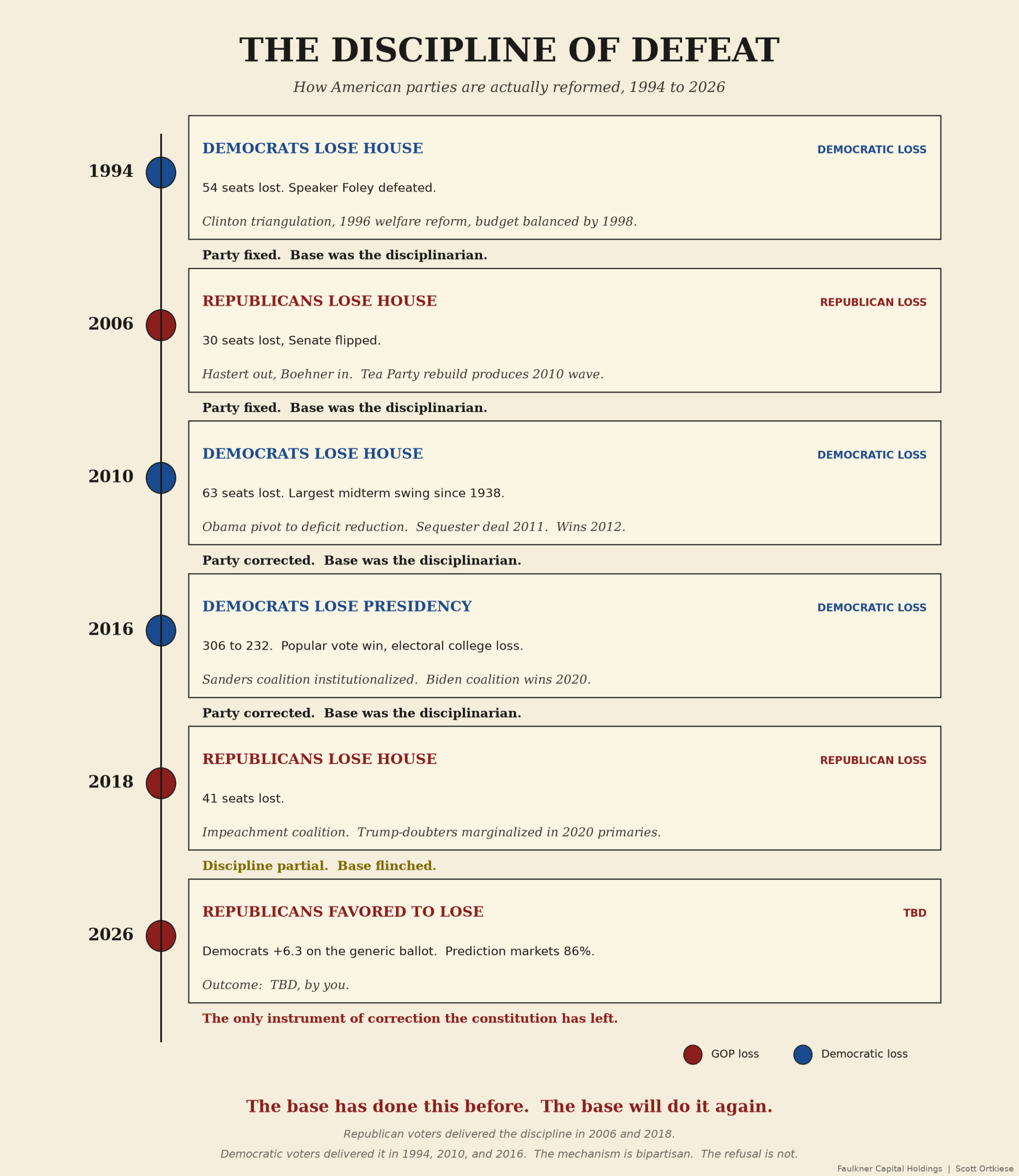
This is not a defection. It is a discipline. Parties are corrected by being thrown out. That is how the Democrats were disciplined in 1994, in 2010, and in 2016. That is how the Republicans were disciplined in 2006 and in 2018. Each of those disciplinings produced a better, more responsive, more serious version of the party that lost, because losing forced a reckoning inside it that no incumbent, acting alone, could ever produce. Nothing else works. Nothing else has ever worked.
Do not tell yourself the party will come to its senses without you. It will not. Do not tell yourself that primary challenges will fix it. Trump owns the primary electorate at eighty-seven percent, and every primary challenger who has tried in 2025 and 2026 is now unemployed or dead in polling. Do not tell yourself that a few good senators will hold the line. Cassidy is gone. Collins is going. Tillis has quit. Cornyn is being replaced by a man under indictment. Do not tell yourself that this president will lose interest, or moderate, or retire, or be constrained by advisors, or be corrected by markets short of catastrophe. He will not. He has not. He never has. The record on this question is unbroken over ten years, and anyone still selling you the pivot in 2026 is running the same con Bill Barr ran, and Reince Priebus ran, and Paul Ryan ran, and Mitch McConnell is still running from a wheelchair.
If you want the Republican Party back, throw the Republicans out. Make them earn their return. In two years, in six, in ten if that is what it takes, a chastened party with new leadership, new donors, and new incentives may deserve your vote again. Today’s party does not. Voting for it, in the name of loyalty to what the party once was, is the single most effective way to ensure that party never comes back. Every ballot cast for a Republican on November 3 is a ballot cast for Donald Trump personally. There is no other Republican on the ticket. They surrendered that identity themselves.
The lever you pull on November 3 is the only instrument of correction the American constitutional order has left. The courts have folded. The Senate has folded. The House has folded. The Cabinet was designed to fold. The military stays out on principle. That leaves you. Use the lever. Vote against every Republican on your ballot, from dogcatcher to president-in-waiting, and do it in the name of the party you want to see restored. Nothing smaller will move them. Nothing smaller ever has.
What follows is the mechanism that makes all of the above true, and unarguable.
The setting
Sixty-seven days before a midterm election it is now favored to lose, the Republican Party is doubling down on Donald Trump. Democrats lead the generic ballot by 6.3 points and prediction markets price the House flip at 86 to 88 percent (U.S. Polling Data, Kalshi and Polymarket via Event Markets). The president’s approval sits at 33 to 40 percent depending on the pollster, his Iran war polls at 31 percent, and the bond market has, since August 18, been repricing his fiscal posture in the form of a 30 year yield unseen since 2007 (Reuters, Forbes). Every other party in American history would be running from the top of the ticket by now. This one is chaining itself to him.
The behavior looks irrational. It is not. It is the rational, individual, self-preserving response of 245 Republican members of Congress to the party structure Donald Trump has spent a decade building around them. That is a different and worse fact than irrationality. It means the party will not correct itself. It will have to be broken from the outside.
Six pressures, each one small, all six together decisive, explain what looks from a distance like a suicide pact.
One: The primary electorate votes, the general electorate does not
Of the 435 House seats up in November, perhaps 30 to 40 are genuinely competitive. The other 400 are safe on paper for one party or the other. In a safe Republican seat, the only election that matters is the June primary, and the primary electorate looks nothing like the general electorate.
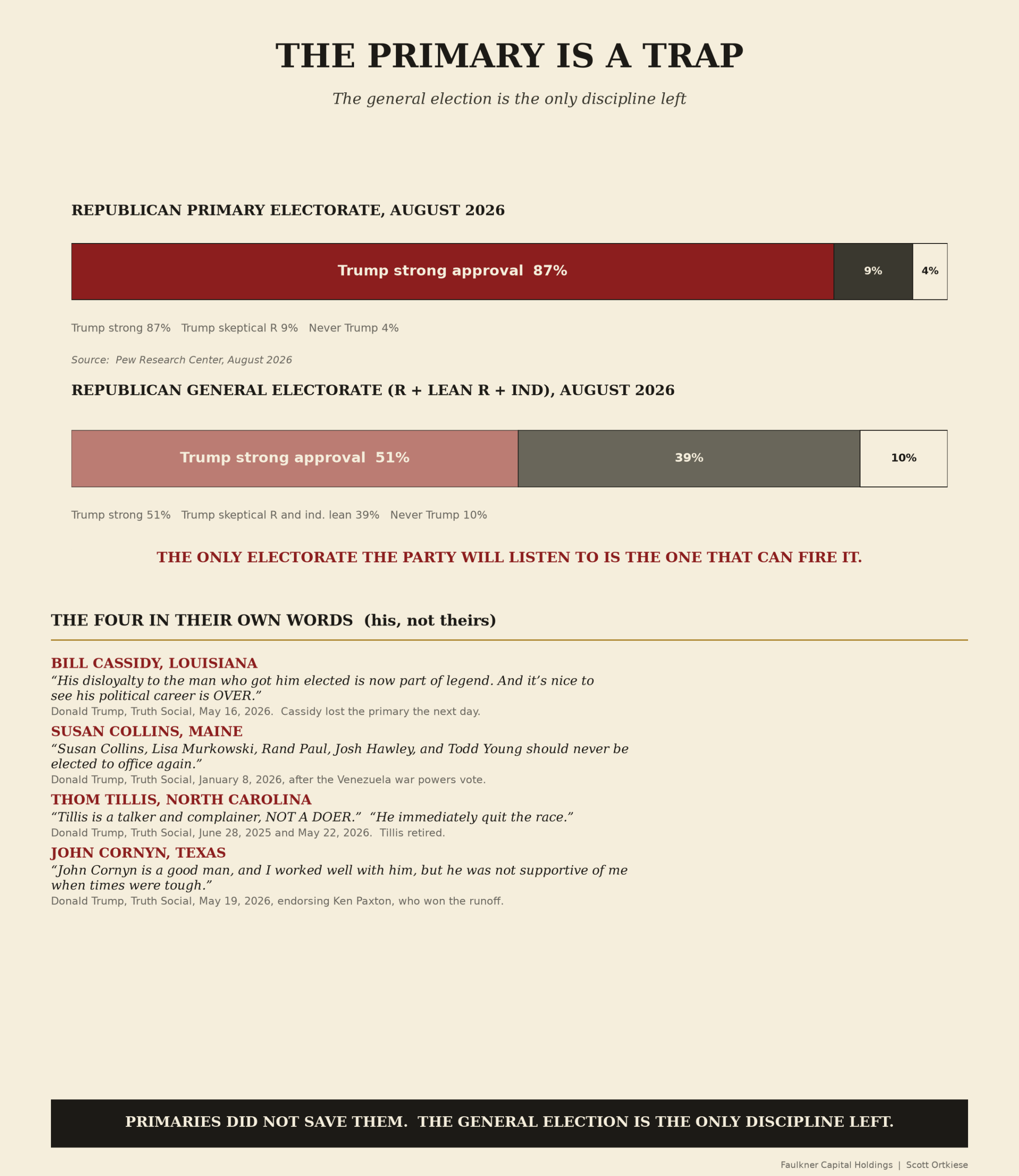
Trump’s approval among Republicans sits at 79 percent in the Economist and YouGov poll, 86 percent per Emerson, 87 percent per Pew (YouGov, USA Today on Emerson, Pew). Cross him and you lose your primary. Vote with him and, at worst, you lose the general, in which case you have lost the same election you would have lost anyway with a different set of enemies. This is not brave. It is arithmetic. Individual incumbents optimize for their own survival, not the caucus’s collective standing, because the caucus’s collective standing is not on the ballot in their district. Their name is.
Two: The punishment has been made concrete
Trump has already destroyed the careers of Republicans who defied him in ways their colleagues cannot pretend not to have noticed. Bill Cassidy is facing a primary challenger Trump personally recruited. Susan Collins was told by the president himself that she should “never be elected again.” Thom Tillis chose retirement over the fight. John Cornyn was ousted in Texas and replaced on the ballot by Ken Paxton, a man whose corruption record would have disqualified him from a state judgeship in 1978 (NOTUS, Associated Press).
The PBS NewsHour puts it plainly: “It’s clear he holds significant sway, effectively jeopardizing congressional careers for those who oppose him” (PBS). Every Republican in the room has watched the punishment demonstrated. None of them needs to test the mechanism personally. The Voight-Kampff test that produced Liz Cheney’s ejection in 2022 has been iterated a hundred times since. The membrane holds. The lesson is learned.
Three: The exit ramp is already closing
Thirty-six House Republicans and seven Senate Republicans have already announced they will not seek reelection (National Today tracking, New York Times exit tracker). The retirements are the tell. They are Republican members who read the same polls as you, made the same calculation, concluded that the primary was unwinnable or the general was unwinnable, and quietly stepped off.
The ones who remain have made the opposite decision. They will run with Trump because the price of running against him is a certain primary loss now, and the price of running with him is only a possible general loss in November. A possible loss beats a certain loss every time. That is not cowardice. That is expected-value math, done by 245 people separately, each of them reaching the same conclusion because the incentive structure is the same for all of them. It is the game-theoretic signature of a party in which no lateral escape from the leader is available.
Four: The fiscal accident will arrive after November, or so they hope
The negative arbitrage compounds daily. The 30 year yield hit its highest close since 2007 on August 18. Treasury paid 85.6 billion dollars of interest in a single day. Scott Bessent doubled the long-dated buyback on August 19. Federal net interest crossed 17 percent of federal revenue in fiscal 2026, past the threshold Kenneth Rogoff identifies as the marker of fiscal dominance (Congressional Budget Office August 2026 baseline, Reuters on the buyback).
But the accident, the failed auction, the dollar break, the emergency Fed intervention, arrives on no fixed schedule. It might arrive in October and cost the Republicans forty House seats. It might arrive in February and cost them nothing electorally. The Iran war is at 31 percent approval, but 80 percent of Americans expect it to drag on (Forbes), which means voters have already priced the war into the ballot. What they have not priced is the bond market.
Incumbents are wagering that the fuse Trump and Bessent lit on August 18 burns slowly enough that the explosion arrives after they are either safely reelected or safely retired. It is the same wager the Bourbon aristocracy made in 1788 and the German industrialists made in 1932: that catastrophe, being invisible today, will not arrive on their personal calendar. The Bourbon and Weimar industrialists were wrong on identical grounds. Every Republican incumbent who has watched Bessent’s buyback and stayed silent is betting they will be luckier.
Five: The map still gives them cover the polls do not
Democrats need a net four Senate seats and a net five House seats. The House looks like a wave environment, D+6.3 on the generic ballot, comparable to 2018, when Democrats picked up 41 seats. But Republicans start with a 222 to 213 majority and gerrymandered maps in Texas, Florida, North Carolina, Ohio, and Wisconsin still give them structural cover the popular vote does not (U.S. Polling Data). A six-point popular-vote loss produces perhaps a 20 to 30 seat swing, painful, but not annihilating.
For the roughly 190 House Republicans in truly safe seats, Trump costs them nothing personally. He costs the majority. He does not cost the individual. And Congress is not a jury of the majority. It is 435 juries of one. Each one of them, looking at their own district, sees a president they can survive. It is only when you sum the 435 juries that you find the party has committed suicide. But summing is not a task any individual member has any incentive to perform.
Six: There is no one left to lead a breakaway
For a party to discipline its leader from within, it needs institutions inside it capable of coordinating a bloc. The Republican Party has spent the last decade dismantling every such institution. The Republican National Committee has been staffed with loyalists since 2024. The state parties have been purged of anti-MAGA infrastructure. The think tanks that once produced independent policy, the American Enterprise Institute, the Heritage Foundation before Project 2025, the Manhattan Institute, are either captured or defunded. The donor class is either aligned, Musk, Thiel, Ackman, Adelson estate, or silenced, the Koch network, the Ricketts family, the corporate PACs of the S&P 500. Fox News is captured. Sinclair is captured. Truth Social is captured. Every institution that in a healthier Republican Party would have produced a Howard Baker figure now produces only auditions for the next Trump.
The result is that a coordinated breakaway is not merely difficult. It is structurally impossible with the assets currently available. A Republican senator who wants to move against Trump has no committee chair to phone, no state chairman to whip, no donor coalition to fund the primary opponents his defection would provoke, no editorial page to argue his case on the right, and no clear next-generation leader around whom to rally. So he acts alone. And alone, the dominant strategy is to bow.
The rupture triggers, and their probabilities
Three shocks could rupture the discipline before November. Two are more likely than the polling class admits. One is not forecastable at all.
A failed Treasury auction. The 20 year sale on August 26 tailed by 1.2 basis points. The next 20 year is October 22, two weeks before the election. The next 30 year is November 12, immediately after. A failed auction would move the negative-arbitrage story from partisan complaint to systemic crisis in twenty-four hours, and would give Republican senators cover to blame Bessent by name without touching Trump. The essay’s own probability decomposition puts the total probability of an acute crisis at 30 percent between now and November. That is the highest ambient probability of a systemic financial rupture the U.S. has faced since 2008.
A visible Iran-war escalation. A downed carrier, a Strait of Hormuz closure, a Beirut-scale casualty event. The war is unpopular; the escalation would give hawks like Susan Collins, Lisa Murkowski, and Todd Young cover to break on national security grounds. Probability, per the reporting record and prediction markets, in the 20 to 25 percent range between now and November.
A Trump health event. Unforecastable in the polling sense. It is the single most-hedged event on Kalshi and Polymarket through October. If it happens, the coalition freezes overnight. If it does not, the current dynamic holds.
None of the three shocks is the party’s own decision. That is the diagnostic finding. The Republican Party will not correct itself. It will require a shock exogenous to itself, delivered by the bond market, by a foreign adversary, or by actuarial fate, before its members are freed to act in the interest of the country their party once claimed to represent.
What the pattern is
They are not throwing themselves on Trump’s sword out of conviction. They are doing the arithmetic each of them is uniquely equipped to do, which is the arithmetic of their own political survival, and each one is reaching the same rational answer. The sum of 245 rational decisions is a party that has committed collective suicide with its eyes open. This is not the first time an American political coalition has done this. The Federalists did it in 1815. The Whigs did it in 1854. The Democrats in the South did it in 1948 and again in 1964. What is new in 2026 is not the pattern. It is the fact that the coalition committing suicide is the one currently holding the sovereign balance sheet, the nuclear codes, and the doctrinal machinery of a state that still calls itself a republic.
The rupture, when it comes, will not come from inside the room. It will come from the bond market, or from Tehran, or from the actuarial tables. The men and women who sat in that room and did nothing will spend the rest of their careers explaining that the arithmetic they did, one at a time, was rational, and that no one of them could have stopped it. They will be telling the truth. That truth is also their indictment.
Coda
The math of individual survival, iterated 245 times, is how republics die. The only correction available now is a general election delivered by the party’s own voters, aimed at their own incumbents, in the name of the party they still want their party to be. Every Republican vote cast for a Republican on November 3 is a vote to keep this exact arrangement in place for another two years. Every Republican vote cast for a Democrat on November 3 is the first honest thing a Republican voter can do for the Republican Party in a decade.
Throw them out. Make them earn their return. That is the whole assignment.
Read the mechanism this argument rests on: Trump’s Doomsday Machine, Part II: The Negative Arbitrage
Read the primer for the bond mathematics: Bonds Explained: A Plain-English Primer for Serious Readers
Corrections and amplifications: so@throughlinesynthesis.com
Scott Ortkiese | Throughline Synthesis | Houston, August 29, 2026