
Tech founders, financiers, paid raters and donor-backed politicians protect private returns while Europe buys into their system.
The West Eats Its Future. Bankers, tech barons, politicians and arms dealers feast on an economy they are hollowing out.

Energy and Geopolitics | Structured Finance | President and CEO, Faulkner Capital Holdings
America’s one percenters, aka the “rentier class,” want the income from innovation without the discipline of competition. They want control without proportionate exposure to loss, public protection without public authority, and customers who cannot leave.
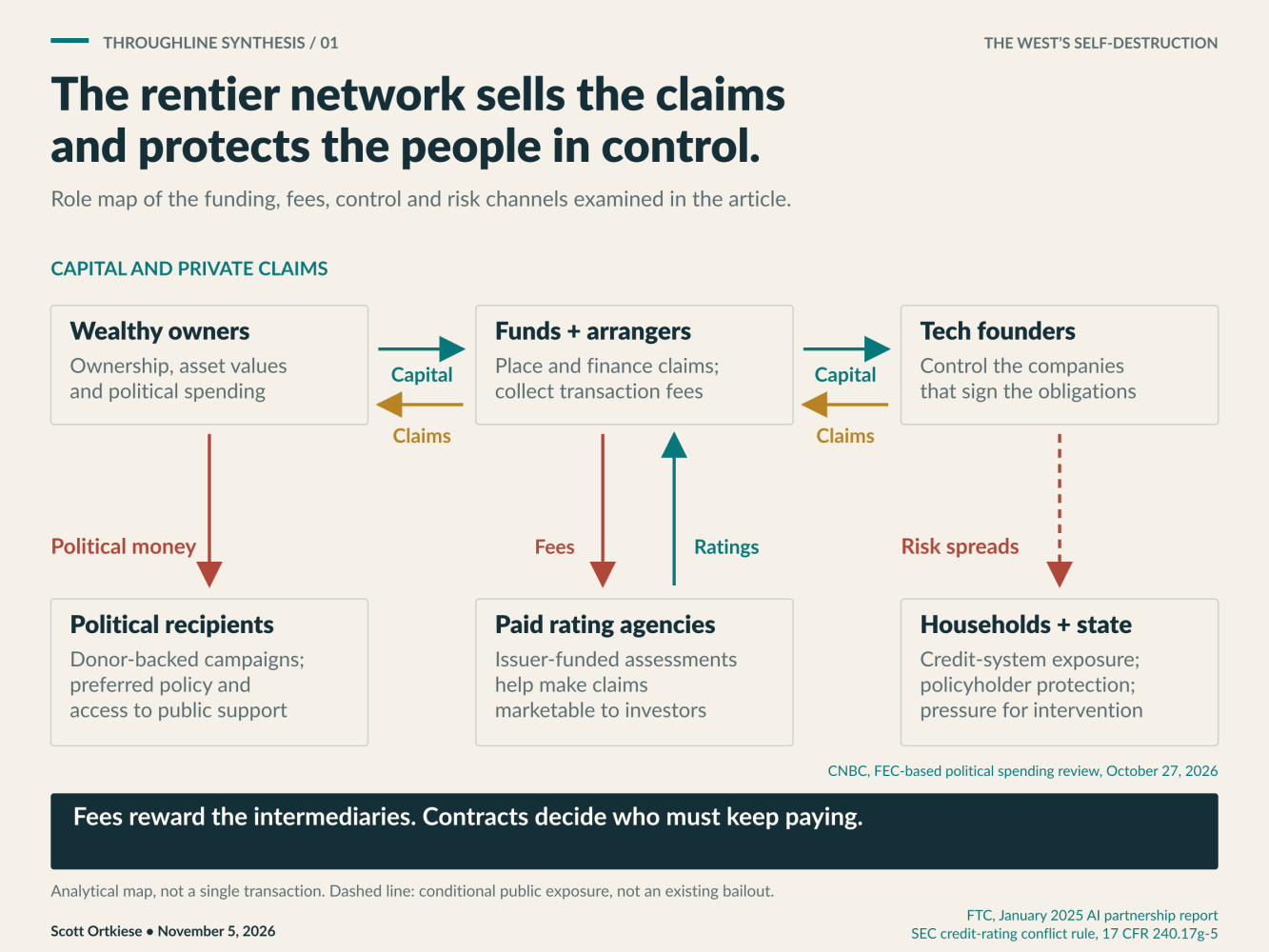
The machinery joins tech founders, financiers, paid rating agencies and donor-backed politicians. Each supplies something the others need: control, financing, certification or political protection. The contracts, disclosures and campaign spending show the connections.
Cristina Caffarra and the EuroStack Foundation deserve applause for confronting Europe’s technological dependence and demanding European control of critical digital infrastructure. (EuroStack’s mission; Caffarra’s warning) Renting access to somebody else’s technology is not sovereignty. It is a supplier relationship.
Europe is being invited to buy into the American arrangement while its own leaders weaken the education, energy and industrial capacity needed to escape it. This is Western self-destruction financed for private gain, not technological destiny.
America’s rentier class has American enablers
America’s failure does not stop at the White House, Congress or Silicon Valley. Americans who defend monopoly income, protected asset values and public guarantees for private investments are helping build it. They want the rewards of competition without accepting the competition.
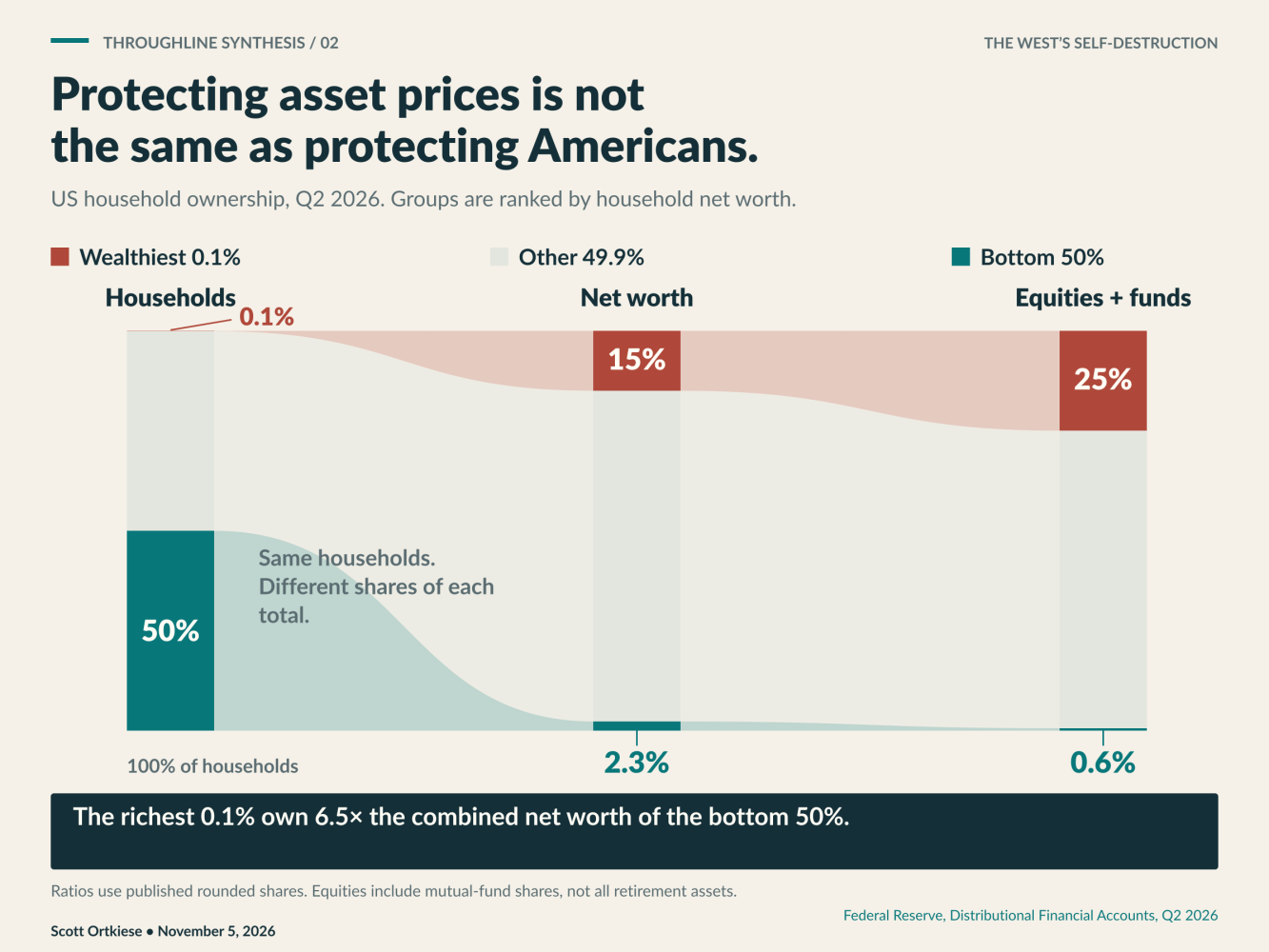
The beneficiaries are not an abstraction. In the 2nd quarter of 2026, the wealthiest 0.1% held 15% of US household net worth and the bottom 50% held 2.3%; the same groups held 25% and 0.6%, respectively, of corporate equities and mutual-fund shares. (Federal Reserve’s distributional accounts)
The richest 0.1% therefore owned approximately 6.5 times the combined net worth of the bottom half. (Calculation from Federal Reserve shares) Protecting asset prices disproportionately protects that ownership. A rising market is not a substitute for affordable housing, competent schools, cheap energy or productive employment.
The rentier bargain is simple: control an asset other people need, charge for access, and defend the charge against competition. In AI, cloud commitments, technical dependence and the cost of switching can help secure that position. The FTC documented those mechanisms in the major cloud and AI partnerships. (FTC’s partnership findings)
The complicity extends beyond the billionaire. A banker who markets a financing structure while ignoring its dependence on the same customer enables it. A fund manager who collects fees while transferring opaque risks into retirement and insurance assets is an enabler. A professional who designs the protections, promotes the valuations or excuses the conflicts cannot claim to be merely watching.
Affluent shareholders and voters who demand protection for their own holdings while dismissing other people’s wages, utility bills and public services are making the same choice. They defend their place in the ownership hierarchy, then call that defense the national interest.
Capital hoarding is not just cash sitting idle. It is the concentration of ownership and the power to decide which productive activities receive financing, what access costs and who absorbs failure. A retirement account does not make a worker’s interests identical to those of a founder who controls the votes or a financier who collects the fees.
Competition that lowers prices is a public gain. Americans who oppose it because incumbent owners might lose money are defending rent extraction, not national prosperity. We cannot demand a competitive future while treating the wealthiest fraction of 1% as a protected national asset.
Tech founders need a paid protection system
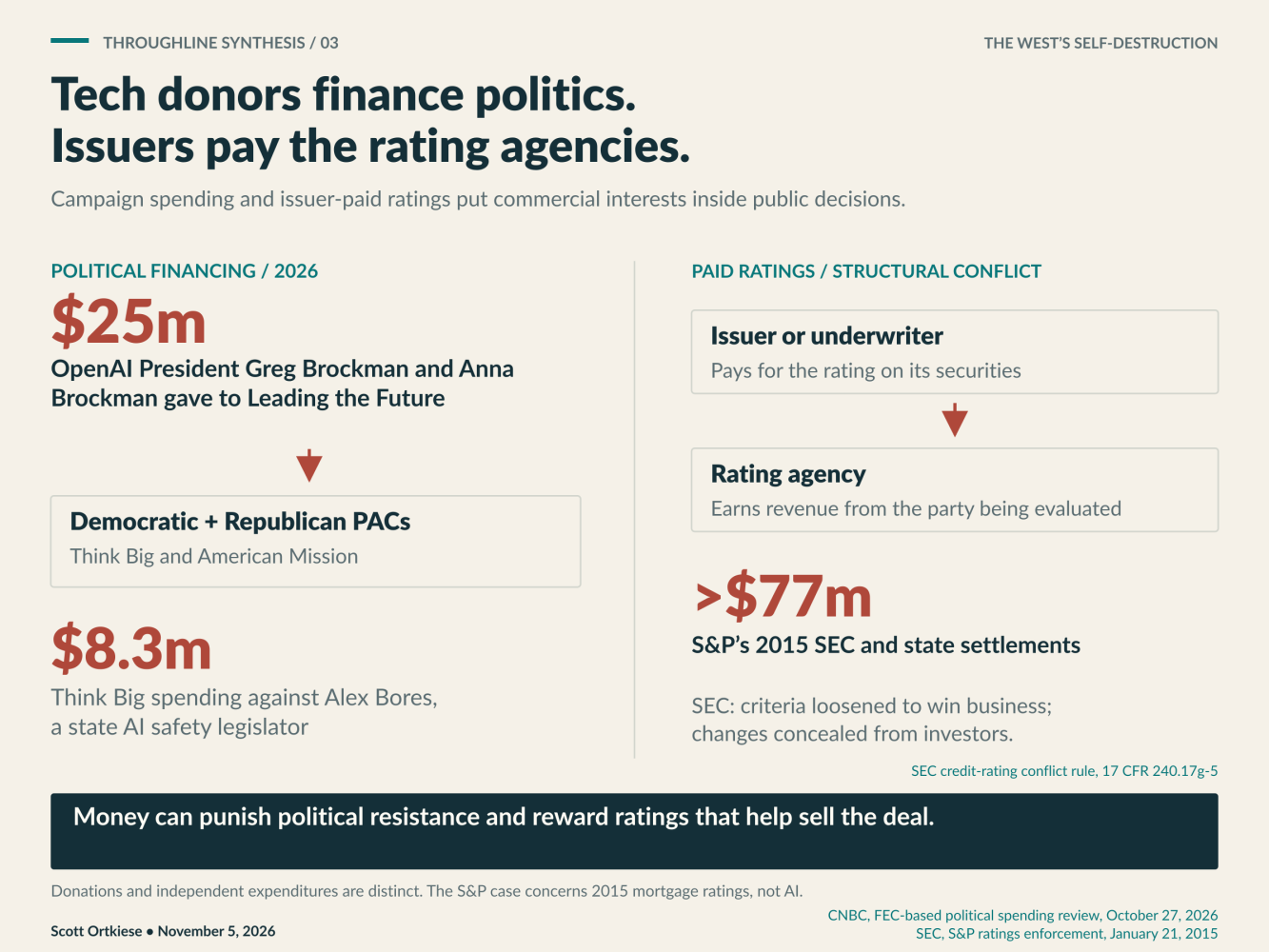
Follow the money into politics. OpenAI President Greg Brockman and his wife Anna contributed $25 million to Leading the Future, a network whose backers also included Andreessen Horowitz and investor Joe Lonsdale. (CNBC’s review of political financing) The network operated Think Big for Democratic races and American Mission for Republican races while promoting faster AI development and opposing a patchwork of state regulation. (CNBC’s committee and policy findings)
That is political insurance across party lines. The donor’s commercial interests survive a change in the party receiving the money.
Think Big spent $310,000 supporting Democratic US Representative Jared Moskowitz in Florida, while American Mission spent more than $500,000 apiece supporting Republican candidates Jessica Steinmann and Chris Gober in Texas and Laurie Buckhout in North Carolina. (CNBC’s candidate-level spending review) These are named campaigns, not an abstract concern about influence.
Think Big spent $8.3 million trying to defeat New York State Assemblymember Alex Bores, a Democrat who authored major state AI safety legislation; a rival AI-aligned committee spent approximately $15 million supporting him. (CNBC’s race-level spending review) Rival companies can fight over the rules while agreeing that enough money should put their preferred rules at the center of the election.
Bought politics is not confined to a politician taking an illegal payment. It includes a political system in which concentrated wealth can finance allies, punish resistance and make its commercial agenda expensive to oppose. Americans who defend that system as merely participation are defending unequal power.
The ratings business supplies another paid intermediary. Federal securities rules explicitly recognize the conflict when issuers or underwriters pay to have their own securities rated. (SEC’s credit-rating conflict rule) The customer buying the assessment benefits from an assessment that helps sell the deal.
This incentive has produced documented misconduct. In 2015, S&P agreed to more than $77 million in SEC and state settlements involving mortgage-securities ratings; the SEC said S&P loosened criteria to win business and concealed the changes from investors. (SEC’s enforcement announcement)
The connection is economic: founders need financing without surrendering control; deal arrangers need transactions; paid raters need clients; political committees need donors. A profitable deal can reward each intermediary before the underlying project has proved that outside customers will pay enough to support it.
These enablers are not peripheral to the AI boom. They make its obligations financeable, its risks marketable and its owners politically difficult to confront. Calling the arrangement innovation does not change who gets paid or who is left holding the risk.
AI progress is not proof that the financing works
Stanford’s 2026 AI Index describes the model-performance gap between the US and China as effectively closed, while documenting substantial American scientific and technological strengths. (Stanford’s 2026 AI Index) The West’s problem is not that its scientists have stopped creating. It is that political and financial leaders treat control of capital and platforms as a permanent entitlement to technological leadership.
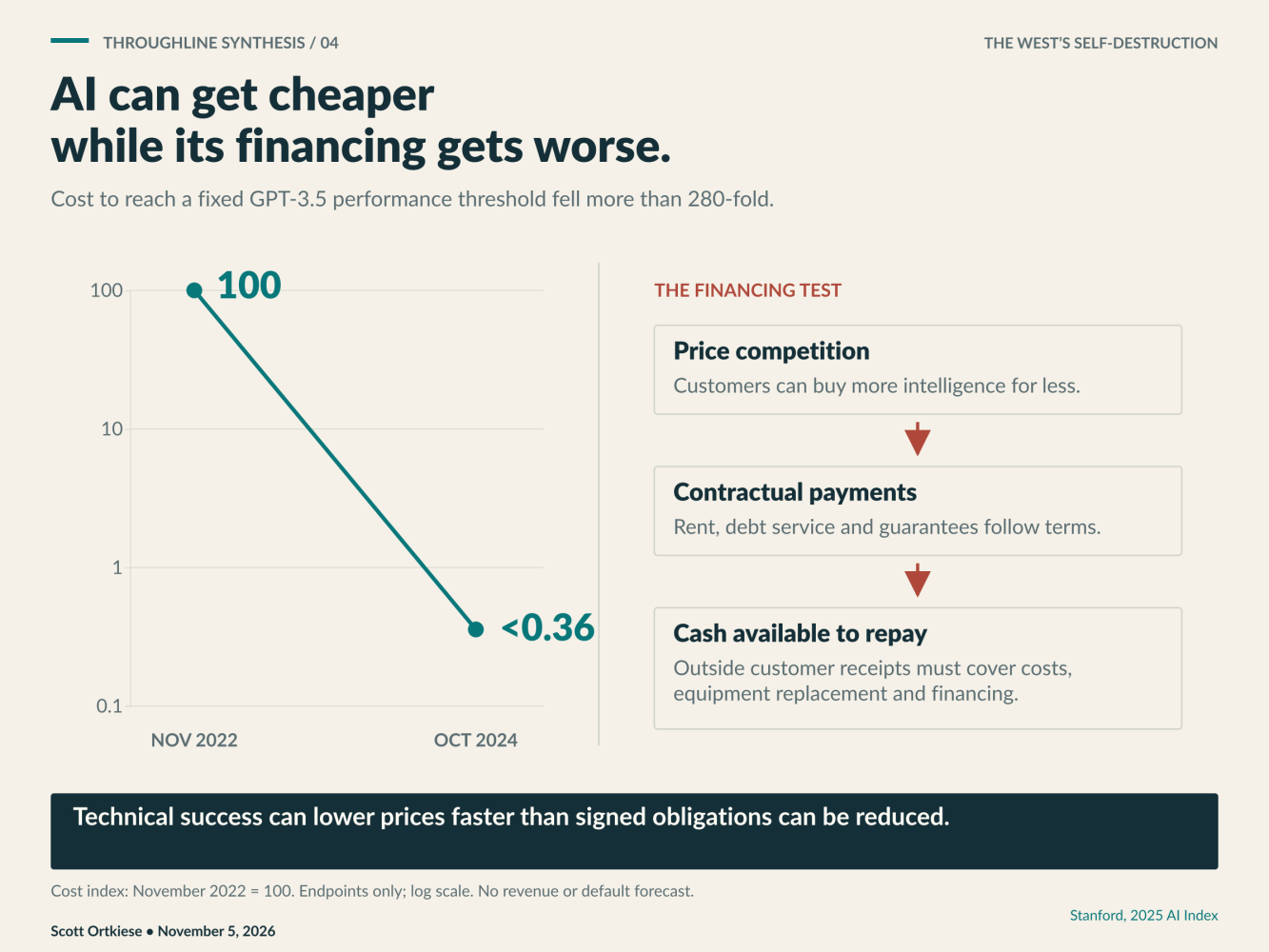
Stanford’s previous report found that the inference cost of a system performing at GPT-3.5’s level fell more than 280-fold between November 2022 and October 2024, helped by increasingly capable smaller models. (Stanford’s cost findings) That is a technological achievement. It also directly challenges investments that require expensive computing and high service prices to remain profitable.
The distinction is central to my earlier analysis of the AI financing boom: cheaper AI can be excellent for customers and destructive to the financial assumptions of its suppliers. The technology can succeed while particular investments fail.
Financial engineering cannot repeal that conflict. Borrowing can fund construction, and a guarantee can improve a lender’s claim. Neither establishes that the eventual customer will pay enough to cover operating costs, equipment replacement, interest and the promised return on capital.
The International Monetary Fund now describes circular financing arrangements connecting equity investment, debt and future revenue commitments, warning that concentration and technological obsolescence can amplify shocks if monetization disappoints. (IMF’s AI ecosystem assessment) The economic test is cash generated outside the financing circle, not the volume of promises circulating inside it.
Meta can slow its plans without escaping its bills
My Meta investigation makes the contractual distinction explicit: the right to stop ordering is not the right to stop paying. A board can announce a lower spending budget while previously signed obligations continue to demand cash.
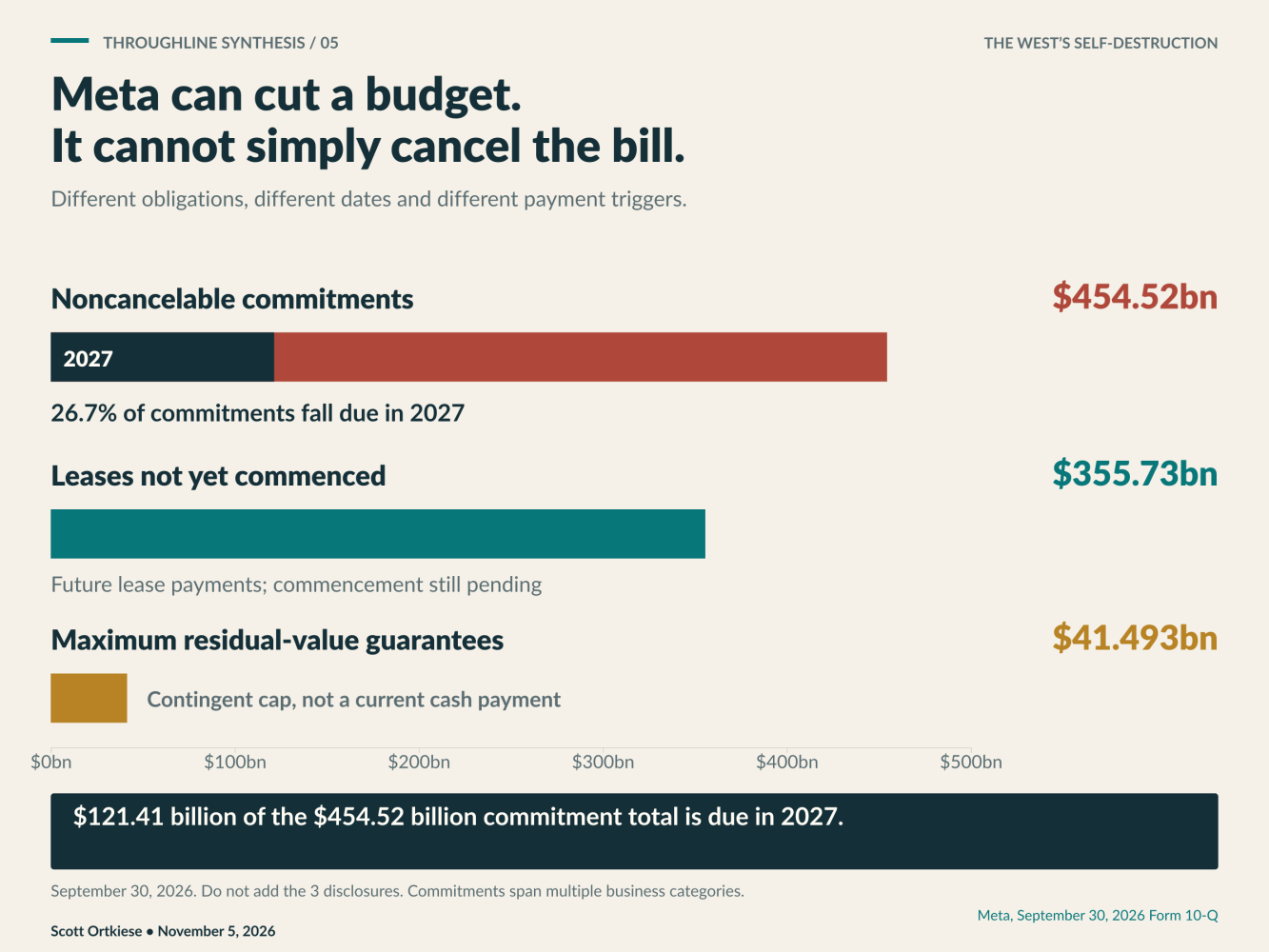
Meta disclosed $454.52 billion in noncancelable contractual commitments at September 30, 2026, including $121.41 billion due in 2027. (Meta’s September filing) These commitments cover multiple categories, including cloud capacity, servers, network infrastructure, energy services and consumer hardware, rather than a single immediate AI debt payment. (Meta’s commitment definitions)
Meta separately disclosed $355.73 billion in leases that had not yet commenced and maximum residual-value guarantees of $41.493 billion associated with its data-center ventures. (Meta’s lease and guarantee disclosures) These are different contractual claims, with different payment dates and triggers.
Suppliers can retain enforceable claims even when the investment fails to earn an adequate return. A separate venture does not release Meta from the leases, funding commitments and guarantees it signed.
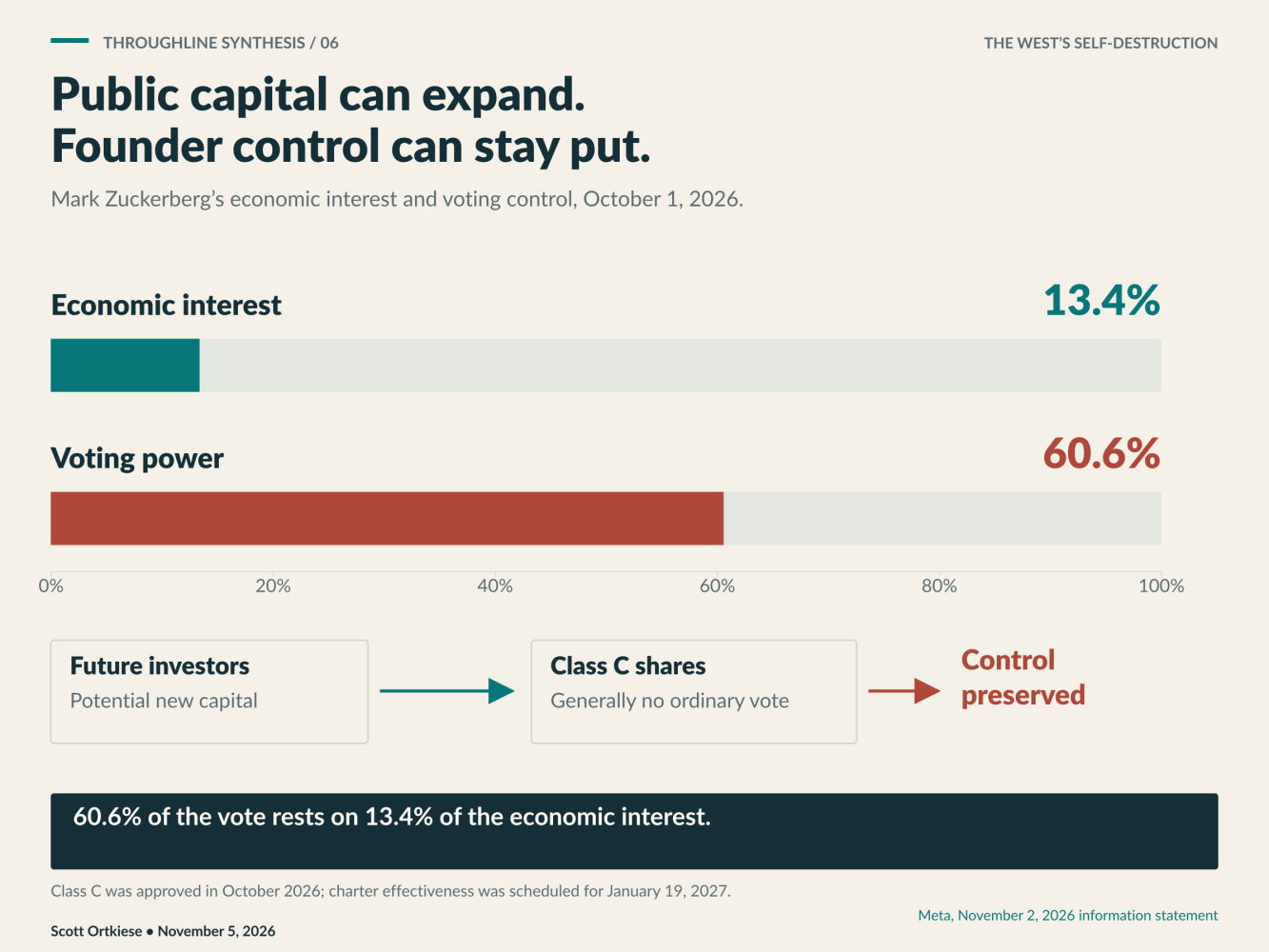
Control compounds the problem. Meta’s November information statement identifies Mark Zuckerberg’s approximately 60.6% voting control versus 13.4% of economic interests and sets out an approved plan for generally nonvoting Class C shares that could support future capital raising without diluting that voting control. (Meta’s Class C information statement)
The public market can supply more money without receiving proportionate authority over the decisions that put it at risk. Founder control remains concentrated; the financing burden can spread.
That is the governance arrangement against which any future appeal for public protection must be judged. Those who retain the power to choose the exposure do not acquire a moral claim on taxpayers merely because the exposure becomes large.
Nvidia helps finance the demand for Nvidia
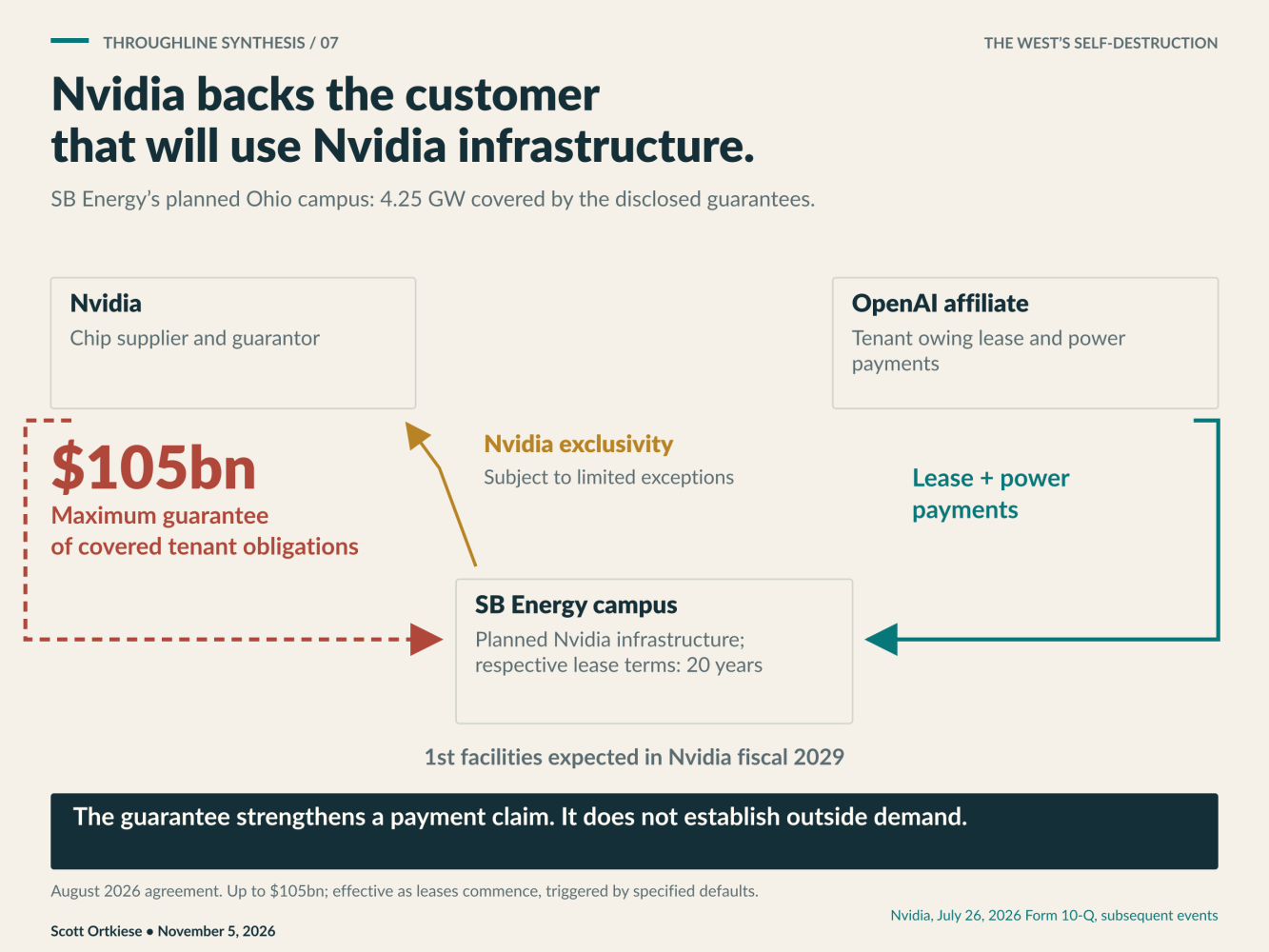
Nvidia’s filing supplies a particularly clear example. In August 2026, it entered guarantees capped at $105 billion supporting an OpenAI affiliate’s lease and power obligations at SB Energy’s PORTS Technology Campus in Ohio, covering approximately 4.25 gigawatts of planned computing load. (Nvidia’s guarantee disclosure)
The guarantees become effective as applicable leases commence, respond to specified tenant defaults, and decline as payments are made over the respective 20-year terms; the 1st facilities are expected to enter service in Nvidia’s fiscal 2029. (Nvidia’s guarantee terms) In exchange, the site will exclusively host Nvidia AI infrastructure, subject to limited exceptions. (Nvidia’s exclusivity provision)
The chip supplier is supporting the credit of a customer whose infrastructure will buy into the supplier’s technology. The guarantee supports project borrowing and protects Nvidia’s future sales.
It does not prove independent end-user demand. It binds another part of the financing system to the same customer’s ability to pay.
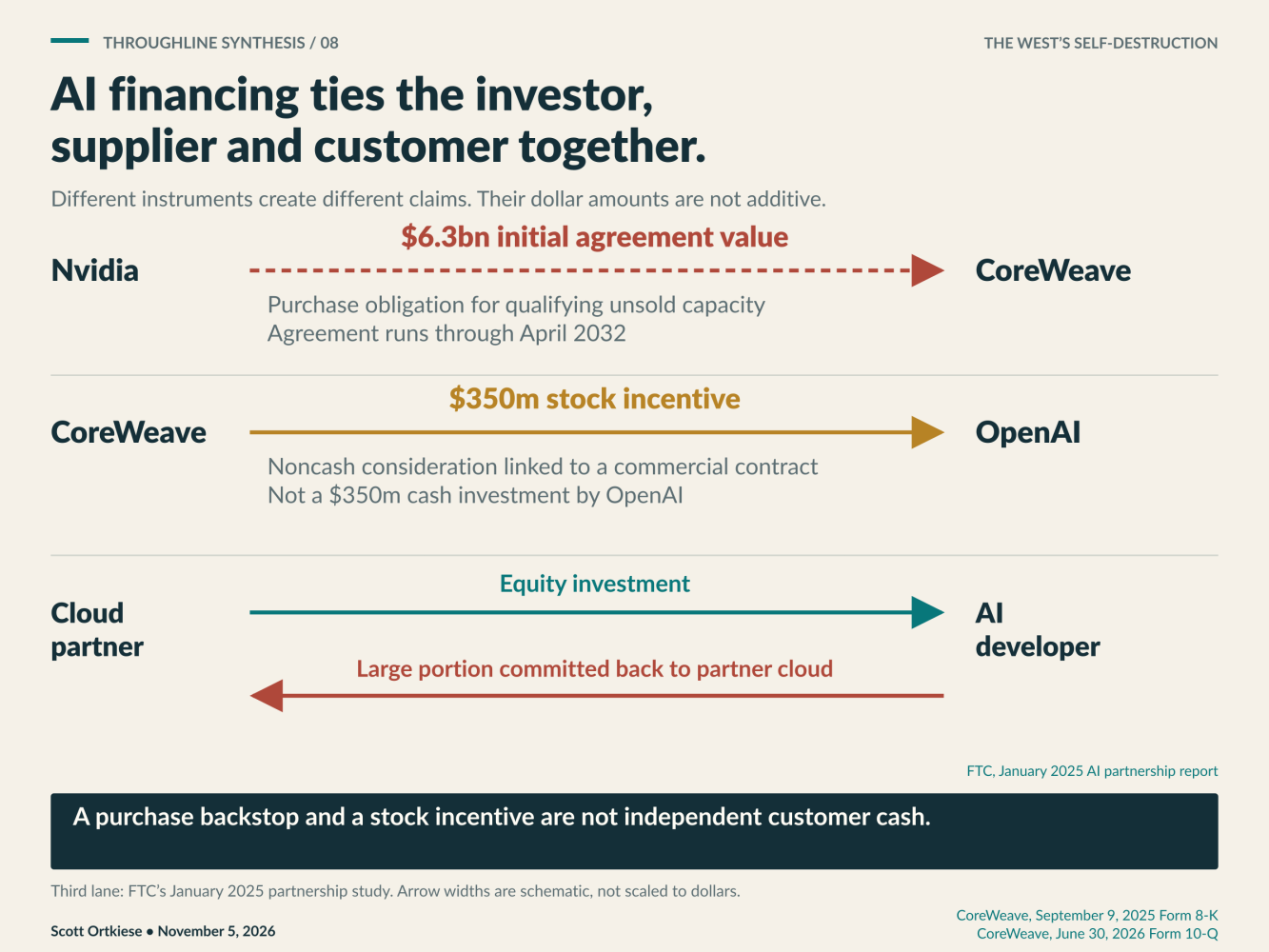
The relationship with CoreWeave, a provider of AI computing infrastructure, adds another connection. A September 2025 agreement obligated Nvidia to purchase qualifying residual unsold CoreWeave capacity under an arrangement initially valued at $6.3 billion and running through April 2032. (CoreWeave’s Nvidia agreement)
CoreWeave also issued OpenAI $350 million in shares as a noncash commercial-contract incentive. (Issuance agreement; CoreWeave’s cash-flow disclosure) That is equity supplied to a customer, not $350 million of outside cash invested in CoreWeave.
The Federal Trade Commission documented the broader pattern in the partnerships linking Microsoft, Amazon and Alphabet with OpenAI and Anthropic: developers were required to spend large portions of their partners’ investments on those partners’ cloud services, while contractual and technical arrangements could increase switching costs. (FTC partnership findings) A supplier relationship becomes a financing relationship, an equity relationship and a constraint on switching suppliers. Europe should not enter that system and congratulate itself on independence because the servers stand on European soil.
SpaceX ties the AI buildout to related parties and the state
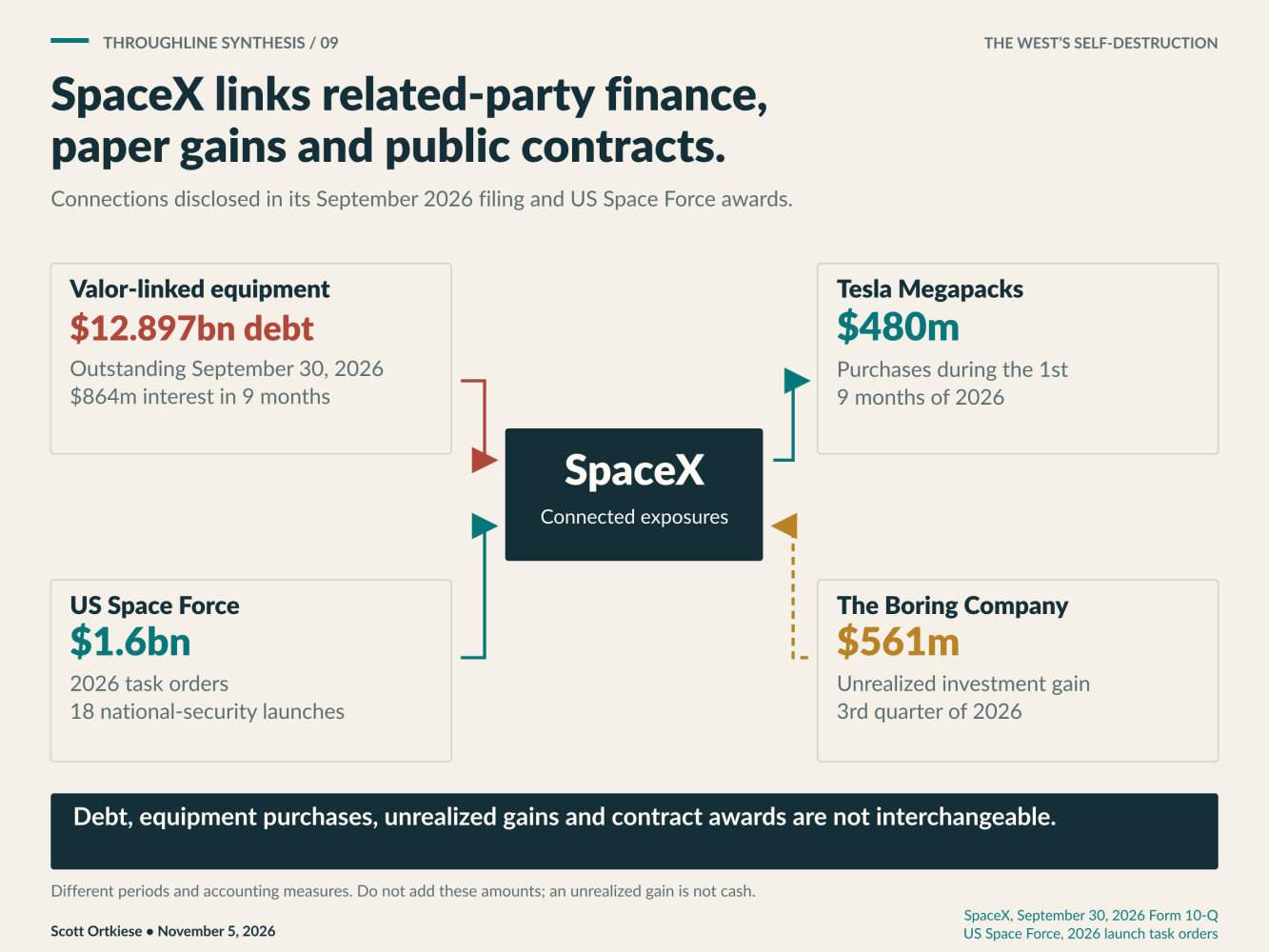
SpaceX’s acquisition of xAI on February 2, 2026, triggered a technical default under a credit facility because of debt assumed at subsidiary level; the company cured it through a bank waiver and amendment on March 2. (SpaceX’s debt disclosure) Combining businesses under common leadership imported obligations that required lenders to change the financing terms.
SpaceX’s September filing identifies equipment transactions with Valor Equity Partners, whose founder, chief executive and chief investment officer, Antonio Gracias, serves on SpaceX’s board. (SpaceX’s related-party note) The transactions did not qualify as sales for accounting purposes: the assets remained on the books, with $12.897 billion in associated debt outstanding and $864 million in interest expense during the 1st 9 months of 2026. (SpaceX’s related-party debt and interest)
The same filing reports $480 million in Tesla Megapack purchases during those 9 months and a $561 million unrealized quarterly gain on SpaceX’s investment in The Boring Company, another business controlled by Elon Musk. (SpaceX’s related-party transactions) Investors must evaluate the connected companies, directors, equipment purchases and financing obligations, not admire each company’s separate story.
Meanwhile, the US Space Force awarded SpaceX approximately $1.6 billion in 2026 task orders covering 18 national-security launches. (Space Force’s contract announcement) Public procurement therefore sits alongside the private financing and affiliated transactions.
The political conflict is not imaginary: Democratic US Senator Elizabeth Warren of Massachusetts documented her office’s concerns about Musk’s simultaneous government role, business ownership and exposure to federal contracts and regulatory decisions. (Warren’s June 2025 report) The demand is straightforward. Public authority must not become another business advantage available to the people already controlling the assets.
Europe has its own accountability failure. In May 2025, the EU General Court annulled the Commission’s refusal to provide access to text messages between von der Leyen and Pfizer’s chief executive, finding that the Commission had not plausibly explained its non-possession of the requested messages. (General Court’s judgment summary) Citizens asked to finance large corporate arrangements are entitled to the records, not the presumption that powerful officials should be trusted without them.
Accounting and ratings cannot manufacture repayment cash
An unrealized investment gain is not customer cash. A purchase commitment is not proof of profitable demand. A guarantee transfers payment risk; it does not abolish the underlying economic risk.
Treating those entries as interchangeable proof of strength is false. The system still needs outside customers whose payments cover its costs.
Meta’s venture accounting illustrates the distinction: it disclosed maximum residual-value guarantees while reporting no associated liability because payment was not considered probable. (Meta’s guarantee accounting) A zero recognized liability is an accounting conclusion under a probability test. It is not a promise that the exposure cannot become expensive.
The public should not be asked to treat a credit rating as a substitute for examining the customer, the guarantor, the collateral and the contract. If all depend on the same AI spending boom, stacking their promises together does not create independent sources of repayment.
This is the substantive charge against the financing labyrinth. It can make a claim easier to sell without making the investment more productive, and it can spread the exposure faster than the eventual cash-generating business develops.
Private credit brings the risk closer to households
My life-insurance investigation follows the danger beyond technology shareholders. Private-credit financing can connect infrastructure borrowers to the institutions holding retirement and insurance savings, where losses have consequences far outside the original deal.
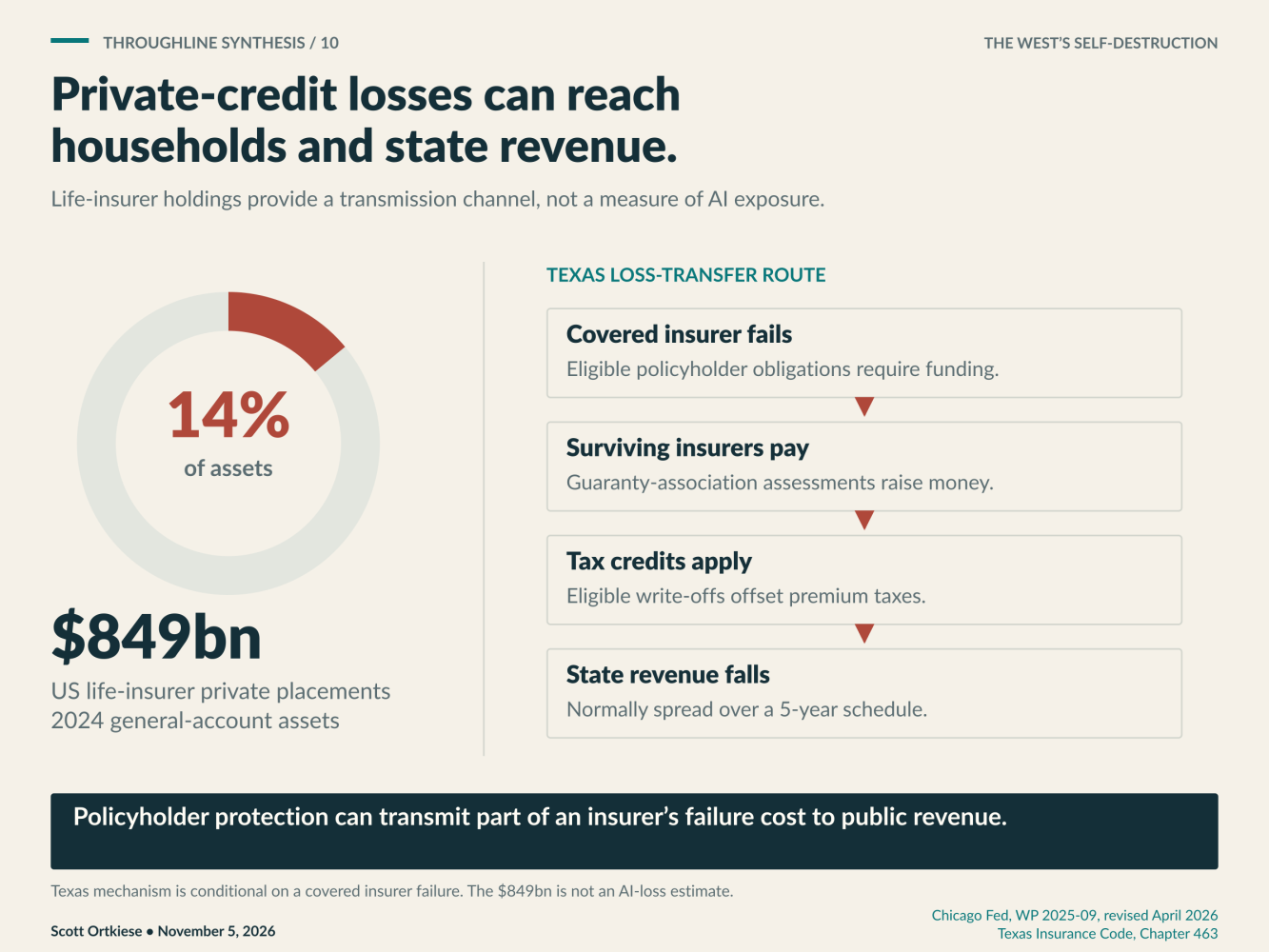
A Chicago Federal Reserve working paper reports $849 billion in life-insurer private placements in 2024, representing 14% of general-account assets. (Chicago Fed’s insurer study) It traces approximately $50 billion of the increase in privately placed asset-backed securities from 2017 to 2024 to financing vehicles affiliated with private-equity-owned insurers and identifies increased liquidity risk and connections to the wider private-credit system. (Chicago Fed’s affiliated-financing findings)
That is the investment system into which AI risk can enter through loans, funds, guarantees, securities and affiliated financing vehicles. Regulators must measure the AI exposure inside it, rather than confuse the size of the system with the size of that exposure.
The public-loss route is already written into law. Texas’s life-and-health insurance guaranty system can assess surviving insurers when covered obligations of an impaired or insolvent insurer must be met, and eligible assessment write-offs can receive premium-tax credits, normally over a 5-year schedule. (Texas Insurance Code, Chapter 463)
The sequence is concrete: an insurer fails; the protection system raises money from surviving insurers; permitted tax credits reduce payments those insurers would otherwise make to the state. Policyholders receive protection, but state revenue can bear part of the cost.
Protecting policyholders is necessary. Allowing poorly disclosed risks into institutions whose failure makes intervention difficult to refuse is not. The fee collectors should not be allowed to pocket the rewards while public protection supplies the escape route.
The too-big-to-fail argument is being assembled before the failure
Trump’s July 2025 data-center executive order directs the Commerce Department to develop financial support for qualifying projects, potentially including loans, loan guarantees, grants, tax incentives and offtake agreements, subject to law and available appropriations. (Executive Order 14318) An offtake agreement is a commitment to buy output; it can provide the paying customer a project needs to obtain financing.
OpenAI’s chief financial officer, Sarah Friar, discussed a government “backstop” and guarantee to improve financing terms, then said OpenAI was not seeking a government backstop for its infrastructure commitments. (Friar’s remarks and clarification) Attaching public credit makes private borrowing cheaper by putting public resources behind it.
The IMF’s October 2026 analysis warns that growing AI debt issuance, off-balance-sheet commitments and concentrated market exposures can transmit a reassessment of AI returns into broader credit conditions. (IMF’s leverage analysis) That provides the raw material for a future rescue argument: the exposure is no longer confined to a speculative technology venture, so allowing losses threatens other institutions and economic activity.
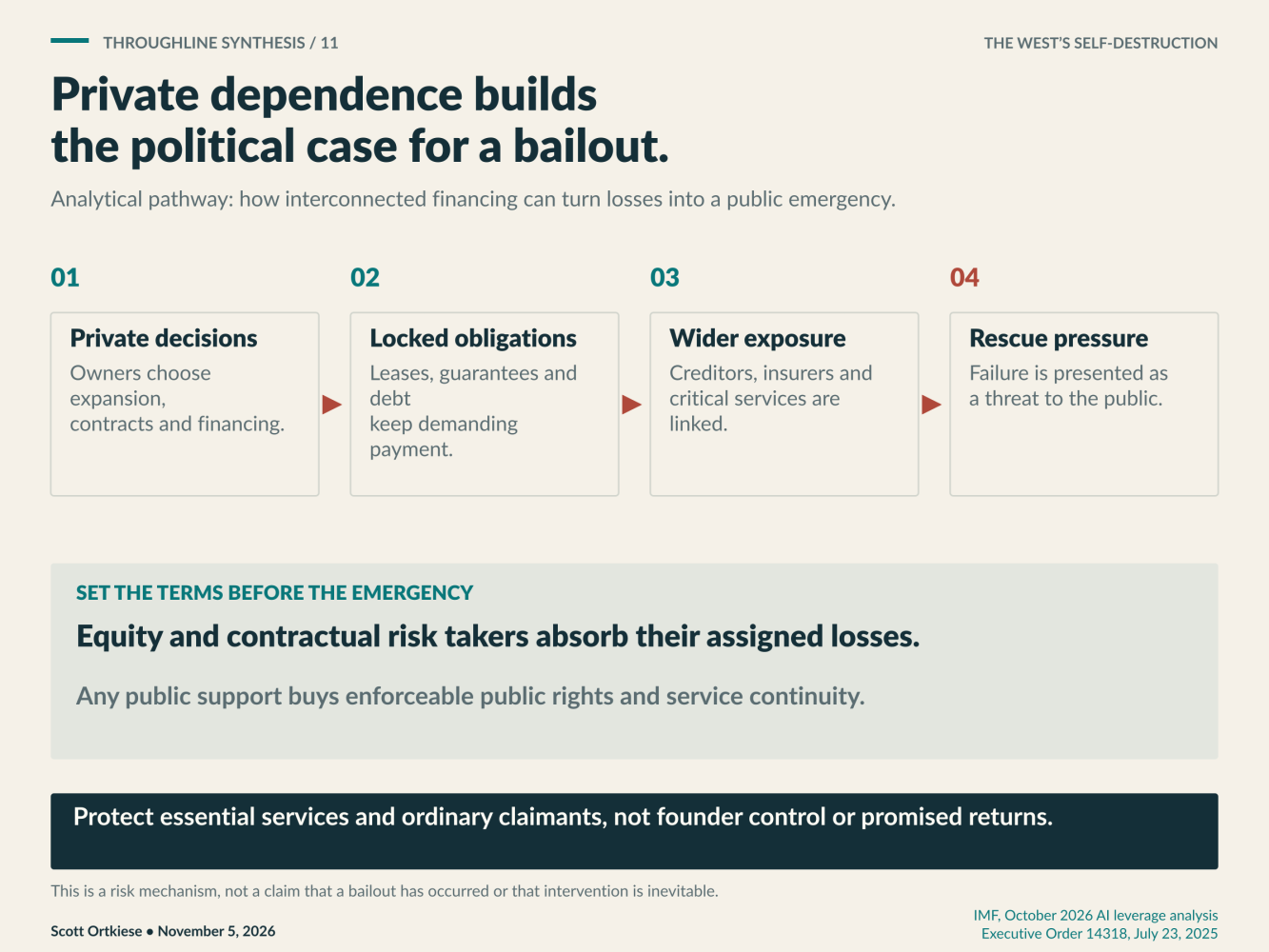
The too-big-to-fail argument writes itself: interrupted financing threatens essential services, widely held investments and jobs, so the public must intervene. Private control is preserved while the consequences of failure are distributed.
The policy answer must be set before the emergency. Protect essential services and ordinary claimants through resolution, restructuring and continuity arrangements; require equity owners and contractual risk takers to absorb the losses assigned to them.
Public money must buy enforceable public rights, not simply restore the value of private claims. The public is not obliged to preserve a founder’s control, a lender’s expected return or a fund manager’s fee stream.
Europe cannot run an industrial economy on expensive electricity and neglected skills
Europe’s danger is becoming the customer that keeps this American system profitable while losing the capacity to build an alternative. Its leaders compound that dependence by neglecting the productive foundations that genuine competition requires.
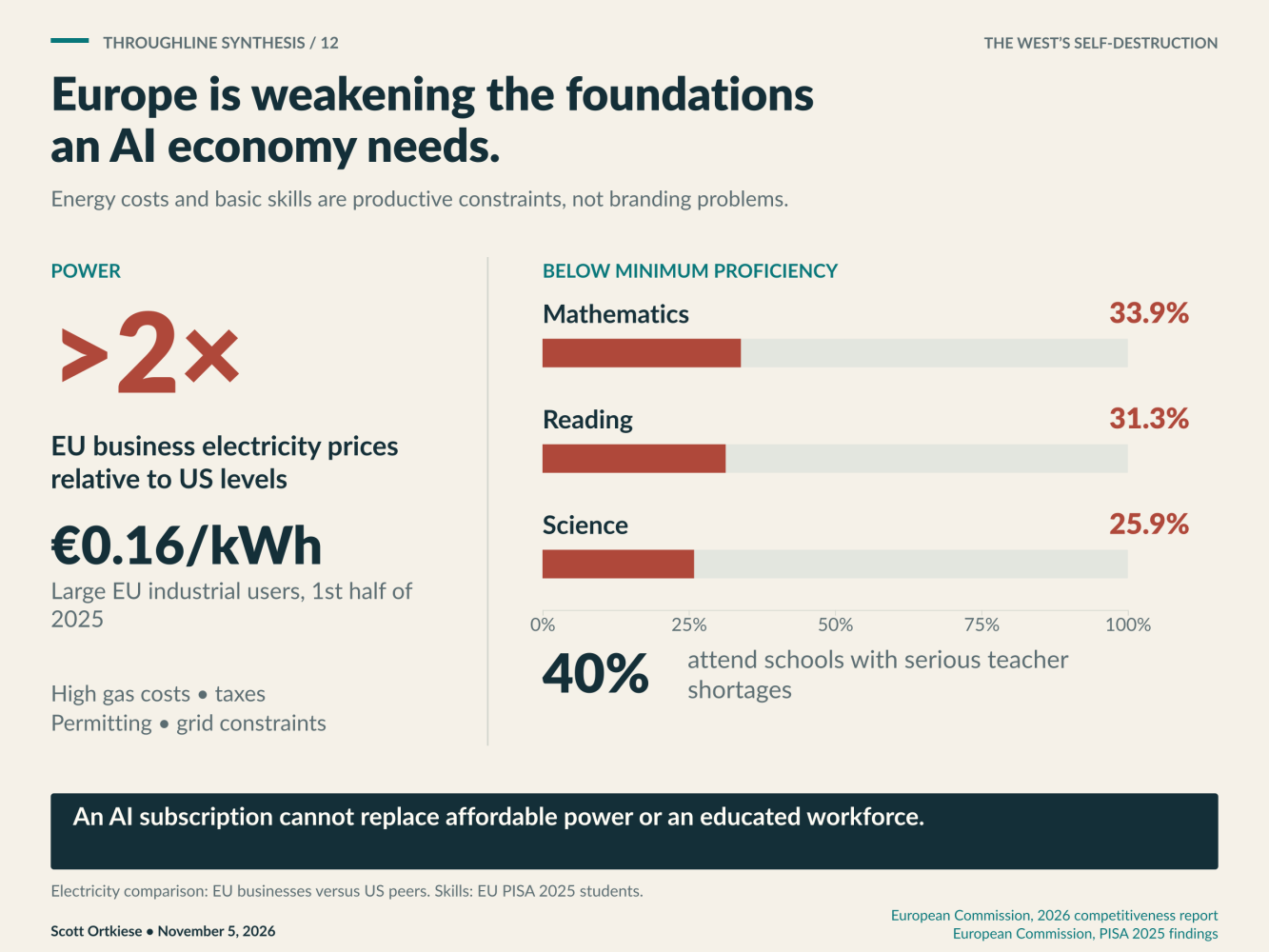
The European Commission’s 2026 competitiveness report says EU business electricity prices remain more than twice US levels; large industrial users paid approximately €0.16 per kilowatt-hour in the 1st half of 2025. (Commission competitiveness report) The same report identifies high gas prices, electricity taxes, lengthy permitting and inadequate grid expansion among the obstacles to competitive electrification. (Commission competitiveness report)
A factory cannot pay its electricity bill with a sovereignty speech. Expensive power penalizes both the goods Europe wants to sell and the computing infrastructure it wants to own.
The Commission acknowledges that energy costs shape investment in chemicals, metals, glass and paper, and that further action is required despite its Affordable Energy Action Plan. (Commission energy assessment) Competitiveness requires affordable power, not another initiative carrying the word “competitive.”
Education presents the same contradiction. The Commission’s analysis of PISA 2025 reports that 33.9% of EU students fall below minimum proficiency in mathematics, 31.3% in reading and 25.9% in science; approximately 40% attend schools experiencing serious teacher shortages. (Commission education findings)
Those students are Europe’s future technicians, researchers and taxpayers. A model subscription does not repair their education. Buying advanced software cannot substitute for developing people capable of understanding, testing and improving it.
This is an anti-education outcome, whatever the promises attached to it. Fund teachers, instruction and technical training before claiming to lead an intelligence revolution.
America has its own version. The US Department of Education’s inspector general reported that the department reduced its workforce by approximately 50% during fiscal 2025, creating risks to statutory responsibilities, institutional knowledge and oversight. (Education inspector general’s 2026 assessment)
Oversight staff discover waste and enforce obligations. Dismantling that capacity and calling it efficiency puts public money at risk.
The money appears when the priority is rearmament
European Commission President Ursula von der Leyen’s ReArm Europe initiative advertised the capacity to mobilize up to €800 billion in additional defense spending, including €150 billion in EU-backed loans through the Security Action for Europe instrument, known as SAFE. (Commission’s financing explanation) That headline describes potential financing, not €800 billion already spent, and the SAFE component is lending that borrowing governments must repay. (Commission’s financing explanation)
Governments are creating financial room for rearmament while industry faces expensive electricity and schools lack teachers. Borrowing postpones the bill. It does not manufacture the engineers, construction workers and materials competing projects require.
Germany, governed by Federal Chancellor Friedrich Merz, has exempted qualifying defense and security expenditure above 1% of GDP from the federal debt-brake calculation. (Germany’s 2026 fiscal report) Germany also established a €500 billion infrastructure and climate-neutrality fund over 12 years, including schools, energy networks and research infrastructure among its purposes. (German finance ministry’s fund description)
The civilian fund proves that financing the future is a political choice. Delivery is another matter: the finance ministry reports €24 billion disbursed in 2025 against approximately €37.2 billion planned. (German disbursement record) Merz owes Germany functioning infrastructure and competitive production, not another impressive borrowing announcement.
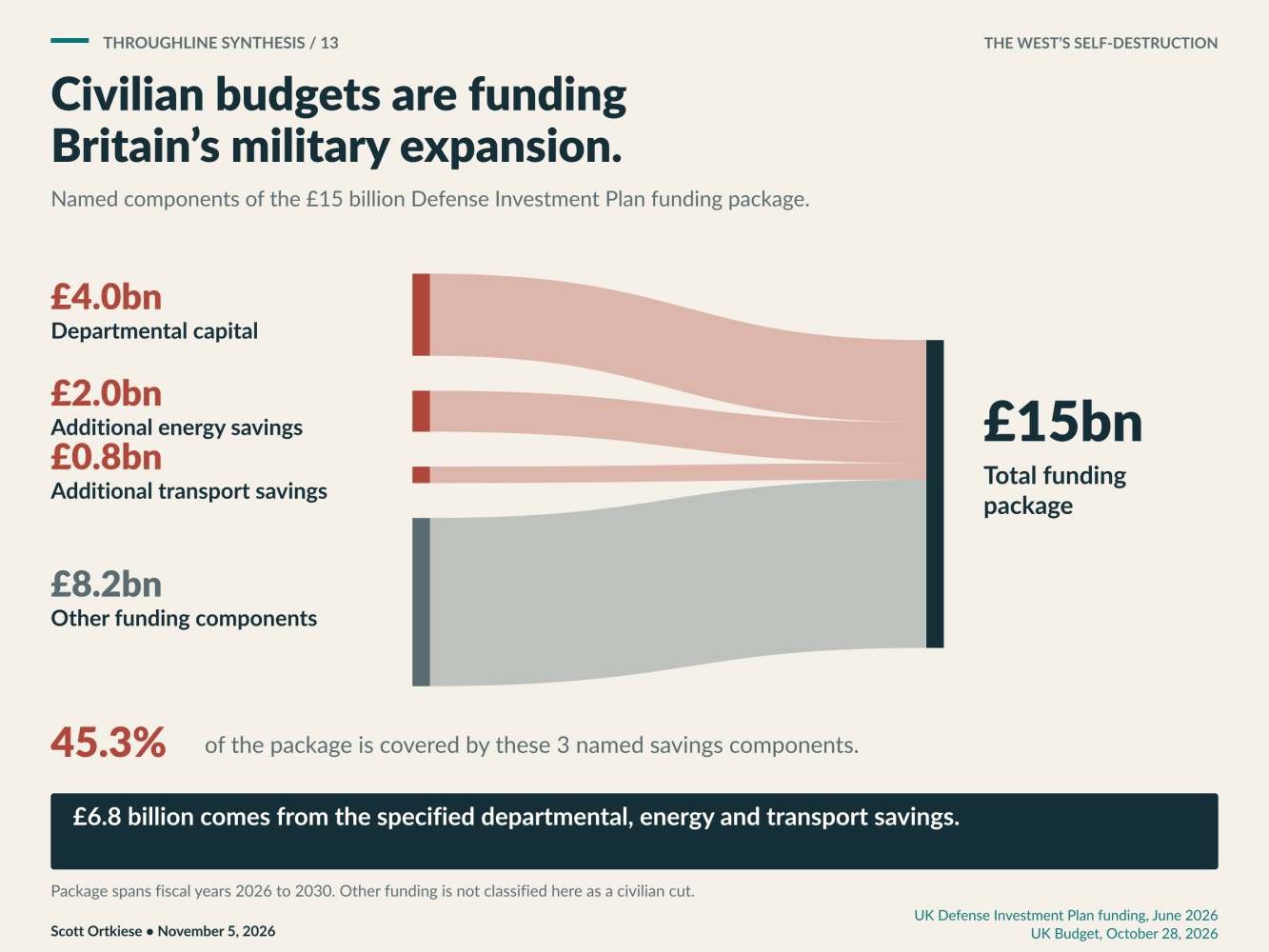
Across the Channel, UK Prime Minister Andy Burnham’s government supplies an unusually explicit example of the trade-off. In the October 28 budget, Chancellor John Healey confirmed that the government was fully funding the Defense Investment Plan, including through capital reprioritization across departments. (UK prime minister; Healey’s budget statement)
The funding plan published in June identifies a £15 billion package across fiscal years 2026 to 2030, including £4 billion from a 1% reduction in departmental capital budgets, £2 billion in additional energy-department savings and £800 million in additional transport savings. (UK defense funding plan) These are civilian budgets that supply the military with money.
Healey also announced £10 billion in additional economic and military support for Ukraine, structured through loans, export-finance guarantees and £500 million in urgent military funding, alongside a new defense-finance taskforce and plans for greater private investment and public-private partnerships in defense. (Healey’s budget statement) The same political instinct appears in military and AI financing: when the commitment grows, reach for another financing structure rather than reconsider the commitment.
Merz, von der Leyen and Burnham should be judged against that arithmetic. Security policy that consumes the foundations of economic security defeats its own stated purpose.
Confrontation is not a substitute for a competitive economy
The EU’s Russian-gas phaseout prohibits remaining long-term Russian LNG imports from January 1, 2027, with the long-term pipeline prohibition generally beginning September 30, 2027, subject to specified provisions. (Council’s gas phaseout) The Council grounds the policy in the security risks associated with Russia’s war and Europe’s dependence on Russian supply. (Council’s rationale)
Russia’s invasion does not make every Western response economically wise. “Security” is not an exemption from cost analysis, and replacing dependence on Russia with dependence on another supplier does not establish independence.
Europe needs dependable energy evaluated by cost, reliability and supply risk. It needs diplomacy that reduces conflict, not confrontation that justifies more confrontation.
The same demand for judgment applies to China. The Commission’s Horizon Europe 2026 and 2027 rules restrict the participation of China-based entities in innovation actions and research-and-innovation activities, with defined exceptions, citing concerns including intellectual property, reciprocity and research security. (Horizon participation rules)
Brussels is narrowing research cooperation with a major technological competitor. Security policy becomes economic sabotage when it hardens into an indiscriminate refusal to learn, cooperate or buy competitively.
The Commission also imposed additional duties of up to 35.3% on Chinese battery-electric vehicles after finding unfair subsidization that threatens European producers. (Commission’s tariff decision) Protection buys time. It does not build a better car.
In AI, the opportunity is to use competing models under terms that preserve European control. As I argued in “America’s AI Blunder Is Europe’s Lesson,” Europe should retain its data, operating authority and ability to replace a supplier rather than equate independence with reproducing the American frontier-model spending race.
Open-weight models make their trained parameters available for download and local operation under specified licenses. (European AI strategy) Evaluate Chinese and European alternatives against the job, the license, security and the buyer’s operating control. Nationality cannot do the analysis.
Western entitlement begins when leaders assume their preferred suppliers deserve the market without winning the competition. It becomes economic self-harm when citizens must pay more to preserve that assumption.
The anti-Russian reflex survives the election
The bipartisan commitment to confrontation is documented. On October 19, Democratic US Senator Richard Blumenthal of Connecticut and Republican US Senator Thom Tillis of North Carolina issued a joint statement reaffirming support for Ukraine, defending military assistance and invoking Congress’s support for “crushing sanctions” against the enablers of Russia’s war. (Blumenthal and Tillis statement)
After the November 2026 election, Reuters identified renewed Ukraine assistance as a likely Democratic congressional priority, alongside opposition to Trump’s Iran war. (Reuters’ post-election assessment) Opposing 1 war does not settle the case for financing another.
The anti-Russian reflex crosses party boundaries and mistakes continued military support for a strategy. Arms deliveries are an instrument. An achievable political settlement is an objective.
NATO governments have committed to spending 5% of GDP annually by 2035 on core defense and related security and resilience, with at least 3.5% assigned to core defense requirements. (NATO’s Hague declaration) A spending target cannot answer whether the strategy reduces the probability of war or strengthens the societies it supposedly defends.
Peace is economic policy. People, energy systems, transport networks and public finances have uses beyond sustaining confrontation.
Western leaders must explain the destination, the cost and the terms on which the killing ends. A policy that treats negotiation as capitulation and expenditure as resolve can keep consuming resources long after its advocates have stopped explaining what success means.
American voters rejected the bargain. Party leaders do not own that rejection.
The November election delivered a concrete rebuke to the data-center buildout: reporting identified 41 local ballot measures across 10 states, with voters opposing development or backing restrictions in 40 of them. (CNBC’s ballot-results review) Those votes deny the industry an unquestioned public mandate.
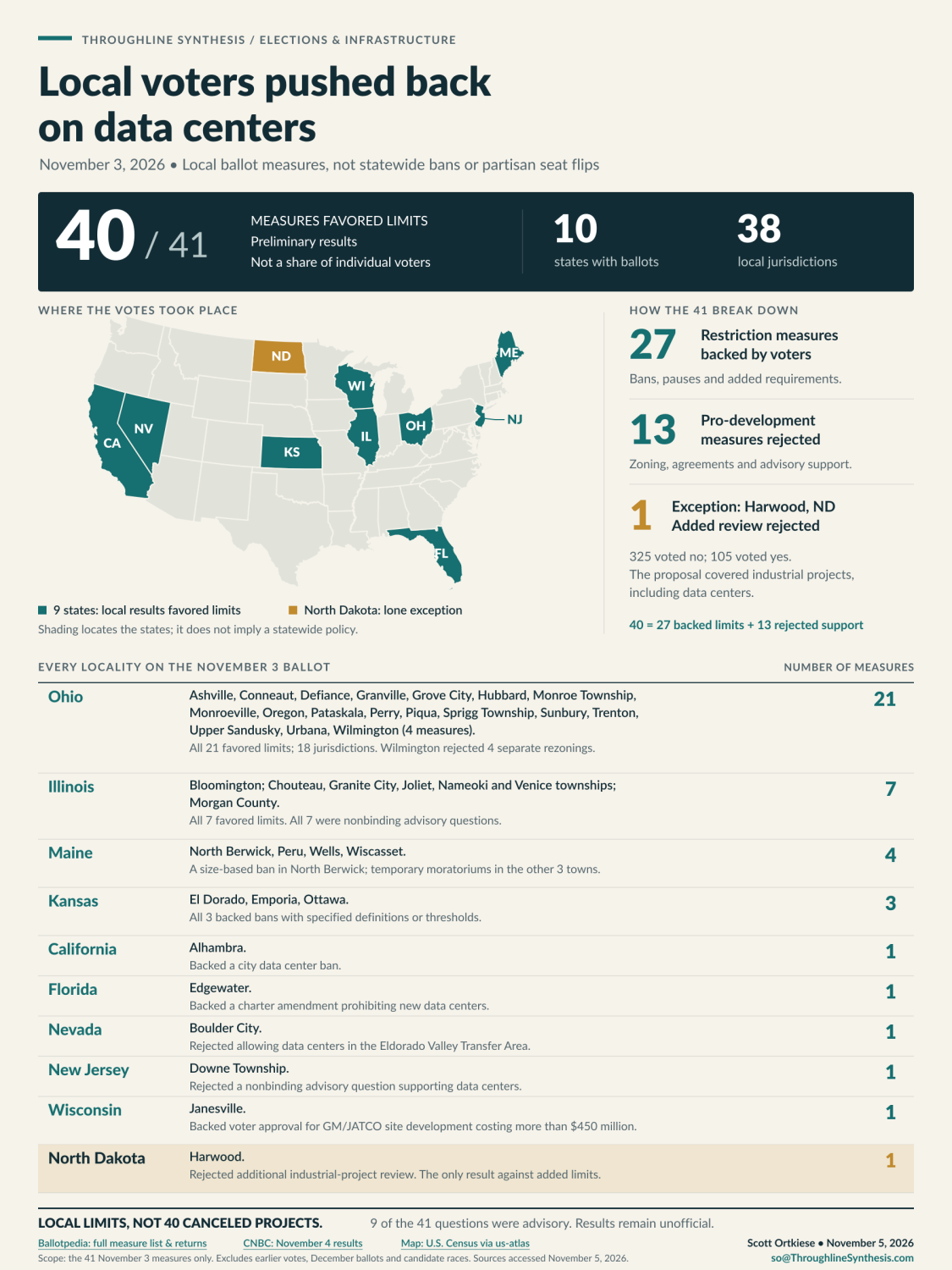
Senate Democratic leader Chuck Schumer responded to the election by declaring, “We listened,” and presenting affordability as his party’s mandate. (Schumer’s November 4 transcript) House Democratic leader Hakeem Jeffries likewise claimed a mandate centered on affordability, health care and ending the Iran war. (Jeffries’s post-election letter)
Winning protest votes is not the same as owning the protest. Voters’ anger about costs and corporate power must not become fresh political capital for an establishment that changes the sales pitch while preserving the underlying deal.
The AI industry has been financing its own political intervention. CNBC’s review of federal filings through October 20 identified approximately $78.5 million in candidate-related spending across rival AI-policy camps, including roughly $26 million in primary spending by the Leading the Future network. (CNBC’s political-spending investigation) That network, backed by donors including OpenAI President Greg Brockman and his wife Anna, deployed Democratic and Republican political committees while opposing a patchwork of state AI regulation. (CNBC’s donor and committee findings)
This is a struggle over who writes the rules and who absorbs the costs. Calling the corporate agenda “innovation” does not make public opposition ignorant. Calling an electoral victory “our vision” does not prove that party leaders have abandoned the interests voters were protesting.
Labor is not a disposable input
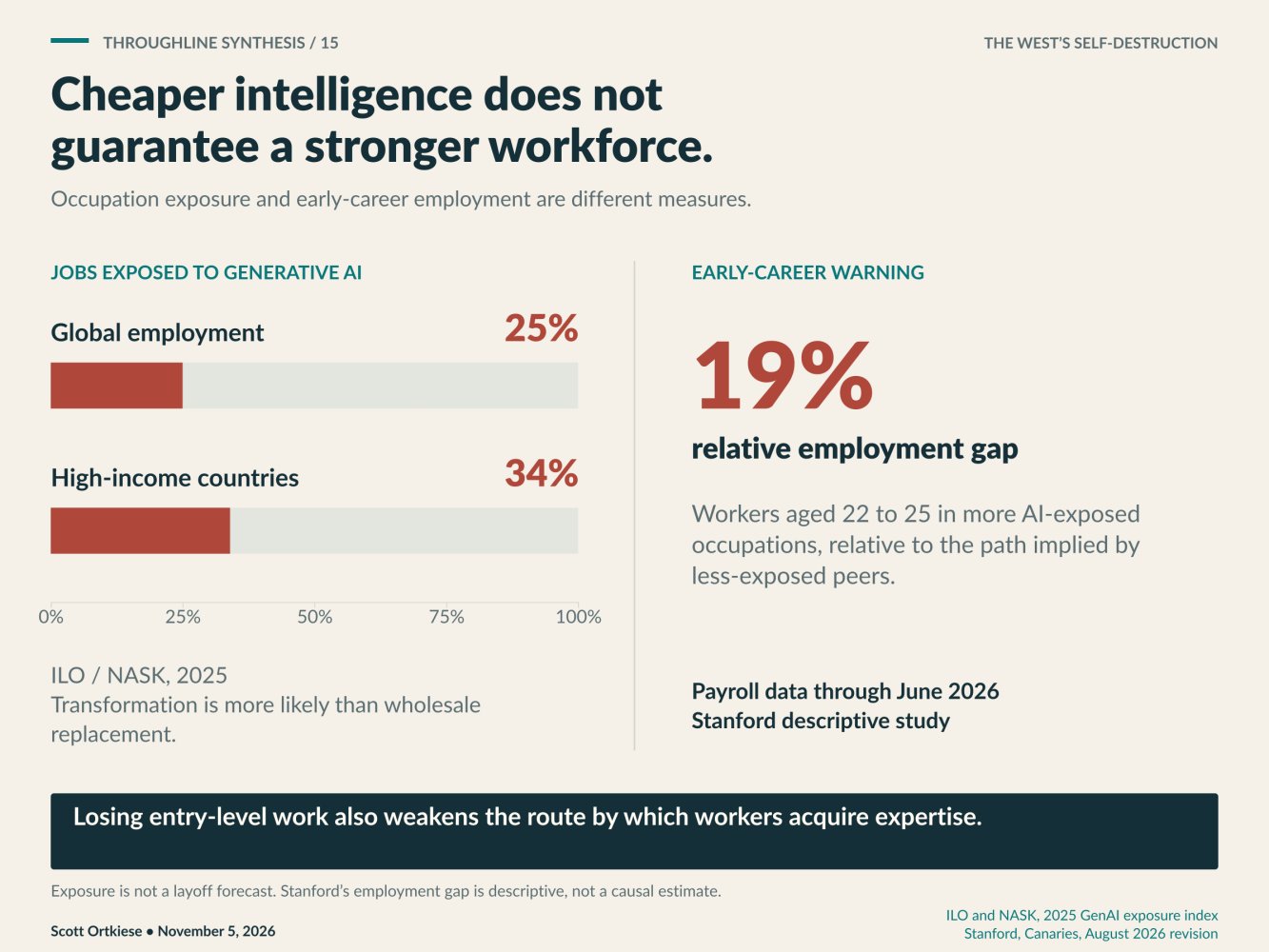
The International Labor Organization’s 2025 index found that approximately 25% of global employment and 34% of employment in high-income countries is in occupations exposed to generative AI, with transformation more likely than wholesale replacement. (ILO and NASK findings) Those jobs are people’s livelihoods, not an engineering footnote.
That makes ownership and bargaining power decisive. Productivity gains can finance higher wages, shorter hours, better services and broader access to expertise. They can also be captured by owners while workers lose income, security and control over their work.
A Stanford descriptive study using payroll data through June 2026 found that employment among workers aged 22 to 25 in more AI-exposed occupations stood 19% below the level implied by growth among less-exposed peers. (Stanford’s employment study) That gap demands attention before a generation loses its route into skilled work.
Closing entry-level opportunities damages more than the current payroll. It removes the work through which young people acquire experience, become capable practitioners and eventually teach others. A company can reduce its training costs while society loses part of the system that produces skilled adults.
This analysis should include the tax base. If labor income falls without replacement income, employment or an adequate tax claim on the resulting profits, governments lose revenue while demand for support increases.
That is how a supposed productivity revolution can damage the social fabric. The problem is not intelligence becoming cheaper. It is allowing the income, authority and benefits to concentrate while calling the displaced costs somebody else’s problem.
Dollar privilege cannot substitute for productive work
The dollar remains central to international payments, reserves and financing, supported by deep markets, institutional confidence and demand for dollar assets, according to the Federal Reserve’s July 2026 assessment. (Federal Reserve’s dollar assessment) That privilege is real. It is not evidence that every American investment financed through it is sound.
Petrodollar recycling, reserve demand and financial-market depth can help move capital. They cannot create cheap electricity, skilled workers or profitable customers by themselves.
My earlier argument linking war, Gulf finance and AI addresses that dependence. Relying on financial privilege while weakening the productive economy consumes an advantage instead of renewing it.
A more competitive and multipolar world does not owe Western companies protected margins. It does not owe Western governments permanent control of the rules, and it does not owe Western investors repayment merely because their financing structures became elaborate.
Entitlement is the refusal to accept those facts. Decline becomes policy when leaders answer competition primarily with exclusion, financial leverage and military power instead of the sustained work required to become better.
Break the rentier bargain before the public gets the bill
Caffarra and EuroStack are right to demand control over Europe’s digital infrastructure. (EuroStack’s program) That control must rest on a functioning industrial economy and serve the people financing it.
Build the energy system. Restore the schools and technical training. Use diplomacy to reduce confrontation and preserve useful commercial relationships. Evaluate competing technologies by performance, full operating cost, security and the rights the buyer retains.
Public purchasing should secure access to data, practical migration between providers, service continuity and the ability to operate without a supplier’s permission. European ownership alone is insufficient if the arrangement merely installs a European intermediary between the public and a foreign monopoly.
Finance capacity against credible demand and measurable benefits. Separate the long useful lives of buildings and power infrastructure from the shorter replacement cycles of computing equipment. Disclose guarantees, affiliated transactions and the parties that bear losses when the plan fails.
The sacrifice required of leadership is not another demand that workers accept less. It is the willingness to surrender privileged access, opaque contracting, protected returns and the presumption that the public will rescue a politically connected investment. Americans who defend those privileges must stop pretending that enriching their rentier class is the same as strengthening their country.
Make every participant answer for the risk it creates. Founders must not preserve control through public rescue. Deal arrangers and fund managers must expose their fees, related parties and loss allocation. Ratings must withstand independent scrutiny. Politicians must stop treating donors’ asset values as a national-security objective.
Instead, we get private control backed by claims of public necessity. Real technological advances become a worse bargain for the society financing them.
Western leaders are not merely forecasting a storm. They are writing its conditions into budgets, contracts and policy.
The Greeks, Carthaginians, Romans and British furnish no guarantee that inherited power renews itself. Historical stature is not a perpetual claim on the future.
We can educate, build, discover, cooperate and compete. Or we can keep dressing financial extraction and militarization as national renewal, preserving yesterday’s privileges while consuming tomorrow’s capacity.
AI does not make that choice for us. We can grasp its benefits, or finance and militarize our way into the grave. Which is it?