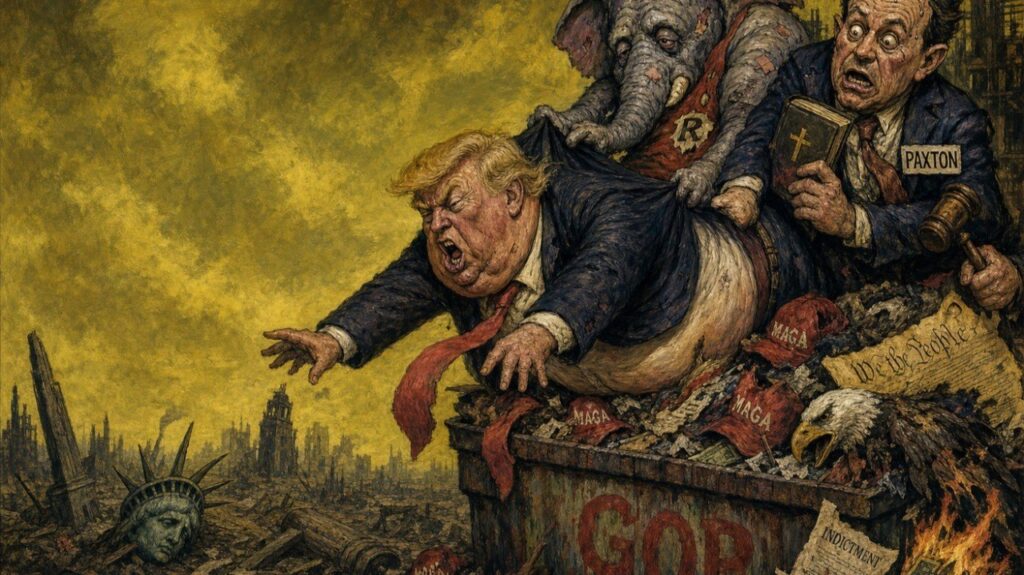
How could a better script be written for Trump to define himself as ignorant trash?

By Scott Ortkiese | June 10, 2026
There is one honest way to measure a presidency, and it has nothing to do with spin doctors, push polls, or the cable-news choir that gets paid to pretend this is normal. You take the man at his own word. You stack what he posts at three in the morning on his own captive social network against what he posts the next afternoon. You lay his snarling ultimatums beside the whimpering climbdowns that follow them by sundown. You set his triumphal “deals” next to the foreign counterparties who openly contradict him within the hour. You match his strutting battlefield boasts against the body counts. Do that honestly for one hundred days, February 28, 2026 through June 10, 2026, and what emerges is not a “master negotiator,” not a “peacemaker,” not a “wartime president,” not any of the other taxidermied phrases his sycophants prop up in front of him like cue cards at a hostage video.
What emerges is a fat, frightened, senile old man who cannot keep his own story straight from sunset to sunrise. A bully whose threats are laughed off by every adversary the instant he issues them. A self-described billionaire who governs from a phone in his bathrobe, vomiting ALL-CAPS hallucinations into the void at hours when functioning adults are asleep. A coward in a big man’s suit. A liar so compulsive he forgets which lie he told that morning. A draft-dodging dilettante playing dress-up as Commander-in-Chief while real American service members come home in coffins because of ultimatums he issued and abandoned in the same news cycle.
This is the case, in his own words and from his own keyboard, that Donald J. Trump is not merely unfit for the office he holds. He is a national humiliation, and the most damning witness against him is himself.
I. The Iran War: An Ultimatum-a-Day President
The clearest indictment is the war he started with Iran on February 28, 2026, the very date this analysis begins. By the time the smoke cleared on the opening salvo, Trump had set in motion a conflict that has killed nearly 3,600 Iranians, including at least 1,665 civilians, more than thirty civilians in Gulf Arab states, and thirteen American service members in the region, and that as of this writing has produced no agreement, no surrender, no “MIGA,” and no peace (BBC).
What it has produced is a Truth Social tape loop of self-contradiction so blatant that CNN had to publish a piece literally titled “Epic flurry: How Trump has shifted his stances on Iran”, cataloguing how, inside three weeks, the president lurched between demanding “unconditional surrender” and declaring victory had already been won (CNN).
Consider the sequence in his own words:
• March 6, 2026, Trump posts on Truth Social: “There will be no deal with Iran except UNCONDITIONAL SURRENDER!”, then promises, in the same post, to “MAKE IRAN GREAT AGAIN (MIGA!)” once “we” install “GREAT & ACCEPTABLE Leader(s).” The Dow falls more than 900 points within hours (CNBC, Al Jazeera).
• March 7, One day later, on CBS, Trump claims the surrender has already happened: Iran has “surrendered to all the Middle East” (CNN).
• March 11, At a rally in Hebron, Kentucky: “We won. We won the war in the first hour, it was over. We won.” (CNN).
• March 16, Asked by PBS when the war will end: “I don’t believe it will be long.” No timeline. (CNN).
• March 23, Trump postpones his own Hormuz ultimatum, citing “very good and productive conversations” with Iran. The IRGC-affiliated Fars News reports no such talks occurred (Wikipedia).
• April 1, Trump claims Iran has just “asked the US for a ceasefire.” The IRGC publicly contradicts him within hours (Wikipedia).
• April 7, At the height of his April ultimatum, Trump posts what may be the single most disgraceful threat ever issued by an American president on a public platform: “A whole civilization will die tonight, never to be brought back.” Administration officials later admit the post was “improvisational, and not part of a national security plan.” UN Secretary-General António Guterres calls it “deeply troubling.” Pope Leo XIV calls the threat “truly unacceptable” (BBC, PBS, Harvard Kennedy School).
• The same evening, April 7, Trump folds. He posts that Iran has offered a “workable” 10-point plan and agrees to suspend strikes for two weeks. PBS dryly notes the obvious pattern: “since the onset of the war, Trump has consistently postponed deadlines just before they lapse” (PBS).
• April 17, Trump announces the Strait of Hormuz is “fully open and ready for full passage.” Hours later, in the same forum, he reverses himself and declares the U.S. naval blockade will continue “UNTIL SUCH TIME AS TRANSACTION WITH IRAN IS 100% COMPLETE.” Iran says the blockade itself violates the ceasefire (PBS).
• May 23, Trump posts that an Iran deal is “largely negotiated.” Iran’s Fars News calls this “incomplete and inconsistent with reality.” Iran’s foreign minister, Abbas Araghchi, posts on X that “whenever a diplomatic resolution is on the table, the U.S. opts for a reckless military venture” (BBC, The Atlantic).
• June 9, An Apache helicopter is downed near the Strait of Hormuz. Trump posts that the U.S. “must, of necessity, respond.” CENTCOM launches strikes on Iranian radar and air-defense sites (Al Jazeera, NPR).
• June 10, On Truth Social, the day this is written, Trump declares: “Iran’s military is a complete and total mess. Much of it, like their navy and air force, doesn’t even exist anymore. They have been completely defeated.” Hours earlier his own administration was telling reporters the deal was nearly done and “going well” (YouTube/WION report, NPR).
Within one hundred days he has demanded total surrender, claimed total surrender, called a deal “largely negotiated,” declared Iran “completely defeated,” extended his own deadlines repeatedly, threatened a civilization with extinction, and then begged for another two weeks. The Iranian negotiating team has come to treat his posts as noise. Foreign Minister Araghchi has openly cited Trump’s fluctuating positions as proof of his unreliability (The Atlantic). This is not strategic ambiguity. This is incoherence weaponized against the United States.
II. Ukraine: The “Mediator” Who Mediates for Moscow
If Iran reveals the volatility, Ukraine reveals the rot. Trump campaigned on ending the Russia-Ukraine war “in 24 hours.” More than a year into his second term, the war grinds on, the Ukrainians have publicly given up on him as an honest broker, and his envoy has visited Moscow at least eight times since March 2025 without setting foot in Kyiv (Brookings, The Atlantic).
The pattern since February 28 alone is damning:
• On March 25, Zelensky tells the press that American officials have explicitly tied a bilateral U.S. security guarantee for Ukraine to Kyiv ceding all of Donetsk, including territory Russia has failed to take by force, to Moscow (Brookings).
• On April 8, Vice President JD Vance dismisses both Ukrainians and Russians as “haggling” over “a few square kilometers”, territory inhabited by Ukrainian citizens and central to Ukraine’s defensive geometry (Brookings).
• On April 14, Vance boasts that he is “particularly proud” the Trump administration has ended U.S. financial support for Ukraine (Brookings).
• On April 29, Trump talks to Putin and announces, based on a Putin “suggestion”, that the Russian leader “might” call a temporary ceasefire to mark a holiday. The pause never materializes in any meaningful way; Trump uses the call to muse that the Iran war might “wind down on a similar timetable” (Politico).
• Throughout the period, Russian officials have publicly leaned on what they call “the Anchorage understanding”, the August 2025 Alaska summit at which Trump apparently signaled openness to recognizing Russian sovereignty over all of Donbas, in exchange for nothing (Brookings).
• Even sympathetic Republicans, like former U.N. Ambassador Kurt Volker, have publicly told Politico that Trump “is in danger of sabotaging his own policy by not doing enough to help Ukraine,” and that he refuses to use the obvious lever, sanctions and military aid, to change Putin’s calculus (Politico).
• The Hill, hardly a left-wing pamphlet, declared Trump’s mediation effort “ineffective” in May, noting that his administration actually lifted oil sanctions against Moscow and boasts about cutting off Ukraine (The Hill).
In Trump’s own framing, his “leverage” is to threaten Ukraine. He has refused to threaten Russia. The result is a “negotiation” in which the aggressor sets the terms and the victim is told to “make a deal.” That is not diplomacy. That is laundry service. The Atlantic, again, surveying the wreckage, concluded that “Ukraine has finally given up on Trump” (The Atlantic).
III. The “Art of the Deal,” Annotated by China
Trump’s other signature theatre is trade. Here too, the gap between his Truth Social braggadocio and the documentary record is so wide it requires no editorial gloss.
On February 20, 2026, the Supreme Court of the United States, by a 6 to 3 margin in Learning Resources, Inc. v. Trump, ruled that the centerpiece of Trump’s economic agenda, the so-called “Liberation Day” reciprocal tariffs imposed under the International Emergency Economic Powers Act, were never lawful in the first place. The Court held that IEEPA does not authorize the President to impose tariffs at all. The decision was categorical: “no partial validation or rate limitation was recognized” (Clark Hill, Atlantic Council, Wikipedia).
The government concedes it now owes American companies $166 billion in refunds for tariffs it had no constitutional authority to collect. As of late May, refund applications for more than $85 billion had already been filed (PBS).
Trump’s response was not to accept the rebuke. It was to substitute a different unlawful tariff regime, invoking Section 122 of the Trade Act of 1974 to impose a 10% across-the-board surcharge. On May 7, 2026, the Court of International Trade ruled that move also exceeded statutory limits (Atlantic Council). And on May 30, he announced he would appeal the refund order, trying to slow-walk the rebates to the very American businesses he taxed unconstitutionally (PBS).
Then came the “historic” China deal. On May 17, 2026, after Trump’s state visit to Beijing, the White House released a triumphant fact sheet: $17 billion per year in U.S. agricultural purchases through 2028, 200 Boeing aircraft, restored beef access, rare-earth concessions, the works (White House).
One week later, NPR did the simple, devastating thing: it laid the U.S. and Chinese readouts side by side. China declined to confirm the $17 billion agricultural number. China declined to specify how many beef facilities would be reinstated. China asserted that the U.S. had agreed to additional market access for Chinese dairy, seafood, and bonsai. China characterized Taiwan as the central issue, Trump’s own subsequent comment that arms sales to Taiwan would be “a very good negotiating chip” set off panic in Taipei. On tariffs themselves, the U.S. statement was silent; China publicly expected reductions (NPR). The “historic deal” was, in essence, two different press releases stapled to a photo op.
This pattern, Trump declaring victory, the counterparty publishing a contradicting account, the markets correcting downward, is now the routine. The Atlantic in May ran a feature whose headline distilled the second-term consensus among diplomats: “Trump Has Gone From Unpredictable to Unreliable.” The article quotes one Arab official: “Unpredictability is one thing; unreliability is another.” It quotes European Commission President Ursula von der Leyen, after Trump tried to renegotiate already-signed European auto-tariff terms: “A deal is a deal and we have a deal.” It documents Chinese officials openly asking whether commitments from Trump or his cabinet will “endure past the next social media post” (The Atlantic).
When the European Commission has to remind the President of the United States that a signed agreement is binding, the negotiator is not the room’s adult. He is the room’s liability.
IV. The Lying, Industrial-Scale, Documented, Trivially Refuted
The man does not just contradict himself across days. He contradicts the public record within sentences. On May 23, 2026, CNN published a fact-check of a single week of Trump’s public statements and catalogued 28 distinct false claims, a sample so dense that it reads like satire if you didn’t know the subject was the President of the United States (CNN).
A short selection, in his own words, with reality appended:
• Inflation: “We inherited the highest inflation in the history of our country.” Reality: inflation was 2.9% the month he took office; the U.S. high was 23.7% in 1920 (CNN).
• Current inflation: “We had inflation but we got that down.” Reality: 3.8% in April 2026, the highest since May 2023, and higher than when he took office (CNN).
• Pre-war prices: Claimed gas was below “$2 a gallon” before the war. Reality: GasBuddy found only four stations nationwide selling under $2 the week the war began; the national average on February 28 was $2.98(CNN).
• Beef: “Beef prices are down.” Reality: a record $6.90/lb in April 2026 (CNN).
• Factory construction: “Factory construction is up.” Reality: spending on manufacturing construction has declined every month of his second term through March 2026 (CNN).
• Investment: “$17 trillion being invested in our country.” Reality: even the White House’s own most generous tally is $10.6 trillion, and that figure itself is padded with vague pledges (CNN).
• The 2024 election: “You know we’re a three-term president.” Reality: he lost in 2020 and is serving his second term (CNN).
• Hormuz: “We have total control of the Strait of Hormuz.” Reality: Iran was still restricting traffic at the moment of the claim; the Fars news agency was contemporaneously dismissing his entire framing as “incomplete and inconsistent with reality” (CNN, BBC).
• Iran’s military: All their warfare materiel “is gone.” Reality: U.S. military assessments themselves indicate Iranian capabilities are degraded but largely intact, a fact Iranian missiles striking the U.S. Fifth Fleet’s base region in Bahrain and an airbase in Jordan within hours of the June 9 American strikes made painfully concrete (CNN, YouTube/MS NOW).
These are not nuanced policy disputes. They are statements that collapse on first contact with a search engine. The president of the United States is now, demonstrably, a worse source on the United States than a $20 Bloomberg terminal subscription.
V. The Truth Social Pathology: A Commander-in-Chief Posting Through It
Every post-Watergate president has been measured by his handling of crisis. Trump’s preferred mode of crisis management is the AI-generated meme. BBC Verify, in a careful audit published May 27, found that Trump posted or reposted to Truth Social 2,457 times between January and April of 2026 alone, a cadence the Atlantic and others have noted exceeds any wartime communication pattern in American history. The piece quotes the obvious: “never before has a U.S. president, the world’s most powerful figure, telegraphed his thoughts about war planning so publicly” (BBC Verify).
The Daily Beast, in a quantitative analysis of his April activity, found that there were only five days in the entire month on which Trump could possibly have slept a full night, given his Truth Social timestamps between 9 p.m. and 6 a.m. He was photographed dozing at the Knicks game whose schedule his renovations had ruined (The Daily Beast).
The substantive consequences of this posting regime are not trivial:
• April 13, 2026, Trump posts an AI image of himself as Jesus Christ during his feud with Pope Leo XIV. The backlash, including from his own base, is so intense he deletes it (CNBC).
• He calls Pope Leo XIV “WEAK on Crime, and terrible for Foreign Policy,” adding the petulant boast that “If I wasn’t in the White House, Leo wouldn’t be in the Vatican.” The Pope, asked for comment, replied that he has “no fear of the Trump administration” (Instagram/PBS, The Hill).
• May 18, 2026, Trump unleashes a 20-post weekend AI spree depicting Obama and Biden as swimmers in the Lincoln Memorial Reflecting Pool, Gavin Newsom in a padded room, and Iranian naval vessels obliterated by AI-generated U.S. drones. Forbes reported the spree directly “threatens Iran” mid-negotiation (Forbes).
• The April 7 “whole civilization will die tonight” post, by his own staff’s later admission, “improvisational, and not part of a national security plan”, was the moment Harvard’s Kennedy School took the unusual step of publishing a public commentary titled “A Whole Civilization Will Die Tonight: The Day the American…” and explicitly described his language as “the grammar of atrocity” (Harvard Kennedy School).
This is not a president communicating to citizens. It is a 79-year-old man posting through a war, then claiming what he posted was strategy.
VI. Venezuela: A “Success” That Indicts the Storyteller
Trump’s defenders will point to Operation Absolute Resolve, the January 3, 2026 capture of Nicolás Maduro, as proof he can wield force decisively. The military operation itself was, on its own terms, impressive: an integrated SEAD campaign, a Delta Force snatch from Fort Tiuna, the prisoner aboard the USS Iwo Jima by sunrise (SOF Support Foundation, Wikipedia).
But even here, Trump cannot help himself. He posted a photograph of Maduro, blindfolded, in a gray Nike sweatsuit, with soundproof headphones, holding a plastic water bottle, to Truth Social like a hunting trophy. He told reporters that acting president Delcy Rodríguez had told Secretary Rubio “we’ll do whatever you need.” Media outlets noted Rodríguez’s statements contradicted Trump’s: she publicly denied any deal had been struck and said “no external agent” was dictating her decisions (Wikipedia).
He claimed an agreement to deliver Venezuelan oil to the U.S. The Venezuelan government denied the agreement. He floated a U.S. occupation paid for by Venezuelan oil revenue. He also assured the country there would be “no further action”, then planners began floating an Iran-style replay, with Trump musing he could “do Venezuela” with Tehran (Wikipedia, CNN).
The pattern recurs: an actual military success, instantly devalued by a president incapable of letting professionals own the narrative, who turns every operation into a Mar-a-Lago photo and every diplomatic relationship into a personal grievance. Venezuelan oil, the actual prize, has produced roughly $1 billion in sales since January and is projected to deliver another $5 billion in months ahead (Wikipedia). That is real money. None of it required Trump posting a hostage photo of a foreign head of state to a far-right social network.
VII. The Aggregate Indictment
Set aside ideology. Set aside taste. Apply the simplest possible standard. Can this man do the job? The answer, in his own words and his own posts, over these one hundred days, is no.
• As negotiator: He has lost the trust of allies (the EU publicly admonishing him for trying to reopen signed deals), the trust of adversaries (Iran’s foreign minister citing his unreliability on X; China publishing parallel readouts that contradict the White House’s; Russia citing an “Anchorage understanding” he never publicly disavowed), and the trust of the supplicants who depend on American honesty (Ukraine, by April, had “finally given up” on him) (The Atlantic, The Atlantic, Brookings).
• As truth-teller: A mainstream cable news network now publishes weekly fact-checks counting his lies in lots of 28 within a single week (CNN). He has lied about gas prices, beef prices, inflation, factory construction, investment levels, election results, military readiness, the contents of his own deals, and the words of his own counterparties. His own Truth Social account is the chief exhibit against him.
• As Commander-in-Chief: He started a war on February 28 that has killed thousands; he has issued and retracted at least eight ultimatums to a single adversary; he has threatened, on a public platform, to extinguish a civilization of 90 million; he has had to be reminded by his own press secretary that “ambiguity” is the cover story for incoherence (The Atlantic); his envoys Witkoff and Kushner have told him privately a deal with Iran would be “difficult, if not impossible” while he publicly insists one is “largely negotiated” (Wikipedia); the Supreme Court has invalidated the legal basis of his signature economic weapon and ordered the Treasury to refund $166 billion to the businesses he illegally taxed (Clark Hill, PBS).
There is no charitable reading of this record. The “madman theory” his defenders invoke is a confession dressed as a strategy: it concedes that the president’s words cannot be trusted and asks the world to factor that lie into its planning. Joshua Schwartz of Carnegie, who has studied the doctrine, told The Atlantic the obvious: what was once a confusion has now hardened into “a discernible pattern of escalation and aggressive rhetoric, followed by predictable retreats, usually driven by economic or political pressures” (The Atlantic). The blustering retreat is the doctrine. The doctrine is humiliation deferred.
Coda: The Indictment From His Own Pen
A man who issues an ultimatum on Friday and folds before Sunday is not a negotiator. A man who declares victory on March 7 and demands surrender on April 7 is not a Commander-in-Chief. A man who posts that a civilization will die “tonight” and then asks the same civilization for a two-week extension is not a statesman. A man whose own Supreme Court tells him his signature policy was never lawful, whose own envoys tell him in private the deal he is shouting about is impossible, whose own allies publicly remind him that signed agreements are binding, and whose own posts can be assembled into a 28-lie weekly compendium. That man is not, on any honest accounting, fit for the office he holds.
The most damning witness against Donald Trump is not the press, not the Pope, not the polling. It is Donald Trump, at 3 a.m., posting on Truth Social.
He has built, in one hundred days, his own indictment. The country need only read it back to him.
Sources span Truth Social posts, the White House, NPR, BBC, CNN, Al Jazeera, Politico, Brookings, The Atlantic, Forbes, PBS NewsHour, The Hill, The Daily Beast, CNBC, the Harvard Kennedy School, the Office of the U.S. Trade Representative, and the Supreme Court of the United States. Dates and quotations are taken from those sources as published between February 28 and June 10, 2026.