Author’s Note
This is the tenth installment in a series on the US-Israeli war against Iran. The analytical frameworks underlying this article were developed in The Payoff Matrix of a Doomed War (March 3, 2026) and the petrodollar analysis published on March 9. Readers unfamiliar with those pieces are encouraged to read them first.
A LinkedIn post by a fintech CEO in Singapore prompted this article. The post presented Kharg Island as an investment insight, a hidden pressure point that “most investors have never heard of,” then pivoted to a sales pitch for his stock picking app. The geopolitical content was shallow and factually wrong in places that matter. But the post did one useful thing. It put the name Kharg Island in front of people who otherwise might never have encountered it.
The problem is not that people are hearing about Kharg Island. The problem is what they are not hearing. They are not hearing that the Trump administration is discussing seizing it. They are not hearing that a former Lockheed Martin executive, now running something called the National Energy Dominance Council, has gone on Fox Business to announce that the United States intends to take Iran’s oil, and compared the plan to Venezuela, where U.S. energy companies assumed control of the country’s petroleum industry after Washington kidnapped its president. They are not hearing that the 82nd Airborne Division just canceled a major training exercise and is sitting at Fort Liberty, North Carolina, with its bags packed.
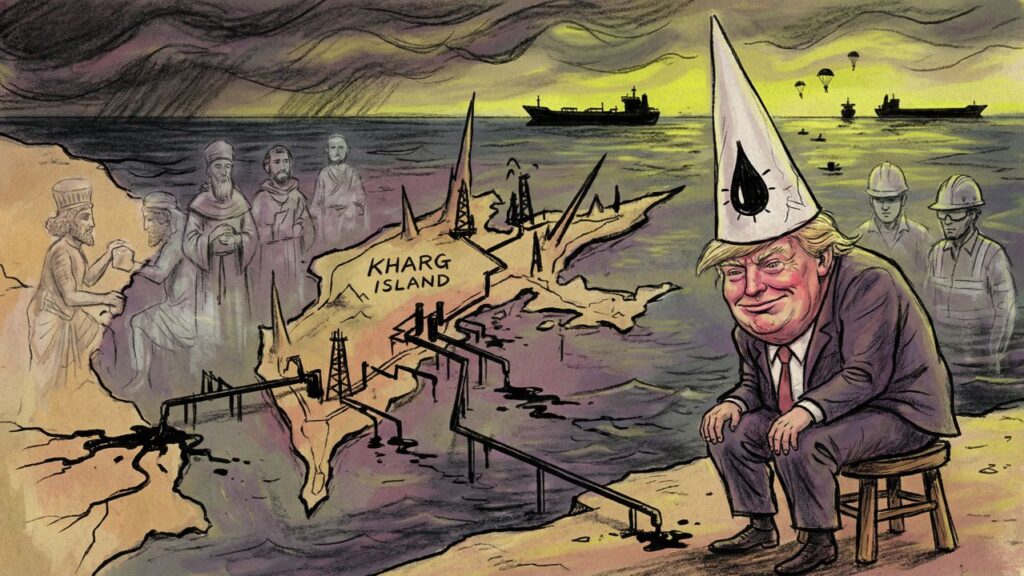
And they are not hearing that Kharg Island is not a stock tip. It is a 2,500 year old piece of the Persian Gulf that is about to become the flashpoint for the next phase of this catastrophe.
As Professor Jiang Xueqin observed in his March 9 analysis, “We had the case of Venezuela, that Trump came in and said we are in control of Venezuela. Right now on Fox News, they are talking the same way. We have to control the oil in Iran.”
Most kindly, Scott Ortkiese
The Island
Before the oil, there was coral, and freshwater, and monks.
Kharg Island sits in the northern Persian Gulf, a small coral landmass roughly eight kilometers long and four and a half wide, about the size of Manhattan below 14th Street, twenty five kilometers off the coast of Iran near the port city of Bushehr. It is one of the few Persian Gulf islands with natural freshwater, which is why people have lived there for millennia.
The earliest archaeological evidence dates to the Achaemenid Empire, the civilization founded by Cyrus the Great, whose Cyrus Cylinder in the British Museum declared 2,564 years ago that all people have the right to choose their own religion and that the enslaved shall be freed. A cuneiform inscription in Old Persian was discovered on Kharg in 2007, carved into coral rock. It read, “The not irrigated land was happy [with] me bringing out [water].” The Persians had built qanat, underground aqueduct systems, on this tiny island, irrigating it across twenty-five centuries of history. In 2008, unknown vandals destroyed seventy percent of the inscription.
The island holds rock cut tombs reminiscent of Palmyra and Nabataea. It holds the ruins of a Nestorian Christian monastery complex, ninety-six meters by eighty-five meters, with a chapel, nineteen monks’ cells, a library, and a courtyard. Medieval sources describe it as a center for pearl fishing and Gulf trade by the late tenth century. The French traveler Jean de Thévenot visited in 1665 and recorded commerce with Isfahan and Basra. The Dutch East India Company established a trading post and fort in 1753, naming it Mosselstein.
This is the civilization that the American Enterprise Institute calls a “no brainer” to seize.
The Terminal
In the 1960s, the American oil company Amoco built a crude oil export terminal on Kharg Island, transforming it from a quiet Gulf outpost into the loading dock for one of the world’s great petroleum economies. The terminal was expropriated after the 1979 revolution. Today, it handles approximately ninety percent of Iran’s crude oil exports, with a loading capacity of up to seven million barrels per day and the ability to accommodate ten supertankers simultaneously.
Pipelines carry crude from Iran’s major onshore fields, Ahvaz, Marun, and Gachsaran, to the island’s storage tanks, which have a capacity of roughly thirty million barrels. From there, very large crude carriers load at deepwater berths that Iran’s shallow coastline cannot otherwise provide. The tankers then transit south through the Persian Gulf and out the Strait of Hormuz, delivering their cargo overwhelmingly to China, which purchases more than eighty percent of Iranian crude.
In the weeks before the February 28 strikes, Iran ramped exports from Kharg to near record levels, loading over three million barrels per day between February 15 and 20, nearly triple the normal export pace of 1.3 to 1.6 million barrels per day. Approximately eighteen million barrels of crude were stored on the island at the time of the attack, roughly ten to twelve days of exports under normal conditions.
Iran was loading the ark before the flood.
The Tanker War Precedent
This is not the first time Kharg Island has been in a war, or the first time an enemy has tried to destroy it.
During the Iran-Iraq War, Saddam Hussein declared an exclusion zone around Kharg Island in 1981 and spent the better part of eight years trying to bomb it out of existence. Iraqi Mirage F-1s and MiG-23s armed with French-made Exocet missiles attacked the terminal, the loading piers, and the tankers themselves. The first tanker hit was the Turkish vessel Atlas I, struck by Iraqi bombs while loading at Kharg on May 30, 1982. By 1986, much of the terminal infrastructure had been severely damaged. Wikipedia’s own entry records that “the Kharg Island facilities were put out of commission in the autumn of 1986.”
And yet Iran never stopped exporting oil from Kharg. Not entirely. Not permanently. When the terminal was too damaged to use, Iran shifted exports to smaller facilities at Lavan Island and Sirri Island, farther south. When repairs were made, loading resumed. The island absorbed eight years of sustained aerial bombardment from a neighboring state with a modern air force and survived.
JPMorgan, in a note published on March 9, 2026, drew the explicit lesson. “Although Iraqi forces struck some terminals and tankers during the eight year war, Kharg remained largely operational, and damage was typically repaired quickly, demonstrating that disabling it would require sustained, large-scale attacks.”
Iraq launched 283 attacks on shipping during the Tanker War. Iran had to shift, adapt, and improvise. But Kharg endured. The lesson is not that Kharg is invulnerable. The lesson is that destroying it requires a commitment that looks nothing like a special forces raid and everything like an occupation.
What Happened on February 28
On the first day of Operation Epic Fury, Reuters reported blasts near Kharg Island. Open-source intelligence analysts identified that the island’s 77-megawatt gas power plant, which supplies the terminal’s pumps, loading equipment, and storage operations, appears to have been destroyed, with early March satellite imagery showing significant damage. Analysts estimated the power plant would take one to two years to rebuild.
My own reporting in Anatomy of a Blunder described the Kharg Island export terminal as “devastated” in the initial strikes. The evidence from the first seventy two hours suggested a direct hit on critical infrastructure.
And then something interesting happened. The tankers kept loading.
Bloomberg confirmed on March 4 that Iran continued loading crude at Kharg just two days after the strikes. On March 8, satellite imagery from the European Copernicus system showed two very large crude carriers, each capable of holding two million barrels, moored at loading berths. Five additional VLCCs and two Suezmax vessels were anchored south and east of the island. Windward’s maritime intelligence assessment said the terminal “remains highly active.”
Iran is also loading crude from the Jask terminal, located on the eastern edge of the Strait of Hormuz in the Gulf of Oman, a bypass that avoids the Strait entirely, though the Goreh Jask pipeline’s effective capacity is only about 300,000 barrels per day. Lloyd’s List reported that a VLCC loaded at Jask last week, only the fifth time in five years a vessel has done so. The loading took 10 days, compared to 1 or 2 at Kharg.
The tankers transiting the Strait are overwhelmingly shadow-fleet vessels, ships that operate outside Western compliance frameworks, often with their Automatic Identification Systems switched off for the first 10 days of each voyage. Lloyd’s List found that about half of all tanker traffic through the Strait between March 1 and 8 consisted of shadow fleet vessels. Most mainstream Western shipowners have suspended operations in the Persian Gulf entirely.
Meanwhile, the Strait itself has effectively closed to normal commercial traffic. Sal Macagliano, the maritime shipping analyst who hosts What’s Going on With Shipping?, tracked the collapse in real time using data from the Joint Maritime Information Center. On February 28, 98 ships transited the Strait of Hormuz. On March 8, that number was one. Normal traffic runs between 120 and 140 ships per day. One.
Macagliano showed the JMIC chart going back to the beginning of the year. The line hovers between 120 and 140 daily transits, then falls off a cliff on February 28, the day U.S. forces began offensive operations against Iran in concert with Israel. He overlaid this with an incident map of Iranian attacks on commercial shipping from the Washington Institute for Near East Policy, and with live AIS data from MarineTraffic. The picture that emerges is a crowded Indian Ocean, a ghostly Strait of Hormuz, and growing anchorages of idle ships on both sides of the bottleneck.
And then there is the matter of what the President said about it. On Sunday, March 9, Trump went on Fox News and told commercial ships to “show some guts” and sail through the Strait. “There’s nothing to be afraid of,” he said. “We sunk all their ships.”
As Macagliano pointed out, there is a problem with this directive. The president’s own government, specifically the United States Maritime Administration, an arm of the Department of Transportation, issued an alert on March 6 that reads, “Significant military activity continues in the geographic areas listed above. It is recommended that vessels keep clear of this area if possible.”
The president is telling ships to sail through the Strait. The president’s own maritime agency is telling ships to avoid the Strait. And there are zero U.S. Navy vessels currently in the Persian Gulf to escort anyone. Macagliano used a chart compiled by Ian Ellis Jones to show the disposition of naval forces. The USS Abraham Lincoln and its strike group are operating in the Arabian Sea. The USS Gerald R. Ford has just transited the Suez Canal into the Red Sea. There are perhaps four Arleigh Burke class destroyers and three littoral combat ships configured for mine sweeping available to cover roughly 500 miles of sea lane from Kuwait down to the Strait of Hormuz.
Commercial ships and their insurers do not think like navies. Macagliano made the point plainly. A Navy captain might be willing to sail through a contested choke point with a “99 percent chance of surviving a missile attack.” An underwriter will not.
The $20 billion federal reinsurance program that Trump announced to encourage commercial transit reflects this. In Macagliano’s assessment, it came too late. “What you needed was the $20 billion the day the attack started, when they had war risk insurance but not enough. That’s where the U.S. should have come in. Instead, what happened? Ships locked up, and now we’re trying to overcome inertia.”
The distortions are already extreme. Macagliano noted that tanker charter rates have exploded. Day rates that sat around $50,000 have, in some cases, reached $744,000. Greek shipowners are running tankers with AIS turned off through the Strait because the money is too good not to. Fujairah, at the tail end of the UAE’s Habshan Fujairah pipeline, has already been hit. An attack on the terminal there drove ships away from one of the world’s most important bunkering hubs. Kuwait has declared force majeure and is cutting crude production because it cannot reliably get tankers in to load. Qatar has shut down LNG exports. And the price of very low sulfur fuel oil has spiked because ships cannot get into Fujairah to refuel.
The picture is this. Kharg was hit. Its power plant may be destroyed. But the terminal is still functioning, perhaps on backup or jury rigged power, and Iran is still moving oil. The Strait is a ghost highway with a single ship on it. The entire economics of global shipping are buckling under the weight of this war.
The island that Saddam Hussein could not kill in eight years of bombing has not been killed in ten days. But the commerce it depends on, the ships, the insurance, the escorts, the routes, has been annihilated by the war that was supposed to be over “very soon.”
The Seizure
On March 7, Axios reported that the Trump administration has discussed seizing Kharg Island.
The report emerged alongside discussions about deploying special forces into Iran to secure enriched uranium stockpiles at Isfahan, and in the context of NBC News reporting that Trump has shown “serious interest” in sending U.S. troops into Iran for “strategic ground operations.” The 82nd Airborne Division, the Army’s premier rapid deployment formation, capable of deploying roughly 4,000 to 5,000 paratroopers anywhere on earth within eighteen hours, abruptly canceled a major training exercise at Fort Liberty, North Carolina, keeping its headquarters element on standby. Pentagon officials cited “operations security” in declining to discuss future movements. As one official told reporters, “We’re all preparing for something, just in case.”
Professor Jiang assessed the significance directly. “Right now, it’s mainly an air war where the United States and Israel have air supremacy. They can theoretically retreat from this war. But the moment that ground troops go into Iran, then it is impossible to retreat, and this war can only escalate.” A ground invasion, Jiang warned, “may draw in the GCC. It may draw in the Europeans. It will definitely draw in Russia. It may even draw in China.”
The man articulating the rationale for Kharg’s seizure is Jarrod Agen, executive director of the National Energy Dominance Council. Agen’s biography is instructive. He served as Vice President of Communications for Lockheed Martin, the world’s largest defense contractor, between Trump’s two terms. He is now running a White House office whose stated mission is to “unleash American energy and sell U.S. energy to our friends and allies.”
On Fox Business, Agen said, “What we want to do is to get such massive oil reserves in Iran out of the hands of terrorists. Ultimately, we’re not going to have to worry about these issues in the Strait of Hormuz because we’re going to get all of the oil out of the hands of terrorists.”
Then he compared Iran to Venezuela.
The comparison is the tell. In Venezuela, the United States captured President Maduro in a nighttime raid, and control of the country’s oil industry shifted to U.S. energy companies. Agen is not describing a military operation. He is describing a business plan, the same business plan, applied to the third largest oil reserves on the planet.
Michael Rubin, a senior fellow at the American Enterprise Institute, the same think tank that provided intellectual cover for the Iraq invasion, called seizing Kharg Island a “no brainer.” His argument was simple. “Controlling Iran’s energy resources would allow stronger pressure on the Iranian government’s income. If they can’t sell their own oil, they can’t make payroll.”
Israeli opposition leader Yair Lapid went further. “All oil fields and energy industries on Kharg Island must be destroyed. That would collapse Iran’s economy and regime.”
Let us be clear about what is being discussed. A former Lockheed Martin communications executive is proposing, from a White House office, that the United States seize the oil infrastructure of a sovereign nation, infrastructure built by an American oil company sixty years ago and nationalized after a revolution the CIA helped provoke in 1953. The plan is modeled on Venezuela, where a nighttime kidnapping operation was followed by the transfer of state petroleum assets to private American corporations. The intellectual justification comes from a think tank funded by defense industry donors. And the Israeli opposition is calling for the complete destruction of the facilities as a tool of regime change.
This is not a military strategy. This is a corporate acquisition conducted with paratroopers.
The Redline That Held, Until Now
What makes the Kharg discussion historically extraordinary is that every previous American administration treated the island as untouchable.
During the 1979 hostage crisis, Jimmy Carter imposed sanctions on Iran, froze Iranian assets, and authorized a disastrous rescue mission that killed eight servicemen in the desert. But he did not touch Kharg Island. He did not bomb it. He did not blockade it. Carter, a man whose presidency was destroyed by Iran, understood that there were consequences worse than political humiliation.
During the Tanker War of the 1980s, Ronald Reagan sent the Navy to escort Kuwaiti tankers through the Persian Gulf and authorized strikes on Iranian oil platforms, missile batteries, and naval vessels. U.S. SEALs captured an Iranian minelaying vessel. The USS Vincennes shot down an Iranian civilian airliner and killed 290 people. But Kharg Island was never targeted by American forces. Reagan let Saddam do the bombing, and even Saddam could not shut it down.
During the June 2025 Twelve Day war, Operation Midnight Hammer, Kharg was explicitly excluded from the bombing list. The strikes hit nuclear facilities, air defenses, and military infrastructure. The oil terminal was left standing. According to the Chosun Ilbo’s reporting, U.S. officials understood that destroying Kharg would eliminate the economic foundation of any post war Iranian government, regardless of who ran it.
Richard Nephew, a former U.S. deputy special envoy for Iran, explained the logic simply. “The economy bottoms out without it.”
Michael Doran of the Hudson Institute, not a dovish institution, confirmed. “The U.S. administration does not want the foundation of Iran’s post war economy to be destroyed. The White House also does not want oil prices to rise. Israel cannot act outside the U.S. redlines.”
Delgha Katinoglu, an Iranian energy expert, delivered the most devastating assessment to the New York Times. “If the regime eventually falls, no future government would be able to stabilize the country or provide basic services if the energy infrastructure is destroyed. Destroying Iran’s oil and gas facilities could actually block the path to democratic transition.”
Read that again. The destruction of Kharg Island would not enable regime change. It would prevent it. The post war government, the one Washington claims to want, would inherit a country without an economy. Iran earned $78 billion from energy exports in 2024, despite heavy sanctions. Take away Kharg, and you do not get democracy. You get Somalia.
Carter understood this. Reagan understood this. The architects of Midnight Hammer understood this. The current administration is discussing it as a “no brainer.”
The Snake Eats Its Tail
Here is where the Kharg Island discussion collides with the petrodollar analysis I published on March 9, and where the strategic insanity becomes mathematically demonstrable.
The petrodollar system depends on three things. Oil flowing through the Persian Gulf, that oil being sold in dollars, and the dollar proceeds being recycled into U.S. financial markets. My analysis documented, drawing on Professor Jiang, Peter Schiff, Michael Hudson, and others, that this recycling mechanism, particularly the recent wave of GCC sovereign wealth fund investment into AI data centers and U.S. technology companies, is what keeps the American financial system functioning. As Jiang stated in his March 9 analysis, the GCC nations are “the lynch pin of the American empire, where they sell petrodollars and then recycle these petrodollars into the American financial system.” The AI bubble in the United States, Jiang assessed, is “completely financed by the GCC nations.” Break the cycle, and America faces what he described in our earlier interview as “a much greater depression than the 1930s.”
The Strait of Hormuz is already effectively closed. One ship transited on March 8. Oil is at $119 per barrel and climbing. Maritime insurance has been withdrawn. Charter rates have gone from $50,000 to $744,000 a day. GCC states cannot export, cannot generate petrodollars, and cannot recycle. Kuwait has declared force majeure. Qatar has shut down LNG. The AI bubble is losing a critical funding source. An Amazon data center in the UAE has already been hit by an Iranian drone. And the Japanese prime minister has said that if the Strait stays closed, Japan will run out of oil in approximately eight months. That makes Japanese diplomatic or even military intervention in the conflict a near certainty rather than a theoretical possibility.
Now imagine seizing Kharg Island.
JPMorgan’s assessment is unambiguous. “A direct strike would immediately halt the bulk of Iran’s crude exports, likely triggering severe retaliation in the Strait of Hormuz or against regional energy infrastructure.” Iran has warned, through the IRGC, that if its energy infrastructure is targeted, it will “respond immediately and target their infrastructure,” meaning Saudi Aramco, Emirati refineries, Qatari LNG facilities, and the desalination plants that keep tens of millions of people alive in the desert.
The GCC states are already under siege. Dubai’s brand as a safe financial hub has been shattered by Iranian drone strikes. Saudi Aramco has suspended operations at its largest domestic refinery. Bahrain, where roughly fifty percent of the population is Shia under a Sunni monarchy, is teetering toward revolution. Now add the deliberate provocation of seizing Iran’s primary revenue source, the one thing that finances whatever remains of its government and military, and the retaliation will not be proportional. It will be existential. Every desalination plant, every pipeline, every offshore platform in the Gulf becomes a legitimate target in Tehran’s eyes, because the United States will have demonstrated that Iran’s energy infrastructure is fair game.
As Jiang noted, the vulnerability is absolute. “Sixty percent of their water comes from desalination plants. They import 89 percent of their food from overseas. You can blow these desalination plants up easily with a drone, with a $50,000 drone, and completely destroy Saudi Arabia.” These GCC nations, Jiang assessed, are “not viable nation states” but “artificial constructs of empire,” “a giant mirage created by the American empire as well as post-Cold War peace and prosperity. And now this Iran war, this mirage has been shattered.”
The administration is proposing to seize an oil terminal to control Iran’s economy while simultaneously destroying the petrodollar recycling mechanism that keeps America’s own economy afloat. It is using the tools of imperial extraction, the Venezuela playbook, the Lockheed executive, the “energy dominance” branding, to execute an operation whose predictable consequence is the acceleration of precisely the de dollarization, energy disruption, and financial contagion that my petrodollar articles documented in detail.
The snake is eating its own tail. And it thinks the tail tastes like victory.
The Game Theory
In my March 3 article, I applied Thomas Schelling’s brinkmanship framework to the Iran war and showed that both players had removed their steering wheels in a game of Chicken. The United States did so through its public commitment to regime change. Iran did so through the theological framing of jihad following the assassination of its supreme leader. The result was what game theorists call a commitment trap. Both sides had made irreversible commitments. The only remaining outcome was mutual catastrophe.
Seizing Kharg Island is the move that eliminates the last off ramp.
Jiang framed the escalatory logic with precision. “The moment that ground troops go into Iran, then it is impossible to retreat, and this war can only escalate.” A ground war, he warned, would “most likely draw in other actors as well. It may draw in the GCC, it may draw in the Europeans, it will definitely draw in Russia, it may even draw in China, and it may also draw in South Korea and Japan.” The Strait of Hormuz, Jiang observed, “really is the nexus of the world. It is the center of all global trade, and if it stays closed because of this war, then eventually it will draw in the entire world.”
If the United States takes Iran’s oil terminal, Iran has nothing left to negotiate with and nothing left to lose. The IRGC activated its Mosaic Defence doctrine on February 28. Thirty-one autonomous provincial commands have independent firing authority and pre-delegated launch protocols. These commands do not need Tehran to authorize retaliation. They do not need Kharg’s revenue to maintain short term operations. They have weapons stockpiled. They have local smuggling economies generating billions.
Seizing Kharg does not neutralize Iran. It transforms a war against a state into a war against thirty-one autonomous militias with anti-ship missiles, drone arsenals, and nothing left to lose. It is the strategic equivalent of pouring gasoline on the fire and calling it firefighting.
It also does something else, something that matters beyond the Gulf. It tells China that the United States has just seized the terminal that loads roughly 80% of its Iranian crude imports. It tells every BRICS nation that the United States will take your oil if you do not comply. It tells every country considering dollar alternatives that Washington’s definition of “terrorism” extends to any government sitting on resources it wants. It validates, in a single act, every argument Russia, China, and the Global South have made about the nature of American power.
The Kharg seizure is the end of the American narrative. Not the military narrative. The moral narrative. The one that said we are different from the empires that came before. The one that said we do not conquer for resources. The one that said the rules based order means something.
A former Lockheed Martin executive, running the National Energy Dominance Council, compared the plan to Venezuela on live television. The mask did not slip. It was removed, folded neatly, and placed on the table.
The Bill
Oil is at $119 per barrel. Six American soldiers have been killed. The Strait of Hormuz has gone from 98 ships a day to one. Charter rates have surged 1,400 percent. Kuwait has declared force majeure. Qatar has shut down LNG. The Fujairah bypass terminal has been attacked. Japan’s prime minister says his country runs out of oil in eight months. The 82nd Airborne is on standby. And a White House official has announced on Fox Business that the goal is to take Iran’s oil.
The same president who told commercial ships to “show some guts” and run the Strait is commanding an administration whose own Maritime Administration is telling ships to avoid the Strait. There are zero U.S. Navy vessels in the Persian Gulf to escort anyone. And the $20 billion federal reinsurance program arrived after the ships had already locked up. It was too late to prevent the collapse of commercial traffic and too little to restart it.
At 1:00 a.m. on a Tuesday in March, I opened my laptop and found a fintech CEO in Singapore explaining Kharg Island to his followers as a trading opportunity, before redirecting them to a platform revamp designed to help investors “detect market moving signals earlier.” He wrote that the administration had “deliberately avoided critical energy infrastructure.” He wrote that “markets often misread the early phases of geopolitical confrontations.” He wrote, “Catch the Spike. Change Your Life.”
The spike he is selling is $119 oil, six dead Americans, a closed strait, and the discussion of a military seizure of a sovereign nation’s oil terminal by a man who used to do public relations for Lockheed Martin. That is not a market signal. That is the sound of an empire stripping the last pretense from its foreign policy and calling it energy dominance.
Kharg Island has stood for twenty-five centuries. Achaemenid engineers irrigated it. Nestorian monks prayed on it. Dutch traders profited from it. Amoco paved it. Saddam bombed it. And now the United States of America is discussing whether to seize it, not to protect anyone, not to liberate anyone, not to enforce any law or uphold any principle, but to take the oil.
The Cyrus Cylinder in the British Museum declared that all people have the right to choose their own religion, that the enslaved shall be freed, and that racial equality is the law of the land. That document was written by the civilization whose island we are now proposing to steal.
If there is a redline left in this war, it runs through Kharg. And the people discussing whether to cross it cannot name a single monk who prayed there, a single inscription carved into its coral, or a single reason, beyond profit and power, to believe that what they are planning will end any differently than Iraq, or Afghanistan, or Libya, or any of the other countries they improved to death.
The last redline. The last pretense. The last island.
Scott Ortkiese is the principal of Throughline Synthesis Group, a research and analysis firm based in Houston, Texas. His previous articles in this series include “The Hit: Who Ordered the Destruction of Iran and How Much It Cost,” “The Hit on Iran Part II: Midnight Nightmare and the Architecture of an Unnecessary War,” “Anatomy of a Blunder: The U.S. Israeli War on Iran Through Eleven Expert Lenses,” “The Payoff Matrix of a Doomed War: A Game Theory Analysis of the US Israel Assault on Iran,” “Peace Was at Hand: How a Diminishing West Got Scared, Played Its Last Empire Card, and Put World War III Back on the Table,” “The Trump Protection Racket: How a Declining US Empire Extorts Friends and Enemies Alike,” “The Petrodollar Trap: How the Iran War Threatens to Collapse the Financial Architecture of the American Empire,” “Five Damned Good Reasons the Loss of the Petrodollar Means the Death of the American Empire,” and “The Deus Ex Machina That Isn’t Coming.”
Related reading
- The Gulf States Paid Washington to Destroy Them
- America and Israel Just Bombed Their Own Gas Stations
- US-Israeli Attack on Iran Will Trigger Global Starvation
- A Bill of Indictment for Murder and Genocide Against the American Military and Trump, as its Commander and Chief