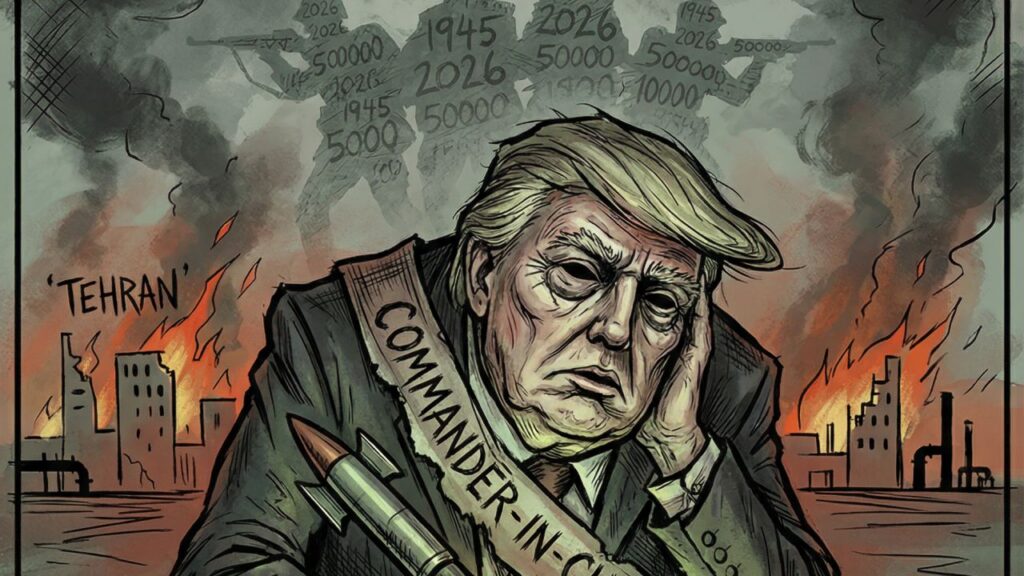
For eighty years, Americans have been told a comforting story about victory. In this version of history, the United States stormed the beaches, defeated fascism, and then generously rebuilt a shattered world out of sheer civic virtue. Look closely at who actually broke the Wehrmacht and the Japanese empire, though, and you find a different picture: the Soviets and the Chinese did the bulk of the dying in the land wars, while Washington arrived late, destroyed infrastructure from the air, then wrote the terms of peace as banker in chief. The United States learned to win not by fighting the main war, but by financing the reconstruction on its own terms and turning ruined rivals and “allies” into disciplined client states.
That pattern, destroy, rebuild, and rule, became the template for American power. The Marshall Plan and the British Loan were not just generous aid packages; they were instruments to break the British Empire’s economic system, open Europe and Japan to US multinationals, and install compliant elites from Gladio’s stay‑behind networks in Italy to the LDP’s yakuza‑assisted dominance in Tokyo. Fascism itself was rescued and repurposed as an enforcer against socialism and any attempt at genuine economic independence. The “arsenal of democracy” turned out to be something more prosaic and more ruthless: an empire that monetized rubble and securitized the future. The war on Iran is Washington’s attempt to rerun that 1945 playbook, to destroy, occupy, and dictate terms, on a 2026 balance sheet that can no longer finance a Marshall Plan or intimidate its creditors.
Who Actually Won WWII?
If you start from casualty tables instead of Hollywood, World War II looks very different. The Soviet Union lost well over twenty million people; China lost tens of millions more as it absorbed the Japanese invasion across the 1930s and 1940s. It was the Red Army that broke the Wehrmacht’s back on the Eastern Front, and Chinese resistance that steadily drained Japanese strength in Asia. The western theaters mattered, but they were not where the Axis was fundamentally ground down.
The United States, by contrast, suffered far lower losses, entered the European mainland late, and relied heavily on bombing campaigns and naval supremacy. Its comparative advantage was not manpower, but capital and productive capacity untouched by war. Franklin Roosevelt’s vision for the post‑war world reflected that reality. He imagined a multipolar United Nations where four major powers, the US, USSR, China and Britain, with France added tactically, would share responsibility for peace rather than carve the world into spheres. That vision died with him in April 1945. Harry Truman and, later, NSC‑68 recast the victory as a mandate for permanent US hegemony against “world communism” and discarded the idea of genuine power sharing almost as soon as the ink was dry.
The 1945 Play: Marshall Plan as Economic Weapon
Seen through that lens, the Marshall Plan stops being a morality tale and starts looking like an economic weapon with a friendly face. Yes, US money rebuilt bridges, factories, and housing across Western Europe. But it also came stapled to conditions: dismantling of the British imperial preference system, acceptance of a dollar‑centric trading regime, and deep opening of domestic markets to American firms.
The British Loan of 1946 and associated agreements effectively forced Britain to unwind the protected imperial sphere that had underpinned its global position. Sterling had to be pried open, colonies steered into a new dollar‑based framework, and London reduced from imperial center to junior partner. Across the continent, US multinationals used financial leverage, legal conditionality, and political pressure to buy into key industrial sectors and shape post‑war development paths. Japan’s reconstruction followed a similar pattern. Under MacArthur’s occupation, the US oversaw land and financial reforms, but also ensured that the emerging political order would be reliably pro‑American and open for business to US capital.
“Aid” in this story was not a charitable afterthought. It was the primary mechanism by which Washington converted war devastation into long‑run dependency: you take the rubble as collateral and write the mortgage on your terms. On a 1945 balance sheet, this worked because America was the creditor, the workshop, and the institutional architect of the new order.
Rescuing and Repurposing Fascism
There is an even darker continuity that polite histories usually skip. The regime‑change story says fascism was crushed and democracy restored. A more honest account is that fascism was selectively “saved” and redeployed. Nazi bureaucrats, intelligence officers, and security networks were not comprehensively purged; many were integrated into Western intelligence and state structures as assets against the left. Operation Gladio in Italy was not a fever dream but a NATO‑linked stay‑behind network that recruited neo‑fascists and used terrorism and manipulation to contain socialist and communist parties.
In Eastern Europe and the Soviet borderlands, Ukrainian fascist formations were cultivated as nationalist instruments against Moscow. In Japan, the Liberal Democratic Party’s post‑war dominance was cemented with the help of understandings between US occupiers and the yakuza, who were unleashed against labor activists and socialist movements that might have taken the country in a more independent direction. Across continents, the pattern repeated. Where populations and parties pushed for socialism, non‑alignment, or serious national development, leaders were assassinated, coups were organized, and pliant elites were installed in their place.
Fascism, in this reading, was less a vanquished ideology than a useful toolkit. It provided anti‑communist cadres, violent enforcers, and authoritarian reflexes to keep client states in line while Marshall‑style funds and US corporate capital remade their economies.
Hegemony vs. the UN: Killing the Referee
The United Nations was supposed to be the institutional expression of Roosevelt’s multipolar bargain. Its Charter bans threats and uses of force against other states, demands peaceful settlement of disputes, and sets up a Security Council where major powers would act together to keep the peace. In practice, the same Washington that helped design this framework has spent decades hollowing it out.
Over recent years, the US has walked out of scores of UN bodies, refused to pay its dues, torn up arms control and human‑rights treaties, and turned Security Council votes into theater. It routinely finds itself voting in a tiny minority alongside Israel and one or two micro‑states against overwhelming global majorities. Trump’s open contempt for the UN, sneering at the Charter’s prohibition on force as “politically correct niceties,” is not a break with this trajectory but its explicit culmination. If you believe you are the global sovereign, any institution that claims to constrain your use of violence looks like a nuisance to be sabotaged or destroyed.
At the same time, European governments that once sold themselves as the guardians of a “rules‑based order” have gone along with this demolition. Even in the wake of openly illegal strikes against Iran, EU ambassadors line up to denounce the victim while they studiously ignore the attackers. The supposed referees of the system are standing on the sideline applauding the strongest player as he kicks over the table.
From “Security Provider” to Protection Racket
Out of this architecture emerged the familiar self‑image of the US as “security provider” to the free world. For Europe and East Asia, that security has always been inseparable from economic subordination. In the early Cold War, the bargain at least came with visible industrial growth. Europe rebuilt, Japan industrialized, and American protection felt like a good deal compared to the rubble and hunger they had just survived.
Over time, the logic flipped into something closer to a protection racket. Europe surrendered cheap Russian pipeline gas and a balanced industrial relationship with Eurasia in order to align with US sanctions and foreign policy. In doing so, it made itself hostage to more expensive liquefied natural gas, volatile spot markets, and Washington’s punishment mechanisms. Germany and France have lined up behind long‑range missile deliveries and proxy wars that make their own cities potential future targets, all while their voters oppose further escalation and resent the austerity that follows military buildup.
In East Asia, Japan and South Korea face demands for massive “investments” and concessions under threat of tariffs and engineered currency or bond crises if they refuse. US bases on their soil both “guarantee security” and paint a bullseye on their infrastructure in any future conflict. The structure is classic: pay tribute, buy our weapons and services, obey our sanctions and trade rules, and we will protect you from the chaos our own policies help generate.
The Debt‑Imperial Circuit
Behind all this sits the balance sheet. Congress cannot be Congress without the ability to continuously roll and expand federal debt. The entire post‑war political economy presumes that the rest of the world will recycle its surpluses into US Treasuries, allowing Washington to run chronic deficits, fund a global military footprint, and keep domestic transfer payments flowing without a catastrophic spike in interest rates.
For decades, that is exactly what happened. Japan, China, the Gulf monarchies, and European states parked trillions in US government paper. Export‑driven economies and commodity producers kept lending their savings to a US that consumed more than it produced, offshored much of its industrial base, and channeled a growing share of GDP into finance, real estate, intellectual property, and security services. The “exorbitant privilege” of the dollar was the monetary expression of the Marshall Plan’s political success.
That arrangement is now visibly fraying. Major creditors have begun to trim their exposure, diversify reserves, and build alternative payment and settlement mechanisms. The expansion of BRICS to include key energy producers and large emerging economies is the political tip of a larger economic spear: a desire to stop underwriting US deficits and to redirect savings into domestic infrastructure, industry, and South‑South links. The more Washington weaponizes the dollar system with sanctions and asset seizures, the stronger this incentive to exit becomes.
In blunt terms, a world that has spent decades paying for a de‑industrialized West that lives off past capital and financial trickery is looking for the door. On a 2026 balance sheet, the US is no longer the patient creditor rebuilding others; it is the over‑leveraged debtor trying to keep its tabs open.
The 2026 Balance Sheet: Schiff’s Iran Warning
Into this historical pattern walks Donald Trump, a man who campaigned on ending forever wars and re‑industrializing America, and who has instead been maneuvered into launching a major war on Iran. Before the first missile flew, the US labor market was already weakening, with several recent months of net job losses. Inflationary pressures were already present. Oil was already marching toward 90 dollars a barrel, up dramatically on the year, which guaranteed a further squeeze on households and industry.
War does not fix any of that; it magnifies it. Wars are paid for with deficits and monetary expansion. Deficits will explode, and the printing presses will run harder than ever, which accelerates a de‑dollarization trend that was already underway. The familiar “flight to the dollar” in moments of crisis is giving way to a sustained move into gold and alternative arrangements once markets price the scale of the fiscal damage.
The rhetoric about destroying and then “helping to rebuild” Iran’s infrastructure rings hollow on this balance sheet. The United States is razing power plants, pipelines, and cities with expensive bombs, yet it no longer has the surplus capital, fiscal space, or global goodwill to finance a real Marshall Plan for Iran, even if it wanted to. The old pattern, bomb, rebuild, install a friendly regime and make a profit on the dependency presupposed an America with surplus industry and a largely compliant creditor base. Today’s America is deeply indebted, politically fractured, and facing rivals that have no intention of paying for their own encirclement.
There is also the brute military and political risk. Iran is a large, mountainous country of around ninety million people. Bombardment may degrade capabilities, but it is unlikely to produce clean regime change. If a devastated but unbroken Iran keeps firing missiles and drones at US bases and shipping lanes after the initial shock, Washington faces a Vietnam‑style dilemma. It can escalate to a ground war it cannot easily win, or it can accept a humiliating stalemate that punctures the myth of omnipotence. Neither outcome looks like the tidy post‑war occupations of Germany and Japan.
Who Wants This War? The Hegemon’s Last Throw
To understand who wants this war, you have to go back to that 1945 hinge. Roosevelt’s multipolar idea, the US, USSR, China and Britain jointly keeping the peace through the UN, died with him. Truman and NSC‑68 turned victory into a project of permanent American hegemony. There would be no genuine power sharing, only a global contest in which Washington reserved the right to pick governments and redraw maps. The atom bombs on Japan were not only meant to end the Pacific War; they were also a message to Stalin that the age of shared responsibility was over and the age of US primacy had begun.
Since then, foreign policy has sat increasingly in the hands of a security state that operates through “off‑the‑books militaries”: coups, regime changes, covert wars, all run through intelligence and special‑operations channels. Eisenhower’s warning about the military‑industrial complex was less a prophecy than a late confession that the Republic had already become an Empire. From the 1953 overthrow of Iran’s elected government to the 2014 change of regime in Ukraine, the mindset has been the same. Washington decides who runs key states; local democracies, laws and the UN Charter are decor.
On top of that machine now sit three interlocked interests: Pax Silica, the rentier class, and the Blob. Pax Silica, the great US tech platforms, chipmakers, and cloud and surveillance giants, does not want a fair fight with Chinese competitors. It wants a cordon sanitaire of sanctions, export controls and standards that fence Chinese firms out of the commanding heights of chips, platforms and data, and that force Europe, Japan and others to pay a premium for “trusted” American stacks. A permanent high‑tech Cold War suits it well.
The rentier class, big finance, insurance, private equity, defense, and their ecosystem, is less interested in building anything than in clipping coupons. It wants recurring cash flow: bond interest, fees, IP rents, software subscriptions, privatized infrastructure revenues, long‑term security and reconstruction contracts. A world of permanent sanctions, arms races, cyber‑wars, and post‑conflict rebuilding guarantees a flow of war bonds, military budgets, and outsourced “security” work.
The Blob, the permanent foreign‑policy caste, wants its role as planetary manager to survive any election cycle. Members of Congress understand perfectly well that their real constituency sits in K Street offices and Silicon Valley boardrooms. They vote war credits and proxy confrontations not because their voters demand it, but because the money and media support that keep them in office do. In return, Pax Silica and the rentiers get their people embedded in regulatory agencies, national‑security posts, and economic councils, writing rules that entrench their dominance.
Trump is not outside this system; he is trapped inside it. He faces midterms in which his party is likely to lose the House and could see the Senate turn hostile, opening the door to impeachment and legal ruin. To stave that off, he needs money, media cover, and a minimally loyal Congressional bloc. Those, in turn, are controlled by the very forces that want confrontation: pro‑Israel lobbying networks, Pax Silica, Wall Street, the defense industry, and the security establishment. Congress as an institution cannot easily choose to “opt out” either. Its power, the ability to dole out budgets, contracts, and patronage, rests on the assumption that the debt machine will keep running and that foreigners will keep buying.
For this coalition, war with Iran is not an inexplicable blunder but a logical move. It is another attempt to prove that the old template still works: decapitate, bomb, corner energy flows, intimidate China and Russia, scare Europe back into line, and then extract rents from reconstruction and long‑term control over pipelines and shipping. The problem, as both the numbers and the global creditor revolt suggest, is that they are running a 1945 play with a 2026 balance sheet.
Emerging Blocs and a Hardening Core
While Washington and Tel Aviv double down, the rest of the world is quietly resorting itself. In Asia, China, Japan, South Korea, ASEAN, Australia and others are knitting themselves together through regional trade and investment pacts. Historical hatred and security flashpoints remain, but the economic logic points toward denser regional integration and a long‑term reduction in dependence on US markets and finance. The Regional Comprehensive Economic Partnership and trilateral talks among China, Japan and Korea are steps in that direction.
Across the Global South, BRICS has expanded to include major energy producers and large emerging markets, creating a loose but meaningful pole outside the Western orbit. These states are experimenting with local‑currency trade, alternative clearing arrangements, and investment funds that bypass Western banks. They are exploring how to grow and industrialize without sending their surpluses back to Washington as tribute.
Europe sits in a dangerous in‑between position. It is formally aligned with Washington, structurally drawn toward Russia, the Middle East and Asia for energy and markets, and increasingly forced into self‑defeating policies by a political class welded to NATO discipline and Atlanticist ideology. Instead of openly rebuilding a relationship with Russia and plugging into Eurasian growth, it launders Russian hydrocarbons via intermediaries, pays far more for energy than it should, and lectures itself about values while its industrial base erodes. Germany, once the bridge‑builder of Ostpolitik, now sacks admirals and generals for pointing out obvious security realities and insisting that any durable peace requires accepting painful facts.
In that configuration, the United States and Israel look less like the center of gravity and more like a hard core surrounded by reluctant, hedging clients and an increasingly assertive non‑Western periphery.
Winning Wars We Didn’t Fight vs. Losing Wars We Can’t Fund
Set side by side, two eras emerge. In 1945, the United States was the world’s workshop and creditor, its homeland untouched by bombing, its currency unrivaled, its rivals shattered and in desperate need of capital. It could afford to let others do the dying, then dictate the reconstruction and the terms of integration into a dollar‑centric system. “Winning wars we didn’t fight” was a grimly rational strategy for a state with surplus industry, cash, and legitimacy.
In 2026, the picture is inverted. The US is relatively de‑industrialized, deeply indebted, and facing structural deficits as far as the eye can see. Its currency is still central but increasingly contested. Its rivals, Russia, China, Iran and the wider BRICS, are far more self‑sufficient and far less willing to accept vassalage. Europe, instead of being rebuilt, is being systematically stripped of cheap energy from both Russia and the Middle East. Trying to rerun the Marshall Plan in these conditions does not revive US primacy; it exposes the hollowness of the old model.
Trump’s Iran adventure crystallizes the danger. It is an attempt to win one more war from the air and write one more set of reconstruction contracts in a world where the money, the credibility, and the fear needed to make that work are all eroding. At best, it leads to an open‑ended cold war that bleeds the US and its dependents while it accelerates the search for alternatives. At worst, it miscalculates its way into a missile‑driven confrontation with nuclear‑armed powers who remember exactly who did the real fighting last time.
The United States is running a 1945 play in Iran on a 2026 balance sheet. It can still destroy, but it can no longer buy the peace, command its creditors, or install obedient clients on the cheap. The age of winning wars it did not fight is over. The risk now is losing a war it cannot fund, cannot win, and cannot reconstruct its way out of, and dragging its allies and its own citizens down with it.
Related reading
- American Empire in Ruins: The Unprovoked, Unconstitutional, and Catastrophic US-Israeli War on Iran
- American Empire in Ruins: The Unprovoked, Unconstitutional, and Catastrophic US-Israeli War on Iran
- What American Media Won’t Tell You About the Iran War and the End of the American Century in Asia
- Trump’s Iran War, China Trip and the Vanishing Empire