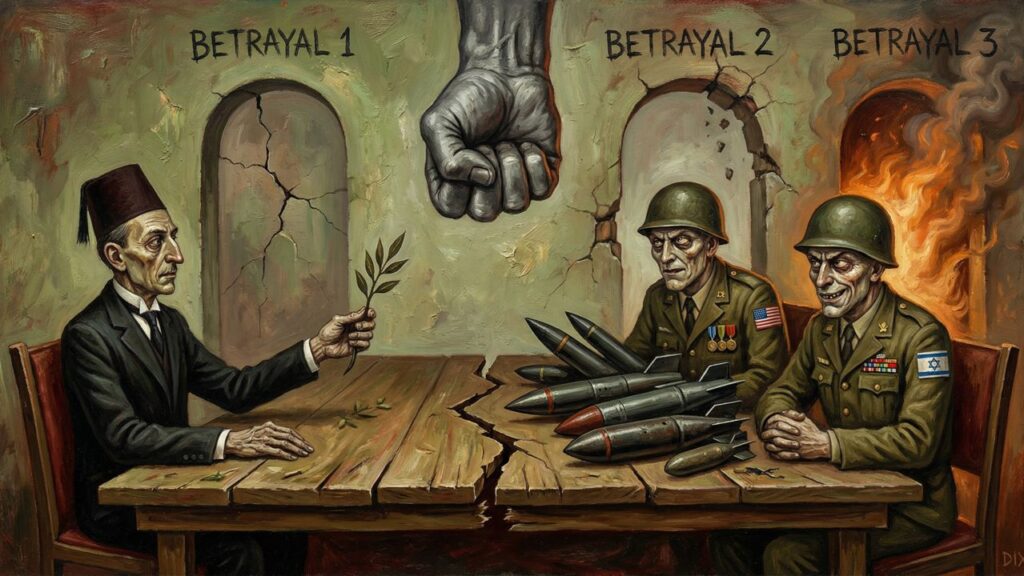
The Pattern No One Will Name
On the night of February 27, 2026, the Omani foreign minister appeared on CBS News to announce that Iran had agreed to extraordinary concessions, zero reprocessing, elimination of existing nuclear stockpiles, and a willingness to place long-range missiles and proxy forces on the negotiating table. It was, as Lt. Col. Daniel Davis put it, “a golden opportunity for the Trump administration if that’s what they wanted. They had it in their hand.” The next morning, the United States and Israel launched Operation Epic Fury.
This was not a miscalculation. It was a pattern, the third iteration of a sequence that stretches back a quarter century, in which Iran offered peace and was answered with punishment. Each betrayal was more brazen than the last. Each closed a door that could never be reopened. And the cumulative effect was to manufacture the very enemy Washington now claims it had no choice but to destroy.
Alastair Crooke, the former British diplomat who spent decades negotiating Middle Eastern conflicts, identified the through-line with precision: “Deception after deception have permeated into Iranian thinking clearly about how they should behave.” Alex Krainer, the former hedge fund manager and geopolitical analyst, put the arithmetic bluntly: this was “not the third time” Iran was attacked during or adjacent to negotiations, and now “who is going to be negotiating in good faith?”
The war of February 2026 did not begin on February 28. It began with three betrayals that, taken together, constitute the most consequential diplomatic self-sabotage in modern American history.
Betrayal One: The Grand Bargain Rejected (2001 to 2003)
The Cooperation Nobody Remembers
The story begins in the rubble of September 11, 2001, when Iran and the United States found themselves, improbably, on the same side. Tehran had long opposed both the Taliban and al-Qaeda. In the immediate aftermath of the attacks, Iran publicly condemned the strike on America and privately offered to assist the U.S. military campaign in Afghanistan.
What followed was the most significant period of U.S.-Iranian cooperation since the 1979 revolution. James Dobbins, the U.S. special envoy to Afghanistan, later testified that Iranian diplomats provided “tangible support to United States and Coalition military operations in Afghanistan and robust support to U.S. efforts to stand up a post-Taliban political order.” Members of the Iranian Revolutionary Guard Corps cooperated directly with the CIA and U.S. Special Operations Forces in the field. At the December 2001 Bonn Conference, Iran used its influence with Northern Alliance factions to broker the political compromises that installed Hamid Karzai as interim leader, and contributed $500 million to Afghan reconstruction, a staggering sum for Tehran.
The cooperation went beyond Afghanistan. Iranian officials offered to work under U.S. command to assist in broader counter-terrorism efforts. They deported hundreds of al-Qaeda and Taliban figures who had fled across the Afghan border. They attended seventeen consecutive monthly bilateral meetings with their American counterparts. Iranian reformists, led by figures like Ambassador Sadegh Kharazi and future Foreign Minister Mohammad Javad Zarif, saw 9/11 as an opening, a chance to demonstrate that cooperation was possible and that the Islamic Republic could be a partner rather than a pariah.
The Slap in the Face
In January 2002, President George W. Bush delivered his State of the Union address and named Iran as a member of the “Axis of Evil,” alongside Iraq and North Korea.
The timing was devastating. As Dobbins later testified, the Iranians “provided considerable assistance” and then received in return a public designation as an enemy of the United States. The reformists who had staked their credibility on engagement were humiliated. Ismail Gerami-Moghaddam, an Iranian reformist, explained the political damage: “Including Iran in the ‘axis of evil’ led the Iranian people to grow increasingly skeptical of American slogans… Our political rivals attacked us. They said sympathizing with a country that puts us in the ‘axis of evil’ will take you down a dead-end road, and they were actually correct.”
Iran persisted nonetheless. The Iranians skipped one monthly meeting to protest the speech, then returned to every subsequent session for over a year. In May 2003, Tehran transmitted what became known as the “Grand Bargain” proposal through Swiss Ambassador Tim Guldimann, a comprehensive roadmap offering to address every American concern: nuclear programs, support for militant groups, destabilization of Iraq, and opposition to a two-state solution for Israel-Palestine. In exchange, Iran sought security guarantees, normalization of relations, and an end to hostile rhetoric.
The Bush administration rejected the proposal out of hand. According to multiple accounts, the State Department rebuked the Swiss foreign ministry for even transmitting it. The administration, “basking in the glory of ‘Mission Accomplished’ in Iraq,” saw no reason to negotiate with a regime it intended to topple next.
What Was Lost
The Grand Bargain rejection did not merely close a diplomatic window. It annihilated the Iranian reform movement’s core argument, that engagement with America could produce results. The hardliners’ thesis, that America would never accept the Islamic Republic regardless of what it offered, was proven correct by America itself. Mahmoud Ahmadinejad’s election in 2005 was not an accident of Iranian politics. It was the predictable consequence of demonstrating to an entire nation that cooperation was punished, not rewarded.
Betrayal Two: The Nuclear Deal Destroyed (2015 to 2018)
The Agreement That Worked
The next generation of Iranian reformists tried again. The 2013 election of President Hassan Rouhani and the appointment of Zarif as foreign minister created a new opening. After years of painstaking multilateral negotiations, Iran and the P5+1 reached the Joint Comprehensive Plan of Action in July 2015, the most intrusive nuclear verification regime ever voluntarily accepted by a sovereign nation.
Iran complied. The International Atomic Energy Agency certified, repeatedly and unambiguously, that Tehran was meeting every commitment under the agreement. Iran had reduced its enriched uranium stockpile by 98%, dismantled thousands of centrifuges, poured concrete into the core of the Arak heavy water reactor, and submitted to the most comprehensive inspection regime in the history of nuclear nonproliferation.
The agreement was endorsed by a unanimous United Nations Security Council resolution. France, Germany, and the United Kingdom affirmed it as “the binding international legal framework for the resolution of the dispute.” Even the U.S. State Department acknowledged that Iran was adhering to the terms.
The Unilateral Withdrawal
On May 8, 2018, President Donald Trump announced the withdrawal of the United States from the JCPOA, over the objections of America’s closest allies, in defiance of the IAEA’s verification findings, and against the counsel of his own Secretary of Defense.
The reasoning was circular and dishonest. The deal was criticized for having expiration dates on certain provisions, as if Iran’s compliance within those dates was irrelevant. It was attacked for not addressing ballistic missiles and regional behavior, issues that were explicitly excluded from the nuclear-focused agreement precisely because addressing everything at once had been tried (the Grand Bargain) and rejected (by America). The goalposts didn’t just move; they were loaded onto a truck and driven to a different stadium.
What made the withdrawal especially corrosive was its context. Iran had demonstrated, at enormous domestic political cost, that it would honor international agreements even with a partner that had previously designated it as evil. The reformists had bet their political lives on the proposition that compliance would produce normalization. Rouhani and Zarif had spent their credibility arguing that the West could be trusted.
America proved they were wrong, again. Krainer identified this as part of the cumulative pattern that made the February 2026 attack not a surprise but an inevitability: “Iran had accepted the JCPOA before the Americans walked away. So Iran seems suddenly very reasonable.”
The Sanctions Regime as Siege Warfare
The reimposition of “maximum pressure” sanctions after the JCPOA withdrawal was not a diplomatic tool. It was economic warfare against a civilian population. Michael Keen’s strategic analysis documented the consequences: Iran’s GDP per capita collapsed from $8,000 in 2012 to $5,000 by 2024. The middle class shrank by an estimated 11 percentage points. Capital flight exceeded $300 billion over fifteen years. Inflation spiraled past 42%.
Commodore Steve Jermy framed the strategic significance: Iran was being pushed toward a calculation where “fighting a war with the US was less risky than submitting to the US.” When a nation is given the choice between slow strangulation and violent resistance, only the naive are surprised when it chooses to fight. The sanctions did not weaken Iran’s resolve. They hardened it. They did not empower reformists. They destroyed them. They did not prevent Iran’s missile program. They incentivized it, because without nuclear deterrence and without the ability to trust agreements, conventional military capability became the only guarantee of survival.
Betrayal Three: The Assassination of Soleimani (2020)
The Diplomat They Killed
Of the three betrayals, the assassination of Major General Qasem Soleimani on January 3, 2020, is the one that most clearly reveals the pathology. Because Soleimani was not merely a military commander when he died. He was a diplomatic envoy on a peace mission, and his killers knew it.
Iraq’s Prime Minister Adel Abdul-Mahdi provided the definitive account. In September 2019, during a state visit to China, Abdul-Mahdi received a phone call from Soleimani asking him to visit Saudi Arabia and act as an intermediary between Iran and the kingdom. “General Soleimani said the matter was urgent,” Abdul-Mahdi recalled. The Chinese were informed and “rejoiced” at the prospect. Saudi Arabia was contacted and “welcomed the proposal.”
The mediation was Soleimani’s initiative. As former Iraqi Prime Minister Abdul-Mahdi later documented, “The initiative for mediation between Iran and Saudi Arabia was a direct result of General Soleimani’s strategic vision, which aimed to promote peace and understanding between the two countries.” The man the West portrayed exclusively as a terror mastermind was, in the assessment of the Iraqi head of government, “an architect of peace, reconciliation, and brotherhood.”
On January 3, 2020, Soleimani arrived at Baghdad International Airport on a commercial airline. He was there, as Abdul-Mahdi confirmed, to deliver Iran’s response to a Saudi message that Iraq had brokered. “He came to deliver me a message from Iran, responding to the message we delivered from Saudi Arabia to Iran,” Abdul-Mahdi told the Washington Post.
Crooke added the crucial detail that connects the Soleimani killing to the February 2026 attack: “The killing of Qasem Soleimani was a deception too, you know. He was coming to (he’d been invited, being all set up) and of course the Americans knew about it, for a discussion about peaceful relations between Iran and Saudi Arabia. But he was there on an official visit coming on a commercial airline and he was shot down with a missile as the Iranian official delegation was standing at this meeting.”
The most damning element: according to Abdul-Mahdi, it was Trump himself who had asked Iraq to mediate with Iran in the first place. The American president requested the channel, the Iraqi prime minister opened it, the Iranian general arrived to continue the conversation, and was killed by an American drone on the tarmac.
What the Assassination Accomplished
The Soleimani killing did not eliminate Iran’s regional network. It did not weaken the IRGC. It did not deter Iranian missile development. What it accomplished was final and irreversible: it destroyed any remaining Iranian belief that the United States could be dealt with in good faith.
The mediation initiative Soleimani was pursuing did not die with him, but it was set back years. Abdul-Mahdi passed the effort to his successor, Prime Minister al-Kadhimi, who eventually brokered the Baghdad talks that led, through Chinese mediation, to the historic Saudi-Iran rapprochement of March 2023. The deal that America killed a man to prevent happened anyway, with China, not America, as the guarantor. It was a self-inflicted wound of strategic proportions.
Ron Paul, at 90, placed the Soleimani assassination within the broader pattern of imperial hubris: “Empires eventually expand themselves too much. They stretch their wings too far and they spend too much money. Debt and expansion of military power tends to bring things to an end.” The assassination was not just a crime against a foreign official. It was the act of an empire that had lost the capacity to distinguish between strength and self-destruction.
The Cumulative Effect: Manufacturing an Enemy
From Cooperation to Existential War
The trajectory is unambiguous:
2001Iran cooperated in Afghanistan, helped install Karzai, contributed $500 million in reconstruction. America named Iran in the “Axis of Evil.”
2003Iran offered a comprehensive Grand Bargain addressing every American concern. America rejected it without response.
2015Iran signed the JCPOA, complied fully with the most intrusive nuclear inspections in history. America unilaterally withdrew and imposed maximum pressure sanctions.
2019Iran pursued Saudi-Iran mediation through Iraq at America’s own request. America assassinated Soleimani during the diplomatic mission.
2025 (June)Iran was in active negotiations. America and Israel launched the twelve-day war during talks.
2026 (February)Iran accepted extraordinary concessions the night before. America and Israel launched Operation Epic Fury and assassinated the Supreme Leader.
Lt. Col. Davis identified the final iteration as the point of no return: “When he attacked the next morning, that made it clear, very clear, that none of this was ever about negotiations. It was always about war.”
Krainer traced the pattern to its inevitable conclusion: “This is not the third time this happened. It happened in Oman with Hamas. It happened with the Iranians seven months ago. And now it happened again the third time.” The cumulative effect was to teach Iran, and the world, that American diplomatic engagement is a trap, a reconnaissance exercise that identifies when an adversary’s guard is down so the strike can be delivered at maximum advantage.
The Existential Threshold
Davis explained why Iran’s response to the February 2026 attack was total rather than calibrated: “I think that they view this as a genuine existential crisis. And I think that they said we’re going to have to, it looks to me like in their councils they must have calculated that we’re going to suffer real bad for this. There’s no doubt about it. But we are going to have a shot at having a positive outcome at the end.”
Jermy confirmed the assessment: for Iran, this was never a war of choice but of survival. “I think from Iran’s point of view, the objective seems to be to survive, because if indeed they can survive and do significant damage, then it will be a victory for them.” When you systematically eliminate every alternative to war (when you reject every offer, violate every agreement, and assassinate every envoy) you leave your adversary with nothing to lose. Iran’s willingness to close the Strait of Hormuz, hammer U.S. bases across the Gulf, and accept devastating strikes on its own infrastructure reflected not irrationality but the cold logic of a nation that had learned, through twenty-five years of betrayals, that surrender was more dangerous than resistance.
Keen’s analysis provided the structural context for Iran’s resolve. This was not a small, isolated state. It was a nation sitting on 209 billion barrels of proven oil reserves, 34 trillion cubic meters of natural gas, and a population of 90 million with a median age of 35. A nation with those resources and that demographic profile does not capitulate. It endures.
The Credibility Catastrophe
Beyond Iran
The damage extends far beyond the U.S.-Iran relationship. Each betrayal was watched by every other nation considering whether to negotiate with Washington.
Crooke drew the direct connection: “This is going to have wider repercussions on Russia and the Ukraine talks. About, you know, what is the point of talking with Trump?” If America kills negotiating partners, withdraws from signed agreements, and launches wars hours after receiving major concessions, then diplomatic engagement with America is not a path to peace, it is a form of intelligence collection by the adversary.
Krainer extended the logic: “In terms of optics, it’s about as bad as it gets… who is going to be negotiating in good faith?” The question is not rhetorical. It applies to Russia considering Ukraine peace talks. It applies to China calculating the reliability of any trade agreement. It applies to North Korea assessing whether denuclearization would bring security or vulnerability. It applies to every nation on earth that might consider making concessions to the United States.
The JCPOA withdrawal was the pivotal moment in this credibility collapse. Iran complied with the most intrusive nuclear verification regime in history, and was punished for it. The lesson absorbed by every government watching was: compliance with American demands provides no protection. Only capability does. North Korea, which chose nuclear weapons over negotiation, has never been invaded. Iran, which chose negotiation over nuclear weapons, was struck twice in eight months.
The Self-Fulfilling Prophecy
The ultimate indictment is that every American fear about Iran was made real by American policy.
Washington feared an Iran with advanced missile capabilities. The JCPOA withdrawal and maximum pressure sanctions gave Iran no reason to restrain its missile program and every reason to accelerate it. Senator Ted Cruz’s own admission that Iran could still produce 100 missiles per month under sanctions was not an indictment of Iranian defiance, it was an indictment of a sanctions strategy that failed to achieve its stated objective while succeeding spectacularly at its unstated one: making war inevitable.
Washington feared an Iran aligned with Russia and China. Every betrayal pushed Tehran deeper into that alignment. The Grand Bargain rejection told Iran that the West was closed. The JCPOA withdrawal told Iran that Western agreements were worthless. The Soleimani assassination told Iran that Western invitations were ambushes. By 2026, Iran’s economy was almost entirely dependent on Chinese demand, absorbing approximately 1.38 million barrels per day of Iranian crude, roughly 90% of Iran’s exports. This was not Iranian strategy. It was the only option America left.
Washington feared an Iran that could threaten the Strait of Hormuz. Forty-seven years of sanctions, isolation, and military threats gave Iran every incentive to develop exactly that capability, because the Strait was the only leverage a strangled economy possessed.
The War They Chose
When Davis was asked whether the February 2026 attack represented a strategic miscalculation, he offered a distinction more damning than the word implies: “To say a miscalculation is bad because that almost implies that you thought maybe it was going to be good but, you know, you based it off of something you thought was going to work but it didn’t. This was well known ahead of time.”
The war was not an intelligence failure. It was not a miscalculation. It was the product of twenty-five years of policy choices, each of which foreclosed an alternative and narrowed the path toward exactly this outcome. The enemy was not found. The enemy was made, deliberately, systematically, and with full knowledge of the consequences by those who understood, and with willful blindness by those who chose not to.
Jermy delivered the epitaph for the entire enterprise: “I can’t think of a single intervention in this last 25 years when we’ve done anything other than make things worse rather than better.”
He might have added: that was always the point. Not for the nations that suffered, and not for the American public that was told each war would be the last. But for the architects of an imperial foreign policy that requires enemies more than it requires peace, the betrayals were not failures. They were the strategy. And Iran was always going to be the price.
This article is the second in a series analyzing the U.S.-Israeli war on Iran. The first, “Anatomy of a Blunder: The U.S.-Israeli War on Iran Through Six Expert Lenses,” examined the military, economic, and strategic dimensions of the February 2026 strikes through the independent assessments of six analysts.
Related reading
- The Nuclear Abyss: Theodore Postol’s Warning for Israel and Iran
- America’s Suicidal Empire: The Iran War, the Death Spiral of a Failing Hegemon, and the World We Are Destroying
- The Last Blunder: How the US-Israel Attack on Iran Killed the American Empire's Operating System
- Trump Is Gambling America’s Power on a Losing Hand