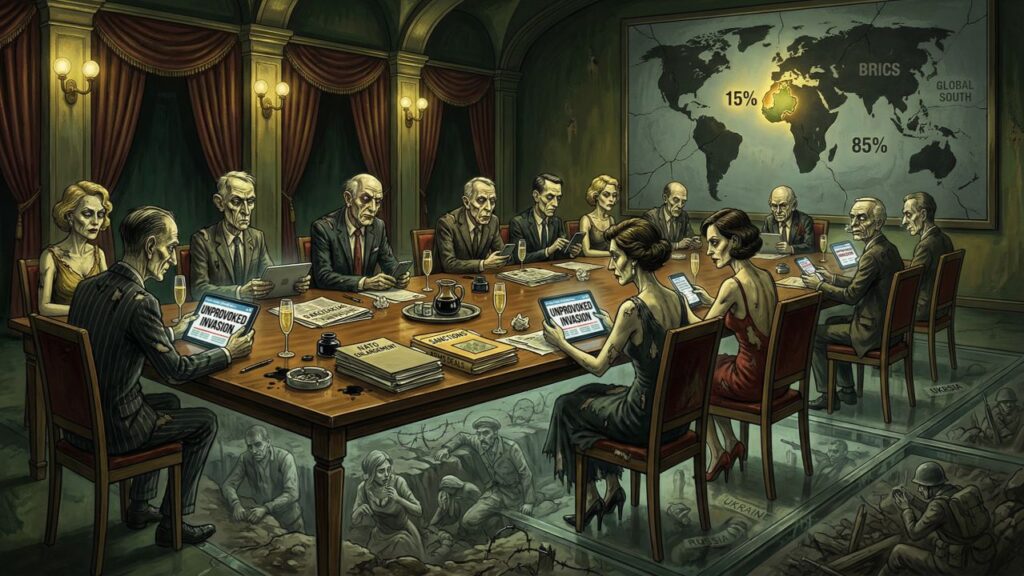
Part II of “Manufacturing War”: from Glenn Diesen’s UN testimony on anti‑Russian propaganda to Jeffrey Sachs’s inside account of how Western hegemony and German duplicity made this conflict inevitable.
In Part I of this series, I argued that every war needs a story, not a reason, and showed how Atlanticists, Neocons, defense contractors, and a compliant media manufactured the “unprovoked invasion” narrative about Ukraine to sell and sustain a proxy war with the world’s largest nuclear power. In this Part II, I follow Glenn Diesen from the UN Security Council to Jeffrey Sachs’s recent interview to show what that story was built to conceal: a 30‑year project of Western hegemony, centered on NATO expansion, German broken promises, and a rejected post‑Cold War peace that could have prevented this war entirely.
Diesen, speaking in the chamber of the UN Security Council, exposed how the information system works: moralized framing, tribal reflexes, linguistic double standards, and institutional laundering all combine to make serious discussion of Russian security concerns politically impossible in the West. Sachs picks up where that leaves off and reconstructs the policy side of the same machine I described in Part I: the decisions, memos, and betrayals through which Atlanticists, Neocons, and their European partners chose dominance over coexistence, and then demanded that the media erase their fingerprints.
I. From UN Podium to Policy Room: Diesen and Sachs
In his speech to the UN Security Council, Glenn Diesen did something that almost never happens in New York: he put the media itself on the docket. Drawing on Walter Lippmann’s First World War propaganda work, he told ambassadors that “liberal democracies” habitually present conflicts as a struggle between good and evil to mobilize public support for war. Once the adversary is cast as pure evil, he warned, any attempt to understand its security concerns becomes treasonous, and any talk of compromise is automatically denounced as appeasement.
The Ukraine narrative he described practically wrote itself within that architecture. Russia was cast as an irrationally aggressive imperial power that launched an unprovoked full‑scale invasion to conquer Ukraine and eventually threaten Europe. Ukraine was presented as a blameless democracy, making no meaningful contribution to escalation, while “the West” was portrayed as a reluctant defender that slowly and virtuously came to Kyiv’s aid. The phrase “unprovoked invasion” became the foundational slogan because it encoded the conflict as a one‑sided act of imperial aggression rather than the culmination of a long security confrontation.
As Diesen told the Council, this framing had two crucial effects. First, it converted any talk of compromise into appeasement that “rewards the aggressor” and supposedly invites more aggression, allowing slogans like “weapons are the path to peace” to be uttered with a straight face. Second, it justified turning a regional security crisis into a global ideological struggle, making de‑escalation politically toxic and anyone who raised NATO expansion, regime change, or Western policy instantly suspect as a “Putinist” or “Russian propagandist.”
What Diesen could only gesture toward in that format is the deeper question: what exactly did this story need to suppress? That is where Jeffrey Sachs enters. His interview provides the policy history that the UN‑ready narrative had to bury, and he delivers it not as a distant observer, but as someone who advised Poland, the Soviet Union, and Russia during the critical transition years.
II. What the “Unprovoked Invasion” Erased
The phrase “unprovoked invasion” only works if you erase three decades of Western actions that loaded the gun. In Part I, I walked through the warnings from George Kennan, William Burns, Roderic Lyne, and others that NATO expansion into Ukraine was “the reddest of red lines” for Russia and the best way to “start a war.” Sachs adds two layers to that history: the economic betrayal of a Russia that asked for integration and was denied it, and the central role of Germany in breaking the very promises that made European peace possible.
The rejected economic peace
Sachs begins in 1989, not 2014. In Poland, he helped design a stabilization program that, backed by Western governments, ended hyperinflation, stabilized the currency, and launched a 30‑year run of economic growth. When he proposed a similar macroeconomic package for the Soviet Union and later Russia, on a larger scale, Washington refused. The same Atlanticist establishment that had eagerly supported Polish stabilization flatly turned down even modest stabilization aid for Moscow.
Decades later, reading the minutes of the White House meeting where his Russian plan was rejected, Sachs said he was shocked by the “flippancy, brazenness, and ignorance” of the participants. Officials who knew little about economic stabilization waved away a chance to anchor peace in Europe by helping Russia through its transition. From his perspective, this was the first fork in the road: a choice between peace (integration, stabilization, shared security) and hegemony (keeping Russia weak, boxed in, and encircled).
Gorbachev and Yeltsin, he insists, were not demanding a restored empire; they were asking for normality. Gorbachev spoke of a “common European home.” Yeltsin’s favorite word was “normal”, no more revolutions, no more Cold War, just integration into a European order. In other words, the post‑Cold War settlement could have resembled the treatment of defeated Germany and Japan in 1945: economic help, security guarantees, and genuine integration. Instead, the Atlanticist-Neocon complex opted for something closer to Versailles: humiliation without reconstruction.
Germany’s long arc of broken promises
Sachs then does something Western media almost never do: he puts Germany, not a vague “West,” at the center of the story. In his account, Berlin’s role is not marginal or reluctant; it is pivotal.
He points first to 1990. When Chancellor Helmut Kohl and Foreign Minister Hans‑Dietrich Genscher sought Soviet consent to reunification, they repeatedly assured Gorbachev that NATO would not move eastward in a way that threatened Russian security. Those assurances, public and private, were the political price of reunification. Yet within a few years, Germany had become, in Sachs’s words, an “enthusiastic NATO enlarger,” vigorously supporting the very project it had implied would never happen.
He then moves to February 2014. On the 21st, as Maidan protests threatened to tip into civil war, the foreign ministers of Germany, France, and Poland brokered a deal with President Yanukovych: early elections later that year in exchange for an end to the unrest. Kiev’s opposition leaders signed; Moscow and Washington were briefed. Within 24 hours, the agreement was swept aside by a coup. Rather than defend the deal they had just guaranteed, Berlin and its partners recognized the new authorities and moved on.
Finally, Sachs turns to Minsk II, signed in 2015 to end the Donbas war. Germany and France acted as guarantors of a plan that promised autonomy for Donetsk and Lugansk within Ukraine, a ceasefire, and a political process to reintegrate the region. We now know from Merkel’s own later comments that, at least in retrospect, Minsk was treated not as a genuine peace framework but as a way to buy time to arm Ukraine for a future confrontation.
From Sachs’s vantage point, this is a pattern, not a series of accidents. Germany benefited massively from Soviet concessions in 1990, then helped shred the assurances that made those concessions possible. It brokered a compromise to avert civil war in 2014, then abandoned it the moment regime change succeeded. It lent its name to a peace agreement in 2015, then refused to enforce it and later admitted it had never treated it as binding. Yet it is German leaders today who insist that “Putin cannot be trusted,” while refusing even to test whether a new settlement is possible.
In the information space Diesen described at the UN, none of this exists. The “unprovoked invasion” slogan performs precisely this function: it amputates the economic refusal of the 1990s, the NATO decisions of 1999 and 2004, the Bucharest summit in 2008, the broken 2014 agreement, and the hollowing out of Minsk II, so that the war can be presented as a spontaneous eruption of Russian evil.
III. Europe’s Vassalage and Complicity
Part I of this series argued that the propaganda system is not free‑floating; it is the ideological wing of a concrete power structure: Atlanticists, Neocons, defense contractors, intelligence services, big‑think tanks, and their media and academic auxiliaries. Sachs’s account shows how their European counterparts (especially in Berlin, Paris, and London) oscillate between vassalage and complicity.
At the 2008 Bucharest summit, for example, France and Germany initially pushed back against George W. Bush’s demand that NATO promise membership to Ukraine and Georgia. Merkel reportedly recognized that offering Ukraine a Membership Action Plan would be seen in Moscow as “a declaration of war.” Yet by the end of the summit, Berlin and Paris had capitulated to a compromise that declared both countries “will become members of NATO” at some unspecified future date. For Russia’s entire political class, as William Burns warned in his “Nyet means nyet” cable, Ukrainian NATO membership was “the reddest of red lines” and could “split the country in two” and “lead to Russian intervention.”
Sachs reads Bucharest as a moment when Europe stopped merely being pressured and chose to join the hegemonic project. From then on, Germany was not just being dragged by Washington; it was an “enthusiastic enlarger” of an alliance its own strategists knew could lead to war. The subsequent betrayals around Maidan and Minsk are, in this light, continuations of the same Atlanticist-Neocon script, executed with European hands.
Diesen’s UN testimony clarifies why this script has been so politically durable. In an information environment where any attempt to consider Russian interests is treated as disloyalty, European leaders have no safe way to admit the obvious: that NATO expansion was a reckless choice; that European diplomacy in 2014 and 2015 was dishonest; and that Ukrainian neutrality and a pan‑European security framework would have been vastly preferable to the current disaster. It is easier to chant “unprovoked” and keep shipping weapons.
This is what “vassalage” looks like in practice. Europe is economically and militarily subordinated to US priorities, yet its own leaders have repeatedly volunteered for this role, even when they understood the dangers. The media system Diesen described exists to ensure that the publics who pay the price never connect the dots.
IV. The 85% World and the Limits of Propaganda
One of the more striking continuities between Diesen and Sachs is their attention to the rest of the planet. In Part I, I noted how much of the Global South refused to sign up for sanctions or join Western denunciations, not because they love Russia, but because they remember Iraq, Libya, and the rest. Sachs brings data and institutional names to that intuition.
He observes that if you aggregate the population of the US, Europe, the UK, Japan, South Korea, Australia, and New Zealand, you get perhaps 12 (15% of humanity. The remaining 85% lives in Asia, Africa, Latin America, and the Middle East) and many of those governments have little interest in another American‑led crusade. Their priorities are blunt: affordable energy, infrastructure, technology, and economic growth.
Sachs points to the expanding BRICS grouping (Russia, India, China, Brazil, South Africa, now joined by Egypt, Ethiopia, the UAE, Iran, and Indonesia) as one expression of this shift. These states do not form a neat bloc, but they share a basic desire “not to be bullied by anybody.” Add the African Union’s 55 countries, nearly 20% of the world’s population today and projected to reach a quarter by mid‑century, and you have a large majority of humanity that no longer accepts the Atlanticist-Neocon “rules‑based order” as legitimate.
Against this reality, Sachs sets the mental map of what he calls the American deep state and Donald Trump alike. In that map, Washington “owns” the Americas (the Monroe Doctrine), Europe (via NATO), the Middle East (via bases and client regimes), India (as a counter‑China pawn), and much of the Pacific. Africa barely registers except as a source of cobalt and rare earths. The assumption is that the United States can still ring China with bases, hem in Russia with NATO, and expect the rest of the world to fall in line.
Diesen’s warning from the UN is that this worldview is sustained at home by propaganda, but it no longer persuades abroad. Western outlets can still manufacture consent in their own markets using moralized narratives about “democracy versus autocracy,” but in the 85% world, those narratives collide with the memory of past interventions and the reality of rising alternatives. The information war has become, in effect, a domestic management tool for a fading hegemon.
V. Hubris, Amnesia, and the Narrow Path Out
Both Diesen and Sachs end up, in different ways, talking about hubris. Diesen, channeling Lippmann, warns that when media turn conflicts into simple morality plays, societies lose their ability to think in terms of cause and effect. Sachs illustrates the same problem with historical vignettes.
He recalls a 1997 speech by Joe Biden at the Atlantic Council, where Biden mocked Russian worries about NATO expansion and scoffed at the idea that Moscow might respond by turning toward China and Iran. The room laughed; the scenario seemed absurd. Today, a deepening Russia-China partnership and strengthened ties between Moscow and Tehran are facts on the ground. He also cites a 1897 speech by British imperialist Joseph Chamberlain, boasting that the British realms covered a quarter of the globe and would be unchallengeable for the foreseeable future, an empire that had effectively collapsed within fifty years.
The pattern is familiar: elites at the peak of their power convince themselves that their dominance is permanent, write policy on that assumption, and then unleash forces that destroy the very order they meant to preserve. The Ukraine war fits this trajectory. The Atlanticist-Neocon complex convinced itself that NATO could expand indefinitely, that Russia had no alternative to obediently accepting its “European vocation,” and that economic humiliation would never produce a serious Eurasian counter‑pole. When those assumptions collapsed, the same class turned to the only tool it fully controls: the story.
Diesen’s UN speech and Sachs’s interview, read together, are an attempt to puncture that story. Diesen shows how language (“unprovoked invasion,” “weapons are the path to peace,” “rules‑based order”) has been weaponized to shut down thought. Sachs shows how policy (NATO expansion, German duplicity, economic sabotage) created the crisis that language was later deployed to obscure.
Neither pretends there is an easy exit. Sachs argues that the “real solution” still runs through Berlin: a German leadership willing to acknowledge its own broken promises, resurrect the logic of collective security, and accept Ukrainian neutrality as the basis for a settlement. That would mean picking up the phone to Moscow instead of performing moral outrage for domestic audiences, and telling European publics what Kennan, Burns, Lyne, and others had already warned their predecessors: that NATO expansion into Ukraine was “stupid on every level” and would likely end in disaster.
Diesen makes clear what would have to change for such honesty to be politically survivable. Western media would have to stop treating any mention of provocation as “legitimizing aggression” and relearn the basic diplomatic habit of putting oneself in the adversary’s shoes. The propaganda system I dissected in Part I (moralized framing, tribal reflexes, double standards, and institutional laundering) would have to be confronted, not as a collection of individual “biases,” but as the ideological arm of a failing hegemonic system.
That is the point of this Part II. The problem is not just that the story we were told about Ukraine is false. It is that the story was necessary, to hide the fact that our own governments loaded the gun, discarded peace, and are now losing the world they thought they owned. Until that is acknowledged, the same system will continue to manufacture the next “unprovoked” catastrophe, and the next, with the same dead certainty and the same dead civilians.
Related reading
- Germany's Reckoning: Jeffrey Sachs Documents Three Decades of Diplomatic Deception on Russia and Ukraine
- The Economic Hitman at Davos: Jeffrey Sachs and Glenn Diesen on America's Hybrid War Against Iran
- The Managed War: How the West Built, Armed, and Prolonged the Destruction of Ukraine
- Manufacturing War: How the West Built and Sold the Russia-Ukraine War