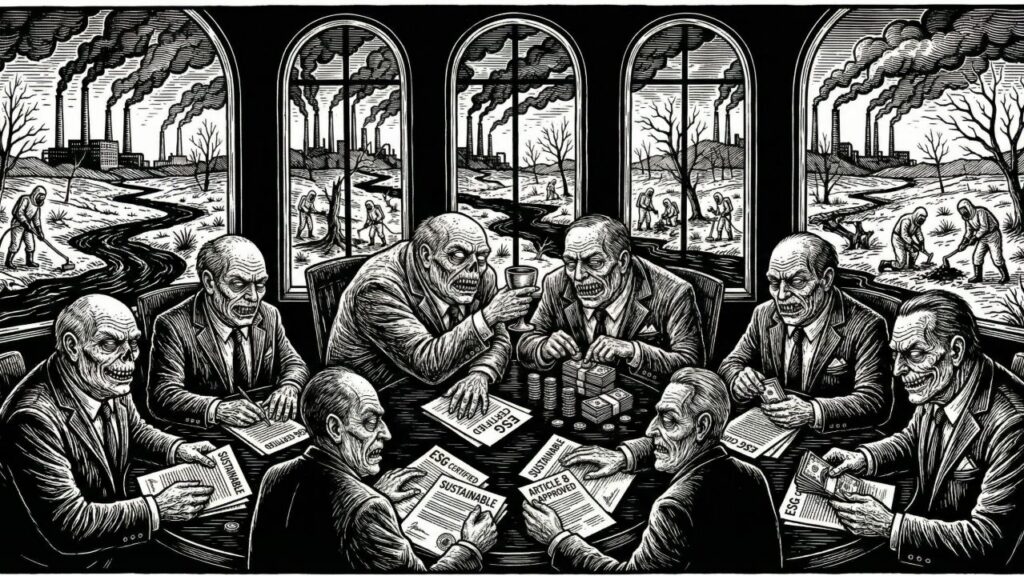
How Asset Managers, Ratings Agencies, Consultants, Lawyers, and Regulators Turned Environmental Offshoring Into a Fee Stream, and Why No One Will Probe Them
By Scott Ortkiese, Throughline Synthesis Group
January 26, 2026
Introduction: Following the Money
The rare earths were never clean, the copper was never sufficient, and the transition supply chains were never sustainable.
Parts 1 through 3 documented the physics and geology that make “clean energy” impossible at the advertised scale, the copper arithmetic that turns legislated electrification timelines into a lie, and the European corporate operators who built their business models on radioactive lakes, cancer villages, and rivers turned black with tailings while marketing themselves as sustainability leaders.
This final part follows the money and the law: who financed it, who credentialed it, who drafted the disclosures and roadmaps, who was supposed to regulate it, and why every mechanism that should have stopped the fraud was captured, defanged, or simply chose not to bite.
This is not a story about well-meaning people getting swept up in a noble cause that turned out to be harder than expected. It is a story about institutions that possessed, commissioned, or cited the same information you have just read, and then built a $35 trillion “sustainable investing” and advisory complex on top of claims they knew, or could not reasonably avoid knowing, were impossible.
When the politics turned, they dropped the label, kept the portfolios, kept the fees, and never acknowledged that the products they had been selling as instruments of planetary salvation were built on offshored environmental crimes.
I. The Asset Manager Architects: Profiting from an Impossible Transition
The ESG boom did not originate in a spontaneous moral awakening by ordinary investors. It was manufactured from the top down by a transatlantic cartel of global asset managers that discovered they could charge a fee premium for portfolios that looked almost identical to their standard index products, as long as they were wrapped in the language of sustainability.
Between roughly 2015 and 2023, firms on both sides of the Atlantic launched hundreds of ESG-branded funds and mandates, raising an estimated $35 trillion in assets described as “sustainable,” “Paris-aligned,” “net-zero consistent,” or “ESG-integrated.” Management fees on these products ran two to ten times higher than plain-vanilla index funds, generating on the order of $200 billion in cumulative fees for holding, in substance, the same companies that anchor the global indices.
The underlying positions included BHP draining Chilean aquifers in the Atacama Desert, Freeport-McMoRan dumping more than 200,000 tons of tailings per day into Indonesian rivers, Glencore turning stretches of the Luilu River into toxic slurry, and European automakers wholly dependent on Chinese battery and rare earth processing chains that cannot meet legislated electrification schedules.
Larry Fink and the Disappearing Climate Risk
Nobody personified this era more completely than Larry Fink, the chief executive who spent six years telling the planet that “climate risk is investment risk” while sitting atop more than $10 trillion in assets and holding 15 to 20% aggregate stakes in the very miners and automakers whose operations Parts 2 and 3 have already indicted.
Between 2018 and 2023, his annual letters to CEOs escalated from soft sermons about “purpose” to proclamations that climate change would “fundamentally reshape finance,” culminating in explicit demands that boards adopt net-zero targets and transition plans.
Throughout this period, BlackRock’s ESG-branded products held:
- The copper majors (BHP, Freeport-McMoRan, Glencore, Southern Copper) whose operations include riverine tailings dumping, aquifer depletion classified as causing “irreparable damage,” forced evictions with sexual violence, and water contamination at tens of times safe limits.
- European automakers (Volkswagen, BMW, Mercedes, Stellantis) whose electrification strategies rely on CATL, Ganfeng Lithium, and Chinese rare earth processors sourcing from Argentine salt flats, Congolese sacrifice zones, and Myanmar militia-financed mines.
- Technology giants whose hardware depends on rare earths, magnets, and copper already documented as physically and politically constrained.
The ESG label did not change these portfolios’ dependence on radioactive tailings in Inner Mongolia, illegal rare earth mining in Myanmar, copper operations that drained Chilean wetlands beyond recovery, or DRC mines that poisoned rivers and burned villages. It changed the price at which the portfolios could be sold.
Then came the backlash.
When Republican-led U.S. states began pulling public pension assets, roughly $13 billion, over perceived anti-fossil-fuel bias, and when “ESG” became a culture-war liability instead of a marketing asset, the climate rhetoric vanished almost overnight:
- 2024: BlackRock stopped using the term “ESG” in public communications
- 2025: BlackRock removed “ESG” from the names of 50 European funds (€51 billion AUM)
- 2025: BlackRock withdrew from the Net Zero Asset Managers initiative
- Fink’s 2025 annual letter: Zero mentions of ESG, sustainability, climate change, or DEI
- 2025: BlackRock liquidated seven sustainable-investing funds
- Davos 2026: Fink’s address focused on AI and inequality, zero mention of climate
The man who spent years positioning BlackRock as the champion of climate-aligned investing executed a full retreat without ever explaining what changed.
The answer is obvious: nothing changed except the political cost. The copper mines kept dumping waste. The supply-chain contradictions remained unresolved. The Chinese dependencies persisted. The portfolios remained invested in companies committing environmental crimes that would trigger prosecutions in Western jurisdictions.
What changed was the marketing.
No regulator has asked the basic question: if climate risk was so material in 2020 that it required a “fundamental reshaping of finance,” when did that risk cease to be material, and where is the disclosure explaining the change?
Vanguard, State Street, and the U.S. Fee-Uplift Cartel
Vanguard built its brand as the low-cost champion of the retail investor, then quietly rolled out ESG funds that charged two to three times the expense ratios of equivalent broad-market ETFs while holding substantially the same mega-cap issuers that benefit from offshored environmental damage. Exclusion screens removed thermal coal, tobacco, and weapons, but the core exposures (large-cap tech, financials, and the same European automakers and miners) remained.
State Street positioned itself as the activist arm of the cartel, erecting the “Fearless Girl” statue and publicizing its willingness to vote against directors who failed to meet ESG disclosure expectations. It used proxy voting power derived from passively managed assets, investors who never explicitly instructed the firm to pursue climate activism, to push companies into net-zero proclamations that the copper and rare earth supply chains documented earlier cannot possibly support.
Behind the branding, all three firms share a simple structural reality: they are each other’s largest shareholders and collectively sit among the top owners of virtually every major public company on Earth.
- Vanguard is BlackRock’s #1 shareholder (9.04%)
- BlackRock is its own #2 shareholder (6.46%)
- State Street is BlackRock’s #3 shareholder (3.98%)
Their combined stakes in the copper majors and European OEMs give them effective veto or blessing power over boards, capital expenditure strategies, and climate plans, even as they sell ESG products that present these same companies as solutions to a crisis they materially worsen.
The European Bench: Amundi, DWS, BNP Paribas, Allianz, UBS
If BlackRock, Vanguard, and State Street were the global architects of the ESG fee machine, their European counterparts eagerly built the regional franchise while wrapping it in the language of “double materiality,” “stakeholder capitalism,” and Brussels regulatory sophistication.
Amundi Asset Management, Europe’s largest asset manager by some measures and a subsidiary of Crédit Agricole, positioned itself as the champion of Article 8 and Article 9 ESG UCITS funds under the EU’s Sustainable Finance Disclosure Regulation (SFDR). By 2025, Amundi managed one of the continent’s largest ESG fund complexes, collecting premium fees on portfolios that held the same European automakers, copper majors, and technology companies already documented as dependent on impossible mineral supply chains and offshored environmental crimes.
DWS, Deutsche Bank’s asset management arm, marketed itself as a pioneer in sustainable investing, offering dozens of Article 8 and 9 funds that were later the subject of regulatory scrutiny and internal whistleblower allegations that ESG claims outpaced actual portfolio discipline. The firm’s sustainable offerings held BHP, Volkswagen, BMW, and other issuers whose supply chains trace directly to the Chilean aquifer damage, Indonesian river dumping, and Chinese rare earth dependency documented in earlier parts.
BNP Paribas Asset Management and its parent bank sat on both sides of the ESG trade: underwriting green bonds and sustainability-linked loans for European automakers and miners, then packaging those same issuers into ESG funds sold to institutional and retail clients at fee premiums. The bank financed Volkswagen’s electric vehicle transition while BNP Paribas AM marketed funds holding Volkswagen as a “sustainability leader”, never disclosing that the transition depended on CATL batteries built with lithium from Argentine operations that violently suppressed Indigenous protesters and cobalt from DRC mines documented for forced evictions and child labor.
Allianz Global Investors, the asset management arm of Allianz SE, whose CEO Oliver Bäte called climate concerns “bullshit” at Davos 2026, operated large ESG fund complexes throughout the period when ESG marketing was profitable and politically safe. When the narrative shifted, Allianz, like BlackRock, quietly de-emphasized ESG branding while retaining the same underlying portfolios and fee structures.
UBS Asset Management and Schroders similarly built substantial Article 8/9 ESG books, marketing themselves as stewards of responsible capital allocation while holding positions in the miners, automakers, and technology firms whose business models rest on the environmental devastation and supply-chain impossibilities documented across these four parts.
The European managers did not merely copy the American playbook, they claimed to improve on it. Where BlackRock and Vanguard faced accusations of “woke capitalism” from American conservatives, Amundi, DWS, and their peers positioned themselves as guardians of a more enlightened, stakeholder-oriented capitalism rooted in European social democracy. They argued for “double materiality”, considering not just how ESG risks affect financial returns, but how corporate activity affects society and the environment.
Yet when it came time to account for how their portfolios depended on radioactive waste in Inner Mongolia, forced evictions in the DRC, and drained aquifers in Chile, the “double materiality” framework produced the same result as American ESG funds: disclosure and policy scores, not actual harm reduction.
The fee streams were the same. The portfolios were the same. The refusal to confront physical and geological reality was the same. The only difference was the accent and the regulatory label.
II. The Ratings and Proxy Machine: Manufacturing Credentials Without Impacts
The ESG ratings industry existed to convert this fee-generating structure into something that could be sold as rigor. For an annual subscription or consulting fee, ratings agencies would score companies on their “ESG performance,” enabling asset managers to claim that their portfolios were objectively better aligned with environmental and social objectives than conventional indices.
The key is how “performance” was defined.
Scoring Disclosures, Not Damage
MSCI, Sustainalytics, ISS ESG, and their peers built methodologies that rewarded companies for having policies, committees, and disclosures about ESG risks, while largely ignoring the physical consequences of their supply chains or the geological and geopolitical constraints documented in Parts 1 and 2.
A European automaker sourcing its batteries from CATL and Ganfeng Lithium (dependent on Argentine brine extraction draining Indigenous communities’ water tables, DRC cobalt mines with forced evictions and child labor, and Chinese rare earth processors fed by illegal Myanmar mines) could score highly as long as it disclosed those dependencies, published supplier codes of conduct, and established board-level oversight structures.
The agencies did not attempt to measure:
- The radioactive waste per ton of rare earth magnet material embedded in a “sustainable” vehicle
- The cumulative copper requirement implied by legislated electrification and whether permitted projects could meet it
- The water table declines and ecosystem collapse around lithium brine fields and copper mines already operating at the edge of environmental tolerances
The result was that companies most aggressively committed to the same impossible timelines and offshored supply chains that Parts 1 through 3 have shown to be structurally fraudulent were rewarded with high ESG scores, precisely because they had the most polished sustainability reporting.
Southern Copper, which has dumped 785 million metric tons of toxic waste into Peru’s Ite Bay over 35 years, carries:
- Top 10 sustainability ratings among mining companies (S&P Global CSA 2024)
- Twice the average sustainability score in the Mining & Metals sector
- FTSE4Good Developed and U.S. indices inclusion
- 60% above average ESG score for nonferrous metals
- Copper Mark certification for all open-pit operations
This is ESG fraud in its purest form: a company that has dumped 785 million tons of toxic waste into the Pacific Ocean carries sustainability ratings that place it in the top 10% of its industry.
Proxy Advisors as Enforcers of Fantasy
Proxy advisors like ISS and Glass Lewis then used these frameworks to turn fantasy into governance practice. Directors were threatened with “withhold” recommendations if they failed to adopt Paris-aligned transition plans or board-level climate oversight, regardless of whether the plans could be executed with existing mines, processing capacity, and permitting regimes.
A board that refused to commit to selling only electric vehicles by 2035 risked being branded as “laggard” by the same gatekeepers who never asked whether the copper, rare earths, and grid capacity required for that commitment existed outside of marketing decks.
Once the commitments were in place, ratings agencies could award higher scores and asset managers could claim that their portfolios were “overweight leaders and underweight laggards,” even though the “leaders” were, by construction, the most deeply entangled in the impossible transition.
European institutional investors, including many of the asset managers named above, publicly championed “double materiality” and argued during consultations on international sustainability standards that European approaches were more rigorous and socially responsible than American frameworks. Yet when those same investors voted proxies for Volkswagen, BMW, Siemens Gamesa, and the mining companies that supply them, they approved transition plans and capital expenditure programs that assumed mineral supply curves, processing capacity expansions, and permitting timelines that Parts 1 and 2 have shown to be geological and political fiction.
This is how an entire industry converted disclosure and policy statements into a surrogate for physical reality, and then billed both issuers and investors for the privilege.
III. The Consultants and Lawyers: Selling Roadmaps, Drafting Boilerplate, Burying Impossibility
The next layer in the apparatus is the class of professional advisers who turned the ESG narrative into company strategy, government policy, and legally blessed disclosure language.
Management Consultants: Advising Both Sides of the Contradiction
Firms like McKinsey, Boston Consulting Group, and their European peers published elaborate research on energy transition pathways, mineral supply constraints, and geopolitical dependencies. Their own reports acknowledged that:
- Rare earth processing produces thousands of tons of toxic and radioactive waste per ton of output, making clean scale-up in Western jurisdictions politically and economically prohibitive.
- China controls roughly 90% of rare earth refining and a dominant share of lithium and battery manufacturing, with permitting timelines for alternative projects in democracies measured in decades.
- Average copper ore grades are collapsing, capital intensity is rising, and the time from discovery to production averages 15 to 20 years for large projects.
These facts are the bedrock of Parts 1 and 2.
Yet the same firms advised European governments on net-zero legislation, drafted Germany’s Energiewende roadmap that shut down nuclear plants while assuming renewable build-out on unattainable schedules, counseled the European Commission on the Green Deal Industrial Plan, and advised automakers to commit to 2030 and 2035 all-EV targets as if geology and permitting queues were optional.
McKinsey advised the German government on energy transition policies that resulted in electricity prices among the highest in the developed world, deindustrialization of energy-intensive sectors, and increased short-term reliance on coal when Russian gas supplies were cut. The firm collected fees for designing a transition that destroyed German industrial competitiveness, then collected more fees advising companies and governments on how to manage the resulting crisis.
The consultants were not ignorant of the constraints, they were paid to map them. Then they were paid again to write strategies that pretended those constraints would be waived by policy ambition.
Law Firms and Disclosure Regimes: Legalizing Misrepresentation by Dilution
If asset managers and consultants provided the narrative, law firms provided the immunity.
Securities law in the United States, Europe, and other developed markets requires issuers to disclose material risks and to ensure that forward-looking statements are grounded in reasonable assumptions.
In principle, a board that commits to electrifying its entire product line by 2035 should have to disclose the fact that:
- The copper required for that build-out does not exist today in permitted projects that can be brought online within the window.
- The rare earths and other critical minerals required are overwhelmingly processed in a single authoritarian country that has already demonstrated a willingness to weaponize export controls.
- The environmental damage associated with existing mines and processing facilities would be politically intolerable if replicated domestically.
Instead, prospectuses, annual reports, sustainability-linked bond frameworks, and Article 8/9 fund disclosures under SFDR are padded with pages of abstract “risk factor” language: references to “supply chain disruptions,” “geopolitical uncertainties,” and “regulatory changes that could affect the company’s ability to meet its goals.”
The impossibility of the goals as stated (given what is publicly known about ore grades, mine lead times, and processing choke points) never appears as such.
Lawyers at Clifford Chance, Linklaters, Freshfields, Allen & Overy, and their American counterparts drafted the boilerplate that made this possible. They signed off on claims that portfolios, corporate strategies, and capital expenditure plans were “aligned with the Paris Agreement” and “consistent with net-zero by 2050,” while burying in generic disclaimers the fact that the underlying mineral and processing supply required to make those statements truthful does not exist on any reasonable timeline.
At some point, this crosses the line from optimism into misrepresentation. It is not credible to argue that the firms tasked with ensuring legal compliance in global capital markets were unaware of the same facts that mining executives, automaker CEOs, and asset managers cite when they are speaking candidly about supply constraints.
IV. The Regulators That Chose Not to Regulate
If fraud is to be named, it is necessary to ask what the relevant watchdogs were doing while ESG became a universal marketing prefix and the environmental harms documented in earlier parts compounded.
Markets and Disclosure Regulators: Mistaking Labels for Substance
Financial regulators in both the United States and Europe allowed funds to be marketed as “ESG,” “sustainable,” “Paris-aligned,” and “net-zero consistent” without requiring meaningful proof that portfolio companies’ business models and supply chains could plausibly meet the commitments embedded in those labels.
In the United States, the Securities and Exchange Commission under Gary Gensler proposed climate disclosure rules and ESG fund naming regulations, but implementation was delayed, diluted by litigation, and ultimately rendered moot by the 2024 election and regulatory rollback. Throughout the ESG boom years, the SEC allowed asset managers to collect premium fees on products labeled “sustainable” without ever requiring proof that the underlying holdings delivered lower lifecycle environmental harm once offshored supply-chain impacts were included.
Europe built the most elaborate sustainable finance regulatory architecture in the world, and in doing so, formalized the fraud.
The EU’s Sustainable Finance Disclosure Regulation (SFDR), implemented in stages beginning in 2021, created three categories of investment products: Article 6 (no sustainability claims), Article 8 (products that “promote” environmental or social characteristics), and Article 9 (products with sustainable investment as their objective).
The framework was designed as a disclosure regime, not a labeling system, but asset managers immediately treated Article 8 and Article 9 designations as marketing badges, and clients interpreted them as official green certifications.
By 2024, the European Supervisory Authorities (ESAs) (ESMA, EBA, and EIOPA) issued a joint opinion acknowledging that SFDR had failed. The regime had become “overly complex,” the Article 8 category was “so broad as to be close to meaningless,” and the framework had enabled greenwashing rather than preventing it.
Amundi, DWS, BNP Paribas AM, Allianz, UBS, and others had flooded the market with Article 8 products that held the same miners, automakers, and technology firms as non-ESG funds, collected higher fees, and faced minimal scrutiny over whether their portfolios actually reduced environmental harm.
The EU Taxonomy, the supposedly science-based classification system defining which economic activities are “environmentally sustainable”, suffered from the same flaw. It focused on activity-level classification and disclosure, not on tracing the full lifecycle impacts and feasibility constraints that govern whether the activities could scale within mandated timelines. A wind turbine manufacturer could be Taxonomy-aligned as long as its operations met certain technical criteria, regardless of whether the neodymium magnets in its turbines came from supply chains built on radioactive waste in Inner Mongolia and conflict financing in Myanmar.
Environmental and Trade Regulators: Enforcing at Home, Outsourcing Abroad
Domestic environmental regulators in Europe, North America, and other wealthy democracies have been aggressive in enforcing the laws that made rare earth processing and large-scale copper mining politically untenable within their own jurisdictions.
They shut down Molycorp’s rare earth operations in California after decades of spills and groundwater contamination. They blocked or delayed new copper mines through environmental review and litigation. They forced companies to internalize environmental costs to the point that projects became uneconomic.
The result: Europe imports nearly 100% of its rare earths from China, sources the majority of its battery materials from Chinese-controlled supply chains, and depends on copper from mines in Chile, Peru, Indonesia, and the DRC whose operations would be illegal under European environmental law.
At no point did these regulators, or their political overseers, adjust climate and electrification targets to reflect the resulting supply constraints. Nor did they meaningfully account for the environmental consequences of importing copper, rare earths, and battery materials from operations that would trigger immediate shutdowns and criminal liability if located in Bavaria, Île-de-France, or the Netherlands.
Trade and customs regimes treated this offshoring as a non-issue. Emissions accounting frameworks measure progress by territorial greenhouse gas output rather than consumption-based metrics, allowing governments to claim decarbonization as long as the smokestacks, tailings ponds, and cancer clusters are on another country’s soil.
The European Union’s Carbon Border Adjustment Mechanism (CBAM), intended to prevent “carbon leakage,” applies only to a narrow set of energy-intensive imports and does not address the lifecycle emissions or environmental destruction embedded in rare earth, lithium, and cobalt supply chains.
Regulatory pride in “leading the world” on climate policy was subsidized by regulatory tolerance of environmental devastation in supplier states.
Fiduciary Overseers: Confusing Posture with Prudence
Public pension boards and institutional fiduciaries in both the United States and Europe embraced ESG integration and net-zero commitments as evidence of prudence.
They did not demand that asset managers present a coherent plan for reconciling 2030 and 2035 decarbonization targets with 15 to 20 year mine development timelines, declining ore grades, and Chinese control of processing.
They did not require that “sustainable” funds demonstrate lower embedded environmental harm per unit of economic output than non-ESG benchmarks once offshored impacts were accounted for.
Instead, they accepted membership in industry initiatives and adherence to voluntary frameworks as substitutes for due diligence.
The guardians of workers’ retirement savings outsourced their judgment to the same institutions that profited from the ESG boom.
V. This Meets the Definition of Fraud
Polite society prefers to call what has happened over the past decade “a misalignment of incentives” or “a breakdown in governance.” Those phrases suggest error without intent.
The record assembled across these four parts tells a different story.
Fraud, in its simplest legal sense, requires four elements:
- A materially false statement or omission
- Made knowingly, or with reckless disregard for the truth
- Intended to induce reliance
- On which others reasonably rely, to their detriment
Consider the following chain:
- Politicians in Brussels, Berlin, Paris, Sacramento, and London enacted binding electrification mandates and net-zero laws whose mineral and infrastructure requirements cannot be met with existing mines, known deposits, and plausible permitting timelines. They did so while their own agencies, consultants, and expert witnesses documented ore grade collapse, 15 to 20 year project lead times, and Chinese dominance of refining and magnets.
- Corporate executives at Volkswagen, BMW, Mercedes, Stellantis, Siemens Gamesa, and others accepted these mandates and issued matching commitments to shareholders, often with detailed projections of electric vehicle penetration, renewable build-out, and emissions trajectories that omit any serious accounting of supply constraints or offshored environmental damage.
- Asset managers (BlackRock, Vanguard, State Street, Amundi, DWS, BNP Paribas AM, Allianz GI, UBS) packaged the equities and bonds of these same companies into products marketed as “sustainable,” “Paris-aligned,” and “net-zero consistent,” charging higher fees while failing to disclose that the strategies and portfolios they were selling depended on environmental practices that would be illegal in the jurisdictions where their clients live.
- Ratings agencies (MSCI, Sustainalytics, ISS ESG) and proxy advisors constructed methodologies and frameworks that systematically ignored the most inconvenient facts (rare earth waste ratios, copper arithmetic, Chinese choke points) in favor of scoring policies, disclosures, and commitments.
- Consultants (McKinsey, BCG, and others) sold governments and corporations net-zero roadmaps and transition strategies built on assumptions their own research documented as impossible.
- Lawyers at major international firms drafted the boilerplate that allowed issuers and asset managers to market impossibility as prudent strategy while burying the constraints in generic risk language.
- Regulators (the SEC, ESMA, national securities authorities, the European Commission) allowed this architecture to operate, blessed the disclosures, authorized the fund labels under SFDR Article 8/9, and failed to intervene even as evidence accumulated that the promised transition could not be delivered as advertised.
Investors relied on these statements when allocating trillions of dollars. Citizens relied on them when acquiescing to policies that have driven up energy costs, hollowed out industrial bases, and left their economies dependent on authoritarian suppliers for critical inputs. Communities in producing countries have paid in poisoned water, destroyed livelihoods, and militarized repression for a “clean energy transition” that exists mainly in Western marketing literature.
It is no defense to say that the physics were complicated or the supply chains opaque. The facts were not obscure, they were presented in the annual reports, environmental assessments, and investigative work that the very same institutions cited when it suited them. The choice to ignore those facts in portfolio construction, ratings methodologies, advisory work, regulatory design, and disclosure drafting was not inevitable. It was profitable.
VI. The Thought Experiment They Cannot Answer
In the 1970s and 1980s, the United States confronted the environmental legacy of unregulated industrial waste through two landmark pieces of legislation:
- Resource Conservation and Recovery Act (RCRA), 1976: Established cradle-to-grave tracking of hazardous waste and made generators legally responsible for proper disposal.
- Comprehensive Environmental Response, Compensation, and Liability Act (CERCLA), 1980: Created the Superfund program to clean up contaminated sites and hold polluters financially accountable.
These laws did something revolutionary: they made polluters legally and financially responsible for the environmental damage they caused, established enforceable standards for hazardous waste management, and created mechanisms for cleaning up contaminated sites.
RCRA and CERCLA were not perfect. Superfund cleanups took decades and cost tens of billions of dollars. But they represented a societal decision that:
- Environmental costs must be internalized
- Companies cannot profit from pollution and leave taxpayers to clean up the mess
- The rule of law applies to environmental protection
The energy transition represents the exact opposite philosophy.
Environmental costs will be externalized to countries with weak governance. Profits will be captured by Western corporations and investors. Geographic accounting will be used to pretend the pollution doesn’t exist as long as it happens outside territorial borders.
The rare earth processing that the United States shut down in the 1990s under RCRA and CERCLA enforcement, Molycorp’s 60 spills of radioactive wastewater in California, was simply moved to China, where it continues today at far greater scale with no equivalent regulatory oversight.
The copper smelting that Europe and North America have largely abandoned due to environmental compliance costs was moved to China, where smelters operate at overcapacity and process at a loss to maintain strategic control.
The lithium extraction generating 15 tons of CO₂ emissions per ton mined, the graphite processing producing toxic wastewater, the cobalt mining linked to child labor, all of it occurs in jurisdictions where RCRA and CERCLA equivalents do not exist or are not enforced. And Western progressive governments count this as environmental progress because their territorial carbon accounting ignores the emissions and pollution embedded in imported products.
The thought experiment:
If the United States applied RCRA and CERCLA principles to the full lifecycle of electric vehicles, requiring that the environmental costs of lithium extraction at Salar de Atacama, rare earth processing at Bayan Obo, copper smelting in Freeport’s Indonesian facilities, and battery manufacturing be internalized by the companies selling the vehicles, the cost of an EV would double or triple, and the climate case for electrification would evaporate.
Instead, those costs are offshored to populations with no political recourse, and progressive politicians claim credit for “clean energy leadership.”
VII. The Three Paths Forward, All Require Honesty
The energy transition faces three paths. Every policymaker, mining executive, and automaker CEO understands these are the only options. Their continued commitment to impossible timelines and “clean energy” rhetoric means they’ve chosen Path 2, offshoring environmental damage while pretending it’s a solution.
Path 1: Honest Accounting and Extended Timelines
Admit that electrification timelines are geologically and politically impossible. Extend targets by 10 to 15 years. Massively subsidize domestic and allied mining and processing regardless of cost.
This path requires:
- Permitting reform that accelerates mine approval timelines to 3 to 5 years instead of 15 to 20 years (NEPA streamlining, CEQA reform, federal override of state and local opposition for projects deemed critical to national security)
- Acceptance that domestic processing will cost 2 to 3x Chinese prices and will require permanent government subsidies (Defense Production Act Title III funding on the scale of hundreds of billions)
- Acknowledgment that even with reforms, copper supply will not support 100% EV mandates by 2035
- Extension of combustion engine bans to 2045 to 2050 to align with realistic supply timelines
- Political humiliation for leaders who championed aggressive timelines
No progressive government is willing to admit this because it would require acknowledging that their climate policies were based on fantasy, not geology.
Path 2: Environmental Offshoring 2.0, The Current Choice
Build processing infrastructure in countries willing to accept lower environmental standards. Secure offtake agreements through bilateral frameworks. Market the output as “responsibly sourced” because it came from allies rather than China.
This path requires:
- Accepting that “friend-shoring” means exporting environmental costs to Malaysia, Vietnam, Indonesia, and other countries with weaker enforcement
- Marketing electric vehicles as “clean” while depending on supply chains built on radioactive waste and groundwater contamination occurring outside Western borders
- Maintaining geographic accounting fraud that ignores Scope 3 emissions and lifecycle impacts
- Hoping that partner countries do not demand the same environmental standards and value capture that would make the economics unworkable
This is the path progressive governments have chosen. It allows them to maintain climate rhetoric while avoiding domestic political costs. It exports cancer villages to countries that lack the governance structures to resist. It depends on geographic accounting fraud to hide the emissions. And it works only as long as partner countries remain willing to accept environmental damage that Western voters would not tolerate.
Path 3: Accept Chinese Dominance and Manage Dependency
Acknowledge that China’s structural cost advantage, driven by willingness to absorb environmental externalities that Western democracies will not accept, is insurmountable. Focus on managing geopolitical risks of dependence rather than attempting supply-chain independence.
This path requires:
- Admitting that Western climate policy depends on Chinese processing capacity (China controls 60% of lithium refining, 90% of battery-grade graphite, 90% of rare earth processing, 50% of copper smelting)
- Building strategic stockpiles, surge capacity, and diplomatic engagement rather than attempting to eliminate dependency
- Accepting that some strategic vulnerabilities are unavoidable
- Negotiating with Beijing from a position of acknowledged dependence rather than pretended autonomy
No Western government is politically able to choose this path because it would constitute an admission of strategic failure.
But this is the most honest path. It acknowledges reality: China made a deliberate decision to internalize environmental costs that Western democracies will not accept, thereby capturing processing industries that cannot be replicated under rule-of-law governance within timelines that matter.
The question is whether Western policymakers will acknowledge this reality before or after catastrophic supply disruptions force the admission.
Conclusion: The Collective Lie Cannot Continue
The ESG era will be remembered, if there is any honesty left in the record, not as the moment finance finally aligned with planetary limits, but as the decade when an entire transatlantic elite class learned how to turn environmental offshoring, impossible promises, and regulatory arbitrage into a branding exercise.
The labels will continue to change (“ESG” today, “transition finance” tomorrow) but the underlying bargain remains the same: someone else’s river, someone else’s aquifer, someone else’s cancer village.
Part 1 documented the rare earth racket and China’s willingness to absorb environmental costs that Western democracies will not accept, and what happened in 2025 when Beijing weaponized that dependency.
Part 2 showed that even if you solved rare earths, the copper arithmetic alone collapses the transition within legislated timelines.
Part 3 named the European corporate operators who built their brands on that impossibility (Siemens Gamesa, Volkswagen, BMW, Mercedes, Stellantis, HSBC, Allianz, Unilever, Shell, Nestlé) and the executives who signed off on every step.
Part 4 has followed the money through the asset managers, ratings agencies, consultants, lawyers, and regulators who converted environmental offshoring into a $35 trillion fee stream, then dropped the label when the politics turned while keeping the portfolios and the profits.
Everyone in this chain (politicians in Brussels, Berlin, Paris, Sacramento, and London; executives at Volkswagen, Siemens, BHP, Freeport, Glencore; asset managers at BlackRock, Amundi, DWS, Vanguard; ratings agencies, consultants, lawyers) has a slide ready to explain how they intend to “decarbonize the West.”
Not one of them can stand in front of the people living beside radioactive tailings ponds, blackened rivers, and drained salt flats and explain why their suffering never appeared in a single prospectus, rating report, Article 8 disclosure, or proxy analysis.
Until that conversation happens (and until someone with subpoena power is willing to trace, line by line, the claims made against the world described in Parts 1 through 3) the ESG profit machine will remain what it has always been: a way to monetize a lie.
Related reading
- Offshoring the Apocalypse: Part 2 of 4 Parts, The Copper Arithmetic That Kills the Transition
- Offshoring the Apocalypse: Part 1 of a 4-Part Series, The Environmental Offshoring Racket
- Offshoring the Apocalypse: Part 3, The Corporate Operators
- The Consulting-Industrial Complex: How McKinsey, BlackRock, and the ESG Cartel Engineered Irreversible Industrial Destruction for Profit