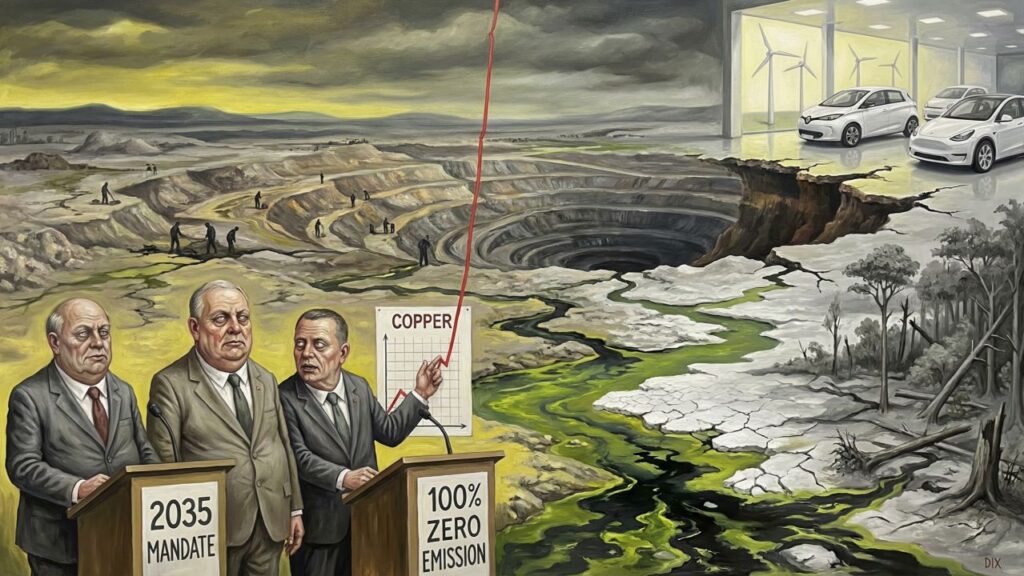
I. The Demand Curve No One Can Climb
The rare earth crisis exposed one uncomfortable truth: you cannot base a “clean energy transition” on materials you refuse to produce under your own laws. Part 2 confronts an even more brutal constraint, copper, and asks a simpler question: even if you solved the rare earth bottleneck, is there enough copper on Earth, on any plausible timeline, to do what politicians have already legislated?
Robert Friedland, founder of Ivanhoe Mines and one of the mining industry’s most provocative voices, recently framed the copper challenge in terms that should terrify anyone who has done the arithmetic: to maintain 3% global GDP growth over the next 18 yearsbefore layering on any additional demand from AI data centers, electric vehicles, or the broader energy transition, humanity will need to mine as much copper as it has extracted in the entire previous 10,000 years combined. His assessment was blunt: “You people have no idea whatsoever what we’re facing.”
He is correct. And the people who should know, the CEOs of European automakers promising full electrification by 2035, the progressive politicians mandating combustion engine bans, the asset managers who spent a decade marketing ESG portfolios built on impossible supply chains, and the activists who championed net‑zero commitments without understanding mineral constraints, either don’t know, don’t care, or are deliberately lying.
Strip away the ESG sales pitch, the net‑zero marketing, the Davos panels, and the progressive policy white papers, and what remains is a structural impossibility with catastrophic implications. The energy transition that Western governments have mandated by law requires copper, lithium, rare earths, graphite, and cobalt that cannot be mined, processed, and delivered within the timelines those governments have legislated.
This is not forecast or speculation. It is arithmetic.
And the fact that every policymaker, mining executive, automaker CEO, and asset manager continues to behave as if geology will bend to political timelines reveals something far more troubling than incompetence. As Part 1 outlined, the fraud rests on three pillars:
- Geographic accounting fraud: Measuring emissions by territorial borders rather than consumption, allowing Western nations to claim decarbonization while offshoring the dirtiest industrial processes.
- Impossible timelines: Mandating electrification schedules that require mining and processing copper at rates that geology, capital availability, and permitting timelines make physically unachievable.
- Environmental offshoring: Building supply chains on toxic waste, groundwater contamination, forced evictions, and child labor in Indonesia, the Democratic Republic of Congo, Chile, Peru, Mongolia, and Madagascar, then marketing the output as “clean energy” and “responsibly sourced.”
This part focuses on the second pillar, impossible timelines, and the copper arithmetic that alone is sufficient to collapse the transition, even if every other piece of the puzzle somehow went right.
II. The Arithmetic of the Impossible: What “Electrify Everything” Actually Requires
Electrification is sold as an engineering challenge; in copper terms, it is a geological impossibility wearing a marketing badge. An internal‑combustion car needs about 23 kilograms of copper; an electric vehicle requires roughly 83 kilograms, a 260% increase per vehicle. A single 3‑megawatt wind turbine requires approximately 4.7 tons of copper. Utility‑scale solar installations require roughly 5.5 tons of copper per megawatt of capacity. Grid modernization and transmission expansion, necessary to integrate intermittent renewable generation, require copper‑intensive transformers, substations, cables, and inverters that fossil fuel grids do not.
The copper intensity of the energy transition is not a bug. It is the defining characteristic.
Global refined copper consumption currently sits around 27 to 30 million tonnes annually. Industry forecasts project demand growth to roughly 40 million tonnes by the mid‑2030s, a 30 to 48% increase, driven by baseline economic expansion, urbanization in India and Southeast Asia, grid modernization, data‑center build‑out, and the early stages of transportation electrification.
Now layer on the mandates that progressive governments have legislated:
- European Union: Combustion engine ban for new passenger cars by 2035
- California: 100% zero‑emission vehicle sales by 2035
- New York: 100% zero‑emission vehicle sales by 2035
- Massachusetts, Washington, Oregon: Matching mandates aligned with California
- United Kingdom: Combustion engine ban by 2035
- Germany: Coalition support for the EU‑wide 2035 ban
Each of these mandates assumes electric vehicles will be available at scale, at affordable prices, with functional charging networks and sufficient grid capacity. Each assumes automakers can secure the copper required for motors, wiring, inverters, and charging stations. Each assumes mining companies can discover, permit, finance, construct, and ramp up dozens of new copper mines within the next decade.
None of these assumptions are remotely plausible.
Friedland’s calculation (that humanity must mine 10,000 years’ worth of copper in the next 20 years just to sustain 3% GDP growth) does not even account for the accelerated electrification these mandates require. If one runs the compounding arithmetic on electric vehicle penetration rising from roughly 10% of global sales today to 50 to 60% by 2035, plus the copper required for renewable generation, grid upgrades, and data‑center expansion, the cumulative demand curve becomes vertical.
There is no plausible supply response that meets this curve. Not at $10,000 per tonne copper. Not at $15,000 per tonne. Not at any price that allows automakers to sell electric vehicles at mass‑market affordability.
The people who drafted these mandates either did not perform this analysis, or performed it and proceeded anyway. The executives who accepted these mandates and issued matching corporate commitments either did not run the copper supply arithmetic, or ran it and lied to shareholders, regulators, and the public about feasibility. The asset managers who marketed ESG products as aligned with net‑zero transitions either did not understand that their portfolios were built on supply chains that could not scale, or understood and marketed them anyway.
At least one of these groups is lying. The evidence suggests all of them are.
III. When Geology Vetoes Policy: Ore Grades, Timelines, and Democratic Permitting
Faced with this demand curve, Western climate policy assumes that “the market” will deliver new supply if the price is right. Copper geology disagrees.
Geological Depletion: The Ore Grades Are Collapsing
Average copper ore grades across major mining districts have fallen by 30 to 50% over recent decades. Chile’s Escondida mine, the world’s largest copper operation, has seen ore grades decline from over 1.5% copper in the 1990s to below 0.8% today. State‑owned Codelco has struggled with aging infrastructure and declining grades across its portfolio, with production falling to historic lows in 2023 despite a $7 billion capital investment program.
As ore grades fall, more rock must be mined, crushed, and processed to produce the same amount of copper. This directly raises energy intensity, water consumption, capital expenditure, and operating costs, pushing up the incentive price required to justify greenfield projects. Friedland has suggested copper may need to stabilize around $15,000 per tonne to trigger sufficient large‑scale mine development. At that price, electric vehicles become unaffordable for mass‑market consumers, rendering the EU’s 2035 combustion ban and California’s zero‑emission mandates economically unachievable regardless of supply.
Capital Intensity and the 15 to 20 Year Timeline That Kills Every Mandate
Industry data place the average timeline from discovery to production at 15 to 20 years for a major copper project. This encompasses exploration, resource definition, feasibility studies, environmental permitting, community negotiations, infrastructure development, financing, construction, and commissioning.
Fifteen to twenty years.
The European Union’s combustion engine ban takes effect in 2035, nine years from now. California’s 100% zero‑emission vehicle sales mandate: 2035. New York’s: 2035. The UK’s: 2035.
Every single one of these mandates requires copper from mines that do not exist yet and cannot be permitted, financed, and constructed within the time remaining.
Consider the examples:
- Resolution Copper (Arizona): BHP and Rio Tinto’s joint venture sits on one of the largest undeveloped copper deposits in the United States. The project has been in various stages of development and regulatory review for over 15 years. It remains in permitting limbo, stalled by litigation and opposition from Native American tribes whose ancestral lands, including the sacred Oak Flat site, would be destroyed by subsidence from underground mining.
Arizona’s political leadership supports electrification mandates while blocking the mine required to supply them. The state wants copper, just not the consequences of mining it.
- Cobre Panamá (Panama): First Quantum Minerals’ operation was one of the largest new copper mines to come online in the past decade, producing approximately 350,000 tonnes annually, more than 1% of global supply. In November 2023, Panama’s Supreme Court declared the mine’s concession contract unconstitutional following public protests. The mine was ordered to close. Production ceased within weeks.
That single court ruling erased enough copper to build approximately 4 million electric vehicles minus 1% of global supply, overnight.
The uncomfortable truth progressive politicians will not acknowledge: you cannot have rapid mine permitting, democratic accountability, environmental protection, and community consent simultaneously. You must choose.
In the United States, major mining projects face the National Environmental Policy Act review process, which can take 5 to 10 years for complex projects. They face state‑level permitting under statutes like California’s CEQA, weaponized by activist groups to delay or kill projects. They face consultation requirements with Native American tribes. They face ESG scrutiny from investors demanding zero environmental incidents before financing.
The result is predictable: Western democracies with strong environmental laws, independent judiciaries, free media, and mechanisms for public opposition cannot permit large‑scale mining projects within the timelines their climate policies require.
China can. The Democratic Republic of Congo can. Indonesia can. But the European Union, the United Kingdom, California, New York, and Massachusetts cannot.
If the copper cannot be mined domestically within democratic, environmentally regulated jurisdictions, where will it come from?
It will be mined and processed in countries willing to impose environmental and public health costs on populations with no political voice, while Western governments import the refined product and claim credit for “clean energy.”
This is environmental colonialism with a sustainability marketing campaign.
The same governments that refused to process rare earths at home, then discovered too late that China could weaponize that dependency in 2025, have now legislated copper demand curves that no known set of deposits, permits, or timelines can meet.
IV. The Copper Real World: Who Gets Sacrificed So the West Can Pretend
If the mines cannot be built in time in the United States, Europe, or Australia without colliding with their own environmental laws and voters, the copper will come from places where neither constraint applies. The result is not an unfortunate side‑effect of climate policy; it is the operating model: drain aquifers in Chile, dump tailings into Indonesian rivers, turn Congolese rivers into toxic slurry, and market the resulting metal as “responsibly sourced” because the smelting happens far from the people writing ESG reports.
A. Freeport‑McMoRan: River Dumping as Business Model
Freeport‑McMoRan operates three of the world’s most environmentally destructive copper mines while marketing itself as a leader in “responsible mining” and “environmental stewardship.”
Grasberg (Indonesia): 200,000 Tons of Toxic Waste Daily
Freeport’s Grasberg operation in Indonesia’s Papua province is the world’s second‑largest copper mine, producing 816,000 tonnes annually. It is also perhaps the single most egregious example of environmental offshoring in the global mining industry.
The operational reality:
- 200,000+ tons of toxic tailings dumped daily into the Ajkwa and Otomina river systems
- Over 80 million tons annuallyapproaching 3 billion tons before mine closure
- 166 square kilometers of productive tropical forest and wetlands buried under toxic sediment
- Rivers turned “cloudy green‑black” and “coffee milk black sulphur” in color, visible from space
- Fish populations collapsed, millions dying annually from heavy metal contamination
- Indigenous Kamoro and Amungme communities losing primary food sources, transportation routes, and livelihoods spanning generations
- $13 billion in environmental damages estimated by Indonesia’s state auditor
Riverine tailings disposal, the practice of dumping mine waste directly into river systems, is banned in virtually every developed country on Earth. It is permitted in Indonesia because the country lacks the regulatory enforcement mechanisms, political will, or financial leverage to resist a mining operation that generates substantial revenue for both the national government and local officials.
Norway’s Government Pension Fund Global explicitly excluded Freeport‑McMoRan from its portfolio due to Grasberg’s riverine tailings. The U.S. Overseas Private Investment Corporation suspended political risk insurance for Grasberg in 1995 for the same reason. Freeport has operated Grasberg without a legally valid waste‑dumping permit for portions of the mine’s history, with contamination reaching Lorentz National Park, a UNESCO World Heritage Site.
Freeport’s response has been to rebrand river dumping as “Controlled Riverine Tailings Management” and describe impacts as “reversible,” with “natural revegetation” and $100 million per year in “controlled tailings system” spending. Dumping 200,000 tons of toxic waste daily becomes “controlled management”; the burial of 166 square kilometers of rainforest becomes “natural revegetation”; the collapse of Indigenous food systems becomes “monitored impacts.”
On September 8, 2025, Grasberg suffered a catastrophic mudslide that killed two workers, left five missing, shut down production for months, and eliminated 591,000 tonnes of copper production through 2026, equivalent to 2.6% of global copper supply. The incident wiped $11 billion off Freeport’s market capitalization and created a 400,000‑ton copper deficit for 2025.
Just as the 2025 rare earth export controls exposed Western dependence on Chinese processing overnight, the 2025 Grasberg mudslide showed how fragile the copper pillar of the transition really is: one slope failure erased 2.6% of global supply.
Cerro Verde (Peru): Decades of Fines for Contaminating a City’s Air and Water
Freeport’s Cerro Verde operation outside Arequipa, Peru’s second‑largest city, produced 430,000 tonnes of copper in 2024. It has also accumulated “dozens of fines” from Peru’s environmental regulator for violations that have directly sickened surrounding communities.
Documented violations include:
- Tailings pond leaking contaminants into subsoil beneath the facility
- Particulate matter exceeding safe limits almost daily for months, causing respiratory illness
- Sulfates and chlorides contaminating groundwater in multiple districts
- Production increased 350% since 1994 without proportional investment in environmental controls
To its credit, Cerro Verde invested over $93 million to build the La Enlozada wastewater treatment plant, which now treats approximately 95% of Arequipa’s municipal sewage and returns treated water to agricultural users downstream. This is genuine environmental investment.
But it does not erase the ongoing air quality violations and groundwater contamination from mining operations, nor the fact that Freeport is capable of compliance where enforcement is strong (Arizona) and chooses not to comply where it is weak (Peru, Indonesia).
B. BHP: Killing Deserts to Save the Climate
BHP operates Escondida, the world’s largest copper mine, producing 1.28 million tonnes annually in Chile’s Atacama Desert, the driest non‑polar desert on Earth. The mine is jointly owned by BHP (57.5%), Rio Tinto (30%), and Japanese interests (12.5%).
Over three decades, Escondida has drained groundwater aquifers and destroyed fragile desert ecosystems that will never recover.
The environmental record:
- Over 60 documented violations for exceeding permitted water extraction limits
- Drained the Salar de Punta Negra salt flat between 1990 and 2017, removing so much groundwater that the ecosystem collapsed
- $93 million settlement in 2021 for “irreparable environmental damage” to the Salar de Punta Negra
- $8.2 million fine in 2022 for exceeding water extraction limits continuously since 2005
- Exceeded permitted water table decline by more than 25 centimeters, classified as a “very serious” violation
- Destroyed wetlands and vegetation across the Punta Negra region; local testimony: “you don’t see any vegetation” where wetlands existed before mining
The Indigenous Atacameño (Lickan Antay) communities, who have inhabited the Atacama Desert for over 12,000 years, depend on groundwater‑fed oases, wetlands, and springs for subsistence agriculture, livestock, and cultural practices. Escondida’s groundwater extraction has dried up springs, eliminated vegetation, and destroyed habitats for flamingos, vicuñas, and other species.
In 2022, the Chilean government filed suit against BHP, Antofagasta, and Albemarle for damage to the Monturaqui‑Negrillar‑Tilopozo aquifer system, seeking damages and remediation for decades of over‑extraction. Scientists agree the ecosystems are “lost beyond repair.”
These are the mines the transition needs expanded if the electrification arithmetic is to work. They are already operating beyond ecological tolerances.
C. Glencore: Sacrifice Zones for Battery Metals
Glencore, one of the world’s largest diversified mining companies, operates copper and cobalt mines in the Democratic Republic of Congo through its Kamoto Copper Company (KCC) and Mutanda Mining (MUMI) subsidiaries. Their operations have generated massive pollution, forced evictions involving sexual assault and arson, reliance on child labor, and what United Nations experts have called a “sacrifice zone” for battery materials.
Kamoto Copper Company: Heavy Metals 43x WHO Limits
- “Massive pollution” of the Luilu River with untreated wastewater, acidification “visible to the naked eye”
- Heavy metal concentrations up to 43 times WHO maximum safe limits, including copper, cobalt, nickel, zinc, arsenic, and uranium
- Aquatic life devastated; fish populations collapsed over 20 years ago and have not recovered
- 20,000+ people lost fishing livelihoods
- Contaminated drinking water causing disease in downstream communities
- 2021 sulfuric acid spill after an explosion, with “huge quantities” discharged and no “relevant measures” taken to secure the site or prevent further contamination
Mutanda and other Glencore‑linked operations show similar patterns: open‑pit mining in protected reserves, severe water pollution, repeated toxic incidents, and a “closed circuit” processing claim belied by continuous contamination data.
Glencore draws both copper and cobalt from these operations, materials that will end up in “green” EVs, renewable installations, and the grid upgrades those installations require.
And this is only copper. Cobalt, while formally a Part 3 topic, is inseparable from these copper flows in practice.
D. Southern Copper, Rio Tinto, Anglo American: Variations on the Same Crime
Southern Copper (Grupo México) has dumped 785 million metric tons of mining waste (tailings containing copper, lead, mercury, zinc, cadmium, arsenic, and cyanide) into Peru’s Ite Bay over 35 years, destroying a critical Pacific fishing area. Copper concentrations are 48 times FAO safe limits in beach sand, and river contamination upstream has rendered water unsafe for 3,000 people.
Rio Tinto’s Oyu Tolgoi project in Mongolia has leaked tailings seepage since 2015, with unsafe levels of dissolved solids contaminating groundwater beyond mine boundaries and harming nomadic herders’ livestock. Its QMM mine in Madagascar suffered two dam failures in three years, releasing contaminated water that killed thousands of fish and affected over 15,000 people.
Anglo American’s Los Bronces and El Soldado mines in Chile face repeated “very serious” charges for acid drainage, arsenic contamination, and water appropriation that leaves communities facing rationing while the company controls multiples of their water rights. In Peru, Anglo’s Quellaveco mine secured 22 million cubic meters of water annually from rivers supporting farmers in an already stressed valley.
Taken together, these operations illustrate the same pattern as rare earths in Part 1, but at copper scale: Western governments legislate demand, then look away as the supply is extracted under conditions that would be criminal at home.
V. The ESG Copper Cartel: Financing an Impossible Curve
The copper story would still be catastrophic if it were merely geology colliding with over‑promising politicians. It is worse than that.
The same three asset managers that branded themselves as guardians of sustainable capitalism (BlackRock, Vanguard, and State Street) collectively control over $20 trillion in assets and hold decisive stakes in the copper majors whose business model is environmental offshoring. They marketed these holdings as “ESG,” “sustainable,” “Paris‑aligned,” and “net‑zero consistent” while knowing exactly how Grasberg, Escondida, Kamoto, and Ite Bay operate.
The Ownership Matrix
Examples:
- BHP Group (Escondida, Chilean aquifer damage)State Street: 7.12%BlackRock: 6.94%Vanguard: 6.02%Big Three combined: ~20%
- Freeport‑McMoRan (Grasberg river dumping, Cerro Verde fines)Vanguard: ~10%BlackRock: 8 to 9%State Street: 4%Big Three combined: ~22%
- Glencore (DRC sacrifice zones)BlackRock: 7.48%Vanguard: 5.05%With Qatar Holding, these investors effectively dominate governance
The pattern repeats: in virtually every major copper producer, the Big Three hold 15 to 25% combined stakes, giving them enormous voting power and influence over boards and strategy.
These firms attend shareholder meetings, vote on director elections, engage in private dialogues with management, and file shareholder proposals on environmental and social issues. Throughout the ESG boom (roughly 2015 to 2023), they collected fee premiums on products labeled “sustainable” while holding the companies dumping tailings into rivers, draining salt flats beyond recovery, and poisoning communities whose names never appear in those ESG brochures.
This is not passive index investing. It is active, coordinated engagement with companies whose copper is indispensable to electrification, and whose externalities would never be tolerated in the asset managers’ home jurisdictions.
VI. Governments and Automakers: Legislating a Geological Fantasy
Politicians wrote combustion engine bans and “100% zero‑emission” targets as if copper were a line item on a whiteboard rather than atoms in finite deposits. Automakers signed on as if mines appear when you pass laws. Both now behave as if the only thing standing between them and their promised transition is more subsidies and more charging stations.
The reality is simpler: without enough copper, none of it happens.
European governments, U.S. states, and national regulators set mandatory phase‑out dates for internal combustion engines, built incentive regimes around EV adoption, and embedded “climate neutrality” into industrial strategies without securing commensurate copper supply. At the same time, those jurisdictions (Germany, Chile, Arizona, Panama) have demonstrated they either cannot, or will not, permit the scale of mining expansion required to meet their own mandates.
Automakers, in turn, issued full‑fleet electrification promises, signed battery supply deals, and published glossy transition plans that assume copper will be there when needed. Their “scenario analyses” rarely include the one path most consistent with current data: a world in which there simply is not enough timely copper to build the fleets and grids regulators have demanded.
The same governments that discovered in 2025 that rare earths could be turned off with a licensing notice from Beijing are now committing their transport systems and industrial bases to a copper dependency that cannot be met with democratic permitting and existing deposits.
VII. Conclusion: When the Numbers Refuse to Obey the Narrative
Rare earths were the first warning. They showed that the West cannot process the materials its own laws require without either massive subsidies or exporting the waste to someone else’s population. Copper delivers the verdict: even if you solved every rare earth problem tomorrow, there is still not enough copper, on any plausible timeline, to do what Brussels, Sacramento, and Berlin have already put into statute.
Ore grades are falling, project timelines have stretched to decades, and the few giant deposits left either sit under communities and ecosystems that cannot survive their full exploitation, or under governments that have already shown they will halt operations when local anger boils over. The 2025 Grasberg mudslide removed 2.6% of global supply and blew a 400,000‑ton hole in the market. That was one hillside failing at one mine.
The policy class is betting the future of transportation, power, and data on the assumption that no similar surprises will ever occur again, and that communities from Arizona to Chile to the DRC will quietly accept whatever expansion is required to meet Western timelines.
The people drafting the laws and transition plans have seen these numbers. So have the executives running the mines and the asset managers whose portfolios depend on them. They continue to promise timelines that geology cannot honor because the costs of admitting the truth (political, financial, reputational) are higher than the costs of continuing the lie.
Part 1 documented the rare earth racket: how dependency was offshored to China, how Beijing weaponized it in 2025, and why “friend‑shoring” mostly means exporting environmental damage to allies with weaker governance. Part 2 has shown that copper alone turns the electrify‑everything agenda into a physical impossibility dressed up as moral necessity.
Part 3 turns to the companies that built their brands on that impossibility, European “sustainability champions” whose supply chains run directly through the sacrifice zones documented here and in Part 1, and the executives who signed off on every step.