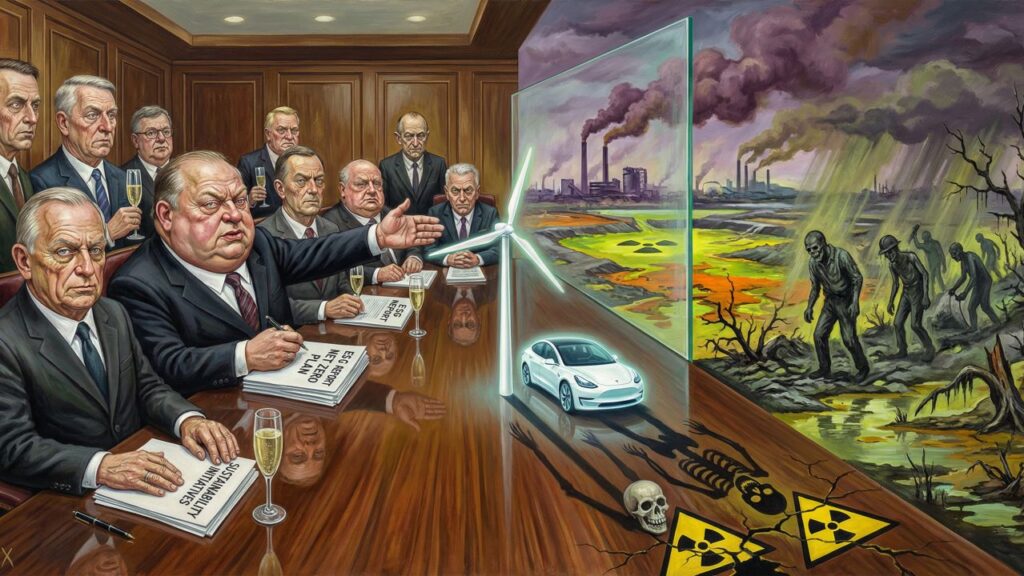
Why the West Can’t, or Won’t, Process Rare Earths
The “clean energy transition” and “AI Revolution” produce radioactive waste, toxic groundwater, and cancer villages, that’s acceptable, apparently, as long as it happens in someone else’s country.
By Scott Ortkiese, Throughline Synthesis Group January 26, 2026
The Davos Sermon and the Lie Beneath It
At the World Economic Forum in Davos last week, Allianz CEO Oliver Bäte delivered an expletive-laden defense of Europe’s green transition. Asked whether political leaders were right to backtrack on net-zero commitments, Bäte called such thinking “bullshit”, twice. Anyone with children, he insisted, “will have to worry” about the planet’s future. The role model, Bäte declared, is China: “They are going to be the leader both in terms of renewable and cost of energy.”
He was half right. China will indeed lead the energy transition, but not because of superior technology or moral commitment. China will lead because it has been willing to accept environmental and public health costs that no Western democracy will tolerate within its own borders: radioactive tailings ponds the size of Central Park, cancer villages where industrial pollution has sickened entire communities, groundwater contaminated for generations. The “clean energy” infrastructure Bäte was defending at Davos runs on supply chains built atop these sacrifice zones.
What Bäte did not mention, what no one at Davos mentioned, is that his own company, Allianz Global Investors, spent years marketing ESG funds as “sustainable” investments while holding positions in the very mining companies whose operations would trigger immediate criminal prosecution if conducted in Munich, London, or New York. When the politics shifted and “ESG” became a liability rather than a marketing asset, Allianz quietly de-emphasized the branding while retaining the portfolios and the fee streams attached to them.
This four-part series documents the environmental offshoring racket that makes Bäte’s confidence possible, and names the corporate operators, asset managers, ratings agencies, and regulators who built a $35 trillion “sustainable investing” complex on claims they knew, or could not reasonably avoid knowing, were impossible.
The fraud rests on three pillars:
- Geographic accounting fraud: Measuring emissions by territorial borders rather than consumption, allowing Western nations to claim decarbonization while offshoring the dirtiest industrial processes to countries with lax environmental enforcement.
- Impossible timelines: Mandating electrification schedules that require mining and processing critical minerals at rates that geology, capital availability, and permitting timelines make physically unachievable.
- Environmental offshoring: Building supply chains on radioactive waste, toxic groundwater contamination, forced evictions, and child labor in China, Indonesia, the Democratic Republic of Congo, Chile, and Myanmar, then marketing the output as “clean energy” and “responsibly sourced.”
Part 1 begins with the dirtiest secret of the clean energy transition: rare earth processing, and why the United States and Europe cannot, or will not, do it themselves.
I. The Immutable Physics of Rare Earth Processing: Why It Cannot Be Made “Clean”
Rare earth processing is not dirty because of poor management, outdated facilities, or inadequate investment. It is dirty because of geology and chemistry, constraints that cannot be engineered away regardless of capital or technology.
The Radioactive Problem: Thorium and Uranium
Rare earth elements do not occur in isolation. They are geologically associated with thorium-232 and uranium-238, radioactive isotopes with half-lives of 14 billion years and 4.5 billion years respectively. When rare earth ore is mined and processed, these radioactive elements do not disappear; they concentrate in the waste streams (tailings, wastewater, and processing residues) where they remain hazardous for thousands of years.
For every ton of rare earth elements produced, the industry generates approximately:
- 2,000 tons of toxic waste
- 1 to 1.4 tons of radioactive waste (thorium and uranium compounds)
- 13 kilograms of toxic dust
- 9,600 to 12,000 cubic meters of waste gas
- 75 cubic meters of acidic, contaminated wastewater
This is not a ratio that can be improved through efficiency or technological innovation. It is the physical reality of extracting low-concentration elements from complex ores.
The Chemical Separation Problem: Hundreds of Steps, Thousands of Gallons of Acid
Rare earth elements are chemically similar, they occupy adjacent positions on the periodic table with nearly identical electron configurations, making separation extraordinarily difficult. Commercial-scale separation requires hundreds of individual solvent extraction steps, each using acids, organic solvents, and chelating agents to incrementally purify individual rare earth oxides.
The chemical reagents used in these processes (hydrochloric acid, sulfuric acid, nitric acid, tributyl phosphate, and kerosene-based solvents) generate persistent, toxic wastewater contaminated with heavy metals, residual radioactivity, and organic pollutants. Even “closed-loop” systems must discharge or dispose of contaminated waste streams that cannot be fully recycled.
Producing one ton of rare earth oxides generates approximately 75 cubic meters of acidic wastewater and one ton of radioactive residue. At the scale required to supply global demand (currently around 390,000 tons of rare earth oxides per year) this translates to 29 million cubic meters of toxic wastewater and 390,000 tons of radioactive waste annually, every year, indefinitely.
These are not externalities that can be “managed” or “mitigated” into irrelevance. They are the input-output structure of the industry itself.
II. Why the United States Shut Down Rare Earth Processing (And It Wasn’t Chinese Competition)
The United States was once the world’s dominant rare earth producer. Molycorp’s Mountain Pass mine in California supplied the majority of global demand from the 1960s through the 1980s. By 2002, the facility was shuttered, and by 2015, Molycorp had filed for bankruptcy twice. The standard narrative attributes this collapse to Chinese government subsidies and predatory pricing that undercut American producers.
The actual cause was environmental regulation and the legal, financial, and political costs of complying with it.
Mountain Pass: Sixty Spills and a Pipeline That Wouldn’t Stop Leaking
Throughout the 1990s, Molycorp’s Mountain Pass facility experienced more than 60 documented spills of radioactive and hazardous wastewater, releasing hundreds of thousands of gallons of contaminated fluids into the Mojave Desert. At full capacity, the operation produced 850 gallons of salty, radioactive wastewater per minuteover 1.2 million gallons per day, which was pumped through an 11-mile pipeline to evaporation ponds located off-site.
The pipeline, which carried water contaminated with thorium, uranium, heavy metals, and processing chemicals, ruptured repeatedly. Cleaning operations intended to remove radioactive scale buildup from the pipe’s interior caused pressure surges that burst weakened sections, spilling tens of thousands of gallons of waste across federally protected desert land. One spill in 1998 alone released 600 gallons of contaminated water per minute for several hours before operators could isolate the breach.
California environmental regulators, the U.S. Environmental Protection Agency, and the Bureau of Land Management documented the violations, ordered remediation, and imposed stricter oversight. Molycorp, facing cleanup costs, regulatory fines, and the capital expenditure required to upgrade its wastewater management systems, determined that compliance was financially unsustainable while competing with Chinese producers operating under no comparable environmental constraints.
In 1998, the company suspended operations. In 2002, it shut down permanently after running out of permitted tailings storage capacity and failing to secure approval for a new waste disposal site. The mine sat idle for nearly a decade.
Molycorp Questa: Thirty Years of Poisoning the Red River
Molycorp’s molybdenum and rare earth operations in Questa, New Mexico, present an even starker case study. For three decades, the facility discharged acid mine drainage and heavy metal-contaminated water into the Red River, a tributary that flows into the Rio Grande.
By the late 1980s, the contamination was so severe that the river turned “cloudy blue” from dissolved copper, aluminum, and other metals. Local ranchers reported cattle losing hair, “drying up,” and dying after drinking from the river or grazing near contaminated areas. Fish populations collapsed. In 1994, the New Mexico Water Quality Control Commission declared at least eight miles of the Red River biologically dead.
Molycorp representatives repeatedly denied responsibility, at one point telling state regulators that the mine “has not harmed, and may have improved, the condition of the Red River.” This position became untenable as independent scientific studies, state environmental assessments, and federal investigations documented systematic contamination traced directly to mine operations.
Facing mounting legal liability, Superfund designation threats, and escalating cleanup costs, estimated at $130 million by the state and $378 million by environmental groups, Molycorp filed for bankruptcy. The cleanup burden shifted to taxpayers. As of 2024, remediation work continues, with final costs still unknown.
The Molycorp Bankruptcy Cycle: When “Clean Technology” Couldn’t Deliver
In 2008, a consortium of investors acquired the shuttered Mountain Pass mine and relaunched the company as Molycorp Inc., promising a “Project Phoenix” modernization that would use advanced, environmentally responsible processing technology to produce rare earths cleanly and compete with China. The company raised $531 million in a 2010 IPO and secured additional billions in debt financing.
By 2013, it was clear that the promised technology did not work as advertised. Costs soared, output fell short of projections, and the company could not achieve profitability at prevailing rare earth prices set by Chinese producers. In 2015, Molycorp filed for bankruptcy again. The assets were sold in a contentious auction partly to a consortium with ties to Chinese rare earth interests.
The post-bankruptcy Mountain Pass mine resumed limited operations in 2017 under new ownership (MP Materials), but with a critical change in business model: the facility mines and performs basic beneficiation on-site, but ships rare earth concentrate to China for separation and refining, then imports the refined product back to the United States. In other words, even the “American” rare earth producer was offshoring the dirtiest part of the process to China because it could not economically or politically do it at home.
Malaysia and the Legacy of Bukit Merah
The United States is not alone. In the 1980s, Mitsubishi Chemical operated a rare earth processing facility at Bukit Merah, Malaysia, to supply the global electronics industry. Local residents and Japanese environmental activists raised alarms about radioactive waste storage, groundwater contamination, and elevated rates of leukemia and other cancers in surrounding communities.
After years of protests, litigation, and mounting political pressure, the facility was closed in 1992. The site is now Asia’s largest radioactive waste cleanup operation, with remediation costs exceeding $100 million. The Bukit Merah legacy created decades of entrenched opposition to rare earth processing in Malaysia, a legacy that would resurface when Australia’s Lynas Corporation sought to build a new rare earth refinery there in the 2010s.
The pattern is consistent: when rare earth processing is conducted in jurisdictions with enforceable environmental laws, independent media, and mechanisms for public opposition, the industry becomes economically unviable or politically unsustainable.
III. How China “Won”: Absorbing Costs the West Refuses
China’s dominance of rare earth processing is not a story of superior technology or geological advantage. It is a story of political economy: the Chinese government made a strategic decision to internalize environmental and public health costs that Western democracies would not accept, thereby creating a cost structure that private companies operating under the rule of law cannot match.
Bayan Obo: The World’s Largest Rare Earth Mine and Its Radioactive Lake
Bayan Obo, located in Inner Mongolia, is the world’s largest rare earth mine and a microcosm of China’s approach. The operation has accumulated more than 70,000 tons of radioactive thorium waste in an 11-square-kilometer tailings pond, an area roughly three times the size of New York’s Central Park, that lacks adequate lining to prevent seepage.
Chinese government environmental assessments have documented that contaminated sludge is seeping into groundwater at a rate of 20 to 30 meters per year, moving steadily toward the Yellow River, which supplies drinking water to millions. Surrounding villages report elevated cancer rates, respiratory illness, and chronic health problems linked to air and water contamination.
The Chinese government has officially acknowledged the existence of “cancer villages”, rural communities where industrial pollution has caused disproportionately high rates of cancer and other diseases. Rare earth mining and processing areas feature prominently in these acknowledgments, yet enforcement of environmental standards remains weak and protests by affected communities are met with arrests and detention.
The neodymium processed from Bayan Obo’s radioactive tailings ends up in permanent magnets manufactured by JL MAG and other Chinese suppliers, magnets that Siemens Gamesa uses in offshore wind turbines marketed to European governments as “clean energy infrastructure,” that Volkswagen installs in electric vehicles advertised as the “Way to Zero,” and that BMW proclaims are part of its path to “climate neutrality.” Part 3 will trace these supply chains, company by company, from sustainability report to cancer village.
The Cost Advantage Is Environmental Non-Compliance
China’s rare earth producers can sell refined rare earth oxides at roughly one-third the price of international competitors for a simple reason: the Chinese government has never established enforceable pollutant discharge standards specifically for the rare earth industry. Producers are not required to meet the same wastewater treatment, air emission, or radioactive waste disposal standards that would apply in the United States, European Union, or other OECD countries.
This is not an oversight; it is policy. By declining to impose, or enforce, environmental regulations that would raise production costs, Beijing effectively subsidizes the industry through externalized environmental and public health damage. The Chinese government’s own estimates place environmental damage from illegal rare earth mining alone at $5.5 billion, a figure that does not include the health costs borne by affected populations or the long-term remediation liabilities that will eventually come due.
For Western companies operating under Environmental Protection Agency oversight, OSHA workplace safety rules, community consent requirements, and tort liability, this is an impossible competitive environment. MP Materials spends approximately $2.4 million per year on environmental monitoring and compliance alone, a line item that Chinese competitors do not have.
Worker Safety and Human Rights: The Hidden Subsidy
Chinese rare earth operations routinely expose workers to toxic dust, radioactive materials, and hazardous chemicals without adequate protective equipment or health monitoring. Medical studies document elevated rates of skin irritation, respiratory damage, and disruptions to the nervous and cardiovascular systems among rare earth workers, yet workplace safety enforcement remains minimal.
This, too, is a competitive advantage. Compliance with Western occupational health and safety standards (ventilation systems, personal protective equipment, medical monitoring, exposure limits, workers’ compensation insurance) adds costs that Chinese producers do not bear.
China’s rare earth dominance is built on a foundation of environmental destruction, public health sacrifice, and labor exploitation that Western governments cannot replicate domestically and corporations cannot openly defend.
IV. The 2025 Crisis: When Theory Became Reality
For two decades, warnings about rare earth dependency remained abstract, theoretical vulnerabilities that policymakers acknowledged in white papers but never seriously addressed. In April 2025, theory became reality. China weaponized its rare earth dominance, and the consequences arrived within weeks.
“Liberation Day” and the Seven Elements That Stopped Production Lines
On April 4, 2025, what the Trump administration called “Liberation Day” for its sweeping tariff announcements, China responded with retaliatory export controls on seven categories of medium and heavy rare earth elements: samarium, gadolinium, terbium, dysprosium, lutetium, scandium, and yttrium. These elements are not interchangeable commodities; they are the specific materials required for high-temperature permanent magnets used in electric vehicle motors, wind turbine generators, guided missiles, fighter jets, and precision-guided munitions.
The restrictions did not ban exports outright. Instead, they required businesses to apply for export licenses from China’s Ministry of Commerce (MOFCOM), licenses that could be approved, delayed, or denied at Beijing’s discretion. Within days, shipments that had moved routinely for years ground to a halt as applications piled up in MOFCOM review queues.
The consequences were immediate and industrial:
- Ford shut down its Chicago Explorer plant for a week in May 2025 after rare earth magnet supplies ran dry. CEO Jim Farley told Bloomberg: “It’s day to day. We have had to shut down factories. It’s hand-to-mouth right now.”
- U.S. rare earth magnet imports surged 660% in June 2025 as manufacturers scrambled to stockpile whatever inventory they could secure before the restrictions tightened further, a panic buying spree that drained available supply and spiked prices.
- European automakers faced similar disruptions. When Beijing tightened export licenses in 2025, magnet exports to Europe fell by three-quarters, forcing several carmakers to halt production lines.
- Dysprosium oxide prices in Rotterdam nearly tripled within one month of the controls taking effect, while terbium oxide more than doubled, even as Chinese domestic prices remained stable, demonstrating Beijing’s ability to selectively punish foreign buyers while protecting its own manufacturers.
The October Escalation: Extraterritorial Jurisdiction and the “50% Rule”
Rather than relax controls after initial negotiations, Beijing escalated in October 2025. On October 9, MOFCOM issued a series of notifications (Nos. 55-62) that transformed China’s rare earth export control regime from a licensing inconvenience into a potential stranglehold on global supply chains.
The most significant escalation: extraterritorial jurisdiction. For the first time, China asserted the right to require export licenses for rare earth magnets and materials shipped between third countries (not from China to another country, but from, say, Vietnam to Germany) if those products contain Chinese-origin rare earth content above 0.1% by value or were produced using Chinese rare earth technologies.
This directly mirrors the U.S. “re-export” controls that have frustrated Chinese semiconductor manufacturers for years. Beijing was sending a clear message: two can play this game.
MOFCOM also introduced a “50% Rule” providing for presumptive denial of export licenses to any entity majority-owned by companies on China’s export control entity list, a direct response to the U.S. Commerce Department’s “Affiliates Rule” imposed on Chinese firms. The symmetry was deliberate and unmistakable.
The November Pause: Relief or Leverage?
On November 7, 2025, following intense negotiations, China announced a temporary suspension of the October export controls. Policymakers in Washington and Brussels expressed relief. Headlines proclaimed “China Hits Pause.”
The celebration was premature. The suspension explicitly runs until November 2026, and can be reimposed at Beijing’s discretion with minimal notice. China did not abandon its export control framework; it demonstrated that the framework exists, functions, and can be activated whenever geopolitical circumstances warrant. The pause is not relief. It is leverage.
Meanwhile, even with the pause, the April 2025 controls on seven heavy rare earths remain in effect. Ford’s “hand-to-mouth” supply situation has stabilized but not normalized. European automakers continue to negotiate license-by-license for magnet shipments. And the fundamental vulnerability, that 90% of rare earth refining capacity sits in a single country willing to weaponize it, remains unchanged.
The Numbers That Define the Crisis
The 2025 rare earth crisis laid bare dependencies that policymakers had preferred to ignore:
MetricFigureSourceChina’s share of global rare earth refining~90%CSIS, IEAEU dependency on Chinese rare earth magnets98%European ParliamentU.S. dependency on Chinese rare earth imports70-80%USGS, CSISHeavy rare earth price premium (Rotterdam vs. China)3x+FastmarketsMagnet export decline to Europe after April controls75%WEF
The “clean energy transition” that Oliver Bäte defended at Davos depends almost entirely on supply chains that a single authoritarian government can disrupt with a regulatory notice. And every wind turbine, electric vehicle, and defense system that Western governments have mandated requires materials from those supply chains.
V. MP Materials and the $550 Million Question: Can You Actually Do It “Cleanly”?
MP Materials, the current operator of Mountain Pass, markets itself as proof that rare earth processing can be conducted responsibly in a Western regulatory environment. The company’s sustainability reports emphasize a “zero discharge” facility with 95% water recycling, closed-loop chemical systems, and dry tailings disposal in engineered, lined landfills rather than open evaporation ponds.
These are genuine improvements over Molycorp’s 1990s operations, and the company reported zero environmental violations in 2023, earning certifications from EcoVadis and other third-party auditors.
But MP Materials has not solved the fundamental problem. It has simply relocated and contained it at much higher cost.
The Radioactive Waste Doesn’t Disappear
MP Materials does not magically separate rare earth elements from thorium and uranium. The radioactive waste is still produced, it is just buried in lined landfills on-site rather than pumped to evaporation ponds or discharged into waterways. The company’s tailings storage facility contains hundreds of thousands of tons of low-level radioactive waste that will emit carcinogenic radiation for centuries.
The long-term integrity of these facilities (whether the liners will hold, whether seismic activity or climate change will compromise containment, whether future generations will maintain monitoring and remediation) remains an open question and a multi-generational liability.
The Economics Only Work with Massive Government Subsidies
MP Materials can only operate profitably because the U.S. Department of Defense has effectively nationalized a portion of its revenue stream. In July 2025, the Pentagon executed:
- A $400 million equity investment, making the Department of Defense MP Materials’ largest shareholder
- A $150 million loan from the Office of Strategic Capital
- A 10-year offtake agreement guaranteeing purchase of heavy rare earth oxides
- A price floor of $110 per kilogram for neodymium-praseodymium oxide, nearly double the prevailing Chinese market price of under $60 per kilogram
This is not a commercial operation competing on cost. It is a strategic asset subsidized by the federal government because the national security implications of Chinese rare earth dominance outweigh economic efficiency.
On January 21, 2026, five days before this article’s publication, MP Materials announced it had achieved commercial production of separated neodymium-praseodymium (NdPr) metal and begun trial production of rare earth magnets at its Fort Worth facility. The company proclaimed this “restores U.S. rare earth magnet production” for the first time in decades.
The milestone is real. The context is essential: MP Materials’ magnet production capacity will reach approximately 1,000 metric tons annually by late 2026, enough to supply a fraction of U.S. defense contractor demand, nowhere near enough to supply the automotive, wind, and consumer electronics sectors.
The Heavy Rare Earth Problem MP Materials Cannot Solve
MP Materials can produce light rare earths, neodymium and praseodymium, at its Mountain Pass facility. But the magnets required for EV motors operating at high temperatures and defense systems requiring thermal stability need heavy rare earths: dysprosium and terbium. Mountain Pass ore contains minimal quantities of these elements.
The company plans to build a heavy rare earth separation facility producing approximately 200 metric tons annually of dysprosium and terbium by 2027. This sounds significant until compared to the scale of the problem: CRU projects a global deficit of 2,920 metric tons of dysprosium and terbium oxides by 2035, more than fourteen times MP Materials’ planned capacity.
According to Benchmark Mineral Intelligence, the West will still rely on China for approximately 91% of its heavy rare earth needs by 2030, after the MP Materials expansion, after Lynas’s Malaysian facilities, after every “friend-shoring” initiative currently announced. The domestic supply chain being celebrated in Washington addresses light rare earths. It does not solve the heavy rare earth problem that makes defense and EV supply chains strategically vulnerable.
If MP Materials were required to compete on price with Chinese producers while maintaining Western environmental and labor standards, it would fail, just as Molycorp did twice before. The only difference is that Washington has now decided the strategic cost of continued Chinese dominance is high enough to justify permanent subsidies.
VI. Friend-Shoring: Exporting the Environmental Damage to Allies
Faced with the impossibility of onshoring rare earth processing at commercial scale under Western environmental standards, U.S. and allied policymakers have embraced “friend-shoring”, a strategy of diversifying supply chains by sourcing critical materials from politically aligned countries rather than strategic competitors.
In practice, friend-shoring rare earths often means offshoring the environmental damage to countries with weaker regulatory enforcement, lower labor costs, and less capacity for public opposition.
Lynas and the Malaysia Playbook
Australia’s Lynas Rare Earths Corporation is the poster child for this model. Lynas mines rare earth ore at Mount Weld in Western Australia, then ships the concentrate 4,500 kilometers to Malaysia for processing at its Lynas Advanced Materials Plant (LAMP) outside Kuantan, a city of 600,000.
The arrangement exists for one reason: Australia would not permit the processing domestically.
Lynas’s Mount Weld ore contains thorium at concentrations that make processing in Australia politically and regulatorily untenable. The Gillard government refused to allow waste storage within Australia’s borders. Environmental groups, Indigenous communities, and the nuclear regulatory agency all opposed domestic processing. So Lynas found a host country willing to accept what Australia would not.
In Malaysia, the LAMP facility faced years of protests, lawsuits, and political opposition from residents concerned about radioactive waste storage near their communities. In 2019, the Malaysian government threatened to revoke Lynas’s operating license unless the company agreed to remove radioactive waste from the country and cease processing “cracking and leaching” operations, the dirtiest phase of rare earth separation, in Malaysia.
Lynas negotiated a compromise: it would build a “cracking and leaching” facility in Kalgoorlie, Western Australia, to handle the most radioactive processing steps, shipping partially processed material to Malaysia for final separation. This arrangement was supposed to reduce Malaysia’s environmental burden while keeping the cleaner processing jobs in-country.
The compromise is already unraveling.
In October 2025, Lynas announced it will invest A$180 million to build a new heavy rare earth separation facility, in Malaysia, not Australia. CEO Amanda Lacaze told analysts the company intends to source heavy rare earths from both Mount Weld and “various Malaysian partners.” Rather than phasing out Malaysian processing as activists demanded, Lynas is expanding it, positioning Kuantan as the first site outside China capable of separating dysprosium and terbium at commercial scale.
The environmental burden that was supposed to shift to Australia is instead growing in Malaysia, because Malaysia will permit what Australia will not.
The Pattern: Weaker Governance, Fewer Questions
Malaysia is not unique. Vietnam has emerged as an alternative processing destination, with Chinese-backed facilities handling rare earth separation under environmental standards that would not survive scrutiny in the United States or EU. Thailand and Indonesia have been discussed as potential sites for new processing capacity, countries where regulatory enforcement is uneven and community opposition can be more easily managed.
The “friend-shoring” strategy does not eliminate the environmental costs of rare earth processing. It relocates those costs to populations with less capacity to resist, while allowing Western governments to claim they have “diversified” away from Chinese dependence.
This is not supply chain resilience. It is environmental colonialism with better public relations.
VII. Demand Reduction: The Only Honest Path (And Why It Won’t Happen Fast Enough)
The uncomfortable truth that policy discussions avoid: the only path to genuine rare earth security that does not involve either massive subsidies, continued Chinese dependence, or environmental sacrifice zones in allied countries is demand reduction, using less rare earth material per application through substitution, efficiency improvements, or outright technology changes.
Substitution Research: Promising but Distant
Research programs funded by the Department of Energy’s ARPA-E, the European Union’s Horizon Europe, and private industry are exploring alternatives to rare earth permanent magnets:
- Ferrite magnets can replace neodymium magnets in some applications but with significant performance penalties, reduced power density, larger motor size, and lower efficiency
- Induction motors that do not require permanent magnets are used in some EV models (Tesla’s early vehicles, some Chinese manufacturers) but have efficiency trade-offs
- Grain boundary diffusion techniques can reduce dysprosium requirements in high-temperature magnets by 30-50%, but cannot eliminate them entirely
None of these alternatives are commercially viable at scale within the timelines that current electrification mandates require.
Recycling: A Longer-Term Hedge
Rare earth recycling from end-of-life products (particularly hard disk drives, wind turbines, and eventually electric vehicles) could theoretically supply 15-25% of demand by 2040. But the economics depend on collection infrastructure, sorting technology, and processing capacity that do not yet exist at scale.
Current recycling rates for rare earths are below 1% globally. Building the infrastructure to change this requires decades, not years.
Geopolitical implication: Demand reduction is a hedge, not a solution. It can reduce the magnitude of rare earth dependency over decades, but it cannot eliminate it in the timeframes relevant to current geopolitical competition. It should be pursued as part of a diversified strategy, not as a substitute for addressing near-term supply-chain vulnerabilities.
VIII. Conclusion: The Uncomfortable Truth About “Clean” Energy, And What Comes Next
The rare earth dilemma exposes a fundamental contradiction at the heart of Western energy and climate policy. Political leaders, corporations, and advocacy organizations champion electrification, renewable energy, and “clean technology” as moral and economic imperatives while depending on supply chains built on environmental devastation, radioactive waste, and public health sacrifice in China, Myanmar, Malaysia, and potentially Vietnam, Indonesia, and Thailand.
The United States shut down its rare earth processing operations not because Chinese competitors undercut them on subsidies, but because American environmental law, regulatory oversight, and community opposition made the industry’s waste streams legally and politically untenable. Molycorp’s Mountain Pass facility spilled hundreds of thousands of gallons of radioactive wastewater into the Mojave Desert; its Questa operation poisoned the Red River for three decades. Both facilities closed under regulatory pressure and the threat of Superfund liability.
China’s rare earth dominance is not a market failure or an industrial policy triumph. It is a political economy outcome: Beijing made a strategic decision to internalize environmental and public health costs (cancer villages, radioactive tailings ponds, contaminated groundwater) in order to control a critical node in the global supply chain, and Western governments and corporations were happy to let them as long as the costs were borne by someone else’s population.
Now, confronting the strategic vulnerability that dependence creates, a vulnerability demonstrated with brutal clarity in April 2025 when Ford’s production lines went silent and European automakers scrambled for magnet supplies, Washington and its allies are discovering that they cannot have cheap rare earths, clean rare earths, and secure rare earths simultaneously. Every option involves trade-offs: massive subsidies to absorb costs domestically, offshoring environmental damage to allies, accepting continued Chinese dependence, or reducing demand over decades through technologies that do not yet exist at commercial scale.
The “clean energy transition” is not clean. It is a transition from one set of environmental externalities, carbon emissions, to another: toxic mining, radioactive waste, heavy metal contamination, and the persistent health burdens imposed on communities near extraction and processing sites. The difference is that carbon emissions are globally distributed and impossible to localize, while rare earth waste can be concentrated in places with weak governance, lax enforcement, and populations with limited political voice.
For Oliver Bäte and the executives at Davos who called concerns about the green transition “bullshit,” here is the question they will not answer: If the environmental costs of “clean energy” were internalized and subject to the same standards as domestic industry, would the energy transition still be called “clean”?
The answer is no. And they know it.
What Comes Next
Part 1 has documented how the United States and Europe offshored rare earth processing to China, and why they cannot bring it back without massive subsidies, permanent environmental sacrifice zones, or continued dependence on authoritarian supply chains.
But rare earths are only one node in the impossible supply chain.
Part 2 documents the copper arithmetic: the electrification mandates that California, the EU, and New York have legislated by law require mining copper at rates that geology cannot deliver and timelines that permitting regimes cannot accommodate. Robert Friedland, founder of Ivanhoe Mines, has warned that humanity must mine as much copper in the next two decades as it has extracted in the previous 10,000 years combined, and he’s talking about baseline economic growth, before the additional demand from electric vehicles, wind turbines, and grid modernization. The math does not work. Everyone who matters knows it.
Part 3 names the corporate operators, ten European “sustainability champions” from Siemens Gamesa to Volkswagen to Unilever, whose supply chains trace to specific facilities, specific environmental violations, and specific cost savings that make their business models viable. Each profile runs the same forensic chain: from sustainability report and CEO quote, through named suppliers and facilities, to documented environmental crimes, regulatory citations, and financial beneficiaries. The hypocrisy is not abstract. It is quantified, facility by facility, violation by violation, with the executives who signed off cited by name and date.
Part 4 follows the money: the asset managers, ratings agencies, consultants, and lawyers who built a $35 trillion ESG industrial complex on claims they knew, or could not reasonably avoid knowing, were impossible. When the politics shifted and “ESG” became a liability, they dropped the label, kept the portfolios, kept the fees, and never acknowledged that the products they had been selling as instruments of planetary salvation were built on offshored environmental crimes.
The environmental offshoring racket is not an unintended consequence of well-meaning climate policy. It is the operational design, and everyone who matters knows it.
The fraud will continue until reality forces honesty. The only question is whether Western democracies will retain enough industrial capacity, economic competitiveness, and political legitimacy to survive the reckoning when it comes.
Next: Part 2, The Electrification Lie: Promising What Geology Can’t Deliver