Overview
On January 28, 2026, Professor Jeffrey Sachs joined Glenn Diesen to discuss the imminent threat of U.S. military action against Iran. The conversation reveals a coordinated campaign of hybrid warfare (cyber attacks, economic destruction, assassinations, street unrest, and now direct military force) designed not for negotiation but for regime change. Central to Sachs’s indictment is Treasury Secretary Scott Bessent’s extraordinary public admission at Davos that the United States deliberately collapsed Iran’s economy to drive citizens into the streets, a confession mainstream media refused to report while simultaneously running daily stories blaming Iranian “mismanagement” for the suffering U.S. policy intentionally caused.
The Military Threat: A “Massive Armada”
Force Buildup and Allied Participation
Diesen opens by cataloguing the military forces converging on the Middle East. From Tehran’s perspective, one would observe:
- Massive U.S. military accumulation in the region
- British, German, Spanish, and Italian transport planes heading toward the Middle East
- A carrier strike group en route to attack Iran
Trump’s social media rhetoric matches the force posture: “A massive armada is heading to Iran. It is moving quickly with great power, enthusiasm, and purpose… time is running out.” A subsequent post declared the fleet “ready, willing, and able to rapidly fulfill its mission with speed and violence if necessary.”
Sachs characterizes this as “pure thuggery” and a direct violation of international law, not merely the prospective attack, but the threat itself.
The Venezuela Precedent
Sachs draws explicit parallels to recent U.S. actions in Venezuela: “Brazen, gross threats followed by an invasion, a kidnapping of the president and the first lady and a claim by the United States that it runs Venezuela, including stealing oil off of tankers and sending that to the United States with Donald Trump declaring that the money goes to him.”
This pattern of lawlessness, Sachs argues, is now being applied to Iran, but with catastrophically higher stakes given the region’s volatility and nuclear dimensions.
Scott Bessent: The Currency Destroyer as Treasury Secretary
Credentials in Economic Destruction
Sachs dedicates significant attention to Treasury Secretary Scott Bessent’s background, arguing it explains his current role:
The reference is to “Black Wednesday” in September 1992, when Soros’s Quantum Fund, where Bessent worked, shorted the British pound, forcing the UK’s humiliating exit from the European Exchange Rate Mechanism and generating approximately $1 billion in profits for the fund. This is the credential that qualified Bessent for Treasury Secretary: expertise in currency destruction.
Diesen’s response captures the implication: “When the Treasury Secretary is an economic hitman, you should be worried, especially when Trump’s behind the wheel.”
The March 2025 Economic Club of New York Speech
Bessent himself, in his Davos remarks, references his earlier public signal of intent. Speaking at the Economic Club of New York in March 2025, he stated that he believed “the Iranian currency was on the verge of collapse” and advised that “if I were an Iranian citizen, I would take my money out.”
This was not analysis, it was announcement. The Treasury Secretary publicly telegraphed the coming economic assault and encouraged capital flight, then executed the policy he had previewed.
The Davos Confession
At the World Economic Forum in Davos, an interviewer asked Bessent about sanctions policy toward Iran. His response constitutes an explicit admission of economic warfare. Sachs reads the statement in full:
Sachs emphasizes the chain of causation Bessent explicitly establishes:
Policy ActionConsequenceOFAC maximum pressureEconomic collapse (December 2025)Banking system attackMajor bank failureCurrency manipulationCentral bank forced to print moneyDollar shortageImport crisisImport crisisPopular sufferingPopular sufferingStreet protests
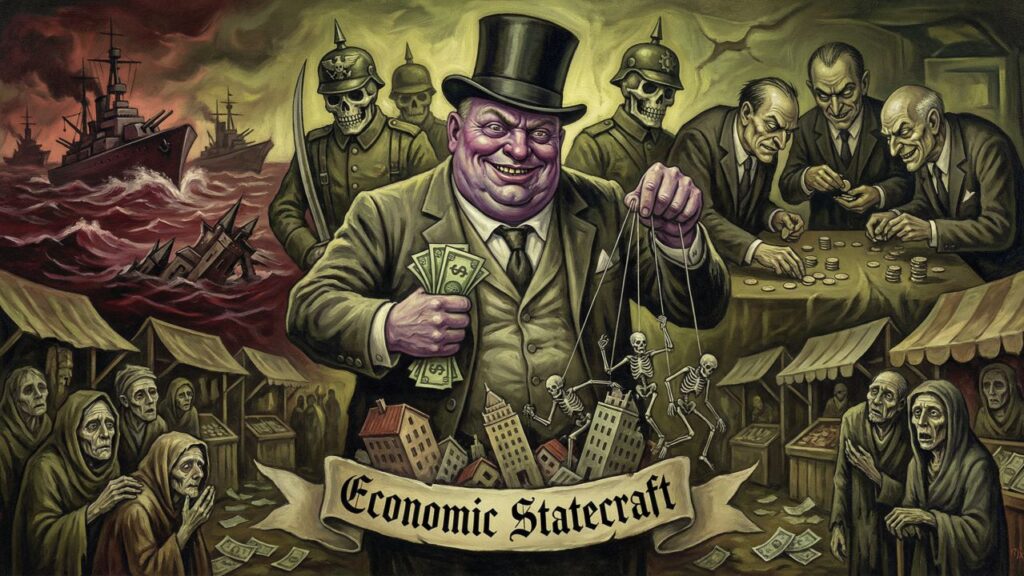
Bessent then blesses this chain of intentional suffering: “This is economic statecraft. No shots fired and things are moving in a very positive way here.”
The Smirk
Sachs notes a detail that captures the moral dimension: “By the way, he had a little smirk on his face. He couldn’t resist the smirk as he finished that last sentence. It was just an added touch of vulgarity.”
The Media’s Role: What the New York Times Won’t Print
The Confession They Buried
Sachs’s most pointed accusation concerns mainstream media coverage:
The Propaganda They Run Instead
Rather than reporting Bessent’s explicit admission, the New York Times, Washington Post, and European media run a different narrative:
The pattern is systematic: present the consequences of deliberate U.S. economic warfare as evidence of Iranian regime incompetence, thereby manufacturing consent for regime change while concealing the actual cause of civilian suffering.
The Evidence in Plain Sight
Diesen reinforces the point by cataloguing publicly available evidence that Western media ignores:
- Bessent at Davos: Explicit admission of economic warfare objectives
- Mike Pompeo: Stated that among the rioters “we have Mossad agents”
- Israeli news: Openly reported that Israel is “pumping weapons into this to fuel the violence among the riots”
Yet anyone who acknowledges Western interference is labeled a “regime apologist” who doesn’t care about Iranian suffering. The perverse inversion, as Diesen frames it: “If you really care about Iranians, you will advocate for the bombing of it.”
Hybrid Warfare: The Full Spectrum Campaign
Sachs’s Framework
Sachs explicitly characterizes the Iran campaign as “hybrid warfare”, a coordinated multi-domain assault:
DomainMethodsCyberCyber warfare operationsEconomicOFAC sanctions, dollar weaponization, banking system isolationPoliticalStreet unrest, provocateurs, false flagsIntelligenceMossad agents among protesters, weapons smugglingKineticBombing campaigns, assassination attempts, decapitation strikes
The Decapitation Strike That Failed
Sachs notes that Israel attempted a decapitation strike against Iranian leadership through “assassinations and through Mossad attacks and through the bombing.” The result: “It did not work. I don’t believe it would work.”
False Flags and Provocateurs
When discussing Iranian street protests, Sachs is explicit about their manufactured dimensions: “Much of it false flags and stoked by provocateurs and by Mossad and so forth.”
The Thirty-Year Israeli Project
No Interest in Negotiation
Sachs frames the current crisis as the culmination of Israel’s three-decade effort to overthrow Iran’s government:
Evidence that negotiation was never the objective:
- JCPOA Destruction: The Joint Comprehensive Plan of Action was negotiated, signed, and ratified by UN Security Council Resolution 2231 on July 20, 2015. “Then Trump ripped it up in his first term.”
- June 2025 Bombing: Israel, with U.S. support, bombed Iran on June 12-13, 2025, “two days before scheduled negotiations between the United States and Iran.”
- Israeli Opposition to Every Deal: “Whenever there has been negotiation, Israel has jumped up and down saying don’t negotiate… There has never been a readiness of the United States to have real negotiations with Iran.”
Sachs is unequivocal: “There is no interest in any negotiated deal because negotiated deals have been available for more than a dozen years and whenever they’ve been reached the United States has ripped them up and Israel has been the chief proponent of ripping up any negotiated deal and since Trump works for Israel there’s absolutely no intention of any negotiation at all.”
European Complicity
Chancellor Merz: “Doing Our Dirty Work”
German Chancellor Friedrich Merz has made two revealing statements:
- During the first Iran attack: “Israel is doing our dirty work.”
- Current statement: “Iran’s days are numbered. It may be weeks but this regime has no legitimacy whatsoever to govern.”
Sachs’s reaction: “Shame on Mertz. But again, it’s just so typical… The thuggishness of Europe shouldn’t surprise me, but it always disappoints me.”
The Principle of Convenience
European governments invoke principles only when their own interests are threatened:
JCPOA Signatories Silent
European powers were co-signatories to the JCPOA. They participated in the negotiations. They watched the United States unilaterally destroy the agreement. Yet now they endorse regime change rather than defending the diplomatic framework they helped create: “They know the truth but they don’t speak the truth.”
Military Participation
European complicity extends beyond rhetoric. British, German, Spanish, and Italian transport planes are heading toward the Middle East, direct military participation in the buildup, not merely rhetorical support.
International Law in Contempt
UN Charter Article 2, Section 4
Sachs quotes the foundational prohibition of the post-World War II international order:
The Trump administration’s view of this obligation is captured by Trump’s deputy chief of staff, who called the UN Charter “a nicety.”
Sachs notes that even the threat (“This fleet is ready, willing, and able to rapidly fulfill its mission with speed and violence if necessary”) constitutes a gross violation. The Charter prohibits not merely the use but the threat of force.
Security Council Responsibility
Sachs calls for immediate UN Security Council action: “I believe the UN Security Council should be forced to meet immediately and stay in meetings and take its responsibility which is unique in the world to stop this and to say clearly to the United States to the president of the United States no you cannot even threaten that way much less make an attack.”
Regional Dynamics and Escalation Risk
Countries That Don’t Want War
Sachs assesses regional sentiment:
Saudi Arabia has specifically stated its airspace will not be used for attacks on Iran, a concrete indication of regional resistance to the war project.
Iran’s Military Capabilities
Sachs outlines what prior exchanges have revealed about Iranian capabilities:
CapabilityStrategic ImplicationHypersonic missilesCan penetrate Israeli air defensesDemonstrated restraintPrior strikes avoided sensitive targets; existential war changes targeting doctrineNuclear thresholdCurrent enrichment not far from weapons-grade; rapid breakout possibleLeadership resilienceDecapitation strikes have failed
Sachs warns: “If this became an existential struggle, Iran could absolutely without question make a dash for nuclear weapons.”
IAEA and the Road Not Taken
Iran has stated willingness to accept IAEA monitoring and enrichment limits, the framework that existed under the JCPOA. But the diplomatic path was destroyed by Trump’s first-term withdrawal, and no genuine offer has been made since.
Revolutionary Guard Decision
In an existential crisis, Sachs suggests the Revolutionary Guard “could decide this is the fate of our nation and we make a dash for nuclear weapons.”
The Catastrophic Stakes
Not Venezuela
Sachs distinguishes Iran from the Venezuela operation:
International Support for Iran
“If the situation became dire for Iran, I assume that other countries would support Iran. Iran is a big country.”
The Assessment
Can It Be Stopped?
The Wall of Opposition
Sachs acknowledges uncertainty but refuses despair:
The Absence of Principle
Yet Sachs is dismayed by the absence of voices willing to invoke principle:
Diesen’s closing assessment is grim: “If all these capabilities are built up and the only way to avoid it according to Trump is a deal which essentially is non-existent, it’s hard to see what else they can go for.”
Conclusion
The conversation presents a comprehensive indictment: a thirty-year Israeli project to destroy Iran, executed by a United States that “does what Israel tells it to do,” implemented through hybrid warfare across every domain, enabled by European complicity, and protected by a media apparatus that buries explicit confessions while running propaganda disguised as news.
At the center stands Scott Bessent, a man whose professional credential is currency destruction alongside George Soros, now serving as Treasury Secretary and openly celebrating at Davos that U.S. policy has collapsed Iran’s economy, driven its people into the streets, and is “moving in a very positive way.” The smirk on his face as he said it captures what Sachs calls the “vulgarity” of the entire enterprise.
The carrier strike group is en route. The attack, Sachs concludes, is imminent. And the world waits to see whether any wall of opposition can be built before Trump “recklessly pulls the trigger.”
Related reading
- Behind the Headlines: Jeffrey Sachs and Glenn Diesen on the System That Built the Ukraine War
- The War That Broke the AI Boom: Economic and Supply Chain Disruptions from the Iran Conflict
- America’s Suicidal Empire: The Iran War, the Death Spiral of a Failing Hegemon, and the World We Are Destroying
- The Enemy We Made: Three Times Iran Extended Its Hand, Three Times America and Israel Answered with a Fist