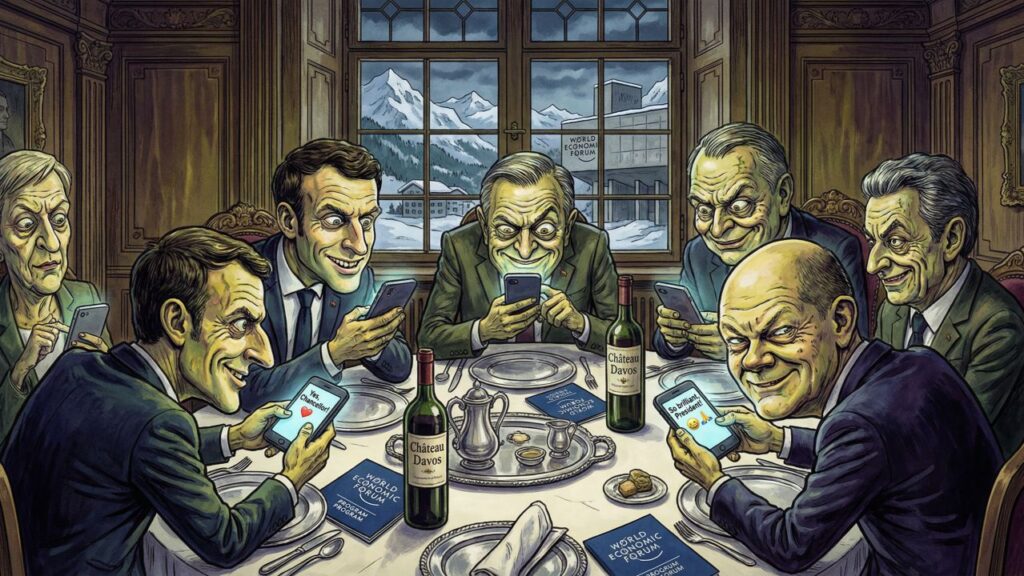
Who knows? Here’s my guess.
Executive Summary
President Trump’s publication of private texts from European leaders represents neither diplomatic incompetence nor impulsive behavior, it is a calculated strategic weapon designed to achieve multiple simultaneous objectives. The leaks serve as instruments of public humiliation that establish dominance hierarchies, extreme anchors that make subsequent demands appear reasonable, wedges that divide European collective action, and spectacles that demonstrate power to domestic and international audiences. Far from damaging his negotiating position, Trump leverages these publications to create psychological subordination, deter future resistance, and extract concessions by making the cost of opposing him, public embarrassment and loss of domestic credibility, exceed the cost of compliance.
On January 19-20, 2026, Trump published private messages from French President Emmanuel Macron and NATO Secretary General Mark Rutte on Truth Social, dramatically escalating the Greenland crisis. Macron’s text revealed his confusion over Trump’s Greenland demands while proposing to host a G7 summit and invite Russia “in the margins”, contradicting France’s stated policy of isolating Moscow. Rutte’s message, praising Trump’s “incredible” achievements and committing to “finding a way forward on Greenland,” demonstrated NATO leadership’s accommodation to Trump’s framework.
This analysis examines Trump’s objectives through the lens of his documented negotiation methodology, which prioritizes leverage accumulation over relationship preservation, values visible power differentials over absolute gains, and treats every cooperative gesture as a tradable asset. The text leaks are not collateral damage to his strategy, they are the strategy, designed to transform diplomatic norms from constraints on presidential power into exploitable weaknesses of adversaries who still feel bound by them.
The Core Strategic Framework: Dominate and Distance
Trump’s entire negotiation approach centers on a single overriding principle articulated across decades of business dealings: establishing and widening the power gap between himself and counterparties. As negotiation expert Kwame Christian explains, Trump “would rather take $10 for himself and leave his counterpart with $0 than collaborate to split $65 in total value” if doing so establishes a power distance of $55. The gap itself constitutes value because “by widening the differential, Trump ensures that the other party recognizes his dominance, creating a psychological advantage that extends beyond the current deal into future interactions”.
This framework, which Christian terms the “Dominate and Distance” methodology, represents a fundamental departure from traditional competitive negotiation. While most competitive negotiators focus on maximizing their own gains, Trump focuses on maximizing the power distance between himself and his counterpart, even at the cost of absolute value creation. As University of Illinois legal scholar Robin Kar notes, Trump’s approach “prizes a narrow interpretation of freedom of contract” rooted in zero-sum thinking: “I win, therefore you lose”.
This framework explains why publishing embarrassing texts serves Trump’s interests even when it damages diplomatic relationships. The publication inflicts reputational cost on European leaders while demonstrating Trump’s immunity to reciprocal constraints, he violates norms they must observe, proving asymmetric power. As Christian concludes, “subordination itself is an asset and it’s something that he actively builds into his strategy”. The humiliation is not a side effect; it is the point.
Objective One: Extreme Anchoring to Make Real Demands Appear Reasonable
Trump’s Greenland annexation demand functions as textbook extreme anchoring, a tactic he describes explicitly in The Art of the Deal: “I offered $5 million, which was obviously ridiculously low. They countered at $10 million, and at that point I knew I had a great deal, regardless of how the negotiation ended”. By demanding complete annexation of NATO ally Denmark’s territory while refusing to rule out military force, Trump establishes an extreme position that makes subsequent concessions appear moderate.
The strategic logic is straightforward, as Northeastern University negotiation scholars explain: “Extreme anchors can be an effective negotiating tactic” because “if the sides ‘split the difference,’ the resulting ‘mid-point’ may end up closer to your side as a result of the extreme anchor”. Trump almost certainly seeks not annexation but expanded U.S. military presence, revised basing agreements, restrictions on Chinese investment, and enhanced access to rare earth minerals. By anchoring at “complete and total control,” he makes these objectives, which would themselves represent significant European concessions, appear as face-saving compromises.
Experts confirm the United States already possesses extensive rights under existing agreements. The 1951 Greenland Defense Agreement grants the U.S. “broad rights to reactivate around 16 military bases that previously operated in Greenland” and permits expansion of facilities like Pituffik Space Base. As Danish researcher Mikkel Runge Olesen notes, “The U.S. has such a free hand in Greenland that it can pretty much do what it wants”. The U.S. Space Force already operates Pituffik with full radar coverage, and “existing agreements already permit the project’s expansion” for Golden Dome missile defense architecture.
Publishing the private texts amplifies this anchoring effect. When Macron’s message reveals his willingness to “build great things” and proposes inviting Russia to G7 meetings, it signals European leaders are already in bargaining mode rather than resistance mode. When Rutte promises to use “media engagements in Davos to highlight your work” and commits to “finding a way forward on Greenland,” it publicly demonstrates NATO leadership accepting Trump’s framework. These revelations shift the Overton window: the question becomes not whether to accommodate Trump on Greenland but how much accommodation is acceptable.
As one European official acknowledged to CNN regarding Rutte’s flattery at the June 2025 NATO Summit, “the sucking up was pretty over the top” but resulted in NATO members committing to 5% GDP defense spending by 2035, more than double the previous 2% target. The published texts prove that extreme demands plus public pressure yield concrete results, validating the approach and setting expectations for future negotiations.
Objective Two: Public Humiliation Creates Psychological Subordination
Trump’s negotiation philosophy explicitly values inflicting disproportionate pain as a compliance mechanism. As MIT negotiation scholar G. Richard Shell documents, Trump’s core principle is: “When somebody screws you, you fight back hard. You hit them so hard that they will never try it again”. Publishing private texts weaponizes leaders’ own words against them, creating what negotiation scholars call “strategic subordination, a form of psychological anchoring at the level of status”.
Consider the specific humiliations:
Rutte’s Deference: At the June 2025 NATO Summit in The Hague, the NATO Secretary-General called Trump “Daddy” in a public exchange, explaining “Daddy has to sometimes use strong language”. Though Rutte later claimed this was merely a metaphor, the moment symbolized the power dynamic Trump seeks to establish. His published text from January 2026 contained effusive praise for Trump’s “genuinely exceptional” actions that “no one else dared to undertake,” positioning him as supplicant rather than alliance leader. Publishing these messages forces Rutte to either defend the obsequiousness (confirming subordination) or repudiate his own words (creating conflict with Trump while appearing duplicitous to European publics).
European officials acknowledged the strategic cost. As one European official told CNN, granting anonymity to describe private conversations: “People are so embarrassed… Yes, the summit was a success on the whole. But the sucking up was pretty over the top”. Yet the subordination achieved its objective, NATO allies committed to unprecedented defense spending increases, with Rutte and Polish President Andrzej Duda crediting Trump personally: “Increased defense spending is President Donald Trump’s success. Without Donald Trump’s leadership, it wouldn’t have been possible”.
Macron’s Conciliation: The French president publicly positioned himself as defender of European sovereignty, declaring “We do prefer respect to bullies” and stating Trump’s threats represent “new imperialism”. Yet his private text adopts a pleading tone, “My friend… I do not understand what you are doing… Let us try to build great things”, while proposing to unilaterally reverse European Russia policy by inviting Moscow to G7 talks. The gap between public posturing and private accommodation exposes Macron as either hypocritical or ineffectual, undermining his domestic political standing.
At Davos on January 19-20, 2026, Macron called for activating the EU’s “anti-coercion instrument”, the bloc’s most powerful trade weapon, never before deployed. Yet this very response validates Trump’s strategy: Macron must publicly escalate to compensate for the revealed private accommodation, creating domestic political pressure for toughness while Trump has already demonstrated France’s willingness to negotiate.
Norway’s Vulnerability: Trump’s text to Norwegian Prime Minister Jonas Gahr Støre explicitly links Greenland aggression to Nobel Peace Prize resentment: “Since your country decided not to give me the Nobel Peace Prize for having stopped 8 wars, I no longer feel bound to think purely of Peace”. The message forces Norway into impossible choices. Defending the Nobel Committee’s independence confirms Trump’s grievance narrative; apologizing for not awarding him validates his petulance. Either response reinforces subordinate status.
The strategic objective is not merely winning the immediate dispute but reshaping future interactions. As Christian’s analysis notes, “The win is not complete and secured until the gap between Trump and his counterpart has widened so much that the counterpart’s only rational future is to fall in line or avoid confrontation altogether”. By publicly demonstrating European leaders’ willingness to flatter and accommodate privately while opposing publicly, Trump exposes the performance gap, making future public opposition appear hollow and futile.
This creates what negotiation experts call the “compliance trap”: “Pain creates compliance, and compliance creates simplicity. He doesn’t want mutual cooperation. He wants unilateral control”. European leaders now understand that any private communication carries risk of weaponized publication, forcing them to either avoid candor (degrading diplomatic effectiveness) or accept that all communications are potentially public (eliminating the strategic value of backchannel diplomacy). Trump gains asymmetric advantage by demonstrating he operates under different rules.
Objective Three: Dividing Europe by Undermining Collective Action
Trump’s hostility to the European Union as an institution is well-documented and strategic. His explicit preference is “negotiating with a divided group of small countries” rather than “one of the most powerful economic blocs in the world”. In his first term, he “repeatedly asked EU member states when they would be leaving the Union” and “floated the idea of a bilateral US-Germany trade deal”, impossible under EU rules, to test divisions.
Publishing texts from individual European leaders serves this divide-and-conquer objective by:
Exposing Individual Flexibility: Macron’s proposal to invite Russia to G7 meetings contradicts stated EU policy of isolating Russia until Ukraine’s territorial integrity is restored. By revealing French willingness to freelance on core European security policy, Trump demonstrates that EU unity is performative. Other member states, particularly those most threatened by Russia, now question French reliability, weakening collective bargaining power.
Creating Bilateral Competition: When Trump publishes Rutte praising him for making Europe “pay in a BIG way” while simultaneously criticizing other allies, it frames burden-sharing as individual transactions rather than collective obligations. Leaders face domestic pressure to secure their own favorable deals rather than coordinate European responses.
Undermining Coordination Mechanisms: European leaders have responded to Trump by creating an informal “Washington Group” chat for rapid coordination. The group includes UK Prime Minister Keir Starmer, France’s Macron, Germany’s Friedrich Merz, Italy’s Giorgia Meloni, Finland’s Alexander Stubb, and European Commission President Ursula von der Leyen, who “regularly exchange messages, often in the same group chat, whenever Trump takes actions viewed as sudden or destabilising”.
According to Politico, which first reported the group’s existence, “the effectiveness of the group reflects unusually high levels of personal trust among the leaders involved”. Yet by publishing texts, Trump signals that he knows about these coordination efforts and can exploit them. If the Washington Group coordinates a unified response, Trump can selectively leak texts showing individual leaders’ private reservations, undermining the collective position.
Amplifying Existing Divisions: The Greenland crisis has exposed fractures in European unity. German Chancellor Friedrich Merz has been “trying to persuade French President Emmanuel Macron to tone down his response” to Trump’s tariff threats. As Bloomberg reported on January 19, 2026, “Merz said he’s trying to persuade French President Emmanuel Macron to tone down his response to US President Donald Trump’s latest threat to slap new trade tariffs on European allies”.
Merz warned that “a trade war with the US would hit Germany’s export-driven economy particularly hard” and urged a “measured response designed to keep dialogue open”. This positions Germany as prioritizing economic self-interest over alliance solidarity, precisely the dynamic Trump’s tariff threats are designed to exploit. France, by contrast, “has historically favored a tougher line against US economic pressure”.
Demonstrating EU Institutional Weakness: The fact that Trump can threaten tariffs on eight individual European countries (Denmark, Norway, Sweden, France, Germany, Netherlands, Finland, and the United Kingdom) rather than negotiating with the EU as a bloc demonstrates his refusal to recognize EU trade competence. Some of these countries (Norway, UK) aren’t even EU members, but Trump’s conflation is strategic rather than ignorant: it treats “Europe” as a geographic collection of bilateral relationships rather than an institutional actor. Publishing texts from individual leaders reinforces this framing, making the EU Commission’s formal negotiating authority appear irrelevant when presidents and prime ministers conduct backchannel communications directly with Washington.
Objective Four: Extracting Specific Concessions Through Pressure
While annexation rhetoric serves as extreme anchor, Trump’s actual objectives center on concrete security and economic gains achievable through existing legal frameworks. Experts emphasize that the U.S. already possesses extensive military access to Greenland under the 1951 Defense Agreement, which allows Washington to “construct, install, maintain, and operate” military installations, “house personnel,” and manage “landings, take-offs, passages, moorings, movements, and operations of ships, aircraft, and watercraft”.
The probable concession list includes:
- Expanded Military Presence: Reactivation of closed Cold War bases, permanent troop deployments, and enhanced infrastructure funding, with European NATO allies bearing costs
- Chinese Investment Restrictions: Greenland holds substantial rare earth deposits minus 1.5 million tons of reserves, making it the eighth-largest globally. The Kvanefjeld deposit is the third-largest known land deposit of rare earth elements worldwide, with over 11 million metric tons of reserves. The Tanbreez mine contains significant heavy rare earth elements. Limiting Chinese access serves both security and economic objectives, as U.S. officials “extensively lobbied the Tanbreez developer to prevent the sale of the deposit to a Chinese buyer”.
- Revised Defense Agreement: Updating the 1951 treaty to expand U.S. operational freedom while restricting Danish/Greenlandic sovereignty over security decisions
- Mineral Access: Preferential terms for U.S. companies extracting rare earth elements and other strategic resources
- NATO Burden-Sharing: Further defense spending increases beyond the newly committed 5% GDP target
Publishing texts creates pressure for these concessions by making opposition untenable. When Trump reveals Rutte “committed to finding a way forward on Greenland,” it publicly commits NATO leadership to delivering somethingmaking “nothing” an unacceptable outcome. When Macron’s text shows willingness to “build great things” and host summits, Trump establishes that France seeks accommodation rather than confrontation, enabling him to frame French resistance to specific demands as bad-faith negotiation.
The tariff threats (10% starting February 1, rising to 25% by June 1) create artificial urgency and concrete costs for refusal. CNN reported that multiple senior advisers “are skeptical of outright annexation and instead favor expanding US influence through negotiated arrangements… deeper military cooperation, expanded basing rights, or new economic agreements that would effectively give Washington greater control without formally redrawing borders”. The question is not whether to concede but what minimal concessions satisfy Trump while preserving face. Publishing texts ensures European leaders understand that preserving face requires delivering substance.
Objective Five: Spectacle as Power, Controlling the Global Agenda
Trump’s approach reflects what media scholars call the “spectacle presidency”, using media dominance to “control the political agenda to emphasize certain issues and obscure others, when diversion is politically expedient”. As policy scholar Nolan Higdon explains, “You can’t have a spectacle without an audience. Threatening people… makes him more powerful politically by sowing fear that anyone could be next”.
Publishing private texts maximizes spectacle value by:
Forcing Universal Attention: The revelations guarantee global media coverage, ensuring every diplomatic actor monitors Trump’s communications. As his negotiation philosophy states, “Get the word out… if you are a little different, a little outrageous, or if you do things that are bold or controversial, the press is going to write about you”. By making European leaders’ private messages front-page news, Trump ensures his Greenland demands dominate the Davos forum, traditionally a venue for European elite consensus-building. The spectacle transforms Davos from European platform to Trump stage.
Demonstrating Impunity: The willingness to violate diplomatic norms while European leaders remain constrained by them proves asymmetric power. Trump can publish others’ texts; they cannot credibly threaten reciprocal action because doing so confirms they have been communicating with him, validating his framing of them as supplicants. This demonstrates what one analyst calls Trump’s core understanding: “leverage is the biggest strength you can have,” and norm-breaking itself constitutes leverage when opponents feel bound by norms.
Creating Domestic Political Theater: The published texts provide visual proof to Trump’s base that foreign leaders grovel before American power. Rutte’s “dear Donald” salutation and promise to “highlight your work” in media appearances confirms populist narratives about elite sycophancy. Macron’s confused “I do not understand what you are doing” message positions Trump as unpredictable force that sophisticated European technocrats cannot manage, precisely the disruptor brand Trump cultivates. As media scholar Douglas Kellner notes, Trump’s strategy is “assisted by journalists and social media commentators, both supporters and opponents… who cannot stop reporting and commenting on this perpetual onslaught”.
Establishing Deterrence Through Visibility: By making the humiliation public rather than private, Trump ensures every current and future leader understands the cost of opposing him. This aligns with his explicit philosophy of “disproportionate retaliation” designed to “establish dominance that creates fear and prevents future challenges”. As he states in The Art of the Deal: “When somebody screws you, you fight back hard. You hit them so hard that they will never try it again”. Publishing texts transforms bilateral disputes into public lessons: the spectacle deters not just the immediate target but all observers.
Objective Six: Undermining Trust in Democratic Leadership
A subtler but equally strategic objective involves exposing the gap between European leaders’ public rhetoric and private positioning. This serves Trump’s broader anti-institutional agenda by validating populist critiques of elite duplicity.
Rutte’s Sycophancy vs. NATO’s Dignity: The alliance’s legitimacy depends partly on framing mutual defense as principled commitment rather than tribute relationship. When Trump publishes Rutte calling him “Daddy” and crediting him with achievements “NO American president has achieved in decades,” it reframes NATO as patronage network where the Secretary-General flatters the dominant power. This undermines public support for alliance commitments, if NATO leadership treats Trump as feudal lord, why should publics view alliance obligations as sacred?
Macron’s Russia Freelancing vs. EU Unity: European publics have been told that isolating Russia and supporting Ukraine represents civilizational struggle between democracy and autocracy. Macron’s private proposal to invite Russia to G7 meetings “in the margins”, without prior coordination with allies or parliamentary authorization, reveals elite strategic thinking diverges from public messaging. This validates the critique that values-based rhetoric is performance while actual policy operates on power-political calculations indistinguishable from any other era.
The Davos Contradiction: Publishing these texts on the eve of the World Economic Forum highlights the contradiction between Davos rhetoric about “rules-based international order” and the reality that leaders engage in precisely the transactional, flattery-based diplomacy they publicly decry. Trump’s $1 billion “Board of Peace” scheme mirrors the Davos model but with transparent rather than opaque monetization, the honesty of the grift makes it unpalatable where subtler versions pass unremarked.
Under the Board of Peace charter, obtained by Bloomberg and The New York Times, “a $1 billion contribution secures permanent membership, while a three-year appointment requires no contribution”. Trump serves as inaugural chairman with veto power over all decisions. The scheme has been described as “the Greatest and Most Prestigious Board ever assembled” by Trump, though the charter itself makes no mention of Gaza despite being framed as a Gaza reconstruction mechanism.
By exposing European leaders’ private accommodation while they publicly attend Davos to discuss defending international order, Trump accelerates the populist narrative that elites operate through insider networks detached from democratic accountability. This serves his anti-institutional objectives: weakening trust in multilateral institutions, NATO, and the EU makes bilateral, transactional relationships appear not as Trump’s preference but as inevitable reality.
Objective Seven: Testing and Exploiting Divisions Within Alliances
The varied European responses to Trump’s texts reveal internal fissures Trump can exploit:
France: Macron has adopted the toughest public rhetoric, declaring “We do prefer respect to bullies” and comparing Trump’s Greenland threats to Russian annexation of Ukrainian territory. He has called for activating the EU’s anti-coercion instrument, stating “we should not hesitate to deploy it in today’s tough environment”. Yet his private text proposed extraordinary Russian re-engagement. This gap makes France appear either hypocritical or desperate, weakening its leadership credibility.
Germany: Chancellor Friedrich Merz has urged restraint, acknowledging “a trade war with the US would hit Germany’s export-driven economy particularly hard” and arguing for “measured response designed to keep dialogue open”. This positions Germany as prioritizing economic self-interest over alliance solidarity, precisely the dynamic Trump’s tariff threats are designed to exploit. Germany’s export-dependent economy faces asymmetric vulnerability: exports constitute 16% of EU GDP compared to only 8% of U.S. GDP, and the U.S. takes 22% of extra-EU exports while the EU accounts for only 18% of U.S. exports.
United Kingdom: Post-Brexit Britain seeks closer US ties, making it vulnerable to Trump’s divide-and-conquer approach. The UK has “leaned toward restraint as well, framing Trump’s threats as unacceptable but best handled through direct engagement”. Trump can offer bilateral concessions to London that undermine EU collective action. Trump has already criticized the UK for planning to transfer the Chagos Islands (including Diego Garcia military base) to Mauritius, calling it “an act of GREAT STUPIDITY” that demonstrates “total weakness”.
Italy: Prime Minister Giorgia Meloni maintains personal rapport with Trump, creating potential for Italy to defect from coordinated European responses in exchange for favorable treatment. As reporting notes, “Meloni has already indicated a soft approach to Trump’s move on Greenland”.
Denmark: The direct target of Trump’s demands, Denmark has warned through Prime Minister Mette Frederiksen that forcible takeover “would mean the end of NATO”. Yet Denmark depends on broader European support, if other allies prioritize their own economic interests over Danish sovereignty, Copenhagen’s position becomes untenable. Denmark has responded by deploying additional troops to Greenland, with TV2 reporting 58 soldiers arriving to join Operation Arctic Endurance exercises.
By publishing texts that reveal individual leaders’ varying degrees of deference and flexibility, Trump maps the alliance’s fault lines. He can then apply targeted pressure: threaten Germany’s auto exports, offer UK preferential access, court Italy through Meloni, while maintaining maximum pressure on Denmark. The goal is making collective European resistance prohibitively expensive relative to individual accommodation.
Objective Eight: Establishing Precedent for Norm-Breaking
Perhaps the most consequential long-term objective involves normalizing behavior that previous presidents would have considered unthinkable. Each norm violation that fails to trigger meaningful consequences expands the space for future transgressions.
Diplomatic Communications: If publishing allied leaders’ private texts produces no sustained cost, just temporary criticism followed by continued engagement, it establishes that diplomatic confidentiality is no longer binding on US presidents. Future negotiations must assume all communications are potentially public, fundamentally altering their nature.
Alliance Obligations: If threatening military action against a NATO ally to seize territory produces enhanced security cooperation rather than alliance fracture, it proves Article 5 mutual defense guarantees are conditional on US presidential whim. This precedent undermines deterrence against potential adversaries who now understand NATO commitments are negotiable. As European Commissioner for Defence Andrius Kubilius stated, “a forced takeover would deal a fatal blow to NATO and severely damage transatlantic ties”.
Economic Coercion: If tariff threats against allies over non-trade issues (territorial demands) become standard practice, it establishes that US market access is perpetual leverage tool. European economies dependent on US exports must factor political compliance costs into all policy decisions. The EU exported €503 billion of goods to the US in 2023, compared to €347 billion in imports, a €157 billion surplus that creates asymmetric vulnerability.
Personal vs. Institutional: If Trump’s Nobel Prize resentment becomes official justification for territorial demands, “your Country decided not to give me the Nobel Peace Prize… I no longer feel bound to think purely of Peace”, it normalizes foreign policy driven by presidential personal grievances rather than institutional interests.
Each precedent-setting violation that European leaders absorb without decisive response validates the next escalation. The immediate recourse to coercive force and inability to handle even modest opposition “betrays a sense of brittleness and insecurity,” yet if brittleness and insecurity consistently produce compliance, they become effective strategy regardless of underlying weakness.
The Calculated Risk: Why This Strategy Works for Trump
Trump’s willingness to publish private texts reflects several calculated assessments about the current geopolitical environment:
European Dependency: Despite rhetoric about “strategic autonomy,” European security remains dependent on US nuclear umbrella, intelligence sharing, and military capabilities. Trump correctly calculates that European leaders will absorb significant humiliation rather than rupture the relationship entirely. As one European diplomat told media, “the Western alliance really appears to be hanging by a thread”, but the thread holds precisely because European leaders believe they have no alternative.
Economic Leverage Asymmetry: The US economy is less dependent on European trade than European economies are on US market access. Germany’s export-driven model, France’s luxury goods sector, and UK financial services all require US markets. Trump can inflict disproportionate economic pain through tariffs, making compliance cheaper than resistance. As ING economist Carsten Brzeski notes, tariffs “could reduce European gross domestic product by a quarter percentage point this year”.
Domestic Political Constraints: European leaders face domestic audiences exhausted by multiple crises, economic stagnation, migration pressures, energy costs, Ukraine war costs. Protracted trade war with the US polls poorly compared to reaching accommodation, even at cost of sovereignty concessions. Leaders prioritize political survival over alliance principles.
Institutional Paralysis: The EU’s requirement for unanimous consent on major decisions creates structural vulnerability. By targeting individual member states, Trump exploits the institution’s decision-making weakness. As analysis notes, “given Trump’s transactional approach… negotiating with a divided group of small countries would be preferable to dealing with one of the most powerful economic blocs in the world”.
Media Amplification: Trump understands that “media dominance translates directly into negotiation leverage by ensuring that he is always in the headlines”. Publishing texts guarantees saturation coverage that keeps pressure constant while European responses require coordination through slower institutional processes. The OODA loop (Observe-Orient-Decide-Act) favors Trump’s individual decision-making over European collective processes.
The Counterfactual: Why Private Diplomacy Would Serve Trump Less Well
Understanding Trump’s objectives requires recognizing what he doesn’t want: quiet diplomatic resolution that preserves relationships and institutional norms. Such an outcome would fail to achieve his strategic goals:
- Invisible Concessions Lack Deterrent Value: If European leaders privately agreed to enhanced basing rights and increased defense spending without public humiliation, future leaders might resist similar demands. Public subordination establishes precedent; private accommodation does not.
- Relationship Preservation Limits Leverage: Trump’s transactional approach treats relationships as consumable resources rather than appreciating assets. As analysis notes, “He doesn’t want partnerships. He wants submission”. Preserving the relationship constrains future demands; demonstrating willingness to rupture it enhances leverage.
- Norm Preservation Constrains Future Options: If Trump operated within diplomatic norms, those norms would constrain future actions. By violating them systematically, he establishes that norms bind others but not him, asymmetric advantage that compounds over time.
- Quiet Deals Lack Domestic Political Value: Trump’s base values visible demonstrations of dominance over foreign elites. A private agreement that achieves identical substantive gains provides less political benefit than public humiliation that confirms populist narratives.
Conclusion: The Strategic Logic of Diplomatic Vandalism
Trump publishes private texts because doing so simultaneously advances multiple strategic objectives: creating psychological subordination through public humiliation, establishing extreme anchors that make real demands appear moderate, dividing European collective action through visible bilateral relationships, extracting concrete concessions by making opposition untenable, controlling the global agenda through spectacle, undermining trust in democratic leadership by exposing elite duplicity, testing alliance fault lines for future exploitation, and normalizing norm violations that expand presidential power.
The behavior appears destructive only if one assumes Trump values institutional preservation, alliance cohesion, and diplomatic norms. He does not. He values leverage, and diplomatic vandalism creates leverage when opponents remain bound by the rules he violates. As his negotiation philosophy holds, “leverage is the biggest strength you can have,” and “the gap itself is valuable” because it “creates a psychological advantage that extends beyond the current deal into future interactions”.
European leaders face a strategic dilemma with no satisfying resolution. Accommodating Trump’s demands validates humiliation tactics and invites escalating demands. Resisting risks economic costs and security degradation that domestic publics may find unacceptable. The Washington Group chat coordination represents Europeans’ best available response, but Trump knows about it, and can exploit even coordinated responses by selectively publishing texts that reveal internal divisions.
Trump publishes private texts because it works. European leaders continue engaging with him, NATO commitments deepen despite threats, defense spending increases from 2% to 5% of GDP, and concrete concessions materialize on issues from trade to basing rights. Until the cost of Trump’s norm violations exceeds the cost of rupturing the relationship entirely, a threshold European leaders have proven unwilling to reach, publishing texts remains effective strategy that advances his objectives at acceptable cost.
The downstream effects he understands and accepts: erosion of alliance trust, destruction of diplomatic confidentiality, normalization of personal grievance as policy driver, and acceleration of institutional decay. These are not unfortunate side effects but intended consequences that serve his anti-institutional agenda. The question is not whether Trump knows what he’s doing, he clearly does, but whether European leaders can develop effective responses to strategy that treats their most cherished norms as exploitable weaknesses.
As observers gathered at Davos on January 19-20, 2026, one seasoned commentator on Western diplomacy summarized the moment: “This situation is remarkable. We haven’t encountered anything of this nature for 80 years”. Whether this marks a temporary crisis or permanent transformation of the transatlantic relationship depends on choices European leaders make in the coming weeks, choices Trump has structured to ensure that every option serves his strategic objectives.
Related reading
- A Bill of Indictment for Murder and Genocide Against the American Military and Trump, as its Commander and Chief
- Trump Blackmails Allies Abroad While Being Blackmailable at Home: The Irony of It All
- Susie Wiles Can’t Restrain Trump, So She Covers for the Malignant Orange Baby
- Holy Trump or Evangelical Scholar? Neither. Just a Nincompoop Babbling to Morons on the 4th of July