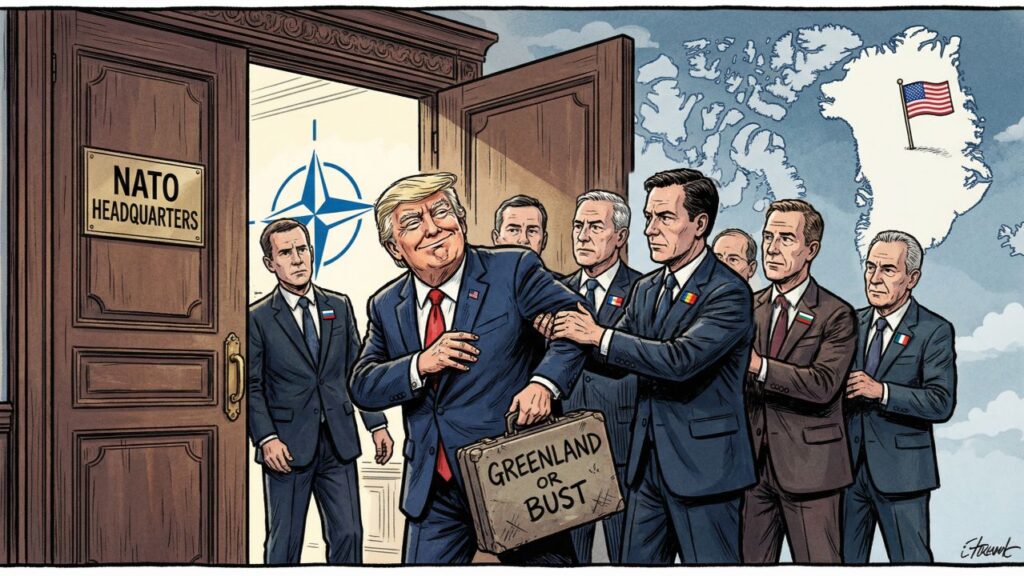
The North Atlantic Treaty Organization faces an unprecedented crisis as President Donald Trump escalates his campaign to acquire Greenland through tariffs, diplomatic pressure, and refusal to rule out military force against a NATO ally. While conventional analysis portrays this as reckless provocation, a more systematic examination reveals a potentially calculated strategy: Trump may be engineering circumstances that would compel NATO allies to expel the United States from the alliance, thereby circumventing Congressional restrictions on voluntary withdrawal while preserving domestic political advantages.
This analysis examines the legal constraints Trump faces, the mechanics of NATO expulsion, and the strategic calculus that would make forced ejection preferable to unilateral withdrawal. The objective is not to endorse or critique the approach, but to assess its plausibility as a coherent strategic option.
The Congressional Firewall
Trump’s freedom to withdraw from NATO unilaterally was substantially curtailed in December 2023 when Congress enacted Section 1250A of the National Defense Authorization Act. This provision, championed by then-Senator Marco Rubio (now Trump’s Secretary of State) and Senator Tim Kaine, prohibits the President from suspending, terminating, or withdrawing the United States from the North Atlantic Treaty without either a two-thirds Senate supermajority or an Act of Congress. The legislation also bars the use of appropriated funds for NATO withdrawal without Congressional approval.
The legal architecture creates formidable obstacles. Section 1250A was designed to maximize the likelihood that any withdrawal attempt would face successful judicial challenge by establishing clear Congressional opposition, thereby placing presidential authority “at its lowest ebb” under the Youngstown framework for separation of powers. By expressly prohibiting withdrawal, Congress has rejected any claim of exclusive presidential authority and teed up a justiciable controversy that courts would have difficulty dismissing on political question grounds.
However, significant legal ambiguity remains. A September 2020 Office of Legal Counsel opinion during Trump’s first term argued that “Congress cannot regulate the President’s decision to exercise a right of the United States to withdraw from a treaty”. This position rests on the theory that treaty termination constitutes an exclusive presidential power over foreign affairs and diplomatic communication, even in the face of statutory restrictions. While scholars debate whether courts would ultimately sustain this argument, the legal uncertainty creates risks for any president attempting unilateral withdrawal.
More fundamentally, even if Trump possessed the legal authority to ignore Section 1250A, doing so would require him to defy a law passed with overwhelming bipartisan support. The 2023 NDAA containing the NATO restriction was enacted with veto-proof margins, and Congress demonstrated its willingness to override Trump vetoes when it did so for the first time in January 2021 on a previous NDAA by an 81-13 Senate vote. A direct confrontation with Congress over NATO would generate intense political blowback and consume political capital Trump might prefer to preserve for other priorities.
The Expulsion Alternative
NATO’s founding treaty contains no mechanism for expelling a member state. Article 13 of the North Atlantic Treaty provides only for voluntary withdrawal: after the treaty has been in force for twenty years, “any Party may cease to be a Party one year after its notice of denunciation has been given to the Government of the United States”. Notably, the depositary function was assigned to the U.S. government, an indication that the alliance’s founders never contemplated American withdrawal.
Yet the absence of an explicit expulsion clause does not render expulsion impossible. International law scholars have identified a mechanism under the Vienna Convention on the Law of Treaties that could enable NATO allies to suspend or terminate U.S. membership. Article 60 of the Vienna Convention establishes that a “material breach” of a multilateral treaty permits other parties to suspend the treaty’s operation in their relations with the defaulting state or to terminate it entirely by unanimous agreement (excluding the defaulting party).
A material breach consists of either (a) repudiation of the treaty, or (b) “the violation of a provision essential to the accomplishment of the object or purpose of the treaty”. The North Atlantic Treaty’s preamble and Article 2 establish that NATO is not merely a military alliance but a community of values committed to “the principles of democracy, individual liberty, and the rule of law”. Article 1 explicitly requires parties to “settle any international dispute in which they may be involved by peaceful means”.
During NATO’s drafting in 1948-49, Canada proposed including an explicit expulsion mechanism for members that violated alliance principles, but this was dropped to avoid appearing “doubtful” of allies before they even joined. However, Secretary of State Dean Acheson told the Senate Foreign Relations Committee in 1949 that while an explicit expulsion provision was unnecessary, “if you can describe the sort of objectives that are shared by all of these countries, and one of them should no longer be able to be seeking those objectives, then the basis is laid for a separation”. The Senate report on the treaty agreed that while expulsion language was “unnecessary and inappropriate,” if a member “persistently violates the principles contained in the pact, the other members will no longer be obligated to assist that member”.
This legal framework has never been invoked in NATO’s 75-year history, but it came under serious consideration in 2019 when Turkey launched military operations in Syria against Kurdish forces supported by other NATO allies. Legal scholars argued that Turkey’s actions could constitute a material breach warranting suspension or expulsion. The precedent demonstrates that the Vienna Convention mechanism, while extreme, is available as a last-resort option when an ally’s behavior fundamentally contradicts the alliance’s foundational principles.
Greenland as Catalyst
Trump’s escalating campaign to acquire Greenland creates the precise circumstances that could trigger the material breach mechanism. On January 17, 2026, Trump announced 10% tariffs on Denmark, Norway, Sweden, France, Germany, the United Kingdom, the Netherlands, and Finland, all NATO allies, increasing to 25% on June 1 “until such time as a Deal is reached for the Complete and Total purchase of Greenland”. Treasury Secretary Scott Bessent defended the tariffs as preventing “a national emergency” through “geopolitical decision” and leveraging “the economic might of the U.S. to avoid a hot war”.
Crucially, Trump has repeatedly refused to rule out military action to seize Greenland. When asked directly whether force remained on the table, he declined to provide assurances. This ambiguity is strategically significant: by maintaining the credible threat of military action without explicitly committing to it, Trump maximizes pressure on Denmark and other NATO allies while preserving deniability.
Any U.S. military action against Greenland, a self-governing territory of Denmark under NATO’s Article 5 protection, would create an unprecedented crisis. Article 5 stipulates that “an armed attack against one or more [NATO parties] in Europe or North America shall be considered an attack against them all,” obligating members to take “such action as it deems necessary, including the use of armed force, to restore and maintain the security of the North Atlantic area”. Danish officials have explicitly stated that Denmark would invoke Article 5 if attacked by the United States. The chairman of Denmark’s Defence Committee, Rasmus Jarlov, stated that a U.S. attack “would mean war with Denmark” and that retaliation would include deadly force.
This scenario, a NATO member attacking another NATO member, has no precedent or established resolution mechanism. The North Atlantic Treaty was constructed on the assumption that conflicts would be resolved peacefully under Article 1. Military action against Greenland would simultaneously violate Article 1’s requirement for peaceful dispute resolution and create a paradoxical Article 5 situation where NATO allies would be treaty-bound to defend Denmark against the alliance’s most powerful member.
Even short of outright military invasion, sustained economic coercion through tariffs combined with military threats could be characterized as a violation of Article 1’s spirit and purpose. When coupled with Trump’s broader pattern of treating NATO commitments as conditional on burden-sharing metrics, including his notorious 2017 omission of explicit Article 5 endorsement and his 2024 campaign statement that he would “encourage” Russia to attack delinquent allies, a case emerges that the United States under Trump’s leadership no longer shares the fundamental values and commitments embodied in the treaty.
European Response: Operation Arctic Endurance
NATO allies have not remained passive. Seven European nations (Germany, Sweden, Norway, France, the United Kingdom, the Netherlands, and Finland) deployed military forces to Greenland in mid-January as part of “Operation Arctic Endurance”. Officially described as training for Arctic conditions and bolstering NATO’s regional presence, the deployment served unmistakable strategic messaging: European NATO members were prepared to defend Danish sovereignty against internal threats, not just external ones.
Danish Deputy Prime Minister Troels Lund Poulsen stated the goal was “to establish a more permanent military presence with a larger Danish contribution”. The timing and composition of the deployment, precisely the eight nations Trump subsequently targeted with Greenland-related tariffs, suggests coordinated signaling by European allies that they view Trump’s Greenland campaign as an Article 5 matter, not merely a bilateral U.S.-Denmark dispute.
EU Defence Commissioner Andrius Kubilius stated bluntly that a U.S. invasion of Greenland “would be the end of NATO” and that EU members would be obligated to come to Denmark’s assistance. European Commission President Ursula von der Leyen called Trump’s tariff threats “a mistake especially between long-standing allies” and warned that “when friends shake hands, it must mean something”. She also announced that Europe was “working on a massive European investment surge in Greenland” and preparing “its own security strategy” in response to the crisis.
The rhetoric from European capitals has grown increasingly confrontational. Norwegian Prime Minister Jonas Gahr Støre revealed that Trump had sent a message stating that because Norway declined to award him the Nobel Peace Prize, he no longer felt “an obligation to think purely of Peace” regarding Greenland. French President Emmanuel Macron, in a leaked private message Trump publicly shared, wrote “I do not understand what you are trying with Greenland”. EU leaders have characterized Trump’s approach as “intimidation,” “blackmail,” and threatening the fundamental integrity of the alliance.
This coordinated European response suggests allies are establishing a diplomatic and military posture that could support a material breach determination if Trump’s escalation continues. By deploying forces, articulating Article 5 obligations, and publicly rejecting Trump’s campaign, European governments are creating the factual predicate for arguing that the United States has repudiated its NATO commitments.
Strategic Advantages of Forced Ejection
From Trump’s perspective, being expelled from NATO offers several advantages over unilateral withdrawal:
1. Circumventing Congressional Restrictions
Expulsion would be initiated by other NATO members, not by Trump. Section 1250A prohibits the president from withdrawing, suspending, or terminating U.S. membership, but it does not, and constitutionally cannot, prevent other sovereign nations from exercising their rights under international law to suspend a treaty relationship with the United States based on material breach. If NATO allies voted unanimously to expel the U.S., Trump could accept the expulsion without violating the statute, since he would not be the actor initiating the separation.
This distinction matters legally and politically. Trump could argue that he attempted to fulfill U.S. obligations but was forced out by unreasonable European allies, thereby complying with Section 1250A’s prohibition on presidential action while achieving the substantive outcome of NATO exit. While Congress might attempt to legislate a requirement that the U.S. dispute any expulsion or seek remedies, such legislation would raise serious constitutional questions about Congress’s ability to dictate the executive branch’s response to actions by foreign sovereigns.
2. Political Narrative Control
Trump has consistently framed NATO in zero-sum terms, portraying European allies as “freeloaders” who exploit American security guarantees while failing to meet defense spending commitments. This narrative resonates with a significant portion of his political base and taps into a decades-long bipartisan frustration with European burden-sharing dating back to the Nunn Amendment debates of the 1980s.
If Trump were to unilaterally withdraw from NATO, he would face accusations of abandoning allies, emboldening Russia, and undermining American global leadership, criticisms that could erode support even among Republicans who share his skepticism of multilateral commitments. Polling shows that while overall American support for NATO remains strong (68% favorable), there is substantial partisan divergence: Democratic support ranges from 76-91%, while Republican support has declined to 43-59%. Among conservative Republicans specifically, support is only 41%. This suggests Trump’s base is divided on NATO, with traditional national security conservatives favoring the alliance while populist America First constituencies are skeptical.
Being expelled, by contrast, would allow Trump to claim victimhood and portray the alliance breakdown as Europe’s fault. He could argue that he fought for American interests (demanding fair burden-sharing, pushing for higher defense spending (European allies did commit to 5% of GDP by 2035 during Trump’s second term), and protecting vital U.S. security interests in Greenland) but that ungrateful, weak, or ideologically captured European allies chose to “kick America out” rather than reform the alliance.
This narrative provides several political benefits:
- Validates the “America First” critique: Expulsion would seem to confirm Trump’s longstanding claim that NATO is fundamentally unfair to the United States, with European allies more interested in constraining American sovereignty than genuinely cooperating.
- Scapegoats Europe: Rather than Trump abandoning allies, allies abandoned America. The responsibility for alliance dissolution shifts to European capitals, particularly if the triggering event involves European military deployment to Greenland in opposition to U.S. security interests.
- Preserves flexibility: Trump could simultaneously claim he “saved billions” in NATO costs while arguing he was prepared to remain in the alliance if Europe had been reasonable. This allows him to appeal both to fiscal hawks and to traditional defense conservatives.
3. Avoiding Court Battles
If Trump attempted to withdraw unilaterally in defiance of Section 1250A, the House Bipartisan Legal Advisory Group could authorize litigation challenging the withdrawal. While justiciability barriers might ultimately prevent judicial resolution, the litigation would create months or years of legal uncertainty, potentially enjoining the withdrawal pending resolution. Trump learned during his first term that even ultimately successful assertions of executive authority can be substantially delayed by litigation.
Expulsion initiated by NATO allies would moot this litigation risk. There would be no presidential action to challenge, no funds appropriated in violation of statute, and no domestic legal violation to remedy. American courts generally lack jurisdiction to compel foreign sovereigns to maintain treaty relationships with the United States, particularly when those sovereigns are acting pursuant to established international law mechanisms like the Vienna Convention.
4. Dealmaking Optionality
Trump’s negotiating style is characterized by maximalist opening positions, apparent irrationality to create uncertainty, and willingness to accept small concessions as “wins” if accompanied by deference. The Greenland campaign fits this pattern: an extreme demand (territorial acquisition) coupled with escalating threats (tariffs, potential military force) that create crisis conditions forcing counterparties to the negotiating table.
If the actual objective is not acquiring Greenland but rather exiting NATO with political cover, the Greenland demand serves as an impossible ask that justifies either (a) European allies expelling the U.S. when Trump refuses to back down, or (b) Trump accepting a face-saving “compromise” that includes significant NATO restructuring, European security concessions, or other outcomes he values.
This optionality distinguishes forced expulsion from unilateral withdrawal. Withdrawal is a binary decision with limited flexibility once initiated. Provoked expulsion allows Trump to modulate the level of provocation, extract concessions during the crisis, and potentially de-escalate if political conditions change, all while maintaining that his hardline position was necessary to defend American interests.
Mechanics of Implementation
For this strategy to succeed, the following sequence would need to unfold:
Phase 1: Escalating Provocation (Current)
Trump continues demanding Greenland acquisition, refuses to rule out military force, maintains tariff pressure on eight NATO allies, and positions any European resistance as evidence of alliance dysfunction. Treasury Secretary Bessent has already articulated the economic coercion rationale, framing tariffs as “avoiding a national emergency” through use of “economic might”. This establishes the necessary predicate that Greenland control is a vital U.S. security interest, not a negotiable preference.
Phase 2: European Defensive Posture
European allies continue Operation Arctic Endurance and possibly expand military deployment to Greenland. Public statements from European leaders emphasize Article 5 obligations and characterize Trump’s campaign as threatening alliance cohesion. This creates the factual record that European allies view U.S. behavior as incompatible with NATO membership, establishing grounds for material breach.
Phase 3: Crisis Event
A triggering incident occurs that crystallizes the material breach claim. This could be:
- Trump orders military exercises or shows of force near Greenland that European allies characterize as preparation for invasion
- U.S. economic coercion intensifies to levels European allies deem incompatible with Article 1’s peaceful dispute resolution requirement
- Trump makes explicit statements conditioning Article 5 commitments on Greenland acquisition or other demands allies cannot accept
- A direct U.S.-European military confrontation occurs in Greenland’s territorial waters or airspace
Phase 4: Material Breach Declaration
Led by major European powers (likely France, Germany, and the UK), NATO allies invoke the Vienna Convention’s material breach provisions. They argue that the United States has systematically violated Articles 1 and 2 of the North Atlantic Treaty by:
- Threatening military force against a NATO ally (Denmark/Greenland)
- Imposing punitive economic measures on multiple allies as coercion
- Treating Article 5 collective defense commitments as conditional on unilateral U.S. demands
- Repudiating the treaty’s foundational premise of peaceful dispute resolution and shared democratic values
This declaration would likely occur through a North Atlantic Council meeting, with a formal legal opinion prepared by alliance lawyers justifying the material breach determination under international law.
Phase 5: Expulsion Vote
The North Atlantic Council, excluding the United States, votes unanimously to suspend U.S. membership rights and calls on the U.S. to withdraw voluntarily under Article 13. This follows the two-step process implied by the Vienna Convention and the Council of Europe’s suspension/expulsion precedent with Russia in 2022. When the U.S. declines to withdraw voluntarily (Trump would almost certainly characterize any such request as illegitimate European overreach), the Council votes to terminate the North Atlantic Treaty’s applicability to the United States effective immediately or after a specified period.
Crucially, this vote would require unanimity of the 31 other NATO members (excluding the U.S.). This is the mechanism’s most significant vulnerability, as even a single dissenting ally could block expulsion. However, if the crisis involves clear U.S. military threats against a member state, achieving unanimity becomes more plausible. The precedent of Russia’s expulsion from the Council of Europe, accomplished in 20 days with unanimous support after the Ukraine invasion, demonstrates that existential threats to the alliance’s integrity can overcome normal bureaucratic inertia and national interest divergences.
Phase 6: Trump’s Response
Trump characterizes the expulsion as European ingratitude and evidence that NATO was no longer serving American interests. He emphasizes that he sought to remain in the alliance on fair terms but that European allies chose to expel the United States rather than reform. He may simultaneously claim victory, “I got the U.S. out of this terrible deal”, while blaming Europe for the alliance’s collapse.
Domestically, this creates a wedge between Congressional NATO supporters (who passed Section 1250A to prevent withdrawal) and Trump. Trump can argue he complied with the statute, he did not withdraw, but Congress’s attempt to force continued U.S. participation in an alliance that no longer wanted American membership was both impractical and beneath American dignity.
Plausibility Assessment
Several factors support the plausibility of this strategy:
Supporting Factors:
- Trump’s demonstrated willingness to violate norms: Trump’s track record includes unprecedented breaks with diplomatic protocol, including the 2016 phone call with Taiwan’s president to provoke China, threats to abandon NATO allies in his first term, and recent military action in Venezuela. The Greenland campaign is escalatory but consistent with his broader approach to foreign policy as transactional dealmaking unconstrained by alliance relationships.
- Domestic political incentives align: Exiting NATO has been a recurring Trump interest since his first term, when he “privately said he wanted to withdraw” and raised the issue “several times over the course of the previous year” according to 2019 reporting. Former National Security Advisor John Bolton predicted “in a second Trump term, we’d almost certainly withdraw from NATO”. However, legal and political constraints now prevent unilateral withdrawal, making forced expulsion a plausible alternative pathway.
- European strategic autonomy momentum: European leaders are already pursuing greater defense independence from the United States, driven by concerns about American reliability predating but intensified by Trump’s return. The EU’s ReArm Europe initiative, discussions of European nuclear deterrence, and proposals to “Europeanize NATO” suggest Europe is psychologically and institutionally preparing for reduced American involvement. This creates conditions where European allies might actually prefer U.S. expulsion to prolonged uncertainty about American commitments.
- Greenland provides legitimate security rationale: While most observers view Trump’s Greenland campaign as irrational or purely personal, the island does hold genuine strategic value: location along Arctic shipping routes, rare earth mineral deposits, missile defense installations, and potential Russian/Chinese influence. By framing Greenland control as a vital security interest comparable to the Monroe Doctrine (“Donroe Doctrine”), Trump establishes a rationale that could sustain escalation if challenged. Treasury Secretary Bessent’s defense of the tariffs as “avoiding a national emergency” through “geopolitical decision” suggests the administration is committed to this framing regardless of international reaction.
- Legal ambiguity creates operational space: The unsettled constitutional question of whether the president has exclusive treaty termination authority means Trump could plausibly argue that even after expulsion, he retains discretion over how to respond, what remedies to seek, and whether to attempt to dispute the expulsion. This legal gray zone gives him flexibility that would not exist with a clearly illegal unilateral withdrawal.
Countervailing Factors:
- Unanimity requirement is extremely high bar: Expelling the United States would require all 31 other NATO members to vote in favor. This seems nearly impossible given diverse national interests and the economic and security costs of breaking with America. Eastern European members like Poland and the Baltic states are particularly reliant on U.S. security guarantees against Russia and would face enormous pressure to block expulsion even if they opposed Trump’s Greenland campaign. Polling shows Poland and Albania are the only NATO countries where majorities approve of U.S. leadership (68% and 64% respectively), suggesting these allies would be highly resistant to expulsion.
- Ambiguity about whether Trump wants full exit or just restructuring: Trump’s actual objectives remain unclear. He has simultaneously criticized NATO burden-sharing while claiming to have strengthened the alliance by securing the 5% GDP commitment. He appointed Marco Rubio, co-sponsor of the legislation blocking NATO withdrawal, as Secretary of State. This suggests Trump’s team includes both NATO skeptics (JD Vance, who advocates pullback from Europe) and alliance supporters (Rubio, traditional national security officials). The Greenland crisis could be genuine pursuit of territorial acquisition, a negotiating tactic for alliance reform, or a cover for exit, or some combination thereof.
- Domestic political costs remain substantial: Even if expelled rather than withdrawing, Trump would face intense criticism from defense hawks, foreign policy establishment, and bipartisan Congressional majorities that support NATO. The military and intelligence communities would likely oppose loudly, creating implementation challenges. While Trump has demonstrated willingness to defy expert consensus, the political costs could exceed those of simply maintaining status quo NATO membership while continuing to pressure allies on burden-sharing, an approach that has proven effective in securing the 5% commitment without rupturing the alliance.
- Unpredictability of crisis escalation: The most dangerous aspect of this strategy is the requirement for a crisis severe enough to justify material breach but controlled enough to avoid actual military conflict. If European forces in Greenland and U.S. forces have a confrontation that results in casualties, the situation could spiral beyond anyone’s control into genuine conflict between NATO members. The risk of miscalculation or inadvertent escalation makes this an extremely high-stakes approach.
- Alternative explanation: simple provocation without exit intent: It is entirely possible that Trump’s Greenland campaign represents straightforward coercive diplomacy aimed at extracting concessions (rare earth minerals access, expanded Thule Air Base rights, Arctic security cooperation, trade concessions) without any intention of forcing NATO exit. His negotiating pattern of extreme initial demands followed by acceptance of modest concessions suggests the current crisis could be a standard Trumpian negotiation rather than a calculated exit strategy. The absence of any leaked reporting suggesting advisors are planning for NATO expulsion (whereas leaks about first-term withdrawal discussions were extensive) weighs against the hypothesis that this is an organized strategy.
Implications
If Trump is indeed pursuing forced expulsion, the implications would be profound:
For the United States:
The end of NATO membership would represent the most significant reorientation of American grand strategy since 1945. The United States would retain bilateral defense relationships and treaty commitments (Japan, South Korea, Australia, etc.) but would lose the institutionalized framework for European security cooperation that has anchored transatlantic relations for 75 years. This could accelerate America First isolationism and refocus U.S. defense priorities on the Western Hemisphere and Indo-Pacific, consistent with Trump’s “Donroe Doctrine” framing and his administration’s emphasis on burden-sharing and alliance restructuring.
The domestic political consequences would include intense polarization around alliance commitments, potential Congressional attempts to rejoin NATO over presidential objections (raising novel constitutional questions), and possible long-term damage to Republican electability if voters conclude the party has abandoned American global leadership.
For Europe:
European allies would be forced into the strategic autonomy they have discussed theoretically but never seriously implemented. Estimates suggest Europe would need to add 300,000 troops, increase defense spending by €250-800 billion annually, and invest €1 trillion+ over a decade to replicate core U.S. capabilities in air defense, intelligence, logistics, and nuclear deterrence. The financial burden would fall primarily on Germany, France, and the UK at a time when all three face fiscal constraints and political instability.
More fundamentally, without U.S. nuclear umbrella, Europe would need to develop independent nuclear deterrence, likely meaning expansion of French and British arsenals and possibly German nuclear weapons, which would profoundly destabilize European security dynamics and potentially violate Non-Proliferation Treaty commitments.
The organizational challenge would be equally severe. NATO’s command structures, interoperability standards, and integrated planning are built around U.S. leadership and capabilities. Creating a “Europeanized NATO” or alternative European defense architecture would require 2-3 years minimum and unprecedented political consensus across fiscal and geographic divides. Whether European democracies could sustain this effort while managing simultaneous economic, migration, and governance challenges is highly uncertain.
For NATO:
The alliance would face an existential choice: continue without the United States (representing 70% of NATO defense spending and the vast majority of power projection capabilities) or dissolve and reconstitute as a European-only defense pact. The former seems implausible given the massive capability gap; the latter would represent a fundamental break with 75 years of transatlantic security architecture.
An alternative scenario involves a bifurcated outcome: a U.S.-Canada defense partnership for North America, a European defense union for continental security, and bilateral coordination mechanisms replacing the integrated NATO structure. This could preserve elements of transatlantic cooperation while acknowledging divergent strategic priorities.
For the Global Order:
U.S.-NATO rupture would accelerate multipolarity and potentially embolden revisionist powers. Russia would view U.S. expulsion as vindication of its long-standing opposition to NATO expansion and as an opportunity to reassert influence in Eastern Europe. China would perceive reduced American commitment to treaty allies globally, potentially increasing risks around Taiwan. The demonstration that even America’s most important alliance can collapse would raise questions about the durability of all U.S. security commitments, potentially triggering nuclear proliferation by allies (Japan, South Korea, Taiwan) questioning American extended deterrence.
Conversely, some analysts argue that a leaner, more realistic U.S. foreign policy focused on vital interests rather than diffuse global commitments could enhance American strategic sustainability and redirect resources to great power competition with China. This perspective holds that NATO in its current form represents a Cold War anachronism that constrains American flexibility and subsidizes European free-riding, and that a strategic realignment, however it occurs, serves long-term U.S. interests.
Conclusion
The hypothesis that Trump seeks to engineer NATO expulsion rather than attempt unilateral withdrawal is plausible though not proven. The strategy would address real constraints (Congressional prohibition on withdrawal), offer political advantages (scapegoating Europe, preserving America First narrative), and align with Trump’s demonstrated negotiating patterns (maximalist demands, provocation, acceptance of small concessions or enemy action as “wins”).
The Greenland crisis creates the necessary conditions: impossible demands, escalating economic and implicit military pressure, refusal to back down, and European defensive responses that could constitute the factual predicate for material breach. The mechanism exists under international law through the Vienna Convention, and recent precedent (Russia’s Council of Europe expulsion) demonstrates it can be executed rapidly when political will exists.
However, formidable obstacles remain. The unanimity requirement for expulsion is exceptionally high, Trump’s actual intentions are ambiguous, domestic political costs would be substantial even for expulsion versus withdrawal, and the crisis escalation required creates genuine risks of military conflict. Alternative explanations (that this is standard Trumpian coercive negotiation for more modest concessions, or simply impulsive provocation without strategic coherence) fit the available evidence equally well.
What can be stated with confidence is that Trump faces binding Congressional constraints on NATO withdrawal, appears determined to fundamentally reshape or exit the alliance, and has chosen Greenland as the vehicle for maximum provocation of NATO allies. Whether this represents calculated strategy toward forced expulsion or a different objective will become clearer as the crisis unfolds and the European response solidifies. The coming months will reveal whether NATO can survive its most serious internal crisis since its founding, or whether Trump has identified a mechanism to accomplish through allied action what Congress prohibited him from doing unilaterally.
Related reading
- Strategic Chaos or Chaotic Strategy? Analyzing Trump's Approach to NATO Restructuring Through the Greenland Crisis
- A Bill of Indictment for Murder and Genocide Against the American Military and Trump, as its Commander and Chief
- Trump Blackmails Allies Abroad While Being Blackmailable at Home: The Irony of It All
- Susie Wiles Can’t Restrain Trump, So She Covers for the Malignant Orange Baby