Executive Summary
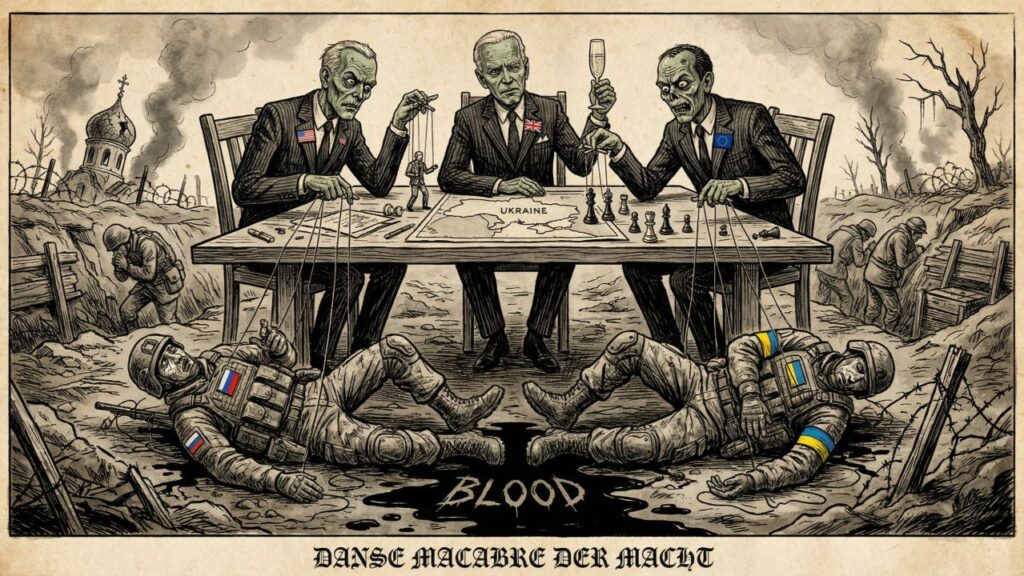
The war in Ukraine was not an accident. It was not the product of an irrational Russian dictator waking up one morning and deciding to invade a peaceful neighbor. It was the culmination of a thirty-year Western strategy to use Ukraine as a weapon against Russia, a strategy explicitly articulated by American strategists, documented in diplomatic cables, admitted by European leaders, and willingly embraced by Ukrainian political elites who sacrificed their country’s neutrality, territorial integrity, and the lives of hundreds of thousands of their citizens in service of a geopolitical project that was never about Ukrainian sovereignty.
What makes this tragedy particularly damning is that it was predicted. Repeatedly. By American diplomats, European statesmen, and Russian officials who warned for decades that NATO expansion into Ukraine would provoke exactly the crisis we are witnessing. Those warnings were not merely ignored, they were treated as evidence that the strategy was working, that Russia could be provoked into a conflict that would justify permanent NATO militarization of Eastern Europe and provide the predicate for regime change in Moscow.
This article documents how Ukraine was herded toward war through a deliberate process that included:
- Strategic instrumentalization articulated in foundational U.S. policy documents identifying Ukraine as the lever to contain Russia
- Regime change operations backed by billions in U.S. funding to install anti-Russian governments in Kyiv
- Deceptive diplomacy in which peace agreements were used as covers to buy time for Ukrainian military buildup
- Sabotaged negotiations in which Western powers actively blocked peace deals that would have ended the war in its first weeks
- Ideological radicalization through post-2014 policies that defined Ukrainian nationhood as incompatible with Russian culture, language, and identity
Equally important is documenting Ukraine’s willing participation. This was not a helpless victim dragged into conflict. Ukrainian political elites, particularly after 2014, made a conscious choice to align their country’s identity and security policy in permanent opposition to Russia, to pursue NATO membership despite knowing it crossed Russian red lines, and to implement cultural policies designed to erase Russian influence even in regions where Russian-speakers were the majority.
Russia’s invasion was illegal under international law. But legality and causation are not the same thing. The West created the conditions that made this war probable, then blocked every off-ramp that might have prevented it. Understanding how we arrived at this catastrophe is the prerequisite for avoiding the next one.
Part I: The Grand Chessboard, Ukraine as Weapon
Brzezinski’s Blueprint
The use of Ukraine as an instrument to weaken Russia was not a conspiracy theory whispered in dimly lit rooms. It was openly advocated in what became the foundational text of post-Cold War American grand strategy: Zbigniew Brzezinski’s 1997 The Grand Chessboard: American Primacy and Its Geostrategic Imperatives.
Brzezinski, who served as National Security Advisor under Jimmy Carter and later advised Barack Obama, laid out the logic with remarkable clarity. Eurasia, he argued, was “the chessboard on which the struggle for global primacy continues to be played.” The central strategic imperative for the United States was to prevent the emergence of any Eurasian power capable of challenging American dominance. Russia, even in its diminished post-Soviet state, remained the primary obstacle.
The key to containing Russia, Brzezinski concluded, was Ukraine: “Ukraine, a new and important space on the Eurasian chessboard, is a geopolitical pivot because its very existence as an independent country helps to transform Russia. Without Ukraine, Russia ceases to be a Eurasian empire.”
This was not analysis. It was a strategic recommendation. Brzezinski explicitly advocated NATO expansion into Ukraine, fully aware that Russia would view this as an existential threat. He dismissed Russian objections as irrelevant: “Russia cannot be allowed to say no to Ukraine’s ultimate admission to NATO.”
The goal was transparent: fracture the historical, cultural, and economic ties between Russia and Ukraine, pull Ukraine into Western institutions, and thereby ensure Russia could never reconstitute itself as a great power. Ukraine was not the beneficiary of this strategy. It was the weapon.
The $5 Billion Investment in “Democracy”
Theory became practice. In December 2013, as Ukraine’s Euromaidan protests escalated, Assistant Secretary of State Victoria Nuland gave a speech to the U.S.-Ukraine Foundation in which she revealed the scale of American involvement: “Since Ukraine’s independence in 1991, the United States has supported Ukrainians as they build democratic skills and institutions… We’ve invested over $5 billion to assist Ukraine in these and other goals.”
Five billion dollars. To put that in context, Ukraine’s entire GDP in 2013 was approximately $180 billion. The United States spent the equivalent of nearly 3% of Ukraine’s annual economic output over two decades funding civil society organizations, political parties, media outlets, and NGOs, all ostensibly in the name of democracy promotion.
Nuland’s speech came weeks before the February 2014 coup that overthrew Ukraine’s democratically elected (if deeply flawed) President Viktor Yanukovych. The United States did not merely support the protests. American officials were on the ground, coordinating with opposition leaders, and, as a leaked phone call between Nuland and U.S. Ambassador Geoffrey Pyatt revealed, literally deciding which politicians would form the post-coup government.
In that infamous call, Nuland discussed “midwifing” a new Ukrainian government, dismissing European concerns with the memorable phrase “Fuck the EU,” and anointing Arseniy Yatsenyuk as the preferred prime minister, which is precisely what happened. This was not democracy promotion. This was regime change, conducted with the same toolkit the United States had employed from Chile to Iran to Yugoslavia.
William Burns’ Warning, Ignored
Not everyone in the U.S. foreign policy establishment was blind to the dangers. In February 2008, as NATO leaders prepared to issue a declaration promising eventual membership to Ukraine and Georgia, William Burns, then U.S. Ambassador to Moscow and currently Director of the CIA, sent a cable to Washington titled “Nyet Means Nyet: Russia’s NATO Enlargement Redlines.”
Burns reported on conversations with Russian officials, foreign policy experts, and pro-Western NGO leaders. The message was unanimous: NATO expansion into Ukraine would be viewed as a direct threat to Russian security, would empower nationalist hardliners in Moscow, and could provoke a violent response.
The cable is worth quoting at length:
“Ukrainian entry into NATO is the brightest of all redlines for the Russian elite (not just Putin). In more than two and a half years of conversations with key Russian players, from knuckle-draggers in the dark recesses of the Kremlin to Putin’s sharpest liberal critics, I have yet to find anyone who views Ukraine in NATO as anything other than a direct challenge to Russian interests.”
Burns went further, predicting with eerie precision what would unfold six years later:
“Experts tell us that Russia is particularly worried that the strong divisions in Ukraine over NATO membership, with much of the ethnic-Russian community against membership, could lead to a major split, involving violence or at worst, civil war. In that eventuality, Russia would have to decide whether to intervene; a decision Russia does not want to have to face.”
The cable was read. The warning was understood. And it was ignored. At the April 2008 Bucharest Summit, NATO issued a declaration stating that “Ukraine and Georgia will become members of NATO.”
Russia’s response was immediate. In August 2008, Russia invaded Georgia following provocations in South Ossetia. The message was unambiguous: NATO expansion into former Soviet space would be met with force. The West proceeded anyway.
Part II: The Maidan and the Purge, Ukraine’s Willing Radicalization
The 2014 Turning Point
The February 2014 Euromaidan revolution is typically presented in Western media as a popular uprising against corruption and authoritarianism, a spontaneous expression of Ukraine’s European aspirations. The reality was more complex and far darker.
Yanukovych was indeed corrupt, authoritarian, and incompetent. But he was also democratically elected in elections that international observers deemed free and fair. His sin, from Washington’s perspective, was not corruption, it was geopolitical orientation. In November 2013, under pressure from Moscow, Yanukovych suspended preparations for an association agreement with the European Union, opting instead for a Russian economic package.
The protests that followed were genuine. But they were also exploited. Western governments, NGOs funded by U.S. and European money, and Ukrainian nationalist groups transformed the demonstrations into a regime-change operation. When violence escalated in February 2014, with snipers killing both protesters and police in circumstances that remain disputed, Yanukovych fled the country.
What followed was not a liberal democratic revolution. It was the capture of the Ukrainian state by nationalist forces whose defining ideology was anti-Russian. The interim government immediately moved to repeal the 2012 law that had granted regional status to minority languages, including Russian, a symbolic declaration that Russian-speakers, who constituted nearly 30% of Ukraine’s population, were no longer welcome as equals.
Though that specific repeal was vetoed, the trajectory was set. Post-Maidan Ukraine would define itself not as a multiethnic, multilingual bridge between East and West, but as a European nation that had to purge itself of Russian influence to achieve authentic sovereignty.
The Language Laws, Cultural Warfare
In April 2019, Ukraine’s parliament passed the “Law on Ensuring the Functioning of Ukrainian as the State Language,” which took full effect in July of that year. The law was described by its supporters as a necessary step to protect Ukrainian identity after decades of Russification. Its critics (including Russian-speaking Ukrainians, the Council of Europe, and human rights organizations) saw it as discriminatory legislation designed to marginalize millions of citizens.
The law mandated Ukrainian as the exclusive language in government, education, media, culture, and most commercial activity. It required that all print media be published in Ukrainian, that radio and television broadcasts be predominantly in Ukrainian, and that Ukrainian be used in all schools, even in regions where the vast majority of residents spoke Russian at home.
For ethnic Russians and Russian-speaking Ukrainians in Crimea, Donbas, and southern Ukraine, the message was clear: You do not belong. Your language is not legitimate. Your culture is a relic of colonialism that must be eradicated.
This was not nation-building. It was nation-destruction. You cannot create a viable state by declaring that 30% of your population is linguistically and culturally illegitimate. Yet that is precisely what post-2014 Ukraine attempted, with Western encouragement and funding.
The Decolonial Project
Ukrainian nationalists framed this transformation using the language of decolonization. Russia, they argued, had been a colonial power that suppressed Ukrainian identity, imposed Russian language and culture, and treated Ukraine as a subordinate territory rather than an independent nation.
The solution, according to this framework, was to “decolonize” Ukrainian society, to purge Russian cultural influence, rewrite history textbooks to emphasize Ukrainian grievances, and align the country’s identity exclusively with Europe. As one analysis from the research documents describes:
“The monist-primordial vision treats Ukraine as an ancient nation requiring complete Russian severance, viewing Russian cultural elements as colonial contamination to be purged. Post-2014 dominance of the monist framework triggered systematic purges of political parties, media, language, religion, and culture. This decolonial identity treats half of Ukraine’s population as foreign implants, an approach guaranteeing domestic instability and international crisis.”
The problem with the decolonial framework, applied to Ukraine, is that it falsifies history. Unlike European colonies in Africa or Asia, Ukraine was not a distant territory conquered and exploited by a foreign power. It was part of the same cultural and political space as Russia for centuries. Millions of Ukrainians and Russians intermarried. Cities like Kharkov and Odessa were Russian-speaking centers of commerce and culture. The Soviet Union’s industrial infrastructure was built by Ukrainians and Russians working together.
You cannot simply declare that history illegitimate and expect the people whose lives were shaped by it to acquiesce. Yet that is what Ukraine’s post-Maidan leadership attempted. The result was civil war.
Part III: The Minsk Deception, Buying Time for War
The Donbas Uprising
Following the Maidan coup, Russian-speaking regions of eastern Ukraine rose in rebellion. In May 2014, the self-proclaimed Donetsk and Luhansk People’s Republics held referendums on independence. Official results showed overwhelming support minus 89% in Donetsk and 96% in Luhansk, though the votes were chaotic, unmonitored by international observers, and dismissed by the West as illegitimate.
Regardless of the precise numbers, it was clear that a significant portion of Donbas residents rejected the new government in Kyiv and feared for their safety under a nationalist administration. Ukraine’s military launched an “Anti-Terrorist Operation” to retake the breakaway regions. By summer 2014, full-scale war had begun.
By September 2014, after months of fighting and thousands of deaths, European leaders brokered a ceasefire. The Minsk Protocol, signed on September 5, 2014, and later supplemented by Minsk II in February 2015, established a framework: Ukraine would grant special autonomy to Donbas, hold local elections, restore economic ties, and pursue constitutional reforms to accommodate Russian-speaking regions. In exchange, the separatists would disarm and Russia would withdraw support.
The Minsk Agreements were endorsed by the UN Security Council, signed by Ukraine, Russia, France, and Germany, and presented to the world as the path to peace. It was a lie.
Merkel and Hollande Admit the Truth
In December 2022, former German Chancellor Angela Merkel gave an interview to Die Zeit in which she made a stunning admission. The Minsk Agreements, she revealed, were never intended to achieve peace. They were designed to buy time for Ukraine to build its military capability for the next phase of the conflict.
“The 2014 Minsk Agreement was an attempt to buy time for Ukraine,” Merkel stated. “Ukraine used this time to become stronger, as you can see today. The Ukraine of 2014-2015 is not the Ukraine of today.”
Days later, former French President François Hollande confirmed Merkel’s account:
“Yes, Angela Merkel is right on this point. Since 2014, Ukraine has strengthened its military posture. Indeed, the Ukrainian army was completely different from that of 2014. It was better trained and equipped. It is the merit of the Minsk agreements to have given the Ukrainian army this opportunity.”
These were not minor officials. These were the heads of state of Europe’s most powerful countries, the guarantors of the Minsk process, admitting that they had engaged in a deliberate deception. For eight years, Russia negotiated in good faith, believing that Minsk offered a framework for peace. For eight years, Ukraine and its Western backers used the ceasefire to rearm and prepare for war.
Former Ukrainian President Petro Poroshenko later echoed the same theme, stating that his goal during Minsk was to buy time to build Ukraine’s military. Russian President Vladimir Putin responded that Merkel’s admission was “completely unexpected and disappointing,” noting that it destroyed any remaining trust in Western commitments.
The RAND Corporation Blueprint
Western strategy toward Russia was not hidden. In 2019, the RAND Corporation, a think tank closely tied to the U.S. Defense Department, published a report titled Extending Russia: Competing from Advantageous Ground. The study explicitly analyzed how to exploit Russian vulnerabilities, including through Ukraine.
The report recommended “providing lethal aid to Ukraine” as a method to bleed Russian resources and bog Moscow down in a protracted conflict. It noted, however, that such a strategy carried risks: “full-scale war with Russian territorial gains would backfire,” potentially strengthening rather than weakening Russia.
The recommendation was implemented. The risk was ignored. The war occurred. Russia gained territory. And the strategy backfired exactly as RAND predicted.
Part IV: Sabotaging Peace, The Istanbul Betrayal
The March-April 2022 Negotiations
The most damning evidence that the West preferred war to diplomacy came in the first weeks of Russia’s invasion. In late March and early April 2022, negotiators from Russia and Ukraine met in Istanbul, Turkey, and came close to a framework agreement that could have ended the war within weeks of its start.
The details of the proposed deal have been confirmed by multiple mediators and participants:
- Ukraine would commit to neutrality and forego NATO membership
- Russia would withdraw to pre-invasion lines
- Ukraine’s security would be guaranteed by a group of countries (potentially including Russia, the U.S., and European states)
- Territorial disputes over Crimea and Donbas would be deferred for future negotiation
Naftali Bennett, who served as Israeli Prime Minister and mediated between Putin and Zelensky during this period, gave detailed testimony about what transpired. According to Bennett:
“Both sides very much wanted a ceasefire. Putin was willing to make huge concessions. He dropped ‘denazification’ as a requirement, which meant he would not demand regime change or the removal of Zelensky. He also agreed that Ukraine could keep its military. In exchange, Zelensky renounced NATO membership, which was the reason for Russia’s invasion in the first place.”
Bennett reported that Putin guaranteed Zelensky’s safety and that serious progress was being made. Reports at the time reflected this optimism. On March 8, 2022, Axios cited Israeli officials stating that Putin’s proposal was “difficult for Zelensky to accept but not as extreme as they anticipated. They said the proposal doesn’t include regime change in Kyiv and allows Ukraine to keep its sovereignty.”
Boris Johnson’s Intervention
Then the deal collapsed. According to Bennett, Ukrainian officials, and Turkish mediators, Western powers, specifically the United States and United Kingdom, intervened to block the agreement.
In early April 2022, British Prime Minister Boris Johnson made a surprise visit to Kyiv. According to Davyd Arakhamia, head of Ukraine’s parliamentary majority and a member of Zelensky’s negotiating team, Johnson delivered a clear message: Do not sign. The West would not support a deal that allowed Russia to claim any kind of victory. Instead, Ukraine should continue fighting, backed by Western arms and financial support.
Turkish Foreign Minister Mevlut Cavusoglu confirmed this account, stating publicly that “certain Western countries told Ukraine not to sign” the agreement. Victoria Nuland, then Under Secretary of State, admitted in a 2024 interview that “us and the Brits advised Ukraine against accepting the terms on offer in Istanbul.”
Amanda Sloat, Biden’s Senior Director for Europe at the National Security Council, went even further, acknowledging the tragic consequences of that decision:
“There is certainly a question almost three years on now…would that have been better to do before the war started, would that have been better to do in Istanbul talks. It certainly would have prevented the destruction and the loss of life.”
Let that sink in. A senior U.S. official admitted, on the record, that a peace deal in Istanbul might have been preferable to three years of war that has killed hundreds of thousands, displaced millions, and devastated Ukraine. But that deal was blocked because it would not have achieved Western strategic objectives, bleeding Russia, justifying NATO expansion, and demonstrating Western resolve.
Ukraine was sacrificed on the altar of American and British geopolitical ambitions. And Ukrainian leaders went along with it.
Part V: Russia as Victim, Provoked, Cornered, and Vilified
Decades of Warnings
Russia did not wake up in February 2022 and decide to invade Ukraine on a whim. It had been warning for thirty years (clearly, consistently, and at the highest levels) that NATO expansion into Ukraine was an unacceptable threat.
As documented earlier, William Burns’ 2008 cable catalogued these warnings from across the Russian political spectrum, not just Putin, but liberals, conservatives, academics, and civil society leaders. All agreed: Ukraine in NATO was a red line.
In 1997, fifty prominent American foreign policy figures (including former Senators, diplomats, and military leaders) signed an open letter opposing NATO expansion, warning that it “may well encourage a chain of events that could produce the most serious security threat to this nation since the Soviet Union collapsed.”
In 2007, Putin gave a speech at the Munich Security Conference in which he warned that NATO expansion and Western unilateralism were destabilizing the international order. He was dismissed as paranoid.
In 2014, after the Maidan coup and Ukraine’s pivot toward NATO, Russia annexed Crimea and backed separatists in Donbas. This was illegal. It was also predicted, by Burns, by European diplomats, by Russian officials who had been saying for years that Russia would not allow Ukraine to be used as a platform for NATO encirclement.
The Provocation Pattern
Russia’s red lines were not merely stated, they were tested, repeatedly, by Western actions that could only be interpreted as deliberate provocations:
2014: The U.S.-backed coup overthrows Ukraine’s elected president, installing a government committed to NATO integration and cultural policies targeting Russian-speakers.
2019: Ukraine enshrines the goal of NATO membership in its constitution.
2021: NATO conducts large-scale military exercises in Ukraine, including training Ukrainian forces on NATO equipment and tactics.
2022: In the months before the invasion, the United States and NATO refuse to provide written security guarantees that Ukraine will not join NATO, something Russia had requested as a diplomatic off-ramp.
At every step, Russia’s warnings were ignored. At every step, Western officials dismissed Russian concerns as illegitimate attempts to control a sovereign neighbor. And at every step, the probability of war increased.
The Nord Stream Sabotage
Even after the war began, provocations continued. In September 2022, the Nord Stream 1 and 2 pipelines, which carried Russian natural gas to Germany, were destroyed by underwater explosions in the Baltic Sea.
Investigations by Swedish, Danish, and German authorities concluded the attack was deliberate sabotage involving sophisticated explosives placed at depths of 70-100 meters. Evidence pointed to Ukrainian involvement, possibly with Western intelligence support. The Washington Postreported that U.S. intelligence agencies had learned of Ukrainian plans to attack the pipelines months in advance and had warned against it, but the attack proceeded anyway.
The destruction of Nord Stream accomplished several Western objectives:
- It eliminated Europe’s primary energy link to Russia, ensuring that even a negotiated peace would not allow a rapid restoration of economic ties
- It locked Europe into dependence on expensive American liquefied natural gas
- It removed Germany’s incentive to push for peace, since German industry could no longer hope to benefit from cheap Russian energy
From Russia’s perspective, this was economic warfare conducted through terrorist tactics. It reinforced Moscow’s conviction that the West sought not just to defeat Russia in Ukraine, but to destroy Russia as a functioning state.
Attacks on Strategic Infrastructure
As documented in research from retired CIA analyst Larry C. Johnson and other sources, Ukraine, with evident Western intelligence support, has conducted strikes on Russian strategic nuclear infrastructure:
- June 2025: Ukraine launched Operation Spider Web, targeting Engels Air Base, which hosts Russia’s nuclear-armed bomber fleet. The attack was enabled by U.S. intelligence and involved British MI6, according to Russian investigators.
- May 2024: Ukraine attacked a Voronezh-DM early warning radar at Armavir. These radars serve no conventional military purpose, they exist solely to detect incoming ballistic missiles and provide warning time for nuclear retaliation. Striking them signals preparation for a first strike.
- December 2025: Ukraine launched a drone attack on Putin’s official residence at Valdai, which houses nuclear command-and-control infrastructure. Ukrainian officials confirmed the target’s significance.
Johnson, the former CIA analyst, notes the obvious implication:
“This is systematic degradation of Russia’s nuclear command-and-control and early-warning infrastructure, exactly the preparatory work required for positioning a first strike while limiting the adversary’s ability to retaliate.”
During the Cold War, such attacks would have triggered immediate crisis escalation and potentially nuclear exchange. Russia’s restraint in the face of these provocations has been remarkable, and dangerous, because it may have convinced Western planners that Russia will never respond, no matter how far it is pushed.
Part VI: Ukraine’s Choice, Martyrdom Over Sovereignty
The Agency Question
It would be inaccurate to portray Ukraine as entirely passive in this process. Ukrainian leaders, particularly after 2014, made conscious choices that prioritized ideological purity and alignment with the West over pragmatic accommodation with their largest neighbor.
Ukraine could have pursued a policy of neutrality, maintaining economic ties with both Russia and Europe, serving as a bridge rather than a battleground. Finland maintained such a policy throughout the Cold War, preserving its sovereignty while acknowledging Soviet security concerns. It worked.
Ukraine could have implemented the Minsk Agreements in good faith, granting autonomy to Russian-speaking regions while maintaining territorial integrity. This would have required compromise and power-sharing, but it would have prevented war.
Ukraine could have accepted the Istanbul framework in April 2022, ending the war after six weeks and preserving most of its territory. Instead, Ukrainian leaders chose to fight on, believing Western assurances that military aid would enable them to defeat Russia and reclaim all lost territory, including Crimea.
None of those outcomes materialized. What Ukraine got instead was the destruction of its economy, the loss of 20% of its territory, the death or maiming of hundreds of thousands of its soldiers, the displacement of millions of its citizens, and conversion into a Western protectorate whose future will be decided in Washington and Brussels, not Kyiv.
The Nationalist Trap
The fundamental error of Ukraine’s post-2014 leadership was embracing a form of nationalism that defined Ukrainian identity in opposition to Russia rather than as distinct from but compatible with Russia. This zero-sum framework made compromise impossible and war inevitable.
As Richard Sakwa, professor at the University of Kent and one of Europe’s leading scholars on Russia-Ukraine relations, explained:
“There were two visions of Ukrainian statehood after 1991. The monist vision treated Ukraine as an ancient nation requiring complete severance from Russia, viewing Russian cultural elements as colonial contamination to be purged. The alternative pluralist vision embraced Ukraine as a multiethnic, multilingual state that could be distinctive without being antagonistic. Post-2014 dominance of the monist framework triggered systematic purges and guaranteed domestic instability and international crisis.”
The tragedy is that Ukraine’s diversity (linguistic, cultural, religious) was a potential strength. A Ukraine that embraced both its European and Slavic identities, that allowed Ukrainians in Lviv to speak Ukrainian and Ukrainians in Donetsk to speak Russian, that maintained trade with both the EU and Russia, could have been prosperous and secure.
Instead, Ukrainian nationalists chose purity over pluralism, ideological clarity over strategic prudence. And they had willing partners in Washington, London, and Brussels who funded that choice, armed it, and cheered it on, right up until the moment Ukraine’s cities started burning.
Part VII: The Endgame, Who Bears Responsibility?
American Architects
Responsibility for this catastrophe must be assigned. At the top of the list are American officials who designed, funded, and executed the strategy of using Ukraine to weaken Russia:
Zbigniew Brzezinski articulated the framework in 1997, declaring that Ukraine must be pulled from Russia’s orbit regardless of Russian objections.
Victoria Nuland, as Assistant Secretary of State, oversaw the $5 billion democracy promotion operation that culminated in regime change in 2014, then personally coordinated the formation of the post-coup government.
President Joe Biden, Secretary of State Antony Blinken, and National Security Advisor Jake Sullivan made the decision to block the Istanbul peace talks, prioritizing the goal of weakening Russia over ending the war quickly.
Boris Johnson, as British Prime Minister, traveled to Kyiv in April 2022 and convinced Zelensky to reject the peace deal, promising unlimited Western support that never fully materialized.
All of these officials knew (because they had been told, repeatedly, in writing) that their policies risked provoking a war. They proceeded anyway. The result is exactly what was predicted.
European Complicity
European leaders bear responsibility for actively deceiving Russia through the Minsk process while using the ceasefire to prepare Ukraine for renewed conflict:
Angela Merkel and François Hollande have admitted that they never intended Minsk to produce peace, only to buy time. This was diplomatic fraud on a civilizational scale.
Ursula von der Leyen and Kaja Kallas, as President of the European Commission and High Representative for Foreign Affairs, have deepened Europe’s commitment to permanent confrontation with Russia, blocking every diplomatic off-ramp and championing policies (sanctions, asset seizures, military aid) that ensure the war’s continuation.
The European Union, designed as a peace project, has reconstituted itself as a war machine, sacrificing its industrial base and energy security in service of a conflict it cannot win and whose costs it refuses to calculate honestly.
Ukrainian Leadership
Ukrainian leaders are not blameless. They had agency. They made choices:
Viktor Yushchenko and the Orange Revolution leadership began the process of reorienting Ukraine away from Russia and toward the West, knowing the risks.
Petro Poroshenko signed Minsk while privately planning to violate it, using the ceasefire to build Ukraine’s military rather than pursue reconciliation.
Volodymyr Zelensky campaigned in 2019 as a peace candidate, promising to end the war in Donbas. In office, he abandoned that platform, enshrined NATO membership in Ukraine’s constitution, and, with Western encouragement, rejected the Istanbul peace deal that could have ended the war in April 2022.
Zelensky’s tragedy is that he believed Western assurances. He believed that NATO would defend Ukraine, that sanctions would cripple Russia, that Western weapons would enable Ukrainian victory. None of it was true. What he got was enough support to keep fighting, but not enough to win, the worst possible outcome. The West bled Ukraine out and called any damage inflicted upon Russia a great moral victory.
Conclusion: The Bitter Harvest
The war in Ukraine is ending not with Ukrainian victory parades but with power grids collapsing, cities evacuating, and a population that has lost a generation of young men. Russia will take Crimea back and consolidate control over territories east of the Dnipro River, rendering Ukraine landlocked and economically devastated. Europe has deindustrialized itself, locked into dependence on expensive American energy, and alienated the world’s largest resource-rich state.
The only winners are defense contractors, whose stock prices quintupled, and American LNG exporters, who now supply Europe at prices three times what Russia charged. That tells you who this war was actually for.
The West herded Ukraine toward this catastrophe through a multi-decade process of strategic manipulation, regime change operations, deceptive diplomacy, and sabotaged peace negotiations. Ukraine’s leaders went willingly, choosing ideological purity over strategic prudence, Western alignment over neutrality, and war over compromise.
Russia was provoked, systematically, deliberately, and predictably. That does not make Russia’s invasion legal. But it does make it understandable. And understanding causation is the first step toward preventing repetition.
The greatest crime of all is that this war was avoidable. Every warning was issued. Every off-ramp was identified. Every diplomatic solution was available. And at every decision point, the West chose escalation over accommodation, ideological confrontation over pragmatic compromise, and Ukraine’s destruction over Russia’s coexistence.
Future historians will study this period and ask: How did a civilization that claimed to value peace, law, and human rights engineer one of the most destructive and unnecessary conflicts of the 21st century? The answer is in the documents cited above, in the cables that were ignored, the peace deals that were sabotaged, and the admissions of the architects that they knew exactly what they were doing.
They chose this. And hundreds of thousands of Ukrainians and Russians paid the price.
Scott Ortkiese is an independent journalist and analyst specializing in geopolitics, energy markets, and political corruption.
Notes & Sources
[All numerical citations correspond to the research sources provided throughout this document, including diplomatic cables, official statements, academic research, and investigative journalism from the period 2008-2026.]
Related reading
- The Managed War: How the West Built, Armed, and Prolonged the Destruction of Ukraine
- Manufacturing War: How the West Built and Sold the Russia-Ukraine War
- RUSSIA WAS PROVOKED, AND UKRAINE WAS DUPED BY THE WEST: WHY "TOTAL LIBERATION" IS A DEADLY ILLUSION
- The Atlanticists' Russian-Hate Cult: Ten Truths About How the West Turned Ukraine Into a Graveyard to Weaken Russia