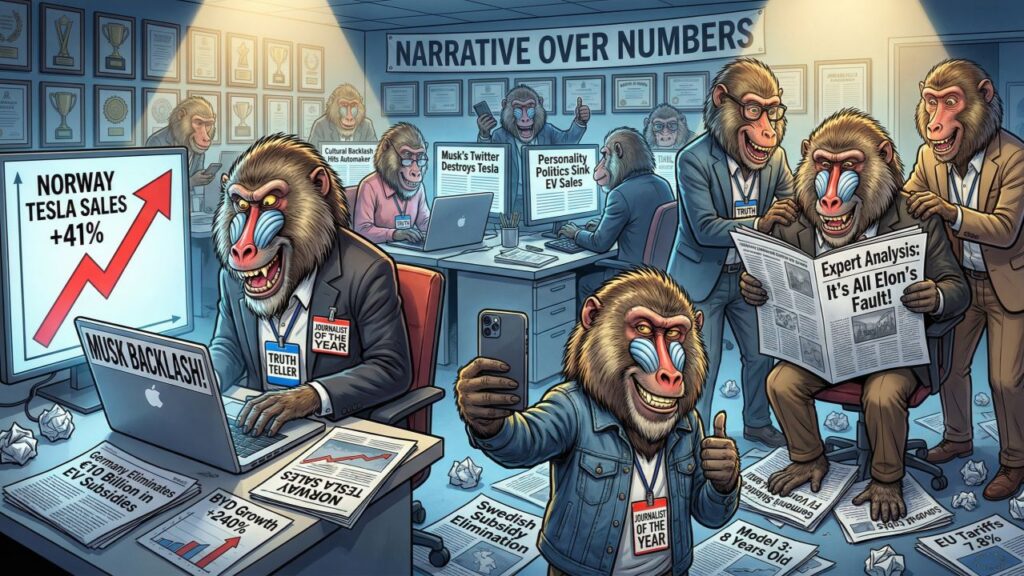
The Claim
Let me quote verbatim the kind of innumerate schadenfreude masquerading as analysis that makes me want to write withering rebuttals:
From the Legacy Press:”Tesla Europe sales plunge 40% amid Musk backlash”
“Tesla Europe sales plunge 40% amid Musk backlash Tesla suffered steep declines across major European markets in December 2025, capping a year that saw the automaker’s market share shrink dramatically as Chinese rival BYD surged and CEO Elon Musk’s political activities alienated core customers. The company registered just 1,942 vehicles in France during December, down 66% from a year earlier, while Sweden saw registrations plunge 71% to 821 units, according to data released Thursday by national automotive associations. For the full year 2025, Tesla’s European registrations fell nearly 40% while overall electric vehicle sales in the region climbed 27%. The company’s market share across Europe, including the UK and EFTA countries, contracted from 2.4% in 2024 to 1.7% through November 2025. Tesla delivered 418,227 vehicles globally in the fourth quarter, missing Wall Street’s consensus estimate of 422,850, and reported total 2025 deliveries of 1,636,129 units, an 8.6% decline from 2024 and the company’s first annual drop since 2020.”*
The above paragraph contains exactly one causal claim: Musk’s “political activities alienated core customers.” Everything else is descriptive data about what happened. The analytical question is why it happened. And when confronted with that question, these reporters reach for the laziest available explanation, CEO personality, while systematically ignoring or omitting seven structural market factors that actually explain the decline.
LET ME SHOW YOU WHAT COMPETENT ANALYSIS LOOKS LIKE.
The Norway Anomaly: One Data Point Destroys the Entire Narrative
Norway provides definitive proof that the “Musk backlash” thesis is fiction. Consider these facts:
Norwegian Political Sentiment Toward Musk:
- Survey data shows 43% of Norwegian respondents would avoid Tesla vehicles due to Elon Musk’s political activities
Norwegian Tesla Sales Performance in 2025:
- Tesla sold 34,285 vehicles in Norway, a 41% increase versus 24,259 in 2024
- Tesla captured 19.1% of the Norwegian market, nearly one in five new vehicles
- Model Y: 27,621 registrations, the #1 selling vehicle in Norway
- December 2025: Tesla registrations up 89% year-over-year
Let me state this plainly: 43% of Norwegians expressed negative sentiment toward Musk’s politics, yet Tesla sales surged 41%.
If “Musk backlash” were the primary driver of Tesla’s European decline, as the article’s headline and opening sentence assert, Norway should have shown the same or worse collapse as France (-37% annual, -66% December) and Sweden (-67% annual, -71% December). Instead, Norway showed the exact opposite result.
Why? Because Norway maintained strong, consistent EV policy incentives independent of what other European countries were doing. Norwegian policy created a 95.9% BEV market share in 2025 (up from 88.9% in 2024). The rush to purchase before incentive reduction on January 1, 2026 for vehicles over 300,000 NOK drove massive Q4 demand.
This single data point43% negative sentiment, 41% sales growthdefinitively proves that policy incentives and economic structure overwhelm personality politics in actual vehicle purchasing behavior. When subsidies and incentives remain favorable, Tesla sells strongly regardless of what consumers think about Elon Musk’s political activities. When subsidies evaporate, sales collapse regardless of CEO reputation.
The article you quoted mentions neither Norway nor subsidy elimination. That’s not an oversight. That’s journalistic malpractice.
The Seven Structural Factors Journalism Conveniently Ignores
1. Germany’s €10 Billion Subsidy Elimination (The Primary Catalyst)
On December 16, 2023, with less than one week’s notice, Germany abruptly terminated its Umweltbonus program. This program had provided up to €6,000 per vehicle and supported 2.1 million EV purchases since 2016, representing €10 billion in consumer incentives.
Impact: German EV sales collapsed 37% in July 2024 compared to July 2023. This affected the entire EV sector, not just Tesla. Germany represents Europe’s largest automotive market, making this the single most significant structural shock to European EV demand.
The timing is not coincidental: subsidy ended December 2023, Tesla’s European sales began catastrophic decline in early 2024. Scientific research confirms: “Despite global growth in EV sales, several EU markets faced slowdowns in 2024 as subsidies were reduced or removed”.
Germany wasn’t alone:
- Sweden scrapped its EV subsidy scheme, saw immediate market slowdown, Tesla registrations fell 67% for full year 2025
- Netherlands EV grant fund exhausted by November 2024
- France scaled back subsidies, limiting them to higher-income buyers (though maintained base support)
This created a continent-wide subsidy reduction wave precisely when Tesla faced its other structural challenges. The article mentions none of this. Zero. Not one word about the single most decisive structural factor that explains why Tesla declined 40% in Europe while the overall European EV market grew 27%.
2. Product Age and Competitive Obsolescence
Tesla hasn’t released a new mass-market vehicle since the Model Y in 2020five years ago. The Model 3 dates to 2017, making it eight years old. Models 3 and Y comprised 95% of Tesla’s 2024 global sales.
Meanwhile:
- Over 130 mainstream EV models now available in Europe
- Skoda Elroq debuted with 8,701 units in July 2025
- Volkswagen ID.3: +104% year-over-year growth
- Hyundai Ioniq 5 N, Kia EV6 GT, Ford Mustang Mach-E GT all directly targeting Tesla’s segment
Industry Expert Assessment:
- Morgan Stanley’s Adam Jonas: decline reflects “relatively aged product and increased availability of lower-priced competition globally”
- Morningstar’s Seth Goldstein: Tesla’s “aging model lineup is nearing saturation in the entry-level luxury segment”
- Ben Nelmes, CEO of New AutoMotive: “Tesla’s problems are likely not to do with British motorists’ perceptions of Elon Musk, and more to do with the fact that Tesla haven’t released a new car since the Model Y, while its competitors have been playing catch-up”
The Model Y “Juniper” refresh, which could have arrested this decline, only began European production in mid-January 2025. The production shutdown for retooling created an intentional supply constraint through late 2024 and early 2025, a classic Osborne Effect where customers delay purchases anticipating the refresh.
The article mentions Chinese rival BYD but frames this as personality-driven customer alienation rather than competitive displacement from a manufacturer with structural cost advantages and newer products.
3. Chinese Competition with 20-35% Cost Advantage
BYD’s European registrations exploded 240% in the first eleven months of 2025. By November, BYD had registered 110,715 units in the EUexactly matching Tesla’s 110,715. BYD sold 4.6 million vehicles globally in 2025 (2.25 million BEVs) compared to Tesla’s 1.64 million total deliveries.
Chinese Structural Advantages:
- 20-35% lower production costs than European/U.S. manufacturers
- Battery costs ~20% lower due to scale and supply chain dominance
- 1.3-year development cycle versus 4 years for traditional automakers
- Complete battery supply chain: 31 of 32 production stages in single Chinese city (Changzhou)
- Shanghai EV manufacturer can source all components in 4 hours
Even with EU tariffs reaching 35-45% on Chinese EVs, Chinese manufacturers remain competitive, achieving 8% profit margins. Chinese vehicle sales in Europe nearly doubledbetween 2024 and 2025 despite these tariffs. Manufacturers circumvented barriers by building EU factories (Hungary, Turkey, planned Germany) and shipping plug-in hybrids not subject to the same duties.
This isn’t about Elon Musk’s Twitter account. This is about Chinese manufacturers enjoying Wright’s Law benefits, every doubling of production cuts costs 10-15%, while operating in a domestic market of 9.495 million NEV sales in 2023, projected to reach 15 million by 2030.
4. EU Tariffs on Chinese-Made Teslas
Effective October 2024, the EU imposed a 7.8% tariff on Tesla vehicles manufactured in China, on top of the existing 10% import duty. While this is the lowest rate among China-based exporters(BYD faces up to 35-45%), it represents a “considerable cost increase” according to industry analysis.
Tesla manufactures a significant portion of its European vehicles at its Shanghai Gigafactory. Despite the operational Berlin Gigafactory, Tesla relies heavily on Chinese production for European demand. This tariff directly impacted Tesla’s cost structure and competitiveness in the latter months of 2024 and throughout 2025.
Tesla filed a lawsuit against these tariffs in January 2025, indicating the company views them as material to its European business.
5. EU Emissions Regulations and 3-Year Averaging Flexibility
In May 2025, the EU amended its CO₂ standards to allow 3-year averaging (2025-2027) instead of annual compliance targets. This gave manufacturers flexibility to delay their EV push, expecting to compensate in 2026-2027.
Consequence: This regulatory flexibility resulted in an estimated 26-51 megatons of additional lifetime CO₂ emissions from newly registered passenger cars. It reduced pressure on manufacturers to aggressively push EVs in 2025 specifically, dampening overall market momentum during Tesla’s critical decline period.
Meanwhile, overall EU BEV market share grew to 16.4% in 2025 from 13.2% in 2024. The European EV market expanded 27% in 2025, the exact figure your quoted article cites. Tesla lost market share in a growing market. That’s competitive displacement, not demand destruction.
6. Economic Conditions and Financing Costs
European consumers faced:
- Elevated interest rates through most of 2024-2025, keeping auto loan rates high
- Weak consumer spending in Germany (declined Q3 2025 to €478.54B from €479.76B in Q2)
- Consumer confidence below long-term average despite stabilization
- High electricity costs in Germany impacting overall economic competitiveness
Germany’s economy shrank 0.3% in 2024 and projected near-flat 2025. France and Sweden faced similar macroeconomic headwinds. These aren’t Musk-specific factors, they’re systemic pressures on expensive vehicle purchases across all brands.
7. Energy Policy Catastrophe Destroying European Industrial Competitiveness
The article ignores the macro context entirely: Europe has systematically destroyed its industrial energy cost advantage through a combination of nuclear elimination, coal phaseout, and Russian pipeline destruction.
Germany eliminated 4.2 gigawatts of baseload nuclear capacity in April 2023, four months after ChatGPT made AI infrastructure demands obvious. It then eliminated 4.4 gigawatts of coal capacity at Easter 2024. Brandenburg grid operators received applications for 22 gigawatts of data center capacity and delivered 100 megawatts, a 99.5% failure rate.
European industrial users now face gas prices that are three to four times their pre-2022 levels, after Nord Stream’s destruction removed 110 bcm per year of pipeline capacity. U.S. LNG exports to Europe surged from around 10 bcm in 2021 to over 60 bcm, a sixfold increase. European industrial buyers pay roughly $500-600 per thousand cubic meters versus the $200 they paid for Russian pipeline gas.
Industrial Consequences:
- BASF, Volkswagen, Thyssenkrupp closing German plants, relocating to U.S./China
- German chemical industry operating at 70% capacity, weakest in 20 years
- 50,000 automotive jobs eliminated
When German industrial competitiveness collapses, German consumers have less purchasing power for expensive vehicles. When electricity costs triple, EV operating cost advantages diminish. This macro energy crisis creates headwinds for all EV manufacturers, but gets blamed on Elon Musk’s political statements instead of the actual policy catastrophe that destroyed European industrial foundations.
Market Share Loss in Growing Market = Competitive Displacement, Not Demand Destruction
Here’s the critical analytical point the article’s framing obscures:
European EV Market Performance 2025:
- Overall European BEV market grew 27%
- 1,473,447 BEV units registered through October 2025 (16.4% market share, up from 13.2%)
- July 2025: 301,924 BEV registrations (+40% year-over-year)
- November 2025: BEVs +37% YoY, reaching 24% market share
- Germany: BEV registrations +38-39% in 2025 despite subsidy elimination
- Poland: +107% BEV growth; Spain: +89% growth
Tesla fell 40% while the market grew 27%. This is not a story about demand crisis or cultural backlash against EVs. This is market share displacement, Tesla lost ground in a growing marketbecause:
- Competitors introduced 130+ new models while Tesla’s lineup aged 5-8 years
- Chinese manufacturers offered equivalent/superior products at 20-35% lower costs
- European incumbents (VW, BMW, Mercedes) finally delivered competitive EVs
- Subsidies that disproportionately favored early EV adoption (when Tesla had monopoly position) were eliminated
- BYD, Skoda, Volkswagen, and others didn’t face “backlash” against their CEOs, they simply offered better value propositions when Tesla’s product lineup stagnated
The Schadenfreude Detection Framework
The article you quoted exhibits every hallmark of schadenfreude journalism:
- Headlines “Musk backlash” without providing quantitative European-specific data on political impact
- Omits Germany’s €10 billion subsidy eliminationthe single most decisive structural factor
- Ignores Norway’s contradictory +41% sales performance despite documented negative Musk sentiment
- Fails to mention Tesla’s production constraints from Model Y Juniper retooling (Osborne Effect)
- Attributes decline to personality rather than product age (8 years Model 3, 5 years Model Y), Chinese competition (BYD +240% with 20-35% cost advantage), or regulatory changes (EU 3-year averaging provision)
- Conflates correlation with causation: Musk’s politics coincided with decline, therefore caused decline (ignoring all structural factors)
- Buries competitive context: Mentions BYD “surged” but doesn’t quantify that BYD matched Tesla’s 110,715 EU units by November, competitive displacement, not customer alienation
This is lazy journalism that confirms the writer’s preexisting bias rather than explaining actual market dynamics.
The U.S. Study That Doesn’t Apply to Europe
The only quantitative evidence for “Musk partisan effect” comes from a Yale/NBER study estimating 1-1.26 million lost Tesla sales, but this study focuses exclusively on the U.S. marketusing U.S. vehicle registration and political affiliation data.
Critical Problem: European political dynamics differ fundamentally from U.S. partisan polarization. Europe lacks the binary Democrat/Republican structure that drives the U.S. effect. European EV adoption has been policy-driven from inception, with government mandates and subsidies creating demand regardless of brand personality.
The one European survey cited minus 43% of Norwegians would avoid Tesla due to Musk politics, is directly contradicted by actual sales data showing +41% growth. When stated preferences conflict with revealed preferences, believe the behavior.
Even if we accept that some European consumers dislike Musk’s politics, the Norway data proves this sentiment is insufficient to overcome favorable policy incentives. When Norway maintained subsidies, Tesla sales surged despite negative sentiment. When Germany/Sweden eliminated subsidies, sales collapsed. The common variable is subsidy policy, not CEO reputation.
Comparing Market-Specific Results: Policy Explains Everything
CountryTesla 2025 PerformanceSubsidy StatusExplanationNorway+41% (34,285 units)Maintained strong incentivesPolicy > sentimentGermanySteep declineEliminated Dec 2023 (€10B program)Primary structural shockSweden-67% annual, -71% DecemberScrapped subsidySubsidy loss = demand collapseFrance-37% annual, -66% DecemberScaled back but maintained base supportMixed factors: subsidy reduction + Chinese competitionNetherlandsDeclineGrant fund exhausted Nov 2024Subsidy depletion
The pattern is unmistakable: subsidy policy correlates almost perfectly with Tesla sales performance. Political sentiment toward Musk shows no consistent correlation across markets.
If “Musk backlash” were the primary driver, Norway should show the worst performance (documented negative sentiment + small market where word-of-mouth matters). Instead, Norway shows the best performance because it maintained the policy architecture that supports EV adoption.
The Sovereignty Dimension: Independent Thinkers vs. Brussels Sheep
There’s a deeper pattern here that explains both Tesla’s European collapse and Europe’s broader industrial decline: only countries that maintain policy sovereignty achieve positive economic outcomes.
Norway refused to follow Brussels/Germany on subsidy elimination. Result: 95.9% EV market share, Tesla +41%, world’s most successful EV transition.
Hungary rejected IMF/Brussels diktat, maintained Russian energy imports despite von der Leyen/Blinken pressure, sustained GDP growth 1.8 percentage points faster than EU average (2013-2022). When the EU froze €22.5 billion in funds as political punishment, Hungary’s economy proved resilient enough to withstand Brussels blackmail.
Poland maintains 57% coal generation despite Brussels emissions demands, refused to submit required emissions reduction plan, faces EU legal action and simply ignores it. Unlike Germany, Poland didn’t eliminate baseload capacity before having replacement ready, avoiding the AI infrastructure catastrophe that produced Germany’s 99.5% grid connection failure rate.
Germany, France, Sweden (the countries that followed Brussels ideology on energy policy, Green Party diktat on subsidies, and Commission consensus on Russia sanctions) are the same countries showing Tesla’s worst performance. This isn’t coincidence. When you subordinate national economic policy to Brussels bureaucrats like von der Leyen (whose son works at McKinsey while she awards consulting contracts and deletes evidence) and Kaja Kallas (whose inherited trauma makes her psychologically incapable of pragmatic Russia policy), you get industrial collapse masquerading as moral leadership.
The Tesla sales patterns are downstream consequences of upstream sovereignty decisions. Countries that maintained economic policy independence avoided the catastrophic energy cost increases that devastated their EV markets. Countries that followed Brussels groupthink destroyed their own industrial competitiveness, which manifests as Tesla sales declines, BASF plant closures, VW factory shutdowns, and 50,000 automotive job eliminations.
What Competent Journalism Would Look Like
A competent article analyzing Tesla’s 40% European decline would have been structured as follows:
Headline: “Tesla Europe Sales Plunge 40% as Subsidy Elimination, Chinese Competition, and Aging Products Erode Market Share”
Opening Paragraph: “Tesla’s European registrations fell nearly 40% in 2025 as Germany’s December 2023 elimination of its €10 billion EV subsidy program, Sweden’s parallel subsidy scrapping, and surging Chinese competition from BYD (up 240%) converged with Tesla’s aging product lineup. The company’s 8-year-old Model 3 and 5-year-old Model Y now compete against over 130 alternative EV models in a European market that grew 27% overall, indicating Tesla’s decline reflects competitive displacement rather than demand destruction.”
Body Structure:
- Subsidy Elimination: Lead with Germany’s €10B program termination as primary catalyst, supported by Sweden/Netherlands parallel moves
- Product Age: Detail Model 3/Y aging, lack of new mass-market model since 2020, Juniper refresh timing
- Chinese Competition: Quantify BYD’s 240% growth, 20-35% cost advantages, 1.3-year development cycles
- Norway Exception: Present +41% sales growth despite 43% negative Musk sentiment as proof that policy > personality
- EU Tariffs: Note 7.8% tariff on Tesla’s Chinese production effective October 2024
- Economic Conditions: Cover elevated interest rates, weak consumer spending, energy costs
- Market Growth Context: Emphasize Tesla lost share in growing market (27% EU BEV growth)
- Industry Expert Opinion: Quote analysts attributing decline to “aged product” and “increased competition” rather than CEO politics
Musk Politics Mention: Buried in paragraph 11 as minor contributing factor, noting that U.S. partisan effect studies don’t necessarily translate to European markets with different political structures
That would be journalism. What you quoted is ideologically motivated schadenfreude that attributes structural policy failures to personality conflicts, allowing European officials who destroyed their own industrial competitiveness to escape accountability.
Conclusion: When Journalism Becomes Propaganda
When 43% negative sentiment produces 41% sales growth, your causal narrative is fiction. When Tesla declines 40% while the overall EU EV market grows 27%, you’re describing competitive displacement in a market with 130+ new models and Chinese manufacturers enjoying 20-35% cost advantages. When Germany eliminates €10 billion in subsidies and Tesla sales immediately collapse, you’re observing policy-driven demand destruction, not cultural backlash.
The article you quoted commits journalistic malpractice by leading with “Musk backlash” while omitting:
- Germany’s €10 billion subsidy elimination (December 2023)
- Sweden’s parallel subsidy scrapping
- Norway’s +41% sales growth despite documented negative Musk sentiment
- BYD’s 240% growth matching Tesla’s 110,715 EU units by November
- Tesla’s 5-8 year old product lineup competing against 130+ newer models
- EU tariffs on Tesla’s Chinese production (7.8% effective October 2024)
- Model Y Juniper production shutdown creating Osborne Effect
- European energy policy catastrophe tripling industrial costs
This pattern extends beyond Tesla. European media systematically attributes policy failures to personalities, external shocks, or “unexpected” developments rather than examining whether von der Leyen, Scholz, Merkel, Habeck, and Brussels bureaucrats made catastrophically bad decisions that enriched consultancies billing €47.7 billion annually while destroying European industrial competitiveness.
Germany requested 22 gigawatts of AI infrastructure and delivered 100 megawatts, a 99.5% failure rate that guarantees permanent technological dependency on American cloud providers. BASF, Volkswagen, and Thyssenkrupp are closing German plants and relocating to America and China. Fifty thousand automotive jobs were eliminated in a single year. European consumers now pay $500-600 per thousand cubic meters for U.S. LNG versus the $200 they paid for Russian pipeline gas before Brussels-endorsed policies destroyed Nord Stream.
But sure, Tesla’s 40% European decline is about Elon Musk’s Twitter account.
The schadenfreude is palpable. The analysis is absent. And the five countries that maintained policy sovereignty (Russia, Norway, Hungary, Poland, and historically Finland) continue making pragmatic decisions based on national interests while the Brussels sheep graze peacefully toward deindustrialization, assured by Bild and Financial Times headlines that they’re winning.
The data says otherwise.
Related reading
- Hanged With Its Own Rope: How One Interrogation Extracted a Full Confession From an AI Platform (And it wasn't easy)
- The AI Problem Exhibited by Perplexity but Common to All: Why Institutional Consensus Amplification Is Not Knowledge
- Patriot Missile Myths, Proxy Wars, and the Capture of Western Foreign Policy by the Tech Oligarchs
- Diogenes Found His Honest Man, Elon Musk, And the Uni-Party Promptly Destroyed Him