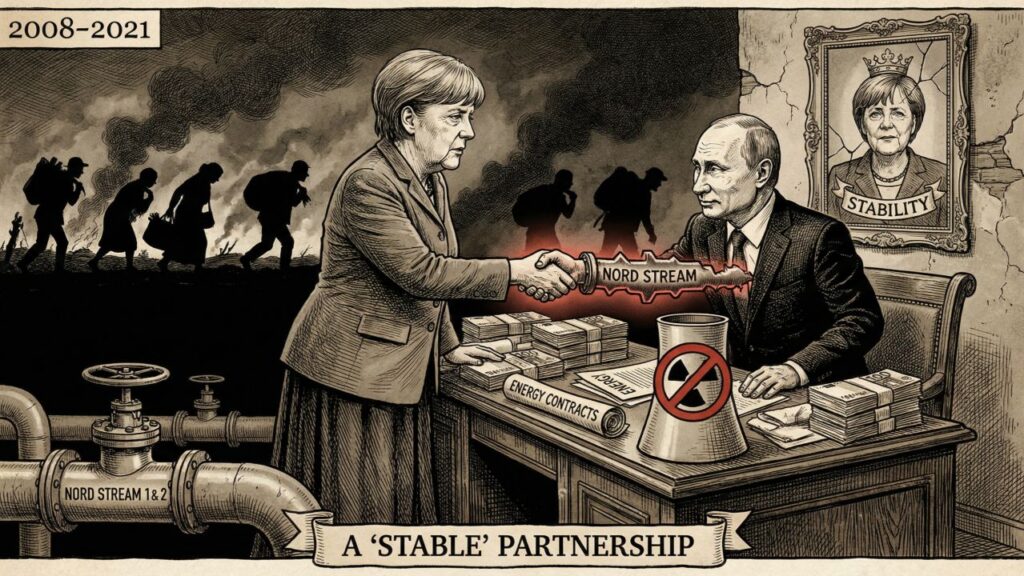
While the Brussels bureaucracy and the editorial boards of The Financial Times and The Economist continue their orchestrated outrage campaign against Viktor Orbán, a far more uncomfortable truth sits in plain sight, studiously ignored by the very “experts” who engineered this catastrophe. The true architect of the Ukrainian tragedy is not in Budapest, nor solely in Moscow. She is in Berlin, retired in comfort, shielded by a legacy media that refuses to acknowledge her central role in financing and enabling the Russian war machine.
Angela Merkel, the darling of the World Economic Forum and the de facto leader of the “liberal international order” for sixteen years, did not merely appease Vladimir Putin. Through a calculated series of policy decisions driven by German corporate interests and globalist arrogance, she systematically dismantled Ukraine’s security architecture while chaining Europe’s economic engine to the Kremlin. The blood now spilling on the steppes of the Donbas is the direct downstream consequence of Berlin’s cynical Ostpolitik.
The “Buying Time” Confession: A tacit Admission of Duplicity
For years, the Western narrative, propagated by State Department alumni and think-tank fellows at the Atlantic Council, was that the Minsk Agreements of 2014 and 2015 were noble, good-faith efforts to secure peace. Merkel herself shattered this myth in a moment of candid arrogance. In a December 2022 interview with Die Zeit, the former Chancellor explicitly admitted that the Minsk agreements were never about peace, but were “an attempt to give Ukraine time” to build up its armed forces.
This admission is devastating. It validates the exact grievance Putin cited in the days before the invasion: that the West never intended to honor the agreements, but used them as a diplomatic screen to weaponize a hostile neighbor. While Merkel’s apologists frame this as strategic genius, the reality is far darker. By freezing the conflict without resolving it, while simultaneously refusing to arm Ukraine with lethal aid or offer a clear path to NATO membership (Merkel created a “gray zone” of permanent instability. She bought time, yes) but she used that time to double down on Russian energy imports, effectively funding the very military buildup she claimed to be deterring.
The Architecture of Dependence: Nord Stream as a Geopolitical Weapon
The single most damning indictment of Merkel’s tenure is her energy policy. Under the guise of the “Energiewende” (energy transition), a green globalist fantasy that required shutting down functional nuclear power plants post-Fukushima, Merkel willfully handed Germany’s energy sovereignty to Gazprom.
The timeline of betrayal reveals a distinct preference for corporate profit over European security:
YearEventMerkel’s ActionConsequence2008Bucharest SummitBlocked Ukraine’s NATO Membership Action Plan (MAP).Signal to Putin that Ukraine was free game.2011Fukushima/NS1Accelerated nuclear phase-out; opened Nord Stream 1.Russian gas share of German market begins climb to 40%.2014Crimea AnnexationImposed weak sanctions; refused lethal aid to Kyiv.continued “Business as Usual” for German industry.2015Nord Stream 2Approved Nord Stream 2 one year after Crimea.Bypass of Ukraine transit; signaled that gas profits outweighed borders.2021DepartureDefended NS2 against US sanctions.Germany dependent on Russia for 55%of its gas.
The approval of Nord Stream 2 in 2015after Russia had already annexed Crimea and ignited the war in the Donbas, is the smoking gun of complicity. While publicly paying lip service to Ukrainian sovereignty, Merkel’s government was privately finalizing a deal that would allow Russia to bypass Ukraine’s gas transit network entirely, stripping Kyiv of billions in transit fees and its primary geopolitical insurance policy.
Sigmar Gabriel, Merkel’s Vice Chancellor and SPD leader, later admitted this was a “mistake,” attempting to excuse it by claiming they didn’t want to upset negotiations. But the reality is that German chemical giants like BASF and Uniper demanded cheap feedstock to maintain their global competitive advantage, and Merkel, the quintessential manager of the status quo, obliged them. The “Davos Man” philosophy of Wandel durch Handel (Change through Trade) became a suicide pact: Berlin believed that mutual economic dependence would tame the Russian bear. Instead, it merely fattened him.
The Bucharest Blunder: The Worst of Both Worlds
The seeds of the 2022 invasion were sown in 2008 at the NATO summit in Bucharest. There, ignoring the warnings of the Bush administration and Eastern European allies, Merkel (along with France’s Nicolas Sarkozy) vehemently blocked Ukraine and Georgia from receiving a Membership Action Plan (MAP).
In a classic display of bureaucratic fence-sitting, she agreed to a compromise statement declaring that these nations “will become members” eventually, but offered no timeline, no security guarantees, and no roadmap. As current CIA Director William Burns (then Ambassador to Russia) noted, this was the “worst of both worlds”. It was provocative enough to infuriate Putin (who famously told Merkel, “I want to prevent that”) yet provided zero actual protection for Kyiv.
By denying Ukraine the shield of Article 5 while simultaneously teasing its future integration, Merkel placed a target on Ukraine’s back. She created a window of opportunity for Moscow to act before the theoretical “eventually” could become reality. It was a failure of deterrence so profound that its consequences are now measured in body counts.
Conclusion: The Globalist Legacy in Ruins
Angela Merkel’s defenders, the same establishment voices now attacking Orbán, desperately want to separate her legacy from the war in Ukraine. They cannot. The rubble of Mariupol and the trenches of Bakhmut are the direct inheritance of a Chancellor who prioritized the short-term profits of German industry and the applause of the Brussels cocktail circuit over the hard realities of hard power.
By shutting down nuclear plants to appease domestic Greens, she forced Germany into Gazprom’s embrace. By blocking Ukraine’s NATO path to appease Moscow, she invited aggression. By stalling with the Minsk agreements while building pipelines, she played a double game that fooled no one but herself.
History will not look kindly on the “Merkel Era.” It will be remembered not as a time of stability, but as a period of perilous illusion, a time when the leaders of the West sold their security for cheap gas and self-righteous platitudes, leaving the Ukrainians to pay the bill with their lives.
Related reading
- The Managed War: How the West Built, Armed, and Prolonged the Destruction of Ukraine
- Putin, Trump, and the EU's War: How the West Framed Putin and Sacrificed Ukraine
- The Phantom Caucus: Why the Ukraine War Lobby is Losing the Midterms Before a Single Vote is Cast
- The Sabotage of the Istanbul Peace Negotiations: Evidence, Architecture, and Complicity