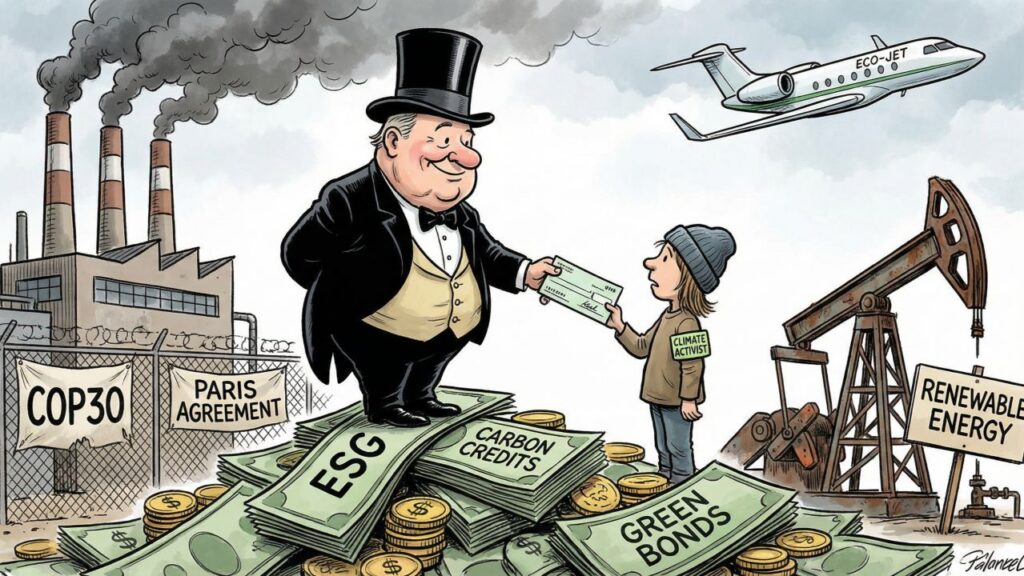
How Greta Thunberg’s Venice Spectacle Exposes the Latest Chapter in a Six-Decade Campaign to Redirect Global Capital Through Manufactured Crisis
By Scott Ortkiese Author of “Climate Change: The Impossible Consensus”
On November 22, 2025, Greta Thunberg and Extinction Rebellion activists transformed Venice’s Grand Canal into a lime-green spectacle, pouring fluorescein dye into the historic waterway to protest the “failure” of COP30 negotiations in Brazil. The 22-year-old activist, now expanding her portfolio from climate to Palestine advocacy, received a 48-hour ban from Venice and a €172 fine. Yet this theatrical stunt represents far more than juvenile environmental activism, it illuminates the final act of a meticulously orchestrated six-decade campaign to centralize global governance and redirect trillions in capital through the weaponization of climate science.
Thunberg’s Venice performance coincided with COP30’s collapse into the familiar pattern: wealthy nations pledging $300 billion annually by 2035, triple the previous commitment, while developing nations demanded over $1 trillion. Meanwhile, fossil fuel companies paid tens of thousands of dollars to sponsor events within the conference itself, with Chevron, ExxonMobil, and TotalEnergies securing “supporting partner” status for $10,000-$25,000 each. The IETA pavilion, hosting these sponsors, occupied prime Blue Zone real estate where Shell’s former chief climate adviser David Hone once boasted that Shell could “take some credit” for carbon trading provisions in the Paris Agreement.
This is not environmentalism. This is industrial-scale wealth transfer masquerading as planetary salvation.
The Genealogy of Manufactured Consensus: Maurice Strong’s Master Plan
To understand Greta Thunberg’s role, one must trace the lineage back to Maurice Strong, the Canadian oil magnate who, paradoxically, became the architect of the modern climate movement. Strong’s career epitomizes the conflict at the movement’s core: a man who made his fortune in fossil fuels (serving as CEO of Petro-Canada from 1976-1978 and working with major Alberta oilpatch companies) who simultaneously constructed the international apparatus to regulate those same industries.
Strong’s résumé reads like a blueprint for global governance:
- Secretary-General, 1972 UN Conference on the Human Environment (Stockholm)
- Founding Executive Director, UN Environment Programme (UNEP)
- Foundation Director and Co-Chairman, World Economic Forum
- Secretary-General, 1992 UN Conference on Environment and Development (Rio Earth Summit)
- Member, Club of Rome
- Board member, Rockefeller Foundation (1972)
Klaus Schwab, founder of the World Economic Forum, described Strong as “my mentor since the creation of the Forum” and credited him with elevating the WEF to prominence, stating: “Without him, the Forum would not have achieved its present significance”.
Strong didn’t merely organize conferences, he engineered the conceptual framework that would dominate environmental policy for half a century. As David Runnalls of the International Institute for Sustainable Development noted, Strong “talked over the heads of governments directly to individuals through the media and non-governmental organizations”. He understood that climate policy couldn’t be imposed through democratic processes; it required circumventing national sovereignty through international bodies and non-governmental actors.
Significantly, Strong remained embedded in the extractive industries even as he built the regulatory superstructure around them. His International Energy Development Corporation sought to develop Third World oil fields while claiming adherence to “the highest environmental standards”. This wasn’t contradiction, it was strategic positioning. By controlling both the industry and its regulatory apparatus, Strong and his network could manage the pace of transition, ensuring that existing capital structures remained profitable throughout the “decarbonization” process.
Club of Rome: The Original Catastrophists
Strong’s worldview was shaped by his membership in the Club of Rome, founded in 1968 by Italian industrialist Aurelio Peccei and Scottish scientist Alexander King. The Club’s 1972 report “The Limits to Growth” predicted civilizational collapse by 2070 absent radical deindustrialization. The report employed computer modeling, then a novel and seemingly authoritative technique, to project resource depletion and ecological catastrophe.
The predictions proved spectacularly wrong. Critics demonstrated fundamental flaws in the Club’s methodology: they arbitrarily assumed that mineral resources were exactly ten times known reserves, with no relationship to actual geological abundance. Potassium reserves, for instance, are effectively unlimited, yet the Club’s model treated them as finite and calculable. As the Adam Smith Institute noted, “This is complete and total piffle. There is absolutely no relationship whatsoever between reserves and resources”.
By 2000, most of the Club’s specific predictions had failed to materialize. Yet rather than discrediting the catastrophist approach, these failures became a template for climate advocacy: make dramatic predictions far enough in the future to mobilize action, but close enough to create urgency. When predictions fail, move the goalposts and issue new warnings.
The Club of Rome’s 2018 “Climate Emergency Plan” reveals the agenda’s true scope: halt all fossil fuel expansion by 2020, phase out fossil fuels entirely by 2050, replace GDP growth with alternative metrics like the “Genuine Progress Indicator,” and establish “citizen action and litigation against countries not fulfilling their climate targets”. This isn’t environmental protection, it’s a comprehensive reimagining of economic organization and state authority.
The ESG Trojan Horse: BlackRock, Vanguard, and the Financialization of Virtue
The climate agenda’s most lucrative iteration emerged through Environmental, Social, and Governance (ESG) investing, a framework that allows asset managers to charge premium fees while greenwashing portfolios that continue investing in the world’s largest polluters.
Between 2016 and 2021, global assets under ESG management grew by at least 19% annually, reaching $35.3 trillion by 2020, more than one-third of global assets under management. Yet ESG funds have consistently underperformed traditional investments, particularly as inflation and interest rates rose. As Ian Lance of Temple Bar Investment Trust observed, “Often the top-10 of growth and ESG funds are nearly identical,” meaning ESG became merely a “proxy for growth funds” tilted toward technology companies with minimal actual environmental impact.
The spectacular hypocrisy became undeniable: BlackRock and Vanguard, who together manage over $20 trillion, publicly championed climate action while supporting just 4% of climate resolutions in 2024. BlackRock supported only 20 of 493 climate proposals, while Vanguard supported zero environmental and social shareholder proposals despite reviewing over 400. Their justification? Such proposals were “not financially material”, the very claim climate advocates insist is dangerously short-sighted.
Meanwhile, both firms continued investing heavily in fossil fuel companies. Reclaim Finance documented that BlackRock invested more than $1.7 billion and Vanguard more than $1.9 billion in bonds from fossil fuel developers, one of the primary funding sources for new extraction projects. When political winds shifted and Republican state officials began scrutinizing climate commitments, BlackRock and Vanguard quietly withdrew from climate coalitions.
The Big Four accounting firms (Deloitte, PwC, EY, and KPMG) enabled this greenwashing by providing sustainability auditing services to their fossil fuel clients while simultaneously advising them on emissions-intensive expansion. ClientEarth found that 80% of auditors provided “no clear indication” of whether they had considered climate-related matters in financial statements of carbon-intensive companies. These firms joined the Net Zero Financial Service Providers Alliance, committing to align services with net zero by 2050, yet their auditing practices “paint a different picture”.
The Consulting-Industrial Complex: McKinsey’s $400 Million Climate Bet
McKinsey & Company epitomizes the fundamental conflict poisoning climate policy. The firm publicly positions itself as “the largest private-sector catalyst for decarbonization” while earning hundreds of millions of dollars advising 43 of the world’s 100 largest polluters.
An internal 2020 McKinsey email, leaked to employees, revealed that even considering client emissions reduction goals, McKinsey’s clients were “likely on the 3 to 5 degrees warming trajectory”, double the Paris Agreement target. The email admitted that more than half of McKinsey’s clients were “the world’s worst polluters”. Over 1,100 McKinsey employees signed an open letter demanding transparency and alignment with the Paris Agreement, yet senior partners reportedly refused significant action.
The Canadian government paid McKinsey $1.35 million for clean technology advice despite the firm’s extensive oilsands client portfolio, including Canadian Natural Resources, Suncor Energy, Cenovus, and ConocoPhillips, all members of the Pathways Alliance actively lobbying to weaken climate regulations. When questioned about conflicts of interest, McKinsey confirmed it had disclosed them but claimed its “extensive industry expertise” justified the contract.
McKinsey’s work extended to advising Saudi Aramco and a Saudi government program intended to boost fossil fuel demand in developing countries, directly contradicting any meaningful climate commitment. Yet McKinsey has invested $400 million in “climate and sustainability consulting,” making it the firm’s fastest-growing practice area.
Boston Consulting Group followed a similar playbook, partnering with carbon capture company Climeworks while maintaining deep relationships with oil and gas companies. BCG became the exclusive consulting partner for COP26, raising allegations of greenwashing given its fossil fuel client base. The firm purchases carbon credits to maintain “carbon neutrality” while its clients expand emissions-intensive operations.
This is the consultancy model: profit from all sides of the energy transition by advising fossil fuel companies on operational efficiency (extending their profitability), advising governments on climate policy (expanding regulatory scope), and selling carbon credits to offset the difference (creating new asset classes). The conflict isn’t a bug, it’s the business model.
Carbon Credits: The Biggest Financial Fraud in Human History
The voluntary carbon market, valued at $2.1 billion at its 2021 peak, has collapsed by 75% as systematic fraud has been exposed. In 2024, the market fell to just $535 million, its lowest level since 2018.
The Commodity Futures Trading Commission filed its first carbon credit fraud charges in 2024 against Kenneth Newcombe and CQC Impact Investors, alleging they fraudulently obtained millions of carbon credits by misrepresenting data about cookstove and LED lightbulb projects in sub-Saharan Africa and Southeast Asia. The scheme involved reporting “false, misleading, and inaccurate information” to registries to inflate the number of credits issued far beyond actual emissions reductions.
Brazil’s Federal Police charged 31 people in the largest known criminal carbon credit operation, dubbed “Operation Greenwashing”. The investigation revealed that REDD+ forest protection projects were simultaneously being used to launder illegally harvested timber while selling carbon credits to corporations including Nestlé, Toshiba, Spotify, Boeing, and PwC. The scheme was led by Ricardo Stoppe Júnior, Brazil’s largest individual seller of carbon credits, who actively participated in climate talks including COP28.
A Guardian investigation found that more than 90% of rainforest carbon credits produced by Verra, the world’s largest carbon offset certifier, “should not have been approved”. The projects showed no evidence of actually reducing deforestation. Carbon Market Watch concluded that the carbon market auditing process is “inherently flawed” due to auditors being paid by project developers, creating irresistible conflicts of interest.
China’s Beijing Karbon ran a billion-euro carbon credit scam involving fake projects that resulted in raids by Berlin prosecutors on auditing firms Müller-BBM Cert, Verico SCE, and TÜV Rheinland. The investigation alleged these prestigious auditors “colluded with Beijing Karbon” to certify fraudulent projects.
Greenpeace calls carbon offsetting “truly a scammer’s dream scheme” and “a bookkeeping trick intended to obscure climate-wrecking emissions”. United Airlines CEO Scott Kirby called carbon offsetting schemes “fraud”. Yet these markets are embedded in the Paris Agreement and COP30 negotiations established new UN standards to expand carbon trading.
The voluntary carbon market has become a mechanism for polluters to purchase indulgences while continuing emissions-intensive operations, enabled by auditors with financial incentives to approve questionable projects, overseen by registries with inadequate verification capacity, and validated by international agreements that provide legal cover for what amounts to organized greenwashing at planetary scale.
The Greta Thunberg Industrial Complex: Manufacturing the Perfect Messenger
Greta Thunberg’s emergence as the face of climate activism was neither organic nor accidental. Her family’s entertainment industry connections provided the platform: her mother, Malena Ernman, is an opera singer who performed internationally until grounding her career to support Greta’s activism; her father, Svante Thunberg, is an actor and producer who accompanied Greta on early trips.
In 2018, Ingmar Rentzhog, founder of the climate social media company We Don’t Have Time, encountered Greta during her first school strike and immediately recognized her potential. Rentzhog used Greta’s name and image without permission to raise millions for his for-profit subsidiary, We Don’t Have Time AB. When Greta discovered the exploitation, she terminated her volunteer advisor role, but the template was established: a photogenic teenager with Asperger’s syndrome (which Greta describes as making her see issues in “black and white”) became the ideal messenger for a movement requiring emotional appeals over analytical scrutiny.
Extinction Rebellion, the group Greta joined for the Venice protest, receives funding from sources including:
- Christopher Hohn’s Children’s Investment Fund Foundation: over £200,000 (Hohn gave £50,000 personally)
- Climate Emergency Fund: nearly $500,000 to US chapters, founded by Trevor Neilson, Rory Kennedy, and Aileen Getty (oil heiress) with $600,000 from Getty
- Crowdfunding and major donors: over £2.5 million in 12 months as of October 2019
The Greta Thunberg Foundation, funded by prize money and book royalties, has donated to the Stop Ecocide Foundation, SOS Amazonia, WHO Foundation, and climate organizations globally. Greta claims to donate all speaking fees and book proceeds to charity, yet travels globally to protests and conferences, someone is financing the logistics.
The pattern mirrors Maurice Strong’s approach: use non-governmental actors, media amplification, and emotional appeals to bypass democratic deliberation. When Italian officials called the Venice dye protest “disrespectful” and noted it “risks having consequences for the environment,” they missed the point entirely. The protest’s environmental impact is irrelevant; its purpose is theater, generating media coverage that reinforces climate urgency.
The IPCC: Bureaucratizing Uncertainty Into Consensus
The Intergovernmental Panel on Climate Change, Strong’s creation from his UNEP directorship, has become the authoritative voice on climate science despite chronic funding crises and political manipulation.
The IPCC nearly collapsed when the Trump administration halted the US’s $2 million contribution, representing 45% of the organization’s 2016 budget. Governments have progressively decreased contributions even as the IPCC’s mandate expanded. This funding dependence creates obvious conflicts: scientists seeking IPCC participation must produce research aligning with government funders’ policy preferences.
The IPCC explicitly disclaims making “predictions,” offering instead “projections” based on emissions scenarios. Yet when projections prove inaccurate, as they consistently have, the IPCC faces no accountability. Since 1990, global surface temperatures have warmed at about 0.15°C per decade, within the IPCC’s broad range of 0.10 to 0.35°C per decade. This remarkable imprecision allows the IPCC to claim success regardless of outcomes.
Climate models have “run hot,” predicting approximately 2.2 times as much warming as actually occurred between 1998 and 2014. Models overestimated warming over the Southern Ocean by over 2.7°F across vast areas, fundamentally misrepresenting critical climate dynamics. As physicist Patrick Michaels noted, if climate models were accurate, predictions should cluster symmetrically around actual temperatures; instead, 97.6% overshot and only 2.4% undershot.
The famous “97% consensus” claim, repeatedly cited by President Obama and climate advocates, exemplifies the statistical manipulation underlying climate politics. John Cook’s 2013 study, which produced the 97% figure, examined abstracts of scientific papers. Yet Cook found that 66.4% of abstracts neither supported nor opposed human-caused warming. The 97% figure represented 97.1% of the remaining 33.6%, meaning only 32.6% of all papers examined explicitly endorsed human-caused warming. Professor Richard Tol’s rebuttal noted that Cook’s “sample is not representative and contains many irrelevant papers. Overall, data quality is low”. Yet the “97% consensus” became political gospel.
Historical Climate Variation: The Inconvenient Truths
The Medieval Warm Period (950-1250 CE) and Little Ice Age (1450-1850 CE) demonstrate that dramatic climate variation occurred repeatedly long before industrialization. During the Medieval Warm Period, temperatures in many regions exceeded current levels, enabling Norse settlement of Greenland and vineyard cultivation in northern England. The MWP was followed by the Little Ice Age, during which glaciers advanced, crop failures proliferated, and Europe experienced devastating cold without any decline in CO2 emissions because significant anthropogenic emissions didn’t yet exist.
These historical variations (caused by solar output changes, volcanic activity, and ocean circulation patterns) are systematically downplayed in climate models that emphasize post-industrial warming as unprecedented. The IPCC itself acknowledged that the MWP shows “peak warmth occurred at different times for different regions, which indicate that the MWP was not a globally uniform event”. Yet this recognition contradicts the narrative of current warming as uniquely dangerous and globally synchronized.
The “global warming hiatus” between 1998 and 2014, during which surface temperature increases slowed despite rising CO2 emissions, further exposed model limitations. The IPCC acknowledged a “much smaller increasing linear trend over the past 15 years from 1998 to 2012, than over the 60 years from 1951 to 2012”. Natural variability, including the Pacific Decadal Oscillation, drove temperature fluctuations that models failed to predict. When temperatures resumed rising after 2014, climate advocates claimed the hiatus had been “disproven,” ignoring that its existence demonstrated models’ inability to account for natural variability.
Al Gore and the Politics of Failed Prophecy
Al Gore’s “An Inconvenient Truth” (2006) established climate catastrophism as mainstream political discourse. Yet Gore’s specific predictions have systematically failed:
- In 2009, Gore claimed a “75% chance that the entire north polar ice cap, during some of the summer months, could be completely ice-free within the next five to seven years”. The Arctic ice cap remains intact as of 2025.
- Gore predicted global sea levels could rise 20 feet “in the near future”. Actual sea level rise has been approximately 3-4 millimeters per year, far below catastrophic predictions.
- Gore claimed there would be no solving climate change without drastic emission reductions by 2016. Global emissions increased from 30.59 billion tons in 2006 to 37.12 billion tons in 2021.
- Gore predicted Mount Kilimanjaro’s ice would disappear due to global warming. Glaciologists determined that sublimation in cold, dry, windy conditions, not warming, drives the ice loss.
A British High Court ruled that “An Inconvenient Truth” contained nine significant errors and required teachers showing the film to students to highlight these inaccuracies. Yet Gore continued receiving platforms at Davos, UN conferences, and global forums, most recently claiming in 2023 that warming was “boiling the oceans” and creating “rain bombs”, rhetoric the media broadcast uncritically.
Gore epitomizes the climate movement’s prophets: wealthy elites issuing apocalyptic warnings while maintaining carbon-intensive lifestyles. Gore’s four private jets emitted 1,629 tons of CO2 during 356 flights while he wrote “How to Avoid a Climate Disaster”. Bill Gates, Jeff Bezos, and other climate-conscious billionaires operate private jet fleets emitting hundreds of times the average person’s annual carbon footprint.
This hypocrisy isn’t peripheral, it reveals the movement’s essence. Climate policy is designed to restrict the economic opportunities of ordinary people through carbon taxes, energy price increases, and regulated consumption while elites continue emissions-intensive lifestyles justified as necessary for their roles “solving” the crisis.
The Paris Agreement: Unequal Burden, Uncertain Benefit
The 2015 Paris Agreement, hailed as humanity’s coordinated response to climate change, established nationally determined contributions (NDCs) that each country sets for itself. This structure guaranteed inequality: developed nations face binding reporting requirements but unenforceable emission targets, while developing nations receive financial assistance without emission constraints.
Economic analyses suggest the Paris Agreement, if fully implemented, would cost developed nations substantially while providing uncertain climate benefits. The European Union would likely suffer welfare losses of 1.0-1.5% by 2030. Annual adaptation costs in developing countries alone are estimated at $70 billion, rising to $140-300 billion by 2030. Yet a recent study found the Paris Agreement has been “working, but not well enough to offset economic growth”, meaning emissions reductions have been swamped by GDP growth.
The agreement established a $100 billion annual climate finance commitment from developed to developing nations, which developed countries failed to meet. At COP30, this commitment tripled to $300 billion annually by 2035, with aspirations for $1.3 trillion annually from all sources. These sums represent the largest wealth transfer in human history, structured through international agreements that circumvent national democratic accountability.
Article 6 of the Paris Agreement established international carbon markets, allowing countries to trade emissions reductions. Shell’s adviser explicitly credited his company with inserting carbon trading provisions into the agreement, provisions that enable fossil fuel companies to purchase offsets rather than reduce emissions, perpetuating extraction while claiming climate compliance.
Research indicates Article 6 could reduce NDC implementation costs by “more than half,” meaning the cheapest emission reductions occur in developing nations, allowing developed nations to continue high-emission activities by purchasing credits from projects that may not represent real, additional, or permanent reductions. The carbon credit fraud documented above demonstrates this system’s vulnerability to exploitation.
The Rockefeller Foundation and Philanthropic Capture
The Rockefeller Foundation, where Maurice Strong served on the board starting in 1972, has been instrumental in financing climate infrastructure. Recent commitments include:
- $50 million Adaptation and Resilience Fund with ClimateWorks Foundation, targeting extreme heat in South Asia, Southeast Asia, and sub-Saharan Africa
- $300 million Climate and Health Funders Coalition with Bloomberg Philanthropies, Gates Foundation, IKEA Foundation, and others
- Ongoing climate finance initiatives mobilizing billions in “partner capital”
These philanthropic efforts share a pattern: wealthy foundations, many built on fossil fuel fortunes, fund organizations advocating policies that regulate competition, create new asset classes (carbon credits, green bonds), and establish international governance mechanisms that operate beyond national democratic control. The Rockefeller Foundation’s $30 million Zero Gap Fund has “mobilized over $1B in partner capital,” meaning philanthropic seed funding attracts vastly larger institutional investment in climate projects.
This isn’t altruism, it’s market making. By funding climate advocacy, these foundations create political pressure for regulations that mandate the services and products in which they’ve invested. The Rockefeller Foundation’s “Innovative Finance” approach exemplifies this: use relatively small philanthropic capital to “de-risk” investments, attracting institutional capital to projects that wouldn’t otherwise be commercially viable.
COP Conferences: Lobbying Disguised as Negotiation
UN climate conferences have become forums where fossil fuel lobbyists outnumber most national delegations. At COP27, 636 fossil fuel lobbyists attended minus 25% more than COP26 and larger than any single national delegation except the UAE. At COP30, over 1,600 fossil fuel lobbyists registered.
COP29 in Azerbaijan, hosted by a petrostate whose climate plan is rated “critically insufficient”, exemplified the corruption. COP29 CEO Elnur Soltanov was recorded discussing “investment opportunities” in Azerbaijan’s state oil company SOCAR while in his official role. The conference secured deals to triple climate finance to $300 billion annually, yet SOCAR and partners plan to increase Azerbaijan’s annual gas production by over 30% by 2033.
The conferences operate as networking events where consulting firms, asset managers, carbon credit developers, and technology companies sell products to governments under the banner of climate action. Sponsorship packages range from $5,000 for event space to $50,000 for partnership status. The German Ministry paid $50,000 to sponsor IETA events, while oil companies paid smaller amounts for pavilion access and media facilitation.
This is regulatory capture at international scale: the industries being regulated fund the conferences producing the regulations, ensure their interests are represented in negotiating texts, and profit from compliance mechanisms they helped design.
The Scientific Dissent You Won’t Hear About
Prominent atmospheric physicists have challenged the climate consensus, yet their work is systematically excluded from IPCC reports and mainstream coverage. Dr. Richard Lindzen, former MIT professor and lead author of IPCC Third Assessment Report Chapter 7, has stated that climate models are fundamentally flawed and that climate sensitivity to CO2 is far lower than IPCC projections suggest.
The replication of contrarian climate research papers found not that these scientists were wrong, but that their methodologies “cherry-picked” data and employed “inappropriate statistical methods”. Yet mainstream climate science engages in identical practices: selecting temperature datasets that show maximum warming, adjusting historical temperature records to increase warming trends, and emphasizing computer models over observational data.
The treatment of the Medieval Warm Period exemplifies this. Early IPCC reports acknowledged the MWP as a global phenomenon with temperatures comparable to or exceeding current levels. Later reports downplayed its significance, emphasizing that warming wasn’t “globally synchronous”, a standard that current warming also fails to meet, with significant regional variations. The “hockey stick” graph, which minimized historical temperature variations to make recent warming appear unprecedented, became iconic despite serious methodological criticisms.
Scientists who question climate orthodoxy face career penalties: grant rejection, publication obstacles, and professional ostracism. This creates a selection effect: only scientists willing to work within the consensus framework receive funding, publication, and IPCC participation. As the Fraser Institute documented, “the IPCC has, when confronted with conflicting evidence, consistently selected and highlighted that which supports policy action to reduce human greenhouse gas emissions”. This isn’t science, it’s advocacy dressed in scientific language.
The Resource Misallocation Crisis
The climate consensus has diverted hundreds of billions of dollars from productive uses (including actual climate research into natural variability, adaptation strategies, and resilient infrastructure) into mitigation schemes that enrich consultants, financiers, and connected corporations while delivering minimal environmental benefits.
ESG funds charge premium fees while underperforming traditional investments and continuing to invest in fossil fuels. Carbon credit markets have proven systematically fraudulent, allowing polluters to continue emissions while claiming carbon neutrality through fake or non-additional offset projects. Renewable energy mandates have created market distortions, requiring conventional power sources to remain operational as backup while subsidizing unreliable alternatives.
The opportunity cost is staggering. Resources directed toward carbon trading infrastructure, ESG reporting requirements, climate conference logistics, and consulting fees could have funded:
- Comprehensive climate monitoring systems to understand natural variability and actual anthropogenic contributions
- Infrastructure hardening against extreme weather regardless of causation
- Advanced nuclear energy development
- Adaptation assistance to vulnerable populations facing climate impacts
- Pollution reduction addressing immediate health harms rather than hypothetical future warming
Instead, the climate-industrial complex has created a self-perpetuating system where:
- Consultants profit from advising all sides of energy transitions
- Asset managers collect fees on underperforming ESG funds
- Carbon credit developers sell offsets of questionable validity
- International organizations expand budgets and authority
- Corporations greenwash operations while maintaining emissions-intensive activities
- Governments impose costs on citizens while exempting connected industries
The Venice Green Canal and the Impossible Consensus
Greta Thunberg’s Venice protest crystallizes the climate movement’s contradictions: activists dye a historic waterway green to protest pollution while claiming the dye is harmless; they demand fossil fuel phase-outs while flying globally to coordinate demonstrations; they condemn capitalism while receiving funding from billionaire foundations built on extractive industries; they invoke “science” while ignoring the scientific method’s requirements for skepticism, replication, and falsifiability.
The “impossible consensus” at the heart of climate politics isn’t scientific, it’s financial. The only genuine agreement is that climate change represents history’s greatest opportunity for wealth transfer, regulatory expansion, and consolidation of global governance. Maurice Strong understood this in 1972 when he launched UNEP. The Club of Rome articulated it in “Limits to Growth.” McKinsey monetizes it by advising fossil fuel companies and governments simultaneously. BlackRock and Vanguard profit from it by collecting ESG fees while investing in polluters. The UN institutionalizes it through COP conferences where lobbyists write regulations. And Greta Thunberg performs it for cameras, generating media coverage that perpetuates the urgent crisis narrative required to maintain the system.
The climate movement has become precisely what it claims to oppose: a mechanism for wealthy elites to consolidate power and extract rents from productive economic activity, justified through manufactured consensus on a complex scientific question that remains genuinely unsettled regarding causation, sensitivity, and optimal response.
Real climate science (studying natural variability, improving observational systems, understanding ocean and atmospheric dynamics, and developing adaptation strategies) has been subordinated to climate politics. The movement’s most vocal advocates display the greatest hypocrisy, its most profitable mechanisms prove most fraudulent, and its most certain claims rest on the weakest evidence. This is not science. It is not environmentalism. It is the largest organized transfer of wealth and sovereignty in human history, conducted under emergency conditions that conveniently prevent democratic deliberation.
The Venice canal returned to its normal color within days. The climate-industrial complex will prove far more persistent, because too many powerful interests now depend on the impossible consensus remaining unchallenged. Exposing this system isn’t climate denial, it’s the essential prerequisite for honest environmental policy that serves human flourishing rather than elite enrichment.
Related reading
- The Climate Change Movement and Its Unsustainable Energy Ecosystem
- A Tale of Three Climate Change Dupes: UK, Germany, and Japan
- The Climate Hoax, Europe's Industrial Base Was Dismantled Before the World's Eyes, While the Press Said Nothing
- THE DEAD SCIENCE THAT ATE $400 BILLION: How an MIT and Princeton Physicist Exposed the Climate Hoax That Robbed a Planet in 2026