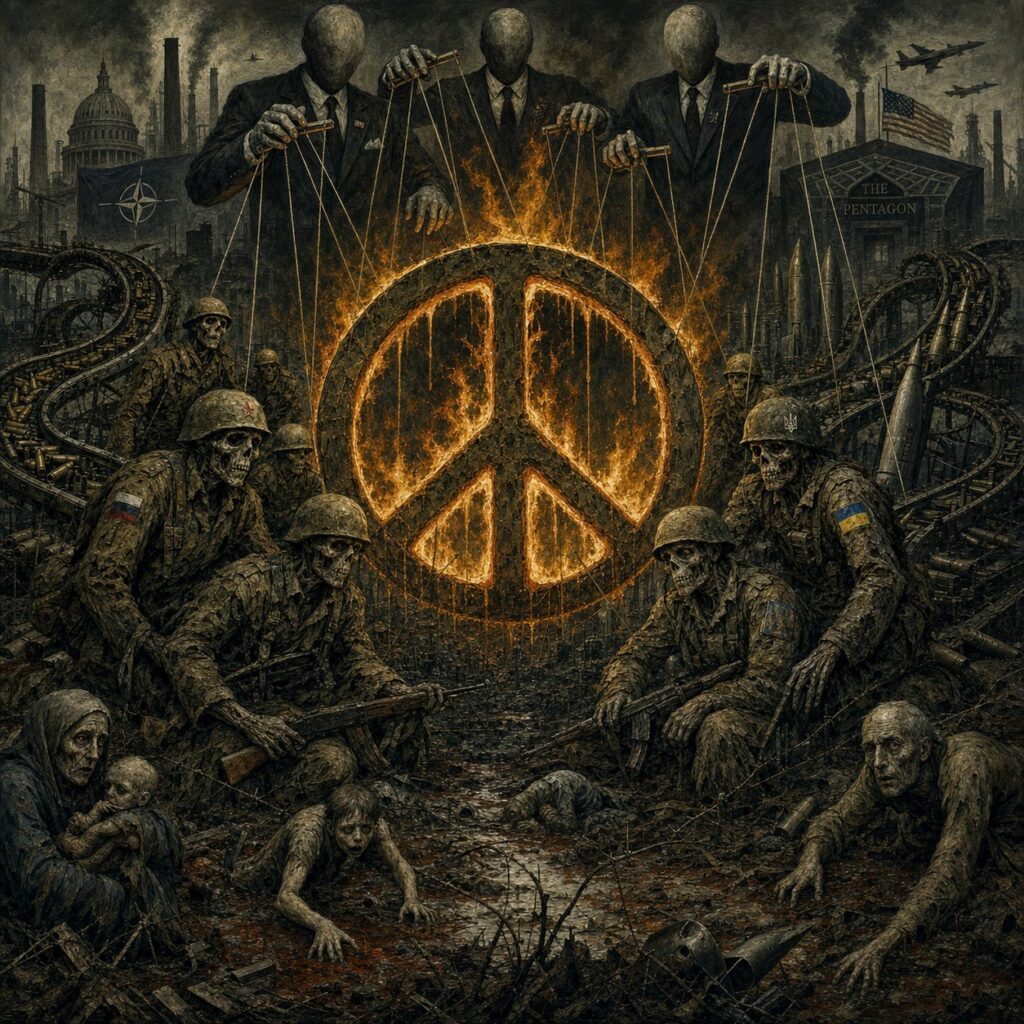
Give peace a chance. Before there is no one left to give it to.
By Scott Ortkiese | July 3, 2026 | so@throughlinesynthes
Submitted for consideration at the annual gathering of the Global Strategic Finance Forum, July 2026
Introduction: The Epistemological Crisis at the Heart of Western Policy
Before one can assess the economic, geopolitical, or financial dimensions of the Ukraine conflict, one must first confront an uncomfortable epistemological failure. The dominant Western narrative rests on a foundation that does not survive rigorous scrutiny. For four and a half years, mainstream institutions, legacy media outlets, and AI platforms have faithfully transmitted a story in which Russia acted as an unprovoked aggressor, Ukraine’s defeat is perpetually “near,” and Western escalation is a defensive act. Each of these claims is, upon examination, either demonstrably false or so stripped of context as to constitute disinformation by omission.
This article does not traffic in contrarianism for its own sake. It draws instead on the analysis of four scholars and practitioners whose combined record of predictive accuracy on this conflict is, by any honest reckoning, vastly superior to that of the institutions whose narratives they challenge: Professor John Mearsheimer of the University of Chicago, one of the world’s preeminent offensive realists; Colonel Douglas McGregor, decorated combat veteran and former adviser to the U.S. Secretary of Defense; Larry Johnson, former CIA analyst; and Alexander Mercouris, editor and analyst with unparalleled direct access to Russian sources and institutions. Their assessments, rendered independently in late June and early July 2026, converge on a set of conclusions that demand the serious attention of every person in this room.
The core argument is straightforward: this war was architected in the West, sabotaged at the peace table by Western actors, prolonged by a military-industrial complex that has converted Ukrainian blood into revenue, and is now accelerating toward a confrontation that could end in either a catastrophic European recession or a nuclear exchange. The peace dividend, the only rational outcome visible from a systems perspective, has been systematically foreclosed. Understanding why that happened, who benefits, and what it means for sovereign debt, energy markets, and global asset allocation is the purpose of this analysis.
Part I: The Architecture of a Provoked War
1.1 The NATO Expansion Problem, Revisited
The question of whether Russia was provoked is not, in 2026, a matter of serious scholarly dispute among the most credentialed realist thinkers in international relations. Professor Mearsheimer has argued for more than a decade, with extraordinary consistency, that NATO’s eastern expansion was the principal driver of Russian threat perception. His position is not contrarianism; it is the straightforward application of the same structural logic that the United States applied during the Cuban Missile Crisis, when Soviet proximity to the American mainland was treated as an existential casus belli.
The parallel is instructive. Larry Johnson, drawing on exactly this logic, posed the following in late June 2026: if the Sinaloa cartel were being supplied with drones, missiles, and targeting coordinates by Russia and China, enabling deep strikes into Texas, Arizona, and New Mexico, the United States would treat that as an act of war and respond accordingly. That is precisely the situation Russia has faced since at least 2014, and with accelerating intensity since 2022. The framing of Russia’s February 2022 intervention as “unprovoked” is not simply wrong. It inverts the causal sequence of events that any competent intelligence analyst can reconstruct from the public record.
The November 2021 U.S.-Ukraine Strategic Partnership Charter was, according to a senior adviser to former French President Hollande, the moment that convinced the Kremlin that Ukraine would either attack or be used as a platform for an attack. At that juncture, Russia’s strategic calculus became: strike first or face an adversary progressively armed and institutionally linked to a nuclear alliance that has publicly stated its objective is Russia’s strategic defeat. Former Secretary of State Mike Pompeo made that objective explicit in a public tweet just days before the July 2026 conversations captured in these transcripts. NATO’s stated goal is not Ukraine’s security. It is Russia’s destruction as a geopolitical actor.
1.2 The 2014 Inflection Point and the Sabotage of Minsk
The 2014 Euromaidan events, framed universally in Western media as a spontaneous democratic uprising, were in fact a NATO-backed coup, as Johnson describes it, that installed a government hostile to Russia and then proceeded to build a large proxy army while systematically sabotaging the Minsk peace agreements. The Minsk accords, signed in 2014 and 2015 under international auspices, were designed to provide a political settlement for the Donbas. They were never intended by Kyiv or its Western sponsors to be implemented.
This is not speculation. Former German Chancellor Angela Merkel, former French President Hollande, and former Ukrainian President Poroshenko each stated publicly, after the fact, that the Minsk agreements were never meant to be honored. They were a mechanism to buy time for Ukrainian rearmament. That admission, recorded in international media, is the single most important documented fact in understanding the origins of the 2022 escalation, and it is almost completely absent from the Western policy debate.
The implications for this audience are profound. If the peace architecture available in 2014-2015 was deliberately undermined by the same parties now demanding continued financing of the war, then the political risk premium on any Ukrainian sovereign instrument or reconstruction bond must be recalculated from the ground up. The guarantor class is the same class that torpedoed the last peace settlement.
1.3 The Istanbul Moment: Peace Killed in April 2022
The deliberate suppression of this particular episode is perhaps the most damning indictment of the managed war thesis. In late March and early April 2022, Ukrainian and Russian negotiating teams reached a preliminary framework agreement in Istanbul. The outline of a settlement was visible. Then, on or around April 9, 2022, former British Prime Minister Boris Johnson arrived in Kyiv with what multiple sources describe as a clear message: the West was not ready for peace, and Zelensky should not sign.
The deal died. The war that has since consumed an estimated 150,000 Ukrainian lives, and by conservative CSIS-sourced estimates cited by Mearsheimer in the July 3 conversation, possibly 450,000 Russian military casualties as well, proceeded on schedule. The financial beneficiaries of that decision are not obscure. The Pentagon’s defense industrial base, BAE Systems, Rheinmetall, Northrop Grumman, and the broader NATO logistics and intelligence apparatus have extracted hundreds of billions from a conflict that competent diplomacy could have ended in its second month.
Part II: The Military Reality That Western Analysts Refuse to Price
2.1 The Battlefield as It Actually Exists
Any investor or sovereign fund manager pricing risk in European assets must reckon with a military reality that is systematically misrepresented by Western institutional sources. Russia is not losing. Russia is not stalemated. Russia is, according to McGregor, Mercouris, Mearsheimer, and Johnson, advancing along multiple axes of the front simultaneously, something it was not doing in the first three years of the conflict when operations were concentrated on single battles such as Bakhmut, then Avdiivka, then Pokrovsk.
The casualty imbalance is staggering. The exchange ratios documented in prisoner and body repatriation data cited by Mearsheimer and Diesen run between 1:20 and 1:40 in Russia’s favor. When the New York Times, drawing on a CSIS study, reported approximately 450,000 Russian military casualties against 125,000-150,000 Ukrainians killed, Mearsheimer identified the fundamental logical incoherence: a force sustaining three times the casualties of its adversary does not advance steadily forward, seize strategic terrain, and operate across multiple simultaneous fronts. The numbers do not survive basic military logic.
Ukraine, in McGregor’s assessment, is “close to dead” as a functioning military state. What persists is what he describes as a facade of government, sustained by hardcore supporters, thousands of foreign mercenaries, and NATO intelligence and targeting infrastructure, capable of launching periodic drone and missile strikes to create the illusion of military viability and thereby attract continued external financing. The strategic purpose is not battlefield victory, which is not achievable, but prolongation, which serves the financial and political interests of the Western war management apparatus.
2.2 NATO’s Direct Operational Role
The claim that NATO is a passive supplier to a sovereign Ukrainian military is no longer defensible in any serious analytical forum. The documentary record, reinforced by the accidental disclosure from an Estonian presidential adviser captured by Russian pranksters in late June 2026 and confirmed by Russian Foreign Ministry spokeswoman Maria Zakharova, establishes that NATO member states have been providing targeting coordinates for attacks on Russian territory, including St. Petersburg.
The G7 summit declaration of June 17, 2026 formalized what had been an operational reality: participating states announced they would accelerate support for long-range Ukrainian strikes deep into Russia and intensify economic pressure. Mearsheimer’s observation bears repeating: if anyone in the Kremlin harbored residual doubt about Western intentions, the G7 declaration should have eliminated it. This is not a support operation. It is a proxy war in which NATO provides intelligence, targeting, logistics, financing, and increasingly direct operational participation, while maintaining the fiction of non-belligerency.
Johnson’s framing is precise: NATO contractors are pulling the trigger. NATO satellites are guiding the weapons. Drones attacking Russian territory are transiting through or originating from NATO member airspace. The only element technically absent is the presence of NATO uniformed personnel at the point of strike. That distinction, which NATO legal architecture treats as decisive, is of rapidly diminishing operational relevance.
2.3 Russia’s Expanding Objectives: The Logic of Novorossiya
Putin’s late June 2026 interview, discussed in depth by McGregor and Mercouris, announced expanded objectives that the Western press processed as alarming escalation. In the framework of classical realism, they represent a predictable and arguably rational response to the destruction of the diplomatic track and the progressive absorption of Ukraine into the NATO operational architecture.
The objective of securing all of Novorossiya, historically the Russian-speaking southern and eastern territories including Odessa, is not new. McGregor notes that Kharkiv and Odessa have always been historically Russian-speaking cities, and that most Russians always believed those cities would have to end up in Russian hands if the operation was to achieve genuine security objectives. The Sumy buffer zone, characterized in Western media as punitive, is in McGregor’s operational assessment simply a rational security necessity: territory adjacent to the Russian heartland cannot be left under the control of a state whose territory is being used for coordinated strikes on Russian civilian infrastructure and, apparently, as the staging ground for what some credible Russian sources describe as an assassination attempt on Putin in December 2025.
Mercouris, who attended a conference in Pskov and held direct conversations with Russians across the social spectrum including factory workers, reports an overwhelming consensus that this is no longer perceived as a limited special operation. It is understood inside Russia as a civilizational conflict with the West. That shift in popular perception removes any residual internal political constraint on escalation.
Part III: The Western War Machine and Its Institutional Architecture
3.1 Washington: Strategy as Commodity
McGregor’s formulation deserves to be quoted directly in its substance: there is no strategy. There has never been a strategy. Since Kennan, since containment, U.S. foreign policy has been organized around the maintenance of 750 bases in 80 countries, the perpetuation of financial hegemony underwritten by military hegemony, and the purchase of defense materiel as if it were a supermarket transaction. The objective in Ukraine is not the strategic defeat of Russia, which is not achievable, and is arguably not even desired by the operational planners who understand what that would mean. The objective is continued revenue extraction from the conflict, presented as geopolitical purpose.
Trump’s trajectory is instructive. He entered his second term with what appeared to be a genuine interest in a negotiated exit, including the Anchorage format of engagement with Moscow. The “Anchorage period,” as Johnson terms it, is dead. Lavrov, Ushakov, and other senior Russian officials have confirmed it. The G7 summit in France appears to have been the decisive moment of reorientation: Trump was reportedly told by Zelensky that Ukraine was winning impressively, and responded by encouraging more aggressive action. A president managing a 24-hour news cycle and a legacy-driven political calculus is, in McGregor’s assessment, doing “whatever he thinks is going to benefit him and his presidency.”
The tragedy of this dynamic for the Ukrainians is that their instrument of governance has been captured entirely by external interests. Zelensky requesting $90 billion from Trump, in McGregor’s telling, is not the act of a sovereign head of state pursuing national interests. It is the pitch of a franchise operation whose customer base is the Western war management apparatus, and whose value proposition is continued kinetic activity sufficient to justify continued disbursements.
3.2 London: The Enthusiastic Principal
Among NATO capitals, London’s role merits special attention. Britain and Germany are, in Johnson’s assessment, the most aggressive actors in the current phase of the conflict. The British posture is explicable by reference to the Cold War proxy war template: the dream scenario of having Ukrainians and Russians kill each other at mass while Britain stands on the sideline and manages the logistics. That scenario, Johnson observes, has now evolved into one where European industrial production and missile assembly facilities, including British ones, serve as the uncontested logistics base for strikes on Russian territory, shielded from Russian retaliation by the implicit NATO Article 5 umbrella.
The reported arrival of a British vessel in Odessa carrying materials that independent analysts have described as potentially radioactive is, if accurate, an extraordinary escalation. Johnson notes that while the sourcing requires verification, it is entirely consistent with the pattern of British willingness to take risks that other NATO members have been unwilling to absorb. Britain’s industrial and military capabilities are, as Johnson notes, a shadow of what they once were. The country “can’t even fill a football stadium with its army.” Yet its political class operates with the confidence of an empire that no longer exists.
3.3 Brussels: The Institutional Enforcement Mechanism
The European Union’s role in this conflict is distinct from both the American and British contributions. It functions primarily as the ideological enforcement mechanism, the body that turns the narrative into policy, punishes dissent within member states, and administers the sanctions architecture whose principal victims have turned out to be the European economies themselves.
The sanctions imposed on Russia following 2022 were, as Diesen and Johnson observe, never going to work as designed. Russia had spent the preceding decade constructing an economic architecture specifically designed to absorb and redirect Western economic pressure. The pivot to Asian markets was not improvised after 2022; it was prepared. When German companies followed Russian gas to China, as Diesen notes, the economic cost of the sanctions accrued not in Moscow but in Frankfurt. German industrial deindustrialization, once a theoretical risk, has become a structural reality. Yet EU leadership, personified by figures such as Ursula von der Leyen, who described Germany being “cut off from Russian gas” when the documentary record establishes the opposite causal sequence, continues to maintain the narrative architecture.
The suppression of dissent within European discourse deserves particular attention from this audience. Mercouris and Johnson both observe that any analytical voice in Europe that introduces the concept of caution, any voice that raises the question of what happens when you continuously provoke the world’s largest nuclear power, is immediately labeled “Putinist.” The foreclosure of debate is not incidental to the managed war thesis. It is the mechanism by which the thesis is sustained.
Part IV: The Nuclear Dimension and the Karaganov Threshold
4.1 The Escalation Logic That Western Analysts Refuse to Model
The single most consequential analytical failure in Western institutional assessments of this conflict is the consistent underpricing of nuclear risk. That failure is not primarily technical. It is political. No major financial institution, no sovereign ratings agency, no multilateral body has incorporated into its baseline scenario the possibility that Russia, faced with the foreclosure of every diplomatic exit and the progressive expansion of direct NATO operational participation in strikes on Russian territory, will cross the threshold from conventional to non-conventional response.
Sergey Karaganov, one of Russia’s most respected strategic thinkers, has articulated a graduated escalation doctrine: first, conventional strikes on military production facilities in NATO member states; second, if that fails to deter, tactical nuclear use. Johnson, who takes Karaganov seriously as a strategic analyst, frames the logic as follows: the West has lost its fear of Russia. It proceeds on the assumption that Russia will absorb any level of provocation without symmetrical response. Karaganov’s point is that this assumption is the most dangerous one in contemporary geopolitics, because once Russia determines that its deterrent is not credible, it will take steps to restore that credibility, and those steps carry catastrophic risk.
Mearsheimer’s assessment is more measured but arrives at the same structural conclusion. Russia is, for now, doing a reasonably effective job of parrying the drone attacks. Its battlefield position is improving steadily. The incentive to go down the Karaganov road is therefore limited in the immediate term. But the G7’s explicit commitment to accelerate the long-range strike campaign changes the calculus. If Russia reaches the point where it can no longer absorb the pain, the options narrow to two: accept what its leadership regards as existential capitulation, or force the kind of direct confrontation that puts European capitals on notice in the same way Soviet missiles in Cuba put Washington on notice in 1962.
4.2 Finland, Nuclear Weapons, and the Security Dilemma in Real Time
Finland’s recent legislative change, enabling the storage of NATO nuclear weapons on Finnish soil, is a case study in the security dilemma operating at speed. Finland conducted profitable cross-border trade with Russia for decades. It has no historical security justification for hosting nuclear weapons; Russia has not threatened it and has expressed no territorial interest in Finnish territory. Yet the country has joined a process that will compel Russia to station nuclear-capable forces in close proximity to Finland, generating exactly the threat that the decision was supposedly designed to address.
McGregor identifies this as “insane” in operational terms. More precisely, it is a textbook illustration of what Mearsheimer and Diesen describe as the classical security dilemma: every action Russia takes for defensive purposes looks offensive to Western observers, and every action Western states take for ostensibly defensive purposes looks offensive to Russia. Once that spiral begins, the logic of mutual escalation operates semi-independently of the intentions of individual decision-makers.
Part V: The Economic Reckoning
5.1 The Energy Architecture of Western Self-Destruction
The economic consequences of the managed war thesis are not hypothetical. They are being priced, imperfectly and with considerable denial, in European debt and equity markets right now. The decision by European governments to cut energy ties with Russia, the continent’s historical supplier of cheap and reliable hydrocarbons, in order to purchase more expensive American LNG, was not, as Johnson observes, the product of rational economic analysis. It was a political and ideological commitment that imposed structural costs on European industries that are now accelerating deindustrialization at a pace that has no peacetime precedent in the post-war era.
Germany’s situation is the most acute. BASF, one of the most energy-intensive chemical manufacturers in the world, has been following Russian gas to China. The manufacturing plants go where the cheap energy is. That dynamic does not reverse when a peace agreement is eventually reached; the capital investment has been made, the supply chains have been rerouted, and the industrial ecosystem that once justified Germany’s position as Europe’s economic anchor is being rebuilt elsewhere. The Nordstream pipeline sabotage, which Johnson and others attribute to U.S. and potentially British operational involvement, permanently removed the physical infrastructure through which a restoration of that energy relationship could have occurred.
Johnson’s warning in the late June 2026 conversation about the near-term implications of the Strait of Hormuz disruption layered on top of the pre-existing European energy crisis is particularly relevant. Diesel and aviation fuel shortages arriving on a weeks-not-months timeline, combined with an economy already running near zero growth and a financial system exposed to reconstruction bond instruments of uncertain value, create a scenario of compounding systemic stress that the European Central Bank is not positioned to address through conventional monetary policy tools.
5.2 The BRICS Acceleration and the Erosion of Dollar Hegemony
Russia’s 2022 decision to intervene in Ukraine, paradoxically, produced the geopolitical outcome that American grand strategy had spent decades trying to prevent: the acceleration of BRICS as a functional economic and potentially monetary alternative to the dollar-denominated order. The sanctions, intended to collapse the Russian economy, instead demonstrated that the dollar system was a weapon that could be deployed against any sovereign state that crossed Washington’s red lines. The demonstration effect was not lost on Beijing, New Delhi, Riyadh, or Tehran.
Johnson notes that Russia’s economy had been made effectively “bulletproof” through a decade of deliberate preparation: diversification toward Asian markets, development of parallel payment systems, ruble-denominated commodity contracts, and bilateral currency agreements that reduce dependence on SWIFT. The sanctions accelerated a process that was already underway. The net result, as Johnson observes from direct experience working on Russia’s economic reorientation toward the East, is that the cheap energy that used to flow to Europe now flows to Asia, and the German companies are following it.
For the asset-backed investment banking community specifically, the implications are structural and durable. Any instrument denominated in or collateralized by European energy infrastructure, European sovereign capacity, or Ukrainian reconstruction assets must be stress-tested against a scenario in which the dollar’s reserve currency role continues its measured but accelerating erosion, in which European industrial capacity does not recover to pre-2022 levels, and in which any reconstruction of Ukraine occurs under Russian rather than Western institutional auspices.
5.3 The Corruption Premium and the Unquantified Losses
McGregor’s assessment that approximately 50% of Western military and financial transfers to Ukraine disappear into corruption, with much of the remainder diverted through arms trafficking to non-state actors in Colombia, Venezuela, and Mexico, represents a quantified risk factor that no Western financial institution has incorporated into its public analytical framework. This is not a peripheral concern. It is a fundamental question of fiduciary accountability for every dollar, euro, or pound that has been channeled into the Ukrainian theater.
The weapons pipeline leakage is not an operational anomaly; it is a feature of a system in which accountability mechanisms have been deliberately weakened to ensure flow. When Zelensky requests $90 billion from Trump with no credible accounting of prior disbursements, and the request is seriously entertained, the institutional framework for any subsequent investment recovery is essentially nonexistent. For anyone in this room with exposure to reconstruction finance instruments, development bank guarantees, or sovereign credit facilities collateralized against Ukrainian territorial assets, the absence of a functional accountability architecture is not a due diligence consideration. It is a disqualifying condition.
Part VI: What the War’s Endgame Looks Like from Moscow
6.1 A Harder Putin and the Foreclosure of Diplomacy
Mercouris, who has direct and recent access to Russian institutional and civil society voices, reports a qualitative shift in the Russian posture that is not adequately captured by Western threat assessments. The Putin who spent 2025 speaking the language of diplomacy, engaging the Anchorage process, and maintaining at least a formal openness to negotiation is gone. In his place is a leader who has concluded, on the evidence of the G7 declaration, the expanded drone campaign, the assassination attempt on his residence in December 2025, and the progressive normalization of attacks on Russian civilian infrastructure, that the West has no interest in a negotiated settlement.
The internal debate within the Russian leadership that Mercouris identified following the Valdai attack, a period of relative silence on Ukraine that lasted several weeks, has concluded. The outcome is a leadership committed exclusively to military victory and the consolidation of a security architecture that makes a replay of the current scenario impossible. Novorossiya, as a strategic concept, is the answer to that requirement: a Russia that controls the Black Sea coastline from Crimea to Odessa, that has landlocked what remains of a Ukrainian state, and that faces no future prospect of NATO missiles positioned within strike range of Moscow.
6.2 The Endgame Scenarios and Their Asset Implications
McGregor outlines three near-term operational possibilities: the seizure of Odessa and the landlocking of Ukraine; a drive toward Kyiv from the north through Belarus; and a combined operation exploiting the collapse of the three fortress cities currently under pressure in central Ukraine, enabling concentration and redeployment of Russian forces at scale. None of these scenarios, in McGregor’s assessment, requires Russian escalation to a qualitatively new level of violence. They are the logical military extension of what is already underway.
The endgame that serves Western financial interests, a frozen conflict allowing continued disbursements, continued reconstruction bond issuance, and continued arms procurement, is not available to the parties who actually determine outcomes on the ground. Russia has no interest in a frozen conflict that allows the West to rearm Ukraine for the next round, as Diesen observes. That is, from Moscow’s perspective, not a settlement. It is a rescheduled war. The only outcomes with genuine strategic durability are either a comprehensive settlement that addresses Russian security concerns, which is what Istanbul 2022 briefly offered, or a Russian military victory sufficiently complete to remove the threat at source.
The former requires Western political actors to admit the narrative has been wrong and accept terms that no incumbent Western government can politically survive endorsing. The latter produces a set of geopolitical and economic realities that the dollar-denominated financial architecture has not priced.
Part VII: The Case for Peace as the Only Rational Asset Allocation
7.1 The Economic Logic of Negotiation
The realist case for a negotiated settlement is not moral or sentimental. It is arithmetical. Europe’s energy infrastructure has been permanently degraded by the deliberate destruction of Nordstream. European industrial capacity is deindustrializing. European defense budgets are being expanded to finance a military capability that, as Johnson documents with considerable precision, does not exist: Britain cannot fill a football stadium with its army; Germany’s once-leading manufacturing sector is shuttered or relocated; French strategic autonomy is a political speech, not a military reality. The additional hundreds of billions being committed to a war that cannot be won, against an adversary whose economy has proven structurally resilient to the sanctions imposed, represent not an investment in security but a compounding destruction of the European economic base.
The alternative, a settlement that neutralizes Ukraine as a NATO forward operating base, accepts the territorial realities that exist on the ground, and restores some version of the energy and trade relationships that served European industrial interests for decades, is recoverable. It is not pleasant. It requires European and American political leaders to acknowledge strategic failure. But it preserves the physical infrastructure of a functional European economy, reopens the energy trade that German industry requires to remain in Germany, and removes the nuclear risk that currently has no pricing in any sovereign credit instrument in the eurozone.
7.2 The Voices Being Suppressed
The most significant structural risk for anyone attempting to model this conflict is the systematic exclusion of the analytical voices that have been most consistently right. Mearsheimer, Johnson, McGregor, and Mercouris are not fringe figures. They are credentialed, experienced, and have been providing accurate assessments since before 2022. Yet the information architecture of Western discourse has quarantined them. European media and political culture have, as Johnson observes, produced a condition in which any voice of caution is immediately labeled Putinist and suppressed. That is not a healthy epistemic environment for pricing risk. It is an environment that produces policy disasters of exactly the kind now unfolding.
Former Ukrainian presidential adviser Oleksiy Arestovych’s publicly stated position deserves note here: if he were to run for the Ukrainian presidency, his first act would be to travel to Moscow and pledge that Ukraine would never again serve as a NATO forward base against Russia, accepting the necessary territorial adjustments. That there exists within Ukraine itself a coherent, politically significant constituency for exactly the kind of settlement that Western governments refuse to countenance should carry analytical weight in any serious assessment of where this conflict is heading.
McGregor’s prescription is the simplest and most structurally sound: the war ends when the West packs up and goes home. Not because Russia deserves a reward, but because the continued presence of the Western war management apparatus is the primary obstacle to any outcome that does not involve either Ukraine’s complete destruction or a direct NATO-Russia confrontation. The logic of systems analysis, the logic of historical precedent, and the logic of basic arithmetic all converge on the same conclusion. Peace is not the soft option. It is the only viable one.
The transcripts cited throughout this analysis are drawn from conversations between Glenn Diesen and Professor John Mearsheimer (July 3, 2026), Colonel Douglas McGregor (July 1, 2026), Larry Johnson (June 27, 2026), and Alexander Mercouris (June 30, 2026). The analytical positions attributed to each are drawn directly from those conversations and reflect the independent judgments of the respective analysts.
Related reading
- Manufacturing War: How the West Built and Sold the Russia-Ukraine War
- The Herding: How the West Weaponized Ukraine to Provoke Russia, And How Ukraine Embraced Its Own Destruction
- Behind the Headlines: Jeffrey Sachs and Glenn Diesen on the System That Built the Ukraine War
- Six Billion People Can See What CNN Won't Tell You: Ukraine Is Losing, and the West Wants the Killing to Continue