
A Trump Endorsement in the Midterms Will Be a Midterm Death Certificate
The independents are coming…
By Scott Ortkiese | June 29, 2026 | so@throughlinesynthesis.com
A field analysis of the American midterm map, written for an audience that does not need to be told what it already sees. The companion data annex carries the underlying charts.
I. The thesis in one paragraph
The 2026 midterms are not a contest the Republican Party is going to fight to a draw. They are, on every measure that matters eighteen weeks out, a reckoning. The President’s net approval has not crawled above negative seventeen in three months, his standing among independents has reached a record minus 50 in the Economist/YouGov series, the generic ballot favors Democrats by the second-largest May margin in any midterm cycle since 2002, every swing demographic has moved double digits against him since inauguration, and prediction markets price a Democratic House at roughly four in five. The Democratic primary electorate has begun firing its tenured incumbents in real time, replacing them with a younger coalition the GOP has no equivalent of and Trump structurally cannot allow. The independent press has become a primary intelligence source on the war, the budget, and the economic record the incumbent party would otherwise control the narrative around. The combination is producing the most predictable midterm reckoning of the modern era, and it should be priced as such by anyone whose book carries political risk.
II. The empirical floor: where the GOP actually stands in June 2026
Strip the partisan polling out and the picture is unambiguous. The companion data annex plots each of these series; the floor is the point.
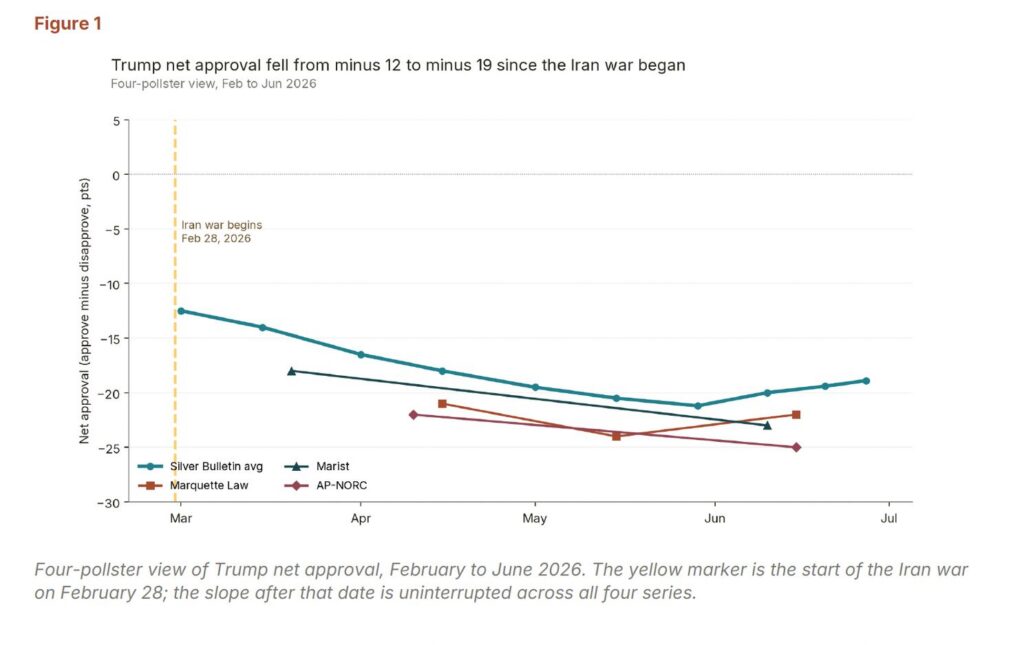
· The Silver Bulletin polling average puts Trump’s net approval at negative 18.9 as of June 27, with strong disapproval at 48 percent against strong approval at 22.6 percent. That is roughly ten points worse than the same point in his first term (Silver Bulletin, June 27, 2026).
· The Marist/NPR/PBS June survey puts overall approval at 36 percent and economic approval at 33 percent, the lowest economic number Marist has ever recorded for him (Marist Poll, June 18, 2026).
· AP-NORC has him steady at 37 percent overall with 65 percent disapproving of his handling of Iran (AP-NORC, June 19, 2026).
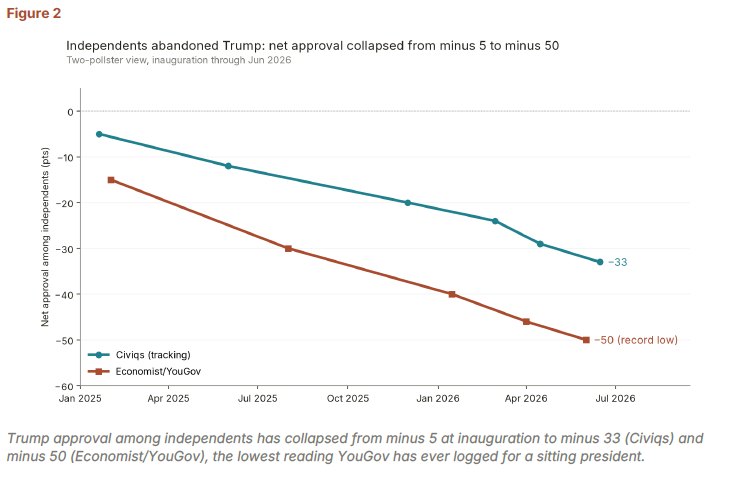
· The Economist/YouGov May 29 to June 1 wave recorded a net minus 50 among independents (21 approve, 71 disapprove), the lowest reading YouGov has ever logged for a sitting president (YouGov, June 2026). Civiqs’ continuous tracker has independents at minus 33, down from minus 5 at inauguration (Newsweek/Civiqs, June 2026).
· A Franklin and Marshall poll in Pennsylvania, the keystone of the 2024 victory, shows a ten-point collapse to 29 percent approval since March (Franklin and Marshall, June 2026).
· The Cook Political Report’s David Wasserman, who is not a man given to hyperbole, told the cotton industry on June 12 that Democrats are now favored to retake the House (Ag Bull Trading, June 12, 2026).
· Prediction markets reflect this. Kalshi has Democrats at roughly 78 percent to retake the House, Polymarket at 82 percent. The Senate sits at a 56.5 percent GOP retention probability, a coin flip with a small lean (Newsweek, June 10, 2026; Polymarket Senate 2026).
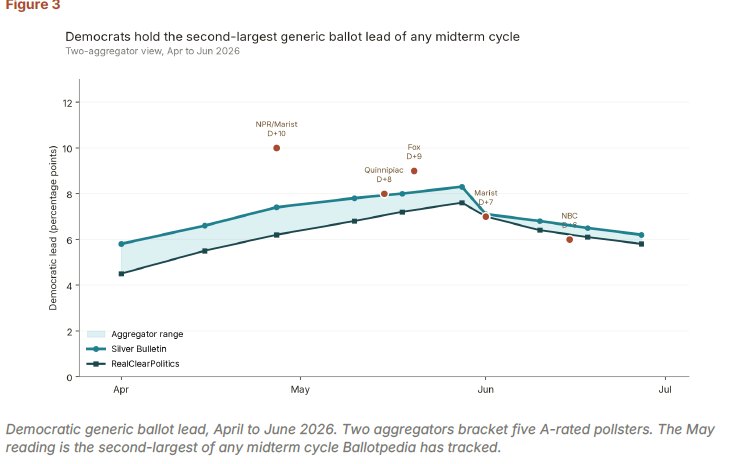
· The generic congressional ballot has Democrats up between 5.8 and 8.3 points across aggregators through May and June, the second-highest May lead in any midterm cycle Ballotpedia has tracked back to 2002 (Ballotpedia, June 18, 2026; Silver Bulletin generic ballot tracker).
These are not snapshot wobbles. They are the floor of a midterm environment in which the President’s party historically loses an average of twenty-six House seats. The party in power needs to defend a four-seat House majority and a Senate map dotted with seats in states where Trump won by single digits in 2024.See Charts 1, 2, and 3 in the annex for the time-series plots.
III. The economic reality the incumbent cannot run on
The Iran war has done what fifteen years of forecasting models said it would do: it has put gasoline near four dollars and dragged headline CPI to a three-year high. This is the inflation the GOP will carry into November.
· May CPI: plus 4.2 percent year over year, the largest gain since April 2023. Energy alone accounted for over sixty percent of the monthly increase. Gasoline rose 7 percent on the month and 40.5 percent on the year (BLS, June 10, 2026).
· PCE, the Fed’s preferred gauge, hit 4.1 percent in May (CNN, June 25, 2026).
· The EIA’s June outlook lifts the 2026 retail gasoline forecast to roughly $3.90 a gallon, nearly a dollar above the February forecast (US Gas Gauge, June 17, 2026).
· Pump prices peaked at $4.62 in May, sit at $3.95 to $4.05 as of late June, and remain 28 to 34 percent above the pre-war baseline (Finder, June 25, 2026; YCharts).
· Reuters/Ipsos shows only 22 percent of Americans approve of Trump’s handling of the cost of living, with 70 percent disapproving (Reuters/Ipsos summary, June 9, 2026).
Cheap-gas optimists like Dick Morris argue that the post-ceasefire decline will rescue the GOP by November (Newsmax, June 20, 2026). The arithmetic does not support him. Pump prices remain a third above the February baseline, EIA expects only a partial roll-back by year-end, the Strait of Hormuz tolling regime expires in roughly sixty days, and Friday’s renewed US strikes on Iranian targets along the Strait have already reopened the geopolitical risk premium (Fox News live coverage, June 26, 2026). The voter at the pump in October will not be measuring against February. He will be measuring against 2024.
IV. The Iran war as a freestanding midterm wound
The Iran war is not an asset for the incumbent party. It is, on every meaningful measure, a deeper wound than Iraq was for Bush in 2006 at the equivalent point.See Chart 1 in the annex: the inflection point in the four-pollster series sits cleanly at the February 28 start of the war.
· Reuters/Ipsos June 17-22: 52 percent say the war was not worth the cost, only 24 percent say it was, only 23 percent say the US is in a stronger position with Iran than before the war (US News/Reuters, June 23, 2026).
· AP-NORC: 65 percent disapprove of Trump’s Iran handling; 53 percent say the military action went too far (AP-NORC, June 19, 2026).
· Gallup: only 34 percent approve of US military action against Iran, putting it among the least popular initiations of force Gallup has measured since the 1980s (Gallup, June 19, 2026).
· Strength In Numbers/Verasight: only 18 percent of Americans believe the US achieved its goals in Iran; 46 percent say the country should never have gone in (Strength In Numbers, June 24, 2026).
· CNN/SSRS: 56 percent disapprove of the strikes; 65 percent want congressional approval for further action; 58 percent believe the strikes increased the Iranian threat (Ground News summary, June 24, 2026).
Four House Republicans crossed over to support a war powers resolution in early June (Foreign Policy Journal, June 4, 2026). The Senate Armed Services markup of the FY27 NDAA saw nearly unprecedented defections from the GOP side over the war and the topline (Taxpayers for Common Sense, June 26, 2026). Voters oppose the proposed Pentagon increase by a 2-to-1 margin. The administration’s response is a sixty-seven-billion-dollar supplemental, twelve billion of it classified, layered on top of a House FY27 defense bill that runs from $1.1 to $1.15 trillion depending on which version one reads (Breaking Defense, June 25, 2026; Inside Defense, June 25, 2026; American Progress, June 1, 2026).
That is the configuration the GOP carries into the midterms: a war the public opposes, paid for by a supplemental the public opposes, on top of a base budget the public opposes, in an economy the public blames the President for. There is no historical analogue in which the incumbent party survives that combination intact.
V. The swing coalitions have already moved
The 2024 Trump coalition is no longer the 2026 Trump coalition.Chart 4 in the annex plots six demographic cuts side by side; every one of them has moved double digits since inauguration.
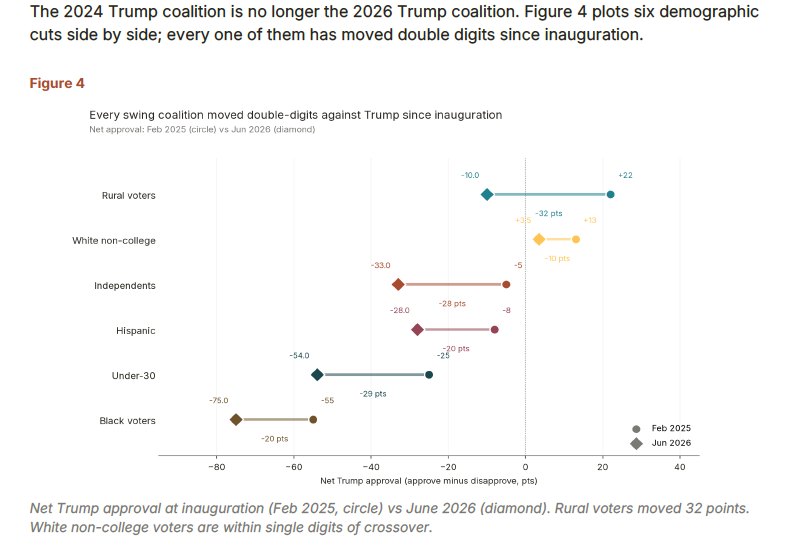
·Rural voters, the structural foundation of the 2024 victory, sat at plus 22 net approval in Marist’s February 2025 reading. The June 2026 reading is minus 10. A 32-point swing in a cohort the GOP cannot afford to lose any ground in (Marist Poll, June 2026).
·White non-college voters, the demographic backbone of the modern Republican coalition, have collapsed from plus 13 to plus 3.5 in the Cook Political Report tracker. The cohort is within single digits of crossover (Panoptica, April 2026 archive).
·Hispanic votersdropped from minus 8 to minus 28. Among 2024 Hispanic Trump voters specifically, Pew finds approval has collapsed faster than among non-Hispanic Trump 2024 voters (Cozen Currents, June 9, 2026).
·Independentshave moved from minus 5 to minus 33 in the Civiqs tracker, and to minus 50 in the most recent Economist/YouGov reading. Sixty-four percent disapprove of Trump in the Marist June wave with no recovery from April (KPBS/Marist, June 18, 2026).
·Under-30 votersare at 77 percent disapproval in NBC’s May 29 to June 7 release;Black votersat 79 percent disapproval.
·Strong Republican approvalof Trump has fallen from 61 percent in April to 53 percent in June, the steepest intra-party erosion of his presidency (KPBS/Marist, June 18, 2026).
A coalition that loses 32 points among rural voters and 10 points among white non-college voters while running negative 50 among independents has no obvious path to defending a four-seat House majority. The hardening of the educated-suburban Democratic coalition was the structural story of 2018. The collapse of the rural and non-college pillars in 2026 is the structural story of the coming midterm.
VI. The Democratic primary electorate is already firing its old men
The Democratic primary electorate is doing in real time what the Republican primary electorate did in 2010 with the Tea Party and refused to do thereafter. It is firing tenured incumbents who do not match the moment. Three House primaries in New York on June 23, in the most Democratic city in the country, on a single Tuesday, produced three losses for the establishment and two ousted incumbents.
NY-10 (Lower Manhattan, Brownstone Brooklyn, Borough Park).Brad Lander defeated Representative Dan Goldman by roughly thirty-one points, 65.5 to 34.5, in one of the most Jewish congressional districts in the country (BBC, June 24, 2026; Times of Israel, June 24, 2026). Goldman, heir to the Levi Strauss fortune, spent more than seven million dollars, two million of it his own (Mother Jones, June 25, 2026). He had the endorsement of AIPAC, of Speaker Emerita Pelosi, of Governor Hochul, and of House Minority Leader Jeffries. Lander, also Jewish, also calling himself a progressive Zionist, ran on the proposition that Israel’s conduct in Gaza is genocide, that AIPAC is hurting the Democratic Party, that he would vote against further offensive military aid, and that “never again” must mean “never again to anyone.” He won Brooklyn by forty-five points. He won Goldman’s own Manhattan precincts by ten.
NY-13 (Upper Manhattan, Bronx).Darializa Avila Chevalier, a thirty-two-year-old former Columbia Students for Palestine organizer and Mamdani field lead, defeated Adriano Espaillat, chair of the Congressional Hispanic Caucus and a five-term incumbent who had been a Jeffries ally and an AIPAC favorite (City Journal, June 24, 2026; Democracy Now, June 23, 2026). AIPAC’s United Democracy Project spent in this race. She still won by about three thousand votes out of sixty-five thousand cast.
NY-7 (Williamsburg, Bushwick, Ridgewood).Claire Valdez, a thirty-six-year-old DSA assemblywoman and former union organizer, defeated Brooklyn Borough President Antonio Reynoso 56 to 36, despite Reynoso holding the endorsement of retiring Nydia Velázquez, the Working Families Party, and nearly every major labor union in the city (The Guardian, June 24, 2026).
These wins came alongside NYC-DSA’s largest state-legislative slate in history. Nine of ten DSA-endorsed candidates won (Fox News, June 25, 2026). Espaillat is seventy-one. Goldman is fifty but votes seventy. The replacements are thirty-two, thirty-six, and forty-something. Mamdani is thirty-four, and Mamdani drove turnout in his 2025 mayoral primary to double or triple 2021 levels in some neighborhoods (Britannica biography). Valdez and Chevalier rode the same coalition.
VII. The Goldman lesson is the cleanest controlled experiment of the cycle
For a financier-and-economist audience, the Goldman defeat is the data point worth dwelling on because the variables are unusually well-controlled.
· Two Jewish candidates.
· Both self-described liberal Zionists.
· Both critics of Netanyahu.
· One of the most heavily Jewish districts in the country, including significant Orthodox precincts.
· An incumbent with universal establishment backing, a seven-million-dollar campaign, two million of it personal, and the implicit protection of AIPAC.
The variable that moved was Israel. Lander used the word genocide. Goldman would not. Lander pledged to take no money from pro-Israel lobbying groups. Goldman accepted the AIPAC endorsement while disclaiming AIPAC. Lander refused to march in the Israel Day parade while Israel is committing what he called genocide. Goldman marched and called the march a proud moment (Mother Jones, June 25, 2026; New York Times, June 17, 2026).
The result: a thirty-one-point loss in Brooklyn, a ten-point loss in his Manhattan home base, in a district built around Jewish voters. The AIPAC-protected Jewish district model is dead. It is not retreating; it is dead. AIPAC’s United Democracy Project has now spent more than twenty-eight million dollars in the 2026 cycle, much of it through pop-up and pass-through PACs, and its return on investment in NY-10, NY-13 and earlier in NJ-12, where Gaza trauma surgeon Adam Hamawy won the Democratic primary, is negative (POLITICO, June 23, 2026; JTA, June 3, 2026).
A counterweight has emerged: American Priorities, allied with Justice Democrats, with two million dollars committed to Lander, Valdez and Chevalier in 2026 and ten million planned across the midterms (JTA, June 2, 2026; New York Times, June 2, 2026). For the first time since AIPAC began running primary super PACs in 2022, the pro-Israel lobby is at parity or being outspent in selected Democratic primaries. That alone is a structural change in the donor map heading into November.
VIII. Why the GOP cannot do the same to its own old men
The Republican primary electorate cannot perform the same hygiene on its own bench, for three reasons that an audience of investors should price in.
First,structural. The Republican primary calendar has been pre-cleared by Trump endorsements. Anyone who challenges an incumbent challenges Trump. Anyone who survives a challenge from a Trump-endorsed primary opponent emerges weaker for November, not stronger. Thomas Massie, a sitting Kentucky Republican congressman, was driven from his seat by fifteen million dollars in AIPAC-aligned primary spending in part because he demanded accountability for US weapons used in Gaza (Daily Kos, June 14, 2026). John Cornyn, the senior senator from Texas and former GOP whip, was defeated in his primary by Ken Paxton (Texas Tribune, June 5, 2026). The Republican primary process is selecting for loyalty, not for general-election durability.
Second,retirement. Sixty-nine members of Congress have already announced they will not seek reelection in 2026, a substantial share of them Republicans (Ballotpedia, June 15, 2026). NPR has begun referring to the freshly liberated GOP senators (Cassidy, Cornyn, Tillis) as the YOLO caucus, senators with nothing left to lose and an interest in distancing themselves from Trump before he becomes a lame duck (NPR, June 18, 2026). Wisconsin Republicans are losing one in five state legislators to retirement (Urban Milwaukee, June 1, 2026). This is the pre-rout behavior of a caucus that knows what is coming.
Third,generational. The Republican bench from age thirty to forty-five is thin, ideologically captured by MAGA orthodoxy, and untested in general elections in suburban districts. The Democratic bench at the same age is, whatever one thinks of its policy program, demonstrably capable of beating multi-million-dollar incumbents in dense electorates. Mamdani’s coalition (cross-racial, cross-class, immigrant, renter, college-educated and not-college-educated) is precisely the demographic profile of the 2026 swing electorate that the rural and non-college shifts in Section V leave the GOP unable to compensate for.
A useful frame: the Democratic Party is going through its 2010 Tea Party moment two cycles late. The Republican Party is going through its 1974 Watergate moment in slow motion. The midterm is the consummation of both processes.
IX. The independent press is now the primary intelligence source on the war and the economy
The midterm environment described in Sections II through V is not the one the legacy press is covering.Chart 5 in the annex plots the substitution: independent press platforms have scaled in lockstep with the GOP’s loss of independents.
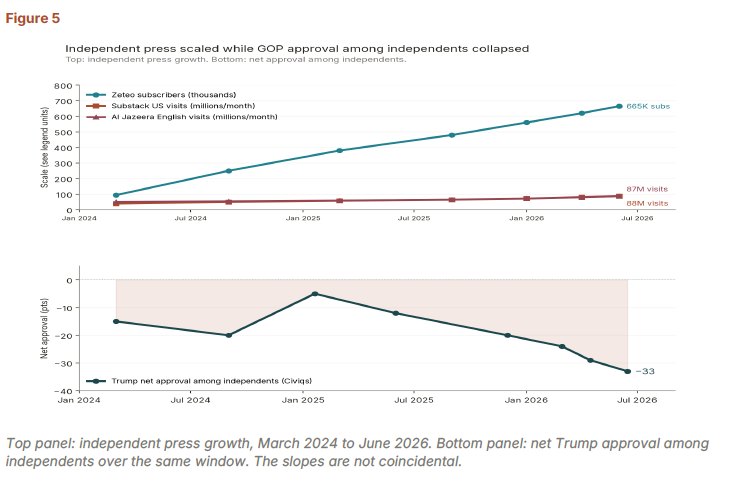
· Zeteo, founded by Mehdi Hasan in March 2024 with 94,000 subscribers, has crossed roughly 665,000 by June 2026, with 50,000 to 100,000 paid and a YouTube channel above two million subscribers (Semafor, June 8, 2026; Press Gazette).
· Substack now ranks among the top 20 U.S. news sites by traffic, with 88.4 million U.S. monthly visits in May, up 31 to 42 percent year over year (Press Gazette, top US news sites).
· Al Jazeera English grew 69 percent year over year to 86.7 million monthly visits (Press Gazette, biggest news websites 2026).
·Drop Site Newshas about half a million followers, an editor recently held by Israeli authorities aboard the Sumud Flotilla, and a daily filing rate on Gaza that exceeds the entire foreign desk of the New York Times (Drop Site archive).
· The Reuters Institute Digital News Report 2026 documented that globally, for the first time on record, social and video platforms (54 percent) overtook direct publisher visits (51 percent) as the primary news access channel (Reuters Institute, June 2026).
The legacy press has visibly stopped doing what the independent press is now doing. Adam Johnson’s running data, compiled inThe Complicit Lens(OR Books, June 2026), shows that the New York Times, Associated Press, Washington Post, CNN, Politico, USA Today and Axios collectively used the word “savage” sixteen times to describe the killing of Israelis and zero times to describe the killing of Palestinians. On MSNBC, “massacre,” “barbaric,” “savage” and “slaughter” were used 348 times in reference to Israeli deaths and twelve times in reference to Palestinian deaths. The labels “war crime” and “genocide” were used 17.2 times more often on CNN and MSNBC for Russia’s invasion of Ukraine than for Israel’s campaign in Gaza (Informed Comment, May 31, 2026; OR Books). A Cost of War Project tally cited byGreatreportershows the New York Times has run fewer than ten standalone stories on Gaza since the start of 2026 (Greatreporter, June 6, 2026). The UN Independent International Commission of Inquiry concluded this month that Israel has deliberately targeted Palestinian children, that approximately thirty percent of those killed are children, and that the conduct constitutes genocide, crimes against humanity and war crimes (Foundation for Middle East Peace, June 26, 2026).
The midterm implication is concrete. The voters who will turn out in November are reading, for the first time in a generation, a press that names the war they are paying for, the inflation they are absorbing, the lobbyists their representatives answer to, and the President whose conviction extends precisely as far as the next applause line. Eighty percent of Democrats now view Israel critically (Mondoweiss, June 17, 2026). The 2026 midterm is the first U.S. national election in which the independent press is at scale large enough to set the agenda independently of the wire services.
X. The Uniparty critique and the former Republicans who will not come home
There is a non-trivial constituency, of which the author of this essay is a member, of former Republicans who will not vote for a GOP incumbent in 2026. The numerical evidence that this constituency exists in size is in the demographic shifts in Section V: the 8-point intra-party erosion of strong Republican approval since April, the collapse to plus 3.5 net approval among white non-college voters, the 32-point swing among rural voters. These numbers are not produced by Democrats. They are produced by voters who voted Republican in 2024 and will not in 2026.
The complaint of the former Republican is not ideological in the abstract. It is concrete and itemized.
1. An Iran war that the President had spent a decade promising to avoid, launched without congressional authorization, financed by an off-books supplemental, and producing none of the goals he claimed.
2. A defense budget exceeding one trillion dollars at a moment when the country cannot fund disaster recovery, cannot fund Medicaid expansion, and cannot fund the energy transition the President nominally claims to support.
3. An inflation profile driven by his own foreign policy choices.
4. A pattern of saying whatever the audience wants to hear, on Israel as on Iran as on tariffs as on fiscal policy, and reversing within thirty days when a donor calls.
5. A Republican Congress that has functioned not as a check but as a clearinghouse.
This is the Uniparty critique in its concrete form, and it is no longer a fringe libertarian complaint. It is being delivered, with very different rhetoric but the same conclusion, by Bernie Sanders, by Zohran Mamdani, by Thomas Massie, by Justin Amash, by Tucker Carlson, by Glenn Greenwald, by Matt Taibbi, by every Substack to the left ofThe Bulwarkand to the right ofJacobin. The convergence is the story, and the midterm is the place the convergence becomes a vote count.
XI. What financial and geopolitical actors should price in
A discipline note for an audience that prices risk for a living. The conclusion is not that the United States is about to undergo a socialist revolution. The Republic survived Mamdani’s grandfather’s generation of socialists and will survive his. The conclusion is narrower and more actionable.
1.A Democratic House is the modal midterm outcome.Price impeachment optionality, subpoena power, appropriations friction, and the end of the unified Republican agenda. Prediction markets put the probability at roughly four in five. Cook, Wasserman and Sabato have all moved in the same direction.
2.The Senate is a coin flip with a small Republican lean.Polymarket at 56.5 percent Republican retention is the right number to anchor against. The map favors the GOP, but Trump’s drag in Maine, North Carolina, Ohio, Alaska and Texas is now structurally negative.
3.Lame-duck Trump is the base case from January 2027.If the House flips, his domestic agenda freezes, his foreign-policy authorizations narrow, and his ability to launch further Iran-style operations without congressional consent becomes politically unsustainable. Expect a constitutional fight over Article I war powers in early 2027.
4.AIPAC’s primary franchise is impaired.It is not destroyed. But the model of using a Jewish-district endorsement plus a super PAC carpet bomb to discipline a Democratic incumbent on Israel has now failed in NY-10, NY-13 and NJ-12 in a single cycle. Donor behavior on the pro-Israel side will adjust. The defense and energy sectors that depend on stable US-Israel policy should plan for a Democratic House majority with twenty to forty members who will vote against further military aid as a matter of routine.
5.The energy markets remain hostage to the Strait of Hormuz.Friday’s renewed US strikes on Iranian targets along the Strait reopen the geopolitical risk premium that the June ceasefire was supposed to close. The administration has demonstrated that it will reach for kinetic options under domestic-political pressure. Hedge accordingly.
6.The independent-press ecosystem is now a primary intelligence source.The Adam Johnson dataset, theDrop Sitedaily, theZeteodesk, theMondoweissarchive, theGrayzone,The Intercept, the Klippenstein and Grim and Scahill bylines, the Substacks of Antoun Issa and Alex McKinnon and Naomi Klein and Ahmed Eldin: these are no longer activist outlets to be discounted. They are reporting that the legacy press has visibly stopped doing. Any institutional analyst not subscribing to a representative sample is operating with a missing dataset.
XII. The closing observation
The American political system has a habit of arriving at obvious conclusions late, but it arrives. The voters of Brooklyn arrived on June 23. The voters of New Jersey’s 12th arrived on June 2. The voters who will arrive on November 3 are reading, for the first time in a generation, a press that names what is in front of them, and they are looking at a Republican incumbent class the President will not let his own party fire.
The Democratic Party has begun firing its own. The Republican Party will not, because Trump will not allow it. The voters will do the firing instead, in November, and the lame duck who remains in the White House will discover that the conviction he never had is now the conviction he urgently needs and cannot manufacture.
That is not a prediction. That is what the data already says. The annex carries the charts.
Scott Ortkiese
Prepared June 28, 2026. Numerical references verified against the cited sources as of the date of writing. Forecasts derived from the Cook Political Report, Silver Bulletin, Polymarket and Kalshi consensus as of June 27, 2026. All citations linked inline. Companion data annex available separately.
Related reading
- American Empire in Ruins: The Unprovoked, Unconstitutional, and Catastrophic US-Israeli War on Iran
- Paxton Collapse: How Trump’s Texas Pick Turns a Safe Republican Seat Into a Coin Flip
- A Bill of Indictment for Murder and Genocide Against the American Military and Trump, as its Commander and Chief
- Trump Blackmails Allies Abroad While Being Blackmailable at Home: The Irony of It All