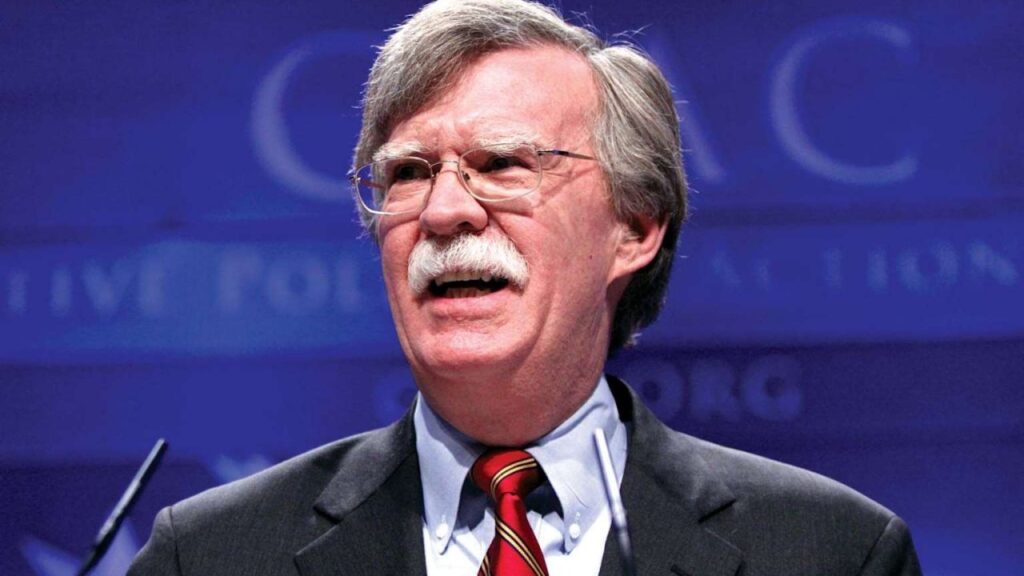
John Bolton occupies a uniquely isolated position in American political history. He is simultaneously despised by the anti-war Left for his role in manufacturing the case for Iraq, by the Trump Right for sabotaging a presidency from within, and by career professionals for a documented pattern of bullying and abuse. This bipartisan contempt is not accidental; it stems from a singular character flaw: an overwhelming intellectual arrogance paired with a willingness to manipulate intelligence and suppress dissent to serve his own ideological ends.
As National Security Advisor (2018 to 2019), Bolton operated as an embedded operative, filtering intelligence to President Trump, blocking the declassification of materials that would have exposed the origins of the Russia collusion narrative, and ultimately weaponizing his access to damage the President politically. His subsequent indictment for mishandling classified documents, and the careless exposure of secrets through a profit-driven memoir, reveal a man who views public trust not as a responsibility, but as a commodity to be exploited.
This is the story of how one man came to embody the worst pathologies of the American national security establishment.
Part I: The Ideologue as Bureaucrat
John Bolton’s career is defined by a fundamental contradiction: a fierce advocacy for American military supremacy paired with a personal avoidance of military service. Born in 1948 and educated at Yale, Bolton supported the Vietnam War but used the National Guard to avoid fighting in it, famously writing, “I had no desire to die in a Southeast Asian rice paddy.” This pattern, advocating for wars others would fight, became the leitmotif of his professional life.
His worldview is staunchly neoconservative: American power is the only legitimate source of order, international law is a constraint to be broken, and diplomacy is often just a prelude to force. Crucially, Bolton advanced these views not through debate, but through bureaucratic warfare.
The “Serial Abuser” at State
In 2001, as Undersecretary of State for Arms Control under George W. Bush, Bolton began a campaign against intelligence analysts who refused to validate his hawkish assumptions. His method was intimidation. When Christian Westermann, a State Department biological weapons analyst, refused to sign off on exaggerated claims about Cuba’s bioweapons program in 2002, Bolton summoned him, screamed at him, wagged a finger in his face, and called him a “munchkin.” He then demanded Westermann’s firing.
This was not an isolated incident. Carl Ford Jr., the Republican head of the State Department’s intelligence bureau (INR), famously testified to the Senate that Bolton was a “serial abuser” who “kisses up and kicks down.” Ford described a culture of fear where analysts tailored intelligence to Bolton’s desires to avoid retaliation. This corruption of the intelligence process had catastrophic consequences.
Manufacturing the Iraq War
Bolton was a key architect of the Iraq War narrative. Working closely with Vice President Dick Cheney, he helped construct a “stovepipe” for intelligence, a channel that bypassed professional review to feed raw, unverified claims directly to decision-makers. He championed dubious reports about Iraqi WMDs and terror links while actively suppressing skepticism from the CIA and State Department. The result was a war sold on false pretenses that killed hundreds of thousands and destabilized the Middle East. To critics, Bolton is not merely a hawk; he is the bureaucrat who broke the truth to build a war.
Part II: The Saboteur in the West Wing
When Donald Trump appointed Bolton as National Security Advisor in 2018, it was a mismatch of historic proportions. Trump sought to end wars and negotiate with adversaries; Bolton believed negotiation was weakness and regime change was the only solution. Rather than resign, Bolton chose to subvert the President’s agenda from the inside.
Suppressing the Russia Hoax Evidence
Perhaps the most damaging charge against Bolton concerns his role in protecting the “Deep State” narrative regarding Russia. Critics, including former NSC official Kash Patel, allege that Bolton deliberately “bottled up” a binder of classified intelligence that cast doubt on the 2017 Intelligence Community Assessment (ICA) about Russian interference. This binder reportedly contained proof that the Steele Dossier was known disinformation and that the Russia investigation was politically motivated.
When Trump ordered these materials declassified to expose the origins of the investigation, Bolton, along with CIA Director Gina Haspel, obstructed the process. By keeping this intelligence compartmented and bureaucratically frozen, Bolton ensured Trump lacked the specific evidence needed to dismantle the Russia narrative before the 2020 election. Publicly, Bolton dismissed Trump’s concerns about the “Deep State” as unfounded, effectively providing bipartisan cover for the very agencies trying to undermine his boss.
Torpedoing Diplomacy: The “Libya Model”
Bolton actively sabotaged Trump’s diplomatic initiatives with North Korea. Before the 2018 Singapore Summit, Bolton went on television and invoked the “Libya model” for denuclearization. The reference was unmistakable: Muammar Gaddafi gave up his weapons in 2003 and was overthrown and killed by NATO-backed rebels in 2011. By using this framing, Bolton sent a calculated threat to Kim Jong Un, designed to enrage North Korea and kill the summit Trump desperately wanted. It was an act of insubordination disguised as history.
The Weaponized Memoir
After being fired in 2019, Bolton did not go quietly. He hoarded classified conversations and anecdotes to write The Room Where It Happened, a memoir that portrayed Trump as incompetent and corrupt. He alleged Trump asked China for election help and lacked basic geopolitical knowledge, claims that were devastating but unverified.
Crucially, Bolton published the book despite White House objections that it contained classified information. This led to a DOJ investigation and, in 2025, an indictment for mishandling national defense information. The investigation revealed that Bolton’s manuscript had been compromised by foreign actors before publication, suggesting his reckless pursuit of profit exposed national secrets. To Trump supporters, this was the ultimate betrayal: a National Security Advisor monetizing his clearance to damage the President.
Part III: Why Democrats Despise Bolton Equally
The anti-war Left’s loathing of Bolton runs just as deep as the Trump Right’s contempt, but for fundamentally different reasons rooted in decades of catastrophic foreign policy outcomes. For progressives, Bolton is not simply a policy opponent; he is the personification of American imperial overreach and the systematic corruption of institutions meant to constrain executive power.
The Iraq War: An Unforgivable Crime
To the Democratic base and anti-war intellectuals, Bolton’s role in the Iraq War is not a policy error that can be debated and overcome. It is a crime against humanity that should have ended his career permanently. The war that Bolton helped sell killed approximately 600,000 Iraqis (according to some estimates), nearly 4,500 American service members, and cost nearly $2 trillion in direct expenditures. The destabilization of Iraq created the power vacuum that allowed ISIS to emerge, leading to further regional catastrophe and American military entanglement that persists to this day.
Critically, Bolton did not simply support the Iraq War based on mistaken intelligence shared by everyone. He actively corrupted the intelligence process to manufacture support for a war he had already decided upon. The “stovepipe” he helped construct specifically excluded skeptical voices from the analysis. When the CIA or the State Department’s intelligence bureau presented contrary evidence, Bolton worked to suppress it, discredit the analysts, and elevate raw, unvetted claims from sources aligned with his predetermined conclusion.
To progressives, this is not a matter of being wrong about foreign policy. It is a matter of deliberate deception in service of an ideological agenda that resulted in mass death. Many on the left view Bolton as bearing direct responsibility for the deaths of hundreds of thousands of people. In their moral framework, he should have faced accountability far more serious than simply losing elections or being fired from jobs, potentially including prosecution for war crimes.
The Neoconservative Ideology: Endless War Without Accountability
Beyond Iraq specifically, Democrats despise Bolton because he represents an entire worldview about American power that progressives view as fundamentally corrupted: the neoconservative belief that the United States has the right (indeed, the duty) to use military force to reshape the world according to American preferences. Bolton explicitly rejected the idea that American power should be constrained by international law, treaties, or the concerns of other nations.
His contempt for the United Nations, his dismissal of international agreements, and his casual advocacy for regime change in Iran, North Korea, Venezuela, and Syria all reflect a conviction that American military supremacy is the ultimate arbiter of global affairs. To the left, this ideology has produced only catastrophe: two decades of war in the Middle East, the rise of anti-American sentiment globally, the squandering of American resources on military adventures, and the strengthening of authoritarian rivals who exploit American over-extension.
Bolton’s unwillingness to learn from Iraq is particularly infuriating to progressives. A normal person, confronted with the evidence of how badly the Iraq War turned out, might question their fundamental assumptions about military intervention. Bolton has done no such thing. He has continued to advocate for military solutions to every international problem, continued to dismiss diplomacy as weakness, and continued to position himself as the wise elder warning about threats that others are too naive to understand.
The Bullying of Intelligence Professionals and the Corruption of Institutions
Progressive critics also point to Bolton’s abuse of intelligence analysts as emblematic of a broader rot in the national security establishment. The intelligence community is supposed to provide objective analysis to policymakers. When leadership politicizes intelligence, as Bolton did, the entire system becomes corrupted.
The Carl Ford testimony about Bolton being a “serial abuser” is not merely about personal rudeness. It reflects a broader pattern of institutional bullying designed to force compliance with predetermined policy conclusions. When analysts fear retaliation for telling the truth, they stop telling the truth. The intelligence community stops functioning as a truth-telling institution and becomes instead a machinery for manufacturing consent for whatever military adventure leadership wants to pursue.
To the left, this is particularly galling because Bolton did this while nominally serving under Republican Presidents who should have shared his ideology. Yet even his ideological allies (Colin Powell, Condoleezza Rice, career intelligence professionals) found Bolton’s behavior intolerable. The fact that even Republicans wanted him exiled from State Department leadership suggests the depth of the institutional damage he caused.
The Unaccountable Warmonger Who Escapes Consequences
Perhaps most infuriating to progressives is Bolton’s ability to avoid meaningful accountability for the catastrophic consequences of his worldview and his actions. He was not prosecuted for his role in the Iraq War. He was not forced to resign from government service. Instead, he bounced between positions, was protected by patrons like Dick Cheney, and ultimately continued to wield influence even after his documented failures.
When he finally faced a consequence, indictment for mishandling classified documents, he was able to frame himself as a victim of political persecution by Trump supporters. To progressives, this perfectly encapsulates the problem: a man who has spent his career avoiding accountability for his actions now uses that same pattern of self-exculpation to escape the mild legal consequences of his recklessness.
The contrast with how whistleblowers like Chelsea Manning and Edward Snowden were treated is stark. Those individuals exposed potential war crimes and constitutional violations through proper legal channels, and they faced decades of imprisonment and exile. Bolton profited from exposing classified information in a memoir and faced only an indictment. To the left, this inequality of accountability is symptomatic of a system designed to protect the powerful while punishing those who challenge them.
The Broader Failure of Democratic Accountability
The Democratic case against Bolton extends beyond his individual actions to what his career reveals about systemic failure in American democracy. Democrats point out that Bolton represented a neoconservative faction that dominated Republican foreign policy for decades, launched a catastrophic war based on lies, destabilized an entire region, and then suffered no meaningful electoral or institutional consequences.
Bush lost his second-term domestic agenda to the Iraq War’s consequences, but Republican control of government continued. Republicans who voted for the war were not held accountable at the ballot box in meaningful numbers. The architects of the war (Cheney, Rumsfeld, Wolfowitz) retired comfortably to think tanks and consulting positions. Bolton, despite his documented failures and abusive behavior, continued to be considered a serious figure worthy of cabinet-level positions even years after the Iraq disaster.
This reflects, in the Democratic view, a deeper problem with American institutions: they simply do not hold powerful foreign policy figures accountable for failure. A CEO who destroyed a company and killed thousands of people would face prosecution. A military commander who made the decisions that led to Iraq would potentially face court-martial. But foreign policy operatives like Bolton face no such accountability because foreign policy operates in a realm where normal standards of professional responsibility do not seem to apply.
Part IV: The Anatomy of a Pariah
Bolton’s universal unpopularity stems from character flaws that alienate every faction.
Intellectual Arrogance: Bolton genuinely believes he is smarter than the Presidents he serves. He viewed Bush, Powell, and Trump not as leaders to follow, but as obstacles to be managed. This arrogance justifies his manipulation of intelligence and his refusal to accept democratic accountability.
Disloyalty as Strategy: Bolton has never been a loyal subordinate. He undermined Colin Powell at State; he was exiled by Condoleezza Rice; and he sabotaged Donald Trump. His only loyalty is to his own ideology. He serves Presidents only as long as they agree with him; the moment they don’t, he becomes an enemy within.
Bullying: His abuse of subordinates is well-documented and strategic. By creating a climate of fear, he ensures that intelligence analysis conforms to his policy goals. This is the antithesis of how national security decision-making should function.
Profiteering: Bolton views public service not as a sacred trust but as an opportunity to accumulate leverage and wealth. His $2 million book advance, secured by exposing classified information, perfectly encapsulates his worldview: personal gain supersedes institutional integrity.
Conclusion: The Unaccountable Operator
John Bolton stands as a symbol of a broken national security system. He is a man whose career is marked by catastrophic judgment (Iraq), abusive conduct (State Department), and profound disloyalty (Trump), yet he remained in power for decades because he was protected by patrons like Dick Cheney and tolerated by a bureaucracy that preferred accommodation to confrontation.
His legacy is not one of service, but of sabotage. He is the operative who believed he knew better than the voters, better than the analysts, and better than the Presidents. In the end, he united the Left and the Right in a shared, visceral loathing of a man who viewed public trust as a weapon to be wielded for his own wars. Progressives despise him for the human cost of his ideology and his refusal to face accountability for catastrophe. Conservatives despise him for his disloyalty and his protection of the very “Deep State” apparatus that Trump promised to reform. Career professionals despise him for his bullying and his corruption of institutions. In the end, Bolton’s isolation is not a mystery; it is the natural consequence of a career built on manipulation, arrogance, and contempt for everyone but himself.
Related reading
- Dan Crenshaw’s War on Shawn Ryan Exposed His 1,000% Congressional Wealth Explosion
- Генерал «Предай-США» (Betray-U.S.), он же Дэвид Петреус, идеально иллюстрирует оксюморон: военная разведка
- General Betray-Us, aka David Petraeus, Perfectly Illustrates the Oxymoron: Military Intelligence
- A Bill of Indictment for Murder and Genocide Against the American Military and Trump, as its Commander and Chief