Theodore Postol’s Warning for Israel and Iran
Theodore Postol is not the kind of man who traffics in abstractions. A professor of science, technology, and national security policy at MIT, a former scientific adviser to the Chief of Naval Operations, and one of the world’s foremost authorities on nuclear weapons delivery systems and missile defense, Postol has spent his career translating the technical realities of mass destruction into language that policymakers can understand, and too often have chosen to ignore. In a March 30, 2026 interview with Glenn Diesen, he delivers what may be the most consequential warning to emerge from the current war: if Israel uses nuclear weapons against Iran, it will not survive the response.
His argument is not polemical. It is physics.
Iran Is Already a Nuclear Threshold State
Postol begins with the material facts. Iran currently holds approximately 408 kilograms of uranium hexafluoride enriched to 60 percent, enough to produce 11 nuclear weapons once further enriched to weapons-grade level. Each individual canister of the substance is roughly a meter in length and weighs about 50 kilograms, compact enough to be transported in an ordinary vehicle and stored in any one of the thousands of tunnels that Iran has spent decades excavating across its territory. The enrichment process required to bring that material from 60 to 90 percent purity requires centrifuge cascades that Iran already possesses in abundance, and the process can be completed within weeks, perhaps faster if multiple cascades are operating in parallel. The weapons assembly itself, a gun-type design of the same basic class as the Hiroshima bomb, requires no test detonation to function reliably. The United States never tested the Hiroshima bomb. It simply used it.
The weapons could be built, Postol states, in a few hundred square meters of tunnel space. No large facility is required. No satellite imagery would betray the activity. Iran does not need to have already taken the final assembly step to possess what is, functionally, a nuclear deterrent. It needs only to have the material, the cascades, and the knowledge, all of which it demonstrably has. The Ayatollah Khamenei’s religious edict prohibiting nuclear weapons contains, Postol notes, a critical caveat: if Iran’s existence is under existential threat, the edict permits their use. The attack of February 28, 2026 and the ongoing war have almost certainly satisfied that threshold.
What a Nuclear Retaliation Against Israel Would Actually Look Like
Postol does not stop at the theoretical. Drawing on his experience monitoring American nuclear targeting plans while serving as an adviser to the Chief of Naval Operations, he walks through, with clinical specificity, what an Iranian nuclear retaliation against Israel would produce, using three low-yield weapons placed with deliberate spacing across a metropolitan target.
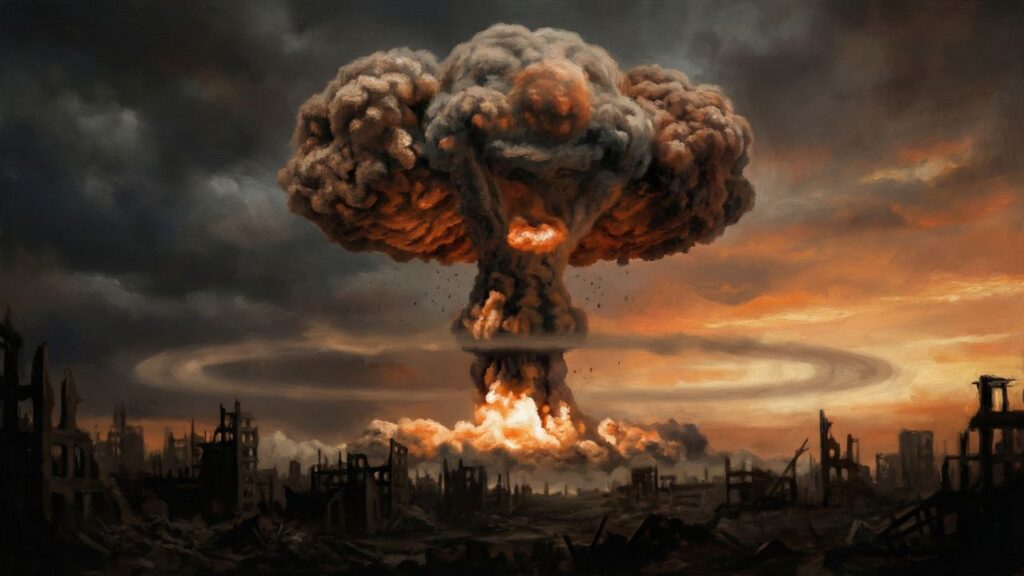
The key physics point, which Postol emphasizes because it is so widely misunderstood by civilian analysts and politicians alike, is that it is not the blast wave that kills the most people in a nuclear attack. It is the fire. The initial fireball, burning at approximately 8,000 Kelvin at its maximum radius, a temperature some 2,000 degrees hotter than the surface of the sun, sets buildings and interiors alight across a wide radius. Crucially, Postol explains, the weapons are most effective when spaced apart rather than concentrated, because this creates a ring of fires with a gap in the center. The physics of convection then does the rest: hot air rises from the burning ring, creates a low-pressure zone at the center that draws in surrounding air at hurricane velocity, and the inward-rushing wind fans the initially small peripheral fires into a single catastrophic firestorm covering tens of square kilometers.
The air temperature within the firestorm zone rises above the boiling point of water at street level and for several times the height of the tallest buildings. People who attempt to flee through the streets are incinerated by the superheated winds. People sheltering underground fare little better: the firestorm acts as a bellows, feeding oxygen to the fire for five, six, seven, eight hours, heating the concrete and brick above the shelters until the shelters themselves become ovens. This is precisely what happened in Hamburg in 1943 and in Dresden shortly after, with conventional incendiary weapons. Three nuclear devices, properly placed, would replicate that effect across a modern city of high-rise buildings.
Beyond the immediate fire zone, radioactive rain follows. The smoke generated by incomplete combustion creates condensation nuclei on which water, radioactive particles, hydrogen sulfide, nitrous oxides, cyanide, and carbon monoxide all accumulate. The resulting rainfall, depending on wind direction and timing, can blanket areas extending far beyond the original detonation points. Those who escape the fire will encounter it. Those who survive both the fire and the radioactive rain but received significant radiation exposure will die weeks later from catastrophic immune system failure and internal hemorrhaging, as the blood loses its capacity to coagulate or fight infection.
Postol’s message to the Israeli military is direct and personal. He wants the pilot who receives the order to deliver a nuclear payload to Iran to refuse. “I want the guy who gets told by Netanyahu to launch nuclear weapons against Iran to say, No, sir. I am not going to do something that leads to the destruction of Israel.” Getting destroyed two or three weeks after a nuclear first strike, he observes, is no different in any meaningful sense from an immediate response. The timeline of retaliation is irrelevant to the finality of its consequences.
How We Arrived Here
Postol is careful to distribute blame for the catastrophe now unfolding across party lines in America. Trump broke the JCPOA, the nuclear agreement that kept Iran’s enrichment capped and under international inspection. But Biden, surrounded by advisers who believed the moment could be exploited to extract additional concessions, declined to reinstate it. That decision, Postol argues, was as consequential as Trump’s original withdrawal. The monitoring mechanisms were lost. Centrifuge construction continued unobserved. The stockpile of 60-percent enriched uranium grew unchecked. By the time the February 28 attack was launched, the window for a non-nuclear outcome had already been closed by two consecutive administrations and their respective collections of, in Postol’s unvarnished phrase, idiots.
The War Is Already Lost
In his closing remarks, Postol states what he believes the evidence compels: the war, from the Israeli and American perspective, has already been lost. Israel’s economy is in ruins. Its air defense systems have been effectively overwhelmed by Iran’s new generation of hypersonic missiles. Its capacity for sustained offensive operations is degrading. The Strait of Hormuz remains closed. American bases across the Gulf have been evacuated or rendered inoperable. None of this will be reversed by escalation.
The only path forward, in Postol’s judgment, is a genuine and credible Israeli acceptance of Iran’s right to exist as a sovereign nation. Not a tactical pause. Not a feigned negotiation of the kind that preceded the February 28 attack on Iran. A real, sustained, verifiable change of posture, one that gives Iranian decision-makers reason to believe that the cycle of truce, rearmament, and renewed attack has been permanently broken. “You cannot continue operating this way,” he says. “You are not the chosen people that you think you are. You are a people who have a great culture. You have great accomplishments. You have every reason to be proud of those accomplishments. But you have no right to be murderous in this way.”
He closes with a warning that speaks to the political future of the Israeli-American relationship as much as to the immediate military crisis. Americans, he says, including American Jews, have reached a breaking point. “I talk to Americans all the time who say, I’m not going to war to defend those Israelis.” The strategic support, the military aid, the political cover that Israel has relied upon for decades is eroding, and the assumption that it will be restored after this war is, in Postol’s assessment, almost certainly wrong.
These are not the words of an ideologue or a polemicist. They are the words of a man who has spent his career inside the technical architecture of nuclear war, who understands in precise physical terms what the weapons do to human bodies and to cities, and who is using what platform he has to ensure that the people with the power to initiate that outcome understand, concretely and viscerally, what it would mean. The question is whether anyone in the chain of command is listening.
Related reading
- The Last Blunder: How the US-Israel Attack on Iran Killed the American Empire's Operating System
- The Payoff Matrix of a Doomed War: A Game-Theory Analysis of the US-Israel Assault on Iran
- The Enemy We Made: Three Times Iran Extended Its Hand, Three Times America and Israel Answered with a Fist
- American Empire in Ruins: The Unprovoked, Unconstitutional, and Catastrophic US-Israeli War on Iran