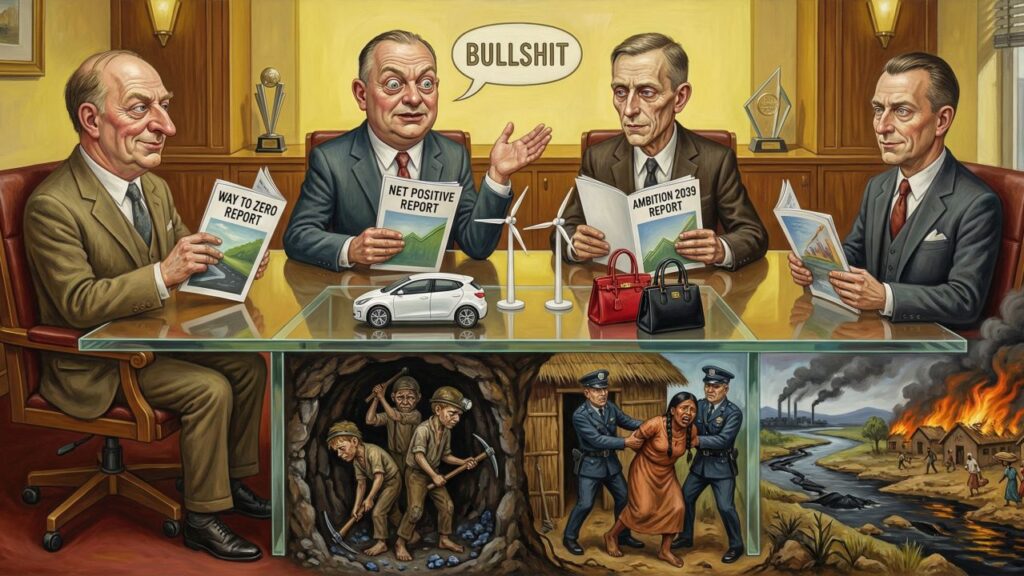
How Siemens, Volkswagen, and Eight Other European Companies Profit from the Supply Chain Crimes They Refuse to Acknowledge
By Scott Ortkiese, Throughline Synthesis Group
January 26, 2026
Introduction: From Mines to Marketing Departments
Part 1 traced rare earth supply chains from Davos keynotes to radioactive tailings ponds in Inner Mongolia and cancer villages where residents drink from contaminated aquifers.
Part 2 followed copper from electrification mandates to Indonesian rivers turned black with 200,000 tons of daily tailings discharge, Chilean salt flats drained into ecological collapse, and Congolese villages burned during forced evictions to make room for cobalt mines.
The fraud documented in those parts (geographic accounting that ignores offshored emissions, impossible timelines that geology cannot honor, and environmental crimes outsourced to populations with no political voice) does not operate by itself. It requires corporate operators: executives who sign supply contracts, approve sourcing decisions, and issue sustainability reports describing those decisions as responsible.
Part 3 names them.
What follows are ten case files (European automakers, energy companies, banks, insurers, and consumer goods giants) each marketing sustainability leadership while depending on supply chains traced to specific facilities, specific violations, and specific cost savings that make their business models viable. Each profile runs the same forensic chain: from sustainability report and CEO quote, through named suppliers and facilities, to documented environmental crimes, regulatory citations, and financial beneficiaries.
The hypocrisy is not abstract. It is quantified, facility by facility, violation by violation, with the executives who signed off cited by name and date.
This is not systems failure. It is operational choices made by named individuals who understood exactly what they were authorizing.
I. Siemens Gamesa, Wind Turbines Built on Warlord Financing and Toxic Waste
The Marketing
Siemens Gamesa Renewable Energy markets itself as a cornerstone of the global energy transition, promising to “make real what matters” and deliver “renewable energy for a sustainable future.” CEO Jochen Eickholt has committed to achieving carbon neutrality across operations by 2030 and building “the most sustainable company in the renewable energy sector.”
The company’s offshore wind turbines, marketed to European governments as clean energy infrastructure, require neodymium-iron-boron permanent magnets for direct-drive generators. These magnets are essential for efficiency and reliability in offshore installations where maintenance costs are prohibitive. Siemens Gamesa does not manufacture these magnets. It sources them from specialized suppliers who, in turn, depend on rare earth oxides processed in China.
The Supply Chain Reality
Siemens Gamesa’s wind turbine magnets are sourced from Chinese manufacturers including JL MAG Rare-Earth Co., Ltd., one of the world’s largest producers of sintered neodymium-iron-boron magnets. JL MAG purchases rare earth oxides, primarily neodymium and praseodymium, from China Northern Rare Earth Group and China Southern Rare Earth Group, state-owned enterprises that control the majority of China’s legal rare earth production and also serve as consolidation points for material from smaller producers.
A 2023 investigation by Global Witness, corroborated by Reuters and Yale Environment 360, documented that China Southern Rare Earth Group sources a portion of its heavy rare earth inventory from Myanmar, where illegal mining operations in Kachin State and the Wa Self-Administered Division finance armed groups, displace ethnic minority communities, and generate toxic waste that contaminates rivers and agricultural land without any environmental controls.
The supply chain: Siemens Gamesa → JL MAG and similar magnet manufacturers → China Southern Rare Earth Group → illegal mines in Myanmar operated by or taxed by militias affiliated with the Kachin Independence Army, United Wa State Army, and Myanmar military-linked brokers.
The Environmental Crimes
Myanmar exported approximately 41,700 tonnes of rare earth oxides in 2023, a dramatic increase from near-zero in 2020, generating an estimated $1.4 billion in revenue. The majority of this material moved through cross-border trade to Yunnan Province, where Chinese processors purchased it at prices significantly below those paid for legally mined and environmentally regulated rare earths.
The operational reality at these mines:
- Open-pit and in-situ leaching operations conducted without environmental permits, waste containment, or water treatment systems. Acidic waste streams containing heavy metals, residual radioactivity from thorium, and processing chemicals discharge directly into tributaries of the Irrawaddy and Salween river systems.
- Workers, including children, employed without safety equipment, medical monitoring, or legal employment contracts. Landslides and chemical exposure have killed dozens of workers since 2020, with no official casualty reporting or compensation.
- Forced displacement of ethnic minority villages to make way for mine expansion, with compensation payments, when provided, ranging from $500 to $2,000 per family for land and homes lost permanently.
- Armed groups controlling mining concessions levy taxes on production, transport, and sales, generating revenue estimated at $300, $500 million annually that finances continued conflict in ethnic minority regions. The United Nations Office on Drugs and Crime documented in 2024 that rare earth mining has replaced opium as the primary revenue source for armed groups in northern Myanmar.
The Financial Benefit
Myanmar’s illegal rare earth oxides sell for approximately 30 to 40% less than legally mined and processed material from regulated operations. This price differential, driven by zero environmental compliance costs, no worker protections, and the use of forced displacement rather than negotiated land acquisition, flows through the supply chain as margin expansion for processors, magnet manufacturers, and ultimately equipment suppliers like Siemens Gamesa.
European offshore wind projects operate under feed-in tariffs and renewable energy subsidies that make project economics viable only if turbine capital costs remain within narrow ranges. If Siemens Gamesa were required to source magnets from rare earth supply chains that internalized the environmental and social costs currently externalized in Myanmar, the turbines would price out of subsidy windows and projects would not reach financial close.
The Hypocrisy Quantified
Siemens Gamesa promises to build “the most sustainable company in the renewable energy sector” while sourcing magnets from supply chains that financed $1.4 billion in revenue to Myanmar militias in 2023, displaced thousands of ethnic minority villagers, and contaminated rivers with uncontrolled toxic waste.
CEO Jochen Eickholt commits to carbon neutrality by 2030. His turbines run on magnets produced with rare earths that generate approximately 2,000 tons of toxic waste and 1 to 1.4 tons of radioactive thorium waste per ton of rare earth oxides processed, waste that is dumped untreated into Myanmar’s river systems because no other disposal method is available or required.
The company markets wind power as clean energy to European governments mandating decarbonization. Those governments do not ask, and Siemens Gamesa does not disclose, where the neodymium comes from, who mined it, or what the environmental cost of extraction was.
This is not an oversight. This is the operational design of the European Green Deal: mandate clean energy, offshore the dirty work, and call anyone who points out the contradiction “bullshit,” as Allianz CEO Oliver Bäte did at Davos 2026.
II. Volkswagen, “Way to Zero” Built on Conflict Minerals and Indigenous Displacement
The Marketing
Volkswagen Group launched its “Way to Zero” strategy in 2020, pledging to achieve carbon-neutral production and a climate-neutral product portfolio by 2050, with interim targets including 70% electric vehicle sales in Europe by 2030. CEO Oliver Blume has repeatedly emphasized that “sustainability is not a nice-to-have, it is a must” and that Volkswagen is committed to “responsible sourcing throughout our supply chain.”
The company’s sustainability reports highlight investments in battery technology, renewable energy for production facilities, and supply chain transparency initiatives. Volkswagen positions itself as a leader in the automotive industry’s transition to electrification, with over €180 billion committed to electric vehicle development through 2030.
The Supply Chain Reality
Volkswagen’s electric vehicle strategy depends almost entirely on lithium-ion batteries supplied by Contemporary Amperex Technology Co. Limited (CATL), the world’s largest battery manufacturer, which supplies over 35% of global EV batteries. CATL has been Volkswagen’s primary battery partner since 2017, with supply agreements extending through 2030 covering the MEB platform (ID.3, ID.4, ID.Buzz) and future models.
CATL’s batteries require lithium hydroxide and lithium carbonate sourced from multiple suppliers, including Ganfeng Lithium, China’s largest lithium producer, which operates the Cauchari-Olaroz lithium brine project in Jujuy Province, Argentina. CATL also sources cobalt from Glencore’s Democratic Republic of Congo operations documented in Part 2, and rare earth elements for battery management systems and electric motors through Chinese processors linked to Myanmar’s illegal mining sector.
The supply chain: Volkswagen → CATL → Ganfeng Lithium (Argentina) + Glencore (DRC) + China Southern Rare Earth Group (Myanmar) → environmental crimes and human rights abuses at the extraction and processing stages.
The Environmental Crimes
Argentina, Cauchari-Olaroz Lithium Project
Ganfeng Lithium’s Cauchari-Olaroz operation in Argentina’s Puna region extracts lithium from brine deposits beneath salt flats at 4,000 meters elevation in one of the driest regions on Earth. The water-intensive operation (requiring approximately 500,000 liters of water per ton of lithium carbonate produced) draws from aquifers that also supply the region’s Indigenous Atacameño, Kolla, and Omaguaca communities, who depend on scarce groundwater for subsistence agriculture, livestock, and domestic use.
The documented violations and impacts:
- Water table declines of up to 4 meters in monitoring wells near the extraction zone, with hydrological models projecting continued decline as production scales to 40,000 tonnes per year.
- Collapse of wetland (vega) ecosystems that provide critical grazing for llamas and alpacas, the primary livelihood for pastoralist communities. Satellite imagery shows vegetation loss across hundreds of hectares surrounding the project site.
- Failed consultation and free, prior, and informed consent processes. In 2020 and 2021, Indigenous communities filed legal challenges alleging that Ganfeng and its partners proceeded with project expansion without obtaining meaningful consent, as required under International Labour Organization Convention 169, which Argentina has ratified.
- Violent suppression of protests in September 2021 and February 2022, when Argentine provincial police forcibly removed Indigenous demonstrators blocking roads to the project site. Over 200 people were injured, and 90 were arrested. Amnesty International documented excessive use of force, arbitrary detention, and intimidation of community leaders.
Myanmar and DRC, The Same Crimes Documented in Parts 1 and 2
CATL sources rare earth elements from the same Chinese supply chains financing Myanmar conflict ($1.4 billion in 2023), and cobalt from Glencore’s Kamoto Copper Company, the operation discharging heavy metals at 43 times WHO safe limits into the Luilu River, burning villages during forced evictions, and relying on child labor in artisanal mining.
The Financial Benefit
CATL’s ability to deliver lithium-ion battery cells at approximately $75, $85 per kilowatt-hour, the price point that makes mass-market electric vehicles financially viable, depends on sourcing raw materials at costs that internalize zero environmental compliance, zero community consent obligations, and zero long-term remediation liabilities.
Ganfeng’s Argentine lithium costs approximately $3,500, $4,500 per tonne to produce, compared to $6,000 ($8,000 per tonne for lithium produced in Australia under stricter environmental and labor standards. The cost differential is not technological) it is regulatory arbitrage.
Volkswagen does not pay the full cost of lithium extraction. Argentine Indigenous communities pay it through permanent loss of water resources. Congolese villages pay it through toxic river contamination and forced evictions. Myanmar ethnic minorities pay it through conflict financing and environmental devastation.
If Volkswagen were required to source batteries from supply chains that internalized these costs, the vehicles would cost €10,000, €15,000 more and sales would collapse.
The Hypocrisy Quantified
Volkswagen’s “Way to Zero” promises a climate-neutral value chain by 2050. The company’s electric vehicles depend on lithium mined in Argentina where police injured 200 Indigenous protesters and arrested 90 to keep the project operating, cobalt from DRC mines that burned villages and contaminated rivers, and rare earths processed with materials financing Myanmar militias.
CEO Oliver Blume insists “sustainability is a must.” His supply chain includes operations that would trigger criminal prosecution and multi-billion-euro remediation liabilities if conducted in Germany.
At Davos 2026, Blume was conspicuously absent, perhaps because explaining Volkswagen’s Chinese dependencies to an audience that included President Trump would be awkward. But the company’s July 2024 acquisition of a 4.99% stake in Chinese EV startup XPeng, with Blume publicly stating “we will combine our experience with new technologies being developed in China,” makes the surrender explicit.
This is not a transition to sustainability. It is a transition to a different set of crimes, committed in different jurisdictions, marketed with different language.
III. BMW, Hungarian Battery Factory Built on Chinese Technology and Conflict Minerals
The Marketing
BMW Group positions itself as a leader in sustainable mobility, committing to reduce CO₂ emissions per vehicle by at least 40% by 2030 and achieve climate neutrality across the entire value chain by 2050. The company’s “Neue Klasse” platform, launching in 2025 (2026, promises “100% electric, 100% digital, 100% circular,” with CEO Oliver Zipse emphasizing that “sustainability is not an option) it is the precondition for our future business.”
BMW’s sustainability reports highlight responsible sourcing initiatives, renewable energy procurement, and blockchain-based cobalt traceability. The company has committed to sourcing 100% of its lithium and cobalt from “certified sustainable sources” by 2025.
The Supply Chain Reality
BMW’s next-generation electric vehicle batteries are supplied by Chinese manufacturer EVE Energy, which is constructing a €1 billion, 28-gigawatt-hour battery cell factory in Debrecen, Hungary, one of Europe’s largest battery plants, with operations beginning in 2026. The facility received approximately €38 million in Hungarian government subsidies.
EVE Energy sources lithium hydroxide from Chinese refiners including Ganfeng Lithium (the same Argentine operations documented above), cobalt from Glencore DRC operations, and rare earth elements through the same supply chains as CATL, processors that consolidate material from both legal Chinese mines and illegal Myanmar sources.
BMW also sources batteries from CATL directly for its iX, i4, and iX3 models.
The chain: BMW → EVE Energy and CATL → Ganfeng Lithium (Argentina), Glencore (DRC), China Southern Rare Earth Group (Myanmar) → the same facility-level violations.
The Environmental Crimes
BMW’s supply chain inherits the entire catalog of violations:
- Argentine lithium extraction depleting aquifers, collapsing wetland ecosystems, and violently suppressing Indigenous protests minus 200 injured, 90 arrested in 2021 to 2022.
- Glencore’s DRC operations discharging heavy metals at 43 times WHO limits, burning villages during forced evictions, and sourcing artisanal cobalt mined by children.
- Myanmar rare earth mining generating $1.4 billion for armed groups in 2023, with toxic waste discharge, child labor, and displacement.
BMW’s direct operational footprint (its own factories in Germany, the United States, and China) complies with environmental and labor laws. The company has invested heavily in renewable energy and water recycling at its facilities. But those facilities assemble vehicles from components supplied by operations that would be illegal in every jurisdiction where BMW operates.
The Financial Benefit
EVE Energy won BMW’s battery supply contract by offering competitive pricing that reflects Chinese manufacturing efficiency, government subsidies, and, critically, access to raw materials priced without the environmental and social costs that would apply under Western regulation.
If BMW were required to source batteries exclusively from supply chains that internalized those costs, lithium from Australian hard-rock mines operating under Aboriginal consultation requirements, cobalt from non-DRC sources with enforceable labor standards, rare earths from U.S. or EU processors operating under radioactive waste disposal regulations, battery cell costs would increase by an estimated 25 to 35%, pricing the vehicles out of mass-market affordability.
BMW recorded €9.1 billion in net profit in 2023. The business model depends on battery costs remaining within the $80, $100 per kilowatt-hour range achievable only through Chinese supply chains built on regulatory arbitrage.
The Hypocrisy Quantified
BMW’s CEO Oliver Zipse insists “sustainability is not an option, it is the precondition for our future business.” The company’s €1 billion Hungarian battery factory, subsidized by European taxpayers, depends on Chinese technology and raw materials sourced from supply chains built on aquifer depletion, toxic river contamination, child labor, and conflict financing.
BMW’s sustainability report commits to “100% certified sustainable” lithium and cobalt by 2025. The company does not explain how lithium extracted in Argentina, where Indigenous protests were violently suppressed and aquifers are permanently depleted, qualifies as sustainable, or how cobalt from Glencore DRC operations meets any reasonable definition of responsible sourcing.
The Hungarian factory is a final-assembly operation with no intellectual property, no core technology, and total dependence on Chinese supply chains. This is not sustainable mobility. This is offshoring environmental crimes to jurisdictions with weaker governance, then marketing the output as climate-neutral.
IV. Mercedes-Benz, “Ambition 2039” Built on CATL Dependency and DRC Cobalt
The Marketing
Mercedes-Benz announced its “Ambition 2039” strategy in 2019, pledging to offer a carbon-neutral new vehicle fleet by 2039. CEO Ola Källenius has positioned sustainability at the center of the brand’s premium positioning, insisting that “the future of luxury is electric and sustainable.”
The company’s sustainability messaging emphasizes renewable energy use in manufacturing, responsible sourcing commitments including blockchain-based cobalt traceability, and €40 billion committed to electric vehicle development through 2030.
The Supply Chain Reality
Mercedes-Benz sources lithium-ion battery cells from CATL for its EQS, EQE, and EQC electric models. CATL has been a Mercedes supplier since approximately 2018. CATL’s supply chains for lithium, cobalt, rare earths, and graphite mirror those documented in previous profiles: Ganfeng Lithium from Argentina, Glencore from the DRC, Chinese rare earth processors consolidating Myanmar material.
The chain: Mercedes-Benz → CATL → Ganfeng (Argentina), Glencore (DRC), China Southern Rare Earth Group (Myanmar) → the same facility-level violations.
The Environmental Crimes
Mercedes-Benz’s supply chain incorporates the entire catalog of abuses:
- Argentine Indigenous communities losing water resources, livelihoods, and facing violent suppression when they protest lithium extraction.
- Glencore’s DRC cobalt mines discharging heavy metals at 43 times WHO limits, burning villages with sexual assault and arson during forced evictions, and sourcing from artisanal mines employing children who work without safety equipment and die in tunnel collapses.
- Myanmar rare earth operations generating $1.4 billion in conflict revenue.
Mercedes-Benz’s own factories in Germany comply with environmental law. But those factories assemble vehicles from components supplied by operations that would trigger prosecutions if they operated under German law.
The Financial Benefit
Even at premium price points, the EQS sedan starts at approximately €110,000, Mercedes-Benz cannot absorb battery costs significantly above market rates. CATL supplies cells at approximately $85, $95 per kilowatt-hour, a price achievable exclusively through Chinese supply chains that externalize environmental costs.
If Mercedes were required to source from supply chains that paid the full cost of lithium extraction, cobalt mining, and rare earth processing (costs currently borne by Argentine communities, Congolese villagers, and Myanmar ethnic minorities) battery cell prices would increase by 25 to 35%, eliminating profitability on electric models and making “Ambition 2039” financially unachievable.
Mercedes-Benz recorded €14.5 billion in EBIT in 2023. The business model depends on Chinese supply chains.
The Hypocrisy Quantified
CEO Ola Källenius promises that “the future of luxury is electric and sustainable.” Mercedes-Benz’s electric vehicles depend on batteries sourced from supply chains that include violent suppression of Indigenous protests in Argentina, river contamination killing livelihoods for 20,000 Congolese villagers, and conflict financing for Myanmar militias.
The company markets the EQS as a “carbon-neutral” vehicle when purchased with optional carbon offset credits. The carbon accounting does not include the emissions from lithium extraction (approximately 15 tons of CO₂ per ton of lithium mined), the energy intensity of cobalt refining, or the long-term environmental liabilities (aquifer depletion, toxic tailings, radioactive waste) that will persist for centuries after the vehicles are scrapped.
At Davos 2026, Källenius was absent from the main stage despite his role as president of the European Automobile Manufacturers’ Association. The automotive industry’s strategic surrender to Chinese supply chain dominance was the week’s unspoken crisis.
Mercedes-Benz’s “Ambition 2039” is not a plan to achieve sustainability. It is a plan to continue offshoring environmental and human rights costs while marketing the vehicles to European consumers who are never told the truth.
V. Stellantis, €4.1 Billion CATL Joint Venture and the Leapmotor Admission
The Marketing
Stellantis, formed in 2021 from the merger of Fiat Chrysler and PSA Group, operates fourteen brands including Peugeot, Citroën, Fiat, Jeep, Dodge, Ram, and Chrysler. The company’s “Dare Forward 2030” strategic plan commits to achieving 100% battery electric vehicle sales in Europe and 50% in the United States by 2030, with net carbon zero emissions by 2038.
CEO Carlos Tavares has positioned Stellantis as pragmatic on electrification, publicly warning about the risks of Chinese competition while committing to comply with EU and U.S. regulatory mandates.
The Supply Chain Reality
Stellantis has committed to one of the European automotive industry’s largest strategic partnerships with a Chinese battery supplier: a €4.1 billion joint venture with CATL to construct one of Europe’s largest battery factories in Zaragoza, Spain, with 50 gigawatt-hours of annual capacity. The joint venture is 50-50 ownership, with production beginning in 2026.
The Zaragoza factory will use lithium, cobalt, rare earths, and other materials sourced through CATL’s existing supply chains, the same chains documented throughout this series.
In October 2023, Stellantis acquired a 20% stake in Chinese EV manufacturer Leapmotor and formed a 51-49 joint venture (Leapmotor International) giving Stellantis “exclusive rights for the export and sale” of Leapmotor vehicles outside China. CEO Tavares stated explicitly: “The Chinese offensive is possibly the biggest risk that companies like Tesla and ourselves are facing.”
The admission is revealing: Stellantis cannot compete with Chinese EV manufacturers on cost or technology, so it has effectively licensed Chinese technology, Chinese supply chains, and Chinese manufacturing processes to sell vehicles in Europe and North America under Western brands.
The Environmental Crimes
Stellantis’s supply chain through the CATL joint venture incorporates the entire suite of violations documented previously:
- Ganfeng’s Argentine lithium operations depleting aquifers, collapsing wetland ecosystems, and prompting violent police suppression of Indigenous protests.
- Glencore’s DRC cobalt mines contaminating rivers with heavy metals at 43 times safe limits, burning villages during forced evictions, and sourcing artisanal cobalt mined by children.
- China Southern Rare Earth Group processing Myanmar rare earth oxides that financed $1.4 billion in revenue for armed groups in 2023.
The Financial Benefit
CATL’s ability to deliver battery cells at $75, $85 per kilowatt-hour depends on Chinese government subsidies, manufacturing scale, and access to raw materials priced without environmental or social cost internalization. Stellantis cannot match those costs using Western supply chains or Western battery manufacturers.
The Leapmotor partnership is even more revealing: Stellantis is paying for access to Chinese EV platforms that it will rebadge and sell in Europe because the company cannot develop competitive electric vehicles internally at the speed or cost required to meet EU mandates. CEO Tavares admitted in late 2023 that “the speed of technology development in China is dramatically higher than what we have in the West.”
Stellantis recorded €18.6 billion in net profit in 2023 on revenues of €189.5 billion.
The Hypocrisy Quantified
Stellantis’s “Dare Forward 2030” pledges 100% electric vehicle sales in Europe and net carbon zero by 2038. The company’s largest battery supply partnership is a €4.1 billion joint venture with CATL, whose supply chains include violent suppression of Indigenous protests in Argentina, river contamination and village burnings in the DRC, and conflict financing in Myanmar.
CEO Carlos Tavares admits “the Chinese offensive is possibly the biggest risk” facing Stellantis, then responds by partnering with Chinese manufacturers and licensing Chinese technology because the company cannot compete otherwise. This is not competition, it is capitulation.
The Leapmotor acquisition reveals the strategic bankruptcy of European electrification policy: EU governments mandated 100% electric vehicle sales by 2035, and European automakers responded by licensing Chinese technology and Chinese supply chains because they cannot meet the mandates independently.
Stellantis will sell Chinese vehicles under Italian and French brand names to European consumers who will never be told that the lithium came from Argentine aquifers, the cobalt from burned Congolese villages, and the rare earths from Myanmar conflict zones.
VI. HSBC, $1 Billion Glencore Loan and the Coal Pledge That Meant Nothing
The Marketing
HSBC Holdings, Europe’s largest bank by assets, announced in December 2021 that it would no longer finance new coal-fired power plants or thermal coal mining projects, positioning the commitment as a cornerstone of the bank’s pledge to achieve net zero financed emissions by 2050. CEO Noel Quinn stated that “HSBC is determined to support our customers in their transition to net zero.”
The bank’s sustainability reports highlight its $750 billion, $1 trillion sustainable finance target, renewable energy project finance, and responsible lending standards.
The Supply Chain Reality
In May 2023, seventeen months after pledging to stop financing coal expansion, HSBC was named as one of five mandated lead arrangers for a $1 billion syndicated loan to Glencore, the Swiss-based mining giant documented in Part 2 for operating some of the world’s most environmentally destructive copper and cobalt mines in the Democratic Republic of Congo.
The loan was a general corporate facility with no restrictions on use of proceeds.
Between 2021 and 2023, HSBC provided approximately $17 billion in total financing to coal industry companies through loans, bond underwriting, and revolving credit facilities, making it one of Europe’s largest coal financiers during the period when it publicly claimed to have exited the sector. The bank financed Glencore bond issuances maturing as late as 2055, thirty years beyond HSBC’s stated coal phase-out timeline.
The Environmental Crimes
HSBC’s $1 billion loan to Glencore directly financed a company whose operations include:
Kamoto Copper Company (DRC): Heavy metals at 43× WHO limits discharging into the Luilu River. The river’s aquatic ecosystem collapsed over 20 years ago, eliminating livelihoods for approximately 20,000 people. A 2021 sulfuric acid spill released massive quantities of acid into waterways with no remedial action.
Mutanda Mining (DRC): Claims of “closed-circuit processing” belied by continuous contamination data showing heavy metals including copper, cobalt, lead, arsenic, cadmium, uranium, manganese, and mercury. Fourteen significant toxic incidents in recent years.
Forced Evictions: Military forces burned the Mukumbi settlement in 2015 to 2016, destroying over 400 structures including homes, a school, health facility, and church. Sexual assault, arson, and beatings accompanied the evictions. A two-year-old girl was severely burned, suffering life-altering scars. Residents received as little as $300 compensation.
Child Labor: Glencore sources cobalt from artisanal miners in the DRC, a sector employing an estimated 150,000 to 200,000 workers including significant numbers of children.
The Financial Benefit
HSBC earned mandated lead arranger fees, interest income, and relationship revenues from the $1 billion Glencore loan. The bank also collects underwriting fees on bond issuances and advisory fees on Glencore’s commodity trading activities.
Glencore’s ability to operate profitably in the DRC depends on externalizing environmental and social costs that would be legally and financially untenable in jurisdictions with enforceable regulation. HSBC finances those operations while marketing itself as a leader in sustainable finance.
The Regulatory Arbitrage
HSBC’s December 2021 coal financing commitment included explicit carve-outs allowing the bank to continue financing “diversified mining companies” that also operate coal assets, as long as those companies have “credible transition plans.” The language was deliberately designed to allow continued financing of Glencore, BHP, and Anglo American.
The commitment prohibited financing new coal power plants and new thermal coal mines, but allowed continued support for existing coal operations through general corporate lending. HSBC could lend $1 billion to Glencore without violating the technical terms of its policy because the loan was not specifically designated for coal expansion.
The Hypocrisy Quantified
HSBC pledged in December 2021 to stop financing coal expansion and positioned itself as a leader in the clean energy transition. In May 2023, the bank provided a $1 billion loan to Glencore, whose DRC operations contaminate rivers with heavy metals at 43 times safe limits, burn villages during forced evictions, and source cobalt mined by children.
CEO Noel Quinn insists HSBC is “determined to support customers in their transition to net zero.” The bank financed Glencore bonds maturing in 2055, three decades beyond HSBC’s supposed coal phase-out date.
Between 2021 and 2023, HSBC provided $17 billion in financing to coal industry companies while publicly claiming to have exited the sector. The bank rebranded its coal exposure as financing for “diversified mining companies with transition plans.”
This is not responsible finance, it is fraud with a disclosure framework.
VII. Allianz, €1.3 Trillion Portfolio and the Davos “Bullshit” Quote
The Marketing
Allianz SE, Europe’s largest insurance company and one of the world’s largest asset managers with approximately €1.3 trillion in assets under management, has positioned itself as a leader in sustainable investing. The company was a founding member of the Net-Zero Asset Owner Alliance in 2019, committing to transition its investment portfolio to net zero by 2050.
Allianz’s sustainability reports emphasize responsible investment strategies, ESG integration, and engagement with portfolio companies on climate issues.
The Davos 2026 Admission
At the World Economic Forum in Davos in January 2026, Allianz CEO Oliver Bäte declared that resistance to Europe’s green transition was “bullshit” and an “aberration,” insisting that “China is setting a precedent as they are poised to lead in both renewable energy and energy costs.”
Days later, Bäte appeared on a panel titled “An Honest Conversation about Why We Are Divided,” apparently oblivious to the irony of lecturing Western voters about climate responsibility while his company profits from Chinese supply chains built on environmental devastation that European voters would shut down immediately if conducted domestically.
The Supply Chain Reality
Allianz’s investment portfolio includes significant equity and bond holdings in virtually every company documented in this series:
- Electric vehicle manufacturers (Volkswagen, BMW, Mercedes-Benz, Stellantis) dependent on Chinese battery supply chains linked to environmental crimes in Argentina, the DRC, and Myanmar.
- Mining companies (Glencore, BHP, Freeport-McMoRan, Rio Tinto, Southern Copper, Anglo American) operating facilities documented in Part 2 for riverine tailings disposal, aquifer depletion, forced evictions, and toxic river contamination.
- Renewable energy companies (Siemens Gamesa, Vestas, Ørsted) sourcing rare earth magnets from supply chains financing Myanmar conflict.
- Chinese battery manufacturers (CATL, BYD) controlling supply chains documented throughout this series.
The Environmental Crimes
Allianz’s portfolio exposure means the company is a direct financial beneficiary of every environmental crime documented in this series:
- Myanmar rare earth mining generating $1.4 billion in conflict revenue in 2023.
- Bayan Obo rare earth mine in Inner Mongolia, where 70,000 tons of radioactive thorium waste sit in an 11-square-kilometer tailings pond seeping into groundwater that supplies millions downstream in the Yellow River basin.
- Glencore’s DRC operations contaminating the Luilu River with heavy metals at 43 times WHO safe limits.
- Argentine lithium extraction depleting aquifers and violently suppressing Indigenous protests.
- Freeport-McMoRan dumping 200,000 tons of toxic tailings daily into Indonesian rivers.
Allianz markets these holdings as aligned with net zero.
The Financial Benefit
Allianz collects management fees on approximately €1.3 trillion in assets under management, with sustainable and ESG-labeled funds commanding fee premiums of 10 to 30 basis points above comparable conventional products.
If Allianz were required to divest from every company documented in this series for environmental crimes, the portfolio would lose exposure to most electric vehicle manufacturers, renewable energy equipment suppliers, and battery technology companies, eliminating the company’s ability to offer climate transition investment products and costing hundreds of millions of euros in annual management fee revenue.
The Hypocrisy Quantified
Allianz CEO Oliver Bäte stood at Davos 2026 and declared resistance to Europe’s green transition “bullshit,” praising China’s renewable energy leadership. His company’s €1.3 trillion portfolio is directly exposed to Chinese supply chains built on radioactive waste, cancer villages, conflict financing, child labor, forced displacement, and environmental crimes that would trigger immediate facility closures and criminal prosecution if conducted in Germany.
Bäte insists that China is “setting a precedent” for renewable energy leadership. The precedent China has set is a willingness to accept environmental and public health costs (70,000 tons of radioactive thorium waste seeping toward the Yellow River, elevated cancer rates in rare earth mining villages, no enforceable pollutant discharge standards) that no Western democracy will tolerate within its own borders.
When Bäte appeared on a Davos panel about societal division, he apparently did not consider that Western voters might be divided because executives like him lecture them about climate responsibility while investing billions in supply chains built on practices Europeans find morally intolerable.
This is not sustainable investing. This is investing in environmental crimes committed in someone else’s country, then calling anyone who points it out “bullshit.”
VIII. Unilever, Paul Polman’s Stakeholder Capitalism Built on Indonesian Deforestation
The Marketing
Unilever, the Anglo-Dutch consumer goods multinational behind Dove, Axe, Lipton, Ben & Jerry’s, and Hellmann’s, positioned itself under CEO Paul Polman (2009 to 2019) as the global standard-bearer for stakeholder capitalism. Polman’s “Unilever Sustainable Living Plan” pledged to decouple growth from environmental impact and source 100% of agricultural raw materials sustainably.
Polman became a global celebrity, co-architecting the UN Sustainable Development Goals, receiving knighthood, winning a UN environmental award, and publishing a book titled Net Positive arguing that businesses should contribute more to society than they take. At Davos 2026, he delivered an “alternative speech” condemning inequality and climate breakdown while insisting that “progress must be judged by whether every child has enough to eat.”
During Polman’s tenure, Unilever’s shareholder returns rose 290%.
The Supply Chain Reality
What Polman actually accomplished was perfecting the art of sustainability marketing while offshoring Unilever’s supply chain to countries with weak environmental enforcement. The company reduced the environmental footprint of its own operations (European factories, offices, distribution centers) while increasing dependence on suppliers in jurisdictions where environmental standards are a fraction of what EU or UK law requires.
Unilever sources:
- Palm oil from Indonesia and Malaysia, where plantations are linked to deforestation, peatland drainage, and fire-setting that destroys orangutan habitat and releases massive carbon emissions.
- Tea from India, Kenya, and other regions where labor practices include child labor, poverty wages, and unsafe working conditions.
- Cocoa from West Africa, where child labor, deforestation, and pesticide contamination are systemic.
The Environmental Crimes
Indonesia, Palm Oil and Deforestation
Despite Polman’s pledge to source 100% sustainable palm oil, investigations by Greenpeace, Rainforest Action Network, and other environmental organizations have repeatedly documented Unilever’s continued sourcing from suppliers linked to deforestation. The 2015 Indonesian fires, among the worst environmental disasters in decades, burned over 2.6 million hectares, released more daily carbon emissions than the entire U.S. economy, and caused respiratory illness for hundreds of thousands. Palm oil expansion was a significant driver.
Unilever has published lists of palm oil suppliers and committed to traceability, but investigations continue to document links between the company’s supply chain and plantation companies accused of deforestation, land-grabbing from Indigenous communities, and labor abuses.
Child Labor in Tea and Cocoa
Human rights organizations have documented child labor in tea plantations in India and cocoa farms in West Africa that supply Unilever brands. In cocoa-growing regions of Côte d’Ivoire and Ghana, child labor is endemic, with children performing hazardous tasks including pesticide application and machete use.
The Financial Benefit
Paul Polman increased Unilever’s shareholder returns 290% during his tenure by commanding premium pricing for brands marketed with sustainability credentials (Dove’s “Real Beauty” campaign, Ben & Jerry’s social justice positioning) combined with cost structures achieved through supply chains in countries with lower labor and environmental compliance costs.
If the company were required to source exclusively from suppliers meeting EU environmental and labor standards, raw material costs would increase substantially, eliminating the profitability that funded Polman’s shareholder returns.
The Hypocrisy Quantified
Paul Polman published a book titled Net Positive arguing that businesses should contribute more to society than they take. His tenure at Unilever increased shareholder returns 290% by sourcing palm oil from suppliers linked to Indonesian deforestation that released more daily carbon emissions than the entire U.S. economy, tea from plantations employing child labor, and cocoa from farms where children use machetes and pesticides.
At Davos 2026, Polman delivered an alternative speech asserting that “progress must be judged by whether every child has enough to eat.” During his tenure, Unilever depended on supply chains where children labored in fields to produce commodities that Unilever brands market with sustainability messaging to affluent Western consumers.
Polman now chairs Oxford Saïd Business School, teaching the next generation of executives the same model: reduce impacts in your home market, offshore the dirty work, collect awards, and call it net positive.
This is not stakeholder capitalism. This is a masterclass in externalizing costs to stakeholders with no political voice.
IX. Shell, “Powering Progress” with LNG Sourced from Forced Displacement Zones
The Marketing
Shell plc has positioned itself as a leader in the energy transition, committing to become a net-zero emissions business by 2050. The company’s “Powering Progress” strategy emphasizes investments in renewable energy, low-carbon fuels, carbon capture, and natural gas as a “transition fuel” that will enable the phase-out of coal.
CEO Wael Sawan has emphasized that Shell will pursue profitable investments in the energy transition while maintaining financial discipline and shareholder returns.
The Supply Chain Reality
Shell’s “transition fuel” strategy depends heavily on liquefied natural gas (LNG). Shell operates LNG projects across multiple continents, including Nigeria, Australia, Qatar, and Mozambique.
But Shell’s LNG operations have generated forced displacement, environmental contamination, and violent suppression of community opposition in multiple jurisdictions.
The Environmental Crimes
Mozambique, Cabo Delgado LNG and Insurgency-Linked Displacement
Shell is a joint venture partner in Mozambique LNG, a $20 billion project in Cabo Delgado Province. The project has generated forced displacement of fishing communities, destruction of coastal ecosystems, and contributed to escalating conflict where an Islamic insurgency linked to ISIS has killed thousands since 2017. The insurgency is fueled in part by local grievances over land displacement and economic exclusion from LNG project benefits.
Human rights organizations have documented forced evictions, inadequate compensation, and militarized security zones that prevent affected communities from accessing traditional lands.
Nigeria, Niger Delta Gas Flaring and Ogoni Land Contamination
Shell has operated in Nigeria’s Niger Delta for decades, and the region has become synonymous with environmental devastation. Despite decades of commitments to end gas flaring, Shell continues to flare gas in Nigeria, violating Nigerian environmental law and contributing to respiratory illness, acid rain, and contamination of agricultural land.
In Ogoni Land, a 2011 UN Environment Programme assessment found drinking water contaminated with benzene at levels 900 times WHO safe limits. More than a decade later, remediation remains incomplete.
Communities in the Niger Delta have faced violent suppression when protesting Shell operations, including the 1995 execution of Ken Saro-Wiwa and eight other Ogoni activists.
The Financial Benefit
Shell’s LNG business generated approximately $10 billion in earnings in 2023. The company’s ability to deliver LNG projects at competitive cost depends on operating in jurisdictions where environmental permitting is streamlined, community opposition can be suppressed, and security costs are accepted as normal operating expenses.
If Shell were required to obtain genuine free, prior, and informed consent from affected communities, the projects would not achieve returns acceptable to shareholders.
The Hypocrisy Quantified
Shell’s “Powering Progress” strategy markets natural gas as a transition fuel. The company’s LNG operations include forced displacement of Mozambican fishing communities, decades of unresolved contamination in Nigeria’s Niger Delta with drinking water poisoned at 900 times safe limits, and gas flaring that violates Nigerian law.
CEO Wael Sawan commits to net zero by 2050. Shell’s LNG infrastructure being built today will operate profitably only if it runs for 30 (40 years, locking in fossil fuel consumption through 2060 or beyond) a decade past the company’s net-zero target date.
This is not an energy transition. This is fossil fuel expansion marketed with climate-friendly language.
X. Nestlé, “Net Zero Roadmap” Built on Cocoa Child Labor and California Water Theft
The Marketing
Nestlé S.A., the world’s largest food and beverage company, has committed to achieving net zero greenhouse gas emissions by 2050. The company’s “Net Zero Roadmap” emphasizes regenerative agriculture, reforestation, and sustainable sourcing.
CEO Mark Schneider emphasizes that “sustainability is fundamental to our business strategy.”
The Supply Chain Reality
Nestlé sources agricultural commodities from supply chains with systemic environmental and human rights abuses:
- Cocoa from West Africa, where child labor is endemic and deforestation continues.
- Palm oil from Indonesia and Malaysia, linked to deforestation and habitat destruction.
- Bottled water brands extracting groundwater in regions facing water stress.
The Environmental Crimes
Côte d’Ivoire and Ghana, Cocoa Child Labor
Despite decades of commitments to eliminate child labor, investigations continue to document children working on cocoa farms that supply Nestlé brands. A 2020 report found 1.56 million children work in cocoa production in Côte d’Ivoire and Ghana, performing hazardous tasks including pesticide application and machete use.
Nestlé has been named as a defendant in lawsuits alleging the company knowingly sources cocoa from farms using child and forced labor. The company’s purchasing practices, demanding low prices from suppliers, make it economically impossible for farmers to pay adult workers fair wages.
California, Groundwater Extraction During Drought
Nestlé has faced sustained criticism for extracting groundwater in California’s San Bernardino National Forest to bottle as Arrowhead Spring Water, despite severe drought and water restrictions. Community groups documented that Nestlé’s extraction depletes springs and streams, harms wildlife habitat, and diverts water from downstream users.
In 2021, California’s State Water Resources Control Board found Nestlé was diverting far more water than authorized.
The Financial Benefit
Nestlé recorded CHF 7.5 billion in net profit in 2023 on revenues of CHF 93 billion. The company’s margins depend on sourcing cocoa and other commodities at prices achievable only because farmers receive poverty wages, child labor is tolerated, and environmental costs are externalized.
If Nestlé were required to source cocoa exclusively from farms paying adult workers fair wages without child labor, cocoa costs would increase substantially, eliminating profitability on chocolate products.
The bottled water business extracts groundwater at minimal cost, then sells it at markups of 1,000% or more.
The Hypocrisy Quantified
Nestlé’s “Net Zero Roadmap” commits to climate neutrality by 2050 through regenerative agriculture. The company’s cocoa supply chain includes 1.56 million children performing hazardous labor, ongoing deforestation, and farms where poverty wages make child labor elimination impossible without changing Nestlé’s purchasing practices.
CEO Mark Schneider insists “sustainability is fundamental to our business strategy.” Nestlé extracts groundwater in drought-stricken California, sells it at 1,000% markups, and fights regulatory oversight through litigation.
The company has spent decades making commitments to eliminate child labor from cocoa supply chains (launching program after program with sustainability branding, collecting awards for corporate responsibility) while the number of children working in cocoa production has remained essentially unchanged.
This is not failure to achieve sustainability goals. This is a business model dependent on child labor, marketed with sustainability language to Western consumers who are never told the truth.
Conclusion: The Executive Roster
What unites these ten cases is operational design, not accident. Each company documented here markets sustainability leadership while depending on supply chains built on environmental crimes, forced displacement, child labor, or conflict financing. Each executive quoted (Jochen Eickholt, Oliver Blume, Oliver Zipse, Ola Källenius, Carlos Tavares, Noel Quinn, Oliver Bäte, Paul Polman, Wael Sawan, Mark Schneider) had line of sight to the facility-level violations documented in this article. Each signed off anyway.
The fraud persists because geographic accounting allows Western companies to measure emissions by territorial borders while offshoring the dirtiest processes to jurisdictions with weak enforcement. The due diligence frameworks are designed to allow compliance through disclosure without requiring sourcing changes. The sustainability reports emphasize “engagement” and “improvement” while actual practices continue unchanged.
Part 1 documented the rare earth racket and China’s 2025 weaponization of Western dependency. Part 2 showed that even if you solved rare earths, the copper arithmetic alone collapses the transition. Part 3 has named the corporate operators who built business models on both impossibilities, and the executives who signed off on every step.
Part 4 follows the money and the law: what should have happened, who chose not to act, and why every regulatory mechanism designed to prevent this fraud was either captured, defanged, or ignored.
Next: Part 4, The Regulatory Void: How Brussels, Washington, and the Ratings Agencies Built a Framework Designed to Fail
Related reading
- Offshoring the Apocalypse: Part 2 of 4 Parts, The Copper Arithmetic That Kills the Transition
- Offshoring the Apocalypse: Part 1 of a 4-Part Series, The Environmental Offshoring Racket
- Offshoring the Apocalypse: Part 4, The ESG Profit Machine
- Brute Force Is Not Progress: The Trillion Dollar AI Bill Everyone Else Is Paying