I wrote this article for two reasons.
First, to set the record straight about what I have actually said, -and what I have not said. In online debates about the war, my position has been caricatured as if I deny Ukraine’s right to exist, or as if I somehow excuse Russia’s invasion. That is false. My argument has always been that two things are simultaneously true: Russia was provoked, and Ukraine was duped by the West. Naming those realities is not “pro‑Russian”; it is a necessary starting point for any honest assessment of how we got here and where Ukraine can still realistically go.
Second, I wrote it out of concern for Ukraine’s future, not to score moral points. If the goal is the best possible outcome for Ukraine from this point forward, then the first step is for Ukrainians and their supporters to tell themselves the truth: that Western policy and NATO strategy helped create the conditions for this war, and that Ukraine was encouraged into an unwinnable path by promises and narratives that were never matched by real, sustained capability. Facing that is painful, but essential. Only by understanding how Russia was provoked and how Ukraine was misled can Ukrainians and their allies make different choices now, -choices aimed not at preserving heroic slogans, but at preserving as much of the country, its people, and its future as is still possible.
Ukraine’s existence and right to self‑determination are not grounds for attack. That much should be obvious. But reducing this war to “Russians hate that Ukrainians exist” is a comforting simplification that hides a harder truth: Russia was provoked, and Ukraine was duped by its own supposed friends. If we actually care about Ukrainian lives and Ukraine’s future, we need to face that squarely.
What “provocation” really means
When critics hear “Russia was provoked,” they often assume it means “Russia was justified.” It does not. It means something more uncomfortable: Western and Ukrainian policy choices created exactly the security scenario Russia had warned for decades it would not tolerate, and then acted shocked when Moscow reacted with force.
This provocation had concrete components:
- NATO’s eastward expansion From the 1990s onward, Russian leaders from Yeltsin to Putin repeatedly objected to NATO moving toward Russia’s borders. Those objections were brushed aside as if they were irrelevant. The 2008 NATO Bucharest summit’s promise that Ukraine and Georgia “will become members of NATO” crossed a line every serious realist in international relations knew would be explosive.
- De facto NATO‑ization of Ukraine After 2014, Ukraine was drawn into deep military integration with the West: training, weapons deliveries, joint exercises, doctrinal alignment. Formally, Ukraine was outside NATO; in practice, it was being built into a Western forward operating partner on Russia’s border.
- The NATO question as a trigger In early 2022 mediation, even neutral intermediaries acknowledged that Russia’s core demand was Ukrainian neutrality and no NATO membership. That was not a post‑hoc excuse; it was the culmination of decades of explicit red lines.
To say Russia was provoked is to acknowledge cause and effect: a deliberate Western decision to ignore those red lines and to use Ukraine as a lever in a larger confrontation with Moscow. It does not bless the invasion. It explains why this war happened, in this place, at this time.
How Ukraine was duped
Ukraine bears its own responsibility for decisions made in Kyiv. But the narrative it was sold, -by Western leaders, media, and many of its loudest foreign supporters, -was fatally misleading.
A real peace opening was pushed aside
In March, April 2022, when the shock of the invasion was still fresh, there was a genuine opening for a negotiated settlement. Mediation in Istanbul produced a rough framework built around:
- Ukrainian neutrality and a pledge not to join NATO.
- Parking Crimea and Donbas questions for later.
- Security arrangements with outside guarantors.
It was a bad deal, but it was a deal that could have preserved most of Ukraine’s territory, population, and infrastructure. Instead of closing it, key Western voices urged Ukraine to walk away and “just fight,” promising that Russia could be beaten on the battlefield.
That is the first layer of duping: when a smaller, weaker country is encouraged to reject an ugly but survivable peace in the name of an imagined total victory.
The victory illusion
What followed was an enormous victory narrative:
- Sanctions would crush Russia’s economy quickly.
- Western weapons plus Ukrainian courage would push Russia back to 2014 or even 1991 borders.
- Western support would last “for as long as it takes.”
None of that has materialized. Russia’s economy adapted. Ukraine’s offensive operations failed at horrific cost. Western will and capacity to bankroll and arm the war at scale are visibly finite. Yet even as reality contradicted the story, Western rhetoric barely shifted.
Ukraine was encouraged to define victory as “complete and total liberation” while being quietly steered into a war of attrition that favors the side with more people, more industry, and more time. That is the second layer of duping: selling maximalist war aims that the West was never prepared to underwrite to the end.
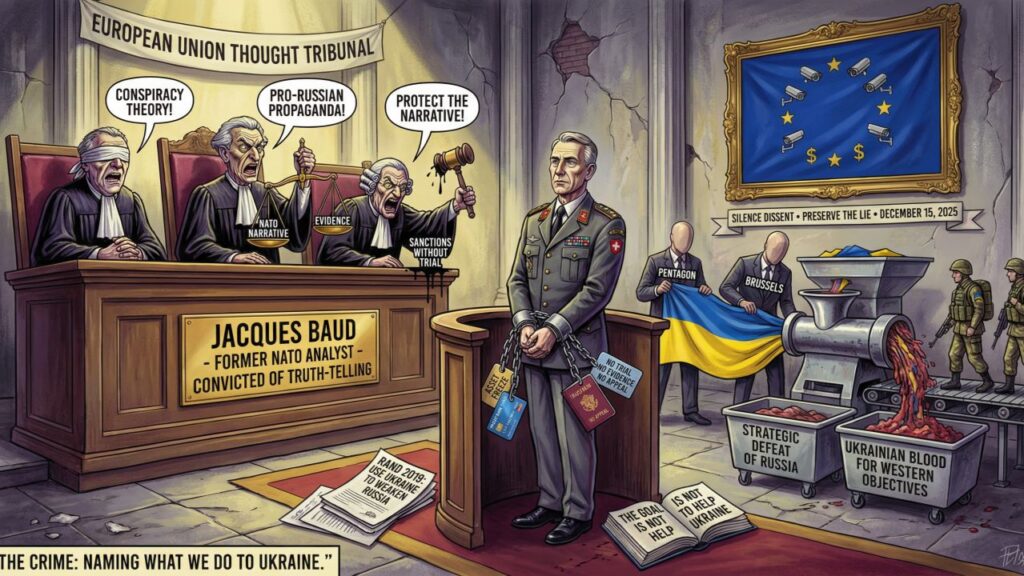
This reading of Western intentions is not speculation. Jacques Baud, a former Swiss intelligence colonel and NATO strategic analyst, argued from the conflict’s outset that Western intervention aimed primarily at inflicting strategic defeat on Russia, that the Ukrainian cause was merely a pretext. In a June 2022 interview, Baud stated plainly: “The goal is not to help Ukraine, but to fight Putin. We are not helping Ukraine. Everything else is a lie.” He cited a 2019 RAND Corporation report titled Extending Russia: Competing from Advantageous Groundcommissioned by the U.S. Army and published before the invasion, that explicitly outlined strategies to weaken Moscow through cost-imposing measures. Among its recommendations: “Providing lethal aid to Ukraine would exploit Russia’s greatest point of external vulnerability.” Baud argued that Ukraine was encouraged not to seek its own victory, but Russia’s defeat, a distinction that explains why Ukrainian forces were pushed into unwinnable attrition warfare while Western rhetoric promised triumph.
For making this case publicly, the European Union sanctioned Baud on December 15, 2025, not for espionage, not for any criminal act, but for “spreading pro-Russian propaganda.” His bank accounts were frozen, his assets seized, and he was barred from travel within the EU, all without trial or judicial process. The EU’s official justification accused him of “conspiracy theories,” yet offered no evidence to refute his analysis, only administrative punishment for the analysis itself.
This is the third layer of duping: when the institutional framework punishes those who name what is being done to Ukraine, it becomes nearly impossible for Ukrainians or their supporters to make informed choices about their own future.
The problem with “complete and total liberation”
“Ukraine deserves complete and total liberation” is morally appealing. But as strategy, it demands hard questions:
- With what manpower, when hundreds of thousands are dead or wounded, hundreds of thousands more are absent or evading mobilization, and millions have left the country?
- With what economy, when the state budget depends on foreign loans and grants, and critical infrastructure is in ruins?
- With what demographic future, when birth rates have collapsed and a huge share of young families is building permanent lives abroad?
- With what external backing, when Western publics are fatigued, U.S. politics are shifting, and European support has clear limits?
If “total liberation” means, in practice, fighting until Ukraine is smaller, more depopulated, more dependent, and negotiating from a worse position, then it is not a plan. It is a fantasy that Ukrainians pay for in blood and ruin.
The language of “never compromise” and “no peace until total victory” feels righteous online. On the ground, it translates into more dead soldiers, more shattered cities, and fewer options when negotiations eventually come anyway.
Why “give peace a chance” is aimed at Kyiv and the West
Saying “Russia should give peace a chance” is easy. The Kremlin is not reading our debates, and it has shown repeatedly that it responds to hard power and leverage, not moral appeals.
The decision‑makers who might actually change course are:
- Ukrainian leaders, who were told that any negotiation equals betrayal and who now face a bleaker map, a smaller population, and a ruined economy.
- Western politicians, academics, and activists, who helped create the environment in which compromise was demonized, maximalist war aims were normalized, and the costs were pushed onto Ukrainians.
That’s why the demand to “give peace a chance” has to be directed primarily at our own side: the governments and opinion‑makers who helped close off earlier, less catastrophic exits, and who still resist admitting that reality has moved far away from the early‑war fantasy of outright victory.
The moral trap: propaganda in the name of virtue
There is a particular irony in Western academics and commentators denouncing “Russian propaganda” while engaging in their own:
- They reduce the conflict to a simple morality play: pure victim vs pure villain, in which all uncomfortable facts about capability, escalation risk, and tradeoffs are treated as heresy.
- They smear any talk of negotiation, neutrality, or limits as “pro‑Russian,” even when the argument is plainly focused on minimizing Ukrainian losses and salvaging some future for the country.
- They use emotionally satisfying slogans in place of sober strategic analysis, then accuse others of deceit.
For people genuinely seeking the truth, that is repellent. It looks exactly like what they claim to oppose: narratives tailored to justify a chosen policy, regardless of consequences.
If your advocacy helps prolong a war that leaves Ukraine in a worse position, -less land, fewer people, more destruction, -then it is not enough to say “your heart is in the right place.” Intentions don’t change outcomes.
Russia provoked, Ukraine duped: what follows?
Saying Russia was provoked is an acknowledgment that Western and Ukrainian choices helped create a situation Russia was always likely to meet with force.
Saying Ukraine was duped is an acknowledgment that:
- It was pushed to reject early peace when the terms were less catastrophic.
- It was encouraged to define victory in ways that were never feasible given the balance of power.
- It is now being told to keep fighting on, even as the promised support wanes and the price in people, territory, and future capacity climbs.
These are not comfortable truths. But they are the truths that matter if the goal is to prevent Ukraine from being hollowed out to the point where even a bad peace can no longer preserve a viable nation.
At some point, the moral high ground stops being “never negotiate with evil” and becomes: stop sacrificing a country on the altar of other people’s narratives.
Related reading
- Manufacturing War: How the West Built and Sold the Russia-Ukraine War
- The Herding: How the West Weaponized Ukraine to Provoke Russia, And How Ukraine Embraced Its Own Destruction
- The Atlanticists' Russian-Hate Cult: Ten Truths About How the West Turned Ukraine Into a Graveyard to Weaken Russia
- The Managed War: How the West Built, Armed, and Prolonged the Destruction of Ukraine