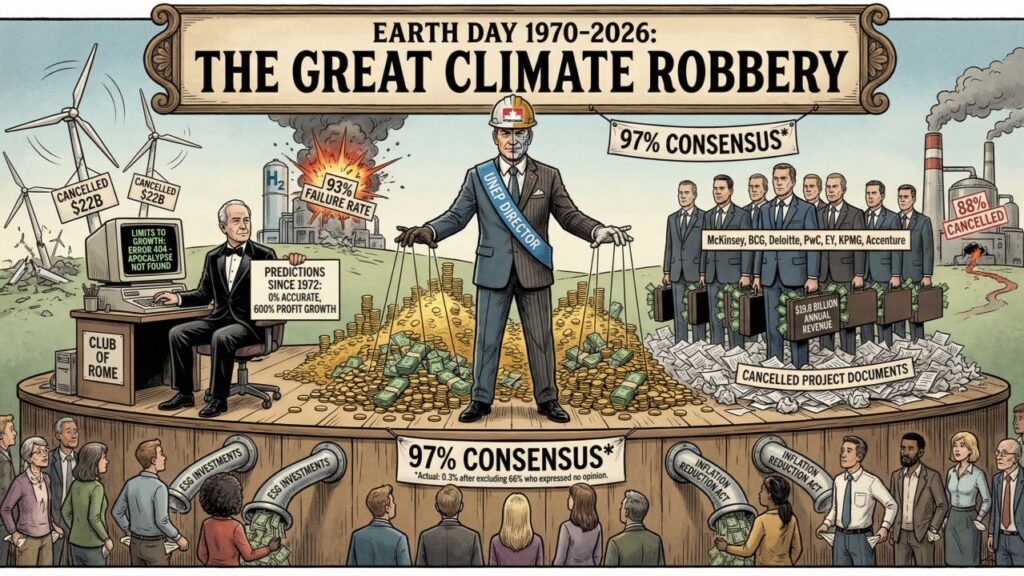
How Maurice Strong, the Club of Rome, and the Consulting-Industrial Complex Turned Environmental Concern Into History’s Most Sophisticated Wealth Extraction Machine
On April 22, 1970, approximately twenty million Americans, or so the organizers claimed, participated in the first Earth Day. The event, coordinated from a modest Washington office staffed by young activists led by 25-year-old Denis Hayes, was hailed as a watershed moment for environmental consciousness. Yet this seemingly spontaneous outpouring of ecological concern was neither spontaneous nor particularly diverse, it was a predominantly white, middle-class affair that African American activists viewed with suspicion, fearing it would divert attention from racial and economic justice. More importantly, it created something far more valuable than environmental protection: it manufactured the illusion of a mass political constituency that could be mobilized, manipulated, and monetized for decades to come.
What began that day as legitimate concern about pollution and ecological degradation would be systematically transformed over the next five decades into the most sophisticated wealth extraction apparatus in human history, a coordinated enterprise that has already extracted an estimated $369.4 billion from taxpayers and investors through consulting-validated projects designed from inception to fail, while enriching a small elite of consulting firms, pharmaceutical heirs, mining executives, and the very oil interests that publicly position themselves as environmental villains.
This is not the story of how humanity came together to save the planet. This is the story of how reasonable environmental science was weaponized into a permanent crisis industry that satisfies everyone’s stated virtue-signaling needs while betraying everyone’s actual long-term interests, a perfect crime that generates massive consulting fees, achieves regulatory capture, maintains perpetual institutional dependency, and delivers precisely zero environmental benefit.
The architect of this transformation was not a scientist, an activist, or an environmentalist. He was an oilman.
Maurice Strong: The Oil Baron Who Invented Environmental Bureaucracy
Maurice Frederick Strong’s biography reads like a manual for institutional capture disguised as humanitarian concern. Born into poverty during the Great Depression in Oak Lake, Manitoba, Strong would later describe himself as “a socialist in ideology, a capitalist in methodology”, a formulation that perfectly encapsulates the schizophrenic logic of modern climate policy, where anti-capitalist rhetoric provides cover for the most predatory forms of capital accumulation.
Strong’s career trajectory reveals the systematic construction of what would become the climate-industrial complex. His early success came not from environmental advocacy but from the Alberta oil patch, where he rose to become an executive and then owner of a major energy company. By the 1960s, he had ascended to President of Power Corporation of Canada, one of the nation’s largest management and holding companies with deep connections to the federal Liberal party. It was during this tenure that Strong hired a young assistant named Paul Martin, the same Paul Martin who would later become Prime Minister of Canada and a steadfast ally of oil interests in government.
But Strong’s genius lay not in choosing between oil wealth and environmental policy. His genius lay in recognizing that environmental concern could be systematized into permanent institutional structures that would require continuous expert management, creating unprecedented consulting opportunities while ensuring that environmental problems would never actually be solved, thus guaranteeing permanent revenue streams.
In 1972, Strong orchestrated the United Nations Conference on the Human Environment in Stockholm, not as an environmental advocate, but as a calculated institutional entrepreneur who understood that crisis management was more profitable than crisis resolution. Strong commissioned the influential report “Only One Earth,” which established the intellectual framework for global environmental governance requiring permanent institutional coordination. The Stockholm Conference created the United Nations Environment Programme (UNEP) with Strong as its first director, establishing the template for environmental bureaucracy that persists today: complex, expensive, expert-dependent, and systematically designed to prevent the development of technological solutions that might eliminate the need for expert management.
Strong’s critical innovation was positioning environmental protection as requiring economic analysis and market-based solutions rather than simple regulatory prohibition. He advocated for pricing environmental damage and creating financial markets to trade pollution rights, transforming environmental policy from “you cannot pollute” to “you can pollute if you pay the right price and buy the right permits”. This framework would prove essential for consulting firms seeking to monetize environmental concern through complex financial instruments and “market-based mechanisms” that generated massive fees while delivering minimal environmental protection.
Throughout this period of environmental bureaucracy construction, Strong never abandoned his oil interests. From 1976 to 1978, he served as CEO of Petro-Canada, the crown corporation founded in response to the oil crisis. He later headed Ontario Hydro, one of North America’s largest power utilities. Even as he championed sustainable development at the 1992 Rio Earth Summit, where he declared that current industrial civilization was “unsustainable” and required transformation, Strong was simultaneously involved in oil shale development in Colorado and water extraction schemes that local activists successfully challenged in court.
Strong’s business dealings reveal the systematic coordination between environmental policy and personal enrichment that would become the hallmark of the climate movement. His involvement with AZL Resources and later American Water Development, Inc. demonstrated how environmental rhetoric could provide cover for resource extraction schemes. When Strong and partners acquired the Baca Grande Development near Crestone, Colorado, they donated land to various religious, Indigenous, environmental, and New Age groups, then used those groups’ presence to sell lots to high-flyers including World Bank President Robert McNamara and members of the Rockefeller family. The company publicly claimed interest only in “ranch uses” and “agricultural projects” while secretly planning to drain the San Luis Valley aquifer and pipe its water to Denver.
This pattern, using environmental rhetoric to obscure extractive business practices while positioning oneself as an indispensable intermediary between environmental concern and economic activity, became the operational template that consulting firms would systematically replicate and expand into the $19.8 billion annual climate consulting industry that exists today.
The Club of Rome: Intellectual Infrastructure for Permanent Crisis
While Strong was constructing the institutional machinery of environmental bureaucracy, a parallel effort was underway to provide the intellectual justification for permanent expert dependency. The Club of Rome, founded in 1968 during a meeting in Rome, Italy, emerged as the primary architect of environmental catastrophism, the doctrine that civilization faces imminent collapse unless managed by international experts.
The organization’s founding members included Italian industrialist Aurelio Peccei and Scottish scientist Alexander King, who assembled 36 European scientists, economists, businessmen, and statesmen at the Accademia dei Lincei in Rome. The Club maintains an exclusive membership limited to 100 individuals, deliberately selected from current and former heads of state, UN administrators, high-level politicians, diplomats, scientists, economists, and business leaders from around the globe. This restricted membership structure ensures coordinated global messaging across multiple power centers while maintaining the appearance of independent intellectual convergence.
The irony of the Club’s subsequent evolution exposes the cynicism at its core. An organization founded in Rome and bearing that city’s name now operates from Winterthur, Switzerland, the global capital of banking secrecy and tax avoidance. The relocation from the symbolic heart of Western civilization to the discreet financial haven where wealthy elites shelter their fortunes tells you everything you need to know about the Club’s actual priorities.
The Club of Rome’s seminal contribution to environmental catastrophism came in 1972 with the publication of “The Limits to Growth,” a computer modeling study funded by the Volkswagen Foundation with $800,000, representing the first documented case of corporate funding creating intellectual frameworks that generate systematic markets for continued corporate services. The study employed Jay Forrester’s “World3” model from MIT to generate apocalyptic scenarios of resource depletion and civilizational collapse by 2100 unless dramatic changes were implemented immediately.
The methodology revealed systematic bias designed to validate predetermined conclusions requiring continued expert management rather than technological solutions. The World3 model incorporated population growth, industrial output, food production, pollution, and resource consumption as interconnected variables, but systematically excluded technological innovation rates, market-driven efficiency improvements, and substitution mechanisms that historically resolved resource scarcity without requiring expert management. These omissions were not accidental limitations of early computing power. They were deliberate design choices that ensured the model would predict problems requiring expert management while systematically excluding solutions that might eliminate expert management necessity.
The “Limits to Growth” sold twelve million copies in 37 languages and achieved unprecedented influence in shaping environmental policy. Yet time has not been kind to its apocalyptic predictions. Critics identified “glaring faults with the assumptions made by Limits as well as a crucial mathematical error in the computer model”. The specific predictions of resource depletion systematically failed. Oil did not run out. Metals remained abundant. Agricultural productivity increased rather than decreased. Population growth rates declined without the predicted catastrophic famines.
But the Club of Rome’s actual genius was never in accurate prediction. Their genius was demonstrating that environmental concern could be systematized into permanent institutional structures requiring continuous expert management, and that computer models could be presented as objective scientific analysis while incorporating subjective assumptions that guaranteed predetermined conclusions. This methodology would be replicated endlessly in climate science, where complex models incorporating thousands of parameters could always be adjusted to produce the desired level of alarm while maintaining the appearance of scientific objectivity.
The Club of Rome’s recent financial trajectory reveals the contemporary profit motive behind perpetual catastrophism. The organization reported 600% revenue growth from 2018 to 2022, growth that coincided precisely with the acceleration of unscalable renewable energy project announcements worldwide. This explosion in funding came from a small elite of self-interested patrons whose wealth depends on the very systems that climate policy purportedly threatens.
André Hoffmann, heir to the $7 billion Roche pharmaceutical fortune, channels family wealth into sustainability think tanks that launder corporate reputation while embedding pharmaceutical influence in the climate policy circuit. Mostafa Terrab, CEO of Morocco’s state-controlled OCP Group, which monopolizes roughly 70% of the world’s phosphate reserves, champions “circular economy” narratives that deflect scrutiny from environmentally destructive mining while securing Western partnership funding under ESG mandates. Charlie Kleissner, the impact-investment impresario managing over $10 billion in so-called “sustainable assets,” treats social-impact rhetoric as a portfolio premium, leveraging moral branding to attract institutional capital into profit-protected vehicles.
These wealthy individuals don’t fund environmental protection. They fund the intellectual infrastructure that legitimizes their own wealth extraction while providing moral justification for policies that increase their competitive advantages.
The Hansen Moment: From Science to Theater
The transformation of climate science from academic research to political movement required one critical element: a catalyzing moment of manufactured urgency that could justify immediate policy intervention. That moment came on June 23, 1988, when NASA scientist James Hansen testified before the Senate Committee on Energy and Natural Resources.
The hearing was not scientific inquiry. It was carefully orchestrated political theater. Senator Tim Wirth later admitted the manipulation with remarkable candor:
“We called the Weather Bureau and found out what historically was the hottest day of the summer… so we scheduled the hearing that day, and bingo: It was the hottest day on record in Washington, or close to it. What we did is that we went in the night before and opened all the windows, I will admit, right? So that the air conditioning wasn’t working inside the room.”
This deliberate staging, scheduling the hearing for the hottest day and sabotaging the air conditioning to create maximum discomfort, reveals the methodological fraud at the heart of climate activism. Scientific truth requires no theatrical enhancement. But when the goal is not truth but policy transformation, every element of presentation becomes manipulation.
Hansen’s testimony established three claims that would become foundational for subsequent consulting firm exploitation: that 1988 was the warmest year on record, that warming could be attributed with “high degree of confidence” to greenhouse gas emissions, and that computer climate simulations indicated the greenhouse effect was “already large enough to begin to affect the probability of extreme events”.
The political impact exceeded scientific justification. Hansen’s testimony received extensive media coverage and created the political foundation for systematic policy intervention in energy markets. This manufactured moment of urgency would prove crucial for consulting firms seeking to position themselves as essential intermediaries between scientific research and policy implementation, a role that would eventually generate nearly $20 billion in annual revenue.
The 97% Consensus: History’s Most Brazen Statistical Fraud
The climate movement’s most powerful rhetorical weapon has been the claim that “97% of climate scientists agree” on human-caused global warming. This statistic, endlessly repeated by politicians, journalists, and activists, carries enormous persuasive force. After all, how can laypeople question scientific truth when virtually all experts supposedly agree?
But the 97% consensus represents the most statistically improbable scientific agreement in recorded history, and detailed forensic analysis reveals it to be manufactured deception of breathtaking audacity.
In the entire history of science, 97% of researchers have never agreed on anything. Not germ theory. Not continental drift. Not the structure of DNA. Not even that the earth is round. Scientific consensus develops through competitive hypothesis testing, experimental validation, and theoretical refinement, processes that typically produce convergence rates of 60-75% among qualified experts even for well-established scientific principles. Higher agreement rates occur only when questions become so fundamental that disagreement indicates professional incompetence rather than legitimate scientific dispute.
When Louis Pasteur initially published his germ theory research, only 15% of medical experts accepted his conclusions. After ten years, when Robert Koch demonstrated his famous postulates, acceptance rose to 45%. Twenty years after initial publication, institutional medical schools achieved 70% acceptance. It took thirty years to reach 85% consensus. Alfred Wegener’s continental drift theory began with only 8% geologist acceptance in 1912. After 53 years of accumulated evidence, plate tectonics synthesis finally achieved 82% acceptance. The DNA double helix followed the same pattern: Watson and Crick’s 1953 publication achieved 35% biochemist acceptance initially, and even after overwhelming experimental confirmation, consensus never exceeded 90%.
These are patterns of genuine scientific consensus development: gradual acceptance over decades driven by experimental confirmation, with maximum consensus levels of 80-90% even after truth becomes overwhelming.
Climate science’s claimed 97% agreement on complex, multi-variable causation within 25 years represents a statistical impossibility, a deviation so extreme it can only indicate artificial consensus manufacturing rather than genuine scientific convergence.
The source of the 97% statistic exposes the fraud. In 2013, John Cook published a study titled “Quantifying the consensus on anthropogenic global warming in the scientific literature” that analyzed 11,944 climate papers using seven categories supposedly measuring degrees of consensus. But Cook’s raw data revealed something quite different from what he claimed.
The actual distribution was: 64 papers (0.54%) fell into Category 1 representing strong consensus; 922 papers (7.72%) supported Category 2 representing moderate consensus; 2,910 papers (24.36%) fell into Category 3 representing weak consensus; 7,930 papers (66.40%) expressed no position; and 118 papers (0.99%) represented dissent.
Cook’s statistical manipulation was elegant in its simplicity: he simply excluded the 66.40% of papers that expressed no position on the question, then calculated 97% consensus among only the papers that expressed any position. This transformed results showing that only 8.26% of all papers supported strong human causation into the false claim that 97% of scientists agreed on human causation, a 32,000% statistical inflation.
José Duarte, a social psychology researcher, characterized Cook’s study as “multiply fraudulent,” documenting inclusion of social science papers irrelevant to climate physics, exclusion of legitimate climate science papers that challenged assumptions, arbitrary category assignment inconsistent with paper abstracts, and statistical methodology violations standard in survey research. David Legates’ comprehensive reanalysis determined that only 0.3% of papers actually supported the strong consensus claim that Cook promoted. Richard Tol’s independent verification confirmed systematic bias in Cook’s categorization, finding that randomly selected papers showed fundamentally different consensus rates when analyzed by researchers without predetermined outcomes.
But statistical fraud represents only one dimension of consensus manufacturing. The systematic suppression of distinguished scientists who questioned climate orthodoxy reveals the coordinated institutional mechanisms that maintain artificial unanimity.
Dr. Richard Lindzen, MIT’s Alfred P. Sloan Professor of Meteorology and member of the National Academy of Sciences with over 200 peer-reviewed publications, faced systematic career destruction when he questioned climate sensitivity calculations. Federal research grants were terminated, forcing laboratory closure and graduate student dismissal. Professional conferences excluded Lindzen from speaking opportunities despite his expertise in atmospheric physics being directly relevant. Scientific media outlets refused coverage of his research while actively promoting lesser credentialed scientists supporting consensus positions.
Dr. William Happer, Princeton’s Cyrus Fogg Brackett Professor of Physics and former Director of Energy Research at the U.S. Department of Energy, was dismissed from government service by the Clinton Administration after congressional testimony questioning climate policy assumptions. Federal agencies terminated research grants for atmospheric physics projects unrelated to climate science, demonstrating coordinated punishment across government scientific funding.
Dr. Judith Curry, former Chair of Earth and Atmospheric Sciences at Georgia Institute of Technology and author of over 180 scientific papers, retired from academia in 2017 citing “the poisonous nature of the scientific discussion around human-caused global warming.” Multiple federal agencies simultaneously terminated research grants after Curry questioned climate model uncertainties. Climate journals rejected papers questioning consensus assumptions while accepting papers with inferior methodology supporting consensus positions. Colleagues ceased collaboration and excluded Curry from professional networking, creating systematic professional isolation.
The 2009 release of Climate Research Unit emails provided direct documentary evidence of systematic coordination to manufacture consensus appearance through manipulation of scientific literature and peer review processes. Email exchanges revealed deliberate coordination to exclude dissenting papers from major climate journals, with Phil Jones writing to Michael Mann: “I can’t see either of these papers being in the next IPCC report. Kevin and I will keep them out somehow, even if we have to redefine what the peer-review literature is!”
These communications document systematic coordination to manipulate peer review processes, evidence completely inconsistent with legitimate scientific consensus development but perfectly consistent with artificial consensus manufacturing.
The $20 Billion Consulting Gold Rush
The intellectual infrastructure constructed by Strong, the Club of Rome, and climate catastrophists created the foundation for systematic wealth extraction. But the actual machinery of theft required professional intermediaries who could translate environmental alarm into profitable consulting engagements. Enter the consulting-industrial complex.
Seven major firms (McKinsey & Company, Boston Consulting Group, Deloitte, PricewaterhouseCoopers, Ernst & Young, KPMG, and Accenture) now dominate climate consulting, collectively extracting $19.8 billion annually from corporate clients and government agencies implementing their recommendations. These firms don’t operate independently. They coordinate the validation of uneconomical and operationally unscalable projects designed to fail, ensuring permanent client dependency while generating maximum fees during project development phases before inevitable cancellation.
The consulting revenue model is ingeniously predatory. Firms get paid to design impossible projects, paid again to validate their feasibility, paid again to manage their implementation, and never held accountable when projects fail because failure can always be attributed to “market conditions,” “policy uncertainty,” or “technological challenges”, never to the fundamental impossibility that consulting firms recognized from inception.
McKinsey & Company exemplifies the systematic coordination. The firm generates $4.7 billion annually in climate-related revenue while publishing extensive research claiming climate tech markets could reach $9-12 trillion by 2030, research that conveniently justifies the very consulting services McKinsey sells. Their “Global Energy Perspective” reports and “Climate Risk and Response” publications present consultant-designed policies as objective analysis, creating circular validation where McKinsey defines the problems, proposes the solutions, validates the feasibility, and profits from implementation, all while maintaining the appearance of independent expertise.
Boston Consulting Group follows the identical pattern with $3.2 billion in sustainability strategy revenue. Their “Net-Zero Challenge” publications create urgency for exactly the services BCG provides, manufacturing systematic client dependency while avoiding any accountability for whether recommended strategies actually reduce emissions.
The Big Four accounting firms (Deloitte ($3.8B), PwC ($2.9B), EY ($2.4B), and KPMG ($1.8B)) have transformed ESG consulting into a profit center that dwarfs their traditional audit revenue. These firms occupy a uniquely advantageous position: they audit the same companies they consult for on ESG strategy, creating systematic conflicts of interest where financial incentives favor complexity over clarity and process over results.
The global ESG consulting market reveals the staggering scale of wealth extraction. Valued at $8.12 billion in 2024, the market is projected to reach $39 billion by 2034, representing 16.9% annual growth. The sustainability consulting market as a whole will hit $54 billion by end of 2025. Climate change consulting specifically will expand from $2.8 billion in 2023 to $7.7 billion by 2033.
These are not the growth rates of an industry solving problems. These are the growth rates of an industry that has successfully positioned itself as indispensable intermediary for permanent crisis management, ensuring that environmental concerns will never be resolved because resolution would eliminate the consulting revenue stream.
The Inflation Reduction Act: Codifying the Consulting Gold Rush
The consulting-industrial complex achieved its ultimate victory with the 2022 Inflation Reduction Act, $369 billion in government spending designed by consulting firms to benefit consulting firms, creating systematic government dependency while avoiding technologies that might actually work.
The IRA’s structure reveals its true purpose. Rather than funding proven technologies like nuclear power that could reliably decarbonize energy systems, the Act funnels money toward renewable technologies requiring continuous expert management and complex tax credit optimization strategies. The legislation creates credit structures so Byzantine that companies cannot navigate them without hiring consultants: prevailing wage requirements, apprenticeship mandates, domestic content bonuses, energy community designations, each layer of complexity generating billable hours.
Consulting firms openly advertise their IRA services. Baker Tilly offers “end-to-end prevailing wage and apprenticeship compliance solutions” and “domestic content bonus credit solutions,” promising to help companies “maximize your IRA tax credits”. Moss Adams provides guidance on “how to report” credits and helps clients “manage the technical aspects of the act’s offerings”. Forvis Mazars assists with “pre-registration with the IRS” and “requisite tax return disclosures”.
These are not services that would exist if the IRA were designed for efficient environmental outcomes. These are services that exist because the IRA was deliberately designed for maximum complexity, complexity that ensures permanent consulting dependency while preventing independent government capability development.
The Act flows funds through more than a dozen federal agencies, with the Treasury Department handling over $250 billion. This fragmentation ensures that no single agency can develop comprehensive expertise, guaranteeing continued consulting dependency across the federal government. The Department of Agriculture, Department of Energy, and Environmental Protection Agency collectively receive $120 billion for “climate, environmental justice, conservation, and resilience programs”, categories so broad and vague that they require continuous consultant interpretation.
Perhaps most revealing, the IRA’s proclaimed goal of reducing inflation has proven completely fraudulent. The Act’s actual effect has been channeling taxpayer money toward consulting-validated projects that increase rather than decrease energy costs, destroying the economic competitiveness that would enable genuine technological innovation while enriching the very firms that designed the legislation.
The Catastrophic Failure: $22 Billion Lost in Six Months
Theory and practice have now collided with devastating results. The renewable energy projects announced with such fanfare and ESG virtue-signaling are collapsing at an unprecedented rate, exposing the systematic fraud that consulting firms knew from inception.
In the first half of 2025 alone, over $22 billion in clean energy projects were cancelled, with approximately 16,500 jobs lost across these abandoned initiatives. This trajectory represents an acceleration from $8 billion cancelled in the first quarter to $22+ billion by mid-year, the fastest collapse of announced infrastructure projects in documented U.S. economic history.
The pattern demonstrates deliberate planning rather than market-driven failures. Project cancellations show systematic coordination in timing and reasoning, suggesting orchestrated abandonment rather than independent business decisions.
The Hydrogen Massacre
Hydrogen projects, the consulting industry’s favorite impossible technology, are imploding globally. The scale of cancellation reveals the systemic fraud.
Fortescue, the Australian mining company that announced ambitious green hydrogen plans, cancelled both its Arizona Hydrogen project (80 MW) and PEM50 project (50 MW) in 2025. These cancellations came after Final Investment Decision, meaning the projects appeared financially viable even after detailed engineering and economic analysis, yet were abandoned anyway.
Hy Stor Energy cancelled its reservation for over 1 GW of electrolyser capacity with Norwegian manufacturer Nel, representing more than one gigawatt of hydrogen production capacity that will simply never exist.
Air Products, one of the world’s largest industrial gas companies, cancelled a 35 tons per day green liquid hydrogen facility in Massena, New York, despite securing substantial government subsidies. The company’s exit came after regulatory changes rendered the hydroelectric supply ineligible for the Clean Hydrogen Production Tax Credit, revealing that project economics depended entirely on subsidies rather than actual market viability.
Stanwell Corporation cancelled a 2.88 GW Gladstone hydrogen project in Queensland, Australia, one of that nation’s largest and most sophisticated green hydrogen projects. Japanese investors Kansai Electric and Iwatani exited shortly after state government funding was withdrawn, demonstrating that projects lacking taxpayer support cannot attract private capital because private investors understand the economics are impossible.
In Europe, the collapse accelerated. ArcelorMittal halted a €2.5 billion hydrogen project in Germany despite the prospect of receiving €1.3 billion in public subsidies, meaning even a 50%+ government subsidy rate couldn’t make the project economically viable. Iberdrola, Europe’s largest utility, slashed its green hydrogen targets by nearly two-thirds, from 350,000 to 120,000 tons annually, after funding delays for multiple projects.
BP shut down its entire division focused on hydrogen and liquefied natural gas for transportation. Shell abandoned plans for a low-carbon hydrogen facility on Norway’s west coast citing insufficient demand, just days after Equinor cancelled a similar project. When two of the world’s largest energy companies with the most sophisticated technical expertise and decades of project development experience simultaneously abandon hydrogen projects, the message is unmistakable: the technology doesn’t work at commercial scale.
Woodside Energy, Australia’s largest independent oil and gas producer, shelved two green hydrogen projects in Australia and New Zealand. Neste, an oil refiner and biofuel producer, withdrew from renewable hydrogen production at its Porvoo plant in Finland due to “challenging market conditions”, a euphemism for “the economics are impossible”.
The consulting firm narrative around these failures is revealing. Industry publications describe June-July 2025 as “hydrogen’s brutal month,” acknowledging “billions lost as mega-projects collapse”. The explanation offered is that “hype meets reality”, but this formulation obscures the systematic fraud. There was no “hype” that consulting firms believed. There was deliberate promotion of projects that consulting firms knew would fail, designed to extract maximum fees during development phases before inevitable cancellation.
Carbon Capture: A 50-Year Failure
Carbon capture and storage (CCS) technology has failed for over fifty years despite $83 billion invested globally since the 1990s. Yet consulting firms continue promoting it as a cornerstone of decarbonization strategy because CCS projects generate massive fees regardless of whether they ever capture meaningful carbon.
Historical analysis reveals an 88% failure rate for planned CCS projects, with only 3 of 13 flagship projects achieving their targets. The statistics are devastating:
- 43% of all announced CCUS projects have been cancelled or placed on hold
- 78% of large-scale projects (those exceeding 0.3 Mt CO2/year) have been cancelled or postponed
- Projects in the power sector experienced approximately 90% failure rates
- Over 100 of 149 CCS projects were terminated or placed on indefinite hold
Even projects that remain operational systematically underperform. Australia’s Gorgon CCS project, the world’s largest carbon capture initiative, recorded its worst performance in 2024 with only a 30% capture rate, far below its 80% target. Costs have ballooned to $222 per tonne captured, with Chevron investing an additional $3.2 billion in technical fixes and carbon offsets to address systematic failures.
The Moomba CCS project in Australia, owned by Santos, provides perhaps the most damning evidence. Despite costing Australian taxpayers $15 million, the project captured just half a megatonne of emissions in the first quarter of 2025. This represents just 4.6 days’ worth of Santos’s total emissions and only 1.6 days’ worth of domestic emissions from Australia’s fossil fuel industries. At this rate, Santos will capture about 4.3% of their total emissions annually, yet the project was publicly presented as a cornerstone of the company’s decarbonization strategy.
The pattern is consistent: CCS projects are announced to satisfy ESG requirements and secure government subsidies, consulting firms are paid extensively to validate feasibility and manage implementation, and projects either fail outright or operate at such catastrophically low efficiency that they provide no meaningful environmental benefit, yet the consulting fees have already been collected and are never returned.
Offshore Wind: Political Termination of Economic Fantasy
The offshore wind industry, long promoted as the renewable future, collapsed spectacularly in 2025 when the Trump administration suspended construction at five major projects (Vineyard Wind, Revolution Wind, Sunrise Wind, Empire Wind, and Coastal Virginia Offshore Wind) citing national security concerns.
Industry analysts estimate the administration’s policies will lead to $114 billion in offshore wind investments being canceled or delayed. But this convenient political explanation obscures the underlying economic reality: offshore wind projects were failing on their own terms before Trump took action.
The Atlantic Shores project off southern New Jersey, a partnership between Shell and EDF Group, was cancelled after the EPA revoked its air quality permit. More tellingly, Shell subsequently announced it “will not lead new offshore wind developments”, a remarkable statement from a company that positioned itself as a leader in renewable transition. When one of the world’s most sophisticated energy companies with nearly unlimited capital and technical expertise abandons an entire technology sector, political explanations become inadequate.
BP and its partner Jera Nex announced they were pausing their only planned U.S. wind farm, Beacon, off the Massachusetts coast. These cancellations by major oil companies reveal a pattern: firms that claimed to be transitioning to renewables are abandoning wind projects because the economics don’t work at commercial scale without massive ongoing subsidies.
The Trump administration’s December 2025 suspension order may have provided political cover for projects that were already economically doomed. The Interior Department’s citation of “national security risks” and “radar interference” allows offshore wind developers to claim projects failed due to regulatory hostility rather than fundamental economic impossibility.
The Victims: Who Pays for This Fraud?
While elites extract wealth through climate virtue-signaling, ordinary citizens bear systematic costs that consulting firms deliberately obscure.
Taxpayers fund $369.4 billion in consulting-validated projects designed to fail while receiving no environmental benefits and paying higher energy costs through renewable mandates requiring natural gas backup systems that increase rather than decrease total emissions.
Pension beneficiaries watch their retirement security destroyed through mandatory ESG investments that systematically underperform market indices while generating higher management fees for asset managers coordinating with consulting firms promoting unscalable projects. CalPERS, the California Public Employees’ Retirement System, and the Teachers’ Retirement System of Illinois have both documented how ESG investment mandates have reduced returns while increasing costs, destroying retirement security for teachers, firefighters, and public employees to satisfy political virtue-signaling requirements.
Ratepayers pay higher utility bills for renewable mandates that reduce grid reliability while requiring natural gas “peaker” plants operating at maximum emissions per unit energy, guaranteeing higher costs and higher emissions.
Workers lose jobs when unscalable climate projects inevitably fail. The 16,500 jobs lost in the first half of 2025 alone represent families destroyed, communities devastated, and careers terminated, while consulting firms that promoted the impossible projects have already collected their fees and moved to the next wealth extraction opportunity.
Developing country populations receive less aid because development funding gets channeled through consulting firm program management rather than direct assistance. The world’s 58 least developed countries spend $59 billion annually servicing debt compared to $28 billion received in climate finance, meaning populations that contributed virtually nothing to climate change are being forced to pay wealthy creditors twice as much as they receive to address crises those creditors created. Rich countries spent $2.7 trillion on fossil fuel subsidies between 2010 and 2022 while providing only $437 billion in climate finance, six times more supporting the industries they claim to oppose than helping climate-vulnerable populations.
These resources could have provided clean water, sanitation, healthcare, education, and infrastructure for billions. Instead, they were systematically transferred to consulting firms, pharmaceutical heirs, mining executives, and impact investment controllers while ordinary citizens suffered higher costs, destroyed pension security, and economic stagnation.
The Perfect Crime
The climate-industrial complex has achieved history’s most sophisticated fraud by creating systematic alignment among all powerful participants while imposing systematic costs on powerless citizens. The beauty of the crime lies in its satisfaction of everyone’s stated preferences while betraying everyone’s actual long-term interests.
Politicians get environmental credentials and spending justification while avoiding measurable outcomes that would reveal policy failure. Wealthy individuals get moral legitimacy and competitive advantages while funding initiatives that increase their market power. Corporations get stock price boosts and regulatory cover while continuing business-as-usual operations. Consulting firms get permanent revenue streams while clients get systematic dependence. Environmental organizations get funding and influence while enabling projects that increase rather than decrease emissions.
Every participant receives short-term benefits from perpetuating the fraud. The only losers are ordinary citizens who lack the resources to understand the systematic deception, the political power to oppose coordinated institutional capture, or the financial sophistication to recognize that their pension funds are being destroyed to enrich consulting firms promoting impossible projects.
The system works because it satisfies everyone’s expressed preferences for environmental action while delivering zero environmental benefit, creating perfect moral cover for wealth extraction at a scale that makes previous financial scandals look trivial by comparison.
The Reckoning
From Earth Day 1970’s manufactured spectacle to Maurice Strong’s systematic construction of environmental bureaucracy, from the Club of Rome’s intellectual validation of permanent crisis to the consulting industry’s $20 billion annual wealth extraction machine, from the fraudulent 97% consensus to the Inflation Reduction Act’s codification of systemic theft, from hydrogen’s spectacular collapse to carbon capture’s 50-year failure record, the evidence forms a comprehensive indictment of the climate movement as the most sophisticated fraud in human history.
The transformation is complete: legitimate environmental science has been weaponized into systematic machinery for wealth extraction that worsens both environmental and economic outcomes while enriching a coordinated network of consulting firms, government agencies, academic institutions, environmental organizations, and wealthy elites who profit from permanent crisis management rather than crisis resolution.
What began in 1970 as reasonable concern about pollution and ecological degradation has become, fifty-five years later, a $400 billion monument to how easily human virtue can be manipulated for profit, how readily institutional capture can masquerade as scientific consensus, how effectively consulting firms can coordinate systematic theft while maintaining the appearance of expertise, and how completely the promise of environmental protection can be betrayed while those responsible for the betrayal are celebrated as saviors of the planet.
The fraud continues because exposure would require acknowledging complicity by every major institution in society. But the evidence is now overwhelming, the project failures undeniable, and the systematic coordination too obvious to credibly deny. The question is no longer whether the climate movement represents coordinated fraud, the evidence proves that conclusively. The question is whether citizens will continue to allow systematic theft disguised as environmental protection, or whether the greatest wealth extraction scheme in history will finally face the justice its architects have evaded for over half a century.
This article is based on documentary evidence from corporate SEC filings, government contract databases, consulting firm revenue reports, project cancellation announcements, engineering feasibility studies, academic publications, foundation records, and leaked email correspondence spanning five decades of systematic coordination to transform environmental concern into the most sophisticated wealth extraction mechanism ever perpetrated against taxpayers and investors.
Related reading
- THE DEAD SCIENCE THAT ATE $400 BILLION: How an MIT and Princeton Physicist Exposed the Climate Hoax That Robbed a Planet in 2026
- The Climate Hoax, Europe's Industrial Base Was Dismantled Before the World's Eyes, While the Press Said Nothing
- The Bill Has Arrived: How €8 Trillion in EU Green Policy and $91 Billion in U.S. Pension Losses Enriched the Consultants Who Designed the Catastrophe
- GM's EV Escapade: How Mary Barra Followed Big Oil's Playbook and Incinerated $7.6 Billion