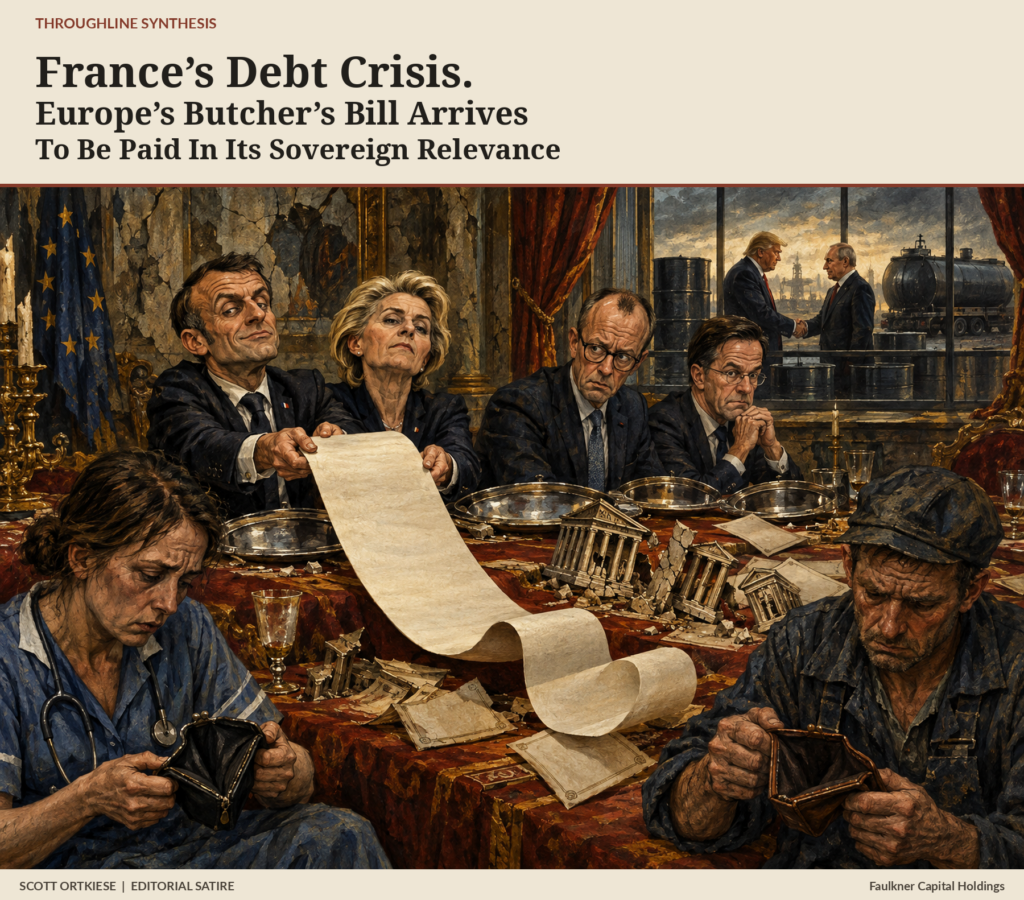
Trump and Putin strike their diesel bargain. Europe defends its failed strategy, carries the financial burden and loses the power to determine the outcome.
Scott Ortkiese | Throughline Synthesis | Houston, October 10, 2026
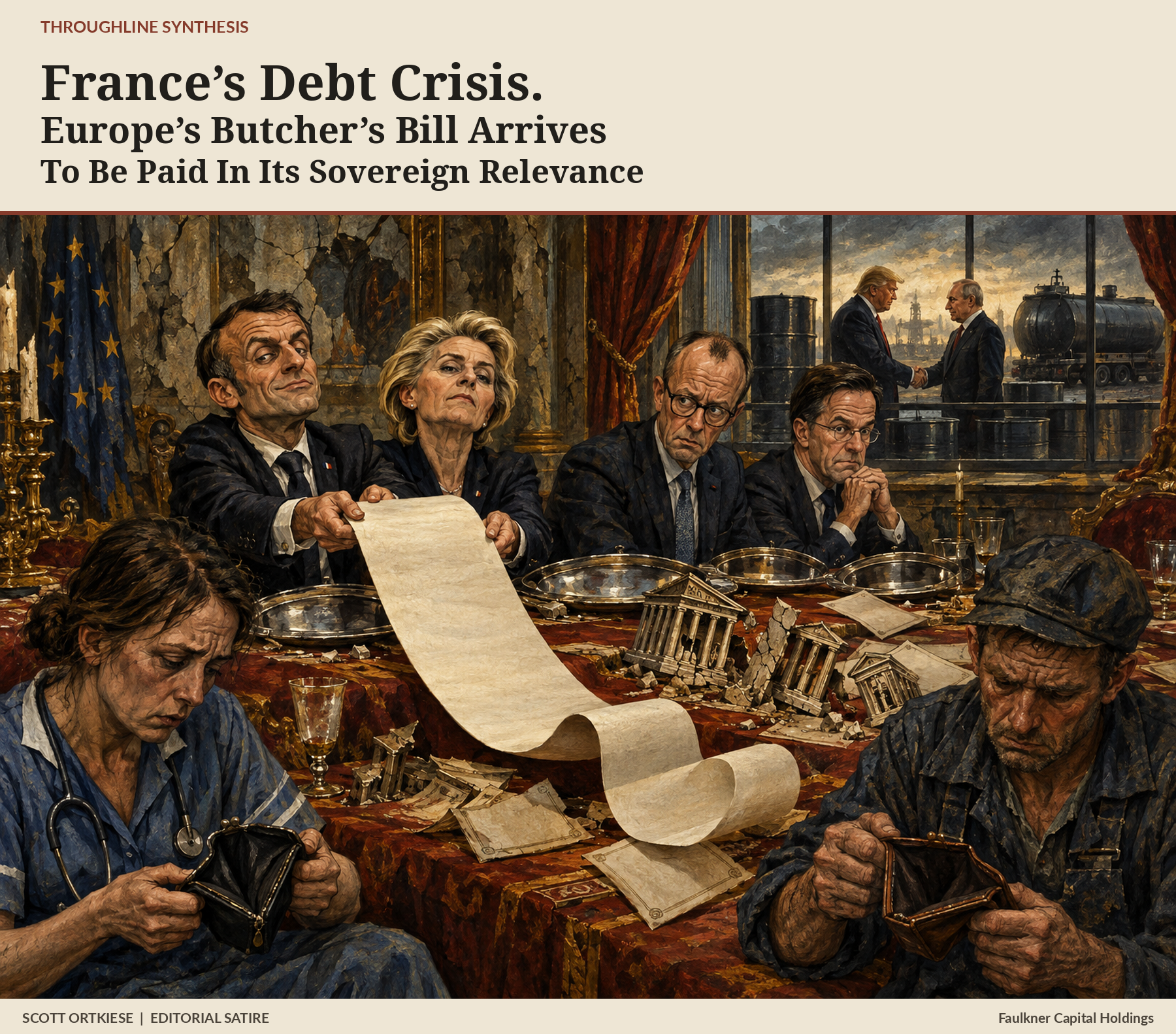
Trump and Putin make the deal. Europe gets the bill.
The U.S.-Russian diesel deal exposes the collapse of Europe’s claim to direct the confrontation with Russia. On October 9, Trump announced a fuel bargain with Putin and authorized a Russian diesel trading channel while his envoys were meeting Ukrainian and European representatives in Miami (Associated Press, Axios). Europe was represented at the talks. It did not control the American decision.
Washington wanted Russian fuel. Moscow obtained a licensed commercial opening without a publicly announced peace settlement or energy ceasefire in return (OFAC, Axios). Germany and the EU’s foreign-policy chief responded by defending sanctions and continued pressure (Deutsche Welle, European Pravda). Their ally changed course. They repeated theirs.
That is the loss of sovereign relevance this article describes: paying to sustain a confrontation without controlling the bargains that reshape it. Europe’s leaders can commit public money. They cannot make Washington subordinate its interests to theirs or make Moscow accept their terms. A seat at the meeting is not control of the decision.
France’s debt crisis makes that humiliation expensive. Rising debt-service costs narrow the money available for an independent European response, while banks and businesses face the consequences of sovereign stress (French budget dossier, Bundesbank). The financial and diplomatic failures reinforce each other. Europe’s creditors constrain what it can finance; Washington and Moscow demonstrate what they can arrange without its approval.
They call it leadership. The public gets the bill.
Europe’s leaders are not innocent spectators to its financial deterioration. My charge is that they have elevated political self-preservation above public welfare: defending their reputations, their institutions and their confrontation with Russia while committing citizens to costs they cannot wish away. They call the policy resolve. The public supplies the money and bears the consequences.
European Commission President Ursula von der Leyen made the financing choice explicit in March 2025. Her ReArm Europe proposal sought fiscal-rule exceptions for higher defense spending, outlined €150 billion in loans and described close to €800 billion in potential mobilization, not money already appropriated or spent (European Commission). The proposed escape clause would permit additional defense expenditure without triggering the excessive-deficit procedure (European Commission). Changing the rules for borrowing does not create the income to repay it. It gives governments permission to incur obligations that citizens must carry.
NATO Secretary General Mark Rutte supplied the priority in his January 2026 address to European legislators: “keep Ukraine’s needs first in focus” (NATO transcript). He promoted the commitment to invest 5% of GDP annually in defense by 2035 while declaring that Europeans who believe they can defend themselves without the U.S. should “keep on dreaming” (NATO transcript). Spend more, remain dependent, and call the arrangement strength. That is not an endgame for sovereign Europe.
German Chancellor Friedrich Merz’s government answered Trump’s Russian diesel opening by reaffirming sanctions, further pressure and continued support for Ukraine (Deutsche Welle). EU foreign-policy chief Kaja Kallas declared, “This is not the time to ease pressure on Russia, and Europe won’t” (European Pravda). Washington changed its immediate commercial policy. Europe’s leadership defended the policy it already owned. The question is not whether they can repeat their position. It is what that position can achieve, at what cost, after their principal ally changes course.
French Prime Minister Sébastien Lecornu’s government provides the domestic counterpart: its proposed budget reduces the deficit too slowly to stop the debt ratio rising, while real spending contracts after excluding debt charges and defense (RTÉ, French budget dossier). Creditors and military priorities receive protection. Other public needs fight over what remains.
These decisions did not create every euro of France’s accumulated debt. Their complicity lies in adding commitments and defending costly strategic choices as financial room contracts. Borrowing needs grow; energy and industrial competitiveness remain unresolved; tighter credit threatens the tax base that must pay the bill. Preserving a leader’s policy is not the same as protecting the people that leader claims to serve.
This is the idiocy at the center of the policy: treating the capacity to borrow, the ability of banks to withstand damage, and continued American backing as substitutes for an achievable strategy. My forecast is that the financial strain will spread. The price will be paid not only in money, but in sovereign relevance: Europe’s ability to finance its priorities, choose its partners and influence the terms of peace.
The bill has arrived
France entered the summer with €3.5955 trillion of public debt, equivalent to 119.0% of its annual economic output (INSEE). Its economy stopped growing in the second quarter after shrinking 0.2% in the first (INSEE national accounts). Its proposed budget now projects €91.2 billion in interest charges next year, up from €79.2 billion this year (French government budget dossier). More borrowing, no second-quarter growth, and another €12 billion demanded by creditors.
That is the financial setting for Europe’s promises about military power, industrial renewal and AI sovereignty. Governments cannot spend the same money twice. Banks cannot finance every political ambition while repairing losses and defending their own access to cash.
Meanwhile, Trump has authorized Russian diesel transactions that European sanctions policy was intended to restrict, seeking fuel supplies from the country Europe’s leaders insist they can isolate (OFAC, Associated Press). Washington and Moscow can pursue that bargain without giving European governments control over it. Europe’s financial burden and its diplomatic influence are moving in opposite directions.
My forecast is that France-centered sovereign stress will spread through banks, investment funds, collateral and credit. My political judgment is that European leaders have compounded long-standing fiscal weaknesses with an expensive confrontation whose objectives outrun their means. The result is not sovereignty. It is a larger bill, fewer choices and greater dependence on decisions made elsewhere.
France is no longer a peripheral problem
French general-government debt increased €59.6 billion in the second quarter, following a €75.8 billion increase in the first (INSEE). These are changes in the stock of debt, not a direct measurement of the budget deficit: borrowing also changes government cash holdings and other financial positions (INSEE methodology). The distinction matters. A serious indictment does not need inflated arithmetic.
France’s 10-year government bond yield stood at 4.87% on October 9, against Germany’s 3.47%. The difference was 140 basis points, or 1.40 percentage points. Investors demanded a substantial extra return for lending to France rather than Germany.
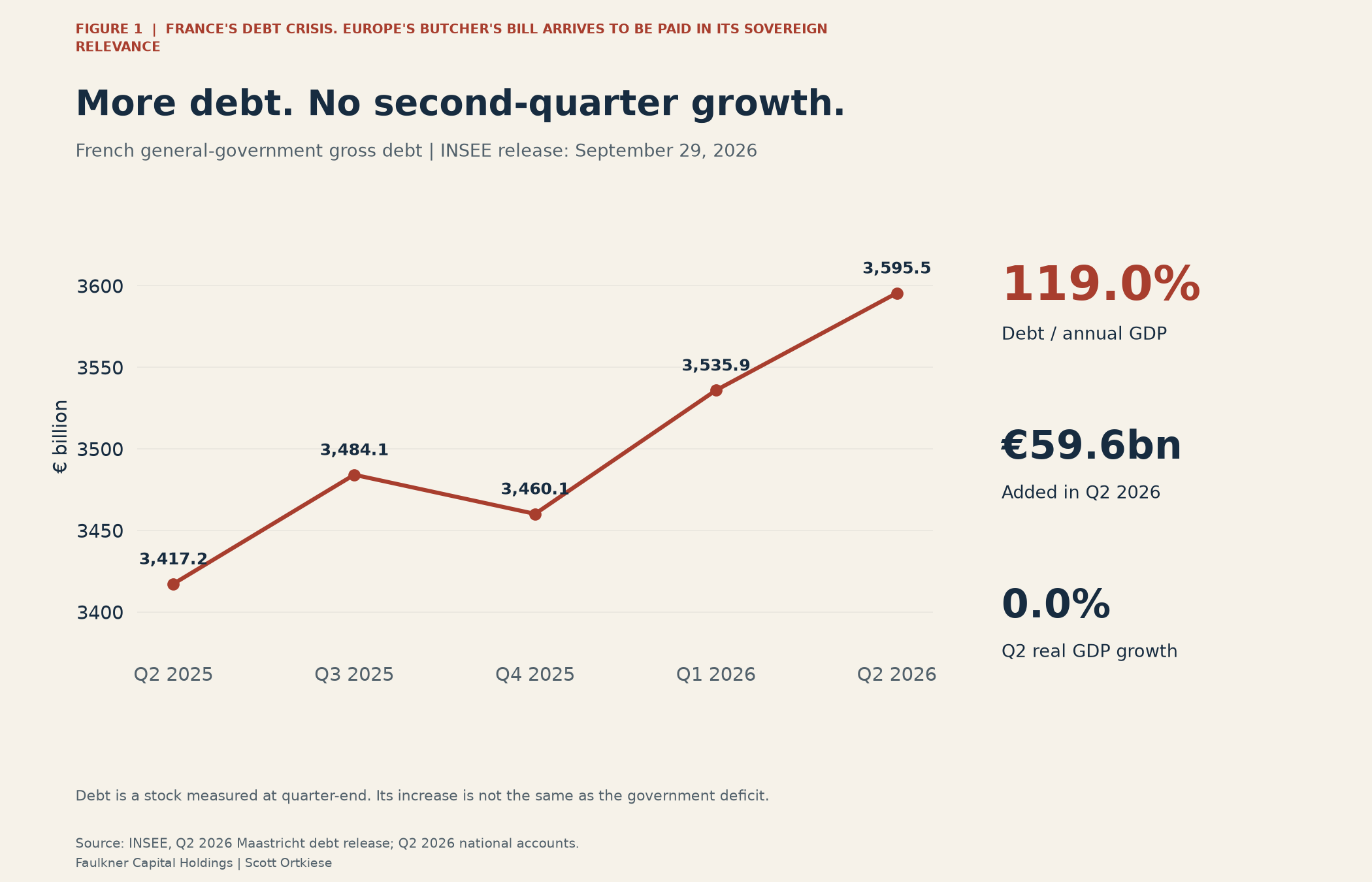
Caption: French debt reached €3,595.5 billion at the end of June, with the debt ratio at 119.0% of GDP (INSEE). The debt series uses a single September data vintage. The separate growth figure measures real GDP, not the nominal GDP denominator of the debt ratio (INSEE national accounts).
Bloomberg’s market discussions identify the distinction that matters: a global bond selloff found particularly combustible ground in France. Political paralysis, deficit doubts and forced position reductions intensified the French move. Their accounts also describe investors seeking safety in German bonds while French bonds fell. Contagion does not require every bond yield to rise together.
By October 7, Bank of France Governor Emmanuel Moulin described the situation as serious but rejected an immediate ECB rescue: “the solution is here at home” (Reuters via RTÉ). His point was that France needed a budget, not that the central bank had permanently abandoned it (RTÉ). That is the political weakness behind the market price: creditors want decisions that a fractured government struggles to deliver.
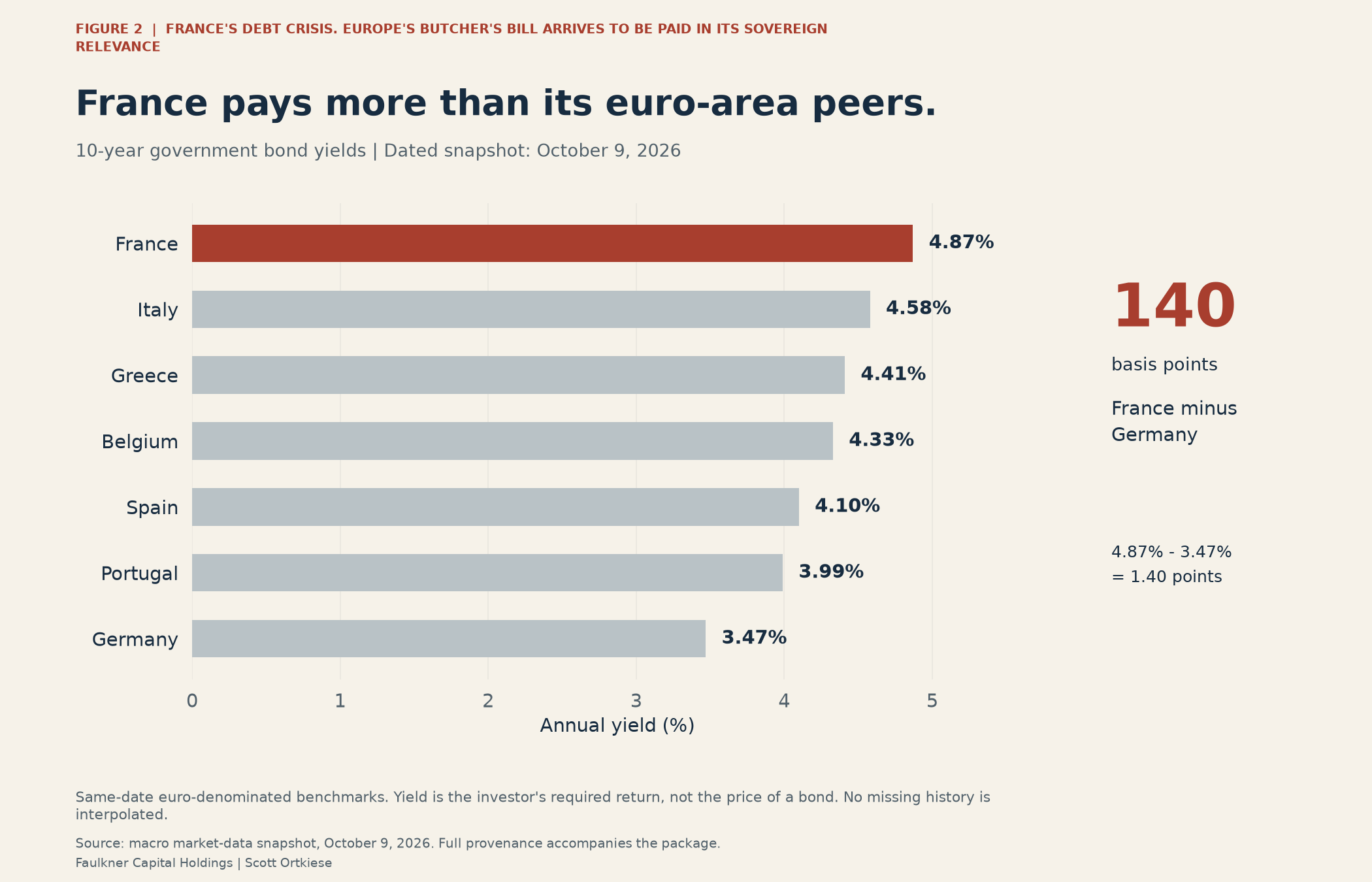
Caption: October 9 benchmark yields were France 4.87%, Italy 4.58%, Greece 4.41%, Belgium 4.33%, Spain 4.10%, Portugal 3.99% and Germany 3.47%. France’s premium over Germany was 140 basis points. These are comparable dated snapshots, not a reconstructed historical series.
Europe’s weaknesses are connected, not identical
The comparable first-quarter figures put government debt at 143.5% of GDP in Greece, 138.9% in Italy, 117.6% in France, 109.1% in Belgium and 101.6% in Spain; Germany stood at 64.4% (Eurostat, July release). France, Italy, Spain and Belgium together carried €9.14 trillion of government debt, calculated by adding the country totals in that release (Eurostat). This is not a small peripheral borrower threatening an otherwise unburdened system.
Italy and Greece have heavier debt burdens than France, but debt ratios alone do not rank imminent failure. Greece’s ratio fell 9.4 percentage points over the preceding year, while France’s rose 4.0 points; Spain also improved (Eurostat). Repayment schedules, growth, creditors and interest terms determine how quickly a large debt becomes a cash problem.
Fiscal flows also differ. France’s seasonally adjusted first-quarter deficit was 5.1% of GDP, Belgium’s 4.8%, Germany’s 3.6% and Spain’s 1.9%, while Greece recorded a 1.2% surplus (Eurostat fiscal balances). Germany is not France with a different flag. Nor does its lower debt ratio insulate German banks, exporters or taxpayers from a European contraction.
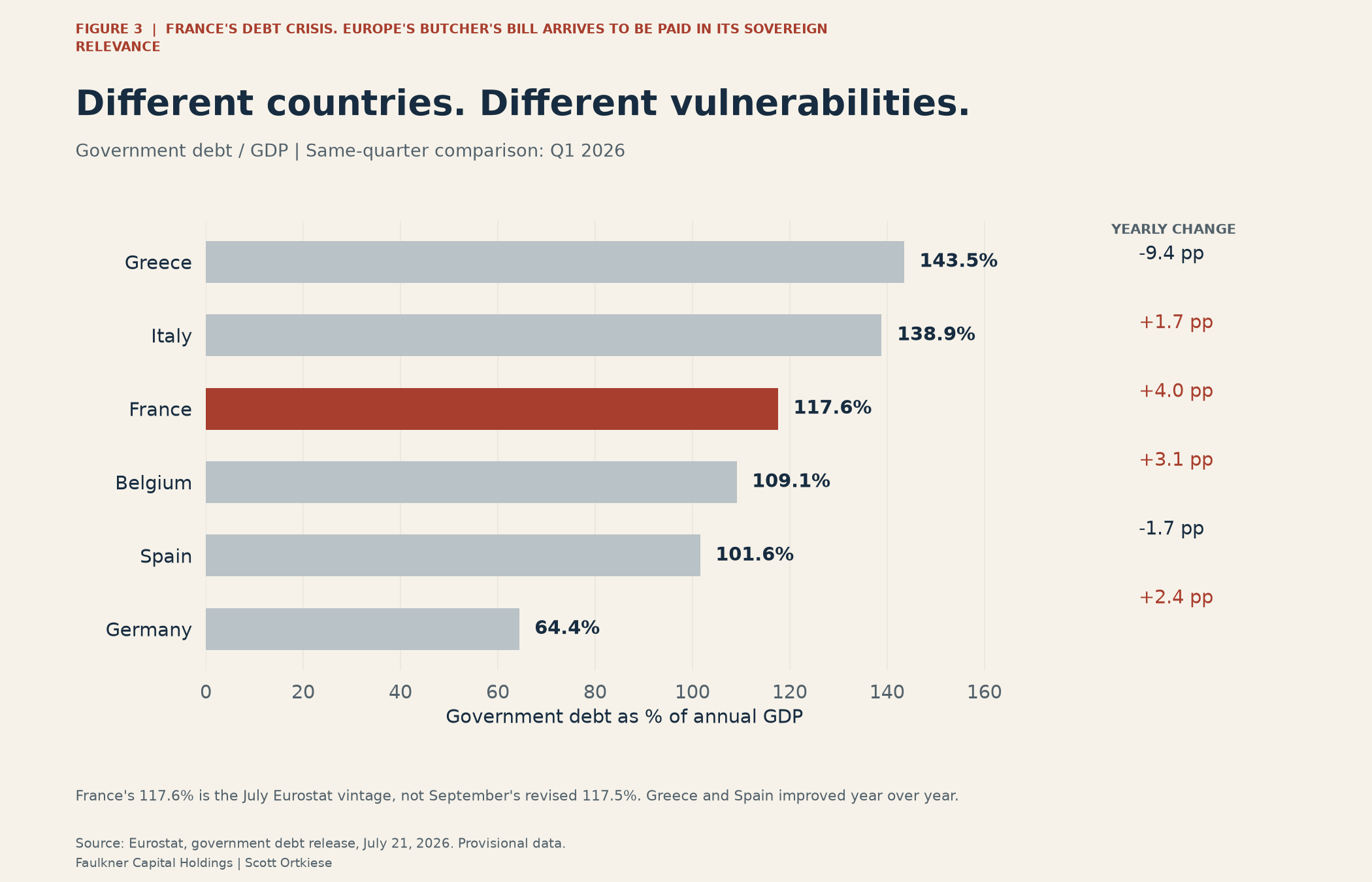
Caption: This comparison holds the quarter and publication vintage constant (Eurostat). France’s first-quarter ratio was subsequently revised to 117.5% in the September national release (INSEE). High debt, deteriorating debt and expensive new borrowing are related problems, not interchangeable measurements.
Europe’s danger is precisely this mixture. Some governments have little fiscal room. Some banks carry substantial sovereign exposure. Some businesses depend on financing and demand across borders. Investors can sell the weakest exposure first, then reduce other positions to raise cash. National differences shape the path of contagion; they do not erect financial firewalls (Bundesbank).
How a bond loses money without defaulting
Consider a hypothetical €1,000 bond that pays €20 a year and returns €1,000 in 10 years. When investors require a 2% annual return, it is worth €1,000. If they require 6%, the old €20 payment is no longer competitive. The price must fall until buying those unchanged payments produces the higher required return.
At 6%, the 10 future interest payments have a present value of €147.2017. The final €1,000 repayment has a present value of €558.3948. Together they are worth €705.5965, rounded to €705.60. Present value simply means what money arriving later is worth to an investor today.
The loss is then straightforward: €1,000 minus €705.60 equals €294.40. Divide €294.40 by the original €1,000 and the price loss is 29.44%. No payment was missed. No default was required.
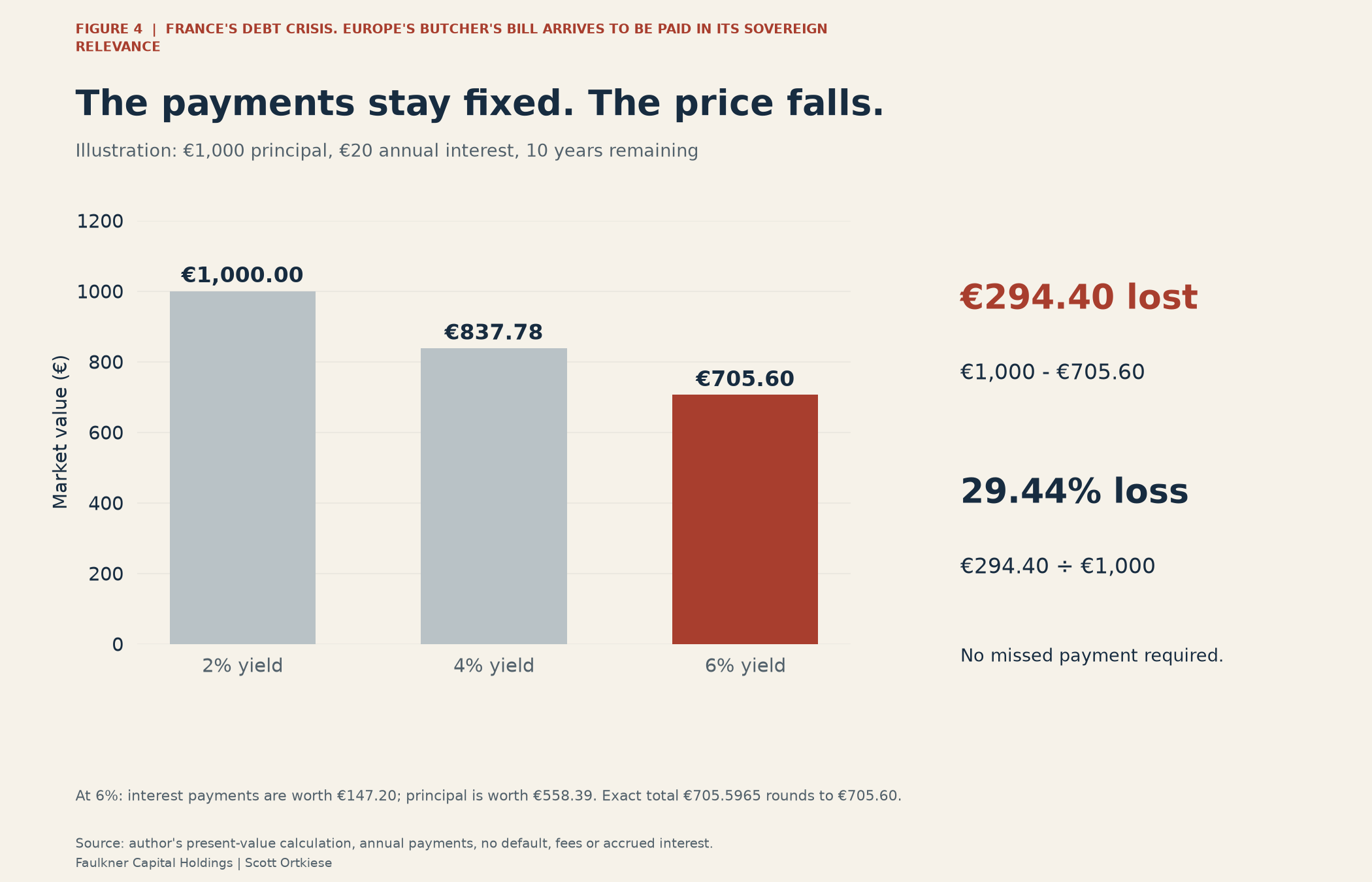
Caption: The hypothetical bond is worth €1,000 at a 2% required yield, €837.78 at 4%, and €705.60 at 6%. Each value discounts the same annual payments and final principal repayment. This is an illustration, not a measured loss on France’s entire debt stock.
A holder able to retain the bond until repayment faces a different problem from a leveraged fund forced to sell it today. The first can continue collecting the promised cash, provided the issuer pays. The second realizes the lower market value immediately. The banking danger begins when institutions that planned to wait are compelled to find cash (Morningstar DBRS).
The government’s interest bill catches up
Existing fixed-rate debt does not all reset when the benchmark yield rises. Higher borrowing costs reach the budget as debt matures and is replaced, new deficits require financing, and inflation-linked obligations adjust (French budget dossier). That delay is not immunity. It is the schedule on which the bill arrives.
France’s own budget documents estimate that a 1-percentage-point interest-rate shock adds about €3 billion to the State’s charge in the year of the shock, €8 billion the following year and €12 billion in the second following year (French budget dossier). These are annual impacts in successive years, not amounts to add together and call the first-year cost.
The proposed budget projects broader public interest charges rising from €79.2 billion in 2026 to €91.2 billion in 2027: an extra €12 billion, or 15.2% (French budget dossier). The separate State-only charge, including assumed SNCF debt, is forecast at €72.93 billion in 2027 (French budget dossier). Mixing those scopes produces dramatic but false comparisons.
The government projects a deficit reduction from 5.4% of GDP in 2026 to 5.0% in 2027, yet debt still rises from 119.3% to 121.7% of GDP in its own forecast (French budget dossier). Even its proposed adjustment does not stabilize the debt ratio.
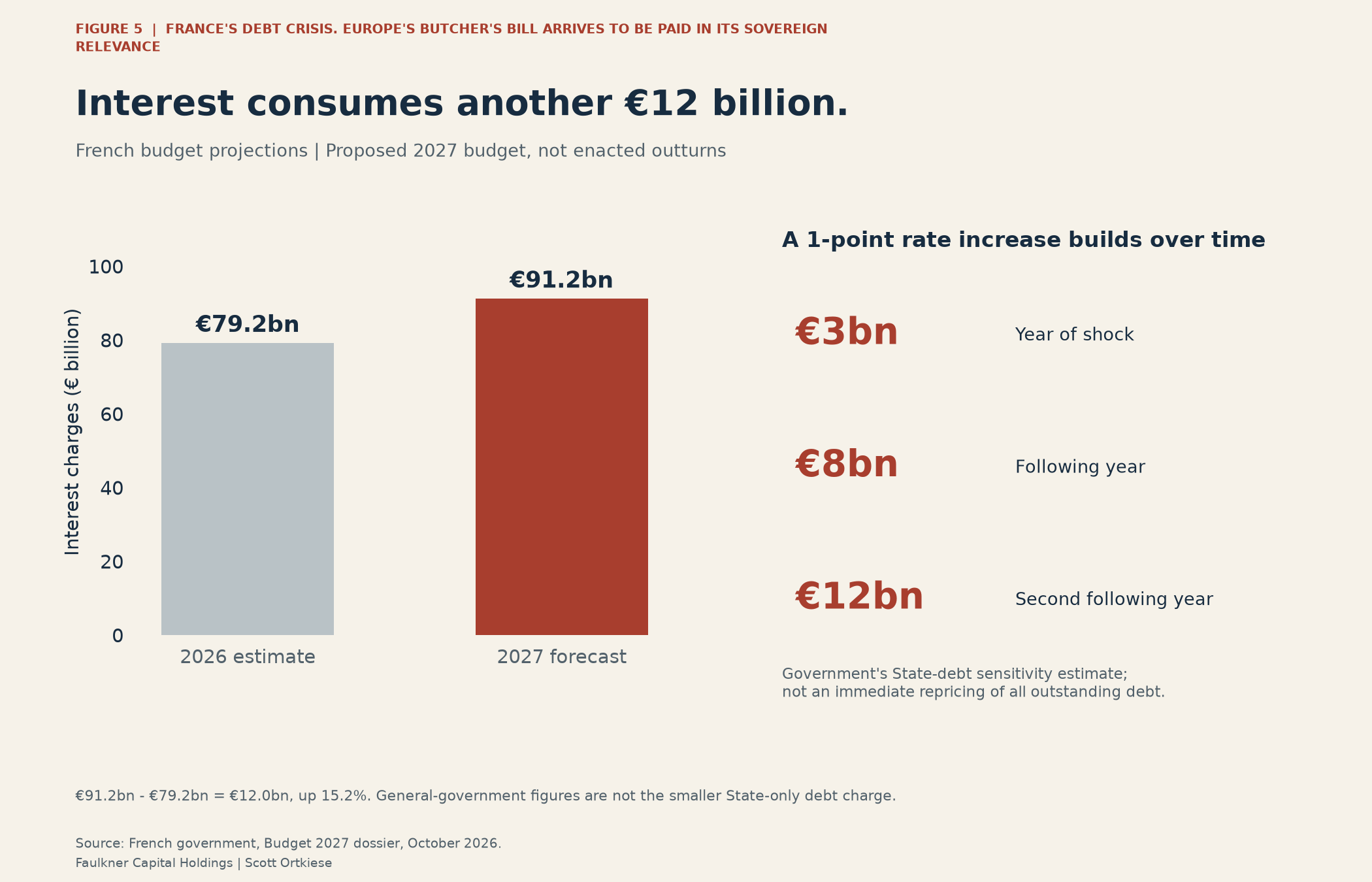
Caption: The bars show government projections, not final expenditure (French budget dossier). The separate sensitivity calculation explains how higher interest rates reach the State’s budget gradually. Neither calculation assumes the entire outstanding debt reprices overnight.
The domestic consequence is explicit in the budget: spending excluding debt charges is projected to be flat in real terms, and negative after also excluding defense (French budget dossier). Creditors and defense absorb room that other services must fight to retain. That is a measurable squeeze, not a slogan about abstract “resource costs.”
The banks carry the government, then the government carries the banks
European banks held €4.54 trillion in sovereign exposure by June 2026, compared with €3.14 trillion in December 2022, according to Marcos Alvarez and Ricardo Sanz-Ramos of Morningstar DBRS (DBRS). Their exposure equaled 264% of Common Equity Tier 1 capital, the highest-quality shareholder capital available to absorb losses (DBRS). Put plainly, €2.64 of sovereign exposure stood against each €1 of that capital (DBRS).
The ratios reached 367% in Portugal, 361% in Italy and 342% in Spain; Germany stood at 215% (DBRS). These are exposures, not losses. But their scale explains why modest portfolio damage can matter greatly to the much smaller pool of equity.
As a deliberately simplified illustration, a 10% economic loss on exposure equal to 264% of capital consumes 26.4% of that capital before hedges, taxes or accounting treatment. Multiply 0.10 by 2.64 to get 0.264. This is not a forecast that every sovereign holding will lose 10%.
The Bundesbank supplies a more structured test. Its September study modeled a 200-basis-point sovereign risk-premium shock and reported average CET1 capital-ratio declines of 1.8 percentage points for Italian banks, 0.8 for German banks and 0.3 for French banks (Bundesbank). A 0.3-point decline would take an illustrative 15.0% ratio to 14.7%, not wipe out the bank.
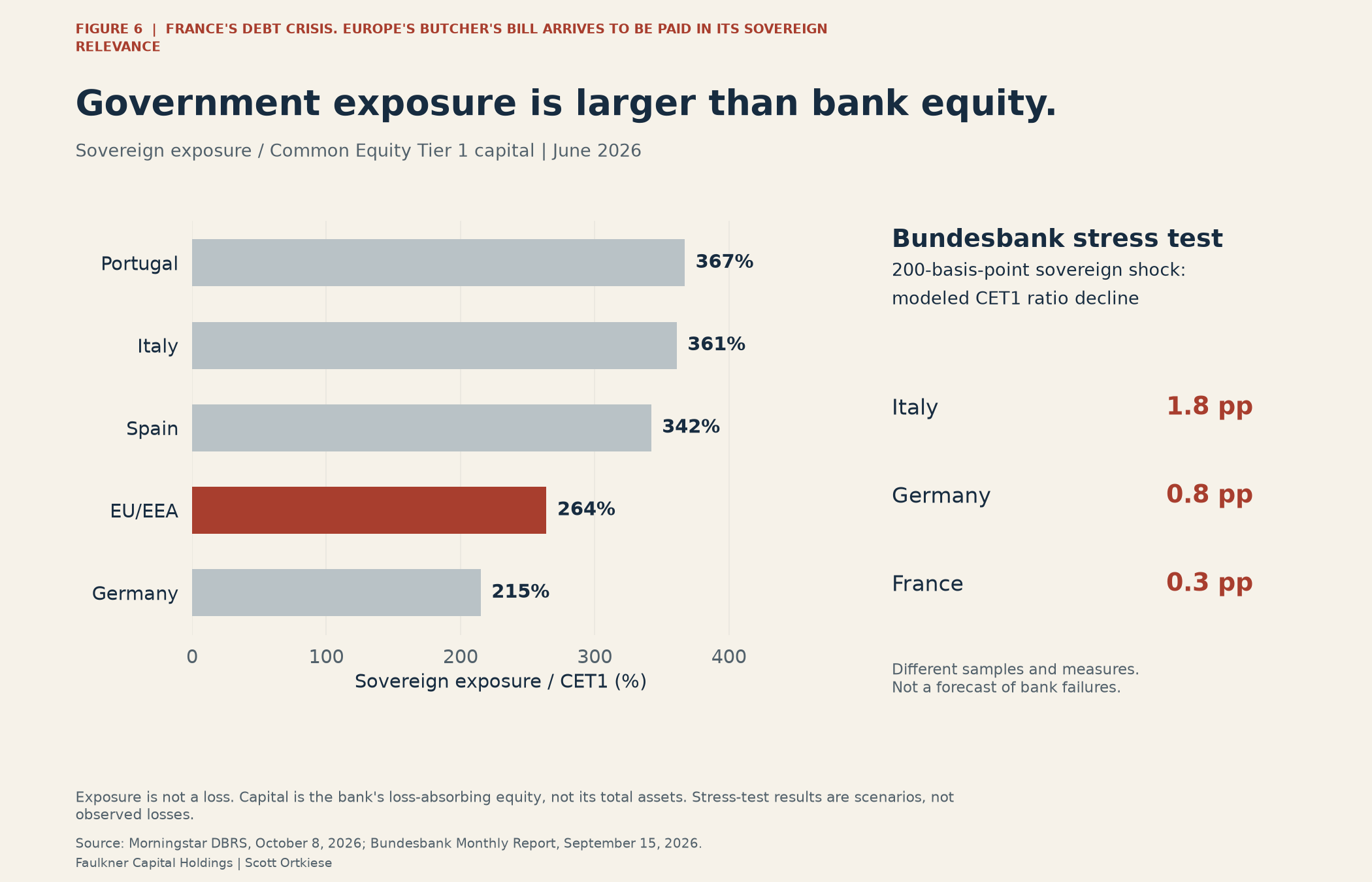
Caption: The exposure ratios and the stress-test results answer different questions and use different samples (DBRS, Bundesbank). Neither is a tally of realized losses. Together they show why portfolio composition and capital matter more than indiscriminate claims that every bank is already insolvent.
The soothing word is “manageable.” Manageable for whom? DBRS judges the expected banking impact manageable because balance sheets, earnings, supervision and domestic diversification have improved (DBRS). That is an assessment of banks’ capacity to withstand stress. It is not a finding that the policies producing additional strain are competent, affordable or harmless to the public.
DBRS reports that 59% of sovereign exposure is held at amortized cost, keeping ordinary market-price movements from immediately flowing through the accounts (DBRS). The accounting treatment does not restore the bonds’ market value or supply cash when a holder must sell. A loss absent from today’s earnings statement is not necessarily an economic loss that has disappeared.
French banks’ shorter maturity profile also provides genuine protection: about a third of their sovereign exposure matures within a year (DBRS). But the government still has to repay those obligations, refinance them or find the cash elsewhere. What protects a bank as its bond matures can expose the taxpayer to the cost of replacement borrowing.
Treating banks’ ability to absorb damage as an excuse for inflicting it is a defense of gross negligence, not sound government. A bank can survive by refusing credit that a business needs. A government can keep paying its creditors while squeezing public services. Institutional survival and public welfare are not the same outcome.
The defenses matter; they are not absolution. My systemic forecast is that sustained funding pressure, forced sales and borrower losses will reinforce one another and exhaust protection where it is weakest. Calling each exposure manageable in isolation does not establish that their combined demands on cash and capital are manageable.
The hidden route through funds and insurers
A July BIS working paper by Stefan Avdjiev, Bryan Hardy and Maximilian Jager finds that the traditional connection between governments and banks has broadened to include nonbank financial institutions (BIS). Banks’ exposures to financial institutions have become more important in explaining why bank risk moves with sovereign risk, while direct sovereign holdings explain less than before (BIS). Moving a bond outside a bank does not necessarily move its risk outside the banking system.
The mechanism is concrete. A leveraged fund borrows against government bonds. When collateral falls in value, its lender demands more security or less borrowing. The fund sells assets or withdraws bank deposits to find cash. The bank faces pressure from the borrower it financed and the deposits it loses (BIS).
Cross-border holdings extend the chain: DBRS reports that 33% of banks’ aggregate sovereign exposure involved other EU or European Economic Area governments (DBRS). Losses and cash demands do not stop at the French border.
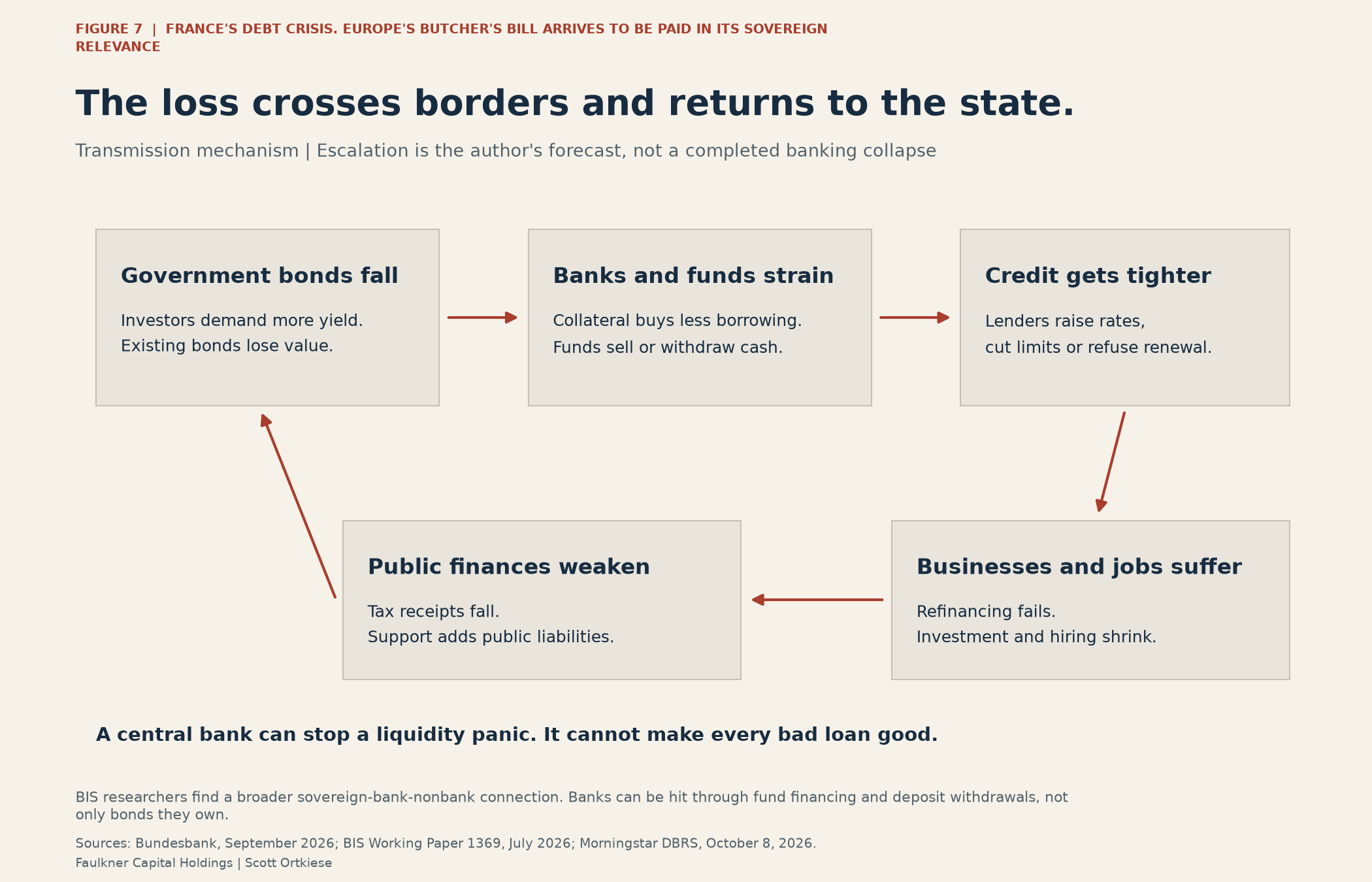
Caption: Sovereign losses, funding pressure and tighter lending can reinforce one another through banks and nonbanks (BIS, Bundesbank). The full escalation shown is the author’s forecast. It is not evidence that every stage has already occurred.
This extends the mechanism in Credit Breaks. AI Falls.: financing fails before promoters abandon their promises. Lenders preserve cash, refuse renewals and demand stronger collateral. Borrowers postpone investment or default. Governments collect less tax and face demands for support.
The ECB can intervene against disorderly market conditions, but its Transmission Protection Instrument is not an unconditional guarantee of every government’s finances; eligibility includes fiscal sustainability and sound policies, and activation remains discretionary (ECB). A central bank can stop a panic. It cannot repair an uncompetitive factory, refill an empty order book or make a bad investment profitable simply by buying bonds.
Energy policy reaches the factory, the kitchen and the data center
Europe’s energy disadvantage predates this week. European Commission material records industrial electricity prices in the second quarter of 2024 at 2.2 times the U.S. level and twice China’s level (European Commission). Those are dated comparisons, not a claim that every European factory pays the same tariff today. They show the cost disadvantage an industrial strategy must overcome.
The same document identifies major electricity-grid investment needs and states that inadequate infrastructure raises citizens’ bills and obstructs strategic industries (European Commission). A government promising sovereign AI while neglecting affordable power has the investment order backward.
Europe’s energy separation from Russia is also incomplete. Urgewald’s October 9 analysis of Kpler cargo data records 12.18 million tonnes of Yamal LNG delivered to EU ports from January through September, 9.5% more than a year earlier (Urgewald). It estimates the gross value at €7.88 billion using monthly European gas benchmarks, not verified contract invoices or Russian state revenue (Urgewald methodology).
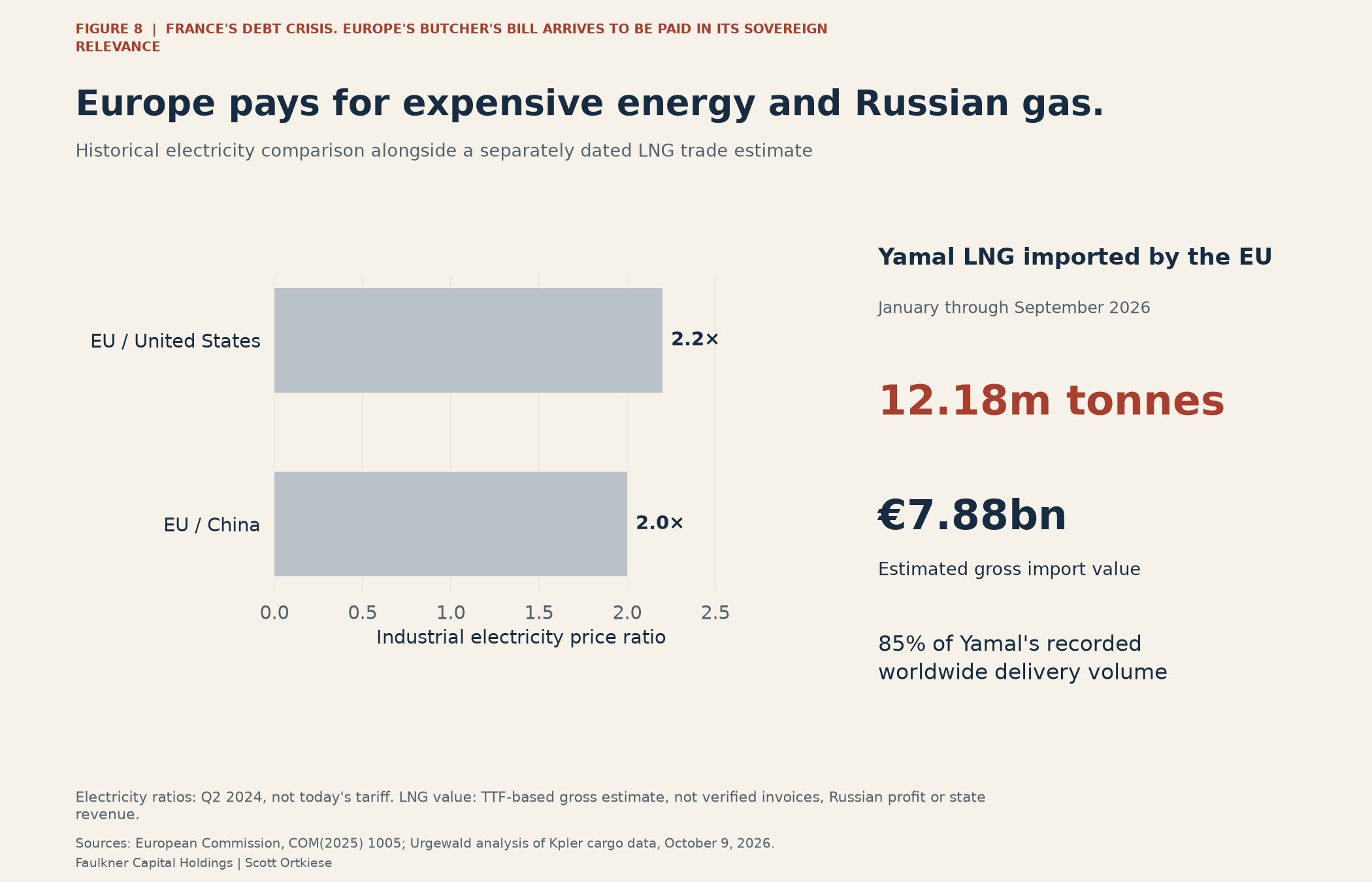
Caption: The electricity comparison and LNG trade figures concern different periods and different markets (European Commission, Urgewald). Urgewald estimates that the EU received 85% of Yamal’s recorded delivery volume during the first 9 months of 2026 (Urgewald). Neither set of figures proves that sanctions alone caused Europe’s entire energy-price problem.
That relationship cuts both ways. Europe still buys Russian energy, and Yamal still depends heavily on European buyers and specialized shipping (Urgewald). Russia’s bargaining power does not make it costless to lose Europe. Europe’s purchasing power does not make Russian supply instantly replaceable at the same cost.
The political failure is pretending these trade-offs disappear when the language becomes sufficiently righteous. Energy policy must answer what replaces the supply, at what price, on what timetable, and who pays during the transition.
Count the war bill honestly
The financial case against an open-ended policy becomes stronger when its accounting is accurate. Kiel’s October 8 examination of Germany’s €100 billion Ukraine-support headline divides it into about €41.7 billion of bilateral support, €35.9 billion of domestic costs and guarantees, and €22 billion of future military commitments (Kiel Institute). Those rounded categories total €99.6 billion, not an exact reconciliation of the headline.
Even the bilateral category is not a clean cash-delivery total: Kiel includes €11.6 billion appropriated for 2026 while stating that the amount already disbursed was unknown (Kiel Institute). An appropriation authorizes spending. A commitment promises spending. A delivered weapon, a refugee benefit and a corporate guarantee are different obligations.
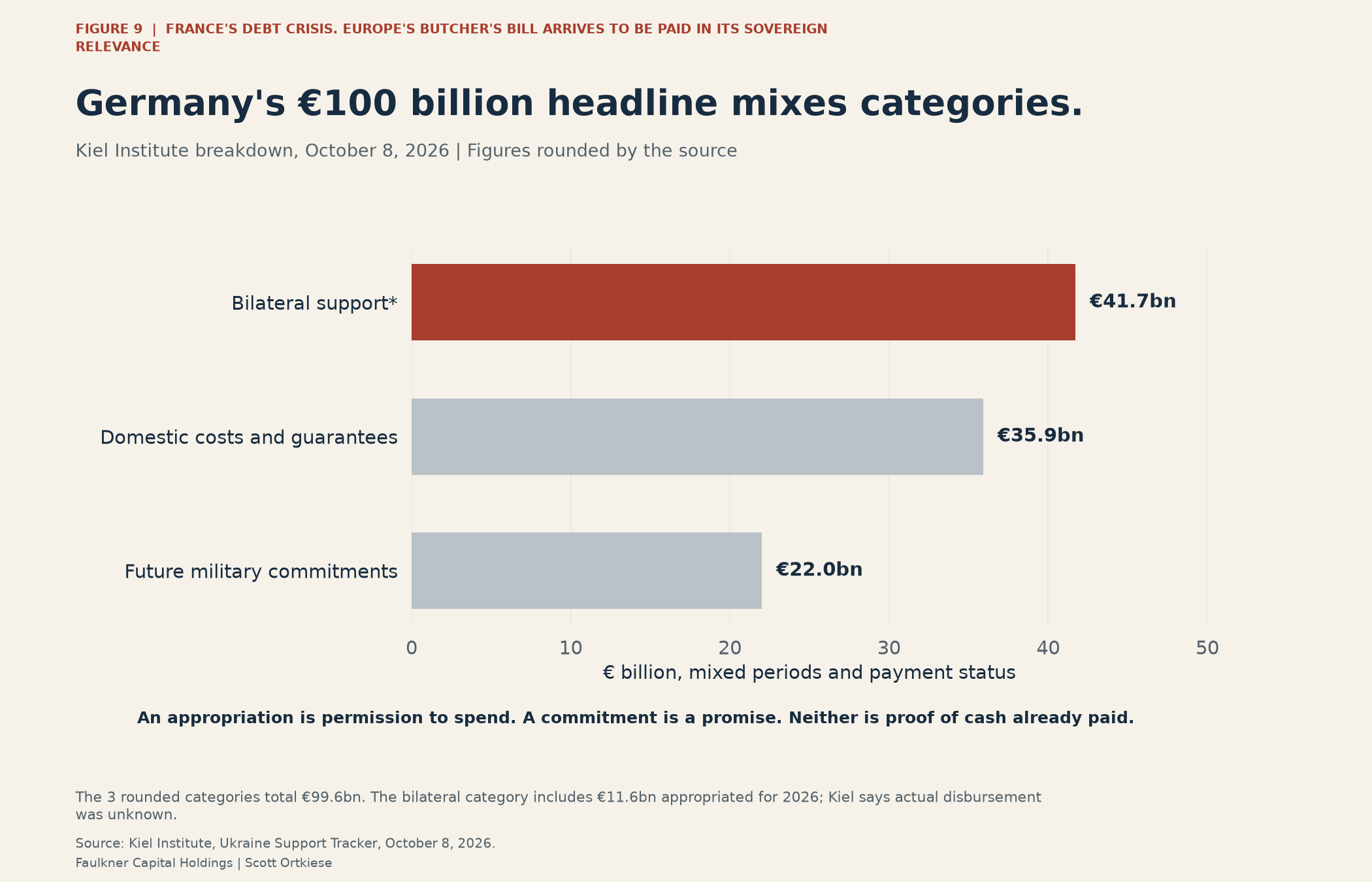
Caption: Kiel’s breakdown separates bilateral support, domestic expenditure and guarantees, and future commitments (Kiel Institute). The domestic category largely concerns Ukrainians living in Germany, not a transfer to Kyiv (Kiel Institute). The remaining difference is not evidence of stolen money.
The opportunity cost remains. Taxpayers fund these choices through taxes, borrowing or spending forgone elsewhere. That does not mean each euro of aid can be assigned to a specific closed classroom. It means leaders owe citizens an explicit comparison between the expected security benefit and the domestic alternatives.
Ukraine’s own destruction is enormous. The joint World Bank, Ukrainian government, European Commission and United Nations assessment puts reconstruction and recovery needs at almost $588 billion over a decade, based on damage through December 2025, with direct damage above $195 billion (World Bank). Reconstruction needs are not the same as aid already spent, and they are not automatically an EU liability. They are the scale of the devastation that any claim of strategic success must confront.
The standard justification for continued aid is that resisting Russia prevents a still larger future security cost. That claim does not excuse an undefined objective or an unlimited bill. Its advocates must identify the outcome they can achieve, the forces and money required, and the conditions under which negotiation becomes preferable. Otherwise, “security” becomes a demand that citizens keep paying so their leaders never have to admit a strategic failure.
Trump buys fuel. Putin gains room.
On October 9, OFAC issued General License 135, authorizing specified transactions involving Russian-origin diesel, including importation into the United States, through 12:01 a.m. Eastern Daylight Time on April 7, 2027 (OFAC). It is not a repeal of all Russian sanctions. Its text also excludes certain debits to Russian sovereign accounts at U.S. financial institutions (OFAC).
Trump announced more than 300,000 tonnes immediately, another 500,000 in November, 1 million thereafter, and additional supply later; the reporting did not establish who would pay or when the announced fuel would reach buyers (Associated Press). A license permits commerce. It does not produce diesel, load a vessel, deliver a cargo or collect payment.
Military Summary’s October 10 assessment makes the physical constraint unavoidable: it discusses refinery attacks, storage damage and continuing strikes while describing the deal. Its interpretation is that damage to Russian refining capacity affects both export performance and bargaining incentives. The account itself describes an ongoing war, not a completed peace settlement.
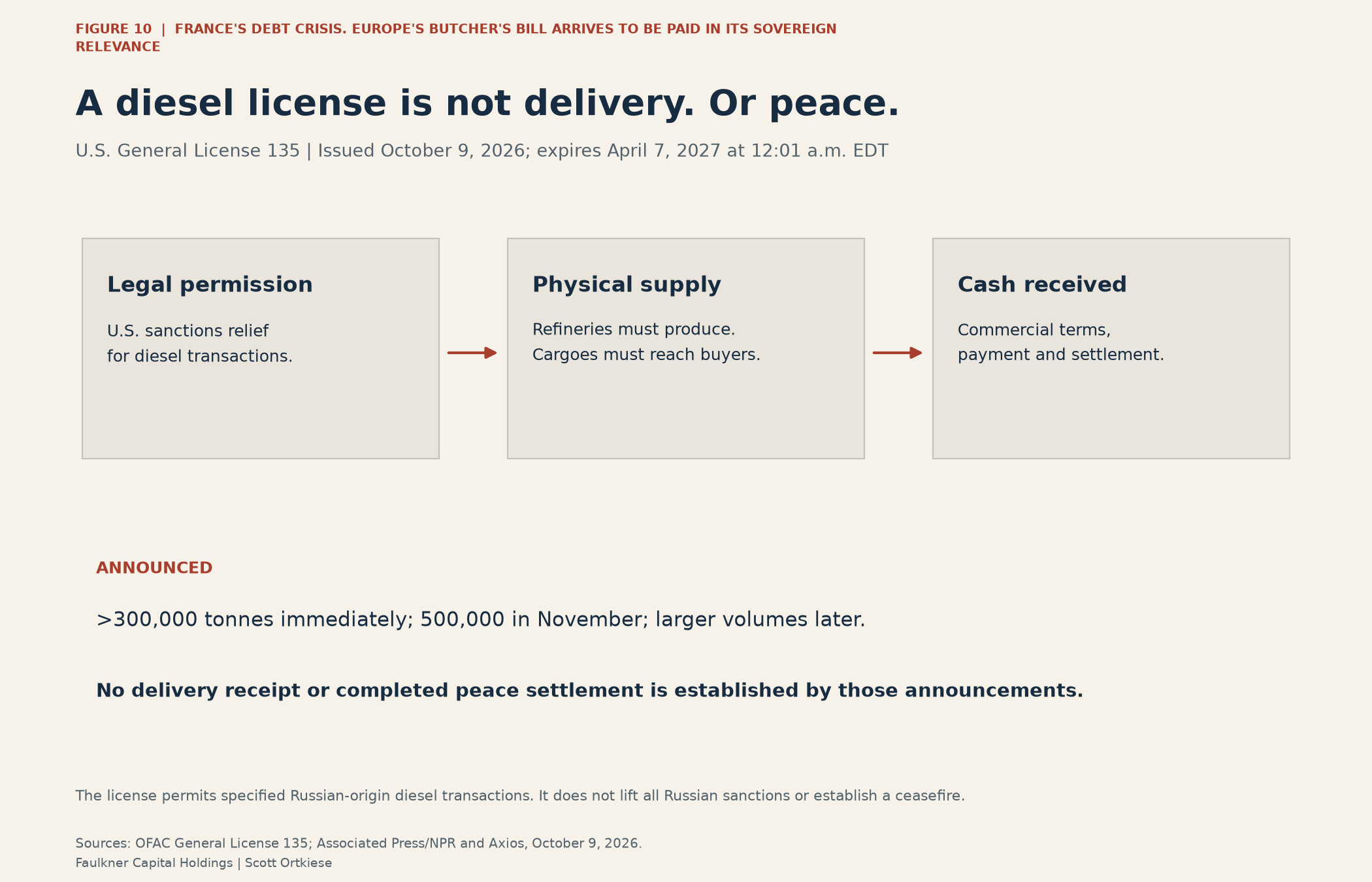
Caption: Legal authorization, physical supply and payment are separate stages (OFAC, Associated Press). The announcement did not establish an energy ceasefire or a final peace agreement (Axios). Russia’s commercial gain depends on actual performance, not the headline volume alone.
Trump’s incentive is not mysterious. The announcement came amid high fuel prices and approaching U.S. midterm elections; he declared lower prices for Americans his priority (Associated Press). Reporting also identifies the U.S.-Israeli war with Iran as the principal disruption to global energy supply, despite Trump blaming Ukrainian refinery attacks (AFP).
My judgment is that Trump is bargaining under pressure created partly by his own policies. He is not absolved because he finally discovers that Russian energy has value. Putin gains an opening because Washington wants something Russia can supply.
Europe attends the meeting and loses control of the decision
European governments were not literally absent from diplomacy. Germany, France, Britain, the European Commission and NATO were represented alongside Ukrainian and U.S. officials in the Miami talks when Trump announced the diesel bargain (Axios, AFP). The more damaging fact is that their presence did not prevent Washington from pursuing a separate commercial accommodation with Moscow.
Zelensky said the decision was “not fair and not honest,” while acknowledging, “We need the Americans” (Axios). That is dependency expressed without diplomatic varnish. The patron chooses its immediate interest; the dependent partner protests.
Germany responded on October 10 that it remained committed to sanctions and further pressure, while also saying diplomatic efforts continued (Deutsche Welle). The policy divergence is plain. Washington opens a licensed diesel channel; Berlin defends the sanctions course.
EU foreign-policy chief Kaja Kallas answered the diesel decision just as directly: “This is not the time to ease pressure on Russia, and Europe won’t” (European Pravda). Her stated concern is that diesel sales give Moscow more revenue to wage war (European Pravda). That is a coherent objection to Trump’s decision. It is not an explanation of how Europe will achieve its own objectives after Washington changes course.
This is not a completed peace settlement. It is a separate bargain pursued while peace negotiations continue (Axios). Europe helps finance the conflict, bears major economic consequences, and cannot ensure that its principal ally maintains the policy on which European leaders have based their strategy.
Russia’s wider diplomatic relationships also matter. China’s Foreign Ministry reaffirmed “comprehensive strategic coordination” with Russia on September 30, while October reporting described Putin’s meeting with Iran’s Masoud Pezeshkian and their continuing strategic partnership (Chinese Foreign Ministry, Xinhua). These are distinct partnerships, not proof of a single formal China-Russia-Iran alliance.
My reading is that Russia’s ascent rests on preserving useful relationships and bargaining options despite Western pressure. Trump’s reversals accelerate that process: adversaries see both the threat of U.S. coercion and the opportunity to bargain around it. Europe risks the worst position, accepting the economic cost of confrontation without controlling either escalation or accommodation.
The horse could not run the race its sponsors advertised
Europe backed a horse with a bleeding compound fracture at the starting line. It could not stand under the geopolitical and economic weight its sponsors placed on it, much less run the race they advertised. Yet European leaders and their neoconservative and Atlanticist allies fired the starting gun. They mistook their determination to defeat Russia for the means to achieve it.
That metaphor indicts the sponsors’ strategy, not Ukrainians defending their homes. Courage is not an industrial base. Sacrifice is not a replacement for manpower, finance, energy or a negotiated endgame.
My indictment includes Trump, Biden, Victoria Nuland, Boris Johnson and the neoconservative and Atlanticist establishment, alongside Zelensky and Europe’s political leadership. Their responsibilities differ, and their decisions occurred at different times. Trump had no role in the Istanbul negotiations of 2022.
Those talks produced a serious framework, not a finished peace treaty. Samuel Charap and Sergey Radchenko’s documentary reconstruction describes proposals for Ukrainian neutrality and security guarantees, alongside unresolved military limits, territory and the obligations of outside guarantors (Foreign Affairs). They identify Western reluctance, Ukrainian battlefield optimism, atrocities and unresolved terms among the reasons the process failed; they do not establish that Boris Johnson alone destroyed a completed agreement (Foreign Affairs).
That record still supports a severe criticism: military backing was strengthened while the diplomatic framework failed to acquire the guarantees and commitments needed to work (Foreign Affairs). The opportunity was real. Its successful conclusion was not guaranteed.
My charge against Kaja Kallas, Mark Rutte, Friedrich Merz, Ursula von der Leyen and the wider policy establishment is that hostility toward Russia displaced a disciplined account of attainable objectives and acceptable costs. No slogan about resolve answers what victory means or what Europeans must surrender to finance it. No demand for continued sacrifice substitutes for a strategy.
Now comes the economic butcher’s bill. Europeans are being served the horse they were told would win and charged for the privilege. Their schools, homes, factories, power systems and public finances belong in the calculation, not at the back of the queue.
AI sovereignty cannot be financed with another fantasy
This is where the financial and geopolitical arguments meet Europe’s AI ambitions. Sovereignty must mean an ability to operate critical services on acceptable terms, protect data, change suppliers and pursue national interests without another government’s permission. European ownership of an expensive building does not establish any of those rights by itself.
The investment decision is not simply whether Europe should build data centers. It is whether to use existing capacity, acquire operating assets, upgrade equipment, lease services or construct new facilities. Each choice has a different price, execution risk and claim on scarce power and capital.
Man Group’s Albert Chu makes a useful distinction on Bloomberg’s The Opening Trade: existing infrastructure produces cash now, while new construction commits money before the asset earns. Rising replacement costs can strengthen the value of an operating asset without making every proposed project economical. That distinction belongs at the center of an AI strategy.
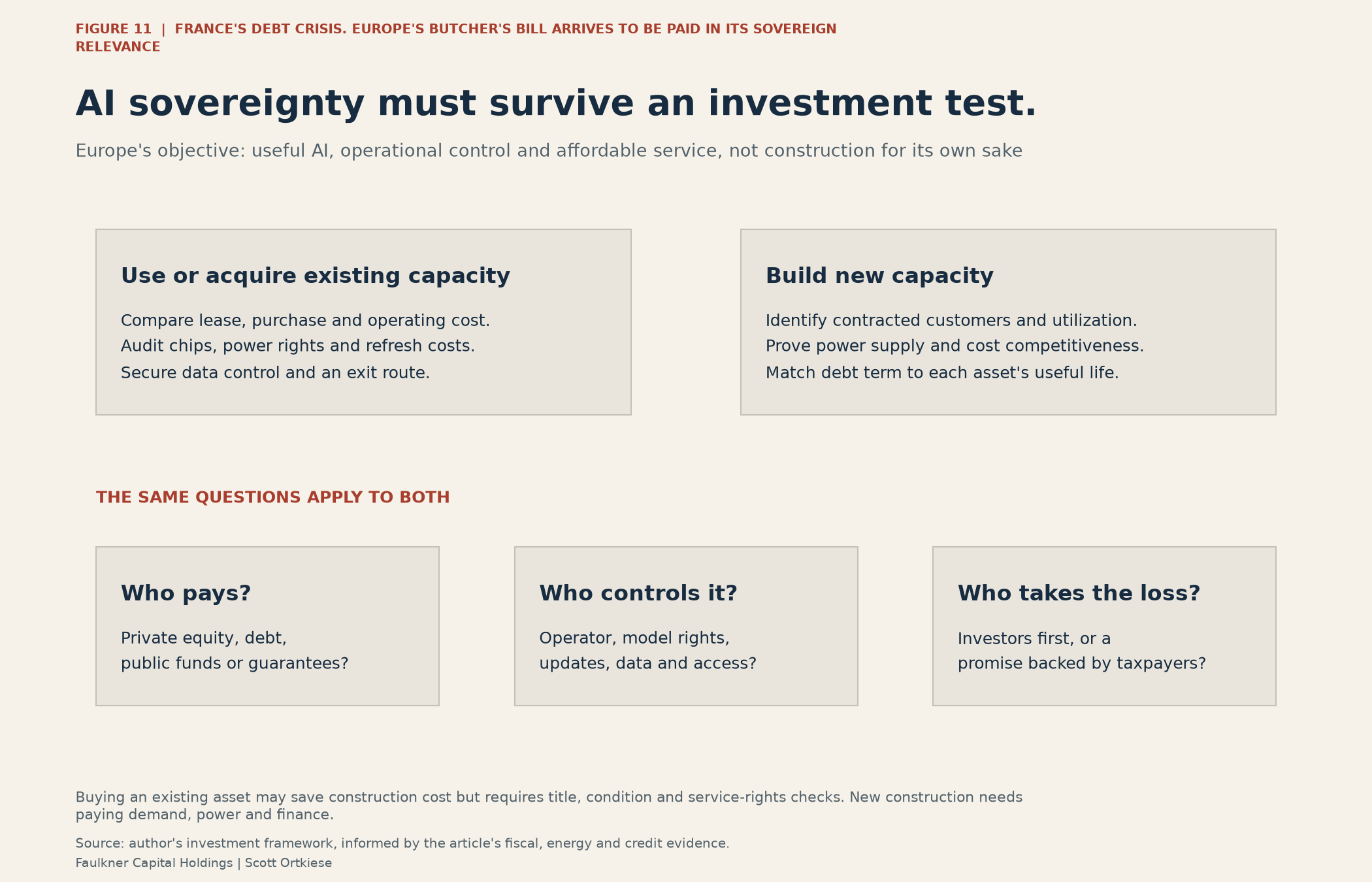
Caption: This is the author’s decision framework, not a cost estimate. Existing assets and new construction must both be tested for demand, power, operating rights, financing and loss allocation. A public guarantee transfers risk to taxpayers even when a private company owns the facility.
The best objective is useful AI at competitive cost with enforceable operational control. The wrong objective is copying the American hyperscaler spending race and calling the resulting debt European independence.
China belongs in the comparison as a technology and development partner, not as a replacement patron. Open-weight models offer a route to operating a chosen model on controlled infrastructure rather than relying exclusively on a remote proprietary service; that is the alternative developed in America’s AI Blunder Is Europe’s Lesson. Open weights do not supply free electricity, guarantee secure software or eliminate the need for computing equipment. The procurement test must include licensing, security review, maintenance, hardware compatibility and the right to keep operating if the supplier relationship ends.
Europe’s customers have bargaining power. That power should purchase performance, access and an exit, not another supplier’s control over the next investment round. Data centers are justified where real demand, suitable power and sound financing justify them. They are not justified merely because politicians need a monument to sovereignty.
Government support does not make a weak project strong. It changes who loses. A state already paying more to service its debts should not guarantee speculative AI revenue without explaining why taxpayers should underwrite that risk rather than finance the energy, education and infrastructure on which the wider economy depends.
What turns the warning into a crisis
The forecast must survive observable tests. Watch whether French funding stress persists, whether other sovereign spreads widen, whether funds face cash demands, whether banks tighten lending, and whether governments’ interest projections keep deteriorating. The dangerous combination is forced selling and unavailable refinancing, not a frightening debt ratio in isolation.
The opposing outcome is also identifiable. A credible budget, stable funding, adequate bank capital, lower energy pressure and actual productive investment would interrupt the chain. A forecast that cannot acknowledge those conditions is propaganda.
My conclusion remains severe. Europe is financing ambitions that its fiscal position, energy economics and political machinery do not support. France is the clearest warning, not the only vulnerable balance sheet. The U.S.-Russian diesel bargain is the diplomatic demonstration of the same failure: Europe commits the money, then discovers that others can change the terms.
Europe does not need another declaration of sovereignty. It needs an achievable objective, an affordable bill, operational independence and leaders willing to negotiate. Instead, political reputations are defended with public money, while mounting obligations narrow the public’s choices.
The butcher’s bill is not payable only in euros. It is payable in factories that cannot compete, public services squeezed by creditors, technology controlled elsewhere and diplomatic decisions Europe cannot command. Trump and Putin’s bargain shows what that loss of relevance looks like in practice. Leaders defend their positions. The people lose the means to determine their future.