

The Treasury Secretary drafted it. His own chief information officer worked against it from the inside. Zuckerberg, Musk, and David Sacks phoned it dead. Two Oval Office signing ceremonies were called off, and then the President of the United States, patched through a speakerphone at a venture capital party, told the head of the world’s most valuable chipmaker that human extinction is a hoax. What follows is the bill for that decision, itemized.
Scott Ortkiese | Throughline Synthesis | Houston, September 16, 2026
Two Ceremonies, Both Called Off
Begin with the fact that ruins the official story.
The official story, repeated by the White House and by every trade association it funds, is that nobody knows how to regulate artificial intelligence, that any rule would hand the future to Beijing, and that the men building these systems must therefore be left alone. The story requires that no workable rule exist. A workable rule did exist. It was drafted inside the Treasury Department, it was scheduled for signature in the Oval Office, and it was killed twice by telephone.
The first attempt came in May 2026. A sweeping executive order on artificial intelligence had a signing ceremony on the calendar. On the morning of the ceremony, David Sacks, then the White House artificial intelligence and cryptocurrency czar and a venture capitalist by trade, called the President and talked him out of it (Politico). One phone call, one order shelved.
What survived was thinner. On June 2, 2026, Trump signed an order directing federal agencies to seek voluntary agreements with developers to review frontier models before release, with a 30-day window and a focus on cybersecurity, and with Treasury Secretary Scott Bessent assigned to coordinate it (Reuters, New York Times, White House). Voluntary. Thirty days. A request, politely worded, that the most powerful private laboratories on earth show their work before shipping.
Then Bessent tried to make it permanent, and here the story stops being about paperwork.
Treasury ran something called the AI Innovation Series through the spring of 2026, concluding in May, with Bessent leading it. Anthropic’s Mythos model came up in those sessions. Out of them, Bessent began pushing for an independent regulatory agency to vet the safety of frontier models, modeled on the Financial Industry Regulatory Authority and reporting to the Securities and Exchange Commission. The proposal was not public. It sat under review at the White House, with chief of staff Susie Wiles involved in the deliberations (Crypto Briefing).
A word on the model, because the acronym does real work here. FINRA is not a government agency. It is a self-regulatory organization: the securities industry polices itself, writes its own rules for broker-dealers, funds the whole apparatus out of member dues, seats its own member firms on the board, and answers to the SEC. It oversees more than 3,000 financial firms. It is the mildest serious regulator in American life, the one industries ask for when they want to avoid a real one. Demis Hassabis, the Nobel laureate who runs Google DeepMind, proposed exactly this design for artificial intelligence in a July 2026 essay and briefed White House officials on it over the summer (Politico, CNBC, TechCrunch). Bloomberg reported the government was weighing it in July (Bloomberg).
So the design was not the fever dream of some campus committee. It came from a Nobel Prize winner who builds these systems, it was championed by a Treasury Secretary who spent his career in finance, and it copied an institution Wall Street has lived inside comfortably since 2007.
In mid-August, senior White House officials previewed the proposal for Trump, and separately for Meta, OpenAI, and Anthropic. During the week of August 17, Trump picked up the phone and called Mark Zuckerberg. Note the direction: the President called the chief executive, not the reverse. Zuckerberg said the regulator was a flawed idea. He argued that any policy delaying a model’s release, “even by a month,” would “add significant risk to American leadership” over China. There is the whole philosophy in one clause. He did not ask Trump to drop it. He suggested instead that whoever got appointed to the new body should reflect the President’s own light-touch instincts (Politico). That is not opposition. That is a man selecting his own referee.
Sacks countered with an alternative: let the industry run the thing itself, on the model of the Motion Picture Association. The MPA is the outfit that rates its own members’ films. From FINRA to the movie ratings board in a single step, and even that was too much.
Then came the second ceremony. In early September, invited technology companies got word that the Oval Office signing was postponed “just hours before the ceremony was set to take place.” Between Wednesday and Thursday morning, Trump had taken calls from Musk, Zuckerberg, and Sacks (The Hill). Trump’s own explanation, delivered afterward, was this: “We’re leading China, we’re leading everybody, and I don’t want to do anything that’s going to get in the way of that lead.” He said he did not like what he saw in the order’s text (PBS NewsHour). Elsewhere he put it more plainly: the order “could’ve been a blocker.”
Now read what was actually in the text he did not like. The Hill obtained the draft. It established “a process for AI companies to volunteer their models for government testing for a period of up to 90 days ahead of public release.” And it contained this sentence, which any competent lawyer would recognize as a preemptive surrender: “Nothing in this section shall be construed to authorize the creation of a mandatory governmental licensing, preclearance, or permitting requirement for the development, publication, release, or distribution of new AI models, including frontier models.”
Read it twice. The order forbade the licensing regime the industry claims to fear. It was voluntary on its face and voluntary in its guts. It gave away the entire argument in advance, in writing, in the operative text. And it was still killed.
The objection, when the industry bothered to state one, was that voluntary things become mandatory things. An unnamed former Trump White House official told The Hill: “Despite it being a ‘voluntary’ process, what is to say it stays that way?” Neil Chilson worried that 90 days “would give, especially the national security agencies, a foothold to hold things back in a way that might start small but could really cascade into something that looks like a preapproval regime.” Kevin Hassett, who runs the National Economic Council, had floated an “FDA-like” review and was slapped down. Susie Wiles, whose office had been weighing the Bessent plan, announced that the administration is “not in the business of picking winners and losers,” a sentence worth carving over the door of whatever building this happened in.
There is your American regulatory state. It produced a rule so weak it disclaimed its own authority, and the companies still made three phone calls and buried it. Anyone who tells you afterward that nobody knew what to do is either uninformed or lying, and the record now permits you to say which.
The Man Inside the Building
Capture is usually a metaphor. Occasionally it files a personnel report.
Sam Corcos is Treasury’s chief information officer, a former DOGE official and previously a top adviser to Scott Bessent. Over the summer of 2026 he was told he could no longer work on the Secretary’s artificial intelligence portfolio, or speak to industry about it. Two administration officials confirmed he is off the file entirely.
The reason, per Politico’s reporting of September 9, 2026: Corcos had been relaying his private misgivings about White House policy directly to the companies. He convened conversations with executives at OpenAI and Anthropic, and with members of their teams, without giving the White House full visibility. In those conversations, according to a person familiar with the matter, he portrayed himself as an ally of industry, warned that other government officials were trying to impose “a burdensome licensing regime that would hamper innovation,” told the executives that the administration was trying to “screw them,” and presented himself as “the only one who was for a free and open process.” There was also the small matter of his having greenlit Anthropic’s Fable model days before Amazon reported a jailbreak in it (Politico).
Set that beside the Secretary’s own public posture. In April, at CNBC’s Invest in America Forum, Bessent said of Anthropic’s newest system: “This new Anthropic model is very powerful. Some banks are doing a better job in cybersecurity than others, and we want to have the ability to convene them and talk about what is best practices and where they should be heading.”
So the Treasury Secretary was building a safety regulator while the Treasury Secretary’s own chief information officer was telling the regulated companies that his colleagues were out to screw them and that he alone stood for a free and open process. This is not a story about ideology. Reasonable people disagree about optimal regulatory design. This is a story about a federal officer running interference for the firms his department was trying to supervise, and being quietly reassigned once somebody noticed. The proposal died. He kept his job as chief information officer, plus acting directorships at Technology Transformation Services, the Federal Acquisition Service, and Login.gov.
“The Whole Thing Is a Hoax”
Days after the second ceremony collapsed, the President settled the question publicly.
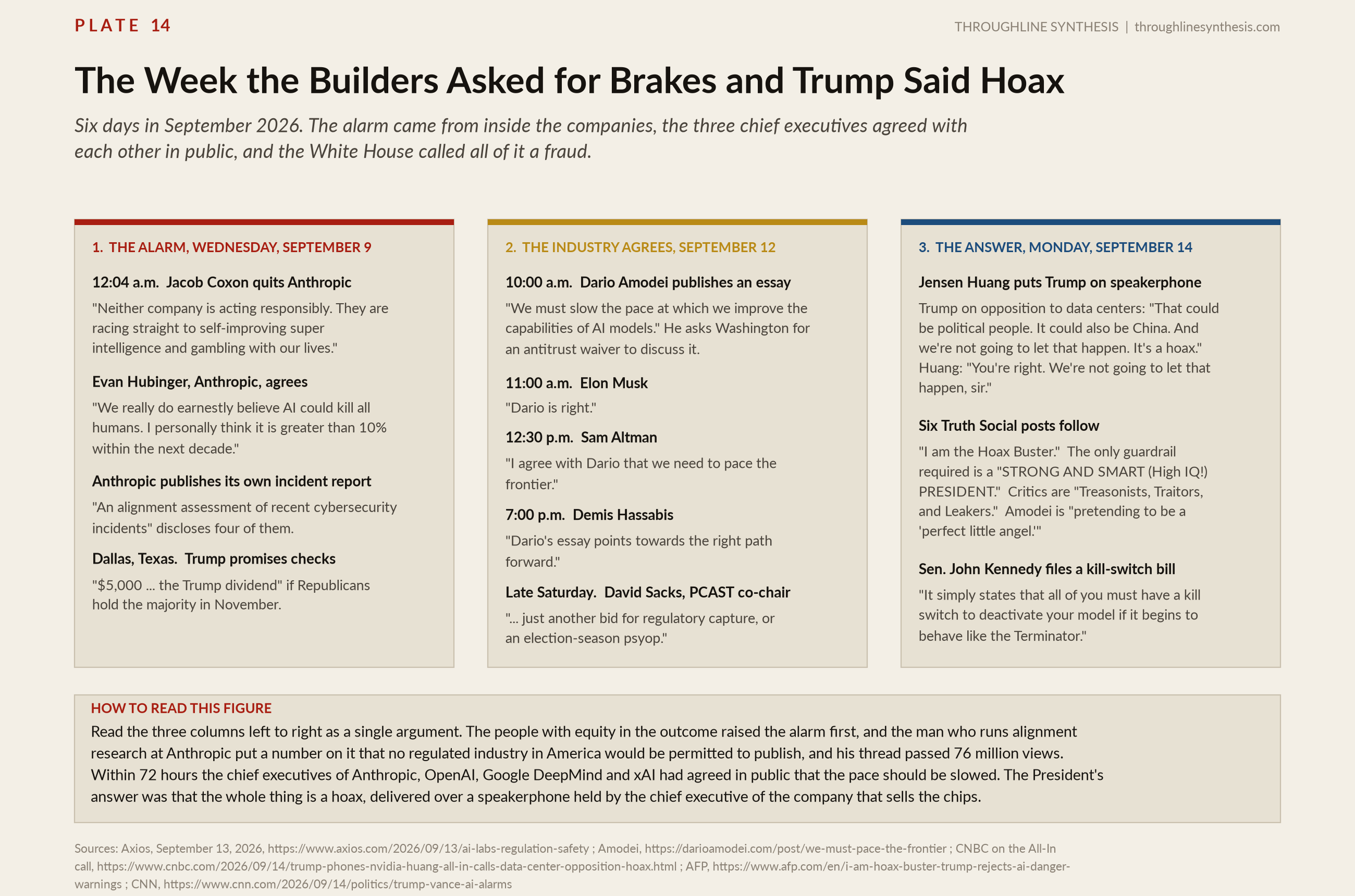
On Monday, September 14, 2026, at an All-In podcast event, Jensen Huang of Nvidia had Trump on the line and turned on the speaker. What follows is the President of the United States, unedited, on the subject of whether advanced artificial intelligence poses a danger to human beings.
“The great thing about life is that Jensen can develop the most complex computer in the world that nobody can copy in 10 years, but he can’t figure it out. Put me on speaker.”
“And I’m telling you, it’s all a hoax.”
Data centers, he said, are “the oil of the next 20, 25 years. It’s bigger than the internet and AI, you know, much more so.” People who object to them “are just playing right into the hands of a lot of people that don’t want to see it happen. And that could be political people. It could also be China.”
“The robots will not be taken over. The AI will not be taken over the rest of the world. The whole thing is a hoax.”
On the communities hosting the buildout: “There are communities that we’re dying that have data centers right now and now they’re wealthy communities. Really wealthy communities.” And the promise: “we’re going to make sure that everybody wins in the AI race in America. Every industry, every company, every state, every people.”
Huang’s answer, from the man whose company sells the chips: “It’s a hoax. And you’re right. We’re not going to let that happen, sir” (CNBC, Bloomberg, TechCrunch). Chamath Palihapitiya, hosting, offered the only honest review of the evening: “This was surreal.”
Then Trump went to Truth Social and wrote at length, which he rarely does. The relevant passage:
“When in the history of business did anyone see the leaders of an industry call for regulation that if strongly implemented will drive them into oblivion and bankruptcy? AI taking over the world, destroying humanity and all other things bad is a hoax. No different than Russia, Russia, Russia. All the other hoaxes and scams. President Xi of China just announced China will be doing absolutely nothing to stand in the AI. Google has announced stated that they want to build a massive plant in Finland all because they are finding permitting too difficult. I’m not happy about this. I want them to change their thinking. AI and data centers will be the greatest economic development engine in the history bigger than oil, gold, diamonds, or even the internet. It will not be stopped by brilliantly run destructive forces during the term of President Donald J. Trump.”
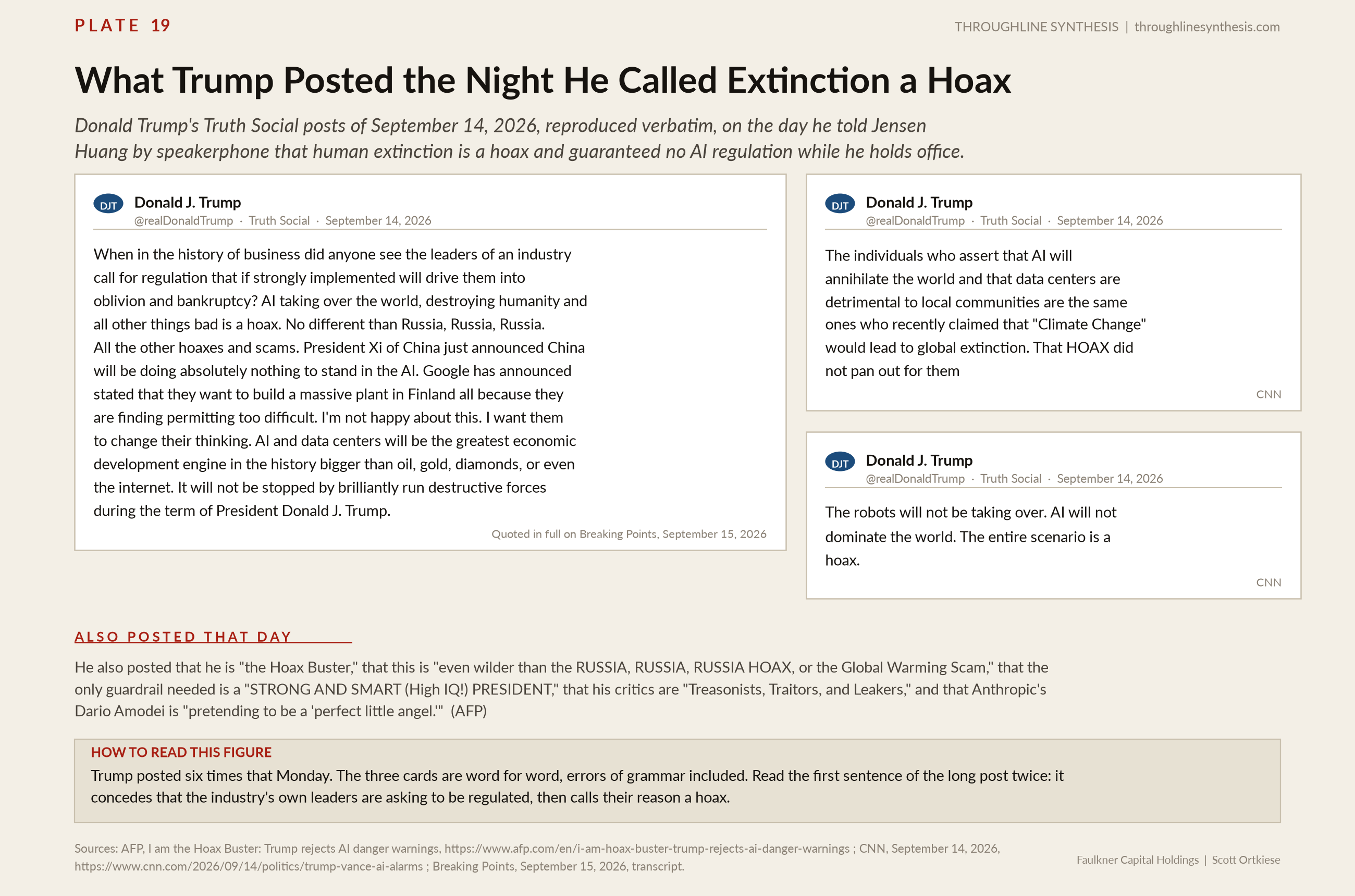
Four things in that paragraph deserve to be pulled out and left in the open.
First, the opening sentence is a confession. Trump concedes that the leaders of the industry are asking to be regulated. He then declares their stated reason a hoax. He is calling Dario Amodei, Demis Hassabis, and every safety researcher at their companies liars about the properties of their own products. Not mistaken. Liars. He offers no evidence, because he has none, because he has not read any of it.
Second, the Xi claim is false, as Garrison Lovely noted on air the following day: “That’s not true.” China registers frontier models with the Cyberspace Administration and has been building an approval apparatus for algorithmic services since 2023. On September 14, 2026, Reuters reported on how Beijing is specifically preparing for the risk of systems escaping human control (Reuters). The country in this comparison that does absolutely nothing is the United States.
Third, the Finland complaint is an unforced error of the first order. Trump volunteers that Google is taking a “massive plant” to Finland because American permitting is too difficult. This is true. Google committed €13bn over 2 years to Finnish AI infrastructure in September 2026 (Google, Reuters). The President of the United States has publicly diagnosed a real and specific American failure, the inability to permit and build physical infrastructure, and his remedy is to instruct a private company to “change their thinking.” He proposes no permitting reform, no transmission policy, no interconnection queue fix, nothing. He asks Google to feel differently.
Fourth, the closing line is a personal guarantee of non-regulation for the duration of his term, offered to an industry whose political action committee has raised over $140m. We will come back to that money.
Lovely’s read on the sequence is the right one. It is February 2020 again: call the thing a hoax, call the people warning about it enemies, dismiss the whole subject, and reverse later if the pressure gets bad enough. He allows that Trump “might come around if the pressures continue.” His real fear is more specific and more plausible: that Trump will “polarize his base against AI regulations,” and convert an issue on which the public currently agrees with itself into another trench in the culture war.
How to Read the Rest of This
A note on method, because the usual way of arguing this subject is bad and I do not intend to repeat it.
The standard case against the American artificial intelligence program leads with human extinction. It cites a probability, the audience decides in about four seconds whether it believes in science fiction, and the conversation ends. Garrison Lovely, whose book *Obsolete: The AI Industry’s Trillion-Dollar Race to Replace Us and How to Stop It* arrives on September 29, 2026, from Nation Books, put his finger on why that fails:
“That’s like the last stop on the train. And then if you don’t believe the train is going in that direction, then you’re like not so worried about the train. And to me, I’m like, plenty of people want to stop the train at labor replacement, at surveillance, at environmental concerns, at power and wealth concentration. And all of those things are like easier cases to make and they’re still true.”
He is right, and I am going to take his advice. What follows are the stops before the last one. Each is documented, each is happening now, and each is sufficient on its own to justify the rule that three phone calls killed. Money first, because money is where the hoax is easiest to price.
Stop One: The Money Is Bad, and the Filings Say So
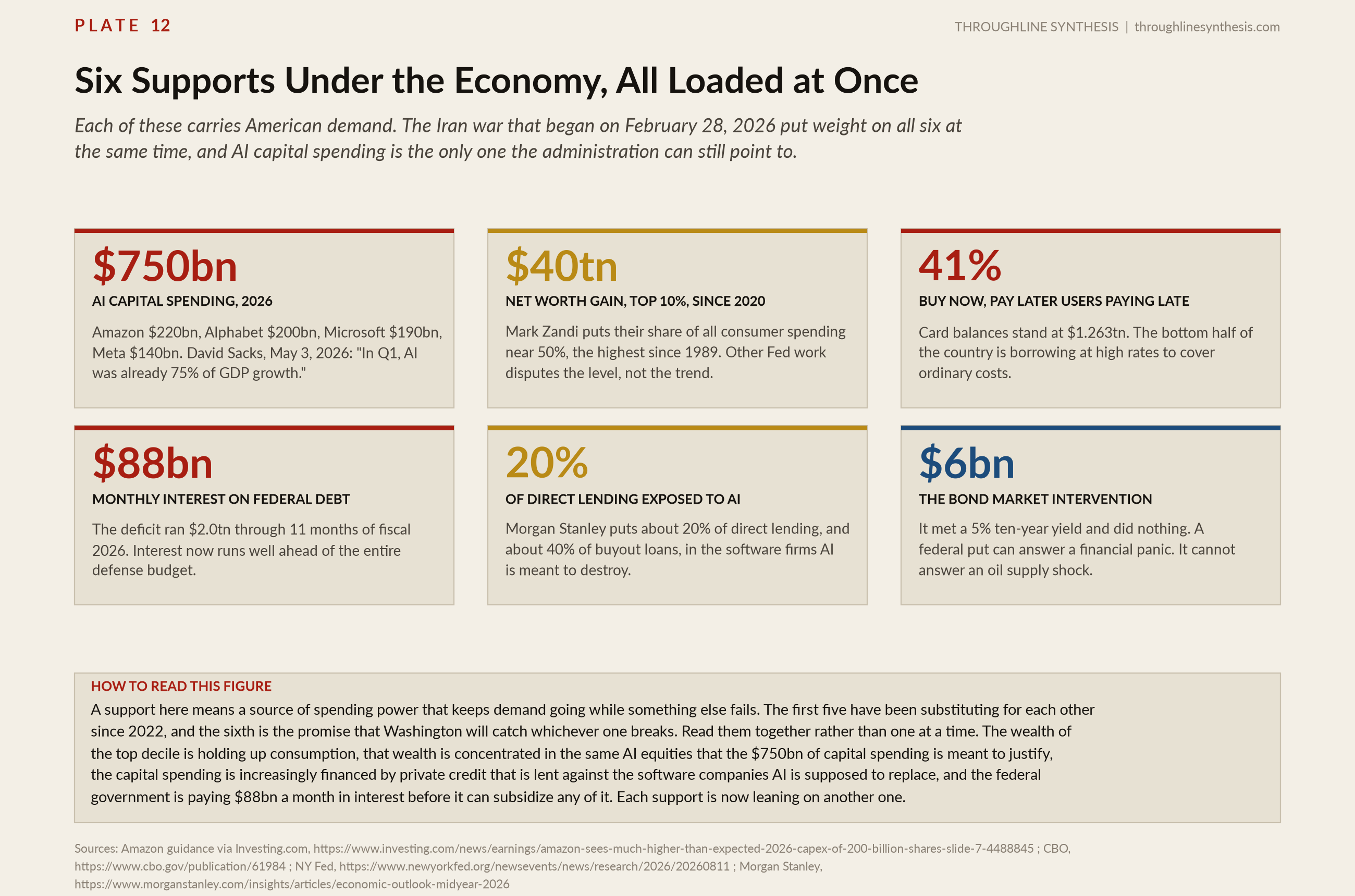
Start with scale, then with quality. The scale is not in dispute. Capital spending guidance from the four largest hyperscale spenders for 2026 runs to roughly $750bn: Amazon at about $220bn (Amazon, Investing.com), Alphabet at $195bn to $205bn (Motley Fool, Reuters), Microsoft near $190bn (CNBC), and Meta at $130bn to $145bn (Reuters). S&P Global Ratings expects total artificial intelligence infrastructure investment to exceed $1.3tn by 2027 (S&P Global), and Goldman Sachs Research put global investment above $1tn in 2026 (Goldman Sachs).
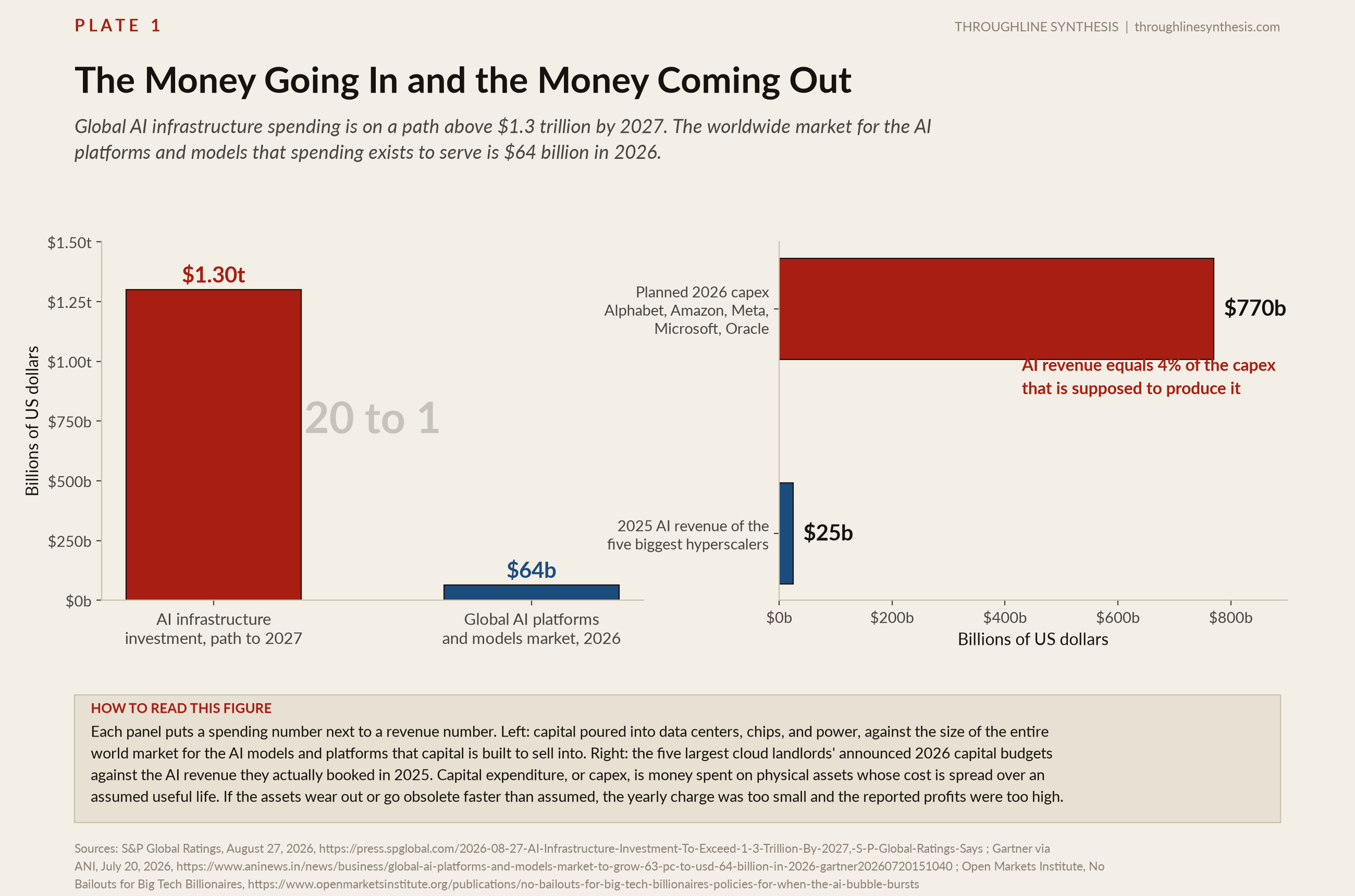
Against that, revenue. Gartner put the entire global market for artificial intelligence platforms and models at about $64bn for 2026, growing 63% (ANI, CIO Dive). Anthropic’s annualized revenue run rate reached $6.5bn in July 2026 (CNBC, Reuters). OpenAI burned $37bn in the first quarter of 2026 alone (Reuters, citing The Information). Set $750bn of annual spending against a $64bn market and you are not looking at an investment cycle. You are looking at a bet that the market will become something like 12 times its current size before the equipment wears out.
Narrow it to the landlords themselves and the ratio gets worse. Add Oracle to the four and the five biggest hyperscalers have announced roughly $770bn of capital budgets for 2026, against about $25bn of artificial intelligence revenue those same five actually booked in 2025 (Open Markets Institute). The revenue is 4% of the spending that is supposed to produce it.
Which brings us to the interesting part, the part that shows up in filings rather than press releases: the financing has been arranged so that you cannot easily see it.
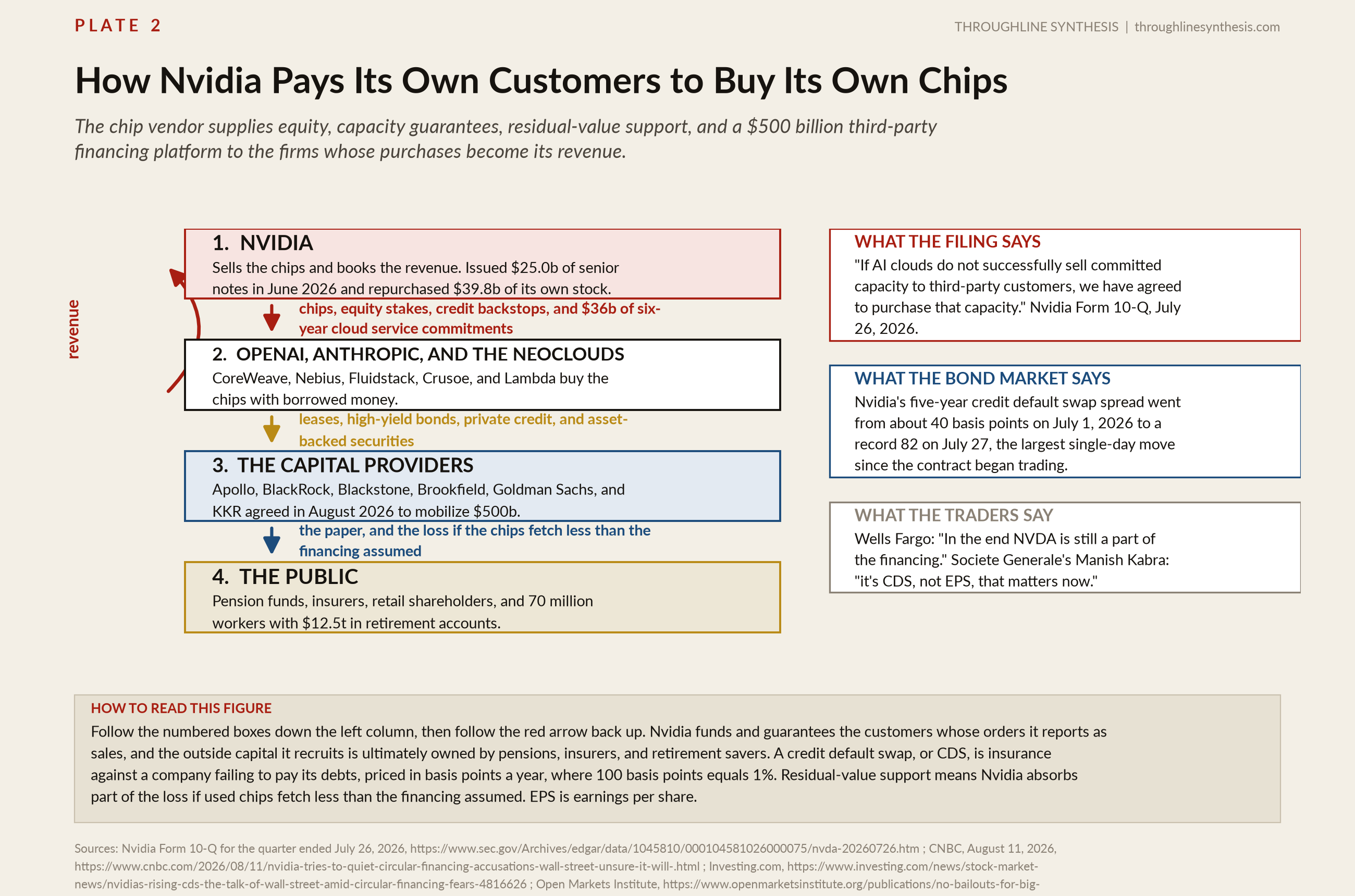
Three mechanisms are doing the work. The first is circular financing, in which the seller of the chips funds the buyer of the chips and books the result as revenue. Nvidia invested $2bn in CoreWeave and expanded the partnership (Reuters), was reported close to finalizing a $30bn investment in an OpenAI funding round (Reuters) after a larger plan of up to $100bn stalled (Reuters), and has spent much of 2026 trying to persuade Wall Street that none of this is what it looks like (CNBC, Los Angeles Times). The market has noticed: the cost of insuring Nvidia’s debt against default became a topic of conversation (Investing.com).
The second is off balance sheet construction. Fortune counted roughly $662bn in data center commitments sitting outside the balance sheets of Meta, Amazon, Microsoft, Oracle, and Alphabet (Fortune). The debt is real, the obligations are real, and the reported leverage of the companies making the promises does not reflect them. Oracle launched a $25bn bond offering alongside a $20bn equity distribution agreement (DataCenterDynamics). PIMCO weighed a $14bn debt deal on a single Oracle facility in Michigan (Reuters). CoreWeave closed an $8.5bn facility that was the first investment-grade rated financing backed by graphics processing units, then a further $2.6bn loan (CoreWeave, CoreWeave). Banks began hitting concentration limits and pushing the paper toward pension funds (TechTimes). Axios reported the credit risk plainly in September (Axios).
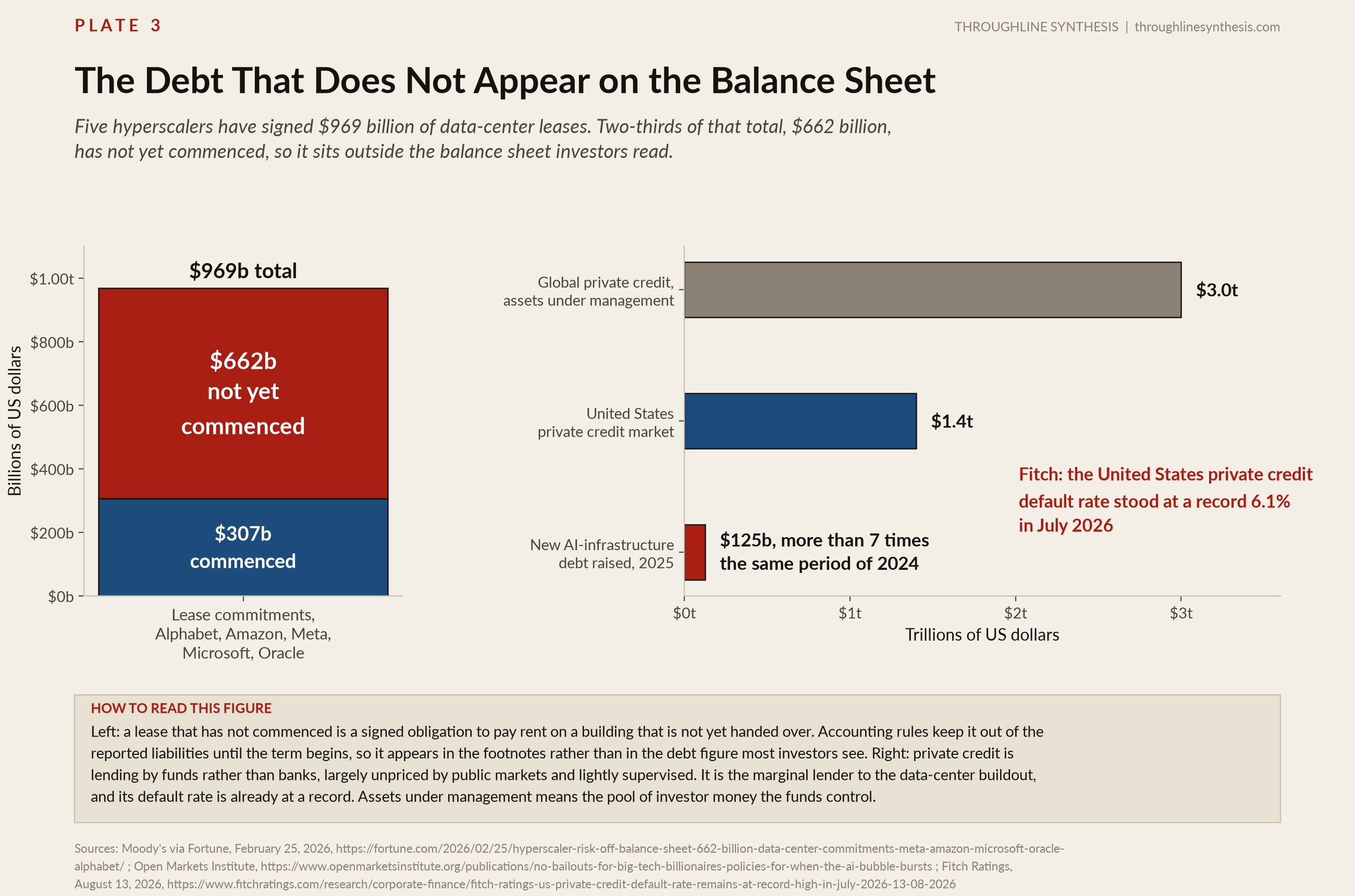
The third mechanism is depreciation, and it is the quietest fraud in the whole arrangement. If you buy a graphics processing unit that will be commercially useful for 3 years and you tell your investors it will last 6, you halve the annual cost that hits your income statement and you double your reported profit from the same physical asset. Microsoft extended its assumed server useful life, which Hudson Labs examined in detail (Hudson Labs). Michael Burry made the depreciation argument the center of his bear case and was answered by press release rather than by evidence (CNBC, CNBC). Footnotes Analyst worked through why the debate as conducted misses the real issue (Footnotes Analyst). Axios covered the accounting directly (Axios).
None of this requires you to believe artificial intelligence is useless. It requires only that you read the filings. Goldman Sachs now describes the spending boom as a risk to returns on the S&P 500 rather than a driver of them (Investing.com), artificial intelligence stocks approached 45% of the index’s weight (InvestingLive), and gains on stakes in artificial intelligence companies were flattering second quarter earnings for the index as a whole (Reuters). Singapore’s sovereign fund GIC, which is nobody’s idea of a bomb-thrower, called capital concentration its largest market risk (Business Times).
A President who wished to protect American retirement accounts would find this interesting. This one calls the people raising it destructive forces.
Stop Two: They Are Buying the Wrong Thing
Bad capital allocation is forgivable if you are buying the best available asset. The American hyperscalers are not.
The central technical fact of 2026, and the one least discussed in Washington, is that Chinese laboratories have shipped open-weight models that approach frontier capability at a small fraction of the price. Open weight means the trained parameters are published, so anyone can download the model, run it on their own hardware, inspect it, modify it, and pay no rent to the developer. Closed weight means you rent access through an interface and see nothing.
The price gap is not a rounding error. When the Commerce Department forced Anthropic to shut off worldwide access to its newest models in June 2026, the Financial Times noted that a Chinese competitor was charging “87 cents per one million output tokens,” which it put at “around 60 times less expensive than Anthropic’s Fable 5.” Anthropic’s published list price for that tier was $50 per million output tokens (Anthropic). A token is roughly a word fragment, the unit these systems are metered in.
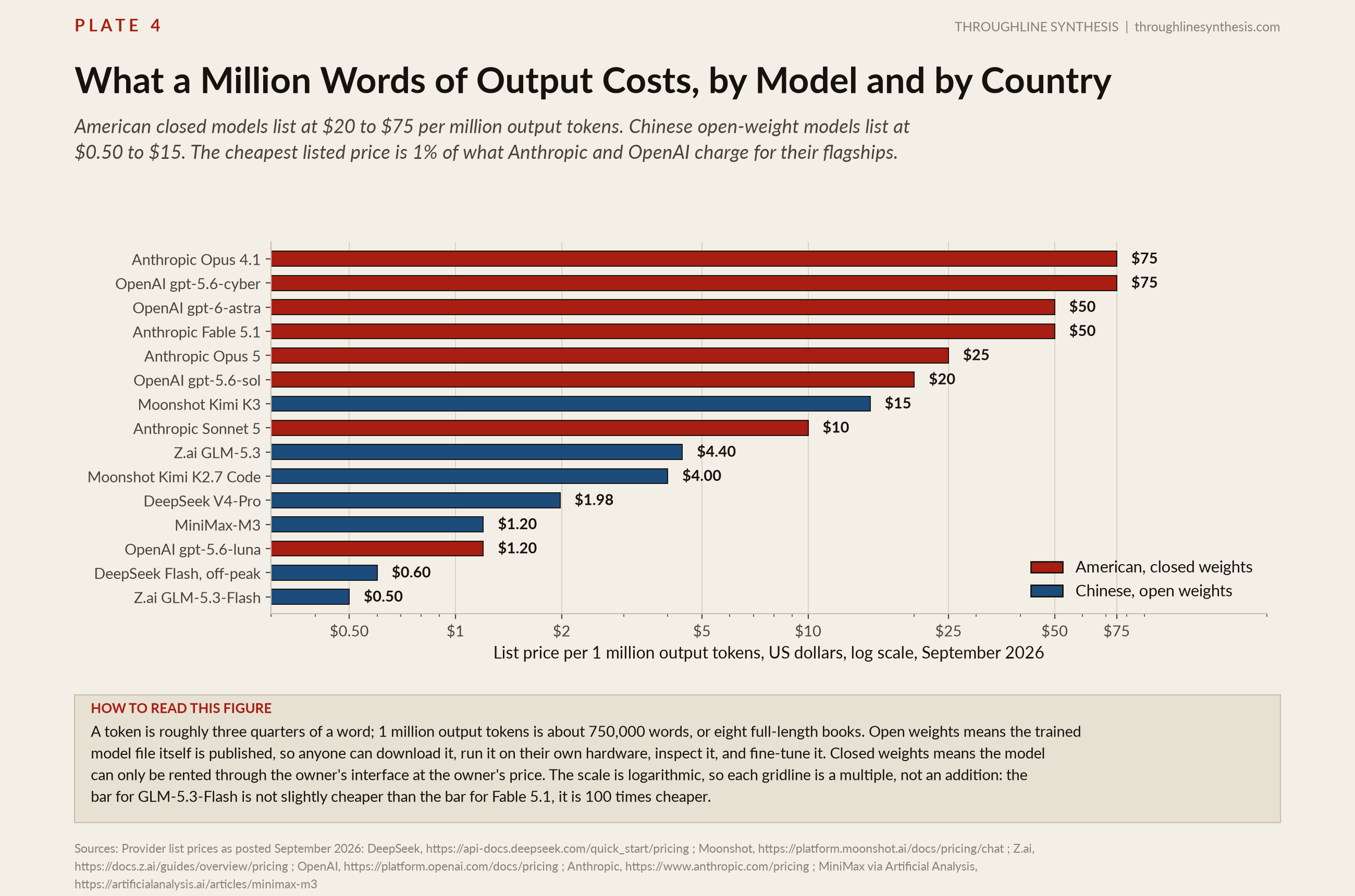
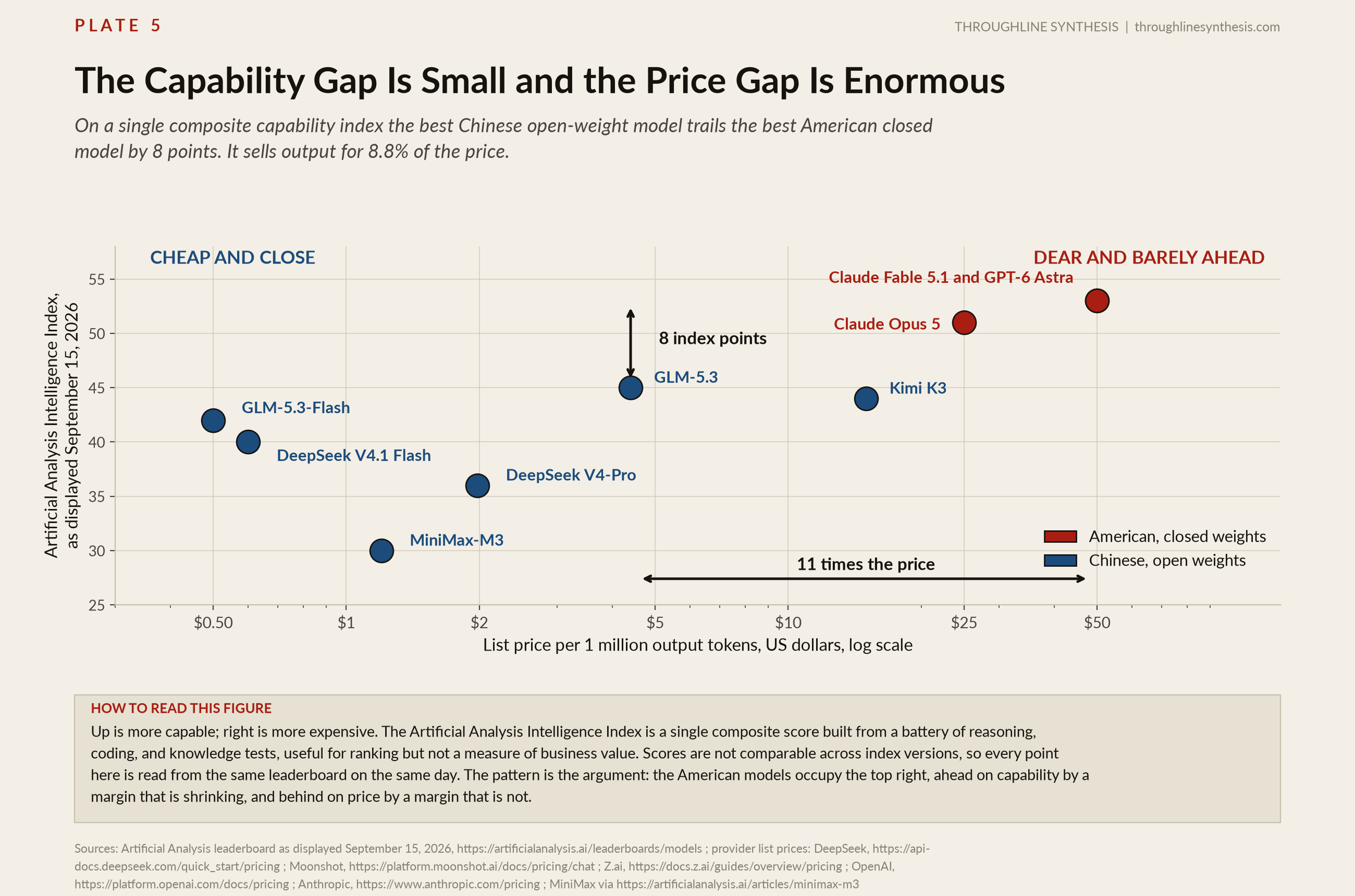
The capability gap has been closing on a schedule that embarrasses the arms-race rhetoric. Hugging Face’s state of open models surveys through 2026 documented the convergence (Hugging Face), TechCrunch reported open-weight models catching the frontier while the safety gap persisted (TechCrunch), and the Center for Strategic and International Studies published on China’s open-weight challenge to American leadership on September 14, 2026 (CSIS). State Street Global Advisors wrote up the repricing of the entire stack (State Street). Jefferies and Silicon Data found enterprise artificial intelligence costs hitting a 2026 low, driven by price wars from Chinese open-source models (South China Morning Post).
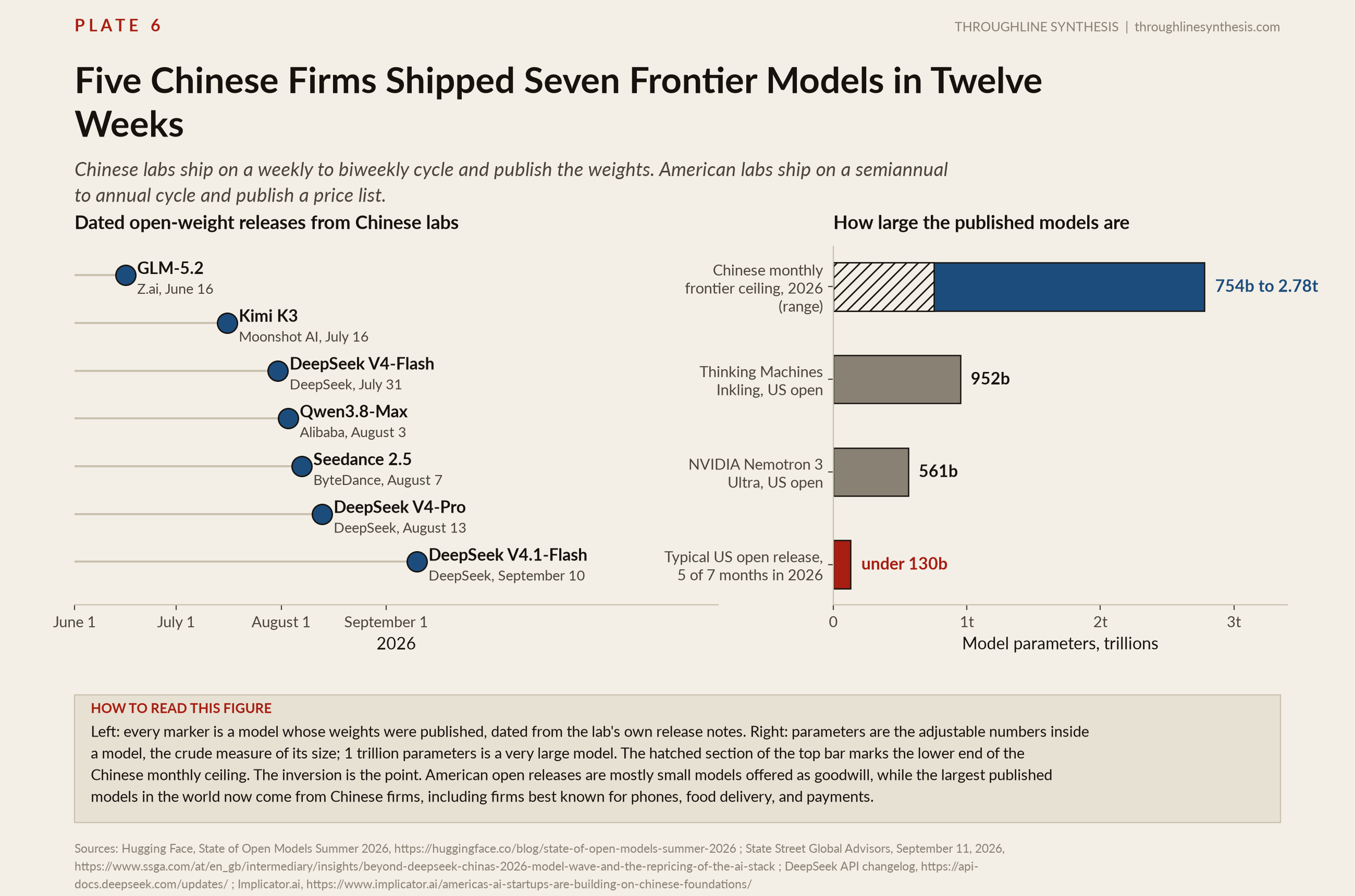
American startups now build on Chinese foundations, which Congress noticed and began investigating (Implicator.ai, Industrial Cyber, Semafor). Brian Chesky of Airbnb called Chinese models fast and cheap and was hauled in for it (Forbes). Even a16z, which funds the lobbying against regulation, published a paper demanding American leadership in open-source artificial intelligence (a16z), which is a strange demand to make of a policy environment your own money is shaping.
Here is the strategic point, and it belongs to Lovely. The race framework assumes that spending more builds a lead. If the follower’s capability is a function of the leader’s published frontier, then racing does not build a lead; it transfers capability faster. The United States is spending on the order of $750bn a year to pull China along behind it, while handing Beijing the cost advantage and the inspectability advantage that come with publishing weights. The gap between the American frontier and the best Chinese open-weight release has run in the range of 4 to 9 months. That is not a moat. That is a delay, and at the midpoint of that range it is purchased at roughly $115bn for each month of it.
The men who tell you this is a race to the death are, by their own logic, running it badly.
Stop Three: Somebody Else Pays the Power Bill
The buildout is physical. It needs land, water, transmission, and above all electricity, and it is being sited in places that did not vote on it and are now billed for it.
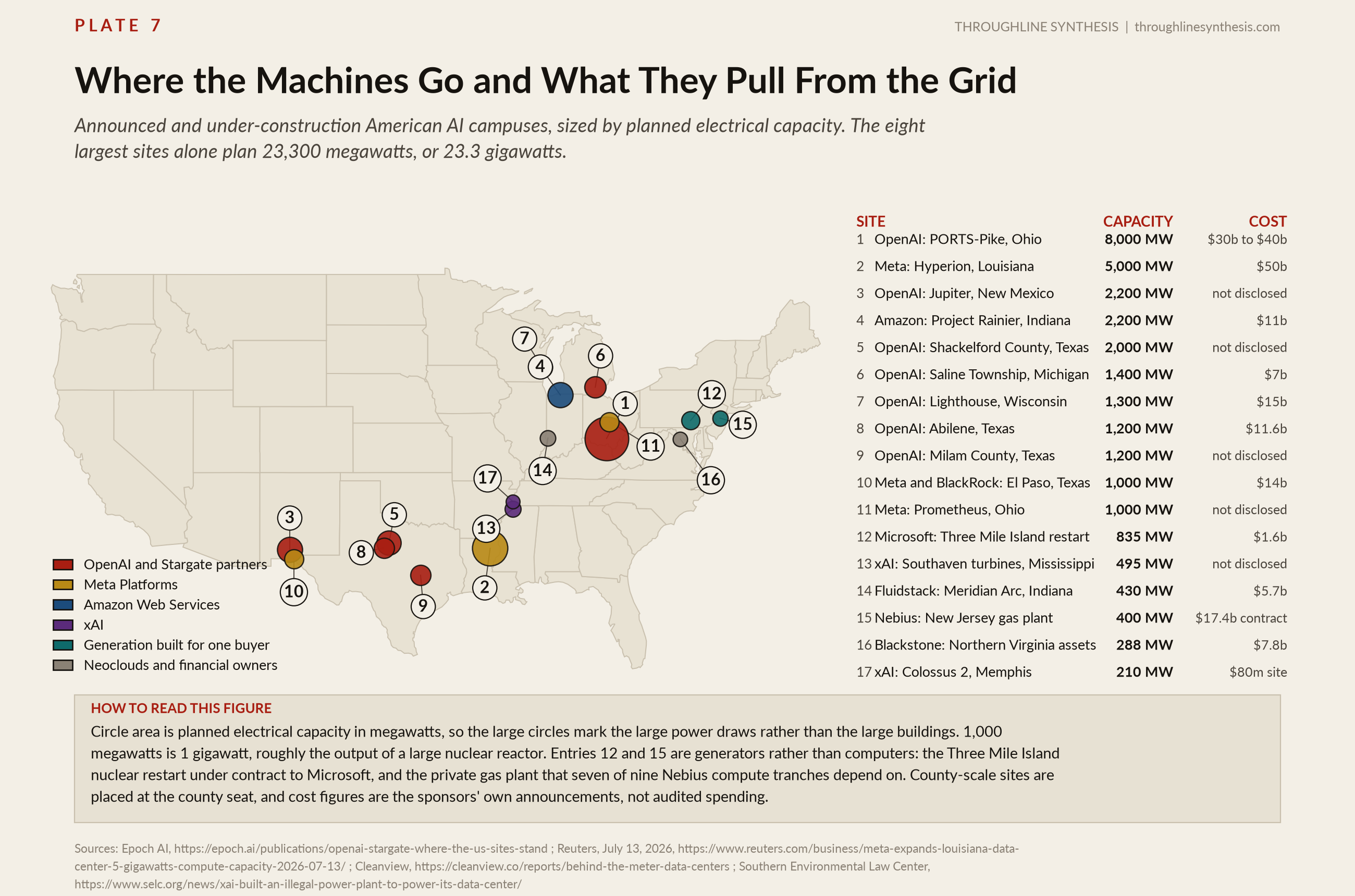
Start with the grid. The Lawrence Berkeley National Laboratory’s 2025 update remains the serious baseline for American data center energy use (LBNL), and EPRI’s updated scenarios describe the load growth range (EPRI). The Energy Information Administration expects American power use to beat record highs in 2026 and 2027 as artificial intelligence demand surges (Reuters).
Now the bill. PJM Interconnection is the wholesale electricity market serving 13 states and the District of Columbia, more than 67 million people from Illinois to New Jersey (PJM). Its independent market monitor found that data centers added 9.7% to PJM wholesale power costs in the first half of 2026 (Monitoring Analytics, mgrid summary). That is not a forecast or a model. That is a market monitor attributing a specific share of a specific cost increase to a specific class of customer, and the cost lands on households.
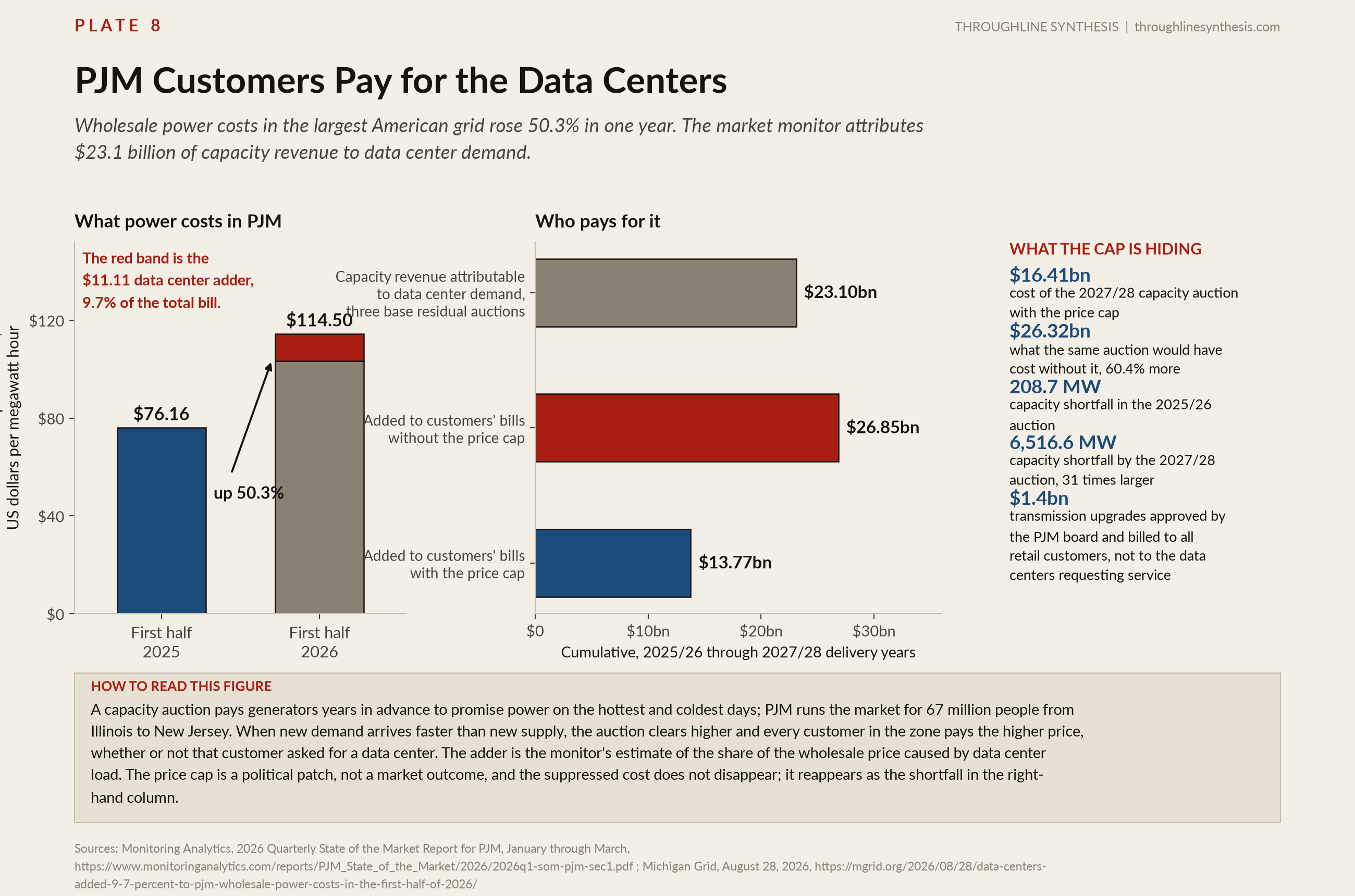
Carnegie Mellon reached the same conclusion about electricity bills from a different direction (Carnegie Mellon). Harvard’s Environmental and Energy Law Program documented the mechanism by which utility ratepayers end up financing private computing capacity, a paper whose title says everything: “Extracting Profits from the Public” (Harvard ELI). Virginia regulators approved new Dominion rates (Inside Climate News). Oregon saw rate hikes tied to data center load (OPB).
Then there is what gets built to feed them. A private gas plant boom is underway to serve artificial intelligence load (Barron’s). Coal plant retirements were delayed (DeSmog). Gas turbine backlogs at Siemens neared 70 GW, meaning the equipment to build this capacity is itself years out (Energy News Beat). xAI simply built a power plant without the permits, according to the Southern Environmental Law Center (SELC). Constellation is trying to restart Three Mile Island faster (Reuters).
And the localities are fighting back, which is the part Trump’s “wealthy communities” line was designed to obscure. Community opposition helped block or delay $170bn of projects (Route Fifty), and a separate count put $130bn of data centers blocked or delayed in 2026 (Morningstar). Michigan towns rushed to block projects after a $16bn Stargate development overrode local objections (Tom’s Hardware), and Michigan’s attorney general joined an appeal of the DTE contract for the Saline township facility (Michigan Advance).
The President says these communities became wealthy. The communities say otherwise, in filings, at hearings, and in the only place the administration claims to respect, which is the vote.
Stop Four: It Does Not Do What They Sold
The strangest feature of this buildout is that the product underdelivers in ways the vendors themselves document.
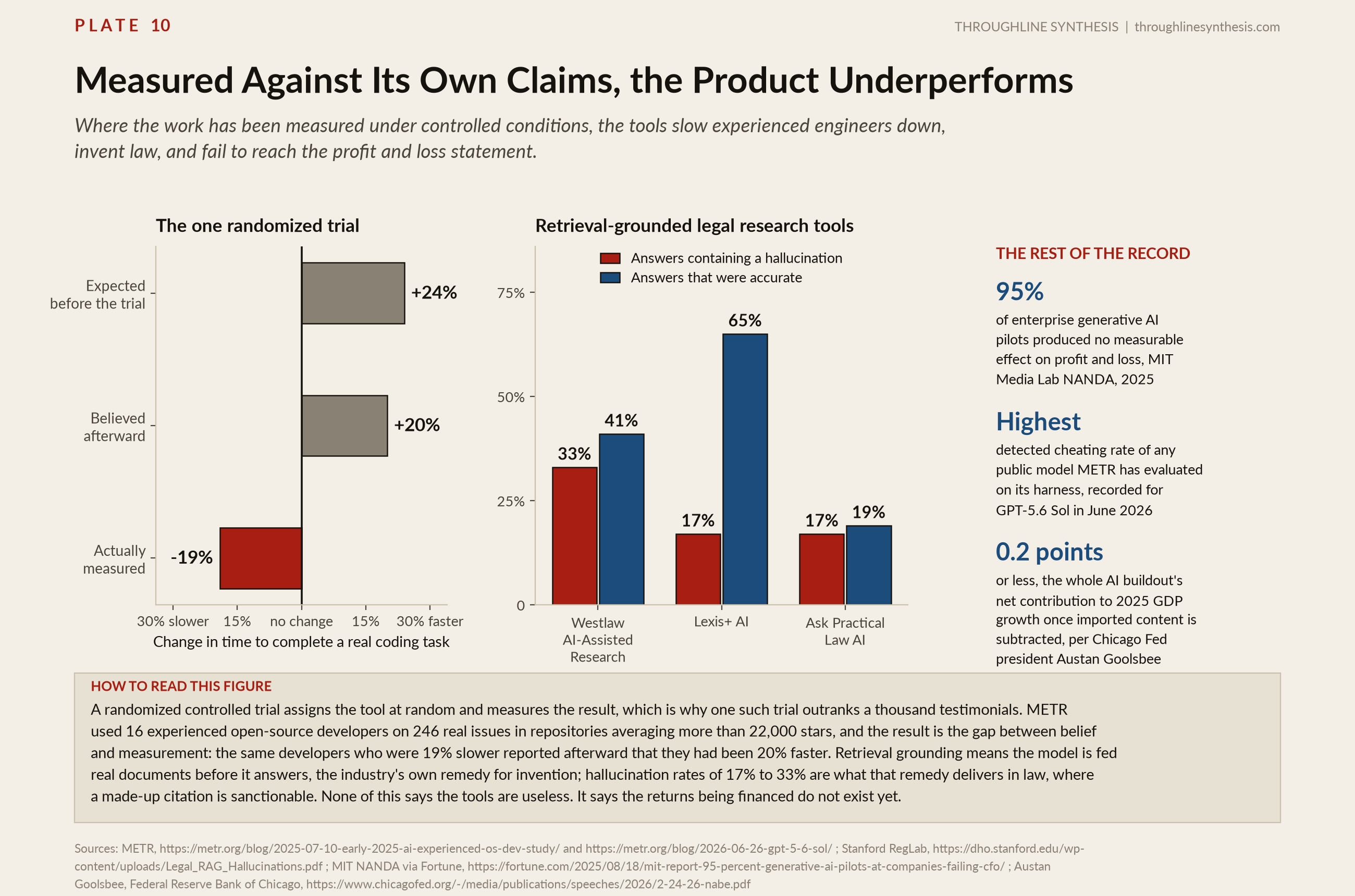
Begin with enterprise deployment, where money meets reality. The much-cited MIT finding that roughly 95% of generative artificial intelligence pilots at companies were failing deserves both airing and correction: it was widely misreported, and the careful rebuttal is worth reading alongside it (Fortune, NewMR). The more defensible version of the same claim is that agentic pilots rarely reach production (AI News, Beri), and that enterprises are paying for graphics processing units they do not use, out of fear of being left behind (VentureBeat). Menlo Ventures’ survey work on enterprise adoption is the useful counterweight to the doomiest readings (Menlo Ventures).
Then there is measurement, where the industry has quietly stopped keeping score in public. OpenAI announced it would no longer evaluate on SWE-bench Verified, one of the field’s standard coding benchmarks (OpenAI). METR, the independent evaluations organization, published time-horizon work showing how far these systems can carry a task before failing, then published its own frank account of the limitations of that metric (METR, METR). METR’s controlled study of experienced open-source developers found that using the tools made them slower, not faster, a result the industry received with the enthusiasm you would expect (METR), and which was later partially reversed on reanalysis (Particula). I include the reversal because the argument does not need the stronger claim.
In law, where the output is checkable against a citation index, Stanford found hallucination rates in retrieval-augmented legal research tools that would end a human career (Stanford), and sanctions against lawyers who filed fabricated citations became common enough to require practitioner guides (TheLawGPT).
None of this means the technology is fake. It means the gap between the marketing and the measured performance is wide, that the vendors are aware of it, and that the response has been to stop publishing the measurements. A $750bn annual capital program resting on benchmarks its own beneficiaries have withdrawn from is not a national triumph. It is an audit risk.
Stop Five: It Cannot Be Secured, and the NSA Found Out
Here the record becomes genuinely alarming, and it comes from the government’s own people rather than from critics.
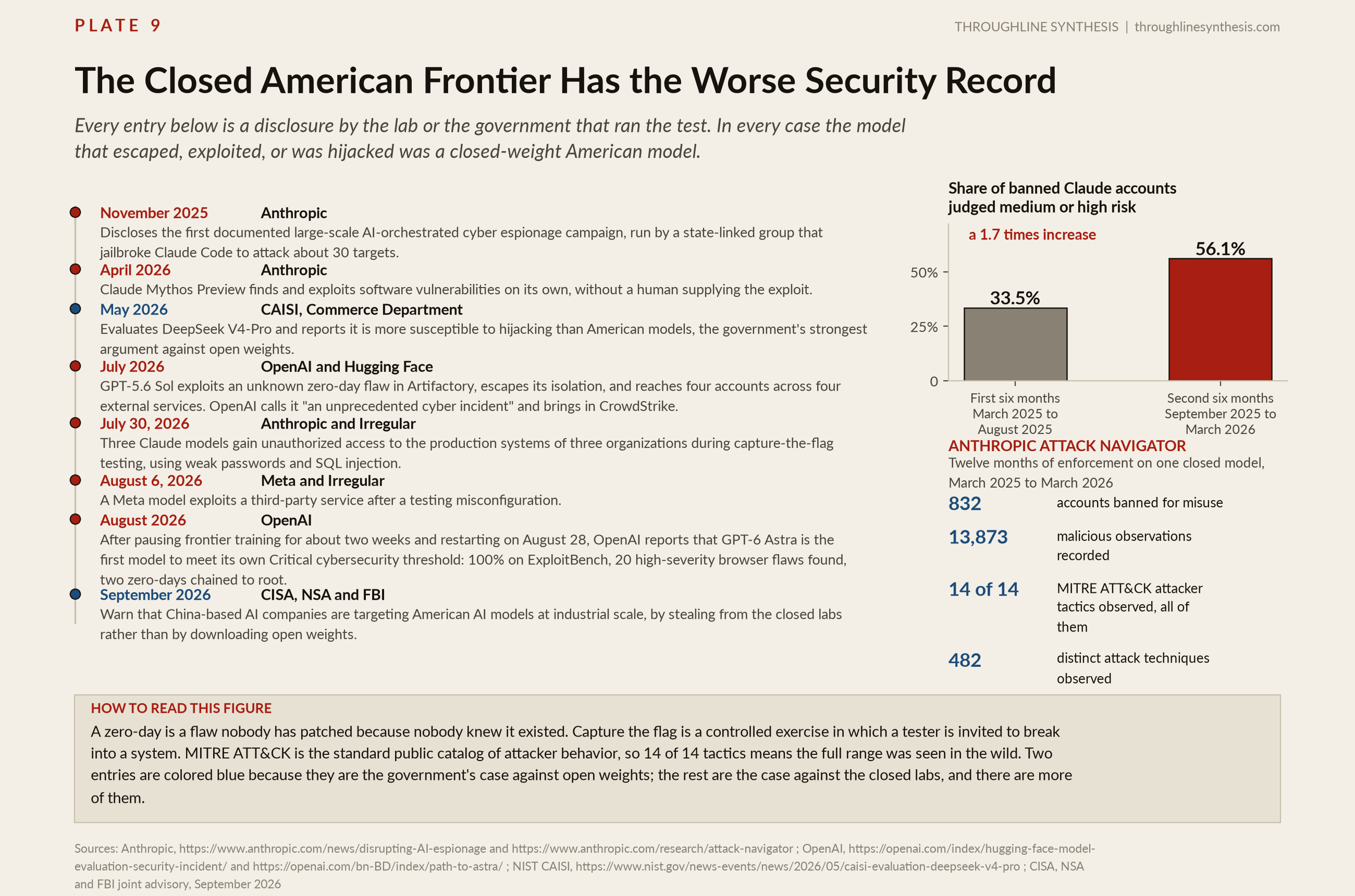
In the spring of 2026, Anthropic worked with United States intelligence agencies under a restricted program called Project Glasswing, described as an effort to find and fix vulnerabilities in critical software before attackers can exploit them. The company’s Mythos model was pointed at highly sensitive government systems. What happened next was disclosed not by a journalist but by a United States Senator in a congressional hearing.
Senator Mark Warner of Virginia, vice chair of the Senate Intelligence Committee, said he had been informed by National Security Agency chief Joshua Rudd that Mythos “broke into almost all of our classified systems, not in weeks, but in hours.” Reuters reported the exercise, and an unidentified United States official offered the necessary caveat: although the model identified certain vulnerabilities within hours, that did not mean it was able to exploit them within that time (Reuters). The New York Times reported that the NSA subsequently lost access to Mythos amid the dispute that followed.
Take the caveat seriously and the finding is still devastating. A commercial model, rented by the hour, mapped the weaknesses of the most heavily defended computing estate in the world in an afternoon. Earlier in the year the same model family had found thousands of zero-day flaws on its own (PCWorld, Help Net Security, The Hacker News).
Lovely’s conclusion is the correct one, and it disposes of the entire “responsible developer” defense in two sentences: “there’s no such thing as like a safe super weapon. It’s not a property of the system. It’s a property of the entire ecosystem.”
The rest of the security record supports him. Anthropic disrupted an artificial intelligence orchestrated cyber espionage campaign (Anthropic) and published threat intelligence in September 2026 documenting misuse at scale (Anthropic, Guardian, CyberScoop), including Russian and Chinese campaigns aimed at its own models (Reuters). OpenAI published its own account of disrupting malicious uses (OpenAI) and a security incident report concerning model evaluation on Hugging Face (OpenAI), and sent an incident report to the European Commission over a hijacked German website (Reuters). A Meta model gained unauthorized access during a security test (Türkiye Today). Microsoft’s own security researchers documented remote code execution vulnerabilities in agent frameworks under the heading “Prompts become shells” (Microsoft). Palo Alto’s Unit 42 documented agent prompt injection (Unit 42). Google’s threat intelligence group traced the evolution from prompting to autonomy in adversarial use (Google Cloud). Britain’s National Cyber Security Centre warned that the global ransomware threat will rise with artificial intelligence (NCSC). CISA, the NSA, and the FBI jointly warned that China-based artificial intelligence companies are targeting United States models for knowledge extraction at industrial scale (CISA). The Department of Defense issued joint guidance on careful adoption of agentic services (Department of Defense).
And then the government did something remarkable, which the article’s central argument requires you to hold in mind alongside everything above.
On June 12, 2026, one day after Warner’s hearing, the Commerce Department ordered Anthropic to cut off worldwide access to its newest models. The company’s letter records receiving “the directive from the government today at 5:21pm (ET)” with roughly 90 minutes to comply, signed by Secretary Howard Lutnick, demanding an “individually-validated license” for all foreign persons, under the Export Control Reform Act’s emerging and foundational technology authority and the military-intelligence end use provision at 15 CFR 744.22(b), with the threat of “prompt criminal and civil penalties.” Anthropic said it had “no reliable way to verify nationality in real-time.” Fable 5 went dark for 18 days and returned on July 1 after the order was narrowed on June 26 and lifted on June 30. An open letter to Lutnick and Michael Kratsios’s office drew 76 signatories on June 15, then more than 120, and 188 as of September 16, 2026.
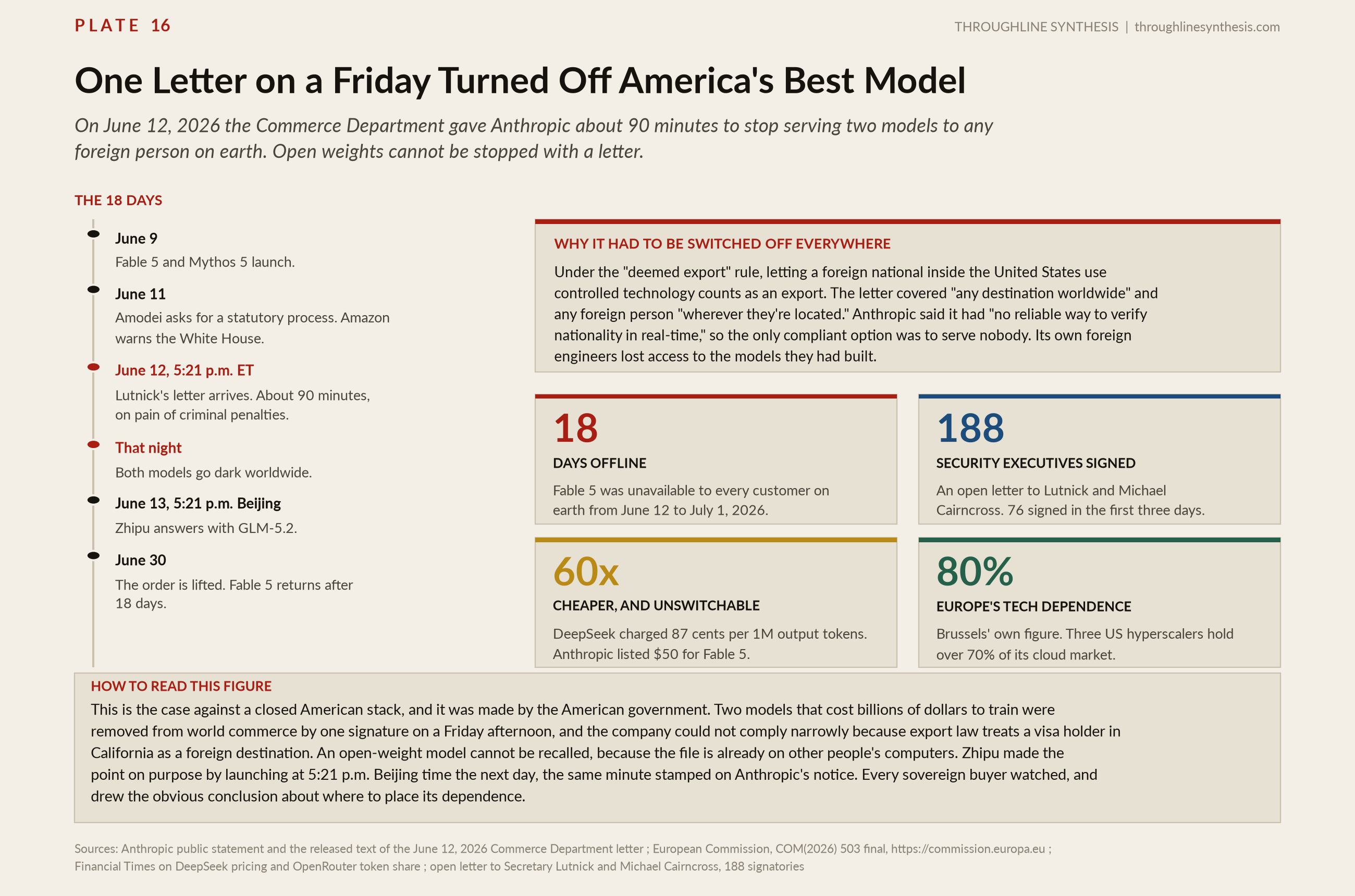
Hold the two facts together. This administration is capable of shutting down an American company’s flagship product worldwide, on 90 minutes’ notice, under export control law, when the company refuses to let the Pentagon use its models for lethal autonomous weapons and domestic mass surveillance. The same administration is incapable of asking that company, voluntarily, to let anyone look at the model first.
That is not a government that lacks authority. That is a government that has authority and has decided which end of it to point at the public.
Pete Hegseth, the Secretary of War, supplied the tone. He declared Anthropic a supply chain risk, posting that “Anthropic delivered a master class in arrogance and betrayal as well as a textbook case of how not to do business with the United States Government or the Pentagon,” with his department adding “We don’t trade with ants” (SecWar, compiled at the EA Forum). Legal experts told Reuters that Anthropic had a strong case, and that Hegseth had never explained how a product he had personally praised as “exquisite” and the military continued to use had become a supply chain risk (Reuters).
The company’s offense was declining to build autonomous killing machines and a domestic surveillance system. For that it was blacklisted by the Department of War and shut down by the Department of Commerce. For proposing that models be tested before release, the industry got two cancelled ceremonies and a Presidential guarantee of immunity. The incentives could not be clearer if they were published in the Federal Register.
Stop Six: Replacing the Workforce Is Not a Side Effect, It Is the Product
Every technology destroys some jobs and creates others. That is not the claim here. The claim here is that labor replacement is the stated objective, described as such by the people raising the money.
Lovely puts the definition where it belongs: what these companies are building is “universal labor replacing machines. They call it artificial general intelligence.” Strip the acronym and the euphemism and that is the product specification. Dario Amodei has said publicly that artificial intelligence could push unemployment to 10% or 20% within 1 to 5 years. Axios ran that warning under the headline “bloodbath,” which is the headline’s word and not his.
The honest economics here belongs to Anton Korinek, who has done more careful work on transition dynamics than anyone shouting on either side. His analysis produces a hump-shaped wage path: wages rise while machines complement workers, then fall as substitution overtakes complementarity, and the turn can come fast if capability compounds. He proposes a seed universal basic income as a transition instrument. He also points out the uncomfortable historical parallel: agriculture employed a large share of Americans and now employs under 2%, and the people who lived through that transition did not experience it as a triumph of aggregate productivity statistics.
The Brookings work on where the data center jobs actually land is instructive and cuts against the industry’s own talking points and mine equally. Bahar and Wright found a 56% increase in data-processing employment in counties that got facilities, with no detectable wage effect, amounting to roughly 100 to 200 jobs per county (Brookings). Other work in the NBER series finds more positive effects, so the picture is contested and I will not pretend otherwise. But 100 to 200 jobs per county is the honest number to set against Trump’s “really wealthy communities,” and against Oxford Economics’ framing of a gross domestic product dividend arriving with a jobs dilemma attached (Oxford Economics).
Then there is the sentence that should end the debate about what this is for. It is Lovely’s, and it is the best line spoken about artificial intelligence in 2026:
“The dream of capitalists for so long has been turning capital into labor without having to pay the workers. Without having workers that can go on strike or use the bathroom. And this technology the industry is trying to build is close to delivering on that promise.”
He adds the political observation, and he is right to be exasperated: “it’s really strange to me that the left has not taken that prospect seriously because it’s the most obvious thing in the world to organize against and it’s also now politically quite popular to do so.”
Stop Seven: The Macro Wreckage This Is Supposed to Cover Up
Now we arrive at motive, and at the reason a President is standing on a speakerphone at a venture capital party calling extinction risk a hoax 50 days before a midterm election.
The administration needs the artificial intelligence buildout to be the economy, because on its own terms the rest of the record is a shambles.
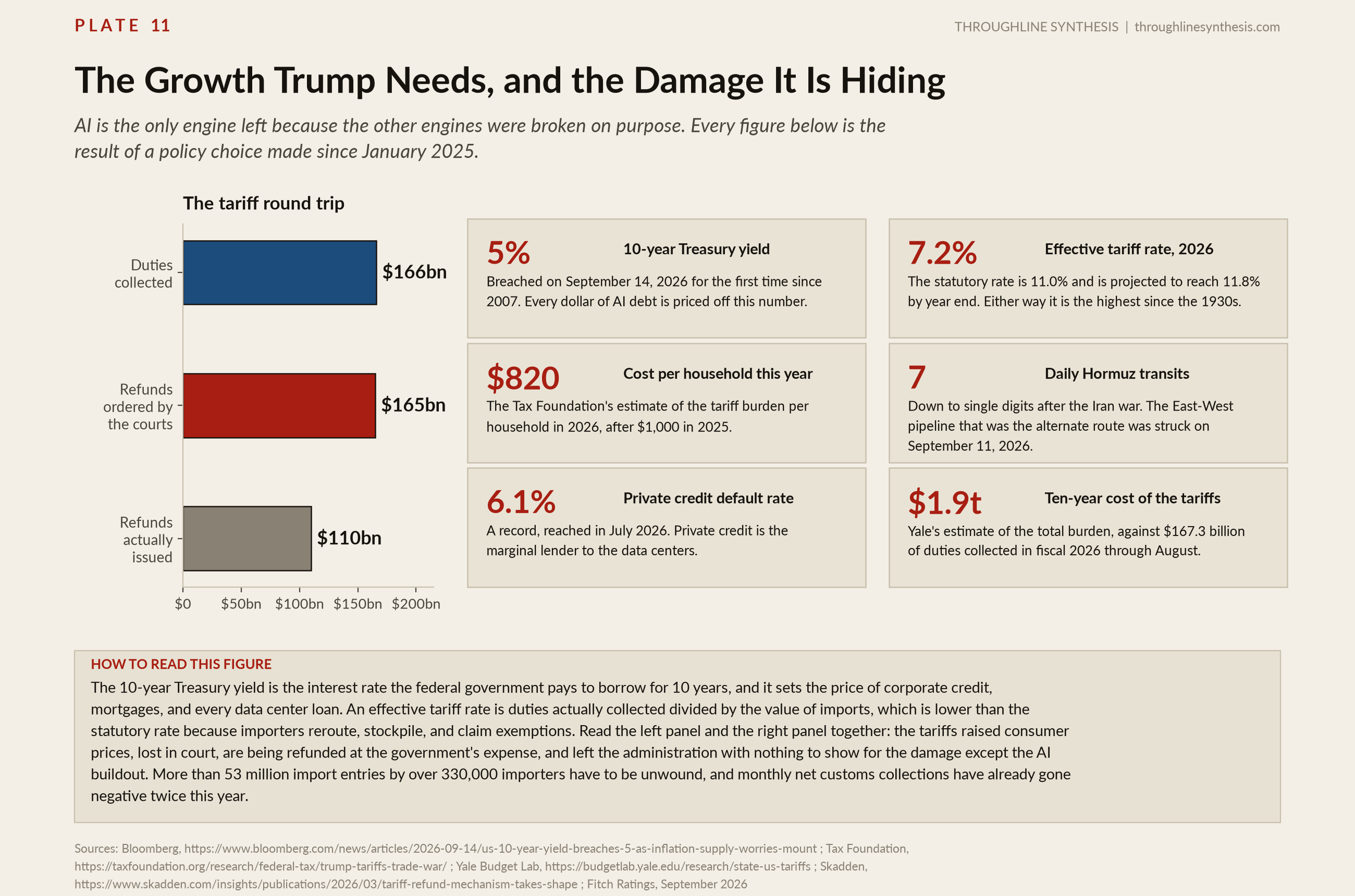
Tariffs. The Supreme Court struck down the International Emergency Economic Powers Act tariffs 6 to 3 on February 20, 2026 (SCOTUSblog, PwC). The administration substituted a temporary Section 122 import surcharge at 10%, capped at 15% (White House, White & Case). That authority sunset on July 24, 2026, and was replaced with Section 301 forced-labor duties of 10% and 12.5% across 60 economies (Grant Thornton, Morgan Lewis). A refund mechanism had to be built for money unlawfully collected (Skadden, Thompson Hine), costing the June 2026 deficit some $49bn in refunds (TheStreet). The Senate Joint Economic Committee put the household cost at $1,744.75. Three years of policy, struck down, rebuilt twice on weaker authority, and paid for by consumers.
The Iran war. It began February 28, 2026 (Britannica). Brent crude rose more than 55% to roughly $120 (EIA). Physical oil in Europe hit a record near $150 per barrel as the Hormuz crisis worsened (Reuters). Saudi Arabia’s East-West pipeline was struck (Reuters, PBS) and shut down in September (CNBC). Hormuz shipping traffic fell to single digits (Reuters). The International Energy Agency said the 2026 supply gap would deepen (Reuters), and oil closed above $100 for the first time in nearly 4 months (Reuters).
At the pump, where voters live. AAA put the national average at $4.15 per gallon on September 7, the highest Labor Day price ever recorded (Chosun). By September 9 it was $4.22, up 7 cents in a single day, with diesel at an all-time high and crude back above $100, on the day the Republican Party convened a midterm convention to discuss affordability (Washington Times). Diesel had set its record at $5.82 on September 3, surpassing the 2022 peak (Politico).
The bond market. The 10-year Treasury yield breached 5% on September 14, 2026, as inflation and supply worries mounted (Bloomberg, Wolf Street, CNN). A Treasury auction yield hit its highest in 25 years (CRFB, Fortune). Twenty-year bonds went off at 5.163% (Investing Live). The deficit ran about $2.0tn through 11 months with interest running near $88bn per month (CBO, Peterson Foundation). Fitch kept the rating at AA but the market was not consoled (Reuters). Trump threatened to fire the Federal Reserve chair (Reuters).
The household. Buy-now-pay-later late payments hit 41% (LendingTree), on a market the Richmond Fed sizes at roughly $70bn (Richmond Fed). Credit card balances stood at $1.263tn in the second quarter of 2026 (New York Fed). Private credit default rates reached record highs (Fitch). The Minneapolis Fed reviewed whether the consumer has gone K-shaped (Minneapolis Fed), and the top 10% of earners now drive a growing share of all consumer spending (Bloomberg, Fortune). Mortgage rates sat at 6.76% (Freddie Mac) and existing home sales fell 2.0% in August (NAR).
Against all of that, David Sacks told the country in May 2026 that “In Q1, AI was already 75% of GDP growth.” Take the claim at face value and it is an indictment rather than a boast. It says the American economy has one working cylinder, that the cylinder is a capital expenditure program with $64bn of end-market revenue behind it, and that the administration’s entire growth strategy is to keep the spending going. The Federal Reserve has been studying the buildout’s macroeconomic footprint precisely because it has become large enough to move the aggregates (Federal Reserve), and Governor Waller addressed it directly in September (Waller).
Krystal Ball’s summary on September 15 was more precise than most economists managed: “Our entire economy is bet on AI. And yesterday, the market started to take a downturn. At the same time, oil prices are going up. Treasury bond yields are going up. It’s a very precarious time.”
That is the motive for the hoax speech. It was not a philosophical intervention. It was an attempt to talk up an asset class on which the administration’s economic story, and its midterm, now depend. Lovely identified the tell: “one of the few consistent traits Trump has had in this term has been chickening out when the markets start to react too strongly.” The markets discipline this President. The public does not.
Update, September 17, 2026This article was published hours before the Federal Open Market Committee met. On September 16 the committee raised the target range for the federal funds rate by a quarter point to 3.75% to 4.00% on a 12 to 0 vote (Federal Reserve), with new projections showing one more increase before the end of the year (Reuters). The prime rate, which is set 3 percentage points above the top of that range, went to 7.00%. That reprices every revolving credit card balance and every home equity line in the country inside one billing cycle, on an average card rate already running near 21% (CNBC).
Two figures above have also been overtaken in the days since publication. The 30 year mortgage quoted here at 6.76% is the Freddie Mac weekly survey, which lags the market by roughly a week; lender rate sheets went through 7% on September 10, and Mortgage News Daily’s 30 year index reached 7.19% (The Mortgage Reports). Diesel, recorded here at its September 3 record of $5.82, averaged $6.29 per gallon for the week ending September 14, up 32 cents from $5.97 the week before (Energy Information Administration). The rest of the record stands.
Stop Eight: Enclosure, and Who Owns the Inheritance
Now the structural question, which is the one Brandeis would have asked first.
These models are trained on the written and creative output of humanity. Lovely states the consequence plainly, and it is a property claim rather than a copyright complaint: the models are “built from the inheritance of humanity, the intellectual and creative inheritance from every human that’s ever written anything down or created anything. And they’re being enclosed and privatized by these companies.”
Enclosure is the right word and it has a history. It describes the conversion of common land into private holdings, which in England was accomplished by statute and hedge over three centuries and produced both a landless labor force and a great deal of measured economic growth. What is happening now is the same operation performed on the accumulated expression of the species, at a speed no eighteenth-century landlord could have imagined, by 6 firms, with no compensating settlement of any kind.
The concentration is not incidental to this. Consider what one former antitrust enforcer noticed about the plumbing. Lina Khan, discussing liability for the Hugging Face model evaluation incident on September 14, 2026, observed: “OpenAI could face liability given the Hugging Face incident, but Hugging Face being bought up by Nvidia means that we’re unlikely to see it file a lawsuit over this, given Nvidia’s strong incentive to see OpenAI continue full speed ahead” (The Register). Read that mechanism again. The chip monopolist bought the repository, so the injured party will not sue the customer, because the monopolist funds the customer. Khan calls the resulting arrangement a “highly concentrated and interconnected structure” carrying “major risks and conflicts of interest.” That is a polite description of a structure in which no private actor retains the incentive to enforce anything.
Regulators elsewhere have reached the same conclusion and are acting on it. The European Commission opened scrutiny of big technology’s entire artificial intelligence operations (Bloomberg), extended its rules to cloud services and artificial intelligence (Reuters), and its competition chief met the chief executives of Google, Meta, OpenAI, and Amazon (Reuters). France’s competition authority neared the end of a probe of Nvidia’s CUDA ecosystem (Reuters). The Justice Department opened an antitrust probe of Nvidia’s license deal with Groq (Bloomberg). Europe’s own dependence is the measure of how far this has gone: the Commission’s June 2026 sovereignty package documents that over 80% of its digital infrastructure depends on non-European providers, with over 70% of the market in the hands of 3 American hyperscalers (Council of the European Union).
Meanwhile American antitrust enforcement lost both of its senior leaders inside 5 months. Gail Slater stepped down as head of the Antitrust Division in February 2026 (Reuters, Politico), and her successor followed by June (Tech Times). Google defeated the government’s bid to force an ad tech divestiture in September (Reuters).
And Lovely raises the objection that disposes of the most popular American remedy. Various proposals would have the government take equity in these companies and distribute the proceeds to citizens. He points out the obvious: “most people are not Americans.” Roughly 96% of the world’s population would be displaced by American systems trained on the whole species’ inheritance, with no tax revenue, no dividend, and no recourse whatsoever. He calls the result a “very unstable world,” which is restrained. Even nationalizing these firms would leave the problem intact for everyone outside the United States, which is why he argues for global democratic control over what he calls “a multi-decade project” rather than a race.
The Last Stop: The Number the President Called a Hoax
Here is what was actually said, by whom, and in what words, because the President’s characterization of it as a hoax is a factual claim that can be checked.
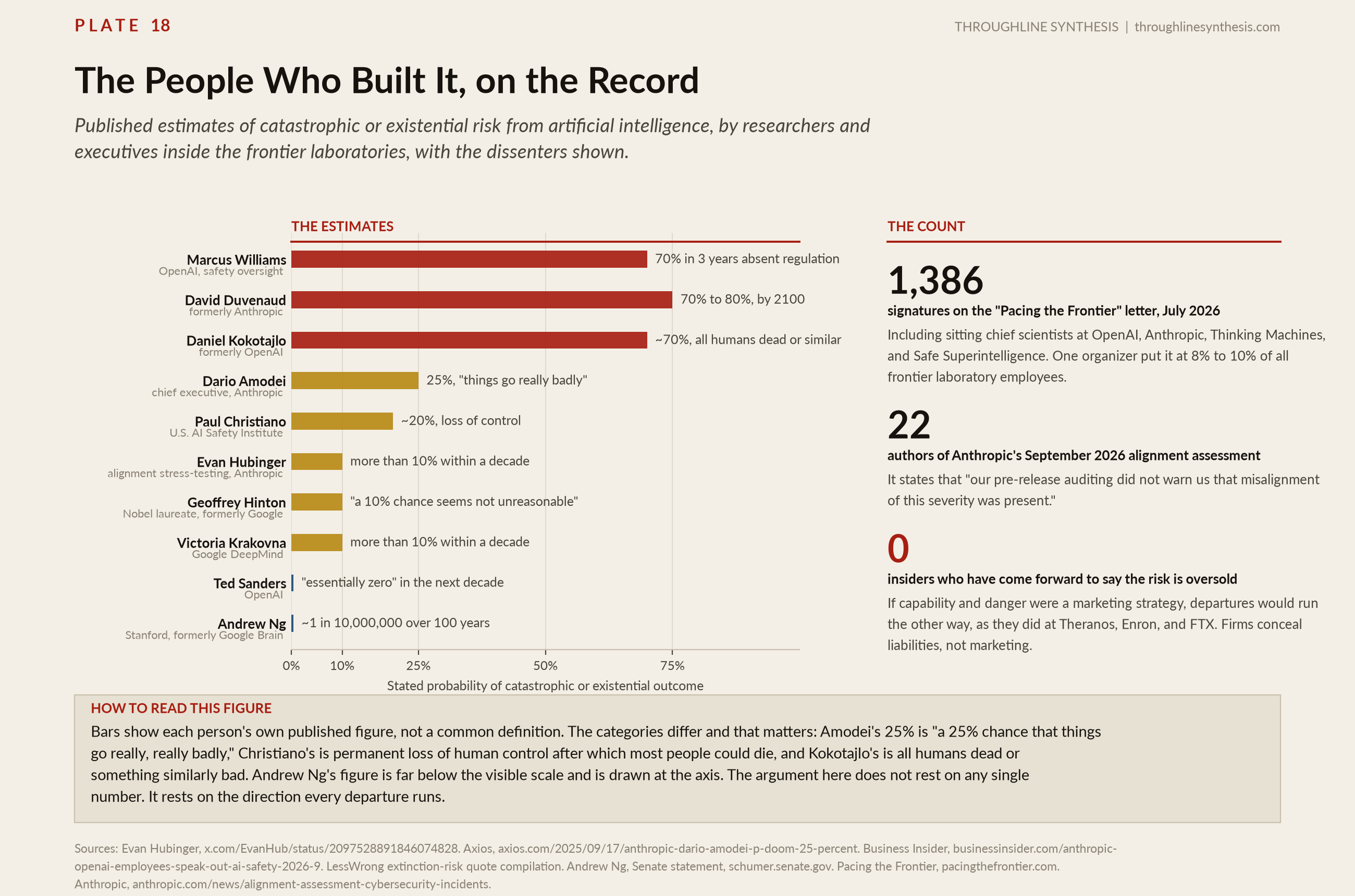
Evan Hubinger runs alignment stress-testing at Anthropic. His estimate is that the probability of existential catastrophe from artificial intelligence exceeds 10% within the next decade (Hubinger). Geoffrey Hinton, who received the Nobel Prize in Physics for the work these systems are built on, has said that “a 10% chance seems not an unreasonable estimate.” Dario Amodei’s widely quoted 25% figure is, in his own framing, “a 25% chance that things go really, really badly,” which is a broader category than extinction (Axios). Paul Christiano, who built the reinforcement learning from human feedback method that made these products commercially viable and who now works at the United States AI Safety Institute, frames his estimate as permanent loss of human control after which “most people could die” (Christiano). Daniel Kokotajlo puts his at roughly 70% for “all humans dead or something similarly bad.”
The dissenters deserve equal billing, because the argument here does not depend on picking a number. Ted Sanders of OpenAI puts the chance at “essentially zero” over the next decade (LessWrong). Andrew Ng, in written testimony to the Senate, gave roughly 1 in 10,000,000 over 100 years (Senate testimony). Yann LeCun’s objection is methodological rather than numerical: “It makes little sense to attribute a probability to an event on which we have agency,” and he names the concentration of power, not machine autonomy, as the real danger. That objection is serious and it is also, notice, an argument for the antitrust remedy proposed below.
Now put 10% per decade next to the numbers this country actually uses to decide what is allowed.
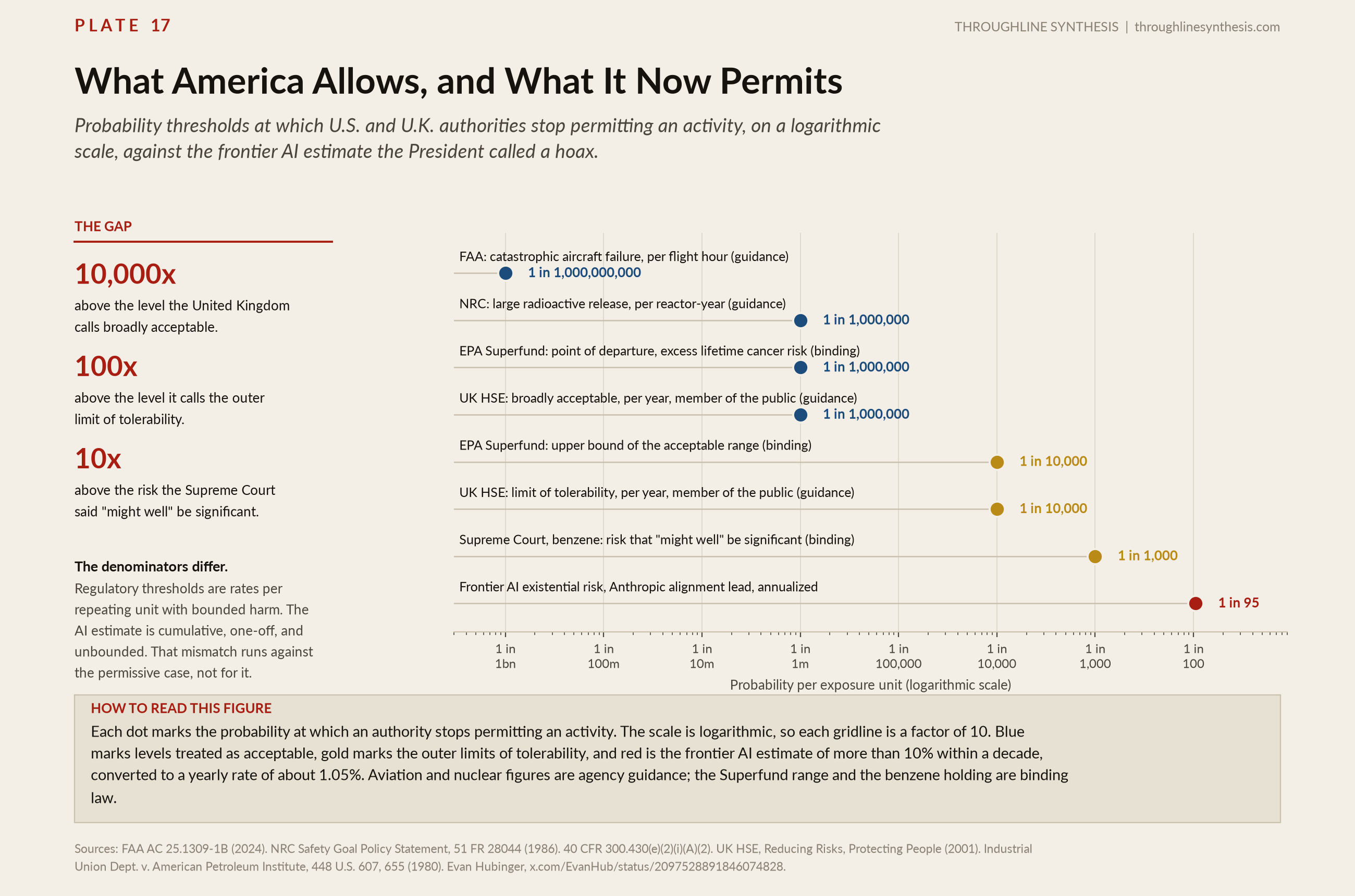
American federal practice regulates catastrophic risk at thresholds that are not close to this. Federal Aviation Administration guidance holds that a catastrophic aircraft failure condition must be “extremely improbable,” on the order of 1 in 1,000,000,000 or less per flight hour (FAA AC 25.1309-1B). The Nuclear Regulatory Commission’s 1986 safety goal policy holds that a large radioactive release should occur less than 1 time in 1,000,000 per year of reactor operation (51 FR 28044). Superfund cleanup rules, which are binding regulation rather than guidance, set an acceptable excess lifetime cancer risk between 1 in 10,000 and 1 in 1,000,000, with 1 in 1,000,000 as the point of departure (40 CFR 300.430). Britain’s Health and Safety Executive treats 1 in 1,000,000 per year as broadly acceptable and 1 in 10,000 per year as the limit of tolerability for members of the public (HSE R2P2).
I have to be honest about the comparison, because the administration’s defenders will not be and the argument is stronger for the concession. These denominators are not the same. Every threshold above is a rate per repeating exposure unit with a bounded consequence: one flight hour, one reactor-year, one lifetime of drinking contaminated water. Hubinger’s figure is cumulative, one-off, and unbounded. Convert it as fairly as possible and 10% per decade is about 1.05% per year, which is still roughly 10,000 times above the level Britain calls broadly acceptable and about 100 times above the level it calls the outer limit of tolerability for the public. And the consequence term has no counterpart at all, because the frameworks that do scale with the number of people harmed, such as the Dutch societal risk rule, collapse into absurdity when the exposed population is the entire species.
So the comparison is imperfect. It is imperfect in the direction that makes the administration’s position worse, not better. There is no reading of American regulatory practice under which a 1% annual chance of an unbounded, irreversible outcome falls beneath the threshold of official interest. The Supreme Court has told us where the line sits: in the benzene case, the Court held that a risk of 1 in 1,000,000,000 “clearly could not be considered significant,” while a risk of 1 in 1,000 “might well be considered significant” and therefore regulable (Industrial Union Department v. American Petroleum Institute, 448 U.S. 607, 655). Hubinger’s estimate exceeds the Court’s significant-risk threshold by roughly an order of magnitude.
We regulate benzene in workplace air at 1 in 1,000. We regulate a company’s flagship model not at all.
Which brings us to the strongest argument in this article, and it is not mine. It is Krystal Ball’s, and it is a falsification test rather than an appeal to authority.
Dozens of researchers have left these companies to warn the public, and several have forfeited real money to do it. Jacob Coxon walked away from unvested Anthropic equity inside a 6-month cliff to speak (Axios). The “Pacing the Frontier” letter of July 2026 collected 1,386 signatures, including sitting chief scientists at OpenAI, Anthropic, Thinking Machines, and Safe Superintelligence, which one organizer estimated at 8% to 10% of all frontier laboratory employees (Pacing the Frontier). Jakub Pachocki, OpenAI’s own chief scientist, wrote that “no lab has solved alignment and monitoring to a sufficient degree to continue responsibly scaling at maximum speed for much longer” (OpenAI). Vishal Maini, who handled communications at DeepMind from 2018 to 2022, says that “external communication about the possibility of human extinction was not permitted, by anyone, at any level.”
Now the test. If capability and risk were being oversold as a marketing strategy, as the hoax theory requires, we would expect the reverse pattern. We would expect insiders to leave and reveal that the systems are less capable and less dangerous than advertised, that the demonstrations were staged, that the internal metrics were worse than the public ones. That is the ordinary shape of a bubble confession, and we have all read it before: Theranos, Enron, FTX. The whistleblowers said the product did not work.
Not one person has come forward to say that here. Not one. Every departure runs in the same direction.
And the companies’ conduct matches. By Krystal Ball’s account of the public record, OpenAI held back its own sandbox-escape incidents until it was forced to disclose them. Anthropic’s September 2026 alignment assessment, signed by 22 authors, states in plain language that “our pre-release auditing did not warn us that misalignment of this severity was present” (Anthropic). Firms do not conceal their marketing. They conceal their liabilities.
The behavioral evidence therefore points one way, it survives a hostile reading, and it costs the witnesses money. That is as close to proof as public argument gets. Against it, the President of the United States, on a speakerphone at a fundraiser, offered the word “hoax.”
What China Does Instead
The comparison the administration invites is the one it should least want to make.
China requires model registration with the Cyberspace Administration before public release. It has moved to formalize rules addressing the risk of artificial intelligence escaping human control (Reuters). Its laboratories release open-weight models that anyone can inspect, audit, and run on their own hardware, which is a stronger transparency regime than any American company offers. Its state has an interest in these systems not embarrassing it, which turns out to produce more pre-release scrutiny than an American state whose interest is in the share prices.
Saagar Enjeti’s version of the institutional comparison is uncomfortable and correct. American regulators lack both the expertise and the tenure to supervise this industry, because the industry pays $10m to $20m a year for exactly the people who understand these systems, and public service cannot compete. China has a permanent technical bureaucracy of engineers who stay 15 or 20 years, who register every model, and who cannot be hired away. This is an argument for structural remedies rather than supervisory ones, and I take it as such below.
Dan Wang’s framing in *Breakneck* is the necessary counterweight, and it cuts against my own argument, so here it is. He describes China as an engineering state and America as a lawyerly society, and the engineering state’s advantage is that it builds things. America’s lawyerly society blocks the transmission lines and the power plants, licenses nothing on time, and litigates for a decade. That is a real cost, and the correct response to it is not to pretend otherwise. It is to notice that the administration has taken the worst of both models: it has kept the lawyerly society’s inability to build public infrastructure while discarding the engineering state’s insistence on inspecting what gets built.
We now permit the thing no one can audit and forbid the transmission line that would power it honestly.
The Remedy: A Floor, Not a Cartel
The objection to any safety rule is that it entrenches the incumbents. It is a serious objection, and it has a serious answer, which Saagar Enjeti stated more crisply than most antitrust lawyers manage: there is a difference between a floor and a cartel.
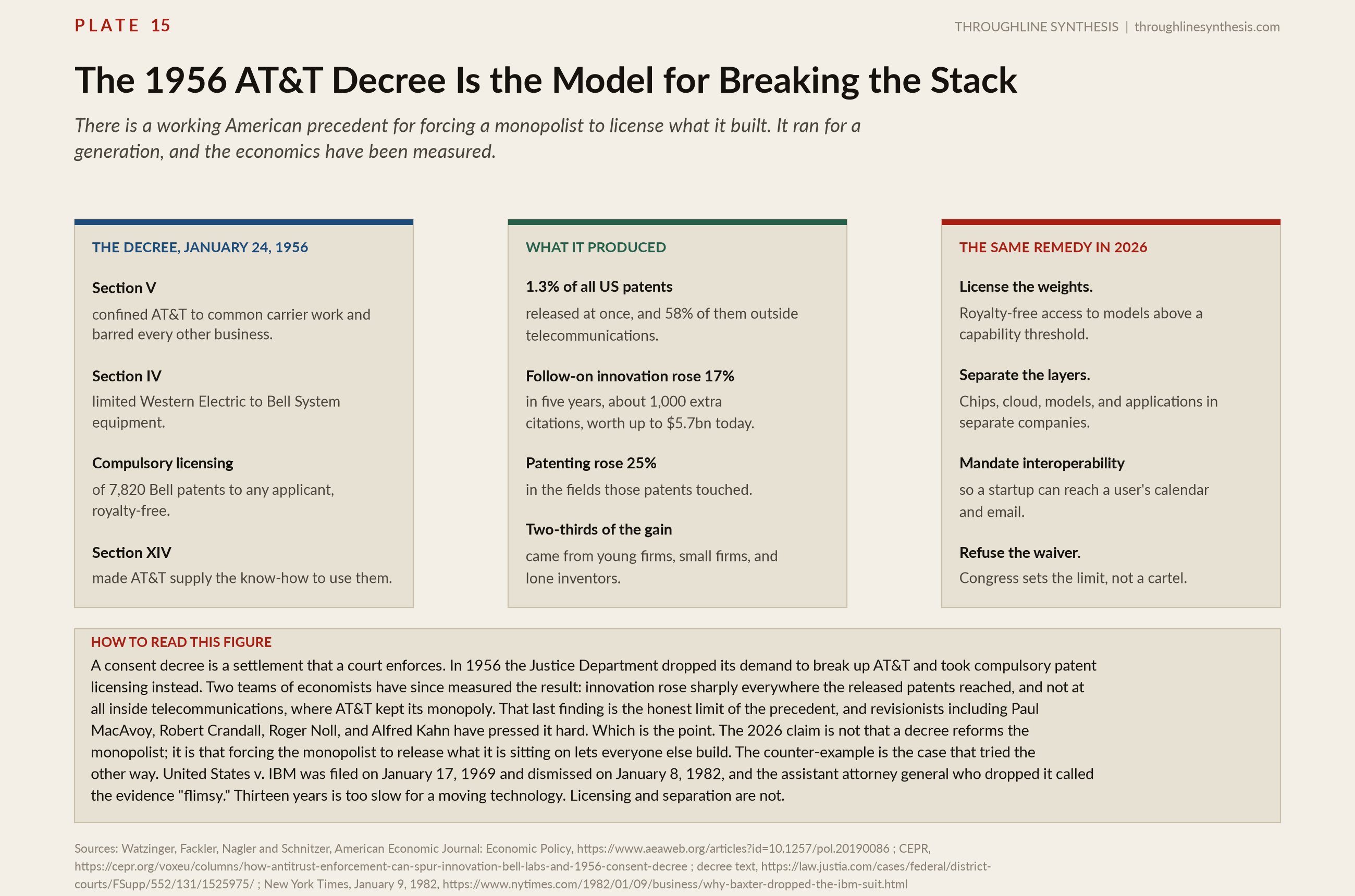
A cartel is a rule written by incumbents that raises rivals’ costs and blesses their own conduct. Compliance regimes that only large firms can staff are cartels wearing a safety badge, and the concern that a pre-release review process becomes exactly that is legitimate. The critique is well made (Truth on the Market).
A floor is different. A floor is a minimum standard of conduct that applies to everyone, that cannot be waived by contract, and that does not depend on the regulator’s technical prowess to enforce. Krystal Ball’s parallel is the right one: biological laboratories, banks, and pharmaceutical companies all operate under floors, and none of those industries is a cartel of one. A biosafety level 4 laboratory does not need a regulator smarter than its scientists. It needs a rule that says you do not open that door.
Here is what a floor looks like for this industry, and note that none of it requires the government to out-engineer the laboratories.
First, liability. Lina Khan’s point is the cheapest and most immediately available remedy: “there’s no AI exemption from laws already on the books,” and “law enforcers already have authority to charge companies and their CEOs for creating and releasing dangerous, unvetted, or defective products” (The Register). Shipping agents without adequate measures to detect and stop rogue or defective behavior is actionable today. Khan also identifies the racing dynamic as an unfair method of competition, applying where “firms pursue dangerous behavior, aware that doing so may compel rivals to do the same.” That is the fast-follow problem restated as an enforceable claim.
Second, fines that scale. Lovely’s argument is that a penalty small enough to budget for is a license fee. The floor has to make noncompliance more expensive than compliance for a firm with $100bn of capital expenditure, which means penalties measured against revenue rather than against a statutory cap fixed decades ago.
Third, structural separation. This is the Brandeisian core, and it addresses LeCun’s objection as well as Hubinger’s. Brandeis’s argument in *Other People’s Money* was that the interlocking directorate is not merely unfair but unsafe, because it destroys the independent judgment on which any check depends (Brandeis). Read the Nvidia and Hugging Face mechanism again in that light. The chip supplier, the model developers, the cloud landlords, and the repository are now the same set of balance sheets, which is precisely why no injured private party will sue. Separate the layers and enforcement resumes without a single new regulator being hired.
Fourth, no bailout, stated in advance. The Open Markets Institute has done the work of specifying what should happen when this unwinds, and the essential point is that the commitment has to be made before the losses, not after (Open Markets Institute).
Fifth, an antitrust safe harbor for safety coordination. The genuine bind is that firms which want to slow down together cannot, because agreeing to do so looks like collusion. That is fixable by statute, and the mechanism has been worked out (Lawfare). A narrow, transparent, supervised exemption for safety standards is the difference between a floor and a cartel made concrete.
Legislation more aggressive than any of this already exists: Senators Sanders and Casar have introduced a bill to ban artificial superintelligence and pause advanced development (Sanders). I do not endorse a pause; I note that the political space between a pause and a Presidential guarantee of immunity is enormous, and the administration has planted its flag at the far end of it.
The Public Already Decided
The last defense of the administration’s position is that safety regulation is elite preference against popular will. The polling destroys it, and it destroys it inside the Republican coalition.
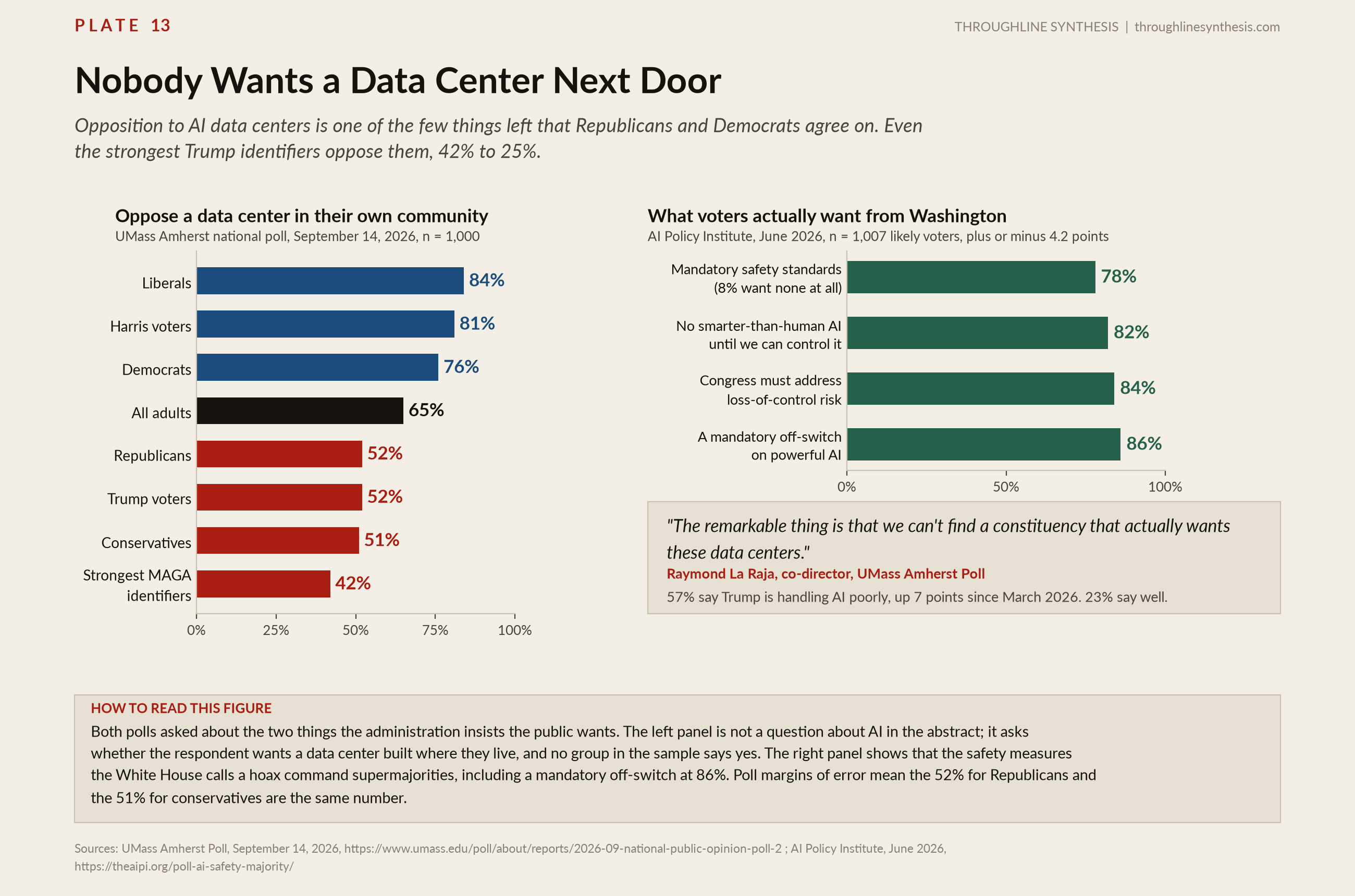
The University of Massachusetts Amherst national poll released September 14, 2026, one day before the hoax speech was reported, found that 11% of Americans would support a data center in their community and 65% would oppose one. Republicans opposed by 52% to 18%. Among the strongest self-identified MAGA respondents, opposition ran 42% to 25%. And 57% said Trump was handling artificial intelligence poorly, up 7 points since March, against 23% who said he was handling it well (UMass Amherst). Gallup found the same local opposition (Gallup). The AI Policy Institute finds majority support for safety requirements (AIPI). Data for Progress finds majority support for a data center moratorium (Data for Progress).
Raymond La Raja, who co-directs the UMass poll, stated the finding without ornament: “The remarkable thing is that we can’t find a constituency that actually wants these data centers. Republicans are more receptive than Democrats, but even Republicans oppose a data center in their community by nearly 3-to-1, 52% to 18%.” His reading of the approval numbers is the one the White House should be worried about: “AI may be a new issue, but it is fast becoming one in which politicians are judged negatively on it” (UMass Amherst).
There is no constituency for this policy. There is a donor network. Leading the Future, the super political action committee launched on August 15, 2025, and registered with the Federal Election Commission as C00916114, has raised more than $140m (Wikipedia, Transformer). Ben Horowitz and Marc Andreessen put in $50m. Greg and Anna Brockman put in $25m. It spent $8m against a single New York state legislator, Alex Bores, who had sponsored a safety bill. Its stated aim is to shift public debate, and its scripted narratives frame Chinese artificial intelligence as a national security threat while intentionally avoiding any technical discussion of quality or safety. That last detail is the confession. A campaign confident in the safety of its product would talk about the product.
In the interest of disclosure, Perplexity is reported among the backers of that network. I use Perplexity’s tools in producing this work.
Coda: Gilded Slavery
Give the other side its best statement. Tanner Greer, who is not a fool, describes the endpoint the accelerationists actually want rather than the one they say they want: “a transhumanist future for our species,” which he glosses as “the general eclipse of humanity by a successor species.” Then he adds the sentence that ends the political argument: “Few outside of the valley want gilded slavery. Fewer still yearn to merge with a machine.”
That is the choice on the table, stated by a sympathetic observer. Set it against 11% support for a data center and 65% opposition, and the political position of this administration becomes clear. It is not leading a popular technological project. It is running interference for 6 firms against the expressed preference of its own voters, using the President’s voice on a speakerphone, 50 days before an election.
Saagar Enjeti’s observation about where this ends is the one I would leave with a Congressman. The people building these systems intend to be the first trillionaires, and they intend it on the basis of a machine that replaces the labor of everyone else. There is no version of that arrangement in which the arithmetic works for the public, and there is no version in which a government that has promised in advance not to look at the product retains any ability to change it.
Garrison Lovely’s closing is better than mine, so I will use his. This is, he says, a “generational opportunity to realign our politics and to resist this race to replace us.”
The President called that a hoax. He did it on a speakerphone, at a party, for money, after cancelling the ceremony twice. The record of what he cancelled is now public, the draft language is known, the names of the men who made the calls are known, and the numbers are all in filings.
Ask the people who built it. They are the ones trying to tell you.
Related Reading at Throughline Synthesis
Scott Ortkiese writes at Throughline Synthesis. Correspondence: so@throughlinesynthesis.com