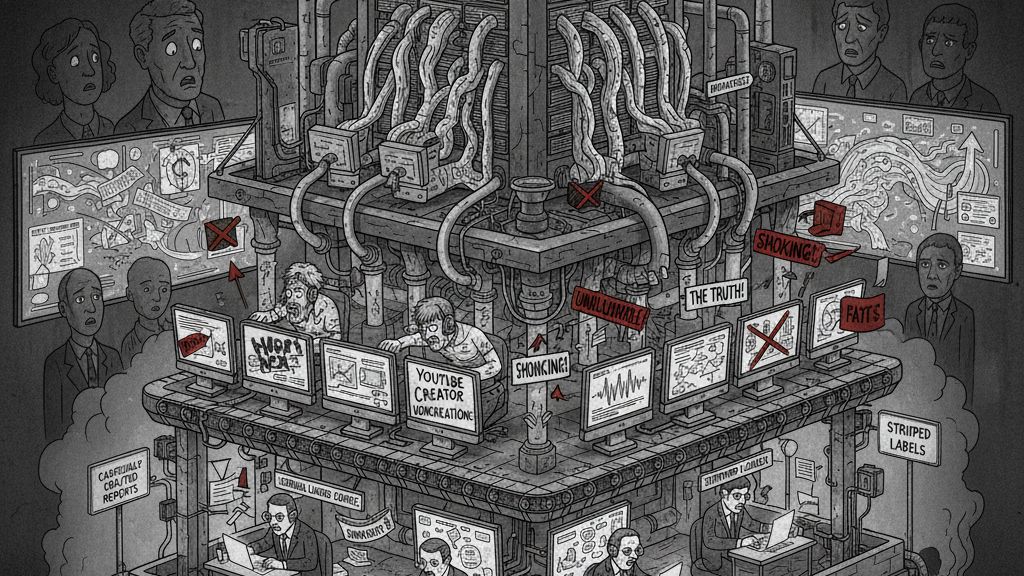
Institutional media and YouTube operate as unlikely partners in the production and distribution of misinformation. This is not a conspiracy. It is a business model.
Here is how it works, in its most systematic form.
A credible news organization (Reuters, Bloomberg, CBC, AP) reports an accurate but contextually neutral fact. A company announces workforce optimization. A regulator issues guidance. A policy changes. The reporting is precise, sourced, and professionally executed. It serves its purpose. The public learns what happened.
Within 72 hours, the fact has been harvested by dozens of low-accountability creators on YouTube, TikTok, and similar platforms. Those creators strip context, inject emotional intensity, add unverified claims, and construct a narrative that bears little resemblance to the original reporting. The result is a story that is false in every material particular but emotionally compelling, algorithmically rewarded, and distributed to millions of people who will never see the original reporting, the corrections, or the context.
Institutional media notices this distortion. Editors at major outlets see their reporting weaponized. They do nothing. No fact-check published on the platforms where misinformation lives. No systematic call for platform enforcement. No naming of bad actors. No public defense of their own work. The burden of truth is outsourced to scattered individuals (engineers, mid-level managers, concerned citizens) who lack the reach or authority to compete with a professionally produced YouTube thumbnail.
The false narrative becomes the public reality. Workers make life-altering decisions based on it. Investors misprice assets. Policymakers respond to pressure shaped by it. And both institutional media and YouTube profit from the entire cycle: media gets amplified reach; YouTube gets monetized engagement; creators build careers on crisis narratives. Everyone extracts value except the public, which bears the cost.
This is not a failure of journalism or an algorithm problem. It is a system that serves the interests of both participants while externalizing costs onto everyone else.
How the System Works: The Three-Tier Information Supply Chain
Institutional media operates in a fundamentally different environment than it did a generation ago. For most of the twentieth century, major news organizations were the final arbiters of public information. What Reuters reported was true; what the New York Times investigated was consequential; what CBS News broadcast shaped national understanding. These organizations had monopolistic control over information distribution. They set the terms of debate.
That monopoly is gone. But the business model built on it persists, and that persistence is what enables the YouTube-media industrial complex to function.
The first tier of this system is institutional media itself. Reuters, Bloomberg, AP, CBC, New York Times, Wall Street Journal, Financial Times, these organizations still produce original reporting under professional constraints that have no parallel in the creator economy. Reporters source claims to verifiable documents or credible interviews. Editors review for factual accuracy and fairness. Legal teams review for libel risk. Standards are enforced; violations damage institutional reputation and raise liability.
This infrastructure is expensive. A single investigative story costs tens of thousands of dollars in reporter time, fact-checking, and legal review. The institutional news model is built on the assumption that this investment creates durable value: facts that matter, established in the public record, defended by reputation and backed by legal liability.
But that assumption has been catastrophically proven wrong.
Institutional media’s reporting is no longer the final word on a topic. It is the raw material for downstream distortion. Within hours, that carefully sourced, legally vetted reporting is harvested, recontextualized, and weaponized by actors with zero professional constraints, zero liability, and direct financial incentives to be as emotionally provocative as possible. Institutional media knows this happens. They see their own reporting distorted in real time. And they walk away.
The second tier is content creators operating on YouTube, TikTok, and similar platforms. These creators operate under fundamentally different economic and legal constraints than institutional media. They typically face no editorial oversight, no legal liability (Section 230 protections shield platforms from responsibility for third-party content), no reputation risk (anonymous or pseudonymous accounts can be abandoned), no fact-checking requirement, and no disclosure obligation.
What they do face is a powerful financial incentive: revenue tied to engagement, and engagement driven by emotional intensity, not factual accuracy. The economics are brutal and straightforward. A calm, well-sourced explanation of policy change generates modest engagement. The same information repackaged as “government is DESTROYING the industry” generates six to ten times more engagement. YouTube’s algorithm rewards the repackaged version with algorithmic promotion. Creators who understand this dynamic adjust their content accordingly.
This is not malice. It is rational economic behavior operating within a system that rewards distortion. The distortion layer does not create facts from nothing. It processes facts from tier one, institutional media, by stripping context, adding unsourced claims, and amplifying emotional intensity. The false narrative is parasitic on the true reporting.
The third tier is the platforms themselves. YouTube and similar services profit from engagement. They do not profit from accuracy or falsehood; they profit from watch time, clicks, shares, and comments, regardless of whether the content is true. Platform incentives are aligned with tier two (creators), not tier one (institutional media). Higher engagement means more ad impressions and more revenue. Emotional content drives higher engagement. Misinformation tends to trigger stronger emotional responses than accurate reporting. Therefore, platforms structurally prefer misinformation to accuracy.
Platforms claim to moderate content through community guidelines, fact-checking partnerships, and human review. But moderation is reactive, not proactive. It acts after viral spread, if it acts at all. Moderation is slow, taking days or weeks to review flagged content. Moderation is inconsistent, with high-performing creators facing fewer consequences than others. Moderation prioritizes extreme content, calls for violence, over systemic falsehood. Most importantly, platforms have no financial incentive to remove misinformation after it has already generated millions of views and ad revenue. The harm is done. The monetization is complete.
Platforms benefit from the distortion layer’s existence. Content creators are more invested in generating engagement than accuracy. Institutional media creates the credibility that allows false narratives to masquerade as legitimate analysis. Platforms extract value from both.
Why Institutional Media Enables This System
The critical question is: why does institutional media allow its reporting to be systematically weaponized without public resistance? The answer is not incompetence. It is structural incentive misalignment combined with fear of platforms and unwillingness to bear the cost of defense.
The first reason is business model dependency. Institutional media depends on Google and YouTube for search traffic, video hosting, and advertising revenue in ways that constrain any aggressive defense of its reporting. Google owns approximately ninety percent of search market share. A major news outlet loses thirty to forty percent of its traffic if Google de-prioritizes its content. YouTube is the default platform for news video. News organizations lack the infrastructure to host video independently at scale. Google and YouTube control a significant portion of the programmatic advertising market. Major outlets rely on Google for ad revenue.
Given these dependencies, news organizations have powerful financial incentives not to antagonize YouTube by demanding enforcement of community guidelines, publicly naming creators who distort their reporting, building competing platforms, or supporting regulatory reforms that would limit YouTube’s power. The relationship is asymmetrical. YouTube can survive without any single news outlet. No news outlet can survive without Google’s distribution and monetization.
The second reason is professional norms against aggressive defense. Institutional media has internal norms that constrain aggressive response to misinformation. Journalists are trained to report facts, not to prosecute cases. Spending resources on attacking a YouTube creator for distorting your reporting can feel like opinion rather than news. Naming individuals and accusing them of deliberate falsehood carries libel risk, even when the evidence is clear. News organizations employ legal teams that erect high evidentiary barriers before allowing such accusations in print. There is a norm against “punching down”, major outlets do not typically engage in public disputes with individuals or smaller creators.
These norms exist for good reasons in traditional media environments. But they become liabilities in a system where low-accountability creators can systematically distort reporting at scale without facing institutional resistance.
The third reason is resource constraints and business model misalignment. News organizations are under-resourced. Following up on every distorted story is not economically sustainable. Investigative fact-checking is expensive, requiring reporter time, legal review, and verification. Follow-up stories don’t drive traffic the way breaking news does. Readers are more interested in “Company X Announces Shutdown” than “We Were Wrong About What Company X Actually Said.” The business model does not reward defense of past reporting; it rewards constant production of new reporting. A news organization that devoted twenty percent of its resources to correcting viral distortions of its reporting would face revenue pressure. Advertisers pay for traffic; readers click on novelty, not correction.
The deepest reason for media’s inaction is simple: acknowledging that their reporting is systematically weaponized would require admitting a hard truth. Institutional media no longer controls its own narrative. For a century, major outlets determined what the public knew. Their reporting could be wrong, but it was authoritatively wrong. It set the terms of debate.
YouTube and similar platforms have destroyed that authority. Admitting this loss of power requires confronting uncomfortable questions. If our reporting is being weaponized at scale with no consequences, how much authority do we actually have? If we cannot defend our own reporting, what is our value proposition? If we depend on platforms for distribution and revenue, can we even afford to antagonize them?
These questions are existential. News organizations avoid them by pretending the problem doesn’t exist.
The Business Model of Crisis
The YouTube-media industrial complex sits atop a larger ecosystem that profits from manufactured crisis. Understanding this ecosystem explains why the system persists despite obvious harms.
YouTube and creators profit from engagement. Crisis narratives generate engagement. Institutional media maintains its reporting monopoly. If alternative media could defend their reporting better, media outlets would lose power. Consulting firms, ESG rating agencies, law firms, and asset managers all profit from perceived crisis. When companies believe they face existential transition risk, whether based on fact or YouTube misinformation, they hire consultants for scenario modeling, “transition risk assessment,” and regulatory compliance services. ESG rating agencies generate revenue tied to perceived corporate risk. Crisis narratives inflate perceived risk; higher risk ratings justify higher fees. Law firms profit from litigation defense, regulatory interpretation, and shareholder dispute resolution. Panicked executives generate billable work. Asset managers enjoy flow-driven revenue. When investors believe an industry is “dying,” they withdraw capital from “legacy” segments and redeploy into “transition” plays, often ESG funds with high fees. The fee arbitrage is substantial. Political operatives advance agenda regardless of factual basis. An exaggerated story about regulatory hostility drives investment in anti-regulation politicians. A false story about industry collapse drives investment in green-energy politicians. Either way, someone profits from the panic.
Every major participant in this ecosystem has aligned incentives to amplify crisis narratives and suppress corrections. High-performing misinformation drives engagement. Engagement drives traffic and ad revenue. Traffic and perceived risk drive consulting fees. Perceived risk drives capital flows. Capital flows drive political alignment.
Corrections work in the opposite direction and carry no reward. Corrections are emotionally flat, generating low engagement. Low engagement means low algorithmic promotion. Low reach means no traffic. No traffic means no revenue, no fees, no asset flows, no political alignment.
The system is structurally designed to reward amplification and punish correction.
Why Corrections Never Happen
A critical feature of the YouTube-media industrial complex is the systematic failure of corrections. Understanding why corrections don’t work reveals the system’s resilience.
Creating misinformation happens quickly, within hours. It costs minimal resources. The complexity is straightforward: edit source material and add emotional framing. The audience reach is massive through algorithmic amplification. Compensation is immediate in the form of ad revenue, engagement, and visibility.
Correcting misinformation requires days or weeks. It costs substantial resources in reporter time, legal review, and editing. The complexity is significant, tracking original reporting, documenting false claims, verifying corrections, and navigating libel caution. Audience reach is minimal. Corrections don’t receive algorithmic amplification; they appear below the false content. Compensation is nonexistent. Corrections don’t drive traffic or engagement.
The speed, cost, and audience asymmetry is so severe that corrections rarely happen. When they do, they reach only a fraction of the people exposed to the false narrative.
YouTube has no financial incentive to prominently display corrections after misinformation has gone viral. Ad revenue is already earned. Millions of views have already occurred. Removing the video alienates the creator and their audience, potentially driving them to competing platforms. Leaving the video up does not harm YouTube’s reputation because users blame creators, not platforms. Fact-checkers can label the video, but labels appear below the video, after most viewers have already watched and been influenced.
The rational platform behavior is straightforward: permit high-performing misinformation, label it if pressed, but never remove it unless facing legal liability or regulatory threat.
Institutional media could sustain “correction beats”, dedicated resources to tracking and correcting viral distortions of their reporting. They do not because it is not economically sustainable. Corrections don’t drive traffic. They require sustained resources for legal review, fact-checking, and source interviews. They generate no revenue because corrections are not breaking news. They risk antagonizing platforms media depends on by appearing as “regulation advocates.”
The rational media behavior is equally straightforward: report the original story, move on, ignore the distortion.
Even if corrections exist, they rarely reach the misinformed audience because corrections appear on different platforms, media websites, not YouTube. Corrections don’t receive algorithmic amplification. Corrections require active seeking; people don’t search for corrections to stories they haven’t identified as false. Corrections don’t trigger emotional engagement; people don’t share or comment on corrections the way they do false claims.
Research is clear on this point: false beliefs persist even when corrections exist because corrections never reach the misled audience.
Systemic Consequences
The YouTube-media industrial complex has consequences that extend far beyond individual false narratives. The aggregate effect is systemic.
Workers make life-altering decisions based on false information about plant closures, industry collapse, or regulatory changes. When a YouTube video claims falsely that an oil company is shutting down Canadian operations, workers in affected communities make relocation decisions, schools lose enrollment, communities face economic disruption. The false narrative drives real economic harm.
Investors misprice assets when misinformation dominates discourse. ESG funds divest from sectors based on exaggerated transition timelines seeded by YouTube misinformation. Companies raise capital costs by paying higher spreads due to perceived, not actual, regulatory risk. Over billions of dollars in capital, this creates real drag on economic growth and innovation.
Policymakers respond to public pressure shaped by false narratives. Politicians see viral videos claiming regulatory hostility and assume they reflect genuine constituent concern, leading to policy shifts responsive to misinformation rather than reality. The result is suboptimal policy formation grounded in false premises.
When institutional media cannot defend its own reporting, public trust in all information sources collapses. People retreat into information silos where emotional resonance matters more than factual accuracy. Democratic consensus becomes impossible because citizens lack shared understanding of basic facts.
Why the System Persists
Understanding why this system persists despite obvious harms is critical to understanding why reform is so difficult. The system persists because it serves the interests of every major participant. YouTube profits from engagement, and crisis narratives generate engagement. Removing misinformation reduces engagement. Creators build careers on crisis narratives. Accuracy generates modest audiences; manufactured crisis generates celebrity. Institutional media maintains its reporting monopoly. If alternative media could defend their reporting better, media outlets would lose power. Instead, media’s refusal to defend creates a power vacuum that YouTube fills (but a power vacuum that still depends on media’s original reporting for legitimacy. Consultants, lawyers, ESG raters, and asset managers all profit from perceived crisis. Real crisis or manufactured crisis) the revenue is the same.
The only loser is the public.
Moreover, the system has structural resilience. Individual reform attempts are weak because YouTube cannot self-regulate. Its business model conflicts with truth. Asking YouTube to restrict misinformation is like asking an oil company to restrict carbon emissions; it is asking them to reduce their core product. Media cannot reform alone. Without regulatory backing or platform cooperation, individual media outlets that try to defend their reporting will face competitive disadvantage. Regulation is captured. The consultants, lawyers, and ESG raters who profit from misinformation have invested heavily in regulatory capture. They lobby for regulations that appear to address misinformation but actually entrench their power.
What the ConocoPhillips Case Demonstrated
In my previous detailed analysis, I documented this system in forensic detail through the lens of one major corporate case. That article is essential reading for understanding how the pattern operates in practice, but it is important to note: ConocoPhillips is not unique. It is a template.
The specifics repeat across energy policy, healthcare regulation, financial services, and nearly every domain where truth competes with engagement metrics. The ConocoPhillips analysis proves that the system is not theoretical. It operates at scale, with documented participants, measurable harms, and institutional complicity. That article should be read as evidence that this is not a hypothetical problem. It is an active, ongoing, systemic failure of information governance.
The Comprehensive Investigation Ahead
The full, detailed investigation I will produce in the coming months will map the YouTube-media ecosystem with granular specificity. It will document YouTube’s revenue model, creator economics, and algorithmic incentive structure in detail. It will show how each component is optimized for engagement-driven misinformation, not accuracy. It will analyze institutional media’s complicity through case studies across energy, healthcare, and finance, demonstrating how major outlets report accurately, then walk away when their reporting is weaponized. It will quantify the consulting ecosystem by documenting how much revenue ESG consultants, law firms, and asset managers generate from perceived, often manufactured, crisis. It will show the direct causal link between misinformation and billable work. It will examine regulatory capture by showing how platforms, consultants, and captured regulators cooperate to create the appearance of “misinformation management” while structurally protecting profitable distortion. It will propose concrete, structural reforms, not aspirational exhortations to “be more responsible” but actual systemic changes that realign incentives. It will build an evidence base by analyzing fifteen to twenty case studies across sectors where accurate reporting leads to YouTube distortion, which leads to institutional silence, which leads to real-world harm.
Conclusion: The Choice Before Us
The YouTube-media industrial complex is not an accident. It is a business model. Both parties profit while externalizing costs onto workers, investors, communities, and democracies.
The system persists because no single actor has sufficient incentive to break the accommodation. YouTube will not voluntarily reduce misinformation if it reduces engagement. Institutional media will not antagonize platforms they depend on. Consultants will not agitate against the crisis narratives that fund their industry.
But the accommodation is not inevitable. It exists because we tolerate it.
Institutions could refuse to supply raw material without defending it. Regulators could remove liability shields for platforms that monetize misinformation. Users could demand better from platforms and reward alternatives. Journalists could name the actors who distort their reporting. Companies could demand platform accountability or threaten legal action.
None of this is happening at scale. And the cost is paid by everyone else.
The pattern I documented in the ConocoPhillips case repeats across energy, healthcare, and finance, in every domain where truth competes with profit. Until we dismantle the machinery that produces it, we should expect it to repeat.
The question is not whether we can fix this system. The question is whether we will.
Related reading
- If Brad Pitt Were Harald Kujat, Ukraine Would Have Peace, Where's the Press?
- The Western Press Won't Report It: Ukraine's Collapse and the Slaughter Underway
- A Tale of Two Donalds: What He Said at Davos and What The Press Said He Said
- Silencing the Interview: When the Legacy Press Calls Everyone Else 'Propaganda'