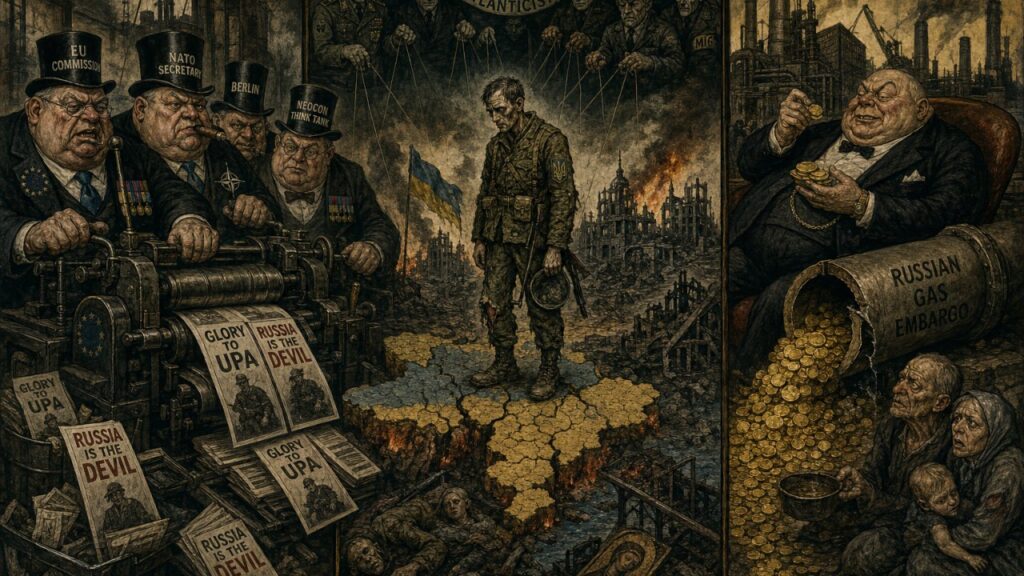
Ukraine was duped by the West: All that remains is its propaganda and a war on its own soil.
By Scott Ortkiese | June 23, 2026 | so@throughlinesynthesis.com
The Trigger: Why Poland Acted
President Karol Nawrocki revoked the Order of the White Eagle from Volodymyr Zelensky in June 2026 for one specific and documented reason: Zelensky signed a decree granting an elite Ukrainian Special Operations unit the honorary designation “Heroes of the UPA,” the Organization of Ukrainian Nationalists’ military wing that carried out the systematic extermination of Polish civilians in 1943-1945. This was not a Polish political tantrum. It was a direct response to Kyiv’s decision to officially glorify, within its armed forces, the exact organization whose documented purpose was the ethnic cleansing of Poles from Volhynia and Eastern Galicia.[1][2][^3]
Nawrocki stated plainly that his decision was “not directed against the Ukrainian people” but against the glorification of the UPA. The Polish position was not ambiguous: Poland’s highest state honor cannot coexist with the simultaneous official canonization of those who butchered Polish civilians by the tens of thousands. To label this response “disgraceful” is to invert every principle of sovereignty and historical accountability that pro-Ukrainian commentators otherwise claim to champion.[^1]
The Scale of Poland’s Sacrifice Is Not a Blank Check
Poland has provided Ukraine with over EUR 21 billion in total assistance since 2022, making it one of the world’s largest donors relative to the size of its economy. By February 2026, Poland had delivered 48 military aid packages totaling over EUR 3.5 billion, including 318 tanks, 586 armored vehicles, 137 artillery systems, and 10 MiG-29 jets. As a percentage of GDP, Poland’s commitment reached 4.91%, the highest of any nation when refugee support is included. Polish territory, particularly Rzeszów-Jasionka airport, serves as the primary logistics hub sustaining Ukraine’s war effort.[4][5][6][7]
Pro-Ukrainian propagandists invoke Ukrainian blood sacrifice to demand Polish silence. The logic is grotesque: it presumes that one nation’s wartime suffering grants it a perpetual veto over another sovereign nation’s historical red lines and state honors. Poland’s contribution is not “aid given at no cost.” Poland operates under direct Russian threat, has absorbed millions of Ukrainian refugees, and has remade its entire defense posture around the war it is helping Ukraine fight. Gratitude, apparently, has a short shelf life when it is inconvenient to acknowledge.
What the UPA Actually Was
The propagandist framing equates Ukraine’s UPA with Poland’s Armia Krajowa to suggest moral equivalence. The historical record does not permit this.
The UPA’s “anti-Polish operation” was not reactive violence or wartime confusion. Historians have documented it as a planned extermination campaign. In June 1943, UPA commander Dmytro Klyachkivsky issued explicit orders to exterminate the Polish population of Volhynia. On July 11-12, 1943, UPA units simultaneously attacked 150 Polish villages across four counties in a single coordinated wave, killing an estimated 8,000 to 10,000 people, mostly women, children, and the elderly, in churches, in fields, and in their homes. Weapons included axes, pitchforks, knives, and fire. Polish historians estimate total deaths from the Volhynia massacre and Eastern Galicia operations at approximately 100,000 Poles between 1943 and 1945.[8][9][10][11][^12]
Armia Krajowa, cited by propagandists as a comparable atrocity formation, was Poland’s primary national resistance army fighting German occupation. While individual AK units carried out retaliatory violence against Ukrainian civilians, there was no AK equivalent of the UPA’s centrally coordinated, command-sanctioned order to exterminate an entire ethnic population from a territory. Conflating the two is not historical nuance; it is deliberate falsification designed to dissolve the distinction between aggressor and victim.
The “30,000 Ukrainians” Deflection
The claim that scholars at the Ukrainian Catholic University documented at least 30,000 Ukrainians killed in interethnic violence involving Polish forces is cited without context as a counterweight to Volhynia. Several facts are essential.
First, the UCU figure requires scrutiny because it is produced by an institution with a vested institutional interest in Ukrainian national narratives. Second, the 1930 Pacification of Eastern Galicia, the most commonly cited Polish state action against Ukrainians in the interwar period, was a harsh repressive operation involving arrests, beatings, property destruction, and forced loyalty declarations, in which Polish sources acknowledge two deaths and Ukrainian sources claim seven. It was a documented abuse of state power against a minority population. It was not a massacre. Third, the violence of the Polish-Ukrainian borderlands was mutual and complex across decades, and serious historians acknowledge this, but no scholarly consensus supports placing Polish and Ukrainian nationalist violence in the same moral or numerical category when the Volhynia operation is specifically at issue.[12][13][^14]
Deploying “30,000 Ukrainians” as a rhetorical offset to 100,000 Polish civilians is not a plea for historical balance. It is a numerically dubious maneuver designed to muddy the waters around an event whose scale and intentionality historians from multiple countries have extensively documented.
The Grabowski Gambit
Invoking Jan Grabowski’s documentation of Polish complicity in the Holocaust as a closing argument against Polish assertions of historical grievance is a textbook example of asymmetric moralization. Grabowski’s scholarship on Polish civilian collaboration with Nazi persecution of Jews is serious academic work that deserves engagement on its merits. Polish state attempts to suppress and criminalize it were wrong, and Polish courts that found him liable for defamation were embarrassing to serious historical inquiry.[15][16][^17]
None of that has any bearing whatsoever on the question of what the UPA did in Volhynia in 1943.
Ukraine’s own record on Holocaust-adjacent memory politics is, to put it gently, not pristine. Israel and Poland issued a joint condemnation of Ukraine in 2020 for state-level glorification of Stepan Bandera, whose OUN and UPA formations were documented participants in Jewish massacres in 1941. The Simon Wiesenthal Center condemned the posthumous award of Hero of Ukraine to Bandera, noting that “men under his command did kill thousands of Jews and Poles”. The Israeli ambassador and his Polish counterpart jointly stated that “celebrating these individuals is an insult” and that “glorification of those who promoted actively the ethnic cleansing is counterproductive in the fight against antisemitism”. Ukraine’s Foreign Ministry, rather than engaging with the substance, responded that Soviet propaganda had tarnished these figures’ reputations.[18][19][20][21]
If the standard is that no nation may assert moral standing until it has fully reckoned with the worst chapters of its own history, Ukraine would be well advised to begin that reckoning with Bandera torchlit marches in Kyiv, streets named after figures condemned by Jewish human rights organizations, and the state canonization of the UPA before lecturing Warsaw about intellectual honesty.[19][22][^18]
Sovereignty Cuts Both Ways
The propagandist’s argument rests on a principle it applies in only one direction: sovereign nations have the right to honor their own heroes and remember their own history as they see fit. Applied to Ukraine, this principle is sacred and inviolable. Applied to Poland, it becomes “disgusting,” “shortsighted,” and “an act of ingratitude.”
Poland did not demand that Ukraine rewrite its history. It withdrew a personal honor from a president who chose to officially embed within his country’s military apparatus an organization whose primary historical legacy in Polish memory is the mass murder of Polish civilians. Nawrocki himself said Kyiv’s decision to name the unit “Heroes of the UPA” undermines years of Polish-Ukrainian reconciliation efforts. That is not ingratitude. That is a sovereign nation declining to ratify the official glorification of the organization that killed its people.[^23]
The Sanctimony Clause
The closing flourish of this kind of propaganda, the assertion that raising historical disputes “at this moment” constitutes a moral offense and an act of ingratitude, is the most revealing element. It demands that Poland bank its dead, suppress its memory, indefinitely defer its historical claims, and smile through the official rehabilitation of a mass murder organization, all because Ukraine is currently at war.
By this logic, Kyiv may name military units after whoever it pleases, celebrate whoever it pleases, and dismiss Polish objections as politically motivated, and Poland must absorb all of this without comment or consequence because its soldiers are not currently dying. This is not solidarity. It is a demand for unconditional subordination dressed in the language of European unity. It insults Poland’s intelligence, its sacrifices, and its dead.
No nation has a spotless history. The difference is that some nations, when their allies point this out with specific documented evidence, engage with it honestly rather than calling their critics disgusting.
References
1. Polish president strips Ukraine’s Zelensky of top state honour– Polish President Karol Nawrocki on Friday stripped Ukraine’s Volodymyr Zelensky of Poland’s highest…
2. Zelensky stripped of Polish honour over WW2 name of army unit – BBC– Ukraine’s Volodymyr Zelensky has been stripped of Poland’s highest state honour, the Order of the Wh…
3. Poland strips Zelensky of top honour over WW2 dispute – RTE– Poland’s president has decided to strip Volodymyr Zelensky of the country’s top honour after the Ukr…
4. Poland’s support for Ukraine tops EUR 21 billion, minister says in…– Poland’s support for Ukraine has exceeded EUR 21 billion, making the country one of the world’s larg…
5. Poland Has Provided Over €3 5 Billion in Military Aid to Ukraine– 🇵🇱⚔️ Poland Surpasses €3.5 Billion in Military Aid to Ukraine
As of February 27, 2026, Poland has d…
6. Poland allocates aid to Ukraine equivalent to nearly 5% of…– Poland has provided military, material, and humanitarian assistance to Ukraine and Ukrainian refugee…
7. Poland helps Ukraine with almost 5% of its GDP, 85% of which goes to refugees– The Office of the Polish President (OP) has released an infographic showing that the country has all…
8. The Genocide on Poles Conducted by the OUN-B and UPA– Following the mass deportations and arrests carried out by the NKVD and after the subsequent German…
9. Chronology – History – Volhynia Massacre– 1941/1942, Ukrainians in Volhynia begin to form military detachments, partly for protection against…
11. Zbrodnia wołyńska, czystka etniczna o charakterze…– 11 i 12 lipca 1943 r. UPA dokonała skoordynowanego ataku na polskich mieszkańców 150 miejscowości na…
12. How Poland and Ukraine overcame a dark history – spiked– In total, somewhere between 50,000 and 100,000 Poles were murdered by Ukrainian nationalists in 1943…
13. Ukrainians in Interwar Poland, 1918-1939 – Volhynia Massacre– Having been annexed by its neighbors in the late 18th century, the Polish state, as reconstituted di…
14. Pacification – Internet Encyclopedia of Ukraine
15. Historians defend prof who wrote of Poles’ Holocaust complicity– Polish nationalists lash Jan Grabowski’s book ‘Hunt for the Jews,’ which was honored by Yad Vashem i…
16. University of Ottawa scholar says he’s a target of Polish ‘hate’ campaign | CBC News– An eminent Canadian historian whose writings on the Holocaust in Poland have attracted death threats…
17. Conviction of Holocaust Scholars in Poland– Read a review of the Polish government’s justification for the laws used to convict Holocaust schola…
18. Israel and Poland slam glorification of Nazi collaborators in Ukraine – Jewish Telegraphic Agency– The condemnation follows a march by several hundred people through Kyiv in memory of a Ukrainian nat…
19. Wiesenthal slams Ukraine award to nationalist – Ynet News– Prominent Jewish human rights organization says Stepan Bandera and his followers linked deaths of th…
20. Kyiv responds to Israel’s accusation of ‘glorifying anti-Semites’– Ukraine categorically condemns all forms of anti-Semitism and pays homage to the victims of the Holo…
21. Hacker News
22. [PDF] statement by mr. alexander lukashevich, permanent representative…
23. ‘NO PLACE IN EU’: Nawrocki Revokes Ukraine Leader’s Highest Honour | Times Now World– Polish President Karol Nawrocki announced that he has revoked Ukrainian President Volodymyr Zelensky…