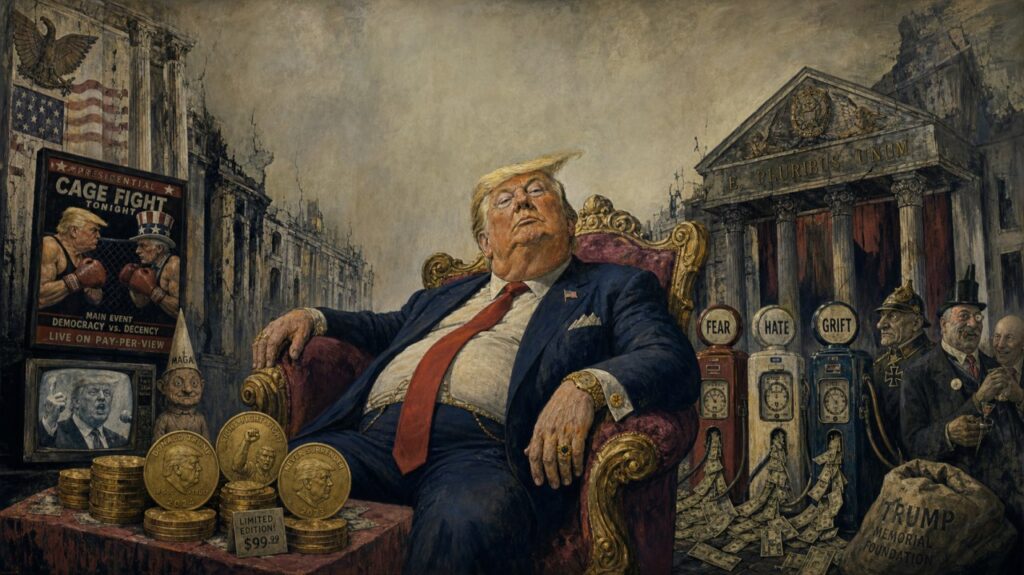
The Trump Brand: An Insufferable Ass Being Impossibly Foolish
By Scott Ortkiese | June12, 2026
At this point, the only honest “Trump commemorative coin” would bear two faces: Trump on one side, Epstein’s shadow on the other, a reminder of how far a presidency and a political system were willing to sink; we elected this art-of-the-deal farce. Scott Ortkiese
The Trump Coin Presidency: War, Inflation, and the Epstein Panic
When the Situation Room becomes a PR bunker and the Oval Office a merch table, the crisis isn’t just one man’s character, it’s a system willing to be ruled by spectacle.
The Trump Presidency: a war that drives up gas, a president who says he “loves” the inflation it triggers, a Situation Room downgraded to an Epstein spin room, and a White House moonlighting as a luxury merch stall for his own face, complete with UFC brawls on the front lawn and ballroom ruins in the background. Call it TSD if you like; the record is still clear. This man has been a catastrophic president, and that’s before you tally the lies, the wrecked U.S. economy, the damage to allies, the forgotten campaign promises, the war crimes against Iran, and the cold-war revival with Russia and China. Happy midterms, GOP; this is the kingmaker you’ve chained yourselves to, and he’s busy minting clones like Ken Paxton.
This presidency now offers a grotesquely coherent picture: a discretionary war abroad, inflation at home, a White House consumed by Epstein-related panic, and a president publicly embracing the very price spikes punishing his own voters. The through-line is not merely scandal. It is the conversion of state power into personal protection, political theater, and commercial branding.
Exhibit A: Inflation
The cleanest evidence is Trump’s own mouth. Asked about a fresh inflation report showing consumer prices rising at the fastest pace in roughly three years, he answered: “I love it… You know what I really love? I love the inflation.” That was not an offhand paraphrase from critics; it was the president, on camera, praising a price environment that was already eating into household budgets.
The economic context makes the quote worse, not better. Coverage of the June inflation report placed year-over-year CPI above 4 percent, with energy costs up sharply and gasoline prices elevated by the administration’s war with Iran and the resulting stress on oil markets. Reuters reported that Trump paired his remark with the claim that prices would fall once the war ended, effectively acknowledging the connection between the conflict and the inflation Americans were experiencing. CNBC likewise tied the spike to oil shocks linked to the war and disruptions around the Strait of Hormuz.
The mechanics are simple enough for any voter to understand. A conflict centered on one of the world’s most important hydrocarbon arteries predictably pushes up crude prices, refines into higher gasoline costs, and then bleeds through the economy into freight, food, and household essentials. By late April and May, published figures put the national average gasoline price around 4.30 dollars a gallon, the highest level in roughly four years, while some reporting described oil prices as up more than 40 percent from prewar levels.
That is why “Trump inflation” is not merely a partisan slogan. It describes a chain of choice and consequence: war, oil shock, pump prices, broader inflation, then real wage erosion. What makes the episode politically devastating is that Trump did not merely preside over the result; he publicly treated the result as an applause line.
Exhibit B: Epstein
If inflation shows the cost of his public choices, the Epstein panic shows the uses of power behind closed doors. The New York Times reported that senior White House officials held a series of Situation Room meetings as they struggled to contain the fallout from the Epstein files and Trump’s refusal to release them. The symbolism is hard to overstate: the secure nerve center of the American state, built for war councils and national emergencies, repurposed for scandal management around the president’s relationship to one of the most notorious sex-trafficking cases in modern history.
The reporting goes beyond atmospherics. According to the Times and subsequent accounts, top officials clashed over how to respond, leak investigations were launched, and Trump made clear he did not want further disclosure. New York magazine, drawing on the forthcoming book behind the Times excerpt, described internal conflict and increasingly elaborate efforts to control the narrative as the story worsened.
More alarming still were the tactical ideas reportedly floated inside the administration. Follow-on coverage described a proposal to use a friendly media figure to interview Ghislaine Maxwell so she could publicly state that Trump had done nothing wrong, alongside discussion of having government lawyers question Maxwell and release a transcript. Even if only some of these ideas advanced, the instinct is the story: a readiness to blend political communications, prosecutorial machinery, and personal legal defense into a single project of presidential self-protection.
That is the constitutional point too many accounts miss. The scandal is not only that Epstein remains politically radioactive. It is that the White House response appears to have treated national-security infrastructure and state legal authority as tools available for reputational triage. A system that tolerates that behavior is not merely scandal-prone; it is already ethically deranged.
Exhibit C: Grift
The third exhibit is vulgar enough to seem almost comic, which is why it matters. Trump has promoted a UFC-style fight event linked to a high-priced commemorative coin bearing his own image, with one gold version reportedly priced near 12,000 dollars. Commentators mocking the coin called it “Julius UF-Caesar,” but the Roman comparison is not just a joke: historians have noted that Julius Caesar’s decision to place his own living image on coinage became a symbol of republican breakdown and personal rule.
This is not harmless tackiness. The coin and event sit inside a broader pattern in which the presidency becomes a sales platform and the aesthetics of public office slide toward personalized brand merchandising. Reports also raised conflict concerns around Trump’s financial relationship to the company behind the event, amplifying the sense that the White House is being used not only as a theater set but as a marketing channel.
The grotesque brilliance of the grift is its timing. While Americans were paying war-inflated prices for gasoline and absorbing the erosion of real wages, the president was associated with selling a luxury collectible that turns his own image into a speculative object. The implicit message is that scarcity and strain are for everyone else; for the ruler and his circle, crisis is just another merchandising opportunity.
The pattern
Taken together, the three exhibits describe something more serious than bad taste or personal vanity. Inflation shows a president embracing the economic pain linked to his own war. Epstein shows a White House willing to mobilize the prestige and machinery of the state to contain politically lethal revelations. The coin and the fight show a presidency that cannot distinguish between governance, propaganda, and retail.
This is why the subtitle matters. The problem is not only Trump’s character, though the evidence on that front is abundant. The deeper problem is institutional adaptation: a governing class, media ecosystem, party apparatus, and donor structure willing to absorb each fresh obscenity and carry on as though the basic distinction between public office and private appetite still exists.
Polls suggest the public is tiring of the performance. Aggregated approval trackers have shown Trump deep underwater in mid-2026, with disapproval outpacing approval by double digits. That does not erase the damage already done. But it does suggest that the spectacle may finally be colliding with the material lives of voters in a way even the strongest propaganda cannot fully anesthetize.
A republic can survive scandal. It can survive vulgarity. What it cannot survive indefinitely is the normalization of a leader who treats inflation as a boast, the Situation Room as a bunker for personal scandal, and the presidency itself as a commemorative coin with his own face on it.
Related reading
- Paxton Collapse: How Trump’s Texas Pick Turns a Safe Republican Seat Into a Coin Flip
- Trump, the GOP, and the Epstein Catastrophe: A Comprehensive Case File
- A Bill of Indictment for Murder and Genocide Against the American Military and Trump, as its Commander and Chief
- Trump Blackmails Allies Abroad While Being Blackmailable at Home: The Irony of It All